
Nearly one in five UK mortgage holders faces a refinancing shock in 2026, with 1.8 million borrowers rolling off low fixed-rate deals into a higher-rate environment [5]. That single fact has quietly transformed the way buyers approach building surveys — not just whether to commission one, but what they ask surveyors to focus on, and what they are now willing to leave out entirely.
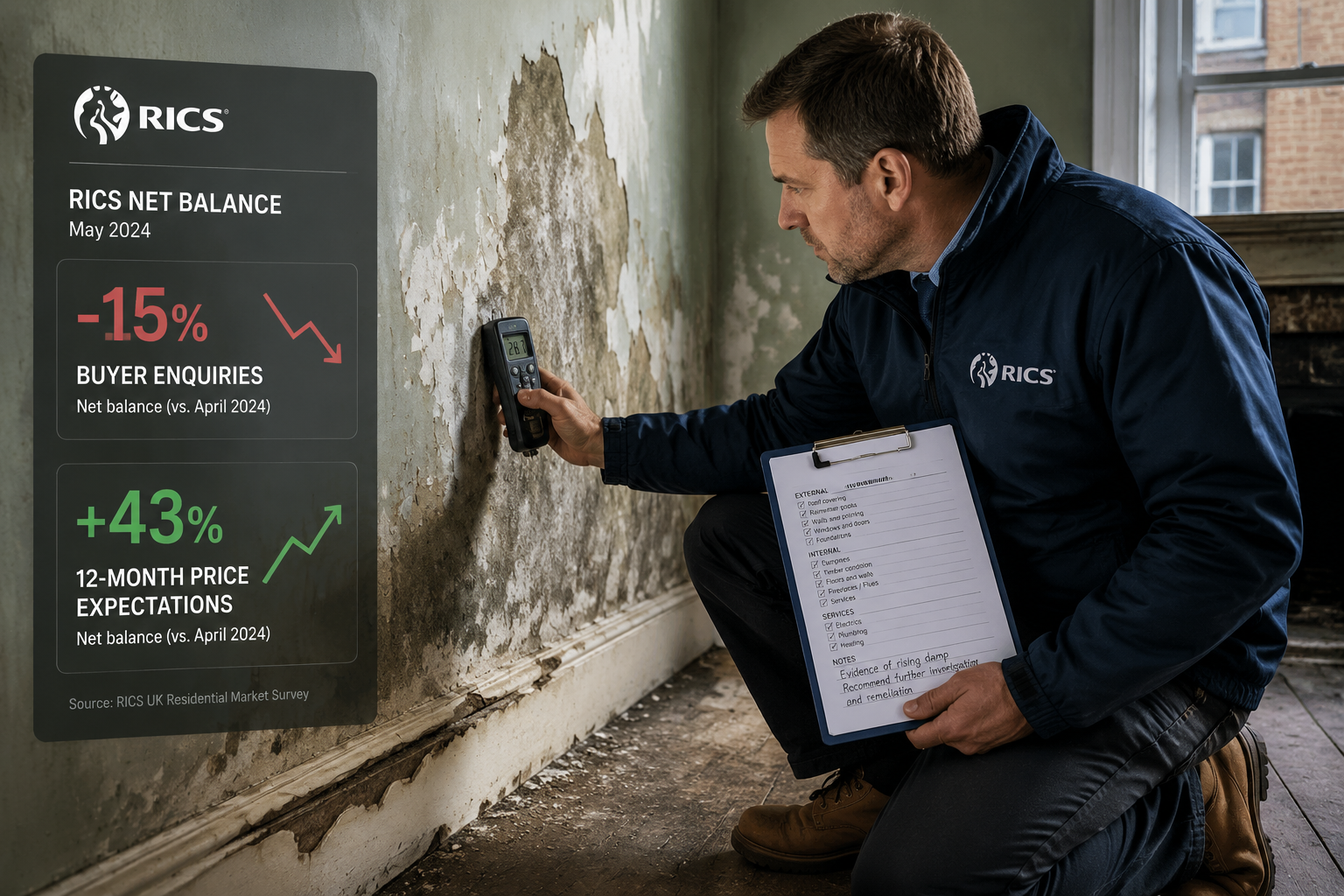
How 2026 UK Housing Market Gloom Is Changing Building Survey Instructions: What Buyers Now Ask (and Skip) is not a theoretical question. It is playing out in real-time across surveyors' inboxes, phone calls, and briefing conversations. The January 2026 RICS Residential Market Survey recorded new buyer enquiries at a net balance of -15% — still firmly subdued — yet 12-month price expectations surged to +43% [4]. That contradiction — gloom now, cautious optimism later — is reshaping the entire logic of what a building survey is for.
This article unpacks that shift in detail: which survey elements buyers are prioritising, which they are skipping, and how surveyors can adapt their services and messaging to match the new reality.
Key Takeaways 📋
- Buyers are prioritising deal-breaker risks (structural defects, damp, cladding, flood risk) over cosmetic issues in 2026's cautious market.
- Energy efficiency and retrofit feasibility have become near-standard survey requests, driven by high energy bills and tightening EPC regulations.
- Budget-constrained buyers are stripping back survey scope, skipping separate market valuations and granular minor-defect commentary.
- Lenders and investors are demanding compliance-focused briefs, covering building safety, leasehold reform, and capital expenditure exposure.
- The "gloom-now, better-later" mindset means buyers want forward-looking resale resilience commentary alongside traditional condition reporting.
The Market Mood Shaping Survey Instructions in 2026
To understand how buyer briefs are changing, it helps to understand the precise emotional and financial state of the 2026 UK housing market.
The RICS January 2026 survey paints a picture of a market caught between two forces [4]. On one side: near-term pessimism, with price expectations at a net balance of -4% over three months and buyer enquiries still negative. On the other: striking medium-term confidence, with +35% expecting higher sales volumes and +43% expecting higher prices over the coming 12 months.
Savills' April 2026 market update reinforces this, describing 2025–26 as a "needs-driven" period where affordability constraints are biting hardest in London and the South East, and where regional variation is more pronounced than in previous cycles [8]. Cushman & Wakefield's 2026 residential forecast adds that softer labour-market conditions and tax freezes are compressing disposable income, slowing the kind of speculative buying that once drove demand for exhaustive, catch-all surveys [3].
💬 "The 2026 buyer is not browsing — they are buying because they have to. That changes everything about what they want from a survey."
— Industry commentary, Mortgage Solutions, April 2026 [5]
Capital Economics' analysis of the February 2026 RICS data captures the resulting mindset well: buyers are identifying "deal-breakers" early and walking away if they find them, rather than using a full survey to chip away at price across a long list of minor issues [9]. The market is too fragile and too slow for that approach to work reliably.
This "gloom-now, better-later" backdrop is the engine driving every change in survey instructions discussed below.
What Buyers Now Ask: The New Survey Priorities
1. 🔍 Structural Integrity and Deal-Breaker Defects First
The clearest shift in 2026 is the explicit prioritisation of serious, material defects over comprehensive cosmetic commentary. Buyers are telling surveyors, in plain terms: find the things that will stop this deal or cost me tens of thousands — and do not waste time on the things that will not.
Capital Economics notes that buyers are specifically asking surveyors to flag [9]:
- Serious structural movement (subsidence, heave, settlement)
- Non-standard construction (concrete panels, prefabricated systems)
- Cladding and building safety issues, particularly on flats post-Grenfell
- Flood and subsidence risk in an era of increasingly volatile weather
- Invasive species such as Japanese knotweed
For properties where these risks are present, buyers are more willing to commission a full RICS Level 3 Building Survey — the most detailed option — because the investment is justified by the potential cost exposure. For properties where these risks appear low, many are actively choosing lighter-touch options.
2. ⚡ Energy Efficiency, Retrofit Feasibility, and Running Costs
This is perhaps the most significant new addition to standard survey briefs in 2026. Wimbledon Surveyors' January 2026 guidance notes a marked increase in buyer queries around retrofit, energy efficiency, and running costs, driven by both elevated energy bills and tightening regulatory expectations [7].
Buyers are now commonly asking surveyors to:
| Request | Why It Matters in 2026 |
|---|---|
| Identify insulation gaps (loft, cavity wall, floor) | High energy bills make running costs a key affordability factor |
| Comment on heat pump feasibility | Government retrofit targets and future EPC requirements |
| Assess solar PV suitability | Buyers want to model long-term ownership costs |
| Flag MEES/EPC compliance risks | Critical for landlords; increasingly relevant for resale |
| Estimate glazing upgrade costs | Comfort and energy performance combined |
This is a direct response to the regulatory environment. With Minimum Energy Efficiency Standards (MEES) tightening and EPC ratings increasingly affecting mortgage availability and resale value, a property's energy profile has moved from "nice to know" to "must know."
3. 🏗️ Forward-Looking Resale Resilience
The RICS January 2026 data's striking gap between near-term pessimism and 12-month optimism has produced an unusual instruction type: buyers asking surveyors to comment on medium-term value resilience [4].
This means questions such as:
- How easily would this property resell if market conditions deteriorate again?
- Are there features (layout, construction type, location factors) that could suppress future buyer demand?
- Does the property lend itself to cost-effective extension or conversion, adding value if growth is slow?
Understanding the difference between a RICS Homebuyer Survey and a full Building Survey matters here — buyers seeking this kind of forward-looking commentary generally need the depth that only a Level 3 survey provides.
4. 📋 Compliance, Legal Exposure, and Capex Quantification
Lenders and buy-to-let investors are driving a specific variant of this trend. Mortgage Solutions' April 2026 commentary notes that lenders are tracking the Renters' Rights Act, leasehold reforms, and building-safety rules, and are requesting surveys that confirm compliance and potential legal or works exposure [5].
For investors, Cushman & Wakefield's forecast highlights that tighter briefs now focus on [3]:
- Rental sustainability under new tenancy legislation
- Capital expenditure exposure — particularly upcoming maintenance and retrofit obligations
- Yield sensitivity to near-term repair costs
Some investors are now explicitly asking surveyors to quantify likely near-term capex in monetary terms, so they can model whether a deal still works at the asking price. This is a significant evolution from the traditional condition-only report.
For anyone navigating this landscape, exploring the full range of RICS survey options is a useful starting point before commissioning.
What Buyers Are Skipping: The Deliberate Omissions
Understanding how 2026 UK housing market gloom is changing building survey instructions means examining not just what is being added, but what is being consciously left out.
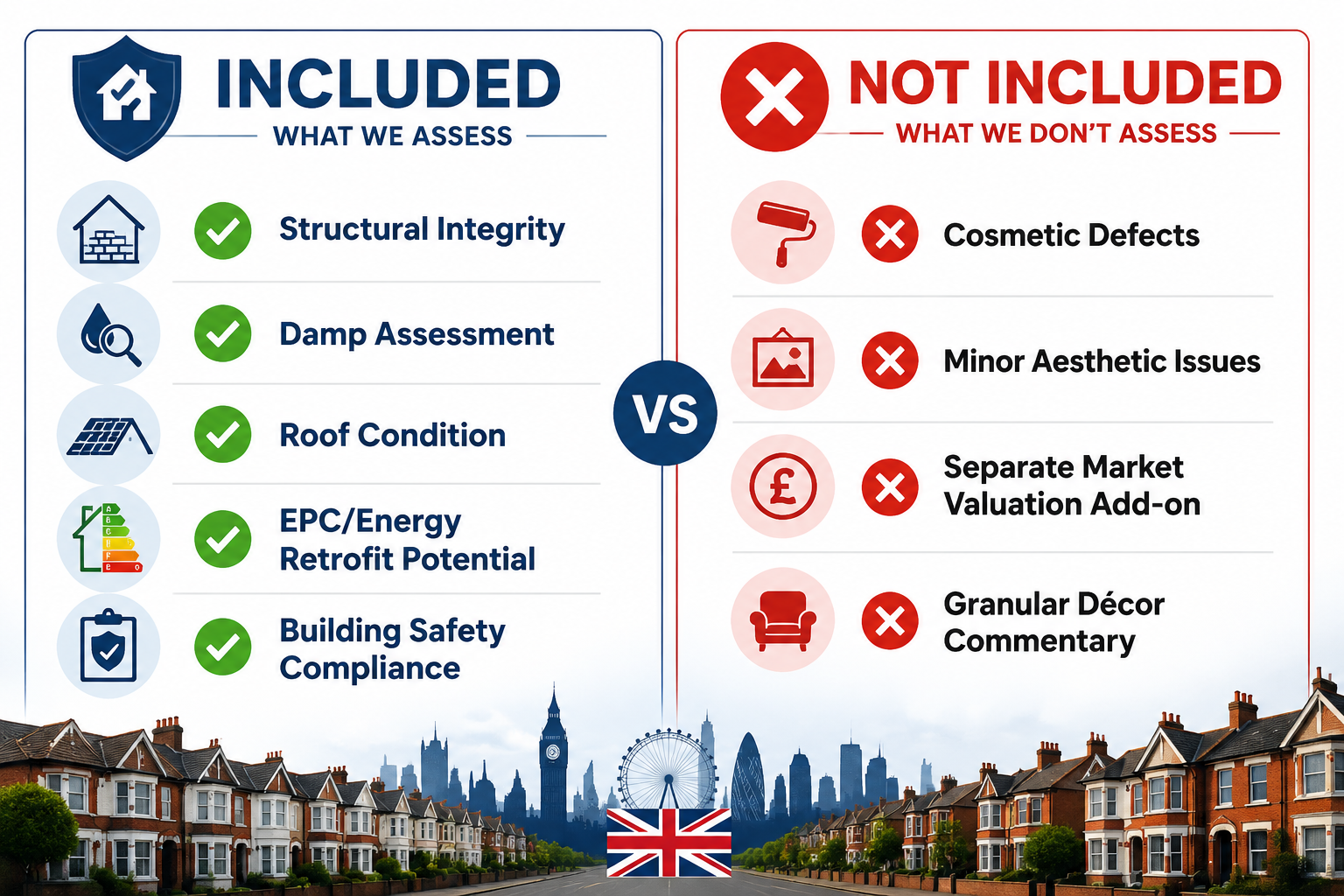
❌ Granular Cosmetic and Minor-Defect Commentary
In a hotter market, buyers used long lists of minor defects — cracked tiles, dated décor, worn carpets — as negotiating chips. In 2026's slower, more serious market, this approach has largely been abandoned.
Wimbledon Surveyors' January 2026 guidance confirms that budget-constrained buyers are explicitly telling surveyors they are happy to skip granular cosmetic or minor-defect commentary if it keeps fees down [7]. The logic is straightforward: in a market where prices are broadly flat in the near term but expected to recover, minor cosmetic issues are unlikely to affect value once growth returns.
❌ Separate Market Valuation Add-Ons
Many private purchasers are choosing not to pay for a separate market valuation when they already have a lender's valuation. Instead, they are diverting that budget into targeted technical advice on energy performance and building safety [7].
This is a rational allocation of limited survey spend — particularly for buyers who have already stress-tested the asking price against comparable sales data available through online portals.
❌ Open-Ended "Tell Us Everything" Condition Surveys on Low-Risk Stock
Mortgage Solutions notes that lenders are increasingly less interested in open-ended condition surveys on straightforward, lower-risk stock [5]. For a standard post-war semi-detached with no obvious structural concerns, a heavily scoped Level 2 Homebuyer Report — focused on key risk areas — is often preferred over an exhaustive Level 3 that covers every minor maintenance item.
This does not mean buyers are taking risks. It means they are being more surgical about where survey resource is directed. For a clear comparison of what each level covers, the Level 2 vs Level 3 survey guide is essential reading.
How This Changes the Negotiation Dynamic
One consequence of these shifting instructions is a change in how survey findings are used in price negotiations. In previous years, a long list of defects — however minor — was a standard tool for chipping the asking price. In 2026, the approach is more targeted.
Buyers are using surveys to negotiate the purchase price on the basis of material, costed defects rather than cumulative minor issues. A surveyor who can provide a credible cost estimate for a roof replacement or a damp remediation programme gives the buyer a specific, defensible figure to take back to the vendor.
This shift rewards surveyors who provide quantified, actionable findings over those who produce lengthy reports padded with low-severity observations. For buyers, it means choosing a surveyor with strong cost-estimation skills, not just observational ones.
💬 "A survey that identifies £18,000 of essential works is worth far more to a 2026 buyer than one that lists 40 minor defects with no cost context."

How Surveyors Can Adapt: Practical Implications
How 2026 UK housing market gloom is changing building survey instructions has direct implications for how surveying firms position their services.
✅ Lead with Risk Triage, Not Comprehensiveness
Marketing and client conversations should emphasise the ability to identify deal-breaker risks quickly and clearly. Buyers in 2026 are not looking for the longest report — they want the most useful one.
✅ Build Energy and Retrofit Assessment into Standard Offerings
Given the near-universal buyer interest in energy performance, surveyors who can provide substantive commentary on retrofit feasibility — not just flag EPC ratings — will be more competitive. Linking this to London damp survey services and moisture assessments adds further value, since damp issues directly affect insulation performance.
✅ Offer Modular, Scoped Survey Options
The trend toward stripped-back, focused surveys suggests demand for modular pricing — where buyers can commission a core structural/damp/roof assessment and add energy or compliance modules as needed. This matches the "cautious recovery" mindset without forcing buyers to choose between a full Level 3 and a basic Level 2.
✅ Provide Capex Estimates as Standard
For investor clients especially, the ability to quantify near-term capital expenditure is increasingly a differentiator. Surveyors who frame findings in cost terms — not just condition ratings — are better aligned with how clients are making decisions in 2026.
For buyers who have recently had an offer accepted and are deciding on next steps, the post-offer acceptance guide provides a clear framework for commissioning the right survey at the right time.
Conclusion: Matching Survey Strategy to Market Reality
The 2026 UK housing market is not broken — but it is cautious, budget-conscious, and forward-looking in ways that demand a different approach to building surveys. Buyers are not skipping surveys; they are making them sharper.
The clearest actionable steps for buyers in 2026:
- Define your deal-breakers before instructing a surveyor — structural integrity, damp, cladding, flood risk, and building safety should be non-negotiable priorities.
- Ask explicitly for energy and retrofit commentary — this is no longer optional in a market where running costs and EPC ratings affect both affordability and resale.
- Choose survey level based on property type and risk profile, not habit — a full building survey is essential for older or complex properties; a scoped Level 2 may suffice for straightforward stock.
- Request costed findings — a surveyor who can quantify repair costs gives you real negotiating power.
- Skip what does not move the needle — cosmetic commentary and duplicate valuations are legitimate areas to deprioritise when budget is tight.
The market will recover. When it does, buyers who used the current cautious period to commission smarter, more targeted surveys will have made better-informed purchases — and will be better positioned to benefit from the upturn.
References
[1] UK Property Market 2026 House Price Forecast – https://www.robinsonandhallauctions.co.uk/uk-property-market-2026-house-price-forecast/
[2] Lloyds Bank Markets and Commentary Article – https://www.investments.lloydsbank.com/markets-and-commentary/market-news/article/?id=21504901&type=bsm
[3] Cushman & Wakefield – GB Residential Forecast 2026 – https://www.cushmanwakefield.com/en/united-kingdom/insights/residential-forecast
[4] RICS – UK Residential Market Survey January 2026 – https://www.rics.org/content/dam/ricsglobal/documents/market-surveys/uk-residential-market-survey/UK-Residential-Market-Survey_January-2026.pdf
[5] Mortgage Solutions – Navigating a Cautious UK Housing Market in 2026 – https://www.mortgagesolutions.co.uk/better-business/business-skills/2026/04/15/navigating-a-cautious-uk-housing-market-in-2026-and-why-surveying-insight-matters-more-than-ever-ison/
[7] Wimbledon Surveyors – The 2026 UK Housing Market Recovery: What Building Surveyors Need to Know – https://wimbledonsurveyors.com/the-2026-uk-housing-market-recovery-what-building-surveyors-need-to-know-about-shifting-demand-patterns/
[8] Savills – UK Housing Market Update, April 2026 – https://www.savills.com/research_articles/255800/389633-0
[9] Capital Economics – UK RICS Residential Market Survey Feb 2026 – https://www.capitaleconomics.com/publications/uk-housing-market-update/uk-rics-residential-market-survey-feb-2026