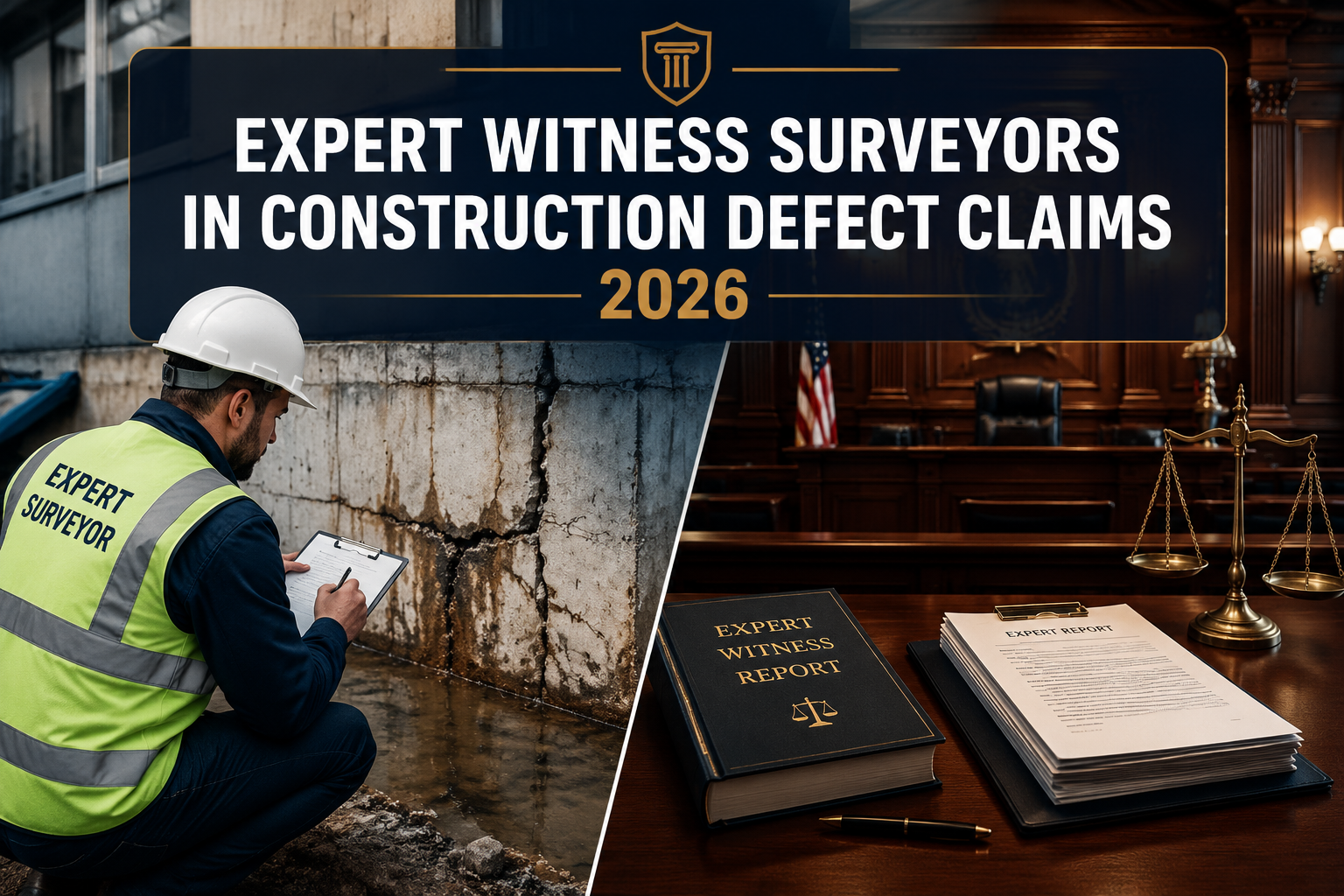
Construction defect litigation in England and Wales has surged by an estimated 34% over the past five years, with poorly managed expert evidence cited as the single most common reason courts criticise parties — and occasionally penalise them in costs. Understanding the full lifecycle of a dispute through the lens of Expert Witness Surveyors in 2026 Construction Defect Claims: From First Instruction to Cross-Examination is no longer optional for practitioners, property owners, or surveyors who want to avoid those criticisms. This guide walks through every stage of the process — from the moment a surveyor receives instructions to the pressure of live cross-examination — with practical workflow advice, evidence management tips, and the mistakes that courts most often flag.
Key Takeaways 📋
- Early, clean instruction is the foundation of a credible expert witness opinion — ambiguous briefs contaminate independence.
- A surveyor's overriding duty is to the court, not to the instructing party; courts will penalise experts who forget this.
- Structured evidence gathering (site notes, photographic logs, Scott Schedules) is what separates persuasive reports from dismissed ones.
- Joint expert meetings and agreed statements can resolve up to 60% of technical issues before trial — preparation for these is as important as the report itself.
- Cross-examination targets methodology and consistency; surveyors who document their reasoning contemporaneously are far harder to shake.
What Makes a Construction Defect Case Different?
Construction defect disputes are technically dense. Unlike a simple boundary disagreement, a defect claim may involve:
- Structural failure (subsidence, cracking, deflection)
- Water ingress and damp penetration
- Workmanship failures against a contract specification
- Non-compliance with Building Regulations or British Standards
- Latent defects discovered years after practical completion
Each of these categories demands a different investigative approach. A building surveyor appointed as an expert witness must have demonstrable competence in the specific defect type alleged — courts are increasingly alert to experts who overreach their specialism.
💬 Pull Quote: "The expert witness who tries to be all things to all defects is the expert witness who gets destroyed in cross-examination."
The Legal Framework in 2026
The Civil Procedure Rules (CPR), particularly Part 35 and the accompanying Practice Direction, govern expert evidence in England and Wales. The key principles remain unchanged in 2026:
| Principle | What It Means in Practice |
|---|---|
| Overriding duty to the court | The expert's opinion must be independent, even if it damages the instructing party's case |
| Single joint expert preference | Courts encourage one shared expert where possible |
| Proportionality | The scope of expert evidence must match the value of the claim |
| Reasoned opinion | Bare conclusions without methodology are inadmissible |
Understanding construction law fundamentals is essential background for any surveyor stepping into the expert witness role.
Stage 1 — First Instruction: Getting the Foundation Right
Accepting or Declining Instructions
The moment a solicitor makes contact, the expert witness process has begun. Before accepting, a surveyor must assess:
- Specialism match — Does the alleged defect fall squarely within the surveyor's expertise?
- Conflicts of interest — Any prior involvement with the site, parties, or related professionals?
- Capacity — Can the surveyor meet likely court timetables without compromising quality?
- Independence — Is there any commercial relationship that could compromise objectivity?
Declining instructions is not a weakness. Accepting instructions outside one's competence is a serious professional risk and a gift to opposing counsel.
The Letter of Instruction
A clear, written letter of instruction should set out:
- The specific defects alleged
- The questions the expert is asked to address
- The documents provided at the outset
- The timetable for the report
Red flag: If the letter of instruction asks the surveyor to "support our client's position," that is a boundary violation. The correct response is to clarify — in writing — that the duty is to the court, not the client.
Initial Document Review
Before visiting the site, the surveyor should review:
- Contract documents and specifications
- As-built drawings
- Building Regulations completion certificates
- Any prior survey reports (including condition surveys or homebuyer reports)
- Correspondence between parties
- Photographs taken by others
This desk review shapes the site inspection agenda. Arriving at a defect site without a structured inspection plan is one of the most common — and avoidable — errors.
Stage 2 — Evidence Gathering: The Work That Wins Cases
The Site Inspection Protocol
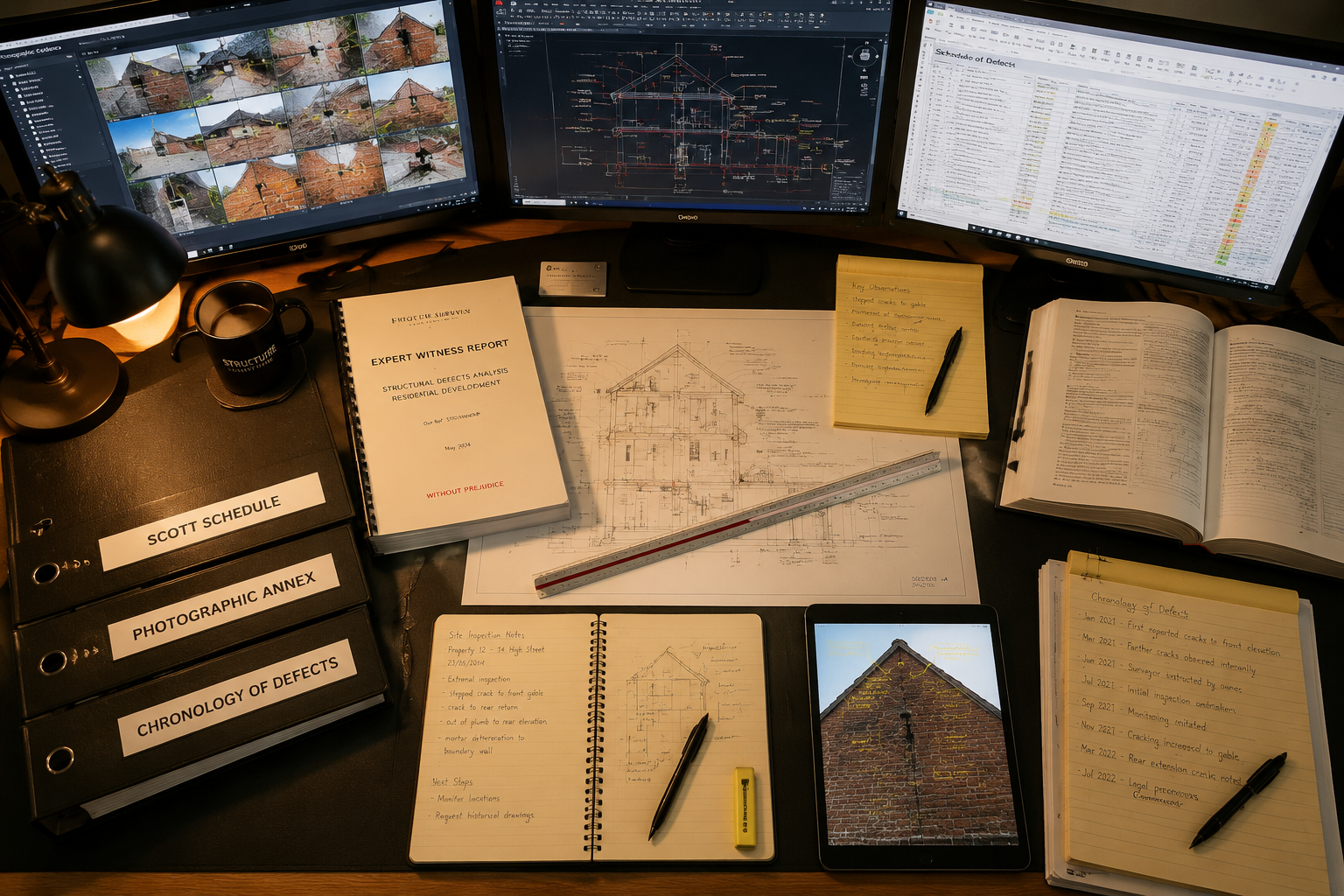
A rigorous site inspection is the backbone of a credible expert report. Best practice in 2026 includes:
Before the visit:
- Prepare a defect schedule checklist aligned to the pleaded case
- Arrange for both parties' representatives to attend (or at minimum, notify them)
- Confirm access to all relevant areas — hidden defects require invasive investigation
During the visit:
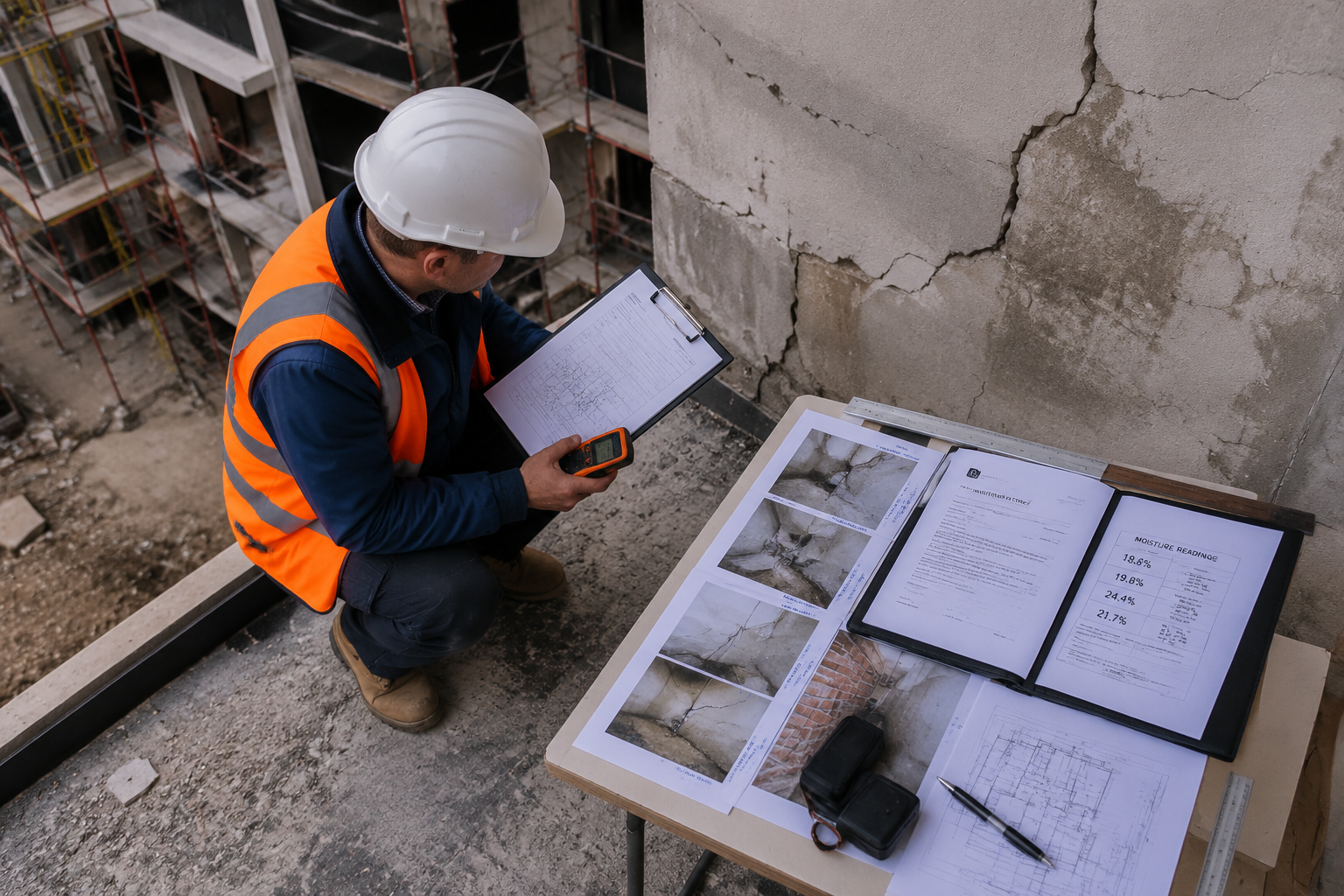
- Photograph every defect systematically: wide shot, mid shot, close-up
- Record measurements, moisture readings, and crack widths contemporaneously
- Use a dictaphone or digital notes app to capture observations in real time
- Note ambient conditions (temperature, humidity, recent weather)
After the visit:
- Compile a chronological site note within 24 hours
- Cross-reference photographs to the defect schedule
- Flag areas requiring further investigation (opening up works, specialist testing)
🔑 Key Point: Courts have repeatedly criticised expert reports where the surveyor could not recall specific observations from the site. Contemporaneous notes are not optional — they are the expert's shield under cross-examination.
Building the Scott Schedule
In construction defect litigation, the Scott Schedule is the central document. It lists each alleged defect, the claimant's case on causation and remedy, and the defendant's response. The expert witness surveyor typically contributes the technical columns.
A well-structured Scott Schedule:
- Uses consistent, plain language for each defect description
- Cross-references photographic evidence by reference number
- States the applicable standard breached (Building Regulation, British Standard, or good practice)
- Provides a costed remedy for each item
- Distinguishes between defects the expert agrees with and those disputed
Poor Scott Schedules — vague descriptions, missing standards references, inconsistent costing — are among the most common reasons construction defect claims become disproportionately expensive. For surveyors working across London, understanding construction project legal requirements is essential to building a technically sound schedule.
Specialist Testing and Investigations
Many construction defects cannot be diagnosed from visual inspection alone. Common specialist investigations include:
- Damp and timber surveys — moisture meter readings, endoscopic inspection, laboratory analysis of samples
- Structural surveys — deflection measurements, crack monitoring, load calculations
- Drainage surveys — CCTV drain inspection
- Thermal imaging — identifying insulation failures and cold bridges
The expert witness surveyor does not need to conduct every test personally, but must be able to interpret results and explain their significance in the report. Where third-party specialists are used, their methodology must be documented and their reports appended.
Stage 3 — Writing the Expert Report: Clarity Over Complexity
Structure of a CPR-Compliant Expert Report
A Part 35-compliant expert report must include:
- Details of the expert's qualifications and experience
- A statement of the expert's instructions (the letter of instruction is usually appended)
- A summary of the facts relied upon
- The expert's opinion on each issue
- A statement of truth — the expert confirms the report is true to the best of their knowledge
- The Part 35 declaration — confirming the overriding duty to the court
Writing for Two Audiences
The expert report is read by:
- The judge — who may have no technical background and needs clear, logical reasoning
- Opposing counsel — who will look for inconsistencies, overstatements, and gaps in methodology
This dual audience demands a writing style that is precise but accessible. Grade 7 readability is not just a content marketing principle — it is genuinely what courts respond to best.
Common drafting mistakes to avoid:
| Mistake | Why It Matters |
|---|---|
| Advocacy language ("clearly," "obviously") | Signals lack of objectivity |
| Bare conclusions without reasoning | Inadmissible under CPR Part 35 |
| Inconsistency with site notes | Exposed immediately in cross-examination |
| Overreaching the expert's specialism | Undermines credibility on all points |
| Failing to address contrary evidence | Courts expect experts to engage with the other side's case |
Stage 4 — Joint Expert Meetings and Agreed Statements
Why This Stage Is Decisive
Research consistently shows that well-prepared joint expert meetings resolve the majority of technical disputes before trial. In 2026, courts actively encourage — and sometimes order — joint meetings to narrow the issues.
The joint meeting is not a negotiation. It is a structured technical discussion between experts, without lawyers present, aimed at identifying:
- Points of agreement
- Points of disagreement
- The reasons for disagreement (often more important than the disagreement itself)
Preparing for the Joint Meeting
Before the meeting, the surveyor should:
- Re-read both expert reports carefully
- Identify every point of technical difference
- Prepare a clear, reasoned position on each disputed point
- Anticipate the opposing expert's strongest arguments
The output is a Joint Statement — a document that courts treat as highly significant. Concessions made in a joint statement are very difficult to walk back at trial. Every word matters.
💬 Pull Quote: "A surveyor who enters a joint meeting unprepared is effectively handing the opposing party a free trial advantage."
Stage 5 — Cross-Examination: Performing Under Pressure
What Cross-Examination Actually Tests
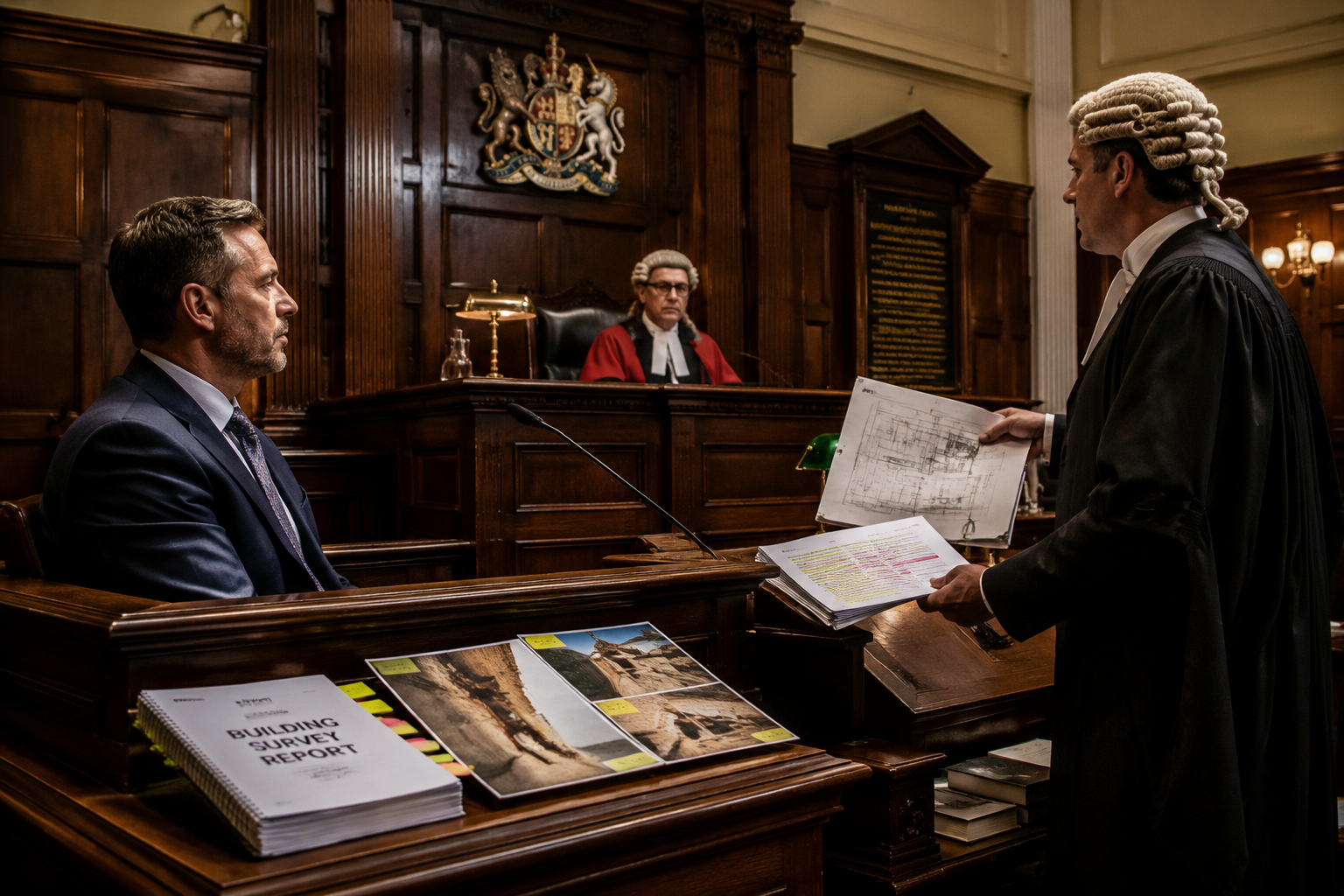
Cross-examination of an expert witness surveyor in a construction defect trial is not primarily about technical knowledge. It tests:
- Consistency — Does the oral evidence match the written report and the site notes?
- Methodology — Was the approach to investigation logical and complete?
- Independence — Does the expert genuinely hold the opinions expressed, or are they a hired advocate?
- Proportionality of opinion — Are the conclusions supported by the evidence, or do they overreach?
Experienced barristers use several techniques to destabilise expert witnesses:
- The concession trap — asking apparently reasonable questions that lead to a damaging admission
- The document ambush — producing a document the expert has not seen or has overlooked
- The methodology challenge — questioning why a particular test was not carried out
- The prior statement — pointing to an earlier report or correspondence that contradicts current evidence
Surviving Cross-Examination: Practical Tips
Before the hearing:
- Re-read every document in the trial bundle that relates to the expert's evidence
- Review the joint statement line by line
- Prepare to explain the methodology in plain English, without jargon
In the witness box:
- Listen to the full question before answering
- Ask for clarification if a question is unclear — this is a right, not a weakness
- Never guess; "I do not know" is a perfectly acceptable answer
- Maintain the same measured tone throughout — frustration or defensiveness reads badly
- If a concession is warranted, make it clearly and move on — judges respect intellectual honesty
The golden rule: An expert witness who changes a well-reasoned opinion under cross-examination pressure — rather than in response to new evidence or a logical argument — loses all credibility. Holding a position under pressure, when the reasoning is sound, is not stubbornness. It is professionalism.
After the Hearing
Win or lose, every expert witness should conduct a personal debrief:
- What questions were hardest to answer, and why?
- Were there gaps in the investigation that opposing counsel exploited?
- Was the report as clear as it could have been?
This reflective practice is what separates good expert witnesses from great ones. For surveyors looking to understand the broader professional landscape, resources on what a surveyor does and their professional responsibilities provide useful context.
Common Mistakes Courts Criticise in 2026
Based on judicial commentary across recent construction defect cases, the following failures appear most frequently:
- ❌ Failing to disclose all instructions — partial disclosure of the letter of instruction
- ❌ Adopting the client's language in describing defects rather than independent observation
- ❌ Inadequate site access — forming opinions without inspecting all relevant areas
- ❌ Ignoring alternative explanations for a defect (e.g., attributing cracking to workmanship without ruling out subsidence)
- ❌ Overcosting remedies — inflated schedules of remedial works that courts discount entirely
- ❌ Late changes to opinion without adequate explanation
For surveyors involved in cases touching on party wall matters or boundary issues, understanding party wall agreements and property boundary disputes adds important contextual knowledge that can prevent gaps in evidence.
Choosing the Right Expert Witness Surveyor
Not every surveyor is suited to expert witness work. When selecting or recommending an expert, consider:
| Criteria | Why It Matters |
|---|---|
| Relevant specialism | Credibility depends on matching expertise to defect type |
| Court experience | Familiarity with CPR Part 35 and courtroom procedure |
| Communication skills | Technical expertise must be translatable to plain English |
| Professional indemnity insurance | Adequate cover for expert witness work specifically |
| RICS or equivalent membership | Professional standards and disciplinary framework |
| Availability for the full timetable | Changing experts mid-case is expensive and damaging |
For those finding a surveyor with the right credentials for expert witness work, verifying RICS membership and requesting examples of previous expert reports is standard due diligence.
Conclusion: Actionable Next Steps for Surveyors and Practitioners
The role of Expert Witness Surveyors in 2026 Construction Defect Claims: From First Instruction to Cross-Examination demands a level of discipline, organisation, and intellectual honesty that goes well beyond standard survey practice. The courts are not forgiving of sloppy methodology, advocacy dressed as opinion, or experts who crumble under pressure.
For surveyors considering expert witness work:
- ✅ Invest in CPR Part 35 training before accepting your first instruction
- ✅ Build a rigorous site inspection protocol and stick to it on every case
- ✅ Develop a document management system that makes every photograph, note, and reading instantly retrievable
- ✅ Practise explaining technical concepts in plain English — record yourself and listen back
- ✅ Seek mentorship from an experienced expert witness before taking a high-value case solo
For solicitors and parties instructing experts:
- ✅ Provide clear, written instructions that respect the expert's independence
- ✅ Give the expert adequate time — rushed reports are weak reports
- ✅ Prepare the expert thoroughly for cross-examination, but never coach their opinions
- ✅ Take joint meeting preparation as seriously as trial preparation
Construction defect claims are won and lost on the quality of technical evidence. In 2026, courts have higher expectations of expert witnesses than ever before. Surveyors who invest in their expert witness skills — and who understand the full journey from first instruction to cross-examination — are the ones who make a genuine difference to the outcome of disputes.