Researchers at the University of Manchester have reported that AI valuation systems can achieve more than 96% accuracy — compared with roughly 70–85% for traditional methods alone [1]. That single statistic is reshaping conversations in every valuation practice across England and Wales. Yet accuracy in a controlled dataset is not the same as defensibility in a Red Book report, a lender's mortgage file, or a disputed sale negotiation. The question for 2026 is no longer whether AI-assisted valuations in the UK belong in professional practice — it is how chartered surveyors should use (and challenge) automated models to stay compliant, credible, and competitive.

Key Takeaways 🔑
- AI valuation tools can sharpen accuracy, but RICS guidance is explicit: they must support, not replace, professional judgement and Red Book methodology [6].
- Data quality is the surveyor's first line of defence — always interrogate an AVM's data cut-off date, comparable selection, and treatment of condition.
- Three documented decisions matter most: when to rely on an AVM output, when to adjust it, and when to override it entirely — each requires a clear audit trail.
- Consumer trust in fully autonomous AI remains low (only 14% of UK consumers are comfortable with agent-led AI systems [4]), so human accountability in valuations is a market differentiator, not just a regulatory obligation.
- UK government policy in 2026 is accelerating AI assurance frameworks [5], meaning lenders and institutional clients will soon demand evidence of how AI outputs were verified — not just what they concluded.
Why Automated Valuation Models Have Moved Centre Stage
Automated Valuation Models (AVMs) are no longer niche fintech curiosities. Rightmove, one of the UK's largest property portals, reaffirmed its 2026 guidance citing AI-powered innovation as a core growth driver [8]. High-street lenders, challenger banks, and institutional investors routinely use AVMs for desktop valuations, portfolio monitoring, and mortgage risk assessment. For chartered surveyors working in residential and commercial markets, this means clients arrive at instructions already holding an AI-generated figure — often from Zoopla, Rightmove, or a lender's internal model.
What AVMs Actually Do (and Don't Do)
An AVM ingests large datasets — Land Registry transactions, EPC ratings, planning records, school catchment data, flood risk scores — and applies machine learning algorithms to produce a price estimate, usually with a confidence interval. The best models are impressively powerful. The worst are confidently wrong.
What AVMs typically cannot account for:
| Factor | Why AVMs Struggle |
|---|---|
| Physical condition | No on-site inspection; relies on EPC proxy data |
| Lease terms & ground rent | Often uses headline tenure, not lease detail |
| Development potential | Planning history is patchy in training data |
| Micro-location nuance | A road's "feel" is not in a dataset |
| Recent market sentiment | Data cut-offs lag live market conditions |
| Structural defects | Invisible without a RICS building survey |
💬 "The model sees what the data tells it. The surveyor sees what the data cannot."
This gap is precisely where professional value lies — and where RICS has drawn its regulatory line.
The RICS Framework: What Chartered Surveyors Must Know in 2026
RICS guidance on AI in real estate valuation [6] is the most authoritative professional framework available to UK practitioners. It does not prohibit AI use. It demands responsible AI use, structured around three core obligations.
1. Data Sourcing, Reliability, and Verification
Before accepting any AVM output, a surveyor must satisfy themselves that the underlying data is:
- Current — when was the training data last updated? A model trained on pre-2023 transactions may not reflect post-mini-budget repricing or 2025 interest rate adjustments.
- Geographically appropriate — a national model may perform well in suburban Manchester but poorly in hyper-local markets like London property or specialist coastal towns.
- Condition-neutral or condition-adjusted — most AVMs assume average condition. A property with significant defects (damp, structural movement, non-standard construction) will be systematically overvalued.
2. Integration with Red Book–Compliant Methodology
RICS is unambiguous: AI tools must be integrated into established valuation methodologies, not substituted for them [6]. In practice, this means:
- The AVM output is one input among several, alongside physical inspection findings, manually selected comparables, and market commentary.
- The surveyor's comparable evidence must be independently verified, even if the AVM has already selected comparables algorithmically.
- The final figure must be defensible under RICS Valuation — Global Standards (the Red Book), regardless of whether an AI tool was consulted.
3. Audit Trails: Follow, Adjust, or Reject
This is the area where many practices are still underprepared. RICS requires surveyors to maintain documentation showing, for each valuation where AI was used, whether the automated output was:
- ✅ Followed — and why the AVM's assumptions were considered sound
- ✏️ Adjusted — with a clear explanation of which factors warranted departure
- ❌ Rejected — with evidence of why the model was unreliable for this specific property
This three-way documentation framework is not bureaucratic box-ticking. In a complaint or negligence claim, it is the difference between a defensible professional decision and an unexplained deviation from a publicly available figure.
Practical Integration: When to Rely, When to Adjust, When to Override
The most useful mental model for professional surveyor services in 2026 is a traffic light system for AVM outputs.
🟢 Green: Rely on the AVM (with verification)
Conditions where AVM outputs are most reliable:
- Standard construction, good condition, no material defects
- Active comparable market with recent transactions (within 3–6 months)
- Freehold or straightforward long leasehold (125+ years unexpired, no onerous ground rent)
- Homogeneous housing stock (e.g., post-war semi-detached estates)
- Confidence interval is narrow (typically ±5% or less)
Even here, the surveyor should cross-check at least three manually selected comparables and confirm the AVM's data cut-off is within an acceptable window.
🟡 Amber: Adjust the AVM Output
Conditions requiring material adjustment:
- Condition issues identified on inspection — damp, roof wear, electrical systems — that the AVM cannot price. A specific defect survey finding, for example, may justify a 5–15% downward adjustment depending on remediation cost.
- Lease terms — short leases (below 80 years), high ground rents, or restrictive covenants that the AVM has not weighted correctly.
- Micro-location factors — proximity to a new development, a recently closed amenity, or a planning application not yet reflected in transaction data.
- Divergent comparable evidence — where the surveyor's manually selected comparables cluster meaningfully above or below the AVM figure.
Document the adjustment with a percentage or absolute figure, the specific evidence relied upon, and the professional reasoning applied.
🔴 Red: Override the AVM Entirely
Conditions where the AVM should be set aside:
- Atypical or unique properties — listed buildings, non-standard construction, properties with development potential, or those with significant hope value.
- Distressed sales — repossessions, probate sales, or transactions where the comparable pool is contaminated by non-market conditions.
- Thin markets — rural locations, specialist property types, or areas with fewer than five comparable transactions in the preceding 12 months.
- Rapidly changing market conditions — where the AVM's training data predates a significant macro event (rate change, policy shift, local economic shock).
In these cases, the surveyor's independent judgement is the valuation. The AVM figure should be noted in the file as context, but should not anchor the final opinion of value.
Handling Buyer–Seller Disputes Involving AI Valuations
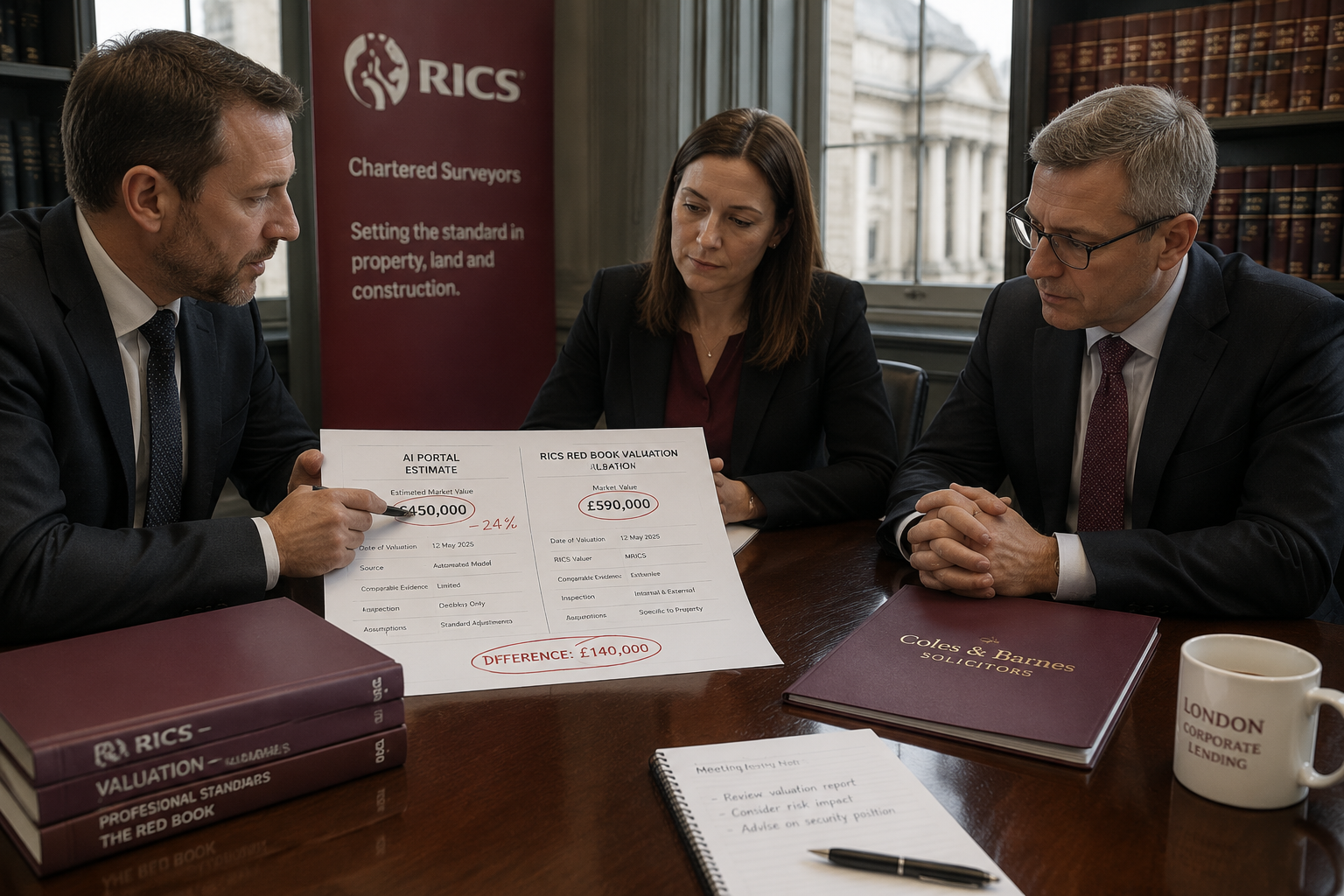
One of the most pressing practical challenges in 2026 is the growing frequency of buyer–seller disputes where a portal's AI estimate diverges sharply from a RICS valuation [9]. Sellers anchored to a Zoopla "Zestimate" or a bank's AVM figure can become difficult counterparties when a surveyor's Red Book figure comes in lower.
Chartered surveyors navigating these disputes should adopt a structured response:
Step 1 — Dissect the AVM's assumptions
Request or reconstruct the comparable selection, data cut-off date, and condition assumptions used by the automated model. Many portal AVMs use a 12–24 month transaction window and assume average condition — both of which may be inappropriate for the subject property.
Step 2 — Present side-by-side comparable evidence
Produce a schedule showing the AVM's implied comparables alongside the surveyor's manually verified comparables, with adjustments for condition, floor area, lease terms, and location. This makes the divergence explainable, not just asserted.
Step 3 — Document the professional reasoning
Every departure from the automated figure should be recorded in the valuation file. If the matter proceeds to a complaint or litigation, the surveyor's file must show a clear, reasoned path from evidence to conclusion — not just a number that happens to differ from the AI's output.
For buyers who have received a poor survey result and are considering renegotiation, understanding the gap between an AVM and a surveyed value is often the starting point. Resources on renegotiating after a poor building survey result can help buyers frame these conversations constructively.
The Consumer Trust Gap: Why Human Accountability Is a Competitive Advantage
EY's AI Sentiment Index for 2026 reveals a striking paradox: 74% of UK consumers have recently used AI, yet only 14% are comfortable relying on fully autonomous, agent-led AI systems [4]. For property valuations — often the largest financial transaction in a person's life — that trust gap is even more pronounced.
This has direct commercial implications for surveyors. Clients do not want a black-box number. They want a professional who can explain why the AI said what it said, whether that figure is reliable for their specific property, and what the surveyor's independent assessment concludes.
Practices that can articulate this clearly — in client communications, in valuation reports, and in dispute resolution — will differentiate themselves in an increasingly AI-saturated market. The surveyor's role is not threatened by AI; it is redefined by it, toward higher-order judgement, communication, and accountability.
The Regulatory Horizon: What UK Policy Means for Valuers
UK government policy in 2026 is simultaneously accelerating AI adoption and demanding AI assurance [5]. The AI Opportunities Action Plan confirms:
- An AI Assurance Innovation Fund launching from Spring 2026 to pilot assurance solutions alongside cutting-edge AI tools.
- Up to £500m for a Sovereign AI Unit to back UK AI companies, including those operating in property and financial services.
For chartered surveyors, this points to a near-term environment where major lenders, regulators, and institutional clients will require documented evidence of how AI outputs were verified — not merely disclosed. Practices that build robust AI governance into their valuation workflows now will be ahead of requirements that are likely to become mandatory within the next 12–24 months [7].
The UK's financial services regulators are already signalling heightened scrutiny of AI use in mortgage and property contexts [7]. Surveyors working with lender panels should anticipate requests for AI use disclosures as a standard element of valuation instructions.
Building an AI-Ready Valuation Practice: Actionable Checklist ✅
For practices looking to formalise their approach to AI-assisted valuations in the UK, the following checklist provides a practical starting framework:
- Establish an AVM inventory — document which AI tools are used, by whom, and for what property types
- Define data quality thresholds — set minimum standards for data recency, comparable volume, and confidence intervals before an AVM output is relied upon
- Create a standard adjustment methodology — document how condition, lease, and micro-location factors are priced into departures from AVM figures
- Implement a three-tier file note system — Follow / Adjust / Override, with mandatory reasoning recorded for each
- Train all fee earners on RICS AI guidance [6] and the firm's internal AI use policy
- Review PI insurance coverage — confirm that AI-assisted valuations are within scope of professional indemnity cover
- Prepare client-facing explainer materials — so clients understand what AI tools contribute and where human judgement takes precedence
Conclusion: The Surveyor's Edge in an AI-Augmented Market
AI-assisted valuations in the UK are not a future scenario — they are the present reality for every chartered surveyor taking instructions in 2026. The University of Manchester's 96%+ accuracy findings [1] confirm that AVMs are powerful tools. RICS guidance [6] confirms they are not sufficient tools. The space between those two truths is where professional value is created.
The surveyors who will thrive are those who treat AI outputs as high-quality first drafts: worth reading carefully, worth interrogating rigorously, and worth overriding confidently when the evidence demands it. That means investing in data literacy, building airtight audit trails, and communicating the basis of professional judgement clearly to clients, lenders, and — when necessary — courts.
Actionable next steps for 2026:
- Review your firm's current AVM use against the RICS AI in Real Estate Valuation guidance [6] — identify any gaps in documentation or methodology.
- Implement the Follow / Adjust / Override file note framework across all instructions where AI tools are consulted.
- Engage with lender panel requirements proactively — ask whether AI use disclosure is already expected or forthcoming.
- Invest in local market knowledge — the one thing no national AVM can replicate is granular, on-the-ground expertise in specific submarkets, whether that is Wimbledon, Notting Hill, or Hackney.
- Monitor the AI Assurance Innovation Fund developments [5] — early engagement with assurance frameworks will position practices ahead of mandatory requirements.
The algorithm does not walk through the front door. The chartered surveyor does. In 2026, that distinction remains the foundation of defensible, trustworthy valuation practice.
References
[1] How AI Is Transforming Property Valuations In 2026 – https://tkpg.co.uk/how-ai-is-transforming-property-valuations-in-2026/
[2] Why UK Businesses Investing AI Automation 2026 – https://www.cloudswitched.com/blog/why-uk-businesses-investing-ai-automation-2026
[3] Top AI Startups UK – https://aifundingtracker.com/top-ai-startups-uk/
[4] UK AI Adoption Trust Governance EY 2026 – https://www.ey.com/en_uk/newsroom/2026/05/uk-ai-adoption-trust-governance-ey-2026
[5] AI Opportunities Action Plan One Year On – https://www.gov.uk/government/publications/ai-opportunities-action-plan-one-year-on/ai-opportunities-action-plan-one-year-on
[6] AI In Real Estate Valuation – https://www.rics.org/profession-standards/rics-standards-and-guidance/sector-standards/valuation-standards/ai-in-real-estate-valuation
[7] New Developments For AI In UK Financial Services – https://www.hoganlovells.com/en/publications/new-developments-for-ai-in-uk-financial-services
[8] UK's Rightmove Reaffirms 2026 Guidance AI-Powered Innovation Drives Growth – https://www.reuters.com/world/uk/uks-rightmove-reaffirms-2026-guidance-ai-powered-innovation-drives-growth-2026-05-08/
[9] Valuation Challenges From AI Tools In 2026: Chartered Surveyor Strategies For Buyer Seller Disputes – https://princesurveyors.co.uk/blog/valuation-challenges-from-ai-tools-in-2026-chartered-surveyor-strategies-for-buyer-seller-disputes/