


Only one in three homeowners who receive a party wall notice fully understands what happens next — and that knowledge gap can cost thousands of pounds in avoidable disputes. Knowing how to identify, evaluate, and appoint the right expert is arguably the single most important step in any party wall matter. This guide to Party Wall Act Listed Experts: Profiles, Credentials and Case Examples for 2026 Dispute Resolution breaks down exactly who these professionals are, what credentials to look for, how real-world awards play out, and how to decide between a single agreed surveyor and joint appointments.

Key Takeaways 📌
- Expert registries exist — the UK Register of Expert Witnesses lists party wall specialists with searchable profiles and credentials [1]
- Appointment is time-critical — adjoining owners have just 14 days to respond to a notice, and surveyors must be appointed within 10 days of dissent [3]
- The building owner usually pays — when a neighbour dissents and appoints a surveyor, the building owner typically covers those costs [3]
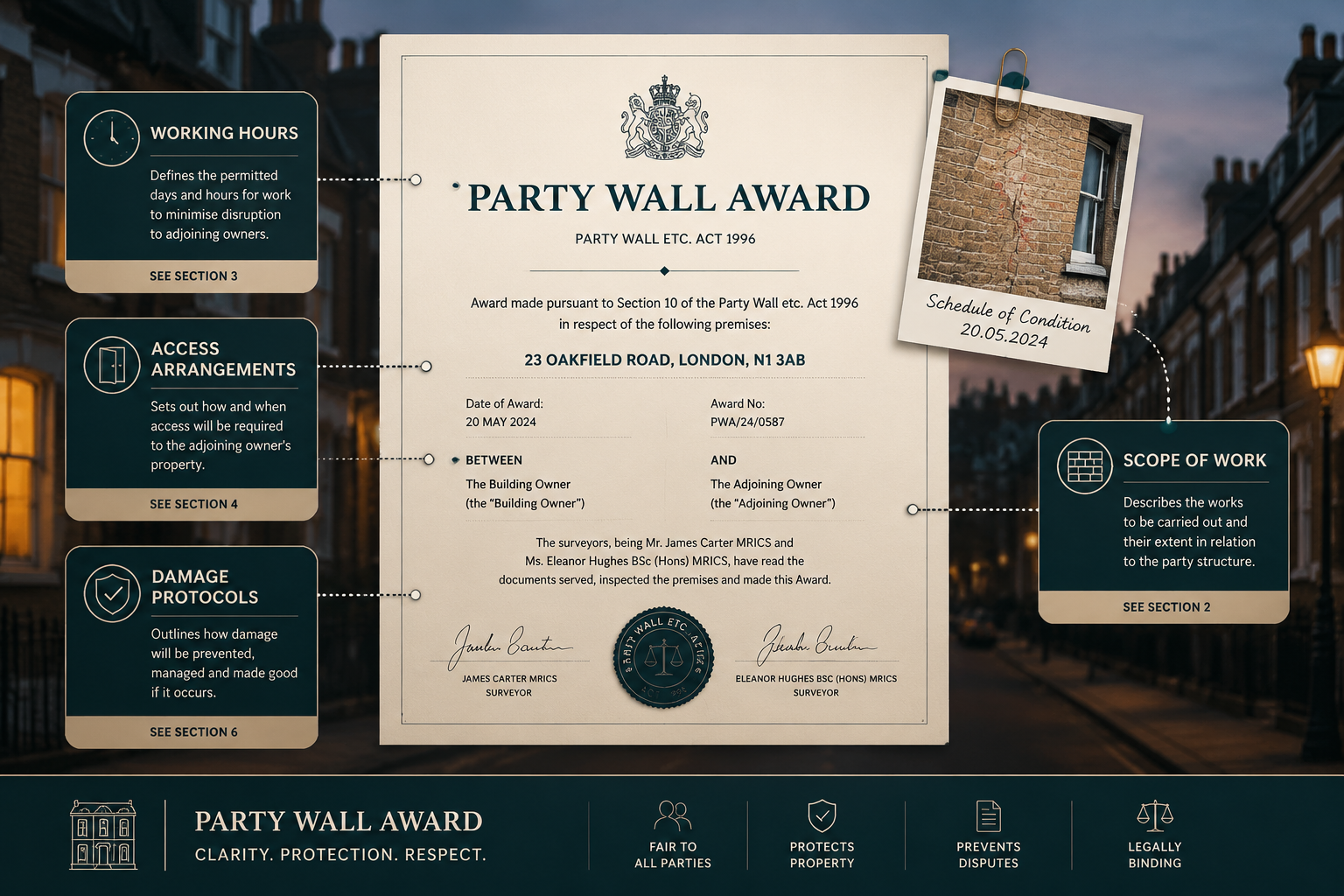
- The Party Wall Award is legally binding — it governs working hours, access, damage protocols, and scope of work [3]
- Independence is non-negotiable — an agreed surveyor must be entirely separate from any surveyor already working for the building owner [2]
What Makes a Party Wall Expert "Listed"?
The term "listed expert" in the party wall context refers to professionals who appear on recognised professional registers and databases. The most authoritative of these is the UK Register of Expert Witnesses, which maintains a searchable database of expert witnesses who declare expertise in the Party Wall etc. Act 1996 [1]. Profiles on this register typically include:
- Professional qualifications (MRICS, FRICS, etc.)
- Years of experience in party wall matters
- Geographic coverage
- Specific areas of expertise (e.g., loft conversions, basement excavations)
- Contact details and practice information
Beyond this register, two professional bodies serve as the primary credentialing authorities for party wall surveyors in 2026:
| Body | Abbreviation | Relevance |
|---|---|---|
| Royal Institution of Chartered Surveyors | RICS | Sets professional and ethical standards; issues guidance on expert witness reports [4] |
| Faculty of Party Wall Surveyors | FPWS | Specialist body focused exclusively on party wall practice [3] |
| Pyramus & Thisbe Club | P&T Club | Long-established networking and knowledge body for party wall practitioners |
💡 Pull Quote: "A listed party wall expert is not simply someone who knows the Act — they are a professional whose credentials, independence, and track record can withstand scrutiny in a formal dispute."
Understanding the Credentials Behind Party Wall Act Listed Experts: Profiles, Credentials and Case Examples for 2026 Dispute Resolution
Core Qualifications to Look For
When evaluating any party wall expert, credentials fall into three tiers:
Tier 1 — Chartered Status
MRICS (Member of RICS) or FRICS (Fellow of RICS) designations signal that the individual has passed rigorous assessments, holds professional indemnity insurance, and is bound by a code of conduct. For party wall work specifically, look for surveyors who list party wall matters as a primary practice area rather than a side offering.
Tier 2 — Specialist Memberships
Membership of the Faculty of Party Wall Surveyors (FPWS) or the Pyramus & Thisbe Club demonstrates active engagement with the specialist community. These bodies publish updated guidance, run CPD (Continuing Professional Development) events, and maintain ethical standards specific to party wall practice.
Tier 3 — Expert Witness Accreditation
For cases heading toward litigation, look for surveyors who hold Civil Procedure Rules (CPR) Part 35 training or equivalent expert witness accreditation. RICS has issued best practices guidance following recent UK litigation on party wall expert witness reports, emphasising that reports must be objective, impartial, and addressed to the court rather than the appointing party [4].
Jurisdiction: England and Wales Only
A critical but frequently overlooked credential check is geographic jurisdiction. The Party Wall etc. Act 1996 applies exclusively to England and Wales — it does not apply in Scotland or Northern Ireland [2]. Any expert claiming party wall credentials must be operating within this jurisdiction. For London-based disputes, local expertise matters enormously; a surveyor familiar with party wall matters in London will understand the density of terraced housing, basement conversion trends, and local authority nuances that affect awards.
Red Flags When Reviewing Profiles
- ❌ No professional indemnity insurance disclosed
- ❌ Chartered status listed without a verifiable membership number
- ❌ No specific party wall case experience — only general building surveying
- ❌ Unwillingness to provide a schedule of condition before work begins
- ❌ Conflict of interest with the building owner's design or construction team
The 2026 Dispute Resolution Process: How Listed Experts Operate
The Notice-to-Award Timeline
Understanding how experts fit into the procedural timeline is essential. Here is how the process unfolds in 2026:
- Building owner serves notice — This must be done in writing, typically 1-2 months before work starts depending on the type of work. Learn more about serving a party wall notice correctly.
- 14-day response window — The adjoining owner has exactly 14 days from the date of delivery (not the date they open it) to respond [3]. Missing this deadline triggers automatic "dissent" status.
- Surveyor appointment within 10 days — Once dissent is registered, surveyors must be appointed within 10 days. If the building owner fails to appoint one, the neighbour can do so on their behalf [3].
- Schedule of Condition prepared — The appointed expert creates a detailed photographic and written record of the adjoining property's condition before any work begins. This document becomes critical evidence in any subsequent damage claim [3].
- Party Wall Award issued — The legally binding award specifies working hours, access arrangements, damage protocols, and the full scope of permitted work [3].
What the Party Wall Award Must Cover
A well-drafted award by a competent listed expert will address:
- Permitted works — Exact description of what the building owner may do
- Working hours — Typically 8am–6pm Monday to Friday, with restrictions on weekends
- Access rights — When and how the building owner's team may access the adjoining property
- Damage protocol — How damage will be assessed, reported, and remedied
- Security for expenses — Financial protection for the adjoining owner in some cases
For a deeper understanding of what these agreements contain and when they are required, see when you need a party wall agreement.
Single Agreed Surveyor vs. Joint Appointment: A Critical Choice
One of the most consequential decisions in any party wall dispute is whether to appoint a single agreed surveyor or proceed with separate surveyors for each party.
Single Agreed Surveyor
Both parties appoint one independent expert who acts impartially for both. This is faster and less expensive. However, there is a strict independence requirement: the agreed surveyor must be entirely different from any surveyor the building owner is already using for design or construction purposes [2]. This rule exists to prevent conflicts of interest that would undermine the award's validity.
Best suited for:
- Straightforward works (e.g., loft conversions, damp proof course insertions)
- Neighbours with a broadly cooperative relationship
- Cases where cost efficiency is a priority
Understanding party wall surveyor fees is important here — a single agreed surveyor typically costs less overall, and the building owner generally pays [3]. For a full breakdown of London pricing, see this guide to understanding party wall surveyor costs in London.
Separate (Joint) Appointment
Each party appoints their own surveyor. The two surveyors then appoint a Third Surveyor — a named expert agreed upon at the outset — who acts as a referee if the two appointed surveyors cannot agree. The Third Surveyor's award is binding.
Best suited for:
- Complex or high-value works (e.g., basement excavations, major structural alterations)
- Situations where the adjoining owner has significant concerns about damage
- Cases where the parties have a contentious relationship
| Factor | Single Agreed Surveyor | Joint Appointment |
|---|---|---|
| Cost | Lower (one fee) | Higher (two fees + potential Third Surveyor) |
| Speed | Faster | Slower |
| Independence | Must be strictly impartial | Each party has their own advocate |
| Best for | Simple works, cooperative neighbours | Complex works, high-stakes disputes |
| Who pays? | Building owner typically [3] | Building owner typically covers both [3] |
Case Examples: How Listed Experts Shape Award Outcomes
Case Example 1: Loft Conversion Dispute — Schedule of Condition Saves the Day
A homeowner in South London began a loft conversion affecting a shared party wall. The adjoining owner dissented and appointed a listed RICS-chartered expert. Before work started, the expert produced a detailed Schedule of Condition with 47 photographs documenting hairline cracks in the adjoining property's bedroom ceiling and plasterwork.
Six weeks into the build, the adjoining owner reported new cracking. Because the Schedule of Condition existed, the expert could compare pre- and post-work photographs objectively. The award's damage protocol was triggered, the building owner's contractor repaired the damage, and the dispute resolved without litigation. The Schedule of Condition was the decisive document [3].
Case Example 2: New Foundation Excavation — Third Surveyor Invoked
A developer in North London planned a rear extension requiring new foundations within 3 metres of the adjoining property's foundations — a classic trigger for party wall procedures [2]. The adjoining owner appointed their own FPWS-accredited surveyor. The building owner's surveyor disagreed on the depth of underpinning required. The Third Surveyor — a Fellow of RICS with 20 years of party wall experience — reviewed both positions and issued a binding determination specifying the exact underpinning specification. The project proceeded without court involvement.
Key lesson: Having a pre-agreed, credentialed Third Surveyor on the register before disputes arise is a mark of a well-managed party wall process.
Case Example 3: Expert Witness Report in Litigation
Following recent UK litigation, RICS issued best practices guidance emphasising that party wall expert witness reports must be objective and addressed to the court, not the appointing party [4]. In one widely discussed case, a surveyor's report was challenged because it appeared to advocate for the building owner rather than provide impartial analysis. The court gave the report reduced weight. This case reinforced that listed experts must maintain strict impartiality even when appointed by one side — a standard that the UK Register of Expert Witnesses profiles help buyers verify upfront [1].
How to Select the Right Expert in 2026: A Practical Checklist

Choosing from a register is only the starting point. Use this checklist when shortlisting experts for party wall agreement assistance:
✅ Verify RICS or FPWS membership — Check the membership number directly on the RICS or FPWS website
✅ Confirm jurisdiction — Expert must practice in England or Wales [2]
✅ Check for conflicts of interest — Especially if considering a single agreed surveyor [2]
✅ Ask for example awards — Experienced experts can show redacted examples of past Party Wall Awards
✅ Confirm professional indemnity insurance — Essential for any formal appointment
✅ Clarify fee structure upfront — Get party wall surveyor quotes in writing before appointing
✅ Assess communication style — The expert must be able to explain technical matters clearly to both parties
✅ Check CPR Part 35 training — If litigation is a possibility, this is non-negotiable
For those involved in neighbour disputes that go beyond party wall matters — such as boundary disagreements — it is worth understanding the average cost of a boundary dispute to set realistic expectations about the full cost of unresolved conflicts.
Common Works That Trigger Expert Involvement in 2026
The most frequent situations requiring a listed expert in 2026 remain consistent with established patterns under the Act [2]:
- 🏠 Loft conversions — Cutting into or building on a party wall
- 🏗️ Rear extensions — New foundations within 3-6 metres of adjoining foundations
- 💧 Damp proof course insertions — Work directly affecting the party wall structure
- 🏚️ Basement conversions — Among the most complex, often requiring Third Surveyor involvement
- 🔧 Structural repairs — Where the shared wall requires significant intervention
Understanding party wall surveyor responsibilities in each of these scenarios helps both building owners and adjoining owners set appropriate expectations before appointing an expert.
Conclusion: Choosing the Right Expert Changes Everything
The difference between a smoothly resolved party wall matter and a costly, protracted dispute often comes down to one decision: appointing the right listed expert at the right time. Party Wall Act Listed Experts: Profiles, Credentials and Case Examples for 2026 Dispute Resolution is not just a topic for legal professionals — it is essential knowledge for any homeowner planning works or receiving a notice in 2026.
Actionable Next Steps
- Search the UK Register of Expert Witnesses [1] for party wall specialists in your area and review their profiles before shortlisting
- Check RICS and FPWS membership directly — do not rely solely on a surveyor's self-declaration
- Respond to any party wall notice within 14 days [3] — missing this window triggers automatic dissent and procedural complications
- Request a Schedule of Condition from your appointed expert before any work begins [3]
- Get written fee quotes from at least two listed experts before making an appointment
- Consider the single vs. joint appointment decision carefully — for complex works, the cost of separate surveyors is usually worth the protection
The Party Wall etc. Act 1996 exists to protect both building owners and their neighbours. A properly credentialed, listed expert makes that protection real.
References
[1] Party Wall Act – https://www.jspubs.com/expert-witness/si/p/party-wall-act/
[2] Party Wall Agreement – https://hoa.org.uk/advice/guides-for-homeowners/i-am-improving/party-wall-agreement/
[3] Simple Guide To Party Wall Notice Reply – https://fpws.uk/simple-guide-to-party-wall-notice-reply/
[4] Party Wall Expert Witness Reports Lessons From Recent UK Litigation And RICS Best Practices – https://nottinghillsurveyors.com/blog/party-wall-expert-witness-reports-lessons-from-recent-uk-litigation-and-rics-best-practices