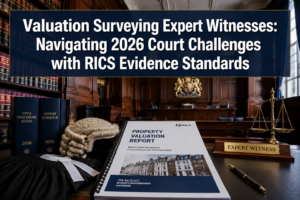

Over 60% of construction disputes that reach formal proceedings in England and Wales involve expert witness testimony from a chartered building surveyor — yet fewer than one in five of those surveyors hold formal accreditation specifically for the expert witness role. That gap matters enormously when courts scrutinise the credibility, impartiality, and methodology behind every report submitted as evidence.
This guide addresses the full picture of Building Surveyors as Expert Witnesses: Evidence Standards for Construction Claims and Dilapidations in 2026, covering how to prepare compliant expert reports for building defects, professional negligence, and dilapidations disputes — all aligned with the latest RICS protocols and illustrated with London-based case examples.
Key Takeaways
- 🏛️ The RICS Accredited Expert Witness Service (EWAS) register was updated in March 2026, establishing formal voluntary standards for chartered surveyors providing expert evidence in civil proceedings. [2]
- 📋 Expert reports must demonstrate impartiality, independence, and freedom from conflicts of interest — not just technical knowledge.
- ⚖️ A January 2026 Supreme Court ruling (Berk v. Choy) has reshaped procedural requirements for construction claims in federal court, with implications for how expert evidence is introduced. [4]
- 🔍 Dilapidations disputes and construction defect claims are the two most common areas where building surveyor expert witnesses are engaged in London proceedings.
- 🤖 New RICS compliance standards now address AI-generated evidence in valuation and building disputes — a critical emerging issue for 2026. [5]
The Role of Building Surveyors as Expert Witnesses: Evidence Standards for Construction Claims and Dilapidations in 2026
What Makes a Building Surveyor an Expert Witness?
An expert witness is fundamentally different from a factual witness. A factual witness reports what they observed. An expert witness is permitted by the court to offer opinion evidence — conclusions drawn from professional knowledge and inspection findings that a layperson could not reasonably reach alone.
For building surveyors, this distinction is critical. When instructed as an expert in a dilapidations dispute or construction defect claim, the surveyor's duty shifts. Their primary obligation runs to the court, not to the instructing party. This principle, established under Civil Procedure Rule 35 (CPR 35) in England and Wales, is non-negotiable.
"The expert's overriding duty is to help the court on matters within their expertise. This duty overrides any obligation to the person from whom the expert has received instructions." — CPR 35.3
Recognised specialisations for surveyor expert witnesses include [1][3]:
| Specialisation | Common Dispute Type |
|---|---|
| Building defects | Construction negligence claims |
| Dilapidations | Lease-end commercial disputes |
| Party wall matters | Neighbour and boundary disputes |
| Valuations | Compulsory purchase, matrimonial |
| Boundary disputes | Title and encroachment claims |
| Construction claims | Contractor/employer disputes |
Understanding what a surveyor does across these roles provides essential context before stepping into the expert witness arena.
The RICS Accredited Expert Witness Service (EWAS) in 2026
In March 2026, the RICS released an updated register of Accredited Expert Witnesses through its Dispute Resolution Service (DRS). [2] The RICS Accredited Expert Witness Service (EWAS) is a voluntary accreditation scheme designed to raise professional standards in a sector that had previously lacked formal regulation.
To be listed on the EWAS register, a surveyor must demonstrate [2]:
- ✅ Genuine impartiality and independence from the instructing parties
- ✅ Freedom from conflicts of interest — both actual and perceived
- ✅ Appropriate specialist experience in their declared practice areas
- ✅ Familiarity with court procedures and CPR 35 obligations
- ✅ Commitment to ongoing professional development in dispute resolution
The RICS Dispute Resolution Service maintains the official register and can nominate accredited expert witnesses for specific cases. Enquiries can be directed to the DRS at 020 7334 3806 or drs@rics.org, with application forms available at www.rics.org/drs. [2]
Accredited experts are listed across England, Wales, Scotland, and Northern Ireland, with international practitioners also available for disputes involving overseas construction matters. [2]
Preparing Expert Reports for Building Defects, Professional Negligence, and Dilapidations
Structure and Content of a Compliant Expert Report
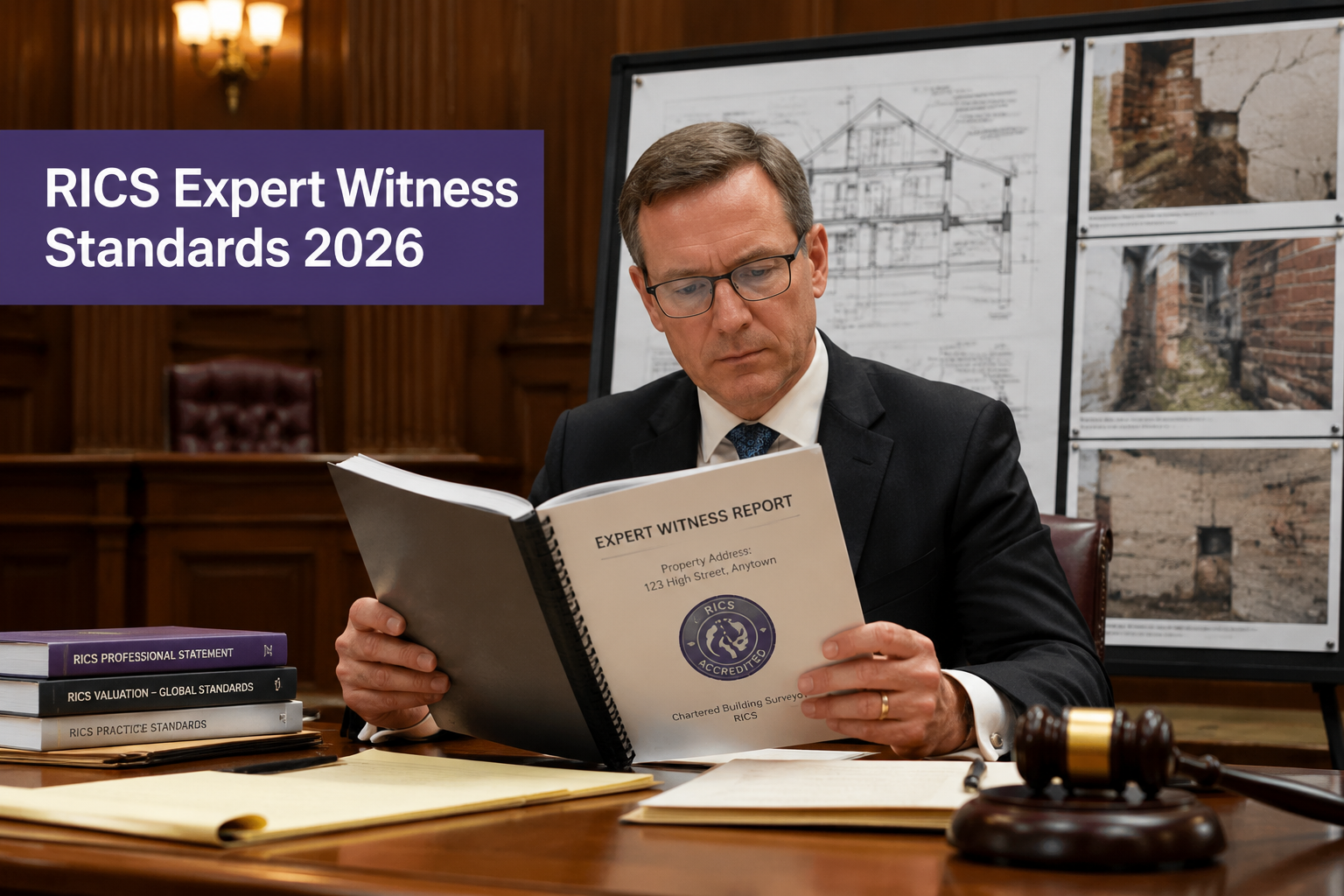
A court-compliant expert report is not simply a detailed survey. It must follow a specific structure that satisfies both CPR 35 requirements and RICS professional standards. Poor structure is one of the most common reasons expert evidence is challenged or given reduced weight.
A compliant expert report typically includes:
- Statement of instructions — who instructed the expert and on what basis
- Summary of qualifications and experience — demonstrating relevant expertise
- Scope of inspection — what was inspected, when, and under what conditions
- Factual findings — objective observations, supported by photographic evidence
- Expert opinion — reasoned conclusions drawn from findings
- Declaration of truth and independence — mandatory under CPR 35.10
- Statement of compliance — confirming awareness of the expert's duty to the court
For dilapidations disputes specifically — common in London's commercial property sector — the report must also address the Scott Schedule, a document that itemises each alleged breach of covenant with the landlord's claim, the tenant's response, and the expert's independent assessment of each item.
A specific defect survey conducted as part of pre-litigation evidence gathering can form the factual backbone of a subsequent expert report, provided it was carried out with appropriate rigour and documentation.
London Case Examples: Valuation Integration in Expert Reports
Example 1 — Commercial Dilapidations, Central London (2025)
A landlord of a Knightsbridge office building pursued a dilapidations claim against a departing tenant following a 10-year lease. The tenant's surveyor argued that the "supersession" principle applied — that planned redevelopment of the property meant the landlord suffered no financial loss from the alleged disrepair. The landlord's expert witness, an RICS-accredited building surveyor, produced a report integrating RICS property valuation methodology to demonstrate that the disrepair genuinely diminished the property's market value prior to redevelopment. The court accepted the landlord's expert evidence, awarding damages that reflected both reinstatement costs and diminution in value.
Example 2 — Construction Defects, South London (2024)
A residential developer in Wandsworth faced a professional negligence claim from a buyer who alleged structural defects were present at handover. The buyer's expert witness — a chartered building surveyor — produced a report referencing a stock condition survey methodology to systematically catalogue defects across 47 individual items. The structured approach, aligned with RICS guidance, gave the report credibility under cross-examination. The case settled favourably for the buyer before trial.
These examples illustrate a consistent theme: valuation integration is not optional in dilapidations and construction claims. Expert reports that address only physical condition — without engaging with financial impact — are routinely criticised as incomplete.
The AI-Generated Evidence Challenge in 2026
A significant new development for building surveyor expert witnesses in 2026 is the emergence of AI-generated evidence in valuation and building disputes. [5] RICS has established new compliance standards specifically addressing how AI-generated analysis should be disclosed, verified, and challenged in expert proceedings.
Key obligations for surveyors using AI tools in expert work include:
- Full disclosure of any AI tools used in analysis or report drafting
- Verification of AI outputs against primary inspection data
- Explanation of how AI-generated conclusions were tested for reliability
- Awareness that opposing counsel may challenge AI-generated comparables or defect assessments
This is not a theoretical concern. Courts have already seen challenges to AI-assisted valuation reports in 2025 proceedings, and the trend is accelerating. Surveyors who cannot explain their methodology — including any technology used — risk having their evidence given reduced weight or excluded entirely.
Evidence Standards, Procedural Updates, and Dilapidations in 2026
The January 2026 Supreme Court Ruling: What UK Surveyors Need to Know
While primarily a US decision, the January 2026 Supreme Court ruling in Berk v. Choy carries instructive lessons for construction dispute practitioners internationally. [4] The court ruled that state-law certificate-of-merit requirements do not apply in federal court — meaning plaintiffs in federal construction disputes no longer need to submit preliminary expert affidavits identifying alleged negligent acts before proceedings commence. [4]
The practical effect is significant: the upfront procedural burden on claimants has been substantially reduced, making it easier to initiate construction negligence claims without first securing a preliminary expert opinion. [4]
For UK practitioners, the parallel is worth noting. English courts already operate without equivalent certificate-of-merit requirements, but the ruling reinforces a broader international trend: courts are prioritising substantive expert evidence over procedural gatekeeping. The quality of the expert report at trial matters more than ever.
Dilapidations: Evidence Standards That Courts Expect
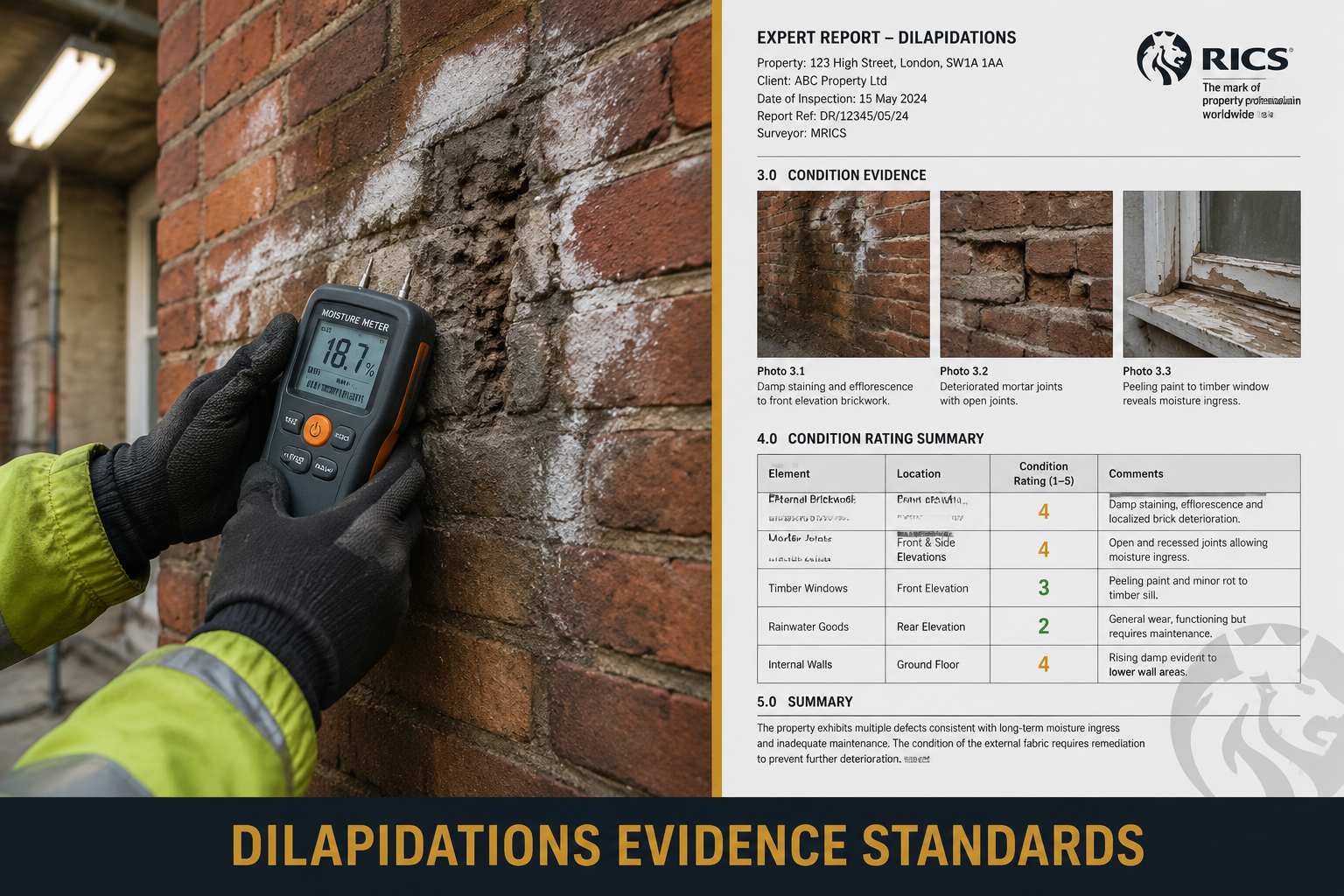
Dilapidations disputes are among the most document-intensive proceedings in property law. The evidence standards expected of a building surveyor expert witness in 2026 are demanding. Courts expect [1][3]:
📸 Photographic Evidence
- Dated, geo-tagged photographs of every alleged breach
- Before-and-after comparisons where available
- Photographs that correspond precisely to Scott Schedule items
📐 Measurement and Testing Data
- Moisture readings with calibrated instrument records
- Structural deflection measurements where relevant
- Thermal imaging data for insulation and damp-related claims
💰 Cost Evidence
- Independently obtained contractor quotes (minimum two)
- Reference to published cost data (e.g., BCIS rates)
- Clear distinction between repair costs and betterment
📄 Lease Analysis
- Precise identification of the repairing covenant
- Assessment of the standard of repair required (not necessarily "as new")
- Application of the Proudfoot v Hart standard where relevant
For surveyors working across London's commercial property market — from Chelsea to Southwark — understanding local market conditions is also essential. A dilapidations claim in a prime West End office will be assessed against very different market benchmarks than one in a secondary industrial estate.
Party Wall Disputes and Expert Evidence
Party wall matters represent another significant area where building surveyor expert witnesses are regularly engaged. The Party Wall Act 1996 creates a statutory dispute resolution framework, but complex cases — particularly those involving alleged damage to adjoining properties during construction — frequently escalate to court proceedings requiring full expert evidence. Understanding party wall surveyor responsibilities is foundational knowledge for any expert operating in this space.
Expert reports in party wall damage claims must establish:
- The condition of the adjoining property before works (typically via a schedule of condition)
- The causal link between the notifiable works and the alleged damage
- The reasonable cost of reinstatement
Without a pre-works schedule of condition, establishing causation becomes significantly harder — a point that experts are frequently asked to address in their reports.
Professional Negligence Claims Against Surveyors
Building surveyors are not only expert witnesses in others' disputes — they are sometimes the subject of professional negligence claims themselves. When a surveyor's advice or report is alleged to have fallen below the standard of a reasonably competent practitioner, a separate expert surveyor is typically appointed to assess whether the defendant's conduct met professional standards.
The test applied is the Bolam standard (as modified by Bolitho): did the defendant surveyor act in accordance with a practice accepted as proper by a responsible body of surveyors? Expert witnesses in these cases must be particularly careful to distinguish between errors of judgment (not necessarily negligent) and departures from accepted professional practice (potentially negligent).
Common grounds for professional negligence claims against surveyors include [6]:
- Failure to identify significant structural defects during a pre-purchase survey
- Inaccurate valuation leading to financial loss
- Incorrect advice on planning or building regulations compliance
- Failure to advise on the implications of a repairing covenant
For buyers who relied on survey advice that proved inadequate, understanding common myths about property surveys can help clarify what a surveyor was and was not obligated to identify.

Practical Steps for Building Surveyors Preparing Expert Evidence in 2026
Before Accepting Instructions
Before agreeing to act as an expert witness, a building surveyor should carry out a rigorous conflict of interest check. This includes reviewing:
- Any prior involvement with the property or parties
- Any financial interest in the outcome
- Any professional relationship with instructing solicitors that could compromise independence
The RICS EWAS accreditation process formalises this check, but even non-accredited surveyors must apply the same standard of scrutiny. [2]
During the Inspection
Evidence gathered during the inspection forms the irreplaceable factual foundation of the expert report. Best practice in 2026 includes:
- Using calibrated, regularly serviced equipment with documented calibration records
- Maintaining a contemporaneous inspection log with timestamps
- Taking systematic photographs using a consistent naming convention
- Noting access limitations that affected the scope of inspection
- Requesting relevant documents and records from both parties before inspection
At the Report-Writing Stage
The report must be written in plain, accessible language. Courts — and often the parties themselves — are not technical specialists. Jargon should be explained. Conclusions should be clearly stated, not buried in technical narrative.
A useful discipline: after drafting, ask whether a non-specialist reader could understand both the findings and the reasoning. If not, revise.
At the Joint Statement Stage
Courts frequently direct opposing experts to meet and produce a joint statement identifying areas of agreement and disagreement. This is not an opportunity to negotiate positions — it is a structured process for narrowing the issues before trial.
Surveyors who treat the joint statement as adversarial — refusing to concede obvious points of agreement — damage their credibility with the court. Genuine concessions, clearly explained, strengthen rather than weaken an expert's overall evidence.
Conclusion: Actionable Next Steps for Building Surveyor Expert Witnesses
The landscape for Building Surveyors as Expert Witnesses: Evidence Standards for Construction Claims and Dilapidations in 2026 has never been more demanding — or more consequential. The March 2026 RICS EWAS register update, new AI evidence standards, and evolving procedural developments internationally all point in the same direction: courts expect more rigour, more transparency, and more demonstrable independence from expert witnesses than ever before.
Actionable next steps for building surveyors:
- Seek RICS EWAS accreditation — voluntary but increasingly expected by instructing solicitors and courts alike. Contact the RICS DRS at 020 7334 3806 or drs@rics.org. [2]
- Review your AI tool usage — ensure any AI-assisted analysis is fully disclosed and verifiable in expert reports. [5]
- Audit your conflict-of-interest procedures — a robust written process protects both the expert and the instructing party.
- Invest in CPD on CPR 35 compliance — procedural knowledge is as important as technical expertise.
- Build your evidence toolkit — calibrated equipment, systematic inspection protocols, and document management systems are non-negotiable.
- Engage early with the Scott Schedule process in dilapidations cases — structured engagement from the outset produces better outcomes for all parties.
Whether operating in Knightsbridge, Wandsworth, or Islington, the building surveyor who combines deep technical knowledge with rigorous procedural compliance will be the expert witness courts trust — and the one whose evidence shapes outcomes.
References
[1] Surveyors Acting As Expert Witnesses – https://www.rics.org/profession-standards/rics-standards-and-guidance/sector-standards/dispute-resolution-standards/surveyors-acting-as-expert-witnesses
[2] RICS Register of Accredited Expert Witnesses March 2026 – https://www.rics.org/content/dam/ricsglobal/documents/surveying/RICS-Register-of-Accredited-Expert-Witnesses_March-2026.pdf
[3] Expert Witness – https://surveying.grumittwademason.com/expert-witness/
[4] High Court Ruling Could Block Expert 4378849 – https://www.jdsupra.com/legalnews/high-court-ruling-could-block-expert-4378849/
[5] Building Surveyor Skills Shortage 2026 Strategies For Firms To Attract Talent Amid Infrastructure Booms And Regulatory Pressures – https://nottinghillsurveyors.com/blog/building-surveyor-skills-shortage-2026-strategies-for-firms-to-attract-talent-amid-infrastructure-booms-and-regulatory-pressures
[6] Building Laws Codes Expert Witness – https://seakexperts.com/keywords/building-laws-codes-expert-witness