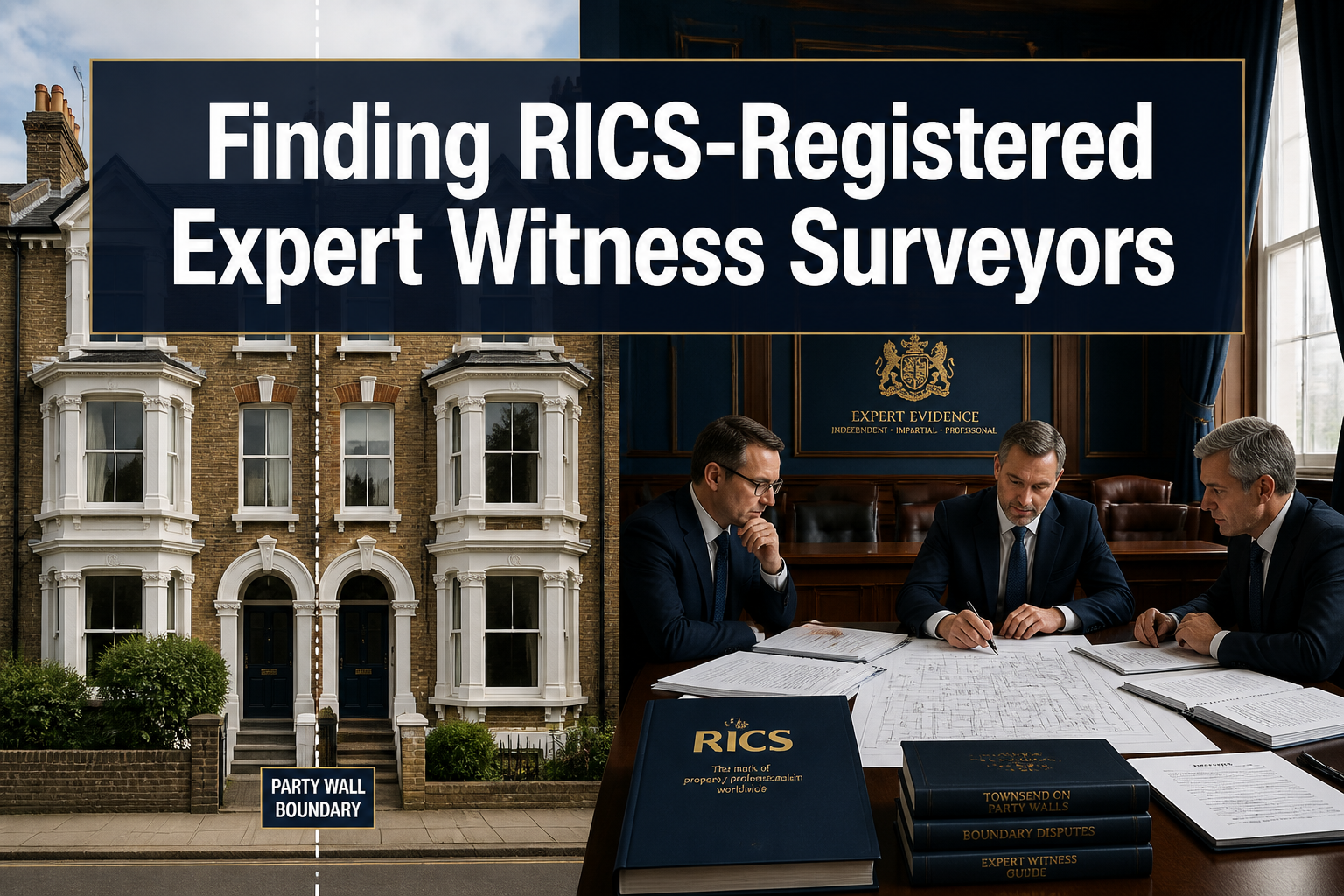
Only 30% of party wall and dilapidations disputes that reach formal proceedings do so with a properly accredited expert witness in place — a gap that costs property owners, landlords, and tenants thousands of pounds in avoidable delays and weakened legal arguments. Choosing the right expert is not a formality; it is a strategic decision that can determine the outcome of a case. This guide on finding RICS-registered expert witness surveyors: essential criteria for party wall and dilapidations disputes is designed to help clients, solicitors, and property professionals make that decision with confidence.

Key Takeaways 📌
- RICS accreditation is the gold standard for expert witnesses in UK property disputes — but it is voluntary, so always verify status directly.
- The RICS Register of Accredited Expert Witnesses (updated March 2026) is the primary directory for finding qualified specialists in party walls and dilapidations.
- Due diligence goes beyond the register — always request a CV, references, and availability confirmation before instructing an expert.
- RICS Dispute Resolution Services (DRS) can nominate an expert witness if parties cannot agree on a joint appointment.
- Specialists in building surveying, dilapidations, and construction disputes are the most relevant RICS pathways for these case types.
Why Expert Witness Quality Matters in Property Disputes
Property disputes — whether they involve a party wall agreement or a commercial dilapidations claim — often hinge on technical evidence. Courts and tribunals rely on expert witnesses to translate complex surveying findings into clear, impartial opinions that assist the decision-maker. A poorly chosen expert can undermine an otherwise strong case.
💬 "The duty of an expert witness is to the court, not to the party who instructs them." — Civil Procedure Rules, Part 35
This principle of impartiality is non-negotiable. An expert who appears partisan, lacks relevant experience, or cannot withstand cross-examination will do more harm than good. That is why the process of finding RICS-registered expert witness surveyors with the right credentials for party wall and dilapidations disputes deserves careful, structured attention.
The Two Core Dispute Types: A Quick Overview
| Dispute Type | Governing Framework | Typical Issues |
|---|---|---|
| Party Wall | Party Wall etc. Act 1996 | Structural damage, boundary encroachment, construction noise |
| Dilapidations | Common law / lease covenants | Repair obligations, reinstatement, terminal schedules |
Understanding which category a dispute falls into shapes the type of expert required. A dilapidations survey demands expertise in lease interpretation and schedule of condition analysis, while a party wall matter calls for deep knowledge of the 1996 Act's procedural requirements and structural engineering principles.
Understanding the RICS Accreditation Framework for Expert Witnesses
What Is the RICS Expert Witness Accreditation Service (EWAS)?
The RICS Expert Witness Accreditation Service (EWAS) is a voluntary accreditation scheme that sets professional standards for chartered surveyors who act as expert witnesses in legal proceedings [5]. Membership signals that an individual has demonstrated specialist knowledge, practical experience, and a commitment to providing impartial, independent evidence.
Importantly, RICS itself makes no warranty about the professional competence of those on the register beyond confirming they have achieved accredited status [5]. This means the register is a starting point — not a guarantee.
How Does a Surveyor Achieve RICS Expert Witness Accreditation?
To gain accreditation, a surveyor must [5]:
- ✅ Successfully complete four training modules covering expert witness duties, report writing, court procedure, and ethics
- ✅ Pass an ethics test
- ✅ Undergo a formal interview with RICS assessors
- ✅ Alternatively, apply from the previous RICS Expert Register and complete a reassessment interview
This structured pathway ensures that accredited experts understand their overriding duty to the court — a duty that supersedes any obligation to the instructing party.
What Specialisms Are Covered?
The RICS register covers a broad range of property specialisms, including [3]:
- 🏗️ Building surveying
- 💼 Commercial property
- 🏚️ Dilapidations
- 🏛️ Compulsory purchase
- 📐 Planning and development
- 💰 Valuation
- 🧱 Construction disputes
For party wall and dilapidations matters specifically, the most relevant pathways are building surveying and dilapidations, with construction disputes expertise often valuable in complex structural cases.
The March 2026 Register Update
The RICS Register of Accredited Expert Witnesses was last updated in March 2026, providing the current list of qualified experts across all specialisations [5]. In parallel, RICS launched a consultation on the draft 8th edition of Party Wall Legislation and Procedure in April and May 2026, inviting feedback from surveyors, legal professionals, and dispute resolution practitioners across England and Wales [2]. This signals an evolving regulatory landscape — making it even more important to select an expert who stays current with RICS guidance.
Essential Criteria for Finding RICS-Registered Expert Witness Surveyors in Party Wall and Dilapidations Disputes
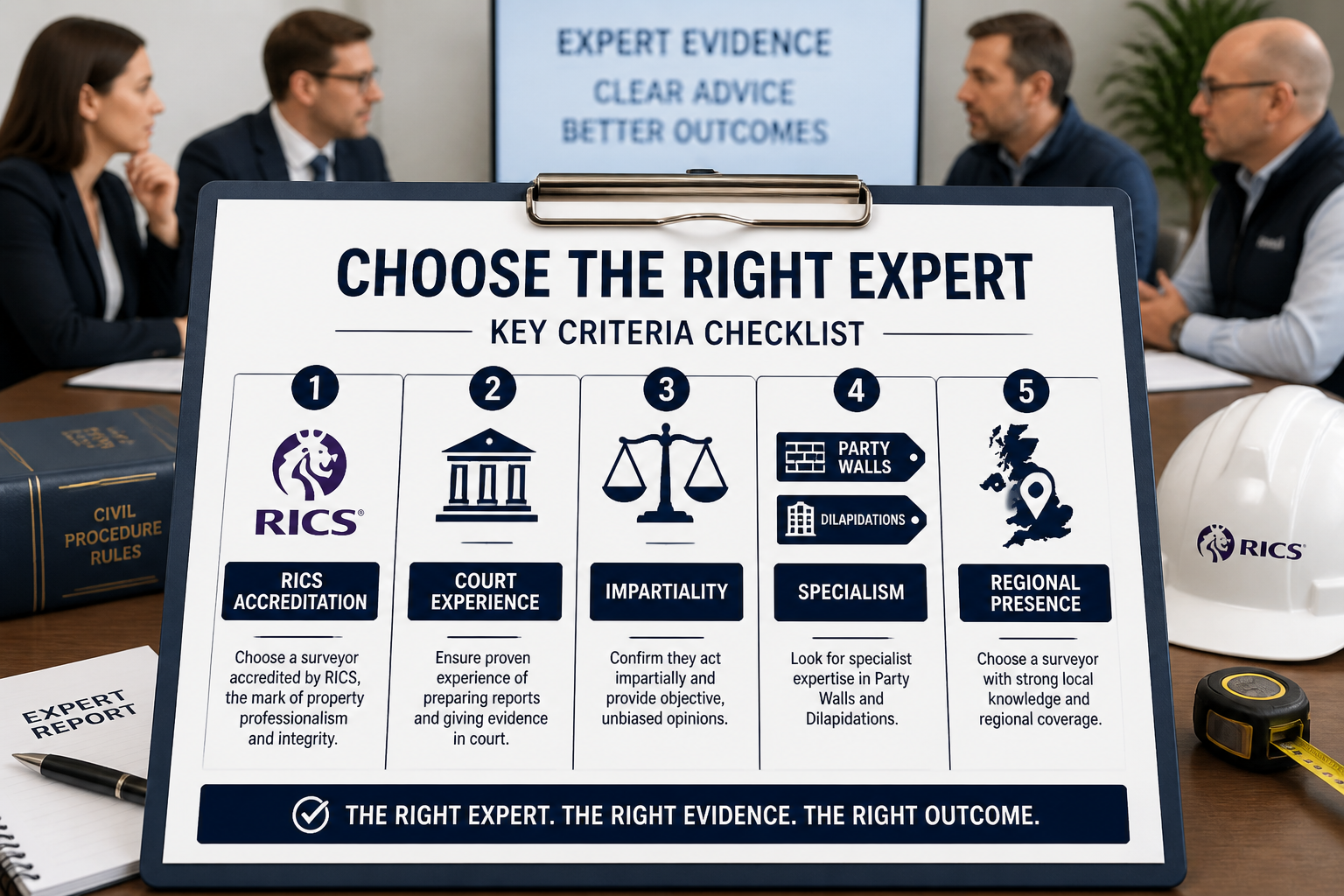
The process of finding RICS-registered expert witness surveyors for party wall and dilapidations disputes involves more than searching a directory. The following criteria provide a structured framework for evaluation.
1. 🔍 Verified RICS Registration and Accreditation
The first step is confirming that any candidate appears on the current RICS Register of Accredited Expert Witnesses [5]. This can be done via:
- The RICS Find a Surveyor portal at ricsfirms.com [3]
- The RICS Register of Accredited Expert Witnesses (PDF, updated March 2026) [5]
- The UK Register of Expert Witnesses, which maintains a dedicated list of experts claiming party wall expertise [4]
Always cross-reference against the RICS member database to confirm the individual holds a current MRICS or FRICS designation. Lapsed membership is a red flag.
2. 🏛️ Demonstrated Court and Tribunal Experience
RICS accreditation confirms training — it does not guarantee courtroom experience. Ask candidates directly:
- How many times have they given oral evidence in court or tribunal?
- Have they been subject to cross-examination in a contested hearing?
- Do they have experience with single joint expert (SJE) appointments?
For legal disputes involving party walls or dilapidations, an expert who has only ever produced written reports without defending them under cross-examination carries significant risk.
3. 🧱 Specialism in Party Walls or Dilapidations
General building surveying experience is not sufficient. The expert should demonstrate:
- Party wall cases: Familiarity with the Party Wall etc. Act 1996, experience producing party wall awards, and knowledge of structural damage assessment methodology. Understanding party wall surveyor responsibilities is foundational.
- Dilapidations cases: Experience preparing or responding to schedules of dilapidations, knowledge of the Dilapidations Protocol, and familiarity with diminution in value arguments.
4. ⚖️ Impartiality and Absence of Conflict of Interest
RICS Dispute Resolution Services, when nominating an expert, ensures the individual is impartial, free from conflict of interest, and available [5]. Parties conducting their own search must apply the same standard.
Ask the candidate to confirm in writing:
- No prior relationship with either party or their legal representatives
- No financial interest in the outcome
- Willingness to act as a single joint expert if required by the court
5. 📋 Quality of Written Reports
Request a sample redacted report from a previous matter. Assess it for:
- Clear, jargon-free language accessible to a non-specialist judge
- A logical structure following CPR Part 35 requirements
- A signed statement of truth
- Transparent methodology and reasoning
Poor report quality is one of the most common reasons expert evidence is given reduced weight by courts.
6. 📍 Regional Knowledge and Availability
For disputes involving specific London boroughs or regional markets, local expertise matters. A surveyor with direct knowledge of Southwark property or Islington property will understand local construction methods, planning constraints, and comparable evidence more readily than a generalist based elsewhere.
Confirm the expert's availability for key hearing dates before instruction — RICS itself flags availability as a due diligence requirement [5].
How to Use RICS Directories and Registers Effectively
Step-by-Step Search Process
Step 1: Visit ricsfirms.com and select "Expert Witness" under the legal issues category [3].
Step 2: Filter by specialism — select "Dilapidations" or "Building Surveying" depending on the dispute type.
Step 3: Cross-reference candidates against the RICS Register of Accredited Expert Witnesses (March 2026 edition) [5].
Step 4: Check the UK Register of Expert Witnesses for party wall-specific listings [4].
Step 5: Contact shortlisted candidates to request a CV, references, and a sample report.
Step 6: Conduct a brief scoping call to assess communication style and technical depth.
When to Use RICS Dispute Resolution Services (DRS)
If parties cannot agree on a jointly appointed expert, RICS Dispute Resolution Services can nominate a suitable expert witness [5]. This route is particularly useful when:
- One party suspects the other of selecting a partisan expert
- The matter involves a highly technical specialism with few available experts
- The court has directed a single joint expert appointment
To request a RICS President nomination, contact RICS Dispute Resolution Services directly:
- 📞 Telephone: 020 7334 3806
- 📧 Email: drs@rics.org
- 🌐 Application form: www.rics.org/drs [5]
Due Diligence Checklist Before Instructing an Expert
RICS explicitly advises that parties using the register must conduct further enquiries regarding expert suitability [5]. The following checklist consolidates best practice:
| Due Diligence Item | Why It Matters |
|---|---|
| Confirm current RICS membership | Lapsed members should not be instructed |
| Obtain current CV | Verify specialism and case history |
| Request references from solicitors | Confirms courtroom performance |
| Review a sample report | Assesses writing quality and CPR compliance |
| Confirm availability for hearing dates | Prevents costly delays |
| Check for conflicts of interest | Protects impartiality |
| Clarify fee structure | Avoids disputes over costs |
💡 Pro tip: The average cost of a boundary dispute can escalate dramatically when expert evidence is challenged or excluded. Investing time in proper selection upfront is always cost-effective.
Common Mistakes When Selecting Expert Witnesses
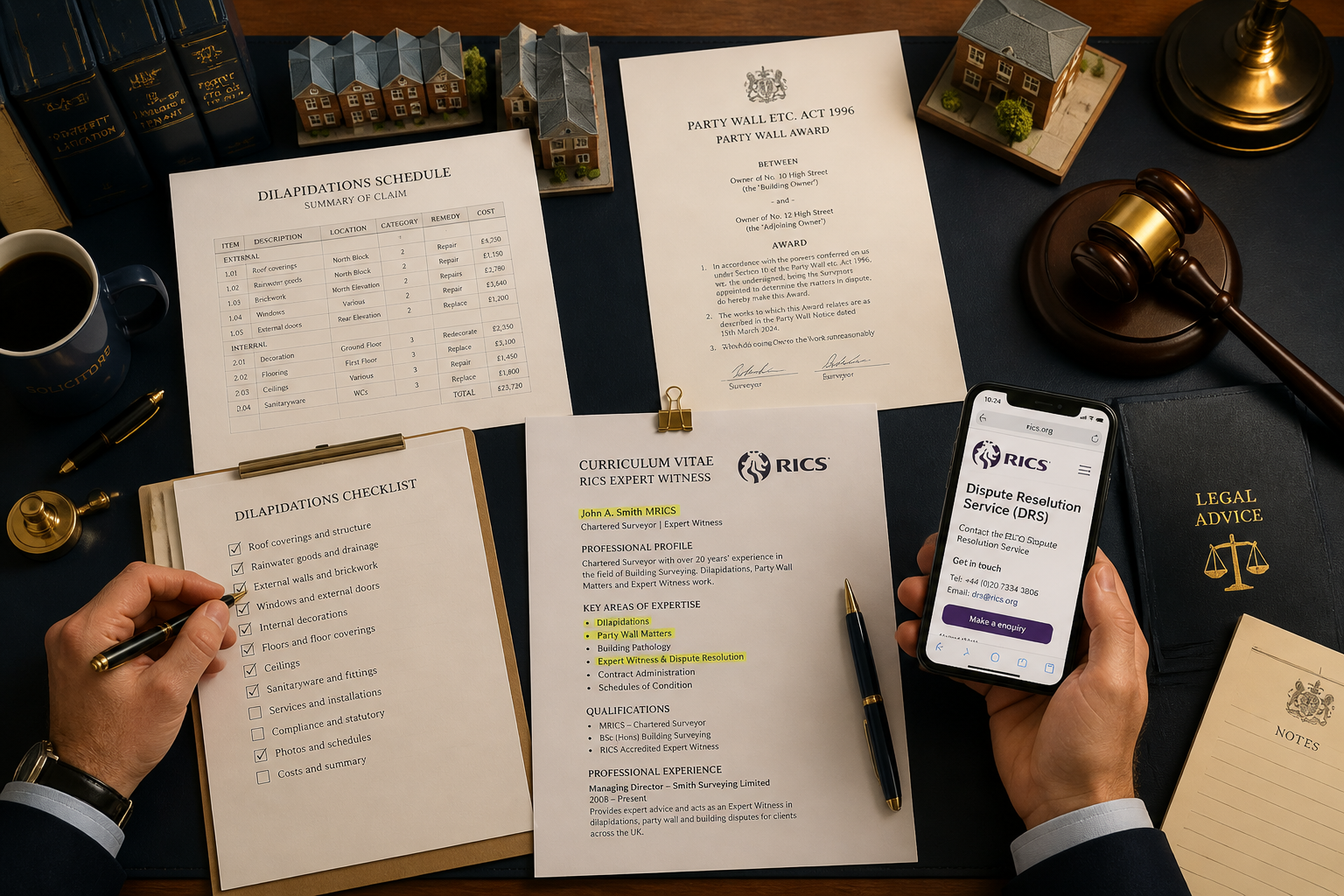
Even experienced solicitors and property managers make avoidable errors in this process. The most frequent mistakes include:
❌ Relying Solely on the Register
The RICS register confirms accreditation — nothing more. RICS itself disclaims responsibility for professional competence beyond that threshold [5]. Always conduct independent due diligence.
❌ Selecting on Price Alone
Expert witness fees in complex party wall or dilapidations matters are a fraction of potential litigation costs. Selecting the cheapest available expert without assessing quality is a false economy. Understanding party wall surveyor costs in context helps frame expert fees appropriately.
❌ Ignoring Specialism Depth
A surveyor with broad building experience but no specific dilapidations casework will struggle to withstand cross-examination on lease interpretation, the Dilapidations Protocol, or diminution in value principles. Specialism depth matters enormously.
❌ Failing to Brief the Expert Properly
An expert witness can only produce useful evidence if they are given complete, accurate, and timely information. Late disclosure of documents or incomplete instructions is a common cause of inadequate reports.
❌ Overlooking the Duty to the Court
Clients sometimes instruct experts expecting advocacy. An RICS-accredited expert witness is obligated to provide objective, impartial opinion — even if it is unfavourable to the instructing party. Misunderstanding this duty creates conflict and can damage a case.
Practical Considerations for Solicitors and Property Managers
For legal professionals handling party wall notices or commercial lease disputes, the following practical points are worth noting:
- Early instruction matters. Expert witnesses should ideally be involved from the pre-action stage to shape the evidence strategy.
- Joint instruction saves costs. Where possible, a single joint expert appointment under CPR Part 35 reduces overall litigation costs and is viewed favourably by courts.
- Keep experts updated. Any new evidence, survey findings, or legal developments should be shared promptly to allow the expert to revise their opinion if necessary.
- Understand the 2026 regulatory context. The ongoing RICS consultation on the 8th edition of Party Wall Legislation and Procedure [2] may introduce updated guidance that affects how party wall disputes are assessed and reported. Instructing an expert who is engaged with this process is a meaningful advantage.
Conclusion: Making the Right Choice in 2026
Finding RICS-registered expert witness surveyors with the right essential criteria for party wall and dilapidations disputes is a process that rewards careful, structured effort. The RICS Register of Accredited Expert Witnesses, updated in March 2026, provides a credible starting point — but it is only that [5]. The burden of verifying specialism, impartiality, court experience, and availability rests firmly with the instructing party.
Actionable Next Steps ✅
- Search the RICS Find a Surveyor portal at ricsfirms.com and filter for expert witnesses in building surveying or dilapidations [3].
- Cross-reference the March 2026 RICS Register to confirm accredited status [5].
- Check the UK Register of Expert Witnesses for party wall-specific specialists [4].
- Request CVs, references, and sample reports from at least two to three shortlisted candidates.
- Contact RICS DRS at 020 7334 3806 or drs@rics.org if a neutral nomination is needed [5].
- Brief your chosen expert early and maintain open communication throughout proceedings.
The right expert witness does not just support a case — they can define its outcome. In a landscape where RICS guidance is actively evolving and courts are increasingly scrutinising the quality of expert evidence, there is no substitute for getting this decision right.
References
[1] Expert Witness – https://www.dilapsolutions.com/services/expert-witness/
[2] Rics Launches Consultation On Updated Party Wall Practice Guidance – https://www.rics.org/news-insights/rics-launches-consultation-on-updated-party-wall-practice-guidance
[3] Expert Witness – https://www.ricsfirms.com/residential/legal-issues/expert-witness/
[4] Party Walls – https://www.jspubs.com/expert-witness/si/p/party-walls/
[5] Rics Register Of Accredited Expert Witnesses March 2026 – https://www.rics.org/content/dam/ricsglobal/documents/surveying/RICS-Register-of-Accredited-Expert-Witnesses_March-2026.pdf
[6] Expert Witness Preparation For 2026 Rental Regulation Disputes Surveyor Evidence Amid Stricter Landlord Compliance – https://nottinghillsurveyors.com/blog/expert-witness-preparation-for-2026-rental-regulation-disputes-surveyor-evidence-amid-stricter-landlord-compliance