Fewer than 15% of qualified surveyors in the UK actively market themselves as expert witnesses — yet demand from solicitors, barristers, and courts for credible, specialist surveying testimony has never been higher. The gap between supply and demand creates a significant professional opportunity, but only for those who understand how to position their expertise clearly and credibly.
This guide to Expert Witness Surveyor Specializations in 2026: Building Your Practice Across Land, Property, and Construction Disputes breaks down the core specializations, the skills courts expect, and the practical steps needed to build a sustainable expert witness practice.
Key Takeaways 📌
- Expert witness surveying spans multiple distinct specializations — boundary disputes, construction defects, dilapidations, valuation, and compulsory purchase — each requiring different technical depth.
- RICS provides formal professional standards that govern how surveyors must present evidence in civil proceedings. [6]
- Forensic surveyors must translate highly technical findings into clear, accessible language for judges and juries. [1]
- The 2026 ALTA/NSPS Land Title Survey Guideline updates directly affect how commercial property surveys are prepared and used as evidence. [8]
- Building a credible expert witness profile requires deliberate positioning, CPD, and a clear understanding of what legal professionals need from a surveying expert.
Understanding the Expert Witness Surveyor Role in 2026
The term "expert witness surveyor" covers a broad church. A boundary dispute in a residential street in South London requires very different expertise from a multi-million-pound construction defect claim on a commercial development. Yet many surveyors present themselves as generalists, which weakens their appeal to legal professionals who need a clearly defined specialist.
"Courts do not want a surveyor who knows a little about everything. They want the surveyor who knows more about one thing than anyone else in the room."
What Courts Actually Need
Legal professionals — solicitors, barristers, and judges — look for expert witnesses who can:
- Provide impartial, evidence-based opinions within a clearly defined area of expertise
- Communicate technical findings in plain language accessible to non-specialists [1]
- Comply with Civil Procedure Rules (CPR Part 35) and RICS professional standards [6]
- Withstand robust cross-examination without undermining their credibility
The RICS Professional Standard Surveyors Acting as Expert Witnesses sets out the formal framework for this work, covering the duty to the court, the content of expert reports, and the conduct expected during proceedings [6].
The Professional Standards Framework
RICS-regulated surveyors acting as expert witnesses operate within a dual obligation: their duty to their client, and their overriding duty to the court. These duties can conflict, and understanding how to navigate that tension is foundational to expert witness practice.
Key compliance requirements include:
| Requirement | Detail |
|---|---|
| RICS Expert Witness Standard | Mandatory for RICS members acting in this capacity |
| CPR Part 35 | Governs expert evidence in English civil courts |
| Single Joint Expert (SJE) Rules | Applies when courts appoint one expert for both parties |
| Conflicts of Interest Declaration | Must be disclosed at instruction stage |
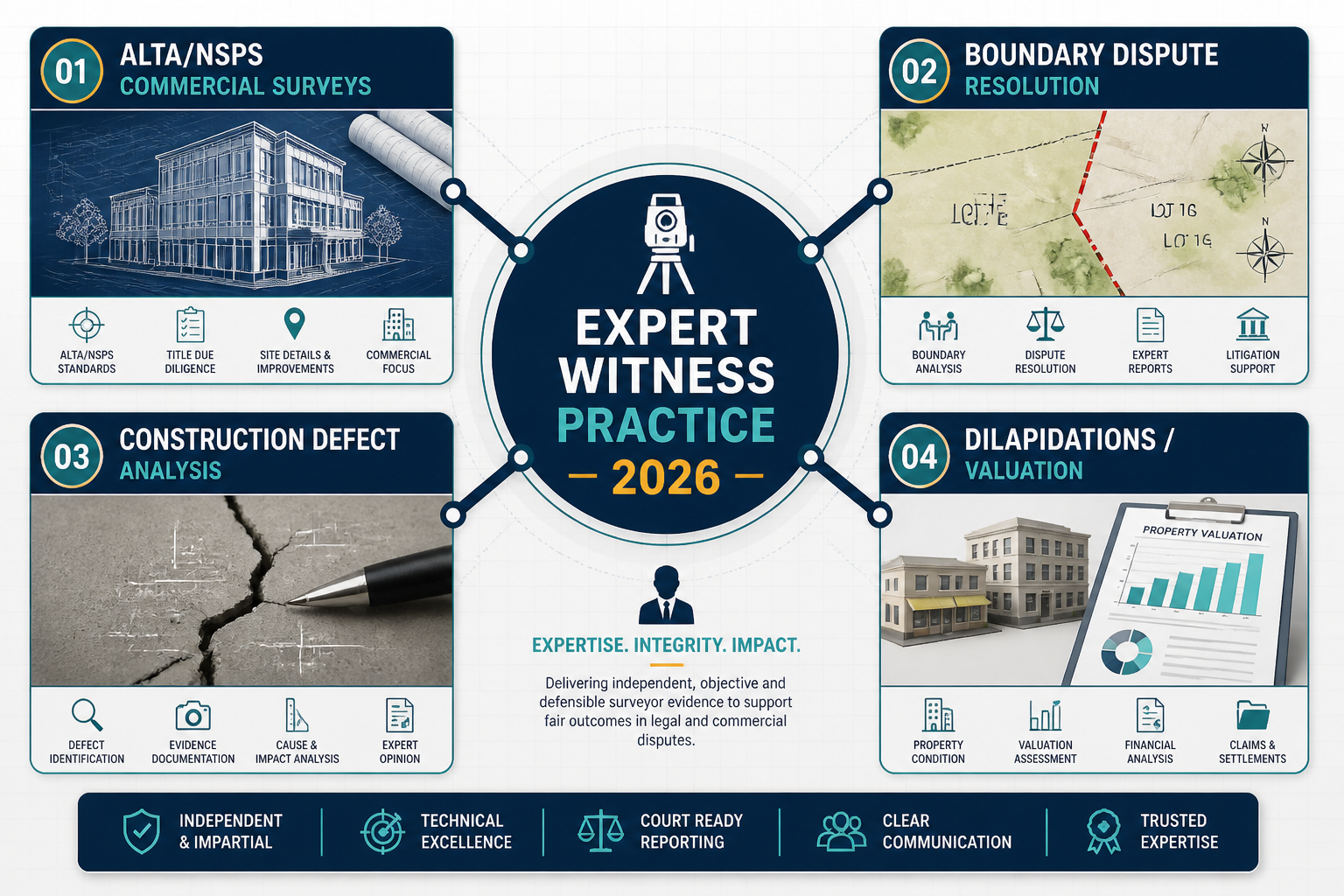
Core Expert Witness Surveyor Specializations in 2026: Building Your Practice Across Land, Property, and Construction Disputes
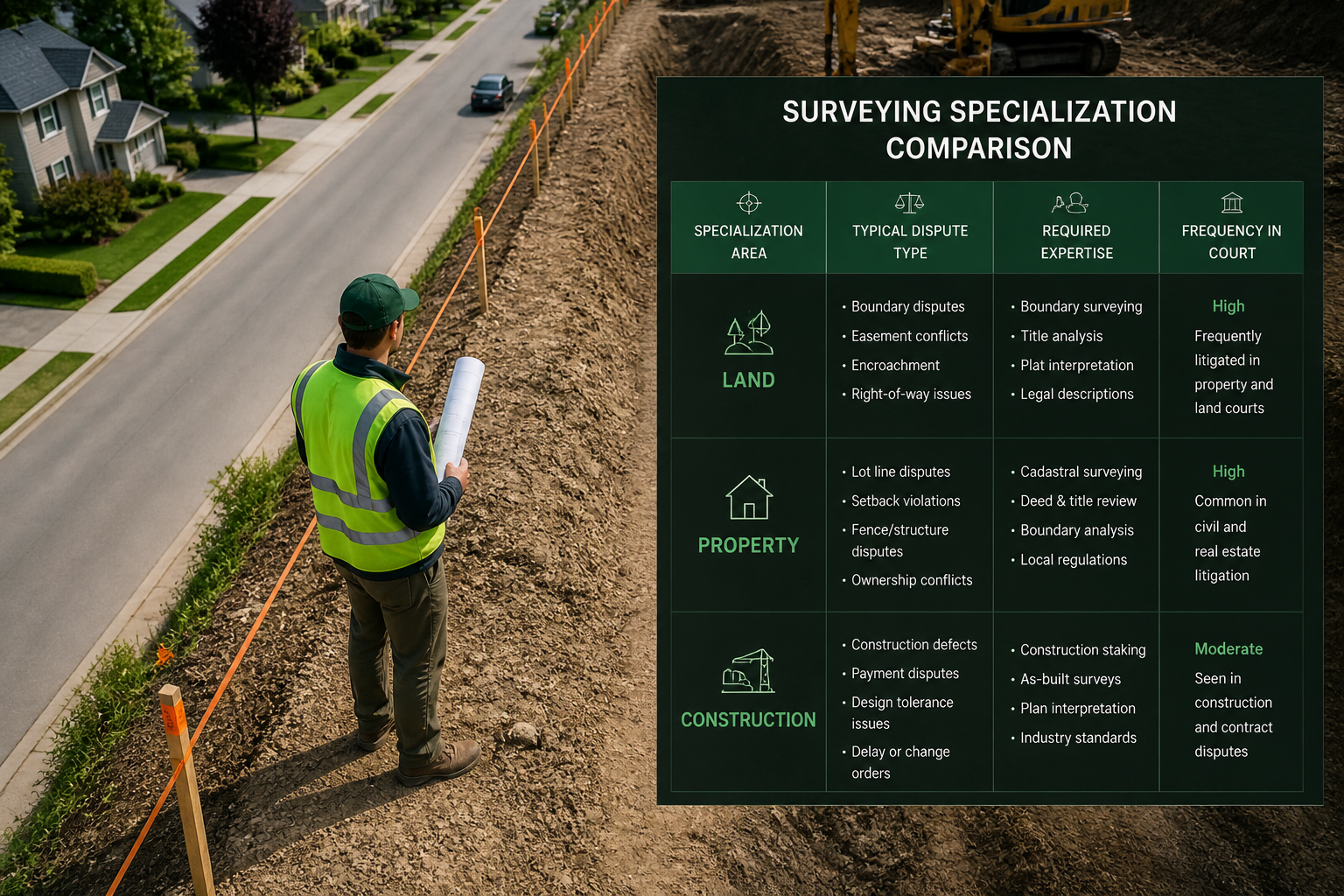
1. 🗺️ Boundary Disputes and Land Surveying
Boundary disputes represent one of the most common areas where surveying expert witnesses are instructed. These cases typically involve:
- Disputed boundary lines between neighbouring properties
- Encroachment claims where a structure crosses a legal boundary
- Easement and right-of-way conflicts
- Title and deed interpretation issues [3]
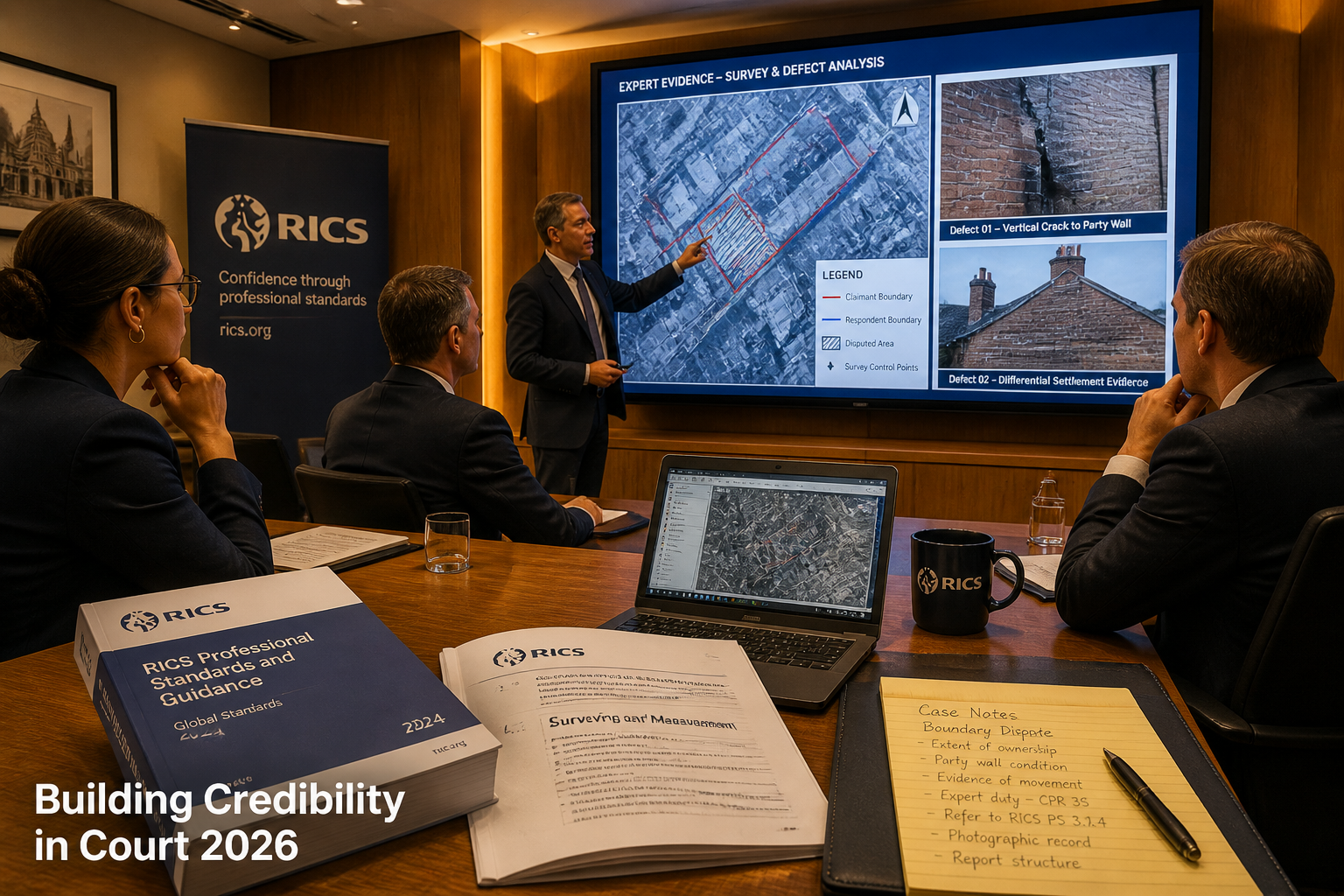
Expert witnesses in this area must demonstrate mastery of historical title documents, Ordnance Survey mapping, Land Registry records, and physical survey evidence. Understanding how boundary dispute resolution works in practice — including the costs and procedural steps involved — is essential background knowledge.
The average cost of a boundary dispute can run into tens of thousands of pounds, which means the stakes for both parties are high and the quality of expert evidence is scrutinised closely.
A related and frequently litigated area involves party wall disputes. Surveyors with deep knowledge of the Party Wall Act 1996 are well-placed to act as expert witnesses in cases involving structural damage, failure to serve notices, or disputes over awards. Questions such as how close a neighbour can build to a fence frequently escalate into formal disputes requiring expert evidence.
2. 🏗️ Construction Defects and Building Surveys
Construction defect litigation is a growth area. Claims involving structural failures, water ingress, defective workmanship, and non-compliant building work all require surveyors who can:
- Identify and document defects with forensic precision
- Distinguish between defects caused by design, workmanship, or materials
- Quantify remediation costs accurately
- Assess compliance with building regulations and industry standards [3]
A thorough RICS building survey forms the foundation of many construction defect expert reports. Surveyors who regularly carry out specific defect surveys are particularly well-equipped for this type of expert witness work, as they are already practised in isolating, diagnosing, and reporting individual building failures.
Common construction dispute categories include:
- Structural movement and subsidence — including cracking in walls
- Damp and moisture ingress — a technically complex area requiring specialist knowledge building condition assessment
- Roof failures and weatherproofing defects
- Non-compliant extensions and alterations
3. 🏢 Commercial Property: ALTA/NSPS Surveys and Title Disputes
For surveyors working in commercial property, the ALTA/NSPS Land Title Survey is the gold standard for documenting boundary, easement, and encroachment issues on commercial sites. In 2026, updated ALTA/NSPS guidelines have introduced changes that directly affect how these surveys are prepared and how they hold up as evidence in commercial property litigation [8].
Expert witnesses instructed in commercial property disputes must understand:
- How ALTA/NSPS surveys document title exceptions
- The significance of Schedule B-II exceptions in title insurance
- How survey discrepancies affect property transactions and trigger litigation
This specialization is particularly relevant in high-value urban markets. Surveyors covering areas such as Kensington, Marylebone, and Camden frequently encounter complex commercial property disputes where specialist expert evidence is essential.
4. 💷 Dilapidations and Lease-End Disputes
Dilapidations claims — where landlords seek compensation from tenants for failure to maintain or repair a property at lease end — represent a significant and often underserved niche for expert witness surveyors.
Key technical requirements include:
- Schedule of dilapidations preparation and rebuttal
- Diminution in value assessments (the Section 18 cap)
- Supersession arguments where landlord's intended works would have eliminated the claimed repairs
- Quantified demand analysis
Surveyors with experience in leasehold property issues and commercial property inspections are well-positioned to develop this specialization.
5. 📐 Valuation Disputes and Compulsory Purchase
Valuation expert witnesses are instructed in:
- Compulsory purchase and compensation claims (CPO)
- Matrimonial and probate disputes involving property valuation
- Negligent valuation claims against surveyors and valuers
- Rating appeals and business rates disputes
This specialization demands RICS Registered Valuer status and a thorough understanding of valuation methodology, comparable evidence, and the Upper Tribunal (Lands Chamber) procedure.
Technical Skills and Qualifications Required in 2026
Educational and Professional Foundations
Expert witness surveyors typically hold:
- A bachelor's degree in surveying, civil engineering, or a related discipline [1]
- RICS membership (MRICS or FRICS) with relevant post-qualification experience
- Specialist CPD in expert witness practice, including court procedure and report writing
Geospatial and Technical Competencies
For land and boundary specialists, technical requirements include expertise in:
- Mapping techniques and surveying methods
- Geospatial data analysis using GIS platforms [2]
- Surveying software including CAD, AutoCAD Civil 3D, and GPS/GNSS equipment
- Field survey methodology and measurement accuracy standards [2]
The Communication Imperative
Technical expertise alone is not sufficient. Courts require expert witnesses who can present complex findings accessibly. Forensic surveyors must demonstrate a strong ability to communicate technical information clearly in legal contexts — both in written reports and oral testimony [1].
"The best expert witness is not always the most technically brilliant surveyor. It is the surveyor who can make a judge understand why their findings matter."
The 33rd Annual National Expert Witness Conference, held in May 2026 in Clearwater Beach, Florida, reflects the growing professional infrastructure around expert witness practice — covering testimony skills, report writing, and cross-examination preparation [5].
Building and Marketing Your Expert Witness Practice in 2026
Positioning Your Specialization Clearly
The most common mistake surveyors make when entering expert witness work is failing to define their niche. Legal professionals do not search for "surveyor expert witness" — they search for "boundary dispute expert witness" or "construction defect surveyor expert." Positioning must be specific.
A practical framework for positioning:
- Identify your primary specialization — the area where your technical depth is deepest
- Document your case history — types of disputes, courts attended, outcomes
- Obtain formal CPD in expert witness practice (RICS and SEAK both offer relevant programmes)
- Register with expert witness directories such as the Expert Witness Institute and JurisPro [2]
- Build relationships with solicitors in your target dispute area
Building a Credible Expert Witness Profile
| Profile Element | Why It Matters |
|---|---|
| RICS-accredited CPD in expert witness practice | Demonstrates compliance with professional standards |
| Published articles or case studies | Builds authority and searchability |
| Specialist directory listings | How solicitors find expert witnesses |
| Court experience (even as SJE) | Establishes track record |
| Clear fee schedule | Reduces friction at instruction stage |
Networking and Professional Development
The expert witness market is relationship-driven. Solicitors instruct experts they trust, and trust is built through:
- Attendance at legal and surveying conferences — including the annual SEAK National Expert Witness Conference [5]
- Participation in RICS dispute resolution forums
- Webinar engagement on current technical topics, such as the 2026 ALTA/NSPS guideline updates [8]
- Mediation and arbitration experience, which complements court-based expert witness work
Common Pitfalls to Avoid ⚠️
- Overstating expertise: Courts and cross-examining counsel will expose gaps quickly
- Advocacy bias: Expert witnesses who appear to advocate for their client rather than the court lose credibility rapidly
- Poor report structure: Reports that do not comply with CPR Part 35 requirements may be rejected or heavily criticised
- Failing to update knowledge: Guideline changes (such as 2026 ALTA/NSPS updates) can affect the validity of survey evidence [8]
Conclusion: Actionable Steps to Build Your Expert Witness Practice in 2026
Expert witness surveying is one of the most professionally rewarding — and financially significant — specializations available to qualified surveyors in 2026. But success requires more than technical competence. It demands clear positioning, rigorous compliance with professional standards, and the ability to communicate complex findings to non-specialist audiences.
✅ Actionable Next Steps
- Define your niche: Choose one or two specializations where your technical depth is strongest — boundary disputes, construction defects, dilapidations, valuation, or commercial property.
- Audit your CPD: Ensure your continuing professional development includes formal expert witness training aligned with RICS standards [6].
- Review current guidelines: If your practice touches commercial property surveys, familiarise yourself with the 2026 ALTA/NSPS Land Title Survey Guideline changes [8].
- Build your profile: Register with expert witness directories, document your case history, and develop a clear fee schedule.
- Engage with legal professionals: Attend cross-disciplinary events, contribute to legal publications, and build relationships with solicitors in your target dispute areas.
- Seek mentorship: Connect with established expert witnesses through RICS dispute resolution networks or the Expert Witness Institute.
The demand for credible, specialist expert witness surveyors is growing. The surveyors who will capture that demand in 2026 and beyond are those who combine deep technical expertise with deliberate professional positioning — and who understand that their primary obligation, once instructed, is always to the court.
References
[1] Types Of Surveyors – https://beasurveyor.com/types-of-surveyors/
[2] jurispro – https://www.jurispro.com/category/mapping-and-surveying-s-3/GA
[3] Land Surveying – https://www.expertinstitute.com/expert-witness/land-surveying/
[4] Land Surveying Expert Witness – https://seakexperts.com/specialties/land-surveying-expert-witness
[5] 33rd Annual National Expert Witness Conference May 2 3 2026 Clearwater Beach Fl – https://store.seak.com/33rd-annual-national-expert-witness-conference-may-2-3-2026-clearwater-beach-fl/
[6] Surveyors Acting As Expert Witnesses – https://www.rics.org/profession-standards/rics-standards-and-guidance/sector-standards/dispute-resolution-standards/surveyors-acting-as-expert-witnesses
[7] Types Of Surveyors A Comprehensive Guide To Specialisations In The Field – https://nottinghillsurveyors.com/blog/types-of-surveyors-a-comprehensive-guide-to-specialisations-in-the-field
[8] Webinar 2026 Alta Nsps Land Title Survey Guideline Changes – https://www.partneresi.com/resources/videos-webinars/webinar/webinar-2026-alta-nsps-land-title-survey-guideline-changes/