Only 54% of construction professionals currently measure carbon emissions across their projects — and that figure is getting worse, not better. [1] That single statistic should give every property valuer pause before applying an uncritical green premium to a 2026 valuation report.
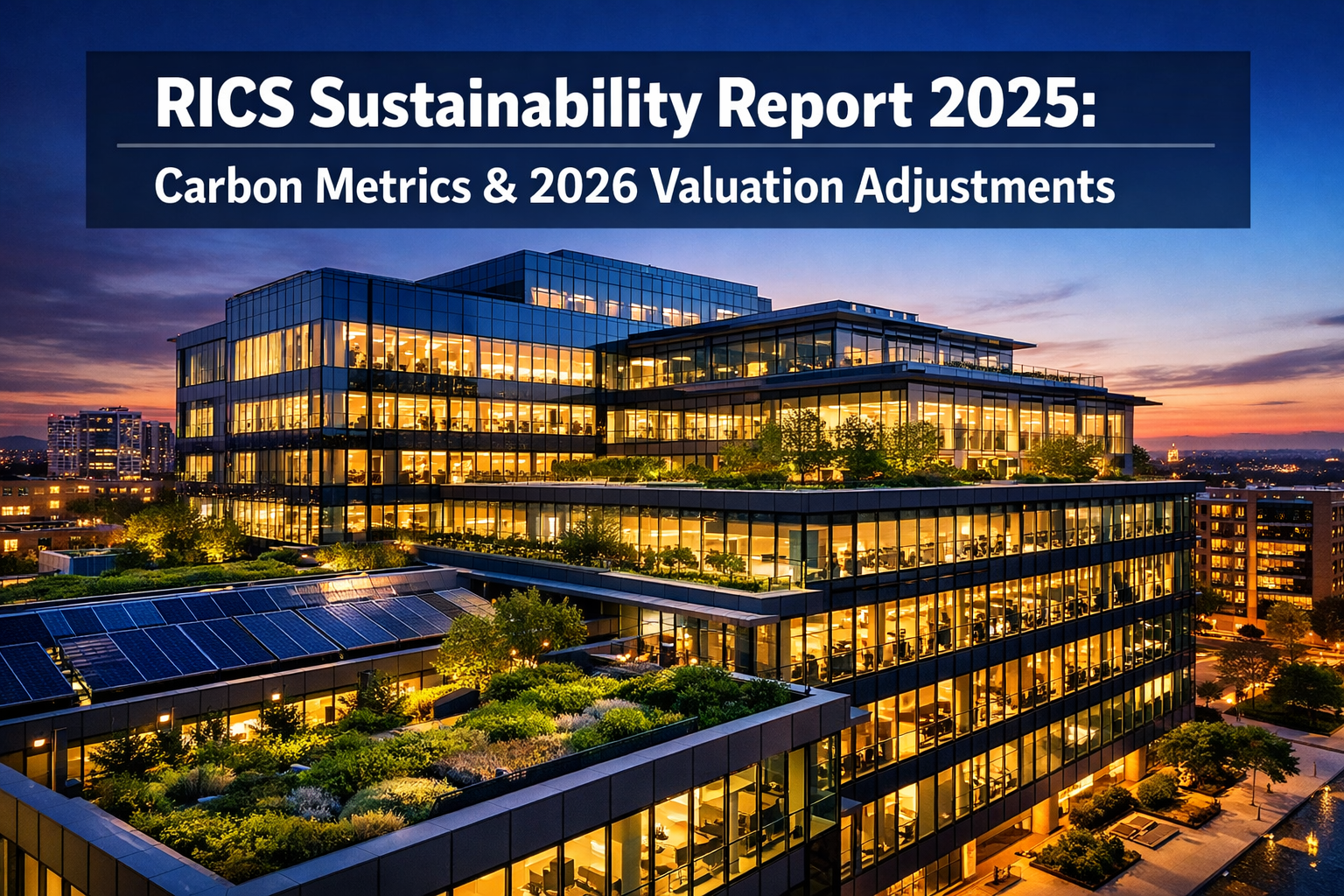
Applying RICS Sustainability Report 2025 to 2026 Valuations: Carbon Metrics and Market Caution Adjustments is not simply a compliance exercise. It is a discipline that demands honest engagement with deteriorating data quality, stalling market momentum, and an evolving global measurement framework that is still being built in real time. This article translates the most important findings from the RICS Sustainability Report 2025 into practical, defensible valuation adjustments for the current market.
Key Takeaways 📌
- Carbon measurement is declining: 46% of professionals now fail to measure project carbon — up from 34% in 2024 — undermining the reliability of carbon-based valuation inputs. [1]
- Green building demand is slowing globally (except MEA), requiring recalibrated and region-specific green premiums in 2026 valuations. [1]
- The CLEAR initiative launched in April 2026 to harmonize whole-life carbon measurement globally; valuers should expect methodological changes throughout the year. [2]
- Market caution adjustments are now essential: The Sustainable Buildings Index remains positive but is losing momentum, signalling that aggressive sustainability premiums carry increased risk. [1]
- Regulatory uncertainty in many jurisdictions means policy-dependent sustainability adjustments need explicit caveats in valuation reports. [1]
Why the 2025 RICS Sustainability Report Changes How Valuers Must Work in 2026
The RICS Sustainability Report 2025 arrived at a pivotal moment. After years of confident narratives about green premiums and ESG-driven asset appreciation, the data now tells a more complicated story. Demand for sustainable buildings is still growing in some regions, but the pace has slowed markedly. More critically, the profession's ability to measure the sustainability characteristics that underpin those premiums is deteriorating. [1]
💬 "You cannot price what you cannot measure — and right now, the sector is measuring less, not more."
For valuers, this creates a dual challenge. The first is technical: how do you incorporate carbon metrics when nearly half the industry is not collecting them consistently? The second is commercial: how do you apply market caution adjustments without over-correcting and undervaluing genuinely high-performing green assets?
The answers require a structured approach grounded in the specific findings of the RICS report, combined with awareness of the CLEAR initiative's emerging global framework.
Understanding the Carbon Measurement Gap in 2026 Valuations
The Data Quality Problem
The most alarming finding in the RICS Sustainability Report 2025 is the sharp rise in professionals who do not measure carbon. In 2024, 34% of construction professionals failed to measure carbon emissions across projects. By 2025, that figure had risen to 46%. [1] Furthermore, 60% or more of professionals do not conduct carbon calculations and climate resilience assessments in at least half of their projects. [1]
For valuers, this creates a fundamental data quality problem. Carbon-based valuation adjustments are only as reliable as the underlying measurement data. When comparable evidence is drawn from a market where nearly half of projects have no carbon data at all, the adjustment methodology becomes speculative rather than evidence-based.
Key implications for 2026 valuations:
| Issue | Valuation Impact |
|---|---|
| 46% of projects lack carbon measurement | Comparable evidence pool is unreliable |
| 60%+ skip climate resilience assessments | Climate risk adjustments lack market support |
| 30% cite skills deficit in embodied carbon | Third-party verification becomes essential |
| Inconsistent methodologies across firms | Cross-market comparisons are problematic |
Embodied Carbon vs. Operational Carbon: A Skills Gap That Matters
30% of construction professionals cite insufficient knowledge and skills to reduce embodied carbon emissions. [1] This is not just a construction problem — it directly affects valuers. When the professionals responsible for delivering low-carbon buildings lack confidence in their own measurements, the carbon credentials of those buildings become difficult to verify and price with confidence.
Valuers working with professional surveyor services should increasingly require explicit documentation of carbon measurement methodology when sustainability characteristics are presented as value-adding features. Where such documentation is absent, a conservative adjustment — or no adjustment at all — is the more defensible position.
Waste Reduction: A Bright Spot With Caveats
One area showing modest progress is waste reduction tracking. 40% of professionals report regular adoption of waste reduction and data-sharing practices. [1] While this is encouraging, it also highlights the uneven nature of sustainability progress across the sector. Waste metrics are more straightforward to collect than whole-life carbon data, which may explain the higher adoption rate. Valuers should not conflate waste performance with broader carbon performance when making adjustments.
Applying RICS Sustainability Report 2025 to 2026 Valuations: Carbon Metrics and Market Caution Adjustments in Practice
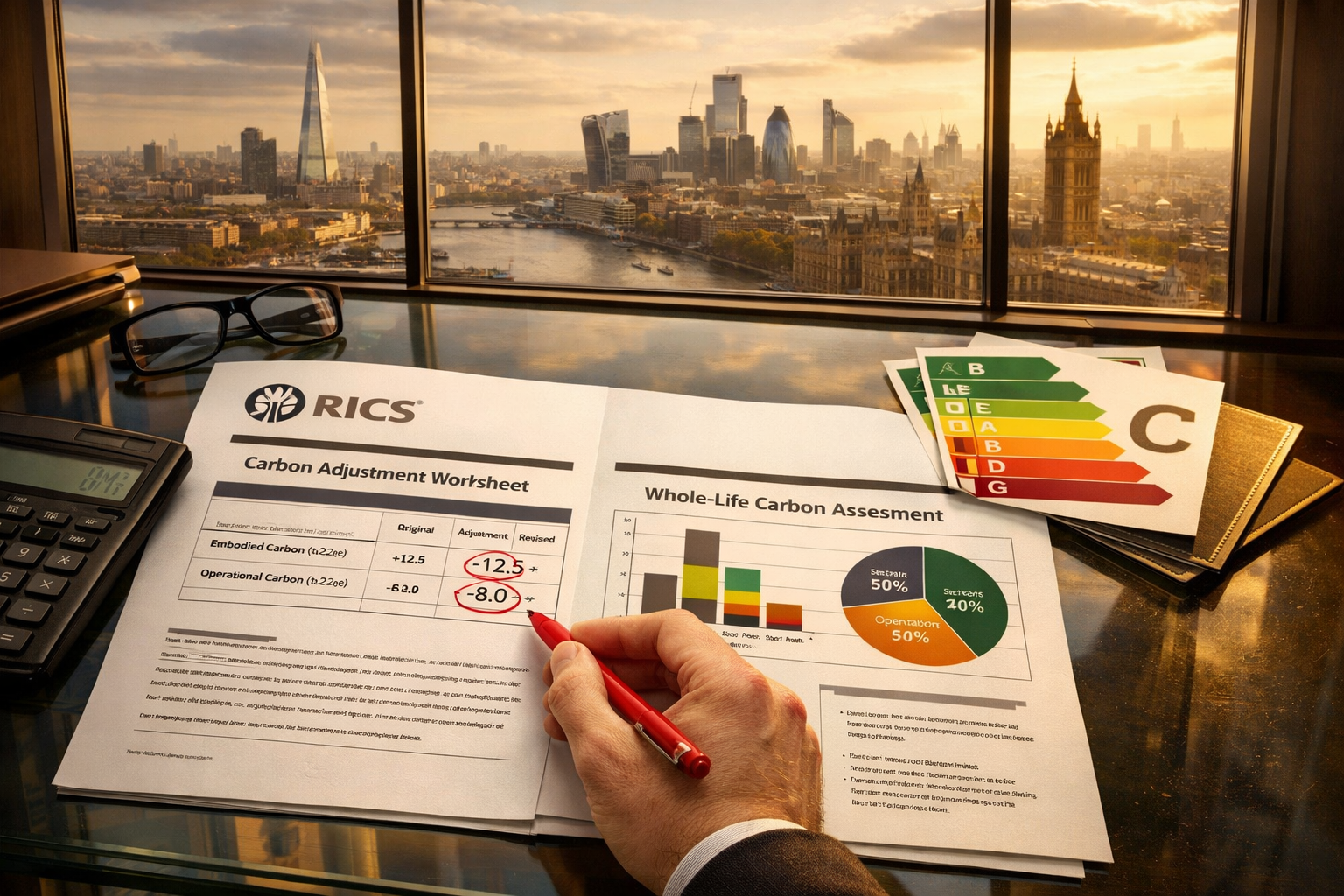
Reading the Sustainable Buildings Index in 2026
The Sustainable Buildings Index (SBI) remains in positive territory, meaning demand for green buildings still exceeds supply in most markets. However, the critical signal from the RICS Sustainability Report 2025 is that momentum is stalling. [1] This distinction matters enormously for how valuers frame green premiums.
A positive but decelerating index does not support the same premium assumptions that applied in 2022 or 2023. The appropriate response is not to eliminate green premiums, but to:
- ✅ Narrow the premium range to reflect reduced market conviction
- ✅ Increase the weight of local evidence over national or global benchmarks
- ✅ Apply explicit uncertainty caveats where carbon data is self-reported without third-party verification
- ✅ Distinguish between asset types — commercial green buildings may still command strong premiums while residential green premiums are more volatile
Regional Demand Differentiation: Not All Markets Are Equal
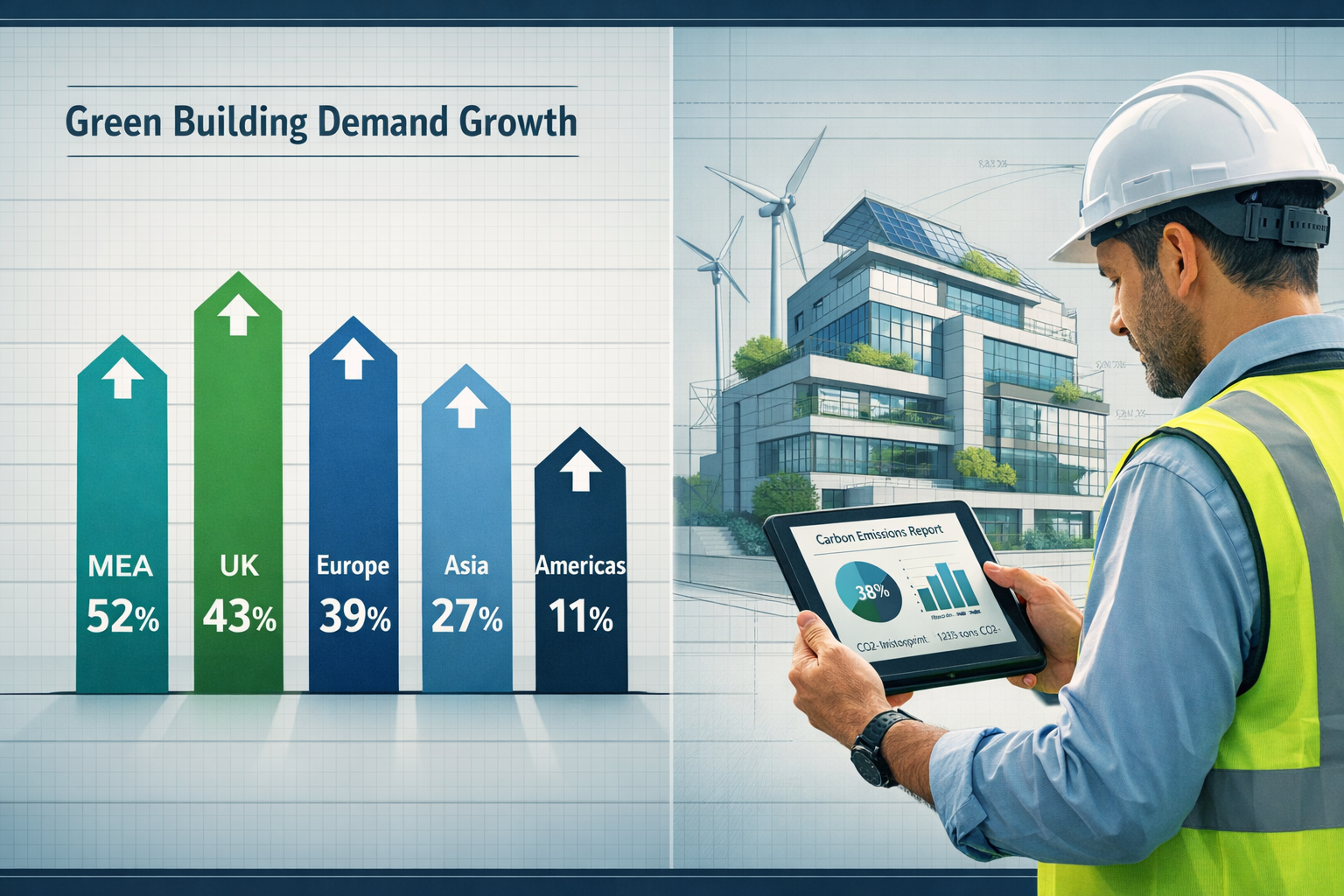
One of the most practically useful findings for applying RICS Sustainability Report 2025 to 2026 Valuations is the dramatic regional variation in green building demand growth:
- 🌍 MEA (Middle East & Africa): +52%
- 🇬🇧 UK: +43%
- 🌍 Europe: +39%
- 🌏 Asia Pacific: +27%
- 🌎 Americas: +11% [1]
For UK-based valuers, the +43% figure is relatively strong. However, it still represents a slowdown from previous cycles, and it should not be applied uniformly across all property types or locations. A property valuation in central London will carry different green premium dynamics than one in a secondary regional market.
Practical application: When preparing comparable evidence tables, explicitly note the regional demand context. A green premium justified in a high-demand MEA market cannot be directly transposed to an Americas-based asset without significant downward adjustment.
Whole-Life Carbon Metrics: What to Include and What to Caveat
Whole-life carbon assessment covers three broad categories:
- Embodied carbon (materials, construction, demolition)
- Operational carbon (energy use over the building's life)
- End-of-life carbon (demolition and disposal)
The RICS Sustainability Report 2025 identifies whole-life carbon measurement inconsistencies across jurisdictions as a primary challenge. [1] Different firms, different countries, and different project types use incompatible methodologies. This means that two properties with identical EPC ratings may have very different whole-life carbon profiles depending on how — and whether — those profiles were calculated.
For valuers, the recommended approach in 2026 is:
"Include whole-life carbon data where it exists, clearly caveat the methodology used, and apply a measurement-uncertainty discount where data quality is questionable."
When conducting a building evaluation, requesting the full carbon assessment methodology alongside the headline figures is now considered best practice. A building with a well-documented, third-party-verified whole-life carbon assessment should command a higher premium than one with self-reported or estimated figures.
The CLEAR Initiative: How 2026's New Global Framework Affects Valuation Methodology
What CLEAR Is and Why It Matters
Launched on 20–22 April 2026 at the Sustainable Buildings and Construction Summit in Lausanne, the CLEAR initiative (Carbon Lifecycle Emissions Assessment and Reporting) represents a coordinated global response to the measurement fragmentation problem. [2] RICS and its global partners designed CLEAR specifically to harmonize whole-life carbon measurement and reporting across international markets.
This is significant for valuers for two reasons:
- It confirms the problem is real: The fact that a major international initiative was required to address carbon measurement inconsistency validates the caution that valuers should already be applying to carbon-based adjustments.
- It signals methodological change ahead: CLEAR's outputs will reshape how carbon data is collected, reported, and compared — meaning valuation methodologies applied in early 2026 may need revision as CLEAR standards emerge.
CLEAR's 2026 Focus Areas
CLEAR's first-year priorities are: [2]
- Coalition building across global professional bodies and governments
- Analysing existing methodologies to identify gaps and incompatibilities
- Developing practical tools and resources for consistent carbon reporting
For valuers, the practical implication is clear: treat 2026 as a transitional year for carbon metrics. Adjustments made now should be explicitly framed as preliminary, subject to revision as CLEAR outputs become available. This is not a reason to avoid carbon adjustments entirely — it is a reason to document assumptions carefully and build in review triggers.
Regulatory Policy: The Missing Enabler
The RICS Sustainability Report 2025 is explicit that regulatory policy measures are now essential for meaningful progress. RICS recommends government mandates for carbon assessment reporting and clear definitions of decarbonisation pathways. [1] Without these mandates, voluntary adoption will remain patchy — as the 46% non-measurement figure demonstrates.
For valuers, this creates a specific risk: policy-dependent sustainability adjustments. A green premium that relies on anticipated future regulation (e.g., a Minimum Energy Efficiency Standard tightening) carries regulatory risk if that legislation is delayed or weakened. In 2026, with policy timelines uncertain in several jurisdictions, such adjustments should be:
- Clearly labelled as policy-contingent
- Supported by a sensitivity analysis showing the adjustment with and without the anticipated regulation
- Reviewed at shorter intervals than standard valuation assumptions
Practical Framework: Applying RICS Sustainability Report 2025 to 2026 Valuations: Carbon Metrics and Market Caution Adjustments
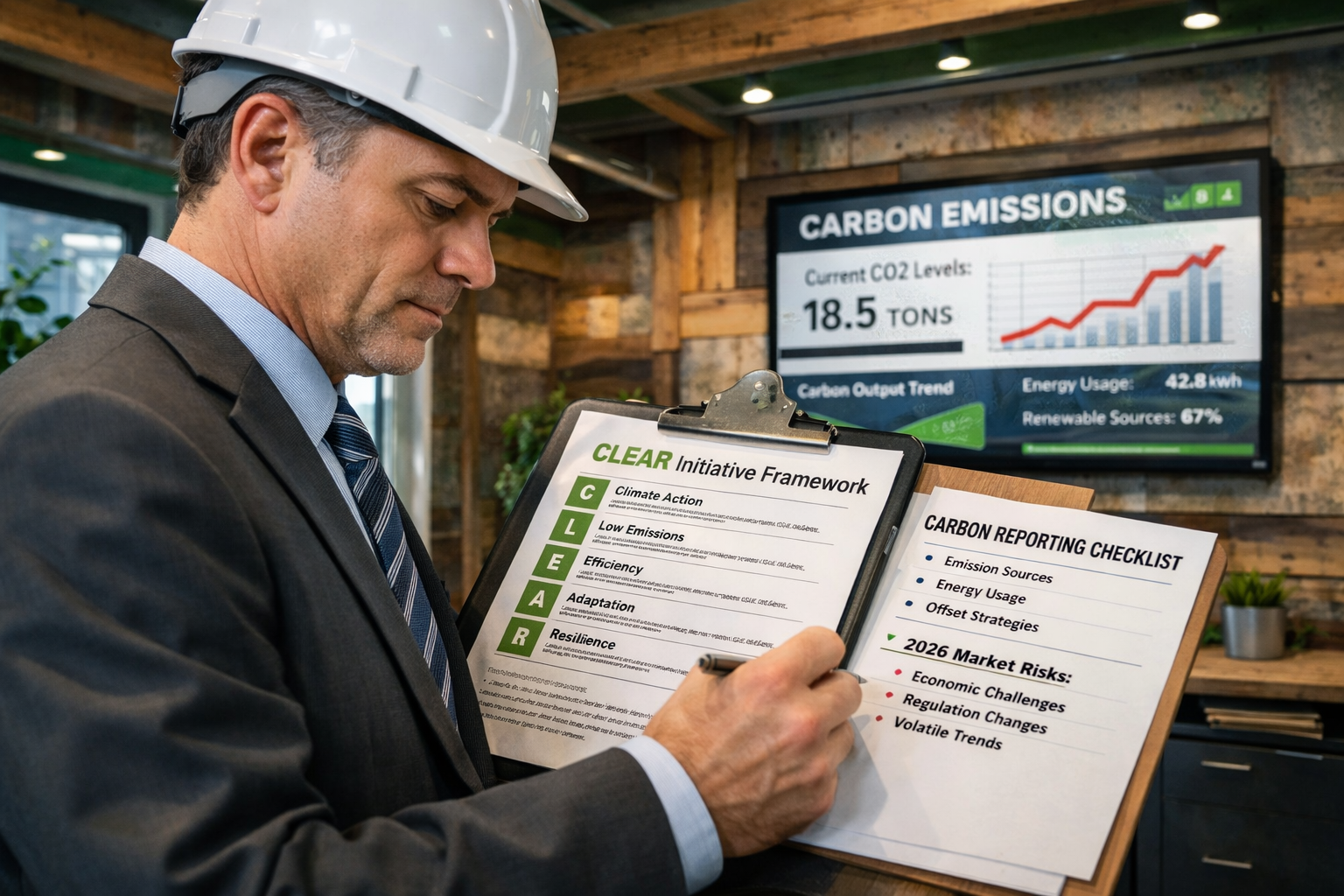
A Step-by-Step Adjustment Protocol
The following framework translates the RICS Sustainability Report 2025 findings into a structured valuation process for 2026:
Step 1: Assess Carbon Data Quality
- Is whole-life carbon data available? ✅ / ❌
- Was it third-party verified? ✅ / ❌
- Which methodology was used? (ISO 14064, EN 15978, or other)
- Apply a data quality discount of 5–15% to adjustments where data is self-reported
Step 2: Apply Regional Demand Context
- Identify the regional demand growth figure relevant to the asset's market
- UK assets: use +43% as the baseline demand context, but apply local market evidence
- Avoid direct comparisons with MEA or European assets without explicit adjustment
Step 3: Distinguish Asset Type
- Commercial assets: green premiums remain more robust; apply with moderate confidence
- Residential assets: premiums are more volatile; apply conservatively
- Mixed-use: apply blended methodology with explicit weighting rationale
Step 4: Frame Policy-Contingent Adjustments
- Identify any premium component that depends on anticipated regulation
- Apply sensitivity analysis: base case (regulation proceeds) vs. downside case (regulation delayed)
- Document the regulatory trigger and review timeline
Step 5: Monitor CLEAR Outputs
- Flag the valuation for review when CLEAR publishes its first methodological guidance
- Maintain a log of assumptions that may need updating as harmonised standards emerge
Working With Property Surveyors on Carbon Assessments
Valuers rarely work in isolation. For residential transactions, the homebuyers report process increasingly intersects with sustainability considerations. Understanding the key differences between Level 2 and Level 3 surveys is relevant here — a Level 3 building survey provides far more detail on construction materials and condition, which feeds directly into embodied carbon assessments.
When an offer has been accepted and a survey is commissioned, the sustainability profile of the property should be part of the initial briefing to the surveyor. For guidance on next steps after offer acceptance, see what to do when your property offer has been accepted.
Where survey findings reveal sustainability deficiencies — poor insulation, outdated heating systems, or high-carbon construction materials — these should feed directly into negotiation strategies around the final purchase price. The average price reduction after a survey provides useful context for calibrating carbon-related downward adjustments in residential transactions.
Common Mistakes to Avoid in 2026 Carbon-Based Valuations
❌ Applying a fixed green premium percentage without evidential support — the SBI's stalling momentum means historical premium rates may no longer reflect current market behaviour.
❌ Treating EPC ratings as a proxy for whole-life carbon performance — operational energy efficiency and whole-life carbon are related but distinct metrics. A high EPC rating does not guarantee low embodied carbon.
❌ Ignoring the measurement gap — assuming that because a carbon figure has been provided, it is reliable. Always assess the methodology behind the number.
❌ Failing to caveat policy-contingent adjustments — regulatory timelines are uncertain; valuations that embed specific policy outcomes without caveats expose valuers to professional liability.
❌ Using cross-regional comparables without adjustment — a green premium from a MEA transaction cannot be applied to a UK asset without significant methodological justification.
Conclusion: Disciplined Caution Is the Defining Valuation Skill of 2026
The RICS Sustainability Report 2025 does not tell valuers to abandon carbon metrics or ignore sustainability. It tells them to be honest about the quality of the data they are working with, the fragility of current market momentum, and the transitional nature of global measurement frameworks.
Applying RICS Sustainability Report 2025 to 2026 Valuations: Carbon Metrics and Market Caution Adjustments means holding two truths simultaneously: green buildings still command premiums in most markets, and those premiums are harder to justify with precision than they were two years ago.
Actionable Next Steps for Valuers in 2026
- Audit your current green premium assumptions — do they reflect the stalling SBI momentum or are they based on pre-2024 market conditions?
- Build carbon data quality assessment into your standard valuation checklist — request methodology documentation, not just headline figures.
- Subscribe to CLEAR initiative updates — methodological guidance published in 2026 will directly affect how whole-life carbon is assessed in valuations.
- Apply explicit regional demand adjustments — UK at +43% is not the same as Americas at +11%; differentiate accordingly.
- Engage specialist surveyors for complex sustainability assessments — the 30% skills gap in embodied carbon means generalist input is insufficient for high-value or complex assets.
- Review policy-contingent adjustments quarterly — regulatory landscapes are shifting; build in formal review triggers.
The valuers who navigate 2026 most successfully will be those who combine genuine sustainability knowledge with the professional discipline to acknowledge what the current data cannot yet support.
References
[1] Sustainability Report 2025 – https://www.rics.org/news-insights/current-topics-campaigns/sustainability/sustainability-report-2025
[2] Rics And Global Partners Launch Clear – https://www.rics.org/news-insights/rics-and-global-partners-launch-clear
[3] Rics Sustainability Slowdown Built Environment – https://netzerocompare.com/articles/rics-sustainability-slowdown-built-environment
[4] Sustainability Report 2025 (PDF) – https://www.rics.org/content/dam/ricsglobal/documents/reports/Sustainability-report-2025.pdf