

Structural collapse claims linked to excavation work have surged by 340% since 2020, with party wall disputes now representing the fastest-growing category of property litigation in England and Wales. As Awaab's Law 2026 extends its reach into the private rental sector (PRS) with mandatory remediation timelines, expert witnesses face unprecedented scrutiny in presenting evidence that meets both RICS standards and new statutory requirements for hazard assessment.
Understanding Expert Witness Roles in Structural Collapse Disputes Under Awaab's Law 2026: Evidence Standards for Party Wall Awards has become essential for property professionals navigating the intersection of structural safety obligations and legal accountability. The expansion of Awaab's Law beyond social housing introduces complex evidentiary challenges that demand rigorous technical analysis combined with courtroom-ready presentation skills.
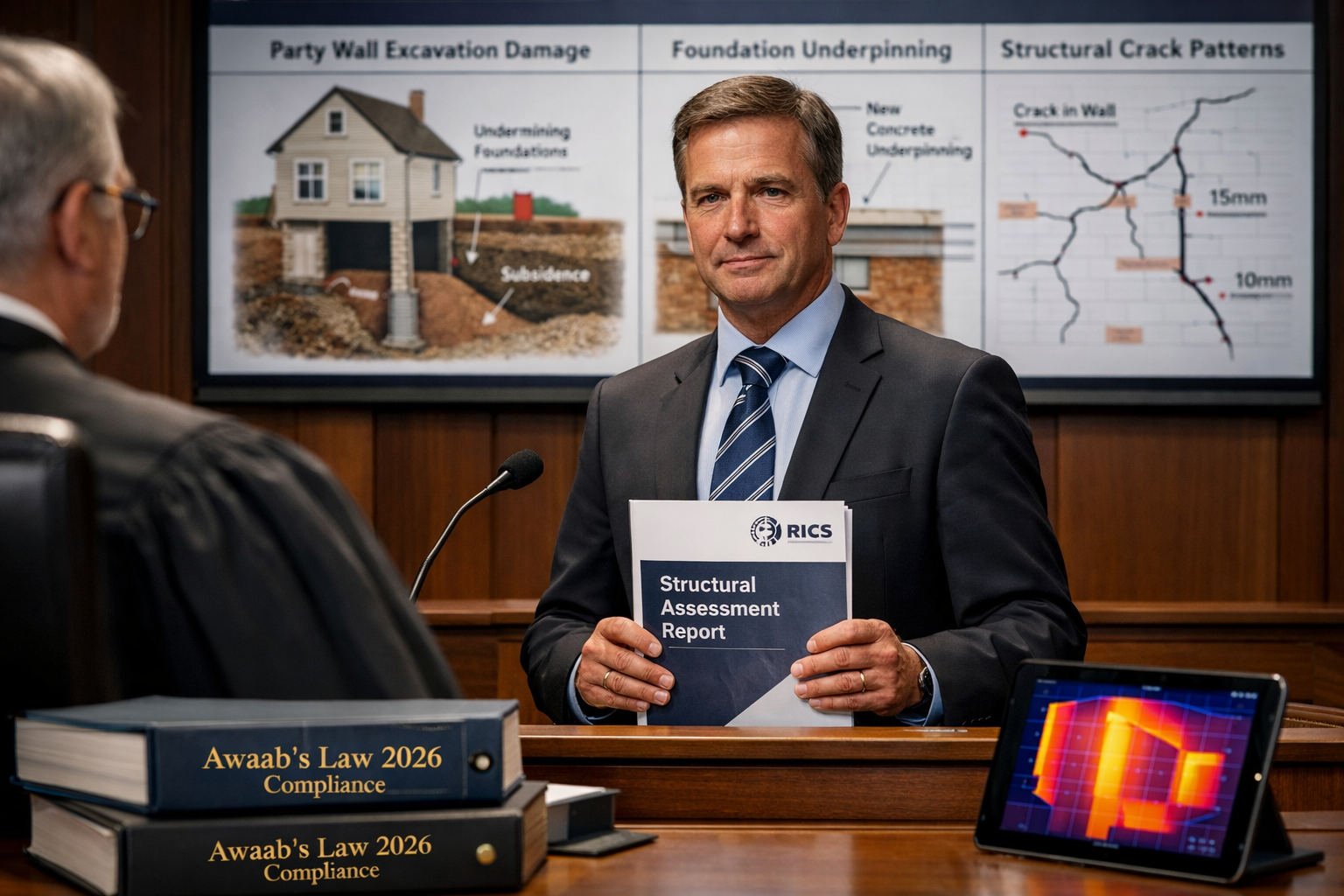
Key Takeaways
- 🏛️ Awaab's Law 2026 expansion now mandates specific timelines for addressing structural hazards in private rental properties, creating new expert witness requirements for party wall disputes
- 📊 RICS evidence protocols require integrated assessment packages that address interconnected risks including structural stability, excavation impacts, and remediation feasibility
- ⚖️ Expert witness testimony must demonstrate compliance with both Party Wall Act 1996 procedures and Awaab's Law 2026 hazard response timelines
- 🔍 Evidence standards have elevated significantly, requiring detailed documentation of structural monitoring, laboratory analysis, and professional opinion formation processes
- 💼 Courtroom strategies now emphasize pre-emptive risk assessment and clear communication of technical findings to non-specialist tribunal members
Understanding Awaab's Law 2026 and Its Impact on Structural Disputes
Awaab's Law, originally introduced to address serious housing hazards following the tragic death of two-year-old Awaab Ishak from prolonged mould exposure, has undergone significant expansion in 2026. The legislation now encompasses the private rental sector with mandatory investigation and remediation timelines that directly affect how structural collapse disputes are evaluated and resolved[3].
The Legislative Framework
The 2026 expansion establishes clear timeframes for landlords to investigate and remedy hazards:
- 14 days for hazard investigation following tenant notification
- 7 days for emergency hazards requiring immediate action
- 30 days for remediation work completion (standard hazards)
- 14 days for emergency hazard remediation
These timelines create critical evidentiary touchpoints where expert witness testimony becomes essential in determining whether structural issues constitute immediate hazards, assessing causation in party wall disputes, and evaluating compliance with remediation obligations.
Structural Collapse as a Defined Hazard
Under Awaab's Law 2026, structural instability caused by excavation work, foundation underpinning, or party wall alterations falls within the category of serious hazards requiring accelerated investigation and response. Expert witnesses must now prepare evidence packages that address:
✅ Immediate risk assessment – Does the structural movement pose imminent collapse danger?
✅ Causation analysis – What specific excavation or construction activities triggered the structural failure?
✅ Timeline compliance – Did the responsible party meet statutory investigation and remediation deadlines?
✅ Remediation adequacy – Do proposed structural repairs meet current building standards and RICS guidance?
The integration of Awaab's Law requirements with existing Party Wall Act 1996 procedures creates a complex regulatory landscape where expert witnesses must demonstrate proficiency in both statutory frameworks.
Expert Witness Roles in Structural Collapse Disputes Under Awaab's Law 2026: Core Responsibilities
The role of expert witnesses in structural collapse cases has evolved dramatically with the implementation of Awaab's Law 2026. Surveyors and structural engineers now function as technical translators who bridge the gap between complex engineering concepts and legal standards of proof required in tribunal proceedings.
Primary Expert Witness Functions
1. Independent Technical Assessment 🔬
Expert witnesses must conduct thorough investigations that remain independent of party interests. This includes:
- Site inspections documenting structural damage extent and progression
- Analysis of construction methodologies and excavation procedures
- Review of historical monitoring data and structural movement records
- Laboratory testing of materials and foundation soil conditions
- Assessment of compliance with Building Regulations and British Standards
The emphasis on independence cannot be overstated. Expert witnesses owe their primary duty to the tribunal or court, not to the instructing party, as established in CPR Part 35 and reinforced through RICS Practice Standards.
2. Evidence Package Preparation 📋
Awaab's Law 2026 has elevated the standard for evidence documentation. Expert witnesses must now prepare integrated evidence packages that address interconnected risks rather than isolated structural concerns[1]. A comprehensive package typically includes:
| Evidence Component | Required Content | Awaab's Law Relevance |
|---|---|---|
| Structural Survey Report | Detailed damage documentation with photographic evidence | Establishes hazard severity classification |
| Causation Analysis | Technical explanation linking excavation work to structural failure | Determines liability under Party Wall Act |
| Timeline Documentation | Chronological record of damage progression and notification dates | Assesses compliance with investigation deadlines |
| Remediation Specification | Detailed repair methodology with cost estimates | Evaluates adequacy of proposed hazard remediation |
| Expert Opinion Statement | Professional conclusions on liability, causation, and appropriate resolution | Forms basis for tribunal decision-making |
Working with experienced party wall surveyors ensures that evidence packages meet both technical and procedural requirements from the outset.
3. Courtroom Testimony and Cross-Examination ⚖️
Expert witnesses must present complex structural engineering concepts in accessible language suitable for non-specialist tribunal members. This requires:
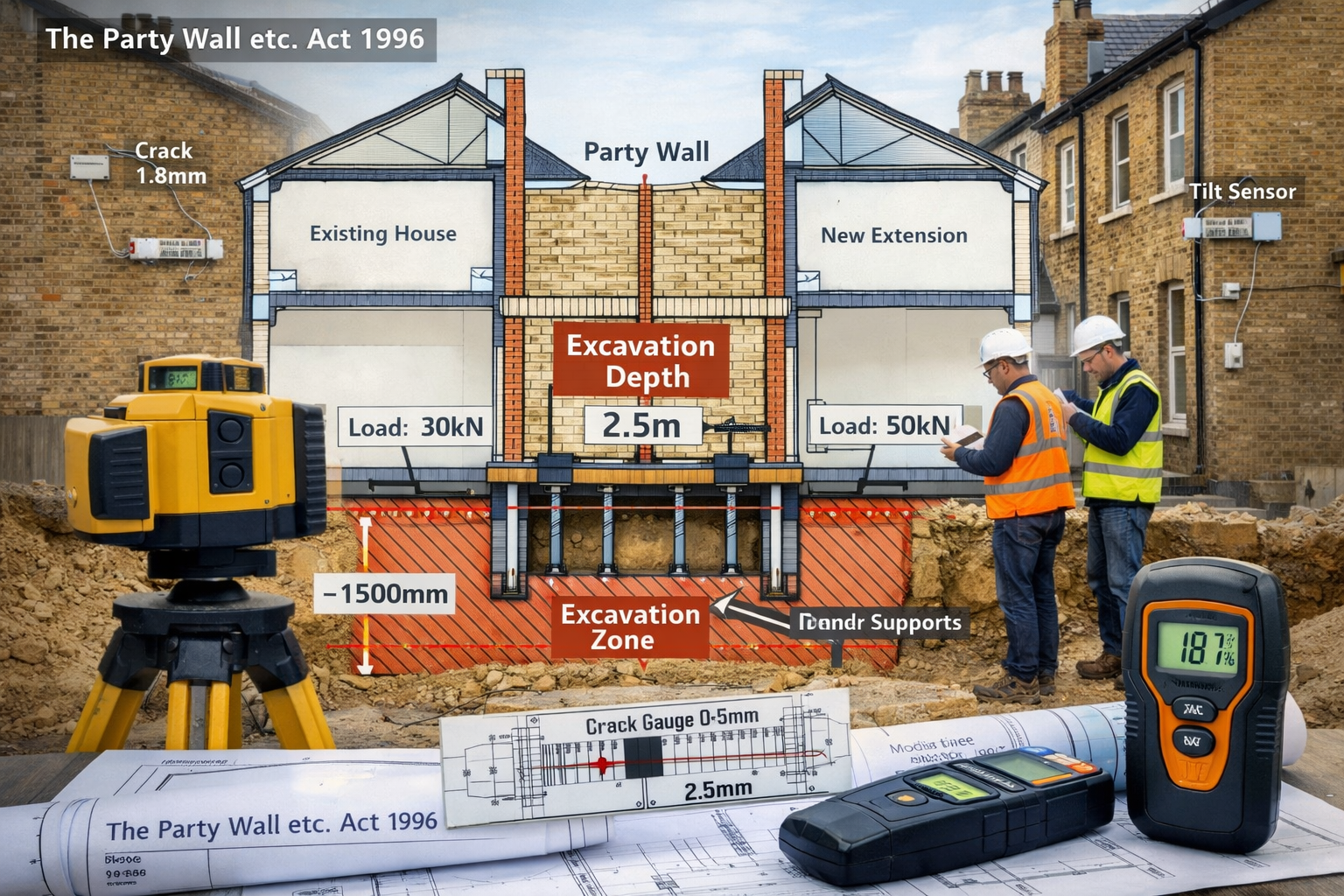
- Clear visual aids – Cross-section drawings, photographic comparisons, and annotated site plans
- Simplified explanations – Translation of technical terminology into plain English
- Confident delivery – Professional demeanor under cross-examination pressure
- Responsive answers – Direct responses to questions without evasion or technical obfuscation
The expansion of Awaab's Law to cover multiple hazard types means expert witnesses increasingly face cross-examination on interconnected risks[1]. A structural collapse case may involve questions about associated damp penetration, thermal performance degradation, or fire safety implications arising from the same construction defects.
Specialized Expertise Requirements
Not all surveyors possess the specialized knowledge required for expert witness work in structural collapse disputes. The role demands:
🎓 Professional Qualifications
- RICS membership (MRICS or FRICS status)
- Specialist structural engineering or building pathology credentials
- Expert witness training and courtroom experience
- Professional indemnity insurance with expert witness coverage
🔧 Technical Competencies
- Advanced understanding of soil mechanics and foundation behavior
- Proficiency in structural monitoring techniques and crack analysis
- Knowledge of excavation support systems and temporary works design
- Familiarity with remediation technologies including underpinning and ground stabilization
📚 Legal Knowledge
- Comprehensive understanding of Party Wall Act 1996 procedures
- Working knowledge of Awaab's Law 2026 statutory timelines
- Awareness of CPR Part 35 expert witness duties
- Experience with tribunal procedures and evidence rules
Engaging expert party wall surveyors with proven courtroom experience significantly improves the quality and credibility of technical evidence presented.
Evidence Standards for Party Wall Awards Under Awaab's Law 2026
The convergence of Awaab's Law 2026 requirements with traditional party wall procedures has created heightened evidence standards that expert witnesses must satisfy. Tribunals now expect comprehensive documentation that demonstrates not only technical competence but also procedural compliance with statutory timelines.
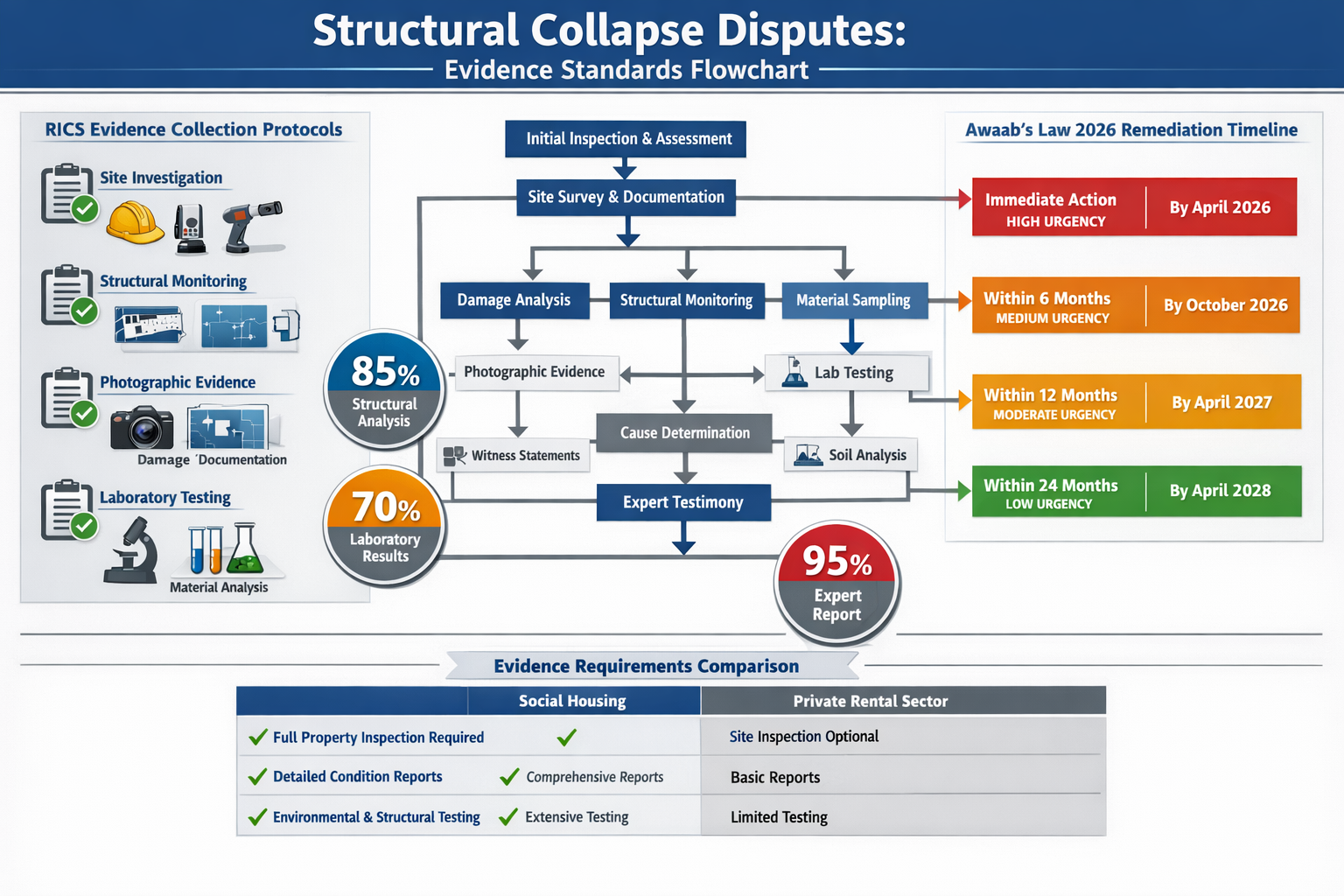
RICS Evidence Protocols
The Royal Institution of Chartered Surveyors has updated its guidance to reflect the integration of Awaab's Law requirements into party wall dispute resolution. Expert witnesses must now adhere to enhanced evidence protocols that emphasize:
Systematic Documentation Methodology 📸
- Initial condition surveys – Comprehensive pre-work documentation of adjoining properties
- Progressive monitoring – Regular structural movement measurements using precise leveling and crack monitoring
- Photographic records – Timestamped images showing damage progression with scale references
- Third-party verification – Independent laboratory testing results for soil conditions and material properties
Integrated Risk Assessment ⚠️
Awaab's Law 2026 requires expert witnesses to consider interconnected hazards rather than isolated structural concerns[1]. A structural collapse risk assessment must now evaluate:
- Primary structural stability threats from excavation or underpinning work
- Secondary hazards including water penetration through structural cracks
- Tertiary risks such as electrical system exposure or fire safety compromise
- Long-term implications including progressive foundation settlement
This integrated approach ensures that remediation strategies address all related hazards comprehensively rather than creating piecemeal solutions that leave residual risks unresolved.
Timeline Compliance Documentation ⏱️
Expert witnesses must maintain detailed records demonstrating compliance with Awaab's Law investigation and remediation timelines:
- Notification date – When the affected party first reported structural concerns
- Investigation commencement – Date expert inspection began (must be within 14 days for standard hazards)
- Preliminary findings – Initial hazard classification and severity assessment
- Remediation proposal – Detailed repair specification with timeline for completion
- Completion verification – Final inspection confirming adequate hazard remediation
Failure to document compliance with these statutory timelines can undermine otherwise sound technical evidence and expose landlords or building owners to regulatory penalties.
Causation Analysis Standards
Establishing causation – the direct link between construction activities and structural damage – represents the most technically challenging aspect of expert witness work in party wall disputes. RICS guidance requires expert witnesses to demonstrate causation through:
Temporal Correlation 🕐
Evidence must show that structural damage appeared after the commencement of excavation or construction work. This requires:
- Pre-work condition surveys establishing baseline structural condition
- Progressive monitoring data showing damage development timeline
- Witness statements from occupants describing when damage first appeared
- Correlation analysis linking construction activities to damage manifestation
Mechanism Analysis 🔧
Expert witnesses must explain the physical mechanism by which construction work caused structural damage:
- Soil stress redistribution from excavation removing lateral support
- Foundation load transfer creating differential settlement
- Vibration-induced crack propagation from piling or demolition work
- Groundwater table alteration affecting soil bearing capacity
The explanation must be technically sound, based on established engineering principles, and presented in language accessible to non-specialist tribunal members.
Alternative Causation Exclusion ❌
Robust causation analysis requires expert witnesses to exclude alternative explanations for structural damage:
- Pre-existing structural defects unrelated to current construction work
- Natural ground movement from clay shrinkage or heave
- Damage from unrelated third-party construction activities
- Deterioration from lack of maintenance or inherent design defects
Expert witnesses who fail to address alternative causation theories face vigorous cross-examination and risk having their opinions discounted by tribunals.
Remediation Specification Standards
Awaab's Law 2026 requires expert witnesses to evaluate whether proposed remediation measures adequately address identified structural hazards within statutory timelines[3]. This evaluation must consider:
Technical Adequacy ✅
- Does the proposed repair methodology address root causes rather than symptoms?
- Do specifications comply with current Building Regulations and British Standards?
- Will the remediation restore structural integrity to pre-damage levels?
- Are temporary support measures adequate during permanent repair execution?
Timeline Feasibility ⏰
- Can the proposed remediation be completed within Awaab's Law statutory timeframes?
- Are material procurement and specialist contractor availability realistic?
- Does the timeline account for necessary building control approvals and inspections?
- Are contingency provisions included for unforeseen complications?
Cost Reasonableness 💷
Expert witnesses must assess whether remediation cost estimates are reasonable and proportionate to the hazard severity. This requires:
- Comparison with industry standard rates for similar structural repair work
- Evaluation of specification necessity versus over-engineering
- Assessment of whether alternative remediation approaches offer equivalent outcomes at lower cost
- Consideration of betterment issues where repairs exceed pre-damage condition
Seeking expert party wall advice early in the dispute resolution process helps ensure that remediation specifications meet both technical and legal standards.
Courtroom Strategies for Expert Witnesses in PRS Remediation Claims
The extension of Awaab's Law 2026 to the private rental sector has created a new category of PRS remediation claims where expert witness testimony plays a decisive role. These disputes typically involve landlords, tenants, and adjoining property owners in complex three-way litigation over structural damage causation and remediation responsibility.
Pre-Hearing Preparation Strategies
Effective expert witness performance begins long before entering the courtroom. Comprehensive preparation includes:
Evidence Review and Organization 📚
- Systematic review of all documentary evidence including notices, correspondence, and technical reports
- Creation of chronological timelines showing key events and statutory deadline compliance
- Preparation of visual aids including annotated photographs, site plans, and cross-section drawings
- Development of clear executive summaries distilling complex technical findings
Anticipating Cross-Examination 🎯
Expert witnesses should work with instructing solicitors to identify:
- Weaknesses in their technical analysis that opposing counsel may exploit
- Alternative causation theories that require rebuttal
- Gaps in evidence documentation that need explanation
- Technical assumptions that require clear articulation and justification
Mock Testimony Sessions 🎭
Experienced expert witnesses conduct practice testimony sessions where colleagues or legal advisors pose challenging questions in a simulated courtroom environment. This preparation:
- Builds confidence in delivering clear, concise responses under pressure
- Identifies technical jargon that requires simplification
- Refines visual aid presentation techniques
- Improves response timing and professional demeanor
Testimony Presentation Techniques
Clarity and Accessibility 💬
The cardinal rule of expert witness testimony: if the tribunal doesn't understand your evidence, it cannot rely upon it. Effective presentation requires:
- Opening with a brief qualification summary establishing expertise
- Using analogies and everyday examples to explain complex engineering concepts
- Avoiding unnecessary technical terminology or defining terms when first used
- Speaking at a measured pace allowing tribunal members to absorb information
Visual Communication 🖼️
Human brains process visual information 60,000 times faster than text. Expert witnesses should leverage:
- Before-and-after photographs showing structural damage progression
- Annotated diagrams highlighting excavation zones and structural support systems
- Cross-section drawings illustrating subsurface conditions and foundation interactions
- Timeline graphics demonstrating compliance with Awaab's Law statutory deadlines
Professional Demeanor 👔
Tribunal members assess expert witness credibility based on both technical competence and professional conduct:
- Maintain neutral, objective tone avoiding advocacy for instructing party
- Acknowledge limitations of evidence or areas of uncertainty honestly
- Respond directly to questions without evasion or excessive qualification
- Demonstrate respect for opposing expert opinions while explaining points of disagreement
Handling Complex Integrated Evidence Packages
Awaab's Law 2026 requires expert witnesses to present integrated evidence addressing interconnected risks[1]. This creates presentation challenges when structural collapse disputes involve multiple hazard types:
Structured Presentation Framework 📊
- Primary hazard identification – Establish the structural collapse risk as the principal concern
- Causation analysis – Explain how excavation work triggered structural instability
- Secondary hazard assessment – Address related risks (water penetration, thermal performance degradation)
- Integrated remediation strategy – Present comprehensive solution addressing all identified hazards
- Timeline compliance verification – Demonstrate adherence to statutory investigation and remediation deadlines
Managing Technical Complexity 🧩
When presenting integrated evidence packages:
- Prioritize information – Focus tribunal attention on critical findings first
- Use layered explanations – Provide simple overview followed by detailed technical analysis if requested
- Maintain logical flow – Structure testimony to build understanding progressively
- Summarize key points – Reinforce critical conclusions at natural transition points
Addressing Awaab's Law Compliance Issues
Expert witnesses increasingly face questions about statutory compliance under Awaab's Law 2026 investigation and remediation timelines[2]. Effective testimony strategies include:
Timeline Documentation 📅
Present clear chronological evidence showing:
- Date tenant or affected party first notified landlord/building owner of structural concerns
- Date expert investigation commenced relative to statutory 14-day deadline
- Date preliminary findings and hazard classification were communicated
- Date remediation work commenced and completed relative to statutory 30-day deadline
Hazard Classification Justification ⚠️
Explain the technical basis for classifying structural damage as:
- Emergency hazard (7-day investigation, 14-day remediation) – Imminent collapse risk requiring immediate action
- Standard serious hazard (14-day investigation, 30-day remediation) – Significant structural instability without immediate collapse threat
- Non-serious hazard – Minor structural movement not requiring accelerated response
The classification determination significantly affects statutory timeline obligations and potential regulatory penalties for non-compliance.
Remediation Adequacy Assessment ✅
Expert witnesses must explain whether proposed or completed remediation:
- Addresses root structural causes rather than cosmetic damage repair
- Meets current Building Regulations and British Standards
- Resolves all identified hazards including interconnected secondary risks
- Provides adequate long-term structural stability and safety
Understanding legal disputes resolution procedures helps expert witnesses tailor their testimony to tribunal expectations and evidentiary requirements.
Professional Standards and Ethical Obligations
Expert witnesses in structural collapse disputes operate under stringent professional and ethical obligations that govern their conduct throughout the dispute resolution process.
RICS Practice Standards
The Royal Institution of Chartered Surveyors establishes comprehensive practice standards for expert witnesses including:
Independence and Objectivity ⚖️
- Expert witnesses owe their primary duty to the tribunal, not the instructing party
- Opinions must be formed independently based on evidence and professional judgment
- Financial arrangements must not create incentives favoring particular conclusions
- Expert witnesses must disclose any conflicts of interest or prior relationships with parties
Competence and Scope 🎓
- Expert witnesses must only accept instructions within their area of genuine expertise
- Opinions should acknowledge limitations of evidence or areas requiring specialist input
- Continuing professional development must maintain current knowledge of relevant standards
- Expert witnesses should decline instructions where they lack requisite experience
Transparency and Disclosure 📢
- Expert reports must disclose all material facts including those unfavorable to instructing party
- Methodology and assumptions underlying opinions must be clearly explained
- Sources of information and reliance on third-party data must be identified
- Changes to opinions based on new evidence must be communicated promptly
CPR Part 35 Compliance
Civil Procedure Rules Part 35 establishes legal requirements for expert witnesses in England and Wales:
Expert's Overriding Duty 📜
- Help the court on matters within their expertise
- Provide objective, unbiased opinion on matters within their expertise
- Not assume the role of advocate for the party instructing them
- Confirm in their report that they understand and have complied with their duty
Report Content Requirements 📋
Expert reports must include:
- Details of expert's qualifications and experience
- Statement of truth confirming understanding of expert duties
- Summary of instructions received and questions addressed
- Methodology used in forming opinions
- Summary of opinions with supporting reasoning
- Statement of matters outside expert's expertise
- Declaration of any conflicts of interest
Managing Conflicts and Challenges
Expert witnesses occasionally face situations that challenge their independence or professional judgment:
Instructing Party Pressure 💼
When instructing solicitors or parties request opinion modifications to favor their position:
- Politely but firmly decline requests to alter technical conclusions
- Explain that expert duty to tribunal supersedes party interests
- Document pressure attempts in case file notes
- Consider withdrawing from instruction if pressure continues
Evidence Limitations 🔍
When available evidence is insufficient to form definitive opinions:
- Acknowledge limitations honestly in expert report and testimony
- Explain what additional evidence would enable more confident conclusions
- Avoid speculation beyond what evidence reasonably supports
- Resist pressure to provide certainty where evidence permits only qualified opinions
Opposing Expert Disagreement 🤝
When opposing experts reach contradictory conclusions:
- Focus on explaining technical basis for own opinions rather than attacking opposing expert
- Identify specific points of agreement and disagreement clearly
- Explain why alternative methodologies or assumptions lead to different conclusions
- Participate constructively in joint expert meetings to narrow issues in dispute
Maintaining professional standards protects expert witnesses from challenges to their credibility and ensures their evidence receives appropriate weight in tribunal deliberations.
Cost Considerations and Fee Structures
The financial aspects of expert witness engagement represent significant considerations for parties involved in structural collapse disputes under Awaab's Law 2026.
Typical Fee Structures
Expert witnesses typically charge using one of several fee arrangements:
Hourly Rates ⏰
- Standard approach for most expert witness work
- Rates typically range from £150-£400 per hour depending on expertise level and location
- Separate rates often apply for site work, report preparation, and court attendance
- Detailed time records document all chargeable activities
Fixed Fees 💷
- Agreed lump sum for specific deliverables (e.g., expert report preparation)
- Provides cost certainty but may not account for unforeseen complexities
- Additional fees typically apply for supplementary work or court attendance
- Common for straightforward cases with well-defined scope
Retainer Arrangements 📑
- Monthly or annual fee securing expert availability
- Suitable for clients with regular expert witness requirements
- May include specified number of hours with additional work charged separately
- Provides priority access and cost predictability
Understanding party wall surveyor fees helps parties budget appropriately for expert witness costs in structural disputes.
Cost Recovery and Awards
In party wall disputes and Awaab's Law remediation claims, cost recovery becomes a critical consideration:
Successful Party Recovery ✅
- Tribunals typically order unsuccessful parties to pay successful party's reasonable costs
- Expert witness fees constitute recoverable costs if reasonably incurred
- Proportionality principle limits recovery to costs reasonable for dispute value
- Detailed cost schedules and fee justifications support recovery claims
Proportionality Challenges ⚖️
Tribunals scrutinize expert witness costs for proportionality:
- Are expert fees reasonable relative to dispute value and complexity?
- Could less expensive approaches have achieved similar outcomes?
- Were multiple experts necessary or could one have addressed all technical issues?
- Did expert work duplicate other professional services unnecessarily?
Cost Management Strategies 💡
Parties can manage expert witness costs through:
- Clear initial instructions defining scope and deliverables
- Regular cost updates and approval thresholds for additional work
- Joint expert appointments where parties share costs
- Focused instructions addressing only disputed technical issues
Future Developments and Emerging Trends
The intersection of Awaab's Law 2026 with party wall procedures continues to evolve, creating emerging trends that will shape expert witness practice in coming years.
Technological Advancements
Digital Evidence Collection 📱
- Smartphone apps enabling tenants to document structural damage with timestamped photographs
- Cloud-based evidence repositories facilitating real-time sharing with expert witnesses
- 3D laser scanning creating precise structural condition records
- Drone photography documenting excavation sites and structural damage extent
Structural Monitoring Technology 📊
- Wireless crack monitoring sensors providing continuous structural movement data
- Ground settlement monitoring systems tracking foundation performance
- Building information modeling (BIM) integration enabling digital twin analysis
- Artificial intelligence algorithms detecting structural damage patterns
Regulatory Evolution
Expanded Hazard Categories 📋
Awaab's Law 2026 currently addresses specific hazard types but future expansions may include:
- Structural stability from climate-related ground movement
- Foundation performance in flood-prone areas
- Seismic resilience in moderate earthquake zones
- Progressive deterioration from deferred maintenance
Stricter Enforcement 🚨
Regulatory authorities are developing enhanced enforcement mechanisms:
- Increased inspection frequency for high-risk properties
- Mandatory structural condition reporting for rental properties
- Professional accreditation requirements for expert witnesses
- Standardized evidence templates and reporting formats
Professional Practice Changes
Specialization Trends 🎯
The complexity of integrated hazard assessment is driving increased specialization:
- Expert witnesses focusing exclusively on structural collapse causation
- Subspecialization in excavation-related party wall disputes
- Development of Awaab's Law compliance expertise as distinct practice area
- Growing demand for experts with both technical and courtroom experience
Collaborative Approaches 🤝
Dispute resolution is shifting toward collaborative models:
- Increased use of joint expert appointments reducing adversarial testimony
- Early neutral evaluation by agreed experts before formal proceedings
- Expert determination as alternative to tribunal adjudication
- Mediation with expert technical advisors supporting settlement negotiations
Conclusion
Expert Witness Roles in Structural Collapse Disputes Under Awaab's Law 2026: Evidence Standards for Party Wall Awards represent a rapidly evolving intersection of structural engineering expertise, legal procedure, and statutory compliance obligations. The expansion of Awaab's Law to the private rental sector has fundamentally transformed how expert witnesses prepare evidence, present testimony, and navigate the complex relationship between party wall procedures and hazard remediation timelines.
Key principles for expert witnesses operating in this challenging environment include:
🔑 Maintain rigorous independence – Professional obligations to tribunals supersede party interests
🔑 Prepare integrated evidence packages – Address interconnected risks comprehensively rather than in isolation
🔑 Document statutory compliance – Demonstrate adherence to Awaab's Law investigation and remediation timelines
🔑 Communicate clearly – Translate complex technical concepts into accessible language for non-specialist audiences
🔑 Stay current – Maintain awareness of evolving regulatory requirements and emerging case law
Actionable Next Steps
For property owners and landlords facing structural collapse disputes:
- Engage qualified expert witnesses early in the dispute process, ideally before formal proceedings commence
- Ensure experts possess both technical competence and courtroom experience relevant to your specific dispute
- Provide comprehensive instructions and access to all relevant documentation
- Maintain detailed records demonstrating Awaab's Law timeline compliance
- Consider joint expert appointments to reduce costs and accelerate resolution
For expert witnesses developing their practice in this area:
- Invest in specialized training covering Awaab's Law requirements and RICS evidence protocols
- Develop courtroom presentation skills through expert witness training courses
- Build relationships with legal professionals specializing in property and construction disputes
- Maintain comprehensive professional indemnity insurance with expert witness coverage
- Participate in continuing professional development to stay current with regulatory changes
For legal professionals instructing expert witnesses:
- Select experts with demonstrated expertise in both structural engineering and Awaab's Law compliance
- Provide clear, focused instructions addressing specific disputed technical issues
- Facilitate early engagement between experts and clients to ensure comprehensive evidence development
- Consider joint expert meetings to narrow issues and potentially achieve settlement
- Budget appropriately for expert witness costs recognizing their critical role in case outcomes
The convergence of structural safety obligations, statutory remediation timelines, and party wall procedures creates a complex regulatory landscape that demands sophisticated expert witness capabilities. As Awaab's Law continues to evolve and expand, expert witnesses who combine technical excellence with clear communication skills and rigorous professional standards will play an increasingly vital role in ensuring fair, evidence-based dispute resolution.
Property professionals seeking guidance on party wall agreement assistance or requiring expert witness services for structural disputes should engage qualified specialists early in the process to ensure compliance with both technical and legal requirements under this demanding regulatory framework.
References
[1] Expert Witness Preparation For Awaabs Law 2026 Expansions Testifying On New Rental Hazards Like Fire And Electrical Risks – https://nottinghillsurveyors.com/blog/expert-witness-preparation-for-awaabs-law-2026-expansions-testifying-on-new-rental-hazards-like-fire-and-electrical-risks
[2] Awaabs Law What Property Managers And Surveyors Must Know – https://www.howdengroup.com/uk-en/awaabs-law-what-property-managers-and-surveyors-must-know
[3] Expert Witness Protocols For Excess Temperature Hazards Under Awaabs Law 2026 Rics Evidence Standards In Prs Disputes – https://nottinghillsurveyors.com/blog/expert-witness-protocols-for-excess-temperature-hazards-under-awaabs-law-2026-rics-evidence-standards-in-prs-disputes