
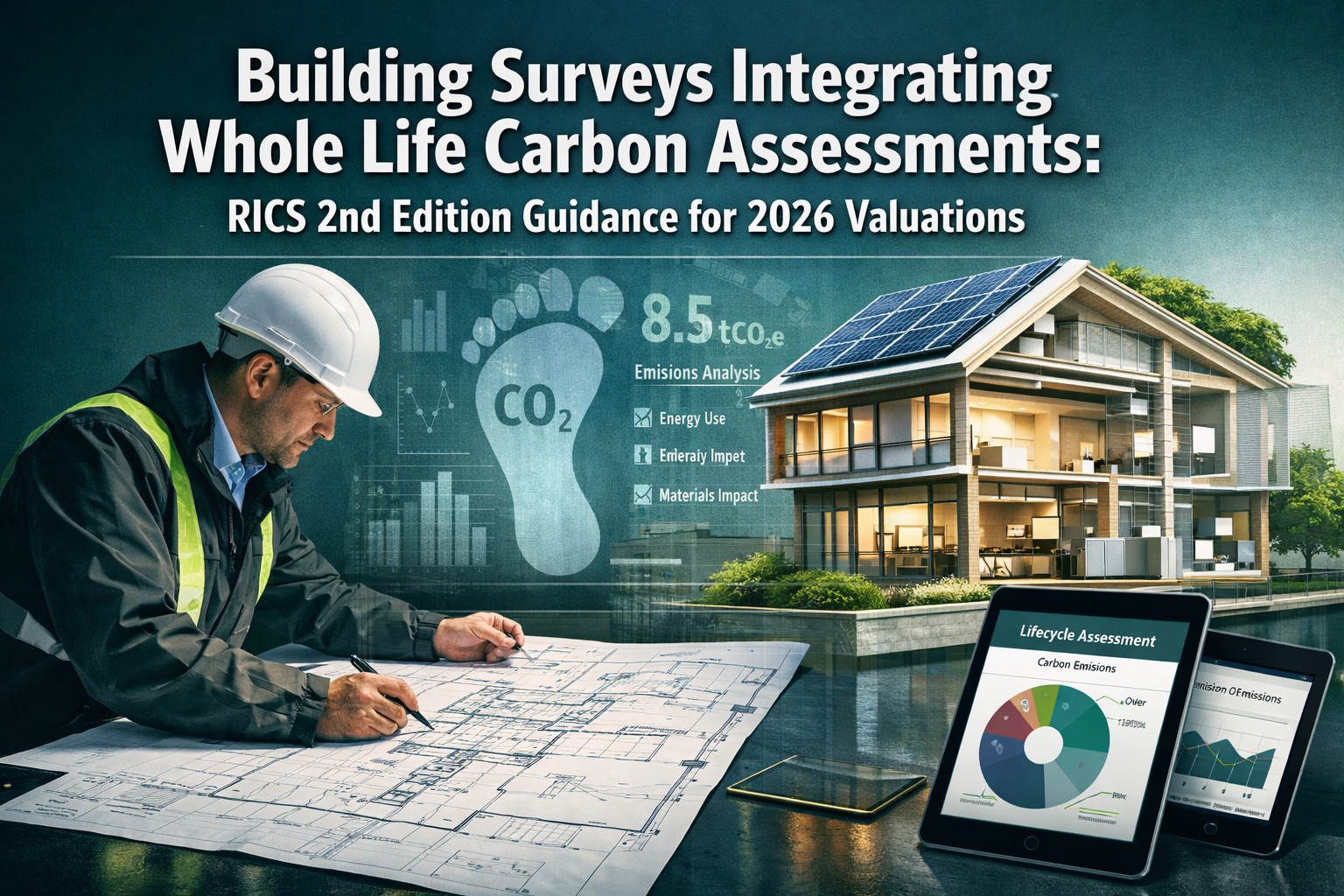
The built environment accounts for nearly 40% of global carbon emissions, yet until recently, most building surveys focused solely on structural condition and market value. That changed on July 1, 2024, when the RICS Whole Life Carbon Assessment 2nd edition became mandatory for all RICS members [6]. Now in 2026, Building Surveys Integrating Whole Life Carbon Assessments: RICS 2nd Edition Guidance for 2026 Valuations represents the new standard for property professionals who must balance traditional survey requirements with comprehensive carbon impact analysis.
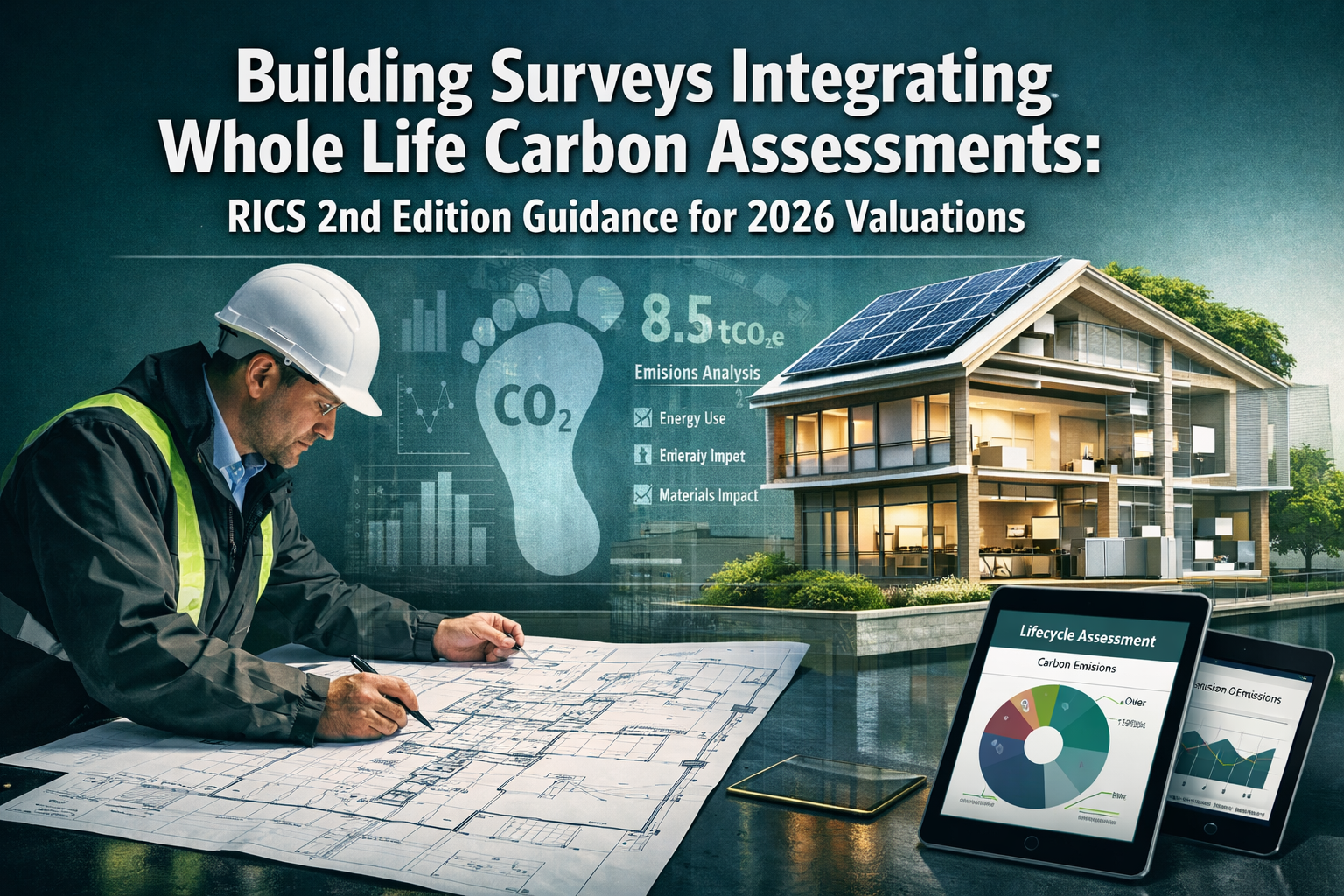
This fundamental shift means chartered surveyors conducting building surveys must now incorporate carbon data throughout the entire property lifecycle—from initial construction through decades of operation to eventual demolition. The implications for property valuations, retrofit decisions, and investment strategies are profound.
Key Takeaways
- Mandatory compliance: All RICS members must follow 2nd edition WLCA requirements when completing carbon assessments since July 2024, with full integration expected in 2026 valuations
- Expanded scope: The standard now covers all built assets and infrastructure, introducing new reporting modules including A0 (preconstruction), B8 (commute emissions), and refined Module D subdivisions
- Practical integration: Building surveys must now assess retrofit viability, net zero compliance pathways, and whole life carbon impacts alongside traditional structural and condition reporting
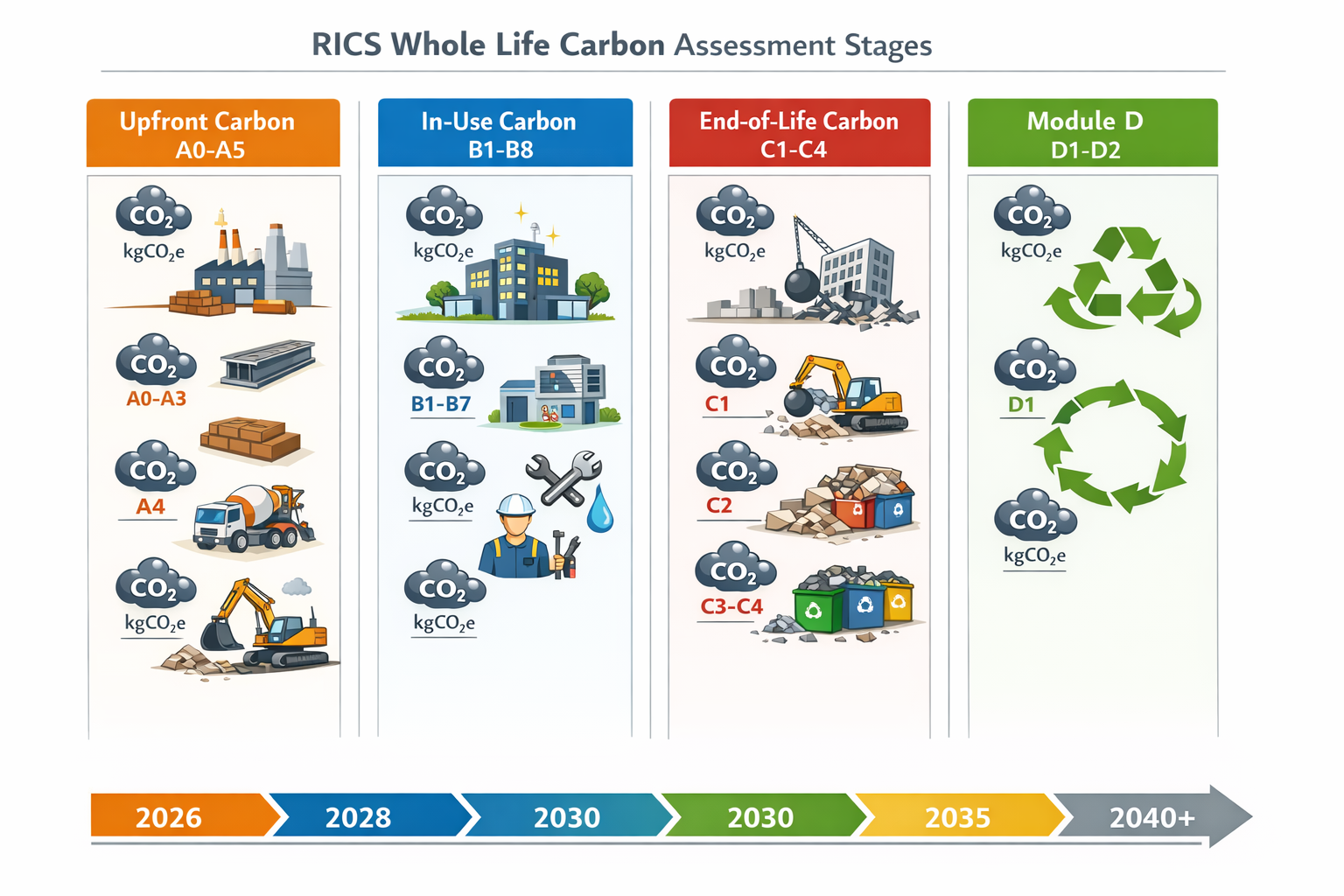
- Enhanced reporting: Four primary lifecycle stages (Upfront, In-Use, End-of-Life, and Beyond Boundaries) provide comprehensive carbon accounting aligned with ICMS 3rd Edition standards
- Professional development: RICS offers specialized certification programs to equip surveyors with the technical skills required for carbon-integrated assessments
Understanding the RICS Whole Life Carbon Assessment 2nd Edition Framework
The RICS Whole Life Carbon Assessment (WLCA) 2nd edition, officially released in November 2023, represents a significant evolution from the original professional statement [2]. This updated standard provides comprehensive guidance for assessing carbon emissions across the entire lifecycle of buildings and infrastructure projects.
What Changed in the 2nd Edition?
The 2nd edition introduced several critical updates that directly impact how chartered surveyors conduct property assessments:
Expanded Application Scope 🌍
The standard now encompasses the entire built environment, including both buildings and infrastructure projects [1]. This broader applicability means surveyors working on everything from residential properties to major infrastructure developments must apply consistent carbon assessment methodologies.
New Reporting Modules
The 2nd edition introduced three significant additions to the carbon accounting framework [2]:
- Module A0: Covers preconstruction activities including site surveys, feasibility studies, and design work
- Module B8: Accounts for employee commute emissions and road vehicle impacts during building operations
- Module D Subdivisions: Now split into D1 (material reuse and recycling benefits) and D2 (utility-related benefits beyond system boundaries)
Enhanced Technical Provisions
The updated standard includes detailed guidance on [1]:
- Element categorization parameters for consistent reporting
- Defined emissions factors aligned with the Built Environment Carbon Database (BECD)
- Transport impact calculation methodologies
- Biogenic carbon assessment procedures
- Uncertainty analysis frameworks
- Decarbonization pathway guidance
Alignment with International Standards
The RICS 2nd edition achieves harmonization with multiple international frameworks [2]:
| Standard | Integration Focus |
|---|---|
| ICMS 3rd Edition | Cost management and carbon reporting consistency |
| EN 15978 | Sustainability assessment of construction works |
| EN 17472 | Sustainability of construction works methodology |
| EN 15643 | Framework for assessment of buildings and civil engineering works |
| BECD | Standardized carbon factor database |
This alignment ensures that Building Surveys Integrating Whole Life Carbon Assessments: RICS 2nd Edition Guidance for 2026 Valuations can be applied consistently across international projects and jurisdictions.
The Four Primary Lifecycle Stages in Building Surveys
Understanding the four primary lifecycle stages is essential for surveyors conducting comprehensive carbon assessments. Each stage captures distinct carbon impacts that must be quantified and reported [2].
Stage A: Upfront Carbon (Product and Construction)
Upfront carbon represents emissions generated before a building becomes operational. For surveyors conducting expert building evaluations, this stage includes:
Module A0: Preconstruction 🔍
- Site investigation and surveys
- Feasibility studies
- Design development activities
- Planning and permitting processes
Modules A1-A3: Product Stage
- Raw material extraction and processing
- Manufacturing of building products
- Transport to manufacturing facilities
Modules A4-A5: Construction Process
- Transport of materials to construction site
- Installation and construction activities
- Construction waste management
For existing buildings undergoing assessment, surveyors must often estimate upfront carbon using proxy data or material inventories. This is particularly relevant when evaluating retrofit scenarios against demolition and new construction alternatives.
Stage B: In-Use Carbon (Operational Phase)
The operational phase typically represents the longest period in a building's lifecycle and often accounts for the largest carbon footprint. The 2nd edition expanded this stage to include eight distinct modules [2]:
Operational Emissions (B6-B7)
- B6: Operational energy use (heating, cooling, lighting, equipment)
- B7: Operational water use
Maintenance and Replacement (B1-B5)
- B1: Use of building (direct emissions from occupant activities)
- B2: Maintenance activities
- B3: Repair work
- B4: Replacement of building components
- B5: Refurbishment and retrofit activities
New Addition: Module B8 🚗
- Employee and occupant commute emissions
- Road vehicle impacts associated with building use
- Transport-related operational carbon
For building condition assessments, surveyors must now evaluate maintenance strategies not just for structural integrity but also for their carbon implications over the building's remaining useful life.
Stage C: End-of-Life Carbon
End-of-life carbon captures emissions from building demolition and material disposal [2]:
- C1: Deconstruction and demolition activities
- C2: Transport of waste materials
- C3: Waste processing for reuse, recovery, or recycling
- C4: Final disposal of materials
This stage is particularly relevant when surveyors assess whether to recommend building retention with retrofit or complete redevelopment.
Module D: Benefits Beyond System Boundaries
Module D accounts for carbon benefits that occur outside the traditional building lifecycle [2]:
D1: Material Reuse Benefits ♻️
- Carbon credits from materials available for reuse
- Recycling benefits for future construction
- Circular economy contributions
D2: Utility Benefits
- Exported energy (e.g., solar power fed to grid)
- Other utility-related benefits beyond building boundaries
The subdivision of Module D in the 2nd edition provides greater clarity for surveyors evaluating sustainable design strategies and circular economy principles.
Integrating Whole Life Carbon into Building Surveys and Valuations
The mandatory implementation of Building Surveys Integrating Whole Life Carbon Assessments: RICS 2nd Edition Guidance for 2026 Valuations requires practical changes to traditional survey methodologies. Surveyors must now collect additional data, perform carbon calculations, and provide recommendations that consider both structural condition and environmental impact.
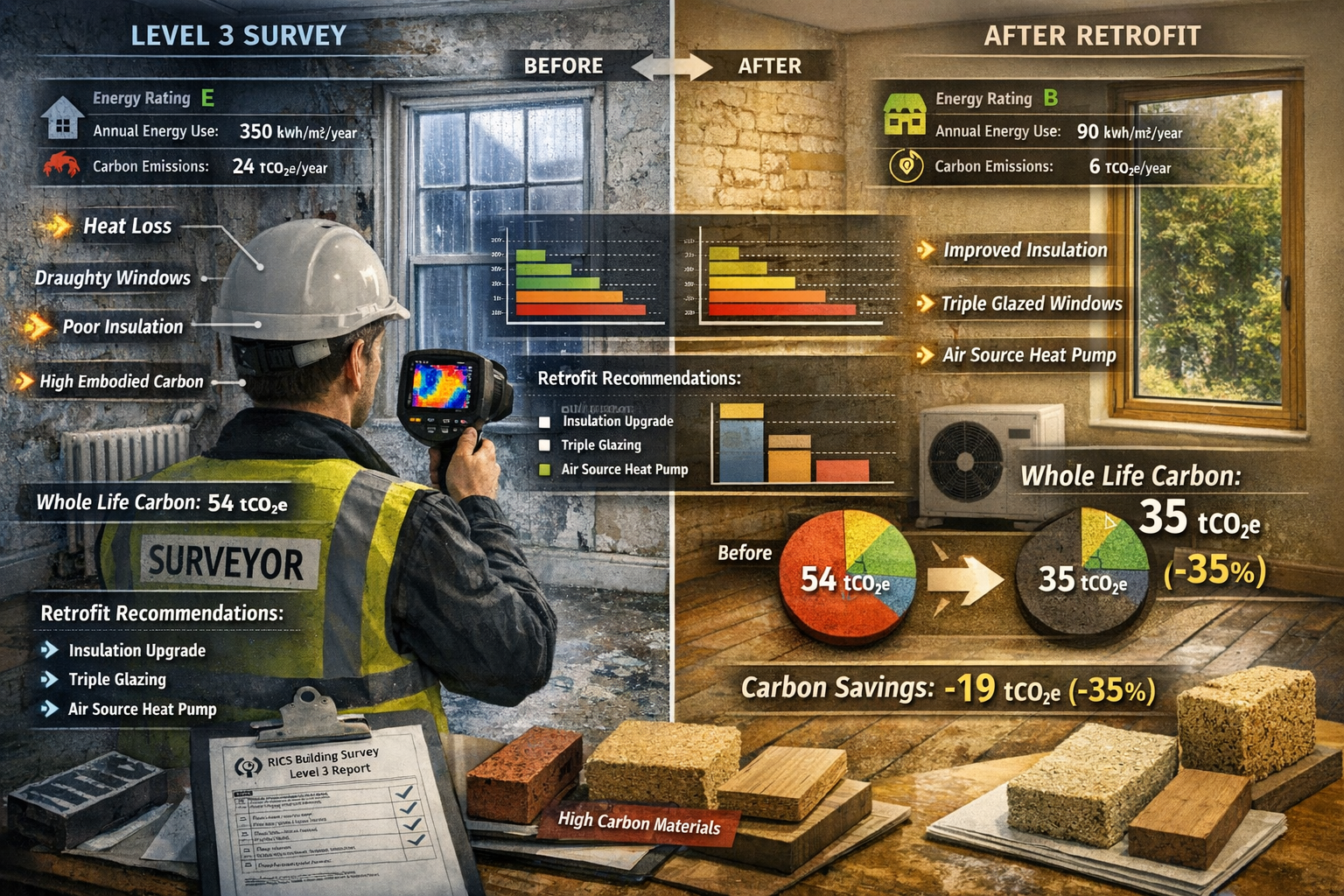
Practical Steps for Level 3 Survey Integration
Level 3 surveys provide the most comprehensive assessment of building condition and are ideal for integrating whole life carbon analysis. Here's how surveyors can incorporate WLCA 2nd edition requirements:
1. Enhanced Site Investigation (Module A0)
During the initial site visit, surveyors should:
- Document existing building materials with carbon intensity data
- Photograph construction details for material quantity estimation
- Assess building fabric performance (thermal imaging, air tightness)
- Identify retrofit opportunities and constraints
- Evaluate structural capacity for low-carbon interventions
2. Material Inventory and Embodied Carbon Assessment
Create a detailed material inventory covering:
- Primary structural elements (foundations, frame, floors, roof)
- Building envelope components (walls, windows, insulation)
- Internal finishes and fixtures
- Mechanical and electrical systems
Use BECD or equivalent databases to assign carbon factors to each material category [2]. This establishes the baseline embodied carbon for existing buildings.
3. Operational Carbon Analysis (Module B)
Evaluate current and projected operational emissions:
- Review energy performance certificates and utility bills
- Assess heating, cooling, and ventilation systems efficiency
- Identify maintenance regimes and their carbon implications
- Estimate replacement cycles for major building components
- Calculate Module B8 impacts if relevant to property type
For properties requiring building works, this analysis informs retrofit specifications that minimize both cost and carbon.
4. Retrofit Viability Assessment
Compare retrofit scenarios against baseline and new-build alternatives:
| Scenario | Upfront Carbon | Operational Carbon (30 years) | Total WLC | Payback Period |
|---|---|---|---|---|
| Do Nothing | 0 kgCO2e | 450,000 kgCO2e | 450,000 kgCO2e | N/A |
| Fabric Retrofit | 25,000 kgCO2e | 280,000 kgCO2e | 305,000 kgCO2e | 8 years |
| Deep Retrofit | 45,000 kgCO2e | 180,000 kgCO2e | 225,000 kgCO2e | 12 years |
| Demolish & Rebuild | 320,000 kgCO2e | 120,000 kgCO2e | 440,000 kgCO2e | 25+ years |
This analysis demonstrates that deep retrofit typically offers the best whole life carbon performance, even when upfront embodied carbon is higher than lighter interventions.
5. Net Zero Compliance Pathway
Provide clear recommendations for achieving net zero carbon:
- Short-term (0-5 years): Operational improvements, basic fabric upgrades
- Medium-term (5-15 years): System replacements, renewable energy integration
- Long-term (15-30 years): Major component replacements, circular economy strategies
Contingency Allowances and Uncertainty Analysis
The 2nd edition requires surveyors to address uncertainty in carbon estimates, particularly at early project stages [2]. For building surveys, this means:
Applying Appropriate Contingency Factors 📊
- Design stage surveys: 20-30% contingency on embodied carbon estimates
- Detailed condition surveys: 10-15% contingency with material verification
- Post-construction verification: 5% contingency for as-built confirmation
Documenting Assumptions
Clearly state all assumptions in survey reports:
- Material quantities estimation methods
- Carbon factor sources and vintage
- Service life assumptions for components
- Operational energy projections
- Future grid decarbonization rates
This transparency allows clients and valuers to understand the confidence level in carbon assessments.
Valuation Implications
Carbon performance increasingly influences property values in 2026. Surveyors should highlight:
Value Enhancement Factors 💰
- Lower operational costs from reduced energy consumption
- Regulatory compliance with building performance standards
- Reduced obsolescence risk as carbon regulations tighten
- Enhanced marketability to ESG-conscious investors
- Potential for green finance and preferential lending rates
Value Risk Factors
- Stranded asset risk for high-carbon buildings
- Future retrofit costs to meet net zero targets
- Regulatory penalties or restrictions on high-emission properties
- Reduced tenant demand for inefficient buildings
- Higher insurance costs for climate-vulnerable properties
When conducting RICS surveys, these factors should be clearly communicated to support informed decision-making.
Biogenic Carbon and Circular Economy Considerations
The RICS 2nd edition provides comprehensive guidance on two increasingly important topics: biogenic carbon and circular economy principles [1].
Understanding Biogenic Carbon
Biogenic carbon refers to carbon stored in biological materials like timber, straw, hemp, and other plant-based building products. Unlike fossil carbon, biogenic carbon is part of the natural carbon cycle.
Assessment Approach 🌳
The 2nd edition requires separate reporting of:
- Carbon sequestration: CO2 absorbed during plant growth (negative emissions)
- Carbon storage: CO2 retained in building materials during use
- Carbon release: CO2 emitted at end-of-life through decay or combustion
For timber-framed buildings or properties with significant wood content, this can result in temporary negative carbon balances during the use phase.
Circular Economy Integration
The standard aligns with circular economy principles by emphasizing [1]:
Design for Disassembly
- Reversible connections rather than permanent adhesives
- Standardized components for easier replacement
- Material passports documenting specifications
- Accessible fixings and modular systems
Material Reuse Potential (Module D1)
Surveyors should identify and quantify:
- Salvageable structural elements
- Reusable building components
- Recyclable materials
- Potential for adaptive reuse
This information supports decisions about building retention versus demolition and influences Module D benefits calculations.
Professional Development and Certification
To support surveyors in implementing Building Surveys Integrating Whole Life Carbon Assessments: RICS 2nd Edition Guidance for 2026 Valuations, RICS offers specialized training.
RICS Global Certificate in Whole Life Carbon Assessment
The RICS Global Certificate in Whole Life Carbon Assessment (2026 Edition) provides comprehensive training on [3]:
- 2nd edition principles and requirements
- Practical carbon calculation methodologies
- Software tools and databases (BECD integration)
- Case study applications across building types
- Reporting and documentation standards
Program Structure
- Duration: 10-month enrollment period
- Format: Online learning with practical exercises
- Assessment: Case study submissions and examination
- Outcome: Recognized professional certification
This certification equips building surveyor services professionals with the technical competencies required for carbon-integrated assessments.
Implementation Resources
RICS provides extensive implementation guidance including [4]:
- Calculation templates and spreadsheets
- Worked examples for different building types
- Carbon factor databases and updates
- Technical interpretation guidance
- Frequently asked questions
These resources help surveyors navigate complex scenarios and ensure consistent application of the standard.
Challenges and Solutions in Implementation
Implementing whole life carbon assessments within traditional building surveys presents several practical challenges:
Data Availability and Quality
Challenge: Limited data on existing building materials and historical construction methods.
Solution 🔧
- Use proxy data from similar buildings of the same era
- Apply conservative assumptions with appropriate contingencies
- Conduct targeted investigations for high-impact components
- Build organizational databases from completed assessments
Time and Cost Constraints
Challenge: Clients may resist additional survey costs for carbon assessment.
Solution
- Demonstrate value through regulatory compliance and future-proofing
- Offer tiered service levels (basic to comprehensive WLCA)
- Integrate carbon data collection into standard survey procedures
- Highlight financial benefits from retrofit optimization
Software and Calculation Tools
Challenge: Complex calculations requiring specialized software.
Solution 💻
- Adopt RICS-aligned carbon calculation platforms
- Use BECD-integrated tools for consistent carbon factors
- Develop standardized templates for common building types
- Invest in training for survey teams
Interpretation and Communication
Challenge: Communicating technical carbon data to non-specialist clients.
Solution
- Use visual graphics and comparison benchmarks
- Provide executive summaries with key findings
- Relate carbon metrics to financial implications
- Offer clear, prioritized recommendations
Future Outlook: Carbon-Integrated Surveys Beyond 2026
The integration of whole life carbon assessment into building surveys represents a permanent shift in professional practice. Looking beyond 2026, several trends will shape the evolution of Building Surveys Integrating Whole Life Carbon Assessments: RICS 2nd Edition Guidance for 2026 Valuations:
Regulatory Developments
- Mandatory carbon disclosure for property transactions
- Building performance standards tied to whole life carbon
- Carbon budgets for existing building stocks
- Enhanced energy performance certificate integration
Technology Advancement
- AI-powered material identification and carbon estimation
- Digital twins integrating real-time operational data
- Blockchain-based material passports
- Automated carbon reporting from BIM models
Market Evolution
- Carbon performance as primary valuation driver
- Green mortgages and preferential financing tied to WLCA
- Carbon offset markets for building retrofits
- ESG reporting requirements for property portfolios
Professional Standards
- Continuous updates to RICS WLCA standards
- Integration with other sustainability frameworks
- Enhanced verification and audit requirements
- Expanded scope to include social and economic sustainability
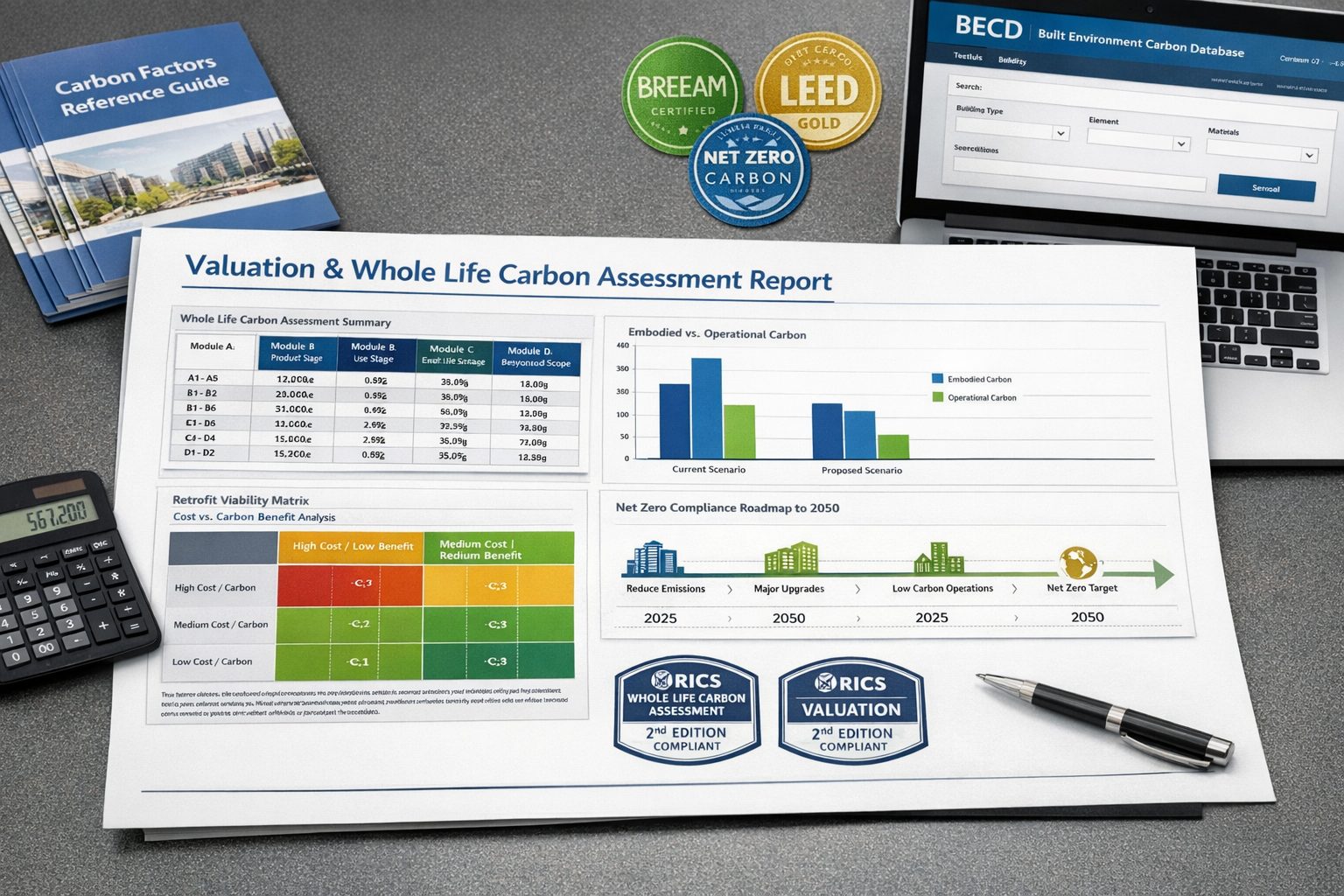
For surveyors and property professionals, staying current with these developments is essential. Those who master carbon-integrated assessment methodologies will be best positioned to serve clients navigating the transition to net zero.
Conclusion
The mandatory implementation of Building Surveys Integrating Whole Life Carbon Assessments: RICS 2nd Edition Guidance for 2026 Valuations marks a fundamental transformation in how property professionals evaluate buildings. No longer can surveys focus solely on structural condition and market value—carbon performance is now an essential consideration that influences investment decisions, retrofit strategies, and long-term property viability.
The RICS 2nd edition provides a comprehensive framework covering all lifecycle stages from preconstruction through end-of-life, with enhanced modules addressing operational emissions, biogenic carbon, and circular economy principles. For surveyors conducting building condition assessments, this means collecting additional data, performing carbon calculations, and providing recommendations that balance structural integrity with environmental impact.
Actionable Next Steps
For Property Professionals:
- Invest in training: Complete the RICS Global Certificate in Whole Life Carbon Assessment to build technical competencies
- Update survey templates: Integrate carbon data collection into standard Level 3 survey procedures
- Adopt calculation tools: Implement BECD-aligned software for consistent carbon factor application
- Build expertise: Start with pilot projects to develop organizational knowledge and workflows
- Communicate value: Educate clients on the financial and regulatory benefits of carbon-integrated assessments
For Property Owners and Investors:
- Request carbon assessments: Ensure building surveys include whole life carbon analysis
- Evaluate retrofit options: Compare scenarios based on total lifecycle carbon, not just upfront costs
- Plan for net zero: Develop phased strategies aligned with national decarbonization targets
- Consider valuation impacts: Factor carbon performance into acquisition and disposal decisions
- Engage specialists: Work with RICS surveyors experienced in carbon-integrated assessments
The transition to carbon-conscious building surveys is not optional—it's a professional requirement that reflects the urgent need to decarbonize the built environment. By embracing Building Surveys Integrating Whole Life Carbon Assessments: RICS 2nd Edition Guidance for 2026 Valuations, property professionals can provide enhanced value to clients while contributing to the broader sustainability transition.
The buildings we survey today will shape carbon emissions for decades to come. Through rigorous whole life carbon assessment, surveyors can identify opportunities to reduce environmental impact while preserving the financial value and functionality that clients depend on. This is the future of building surveys—and that future is now.
References
[1] New Rics Whole Life Carbon 2nd Edition – https://support.etool.app/index.php/knowledgebase/new-rics-whole-life-carbon-2nd-edition/
[2] Understanding The Rics Whole Life Carbon Assessment Standard – https://www.tsariley.com/news/understanding-the-rics-whole-life-carbon-assessment-standard/
[3] Wlcav20courseguide2026v1 – https://www.rics.org/content/dam/ricsglobal/documents/event-programmes/wlcav20Courseguide2026v1.pdf
[4] Whole Life Carbon Assessment Implementation Guides And Supporting Documents – https://www.rics.org/profession-standards/rics-standards-and-guidance/sector-standards/construction-standards/whole-life-carbon-assessment/whole-life-carbon-assessment-implementation-guides-and-supporting-documents
[6] Whole Life Carbon Assessment – https://www.rics.org/profession-standards/rics-standards-and-guidance/sector-standards/construction-standards/whole-life-carbon-assessment