The expansion of Awaab's Law in 2026 will bring fire and electrical hazards under mandatory landlord remediation timelines, creating an urgent need for property owners to understand how party wall procedures intersect with life-safety compliance [1]. When cladding replacements or electrical system upgrades affect shared walls between properties, the Party Wall Act 1996 remains fully applicable—even when works are driven by regulatory deadlines rather than voluntary improvements.
Party Wall Agreements in Fire Hazard Remediation Works: Navigating Awaab's Law 2026 for Cladding and Electrical Upgrades requires building owners and surveyors to coordinate legal notifications, structural assessments, and neighbor consent processes within compressed timeframes. The 2026 expansion introduces fixed remediation deadlines for fire hazards, yet the Party Wall Act's notice periods and dispute resolution mechanisms still apply in full [2]. This creates potential conflicts between statutory compliance deadlines and neighbor negotiation timelines that demand proactive planning.
Understanding how to execute party wall agreements while meeting fire safety mandates protects both legal compliance and neighbor relationships during critical remediation projects.
Key Takeaways
✅ Awaab's Law 2026 expansion includes fire and electrical hazards with strict remediation deadlines, but does not override Party Wall Act 1996 requirements for shared wall modifications [1][3]
✅ Cladding replacement and electrical upgrades affecting party walls require formal notices, surveyor appointments, and party wall awards before commencing works [2]
✅ RICS-compliant party wall surveyors must document pre-existing conditions, assess fire safety modifications, and ensure remediation works protect adjoining properties throughout the process
✅ Template notices and awards tailored for fire hazard remediation streamline compliance while maintaining legal protections for all parties involved
✅ Early engagement with neighbors (minimum 2 months before works) prevents disputes that could delay critical fire safety compliance deadlines
Understanding Awaab's Law 2026 Expansion: Fire and Electrical Hazards
What Awaab's Law Covers in 2026
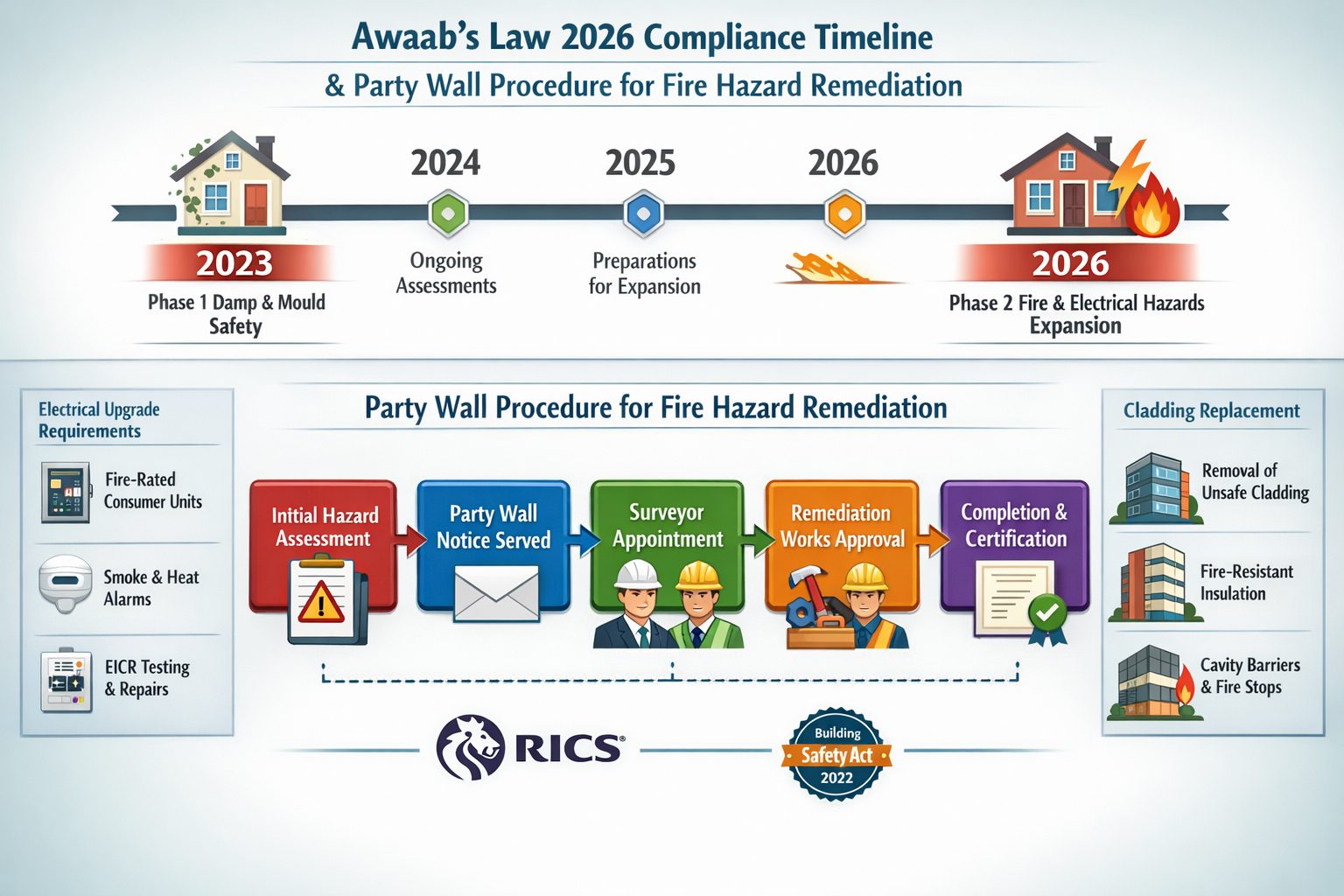
Awaab's Law, formally enacted through amendments to the Social Housing (Regulation) Act 2023, initially focused on damp and mould remediation with strict timeframes for landlord response [3]. The 2026 Phase 2 expansion extends these mandatory timelines to additional Category 1 hazards under the Housing Health and Safety Rating System (HHSRS), specifically:
🔥 Fire hazards including combustible cladding, inadequate fire doors, and compromised fire separation in party walls
⚡ Electrical hazards such as outdated wiring, overloaded circuits, and non-compliant consumer units
🌡️ Excess heat hazards related to poor ventilation and thermal control systems [5]
These hazards carry prescribed investigation and remediation timeframes. For fire hazards classified as "emergency" risks, landlords must begin remediation within 24 hours of notification and complete works within timeframes determined by risk severity [3]. Non-emergency fire hazards require investigation within 14 days and remediation commencement within specified periods based on hazard scoring.
How Fire Hazard Remediation Triggers Party Wall Procedures
The critical intersection occurs when fire safety works physically affect party walls, party structures, or excavations near boundaries. Common scenarios include:
| Fire Remediation Work | Party Wall Act Section | Notice Required |
|---|---|---|
| External cladding replacement on party wall | Section 2(2)(a) – work to party wall | Yes – 2 months |
| Installation of fire barriers within party wall cavity | Section 2(2)(b) – cutting into party wall | Yes – 2 months |
| Electrical rewiring requiring party wall penetrations | Section 2(2)(e) – cutting away projecting foundations | Potentially – 2 months |
| Fire door installation in party wall opening | Section 2(2)(a) – work to party wall | Yes – 2 months |
| Scaffolding installation for cladding works | Special access provisions | Negotiated access |
The Party Wall Act 1996 does not contain exemptions for emergency works or regulatory compliance projects [2]. Even when Awaab's Law mandates urgent remediation, building owners must still serve proper notices and obtain consent or party wall awards before commencing works that affect shared structures.
Regulatory Timeline Conflicts
The tension between Awaab's Law deadlines and Party Wall Act notice periods creates planning challenges:
- Awaab's Law emergency fire hazards: 24-hour response initiation
- Party Wall Act Section 2 notice period: 2 months before works commence
- Awaab's Law non-emergency remediation: 14-day investigation + prescribed remediation timeline
- Party Wall Act dispute resolution: 10 days for neighbor response + 10 days for surveyor appointment + award preparation time
This mismatch means building owners cannot wait for fire hazard notifications to begin party wall procedures. Proactive fire risk assessments and advance party wall notices become essential for compliance with both regulatory frameworks [4].
Party Wall Agreements in Fire Hazard Remediation Works: Legal Requirements and Procedures
When Party Wall Notices Are Mandatory
The Party Wall Act 1996 applies whenever building works affect structures shared between properties or excavations occur within specified distances of neighboring buildings. For fire hazard remediation specifically:
Section 2 Works (Party Structures) apply when:
- Replacing external cladding attached to or forming part of a party wall
- Installing fire-resistant barriers or cavity closers within party wall construction
- Modifying party wall structure to improve fire compartmentation
- Cutting into party walls to install fire-stopping materials
- Repairing or rebuilding party walls damaged by fire or identified as fire hazards
Section 6 Works (Adjacent Excavations) apply when:
- Foundation works for new fire-compliant external walls occur within 3 meters of neighboring structures
- Excavations for below-ground electrical infrastructure improvements affect stability of adjoining properties
Section 1 Works (New Walls on Boundary) rarely apply to remediation projects but may be relevant when fire safety upgrades require constructing new fire-rated boundary walls.
Serving Party Wall Notices for Cladding and Electrical Works
Building owners must serve written notices to all adjoining owners at least 2 months before commencing works affecting party walls [2]. The notice must include:
📋 Essential Notice Contents:
- Building owner's name and address
- Full description of proposed works with technical specifications
- Date works will commence (minimum 2 months from notice date)
- Clear statement that works fall under Party Wall Act 1996
- Explanation of adjoining owner's rights to consent or dissent
- Drawings and specifications showing extent of works to party structure
For fire hazard remediation projects, notices should specifically reference:
- Regulatory compliance requirements (Awaab's Law, Building Safety Act)
- Fire safety objectives of the works
- Expected duration and access requirements
- Measures to protect adjoining property during works
Professional Tip: Include fire risk assessment reports with party wall notices to demonstrate the urgency and necessity of works, which can facilitate faster neighbor agreement and reduce disputes.
The Three-Surveyor Process for Fire Safety Projects
When adjoining owners dissent to proposed works (or fail to respond within 14 days), a party wall dispute arises requiring surveyor appointment [2]. The standard process involves:
Option 1: Agreed Surveyor
Both parties appoint a single party wall surveyor who acts impartially to prepare the party wall award. This is typically faster and more cost-effective for straightforward fire remediation projects.
Option 2: Two Surveyors + Third Surveyor
- Building owner appoints their surveyor
- Adjoining owner appoints their surveyor
- The two surveyors jointly select a third surveyor to resolve any disagreements
- The two surveyors prepare the party wall award collaboratively
For Party Wall Agreements in Fire Hazard Remediation Works: Navigating Awaab's Law 2026 for Cladding and Electrical Upgrades, surveyors must possess expertise in both party wall law and fire safety compliance. RICS-qualified surveyors should:
✓ Understand Building Regulations Part B (Fire Safety) requirements
✓ Assess fire resistance ratings of existing and proposed party wall constructions
✓ Evaluate impact of cladding systems on party wall structural integrity
✓ Coordinate with fire safety consultants and Building Control
✓ Document pre-existing fire safety deficiencies in schedule of condition reports
Party Wall Awards: Essential Clauses for Fire Remediation
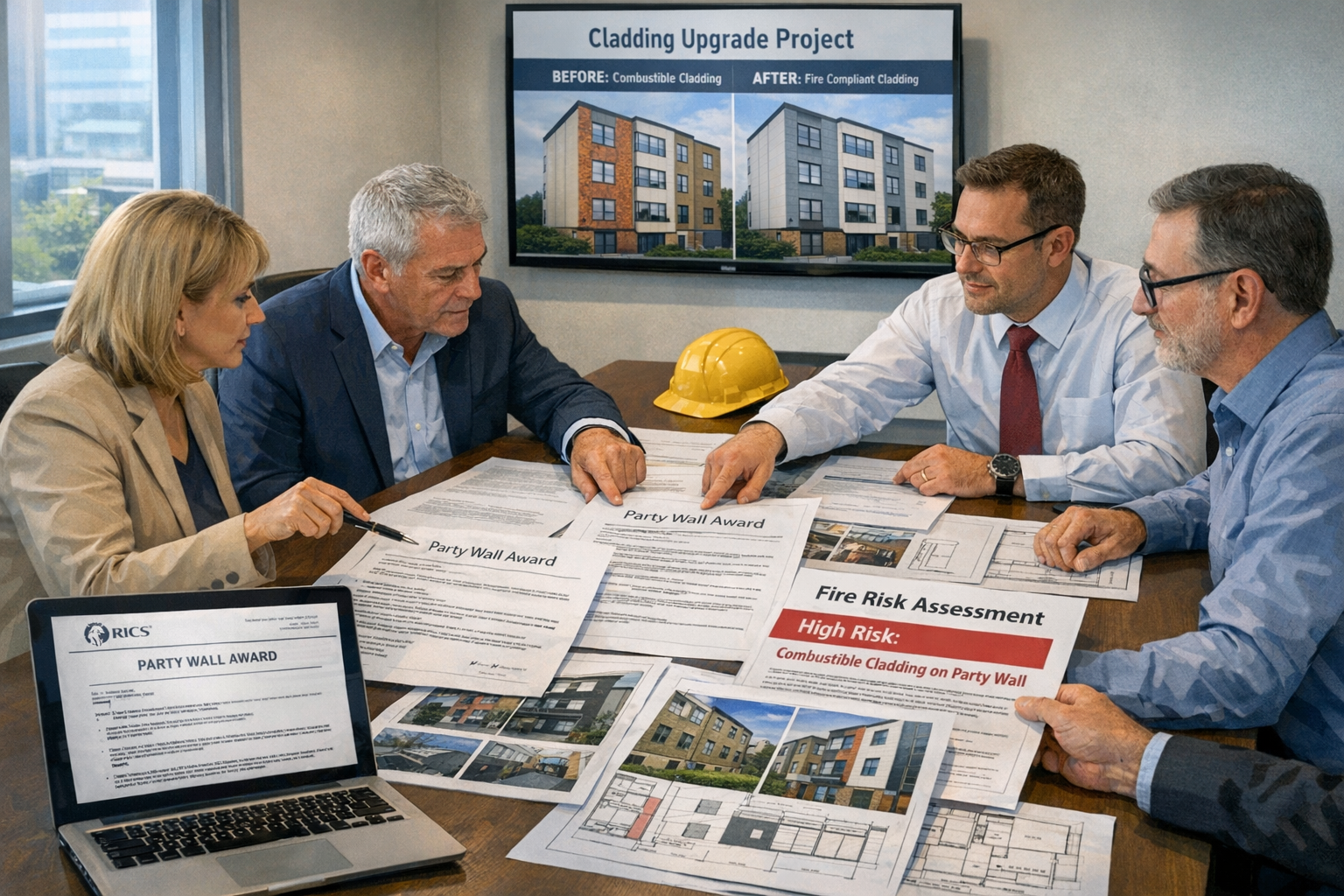
The party wall award is the legally binding document that authorizes works to proceed while protecting both parties' interests. For fire hazard remediation projects, awards must address:
Standard Award Provisions:
- Precise description of authorized works
- Working hours and access arrangements
- Protective measures for adjoining property
- Schedule of condition documenting pre-works property state
- Dispute resolution procedures
- Cost allocation and payment terms
Fire Safety-Specific Provisions:
- Maintenance of fire separation during construction phases
- Temporary fire safety measures during works
- Compliance with Building Regulations and fire safety orders
- Emergency access protocols if fire incidents occur during works
- Post-completion fire certification requirements
- Responsibility for ongoing fire barrier maintenance at party wall junctions
The award must be served on all parties before works commence. Building owners who proceed without a valid award face potential injunctions, damages claims, and enforcement action [2].
RICS Compliance Protocols for Party Wall Surveyors in Fire Safety Projects
Pre-Works Condition Surveys and Fire Risk Documentation
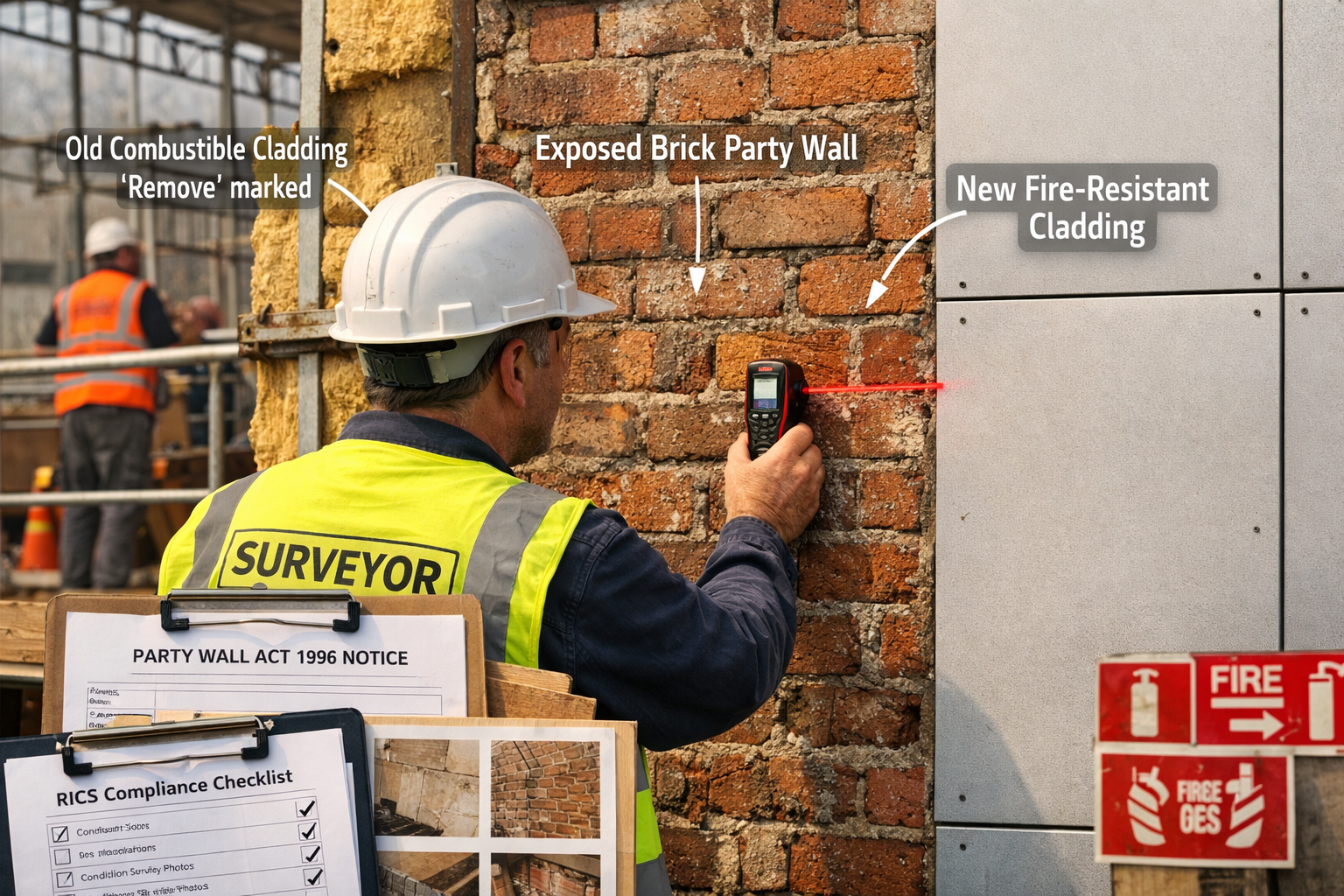
Party wall surveyors must conduct comprehensive schedule of condition surveys before fire remediation works commence. These surveys serve dual purposes:
- Baseline documentation to assess any damage caused by remediation works
- Fire safety baseline to document existing hazards and distinguish pre-existing defects from work-related issues
The schedule of condition for fire hazard projects should include:
🔍 Visual Documentation:
- High-resolution photographs of all party wall surfaces (both sides)
- Video recordings of existing cladding conditions and attachments
- Thermal imaging to identify hidden fire risks in party wall cavities
- Electrical installation photographs showing current wiring routes through party structures
📊 Technical Assessment:
- Party wall construction type and fire resistance rating
- Existing cladding materials and combustibility classification
- Cavity barrier presence and condition within party walls
- Electrical penetrations through party walls and fire-stopping adequacy
- Structural integrity assessment relevant to cladding removal/installation
Written descriptions must be sufficiently detailed to identify any new damage that occurs during works. For combustible cladding replacement projects, surveyors should document the current fire safety deficiencies to establish that remediation works are addressing genuine hazards rather than creating them.
Coordinating with Fire Safety Consultants and Building Control
Party wall surveyors do not replace fire safety specialists but must coordinate with them to ensure party wall awards accommodate necessary fire safety measures. Effective coordination involves:
Information Sharing:
- Fire risk assessment reports identifying party wall-related hazards
- Fire engineering strategies for compartmentation at party wall junctions
- Building Control requirements for fire resistance at boundaries
- Approved Document B compliance specifications for party wall constructions
Award Alignment:
- Party wall award specifications must not conflict with fire safety requirements
- Temporary works provisions must maintain fire separation during construction
- Access arrangements must accommodate fire safety inspections and certifications
- Completion criteria must include fire certification sign-offs
Dispute Resolution:
When fire safety requirements conflict with adjoining owner preferences (e.g., access requirements, noise during urgent works), surveyors must balance regulatory compliance obligations against Party Wall Act protections. Awards should clearly state that fire safety compliance is non-negotiable while providing maximum reasonable accommodation for adjoining owner concerns [4].
Monitoring Works and Protecting Adjoining Properties
Throughout remediation works, party wall surveyors have ongoing responsibilities:
Regular Site Inspections:
- Verify works proceed according to party wall award specifications
- Monitor for damage to adjoining properties
- Ensure fire separation is maintained during construction phases
- Confirm temporary fire safety measures are properly implemented
Damage Assessment:
If damage occurs to adjoining properties during works, surveyors must:
- Document damage immediately with photographs and descriptions
- Determine whether damage results from necessary works or negligence
- Specify appropriate remedial works
- Oversee repairs to restore pre-works condition
Fire Safety Vigilance:
During cladding replacement or electrical upgrade works, party wall surveyors should:
- Ensure combustible materials are not left exposed on party walls overnight
- Verify fire barriers are reinstated progressively as works advance
- Confirm electrical works maintain proper fire-stopping at party wall penetrations
- Coordinate with site management on hot works permits near party structures
Post-Completion Certification and Handover
Upon completion of fire hazard remediation works, party wall surveyors must:
✅ Final Inspection comparing completed works to schedule of condition
✅ Damage Rectification ensuring any work-related damage is properly repaired
✅ Compliance Verification confirming works match party wall award specifications
✅ Documentation Handover providing all parties with:
- Final party wall award with any agreed amendments
- Completion photographs and reports
- Fire certification documents
- Building Control completion certificates
- Warranty information for fire-rated materials installed
This documentation becomes part of the property's permanent records and may be required for future property transactions, insurance claims, or regulatory inspections [5].
Template Documents and Practical Guidance for Building Owners
Party Wall Notice Template for Cladding Replacement
Building owners can use this framework when serving notices for cladding replacement projects affecting party walls:
PARTY WALL NOTICE – SECTION 2(2) WORKS
Date: [Insert Date]
To: [Adjoining Owner Name and Address]
From: [Building Owner Name and Address]
Property Address: [Address of property where works will occur]
NOTICE OF INTENTION TO CARRY OUT WORKS TO PARTY WALL
Under Section 2(2) of the Party Wall etc. Act 1996, we hereby give you notice of our intention to carry out the following works:
Description of Works:
Removal and replacement of external wall cladding system on [address] to comply with fire safety regulations under Awaab's Law 2026 and the Building Safety Act 2022. Works will affect the party wall structure between [your property] and [adjoining property] and include:
- Removal of existing [combustible/non-compliant] cladding panels attached to party wall
- Installation of scaffolding with ties into party wall structure
- Installation of fire-resistant cavity barriers at party wall junctions
- Installation of new fire-compliant cladding system [specify material]
- Reinstatement of weatherproofing and fire-stopping at party wall interfaces
Commencement Date: Works will commence on or after [date – minimum 2 months from notice date]
Reason for Works: These works are required to remediate Category 1 fire hazards identified under the Housing Health and Safety Rating System and comply with mandatory remediation timeframes under Awaab's Law Phase 2 expansion [1].
Attached Documents:
- Architectural drawings showing extent of works
- Fire risk assessment report (relevant sections)
- Specification for proposed cladding system
- Expected duration and working hours
Your Rights:
You have 14 days from receipt of this notice to:
- Consent to the works in writing, or
- Dissent or not respond, triggering the party wall dispute resolution process
If a dispute arises, both parties must appoint surveyors under Section 10 of the Act to prepare a party wall award.
For queries, contact: [Building Owner contact details]
Party Wall Award Checklist for Electrical Upgrade Projects
When electrical remediation works require party wall penetrations or modifications, party wall awards should address:
Technical Specifications:
- Exact locations of electrical cable routes through party walls
- Fire-stopping specifications for all penetrations (minimum 30-minute fire resistance)
- Cable containment methods and fire-rated trunking requirements
- Consumer unit locations and clearances from party wall structures
- Earthing and bonding arrangements at party wall junctions
Access and Working Arrangements:
- Access rights to adjoining property for inspection/testing if needed
- Working hours restrictions (typically 8am-6pm Monday-Friday)
- Notification requirements before accessing party wall areas
- Emergency contact procedures during works
Protection Measures:
- Dust suppression and containment during chasing/drilling
- Protection of adjoining owner's finishes and decorations
- Temporary fire-stopping during progressive installation
- Vibration limits for drilling through party wall masonry
Completion Requirements:
- Electrical installation certificate (BS 7671 compliance)
- Fire-stopping certification for all party wall penetrations
- Building Control sign-off for notifiable electrical works
- Photographic evidence of completed fire-stopping
Cost Allocation and Fees for Fire Safety Party Wall Matters
Understanding party wall costs is essential for budgeting fire remediation projects:
Building Owner Responsibilities:
The building owner (party carrying out works) typically pays:
- Their own surveyor's fees: £800-£1,500 for straightforward projects
- Adjoining owner's surveyor fees: £800-£1,500 per adjoining property
- Third surveyor fees (if appointed): £1,000-£2,000
- Schedule of condition survey costs: £400-£800 per property
- Award preparation and administration: included in surveyor fees
For Party Wall Agreements in Fire Hazard Remediation Works: Navigating Awaab's Law 2026 for Cladding and Electrical Upgrades, costs may be higher due to:
- Complexity of fire safety technical specifications
- Coordination with fire consultants and Building Control
- Multiple adjoining properties in apartment buildings
- Urgent timeline requirements necessitating expedited processes
Cost Recovery:
Building owners cannot recover party wall costs from adjoining owners unless the works provide benefit to both properties. Fire safety remediation typically benefits only the building where hazards exist, so costs remain with the building owner [2].
Fee Disputes:
If party wall surveyor fees appear unreasonable, either party can challenge them through:
- Requesting detailed fee breakdown and justification
- Seeking independent fee assessment from RICS
- County Court proceedings (rarely necessary)
Dispute Prevention Strategies
Proactive communication prevents costly delays in fire safety remediation projects:
Early Engagement (3-4 Months Before Works):
- Informal discussions with neighbors about planned fire safety works
- Explanation of regulatory requirements and urgency
- Preliminary sharing of fire risk assessment findings
- Discussion of potential disruption and mitigation measures
Clear Documentation:
- Professional, detailed party wall notices with supporting evidence
- Visual aids showing proposed works and fire safety benefits
- Realistic timelines with buffer periods for party wall processes
- Transparent cost estimates and insurance information
Reasonable Accommodations:
- Flexible working hours where possible to minimize disruption
- Advance notice of particularly disruptive work phases
- Temporary accommodation offers if works make adjoining property uninhabitable
- Regular progress updates throughout the project
Professional Representation:
Appointing experienced party wall surveyors from the outset signals professionalism and increases neighbor confidence in the process. Surveyors can mediate concerns and find solutions that satisfy both regulatory compliance and neighbor protection.
Conclusion: Integrating Party Wall Compliance with Fire Safety Mandates
Party Wall Agreements in Fire Hazard Remediation Works: Navigating Awaab's Law 2026 for Cladding and Electrical Upgrades demands careful coordination of legal, technical, and regulatory requirements. The 2026 expansion of Awaab's Law creates urgent fire safety remediation obligations, but does not override the procedural protections of the Party Wall Act 1996 [1][2]. Building owners must simultaneously satisfy both frameworks to achieve compliant, legally sound outcomes.
The key to successful navigation lies in proactive planning: beginning party wall procedures well before Awaab's Law deadlines trigger, engaging qualified RICS surveyors with fire safety expertise, and maintaining transparent communication with all affected parties throughout the process.
Actionable Next Steps
For building owners facing fire hazard remediation requirements in 2026:
- Conduct immediate fire risk assessments to identify party wall-related fire hazards requiring remediation
- Engage party wall surveyors early (minimum 3 months before planned works) to prepare notices and assess party wall implications
- Serve formal party wall notices at least 2 months before intended commencement dates, including comprehensive fire safety documentation
- Coordinate with fire safety consultants to ensure party wall awards accommodate all necessary fire protection measures
- Document existing conditions thoroughly through professional schedule of condition surveys before works commence
- Budget appropriately for party wall surveyor fees, potential disputes, and adjoining owner protections
- Maintain communication with neighbors throughout the project to prevent disputes and facilitate cooperation
For surveyors undertaking party wall work in fire remediation projects:
- Enhance fire safety knowledge through CPD courses on Building Regulations Part B and fire engineering principles
- Develop template documents specifically for fire hazard remediation scenarios under Awaab's Law
- Build relationships with fire safety consultants and Building Control officers for effective coordination
- Stay current on evolving Awaab's Law implementation guidance and fire safety regulatory changes [3][4][5]
The intersection of party wall law and fire safety regulation will become increasingly important as the 2026 Awaab's Law expansion takes effect. Building owners and surveyors who master this integration will protect both legal compliance and neighbor relationships while delivering essential life-safety improvements to the built environment.
For comprehensive guidance on party wall procedures, consult our complete guide to party wall agreements and explore our resources on building works and building regulations compliance.
References
[1] Awaabs Law Timeline – https://www.glplaw.com/2026/01/23/awaabs-law-timeline/
[2] Awaabs Law Comes Into Force What Does It Mean For Construction – https://www.trowers.com/insights/2025/november/awaabs-law-comes-into-force-what-does-it-mean-for-construction
[3] Awaabs Law Requirements And Deadlines The Complete Breakdown – https://www.procurementforhousing.co.uk/article/awaabs-law-requirements-and-deadlines-the-complete-breakdown/
[4] Awaabs Law Technical Compliance Hvac Ventilation – https://www.arm-environments.com/resources/awaabs-law-technical-compliance-hvac-ventilation
[5] Awaabs Law 2026 Hazard Expansions Surveyor Protocols For Electrical Fire And Excess Heat Risks In Rentals – https://nottinghillsurveyors.com/blog/awaabs-law-2026-hazard-expansions-surveyor-protocols-for-electrical-fire-and-excess-heat-risks-in-rentals