
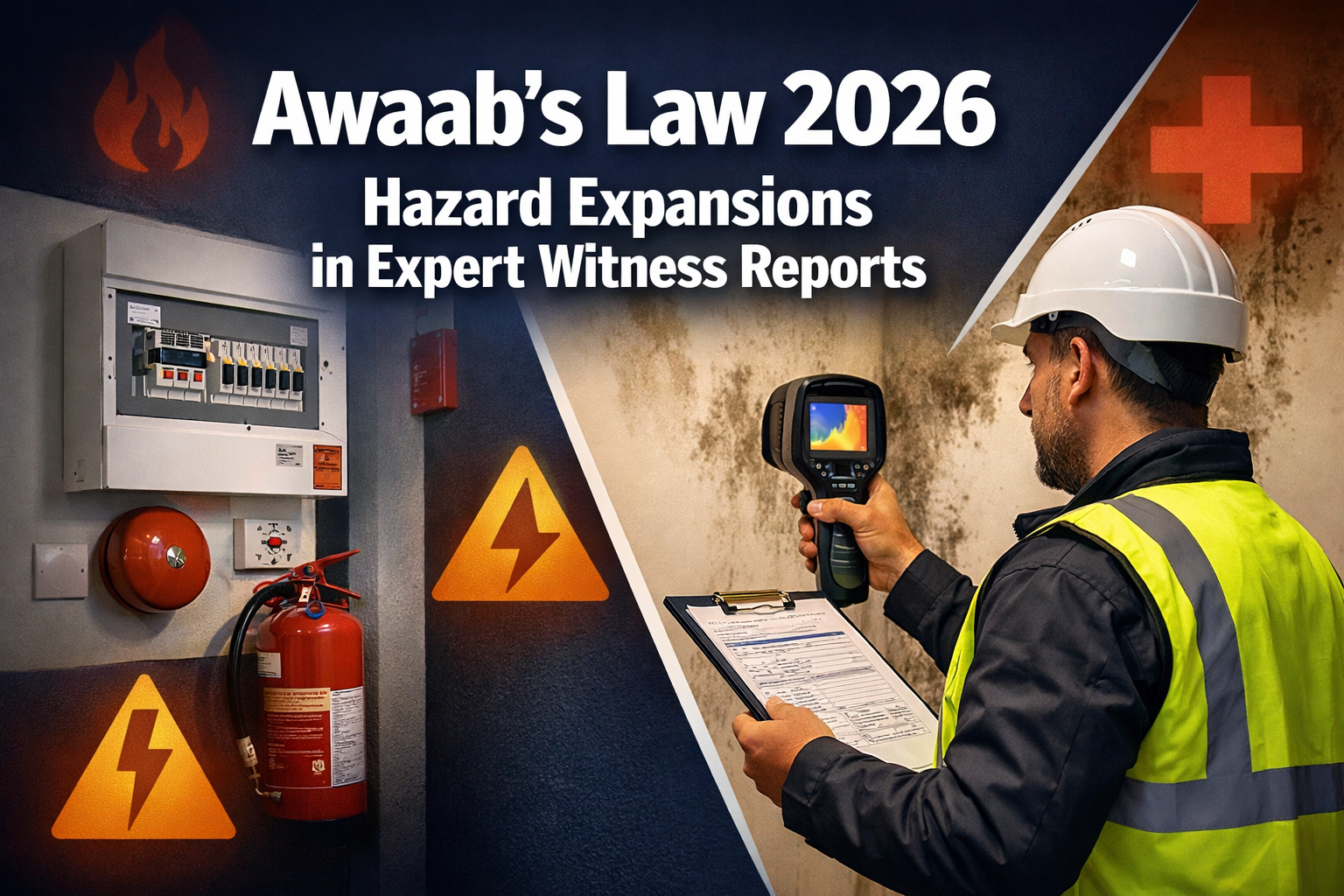
A two-year-old child died from prolonged mould exposure in social housing—a tragedy that sparked legislative reform now reshaping how expert witnesses approach hazard assessments across the UK rental sector. The 2026 expansion of Awaab's Law introduces five new hazard categories that experts predict will generate a 40% increase in landlord-tenant disputes requiring professional witness involvement[1]. For surveyors, property experts, and legal professionals, understanding the protocols for electrical, fire, and hygiene disputes under these new regulations has become essential to practice.
Awaab's Law 2026 Hazard Expansions in Expert Witness Reports: Protocols for Electrical, Fire, and Hygiene Disputes represents the most significant shift in social housing safety standards in over a decade. The legislation now mandates strict investigation and remediation timeframes for hazards previously outside the original scope—creating new challenges for expert witnesses preparing reports for litigation.
Key Takeaways
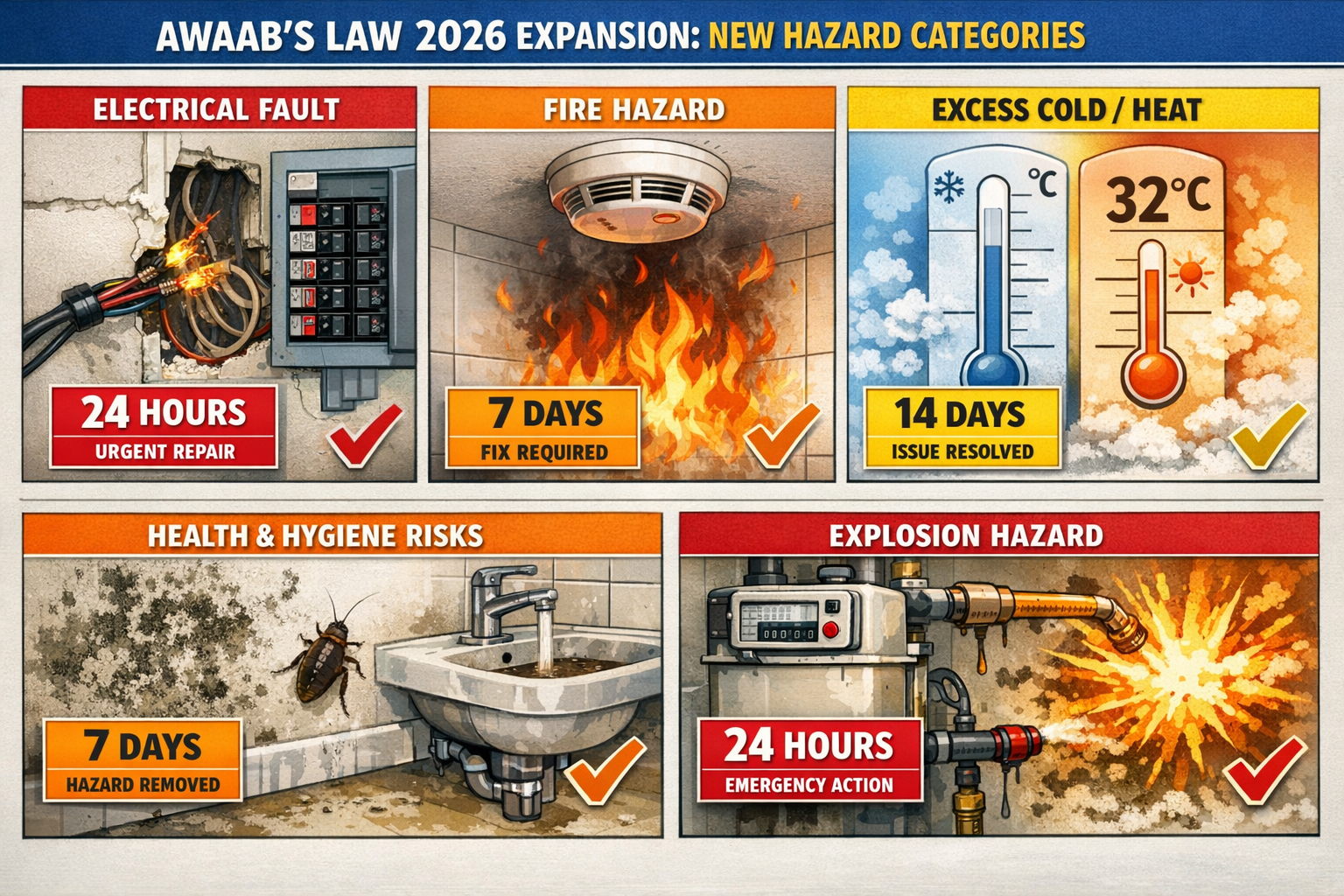
- 🔍 Five new hazard categories added in 2026: excess cold, excess heat, health and hygiene risks, fire hazards, and electrical faults requiring statutory response times
- ⏱️ Emergency hazards must be investigated within 24 hours, with repairs completed within 7 days of investigation reports
- 📋 Expert witness reports must now demonstrate competency in the Housing Health & Safety Rating System and address expanded hazard protocols
- 💰 Tenants can claim 25-60% rent refunds plus compensation ranging from £1,000 to £10,000+ for health impacts from hazard exposure
- 🏛️ The Renters' Rights Bill will extend identical requirements to private landlords, expanding the scope of disputes requiring expert testimony
Understanding Awaab's Law 2026 Hazard Expansions
The Legislative Background
Awaab's Law originally focused on damp and mould hazards following the tragic death of two-year-old Awaab Ishak in 2020. The Phase 2 expansion in 2026 now covers excess cold, excess heat, health and hygiene risks, fire hazards, electrical faults, and explosions as "significant hazards" requiring statutory response times[2].
This expansion fundamentally changes how social landlords must respond to tenant complaints. More importantly for expert witnesses, it creates new categories of disputes requiring specialized technical assessments and professional testimony.
The Five New Hazard Categories
The 2026 expansion introduces specific protocols for:
- Electrical Hazards ⚡ – Faulty wiring, exposed circuits, inadequate earthing, and electrical fire risks
- Fire Safety Hazards 🔥 – Missing smoke detectors, blocked escape routes, combustible materials, inadequate fire doors
- Excess Cold ❄️ – Inadequate heating systems, poor insulation, thermal bridging causing health risks
- Excess Heat 🌡️ – Overheating properties, inadequate ventilation, heat-related health impacts
- Health and Hygiene Risks 🧼 – Sanitation failures, pest infestations, contaminated water supplies
Each category requires distinct assessment methodologies and documentation standards for expert witness reports. Understanding these protocols is critical for professionals involved in damp and timber assessments and broader property condition evaluations.
Statutory Timeframes That Impact Expert Testimony
The legislation establishes rigid timeframes that directly affect expert witness engagement:
| Hazard Type | Investigation Deadline | Repair Completion | Report to Tenant |
|---|---|---|---|
| Emergency hazards | 24 hours | 7 days after report | 48 hours |
| Damp and mould | 14 days | 7 days after report | 14 days |
| Significant hazards | 14 days | 7 days after report | 14 days |
Emergency hazards must be investigated and remediated within 24 hours of being reported to social landlords[2]. This compressed timeline means expert witnesses may need to provide rapid preliminary assessments before comprehensive reports are finalized.
If prescribed repair timeframes cannot be met, social landlords must offer alternative accommodation[2]—a requirement that often becomes a central dispute point requiring expert valuation and suitability assessments.
Awaab's Law 2026 Hazard Expansions in Expert Witness Reports: Essential Protocols
Electrical Hazard Assessment Protocols
Expert witnesses addressing electrical disputes under the 2026 expansions must follow specific protocols that differ significantly from standard electrical safety inspections.
Documentation Requirements
Comprehensive electrical assessments for expert witness reports must include:
- Visual inspection records with timestamped photographs of all electrical installations, consumer units, and visible wiring
- Testing results from insulation resistance tests, earth continuity tests, and polarity checks
- Compliance verification against BS 7671 (18th Edition) wiring regulations
- Historical maintenance records analysis showing landlord response patterns
- Thermal imaging to identify overheating circuits and potential fire risks
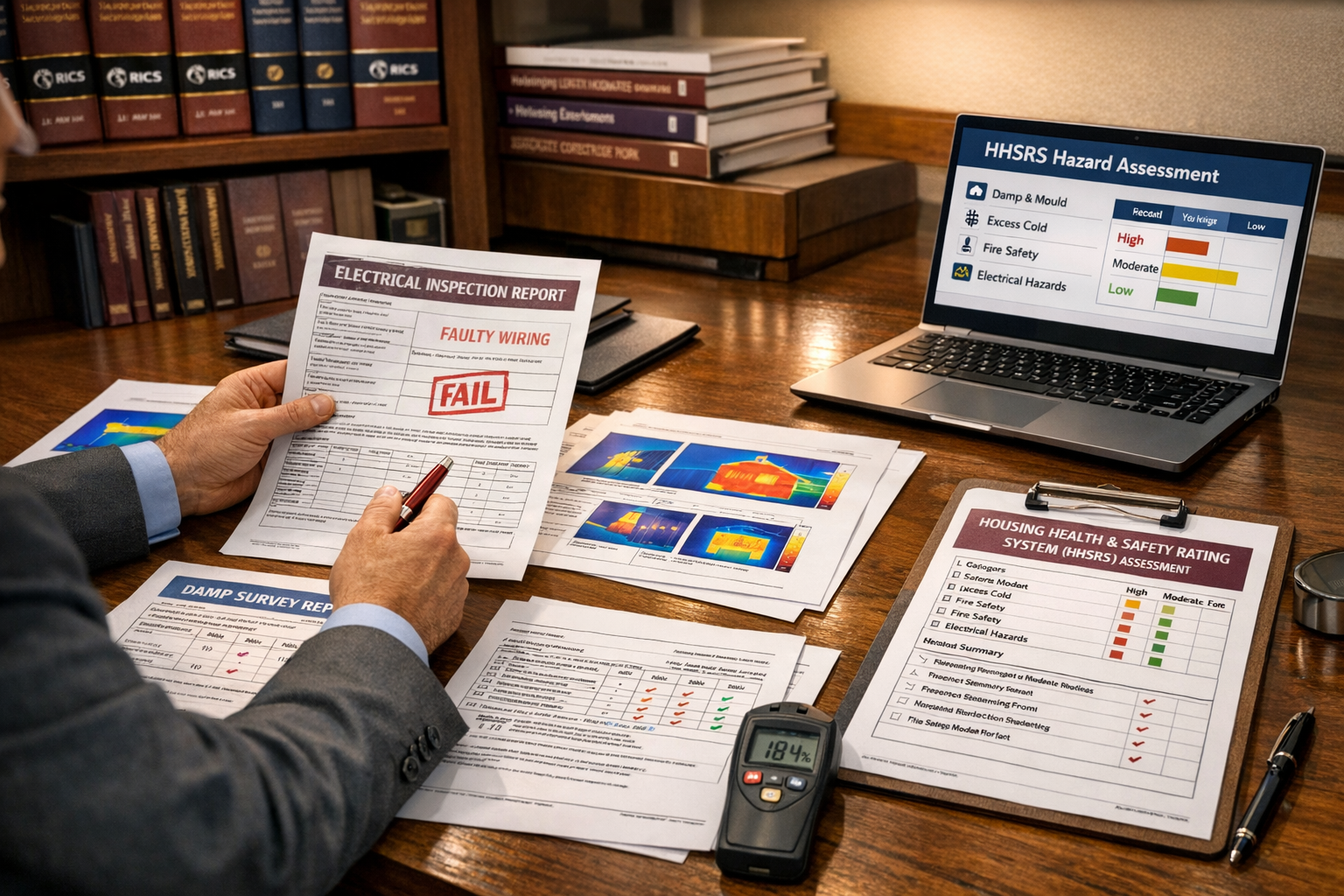
The expert must establish whether the electrical hazard constituted a "significant hazard" under the Housing Health & Safety Rating System (HHSRS) and whether the landlord's response met statutory timeframes.
Common Electrical Dispute Scenarios
Expert witnesses frequently encounter these electrical hazard disputes:
- Delayed repairs to reported electrical faults exceeding the 7-day remediation deadline
- Inadequate investigations that failed to identify underlying electrical system deficiencies
- Temporary fixes that didn't address root causes of electrical hazards
- Missing documentation of electrical safety certificates and inspection records
For properties requiring comprehensive evaluation, experts often recommend building surveys that include detailed electrical system assessments.
Fire Safety Hazard Protocols
Fire hazard assessments under Awaab's Law 2026 require expert witnesses to evaluate both active fire protection systems (smoke detectors, fire extinguishers) and passive fire protection (fire doors, compartmentation, escape routes).
Fire Risk Assessment Framework
Expert witness reports must address:
- Detection systems – Functionality and placement of smoke and heat detectors in compliance with BS 5839
- Means of escape – Clear, unobstructed escape routes with appropriate signage and emergency lighting
- Fire separation – Integrity of fire doors, walls, and floors preventing fire spread
- Combustible materials – Identification of hazardous materials in common areas or within properties
- Landlord response documentation – Evidence of fire safety inspections and maintenance schedules
"Fire hazard disputes often center on whether landlords conducted adequate risk assessments and responded within statutory timeframes to identified deficiencies."
Expert Testimony Considerations
When preparing reports for fire safety disputes, experts must:
✅ Demonstrate competency in fire risk assessment methodologies
✅ Reference relevant regulatory standards (Regulatory Reform Fire Safety Order 2005)
✅ Provide clear causation analysis linking landlord failures to tenant harm
✅ Calculate appropriate compensation based on risk exposure periods
✅ Recommend proportionate remediation measures with cost estimates
Health and Hygiene Dispute Protocols
Health and hygiene hazards represent a broad category requiring multidisciplinary expertise. Expert witnesses must often coordinate with environmental health specialists, microbiologists, and public health professionals.
Assessment Methodology
Hygiene hazard investigations must document:
- Sanitation adequacy – Functionality of toilets, sinks, showers, and drainage systems
- Water quality – Testing for contamination, legionella risks, and supply adequacy
- Pest infestation evidence – Identification of rodents, insects, or other vermin with photographic documentation
- Waste management – Adequacy of refuse storage and collection arrangements
- Ventilation assessment – Air quality testing and mechanical ventilation system performance
For properties with complex moisture damage issues, experts must distinguish between hygiene hazards and damp/mould problems, as each has distinct investigation and remediation timeframes.
Causation and Liability Analysis
Expert witness reports must establish:
- Hazard severity – HHSRS scoring demonstrating the hazard constitutes a "significant" risk
- Landlord knowledge – Evidence the landlord was notified or should have been aware of the hazard
- Response adequacy – Whether investigation and remediation met statutory timeframes
- Tenant impact – Health effects, property damage, and loss of amenity directly attributable to the hazard
Compensation Claims and Expert Valuation Protocols
Tenant Compensation Framework
Under Awaab's Law 2026 expansions, tenants can claim multiple forms of compensation when landlords fail to meet statutory obligations:
Rent Refund Calculations
Tenants may claim 25-60% rent refunds for affected periods[3], with the percentage determined by:
- Hazard severity – Higher percentages for emergency hazards versus standard significant hazards
- Duration of exposure – Extended periods of non-compliance increase refund percentages
- Impact on habitability – Rooms rendered unusable warrant higher compensation
- Landlord response quality – Delays and inadequate investigations increase liability
Example calculation:
Monthly rent: £1,200
Hazard period: 6 months
Refund percentage: 40%
Total rent refund: £2,880
Personal Injury Compensation
Personal injury compensation payouts range from £1,000 to £10,000+ for health problems such as asthma or respiratory issues caused by mould, electrical shocks, or fire-related injuries[3].
Expert witnesses must provide medical causation analysis linking the hazard exposure to documented health impacts. This often requires coordination with medical experts and review of GP records, hospital admissions, and prescription histories.
Special Damages for Property Loss
Tenants can also claim special damages for:
- Damaged furniture and belongings due to damp, mould, or fire
- Temporary accommodation costs if the property became uninhabitable
- Cleaning and remediation expenses for personal property
- Replacement costs for items destroyed by hazards
Expert witnesses must provide detailed valuation assessments with supporting evidence such as receipts, photographs, and replacement cost estimates.
Expert Witness Valuation Methodologies
When preparing compensation assessments, experts should employ:
- Comparative market analysis – Rental value reductions based on similar properties with and without hazards
- Loss of amenity calculations – Quantifying reduced habitability and enjoyment
- Betterment considerations – Adjusting valuations when repairs improve property beyond original condition
- Temporal analysis – Tracking hazard severity changes over the affected period
For complex valuation disputes, experts may need to provide detailed boundary and party wall assessments when hazards affect multiple properties or shared structures.
Preparing Expert Witness Reports for Litigation
Report Structure and Content Requirements
Expert witness reports for Awaab's Law disputes must follow Civil Procedure Rules Part 35 requirements while addressing specific hazard assessment protocols.
Essential Report Components
1. Executive Summary
Concise overview of hazard identification, landlord compliance status, and key findings
2. Expert Qualifications and Instructions
- Professional credentials and relevant experience
- Confirmation of HHSRS competency
- Statement of instructions received
- Declaration of independence and impartiality
3. Property Description and Context
- Construction details, age, and condition
- Tenancy history and complaint timeline
- Previous inspection and maintenance records
4. Hazard Assessment Methodology
- Inspection dates, duration, and conditions
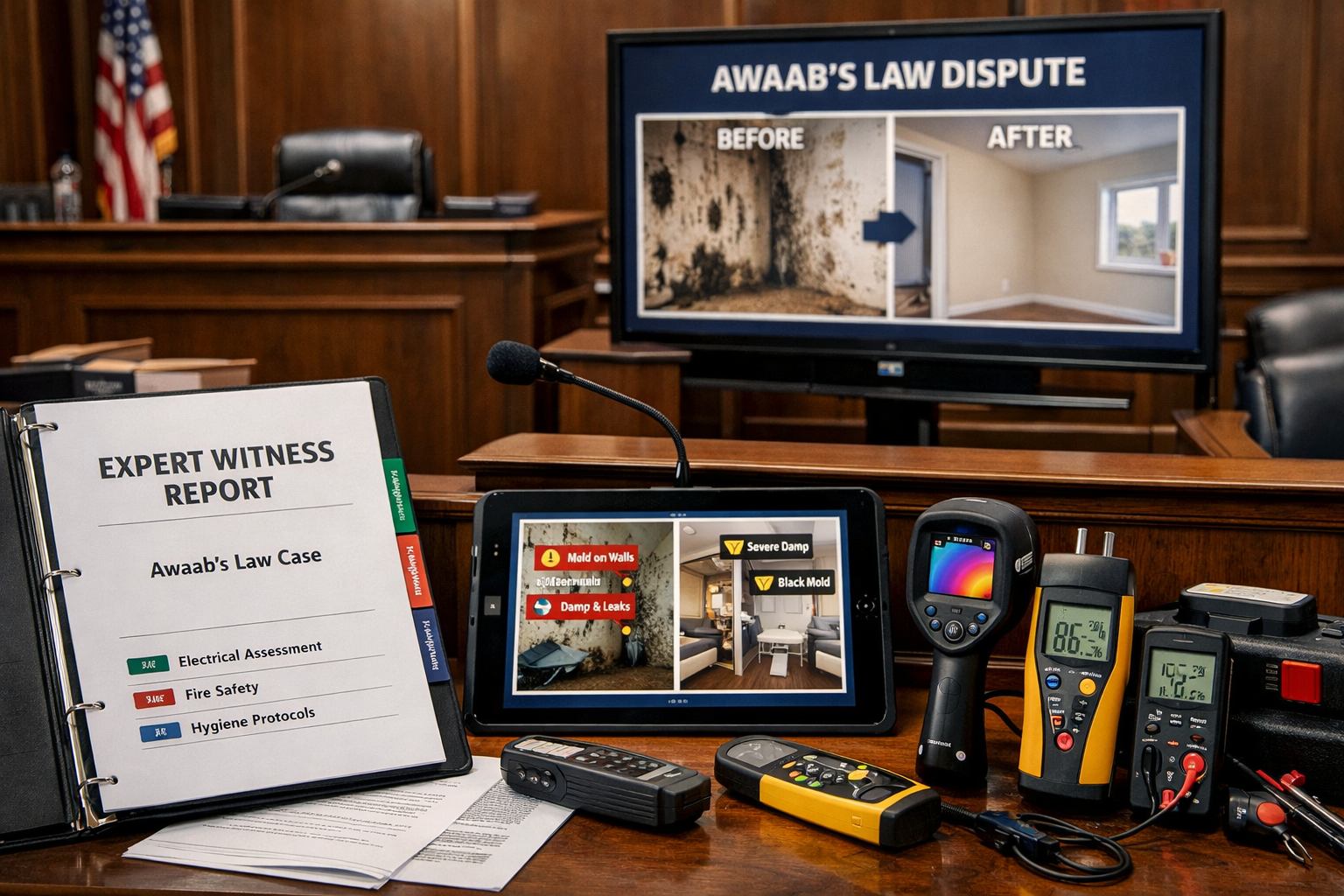
- Equipment used (thermal cameras, moisture meters, electrical testers)
- Testing protocols and standards applied
- Limitations and constraints on inspection
5. Findings and Analysis
- Detailed hazard identification with photographic evidence
- HHSRS scoring and categorization
- Causation analysis linking hazards to specific failures
- Timeline reconstruction of landlord response
6. Compliance Evaluation
- Assessment against statutory timeframes
- Documentation review of landlord investigations
- Adequacy of remediation measures
- Ongoing monitoring requirements
7. Compensation Assessment
- Rent refund calculations with supporting methodology
- Property damage valuations
- Health impact assessments (coordinated with medical experts)
- Recommendations for alternative accommodation if applicable
8. Conclusions and Recommendations
- Summary of key findings
- Opinion on landlord compliance
- Proportionate remediation measures
- Cost estimates for required works
Quality Assurance and Peer Review
Before submitting expert witness reports for Awaab's Law disputes, professionals should implement:
✅ Technical peer review – Independent verification of assessment methodologies and findings
✅ Legal compliance check – Confirmation all statutory requirements are addressed
✅ Documentation audit – Verification all referenced evidence is properly cited and available
✅ Calculation verification – Independent review of compensation calculations and valuations
Many experts recommend engaging with professional surveying services that maintain quality assurance protocols specifically for expert witness work.
Common Pitfalls to Avoid
Expert witnesses preparing reports for Awaab's Law disputes should avoid:
❌ Advocacy – Appearing to favor one party over objective analysis
❌ Scope creep – Addressing issues beyond the expert's specific instructions
❌ Insufficient documentation – Failing to provide comprehensive photographic and testing evidence
❌ Ambiguous conclusions – Using hedging language that undermines report credibility
❌ Delayed reporting – Missing court deadlines due to inadequate project management
Extension to Private Sector: Renters' Rights Bill Implications
Upcoming Changes for Private Landlords
The government plans to extend Awaab's Law to private landlords via the Renters' Rights Bill, requiring identical investigation and repair deadlines[2]. This expansion will significantly increase the volume of disputes requiring expert witness involvement.
Timeline and Implementation
While the exact implementation date remains subject to parliamentary approval, industry experts anticipate:
- 2026-2027 – Legislation passage and regulatory framework development
- 2027-2028 – Phased implementation for private sector landlords
- 2028 onwards – Full enforcement with penalty regimes for non-compliance
Preparing for Private Sector Expansion
Expert witnesses should prepare for the private sector extension by:
- Expanding competency portfolios – Gaining experience across diverse property types and tenancy arrangements
- Developing standardized protocols – Creating efficient assessment methodologies scalable to increased caseloads
- Building professional networks – Establishing relationships with legal professionals, environmental health officers, and specialist consultants
- Investing in technology – Adopting advanced detection equipment and digital reporting platforms
- Continuous professional development – Staying current with evolving regulations and case law
For professionals seeking to understand broader property assessment requirements, reviewing comprehensive survey options provides valuable context for integrating Awaab's Law protocols into standard practice.
Market Impact and Demand Projections
Industry analysts predict the private sector extension will:
- Generate 40% increase in expert witness demand for hazard assessment disputes[1]
- Create specialized practice areas for electrical, fire, and hygiene hazard experts
- Increase average dispute resolution costs by 25-35% due to technical complexity
- Drive consolidation among surveying firms seeking to offer comprehensive hazard assessment services
Technology and Innovation in Hazard Detection
Modern Detection Equipment
Expert witnesses preparing reports under the 2026 expansions must demonstrate competency with modern detection technology[2], including:
Thermal Imaging Cameras
Identify heat loss, thermal bridging, electrical hotspots, and moisture infiltration patterns
Moisture Meters
Quantify moisture content in building materials to distinguish active leaks from historic staining
Electrical Testing Equipment
Insulation resistance testers, earth loop impedance testers, and RCD verification devices
Air Quality Monitors
Measure temperature, humidity, CO₂ levels, and volatile organic compounds
Borescopes and Endoscopes
Inspect concealed spaces, cavities, and inaccessible areas without destructive investigation
Digital Reporting Platforms
Leading expert witnesses increasingly adopt digital reporting platforms that:
- Generate standardized report templates compliant with CPR Part 35
- Integrate photographic evidence with annotated markings and measurements
- Produce interactive timelines showing hazard progression and landlord response
- Calculate compensation automatically based on inputted hazard parameters
- Facilitate secure sharing with legal teams and opposing experts
Artificial Intelligence and Predictive Analytics
Emerging technologies are beginning to assist expert witnesses through:
- Image recognition algorithms – Automatically identifying hazard indicators in property photographs
- Predictive maintenance models – Analyzing historical data to project future hazard development
- Natural language processing – Extracting relevant information from extensive documentation sets
- Comparative analysis tools – Benchmarking landlord response times against statutory requirements
While these technologies enhance efficiency, expert witnesses must maintain professional judgment and avoid over-reliance on automated assessments.
Case Studies: Awaab's Law Disputes in Practice
Case Study 1: Electrical Hazard Dispute
Scenario: Tenant reported exposed wiring in kitchen on January 15, 2026. Landlord inspected on January 30 (15 days later) and completed repairs on February 12 (28 days after initial report).
Expert Witness Findings:
- Electrical hazard constituted "emergency hazard" requiring 24-hour investigation
- Landlord breached statutory timeframes by 14 days for investigation, 21 days for remediation
- Exposed wiring created significant shock and fire risks scoring Category 1 under HHSRS
- Tenant entitled to 45% rent refund for 28-day exposure period
Compensation Awarded: £840 rent refund (£1,800 monthly rent × 45% × 28/30 days) plus £2,500 for anxiety and stress.
Case Study 2: Fire Safety Failure
Scenario: Multiple tenants in converted house reported non-functional smoke detectors and blocked fire escape. Landlord failed to respond for 21 days.
Expert Witness Findings:
- Fire safety hazards constituted "significant hazards" requiring 14-day investigation and 7-day remediation
- Landlord breached investigation deadline by 7 days
- Lack of working detection systems and blocked escape created imminent life-safety risks
- Property should have been deemed uninhabitable pending remediation
Compensation Awarded: Alternative accommodation costs (£1,200 for 3 weeks) plus 60% rent refund for affected period (£2,160) plus £4,000 personal injury compensation for psychological distress.
Case Study 3: Hygiene Hazard Complex Case
Scenario: Tenant reported persistent sewage odor and bathroom drainage issues. Landlord conducted superficial inspection but failed to identify underlying drainage collapse.
Expert Witness Findings:
- Initial investigation inadequate—failed to employ CCTV drainage survey
- Collapsed drain constituted Category 1 hazard under HHSRS for sanitation and hygiene
- Tenant exposed to health risks for 6 months due to inadequate investigation
- Remediation required extensive drainage repairs costing £8,500
Compensation Awarded: £4,320 rent refund (40% × 6 months × £1,800) plus £3,200 for damaged carpets and furniture plus £6,000 for documented respiratory illness exacerbated by poor sanitation.
Conclusion
The Awaab's Law 2026 Hazard Expansions in Expert Witness Reports: Protocols for Electrical, Fire, and Hygiene Disputes represent a fundamental shift in how property professionals approach hazard assessments in the rental sector. With five new hazard categories, compressed statutory timeframes, and significant compensation exposure for landlords, expert witnesses must adapt their methodologies and reporting protocols to meet evolving requirements.
Key Action Steps for Expert Witnesses
- Obtain HHSRS certification – Demonstrate formal competency in the Housing Health & Safety Rating System
- Invest in detection technology – Acquire thermal imaging cameras, moisture meters, and electrical testing equipment
- Develop standardized templates – Create CPR Part 35-compliant report frameworks for each hazard category
- Build multidisciplinary networks – Establish relationships with electrical engineers, fire safety specialists, and environmental health professionals
- Monitor legislative developments – Track the Renters' Rights Bill progress and prepare for private sector extension
- Implement quality assurance protocols – Establish peer review processes and documentation standards
For Landlords and Property Managers
Understanding these protocols is essential for:
- Compliance planning – Implementing systems to meet statutory investigation and remediation deadlines
- Risk mitigation – Conducting proactive hazard assessments before tenant complaints
- Documentation management – Maintaining comprehensive records that demonstrate regulatory compliance
- Expert engagement – Knowing when to retain professional witnesses for dispute resolution
For Tenants and Advocates
Awareness of Awaab's Law 2026 expansions empowers tenants to:
- Assert statutory rights – Demand timely investigations and remediation for reported hazards
- Document hazard exposure – Maintain photographic evidence and written complaint records
- Seek appropriate compensation – Understand available remedies including rent refunds and personal injury claims
- Engage expert support – Retain qualified witnesses when landlords fail to meet obligations
The expansion of Awaab's Law represents not just regulatory change, but a cultural shift toward prioritizing tenant health and safety across the UK housing sector. Expert witnesses who master these protocols will play a crucial role in ensuring accountability and driving improved standards throughout the rental market.
For professional assistance with property assessments and expert witness services, contact qualified surveyors experienced in hazard evaluation and litigation support.
References
[1] Expert Witness Preparation For Awaabs Law Expansion Disputes 2026 Hazard Assessments In Rental Valuations – https://nottinghillsurveyors.com/blog/expert-witness-preparation-for-awaabs-law-expansion-disputes-2026-hazard-assessments-in-rental-valuations
[2] Awaabs Law – https://www.rpclegal.com/thinking/construction/awaabs-law/
[3] Awaabs Law Private Rented Sector Extension – https://awaabs-law.com/awaabs-law-private-rented-sector-extension