
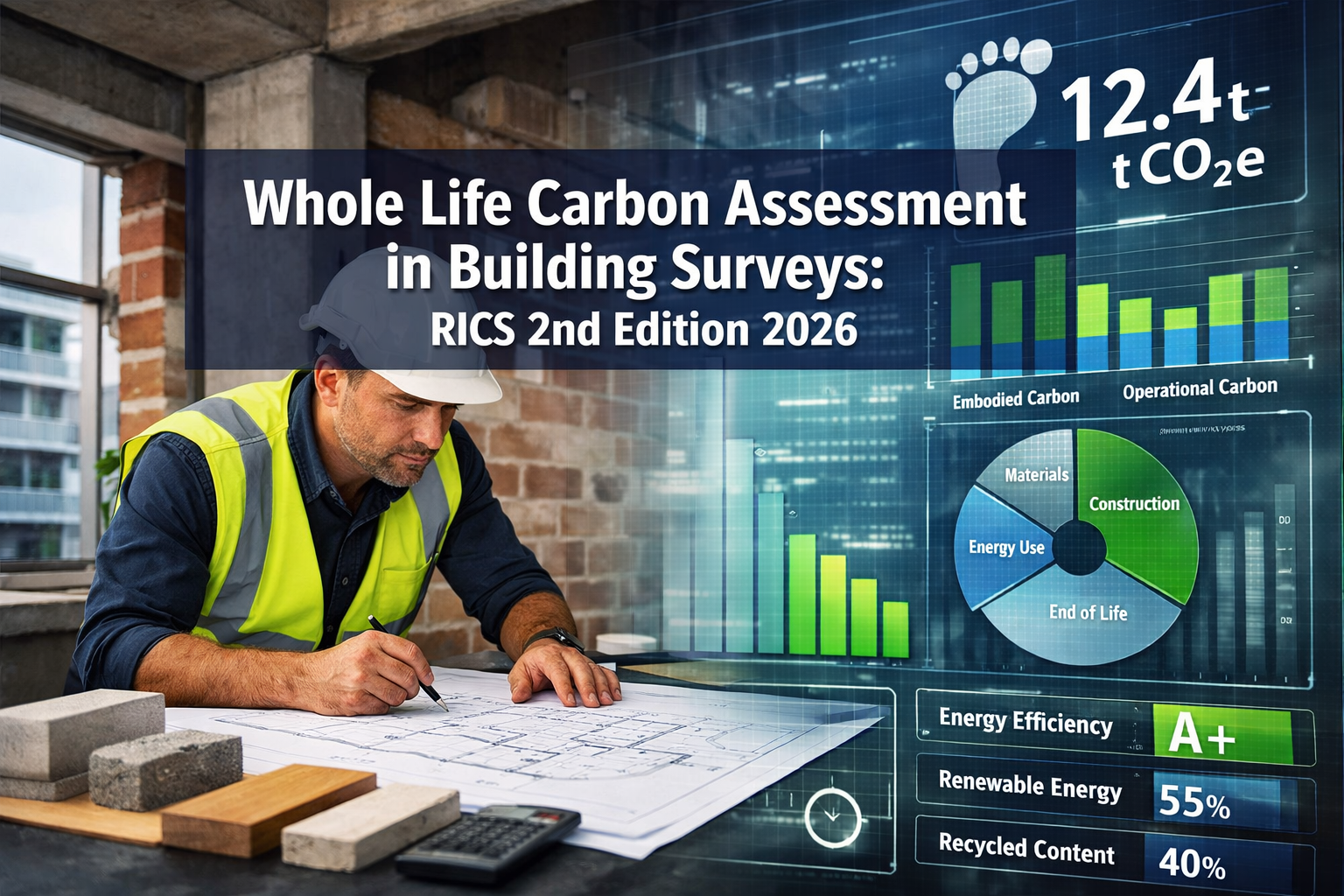
Buildings account for nearly 40% of global carbon emissions, yet most property assessments still ignore the carbon footprint embedded within walls, floors, and foundations. The Royal Institution of Chartered Surveyors (RICS) has responded to this critical gap with their updated Whole Life Carbon Assessment standard, now in its 2nd Edition and integrated with PAS 2080:2023. As we navigate 2026, Whole Life Carbon Assessment in Building Surveys: RICS 2nd Edition Standard and Surveyor Implementation in 2026 represents a fundamental shift in how chartered surveyors evaluate properties—moving beyond traditional structural concerns to embrace comprehensive environmental accountability.
This transformation affects every RICS building survey conducted today, requiring surveyors to develop new competencies and deploy specialized assessment tools.
Key Takeaways
- 🌍 RICS 2nd Edition integrates PAS 2080:2023 standards, creating a unified framework for measuring embodied, operational, and end-of-life carbon in buildings
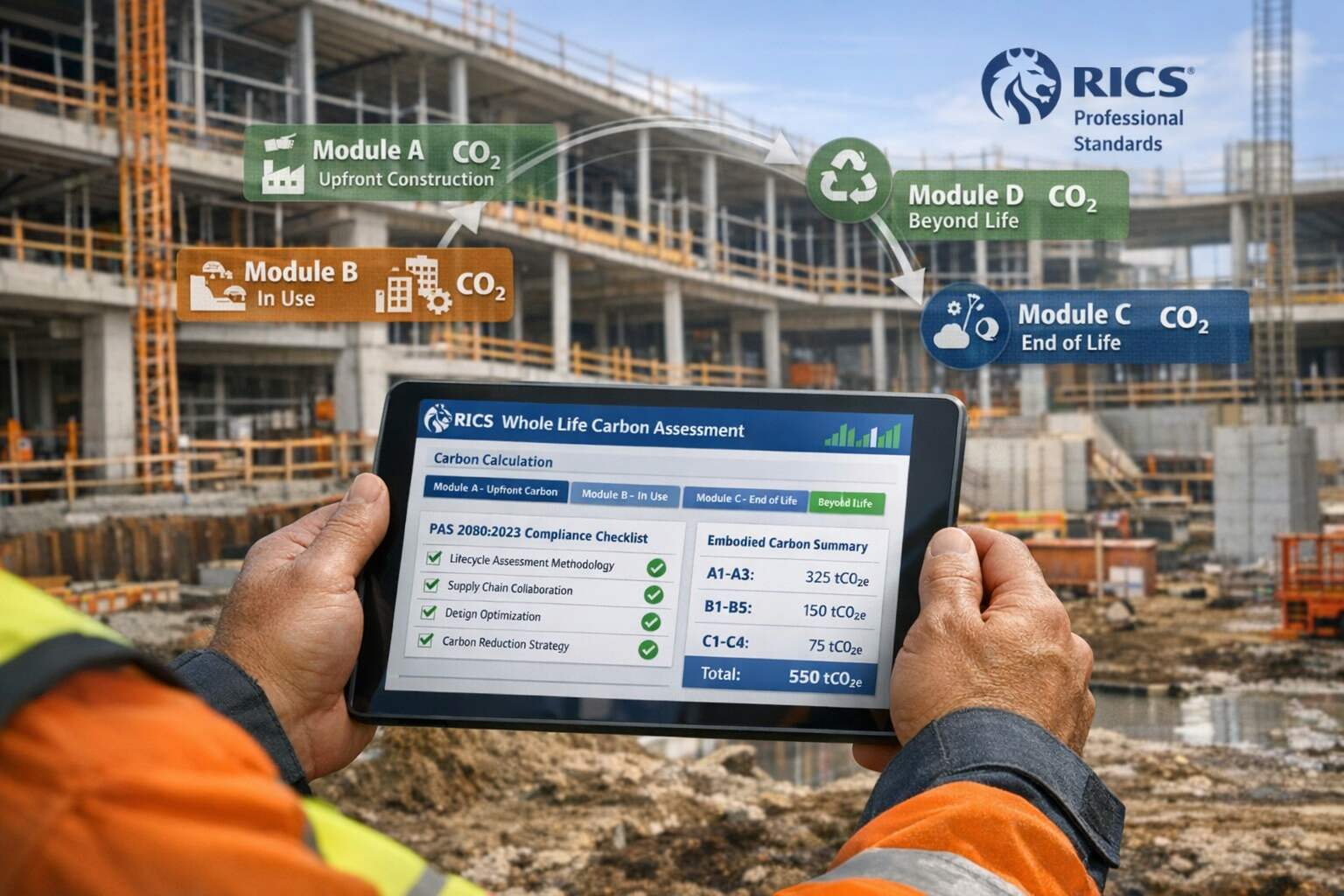
- 📊 Surveyors must now assess carbon across all lifecycle stages (Modules A-D), not just operational energy performance
- 🔧 Practical implementation requires new tools and training, including carbon calculation software, material databases, and updated survey methodologies
- 💼 Building surveys in 2026 increasingly incorporate carbon assessments to meet regulatory requirements and client sustainability objectives
- ⚡ Retrofit and refurbishment decisions now prioritize carbon reduction alongside traditional cost-benefit analysis
Understanding Whole Life Carbon Assessment: The RICS 2nd Edition Framework
What Is Whole Life Carbon Assessment?
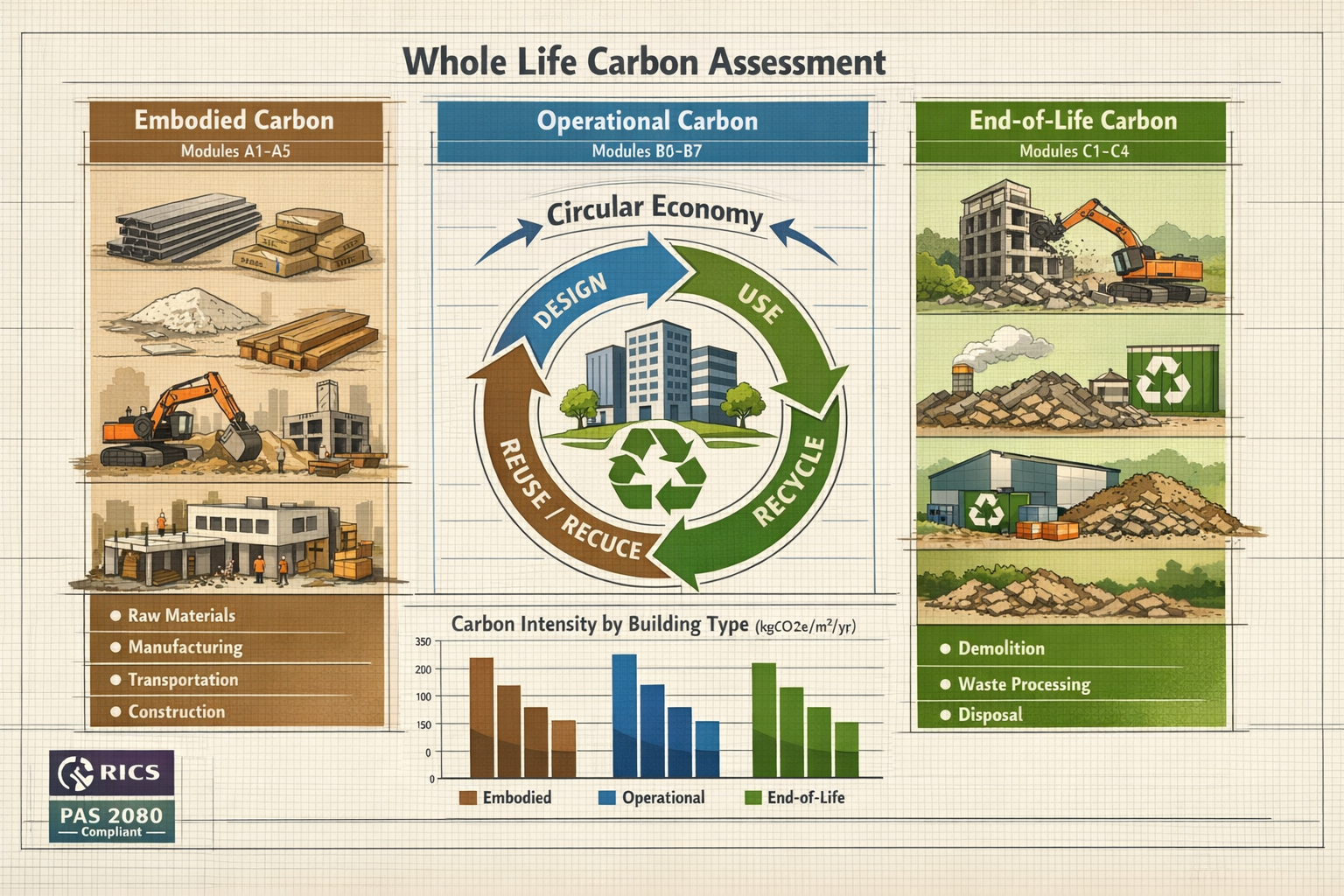
Whole Life Carbon (WLC) assessment measures the total greenhouse gas emissions associated with a building throughout its entire lifecycle. Unlike traditional energy performance certificates that focus solely on operational energy, WLC encompasses three critical components:
Embodied Carbon 🏗️ – Emissions from material extraction, manufacturing, transportation, and construction (Modules A1-A5)
Operational Carbon ⚡ – Emissions from energy use during building occupation, maintenance, and repairs (Modules B1-B7)
End-of-Life Carbon ♻️ – Emissions from demolition, waste processing, and disposal or recycling (Modules C1-C4)
The RICS 2nd Edition standard, published in 2024 and now widely adopted in 2026, aligns with international frameworks including:
- PAS 2080:2023 (Carbon Management in Buildings and Infrastructure)
- EN 15978 (Sustainability Assessment of Construction Works)
- GHG Protocol (Greenhouse Gas Accounting Standards)
Key Updates in the 2nd Edition
The updated standard introduces several significant changes that directly impact how chartered surveyors conduct building assessments:
| Feature | 1st Edition | 2nd Edition (2026) |
|---|---|---|
| PAS 2080 Integration | Referenced separately | Fully integrated methodology |
| Module Coverage | Primarily A1-A5, B6 | Comprehensive A-D coverage |
| Retrofit Guidance | Limited | Extensive retrofit protocols |
| Data Quality Standards | Basic requirements | Tiered data quality framework |
| Surveyor Competency | General awareness | Specific training pathways |
| Software Compatibility | Varied | Standardized calculation tools |
The 2nd Edition recognizes that existing buildings represent the majority of surveying work and provides detailed guidance for assessing retrofit scenarios—a critical consideration for properties undergoing condition surveys.
The Carbon Lifecycle Modules Explained
Understanding the modular structure is essential for surveyors implementing Whole Life Carbon Assessment in Building Surveys: RICS 2nd Edition Standard and Surveyor Implementation in 2026:
Module A (Product & Construction Stage)
- A1-A3: Raw material supply, transport, and manufacturing
- A4: Transport to construction site
- A5: Construction and installation processes
Module B (Use Stage)
- B1-B5: Use, maintenance, repair, replacement, and refurbishment
- B6-B7: Operational energy and water use
Module C (End-of-Life Stage)
- C1-C4: Deconstruction, transport, waste processing, and disposal
Module D (Beyond Building Life)
- Benefits and loads from reuse, recovery, and recycling potential
Practical Implementation for Surveyors in 2026
Integrating Carbon Assessment into Traditional Building Surveys
The challenge for surveyors in 2026 is seamlessly incorporating carbon assessment into established survey methodologies without compromising the core inspection process. When conducting a Level 3 building survey, surveyors now follow an expanded protocol:
Step 1: Initial Property Assessment 📋
- Document building age, construction type, and materials
- Identify structural systems (timber frame, masonry, steel, concrete)
- Record existing insulation, glazing, and building services
- Photograph material specifications and construction details
Step 2: Material Carbon Intensity Data Collection 🔍
- Reference standardized carbon databases (ICE Database, EPD Library)
- Calculate approximate material quantities from visual inspection
- Apply carbon factors for primary structural elements
- Document material condition affecting replacement cycles
Step 3: Operational Carbon Evaluation ⚡
- Review existing EPC ratings and energy consumption data
- Assess heating, ventilation, and cooling systems
- Evaluate renewable energy installations
- Project operational carbon over assessment period (typically 60 years)
Step 4: End-of-Life Scenario Modeling ♻️
- Assess potential for material recovery and reuse
- Evaluate demolition versus refurbishment carbon implications
- Consider circular economy opportunities
- Calculate Module C and D carbon values
Step 5: Retrofit Recommendations 🔧
- Prioritize interventions by carbon reduction potential
- Compare embodied carbon of improvements versus operational savings
- Provide carbon payback period calculations
- Align recommendations with client sustainability targets
Essential Tools and Software for Carbon Assessment
Surveyors implementing Whole Life Carbon Assessment in Building Surveys: RICS 2nd Edition Standard and Surveyor Implementation in 2026 require specialized digital tools:
Carbon Calculation Software 💻
- One Click LCA
- eTool
- RICS WLC Calculator (2nd Edition compatible)
- IES Virtual Environment
Material Databases 📚
- ICE Database (Inventory of Carbon & Energy)
- EPD Hub (Environmental Product Declarations)
- RICS Material Carbon Database
- Local supplier-specific data
BIM Integration Tools 🏗️
- Revit with carbon analysis plugins
- ArchiCAD EcoDesigner
- IFC file carbon extraction tools
Survey Documentation Software 📱
- Mobile survey apps with carbon modules
- Cloud-based reporting platforms
- Photographic documentation with material tagging
- Client portal systems for carbon reporting
Training and Competency Requirements
The RICS has established clear competency pathways for surveyors working with carbon assessment. In 2026, professionals conducting comprehensive building surveys must demonstrate:
✅ Core Knowledge
- Understanding of carbon accounting principles
- Familiarity with PAS 2080:2023 and RICS standards
- Material carbon intensity awareness
- Lifecycle assessment methodology
✅ Technical Skills
- Proficiency with carbon calculation software
- Material quantity estimation from visual inspection
- Data quality assessment and uncertainty management
- Carbon reporting and communication
✅ Professional Development
- RICS-accredited WLC training courses (minimum 16 CPD hours)
- Annual updates on evolving standards
- Peer review participation
- Client advisory capability
Surveyor Implementation Challenges and Solutions in 2026
Common Implementation Barriers
Despite the clear framework provided by Whole Life Carbon Assessment in Building Surveys: RICS 2nd Edition Standard and Surveyor Implementation in 2026, practitioners face several practical challenges:
Challenge 1: Data Availability and Quality 📊
Many existing buildings lack comprehensive construction records, making accurate embodied carbon calculation difficult. Surveyors must often rely on:
- Visual material identification
- Age-appropriate construction standards
- Generic carbon factors rather than specific EPDs
- Conservative estimation methodologies
Solution: The RICS 2nd Edition introduces a tiered data quality framework, allowing surveyors to clearly communicate uncertainty levels. When conducting specific defect surveys, surveyors can use representative values with appropriate confidence intervals.
Challenge 2: Time and Cost Constraints ⏱️
Carbon assessment adds complexity to traditional survey work. Clients accustomed to standard survey fees may resist additional costs for carbon analysis.
Solution: Surveyors are developing tiered service offerings:
- Basic carbon screening (included in standard surveys)
- Intermediate carbon assessment (for renovation projects)
- Comprehensive WLC analysis (for major developments and retrofits)
This approach mirrors the existing survey level structure, making it familiar to clients.
Challenge 3: Software Integration 💻
Many established surveying practices use legacy systems that don't accommodate carbon data collection and reporting.
Solution: Cloud-based platforms now offer API integration with traditional survey software, allowing carbon modules to be added without complete system replacement. This enables surveyors to maintain existing workflows while expanding capabilities.
Case Study: Victorian Terrace Retrofit Assessment
Consider a typical scenario in 2026: A client commissioning a survey on a Victorian terrace property in London, seeking guidance on renovation priorities with sustainability objectives.
Traditional Survey Findings:
- Solid wall construction (no cavity)
- Single-glazed sash windows
- Suspended timber ground floor
- Gas central heating (20 years old)
- Slate roof in fair condition
Carbon Assessment Integration:
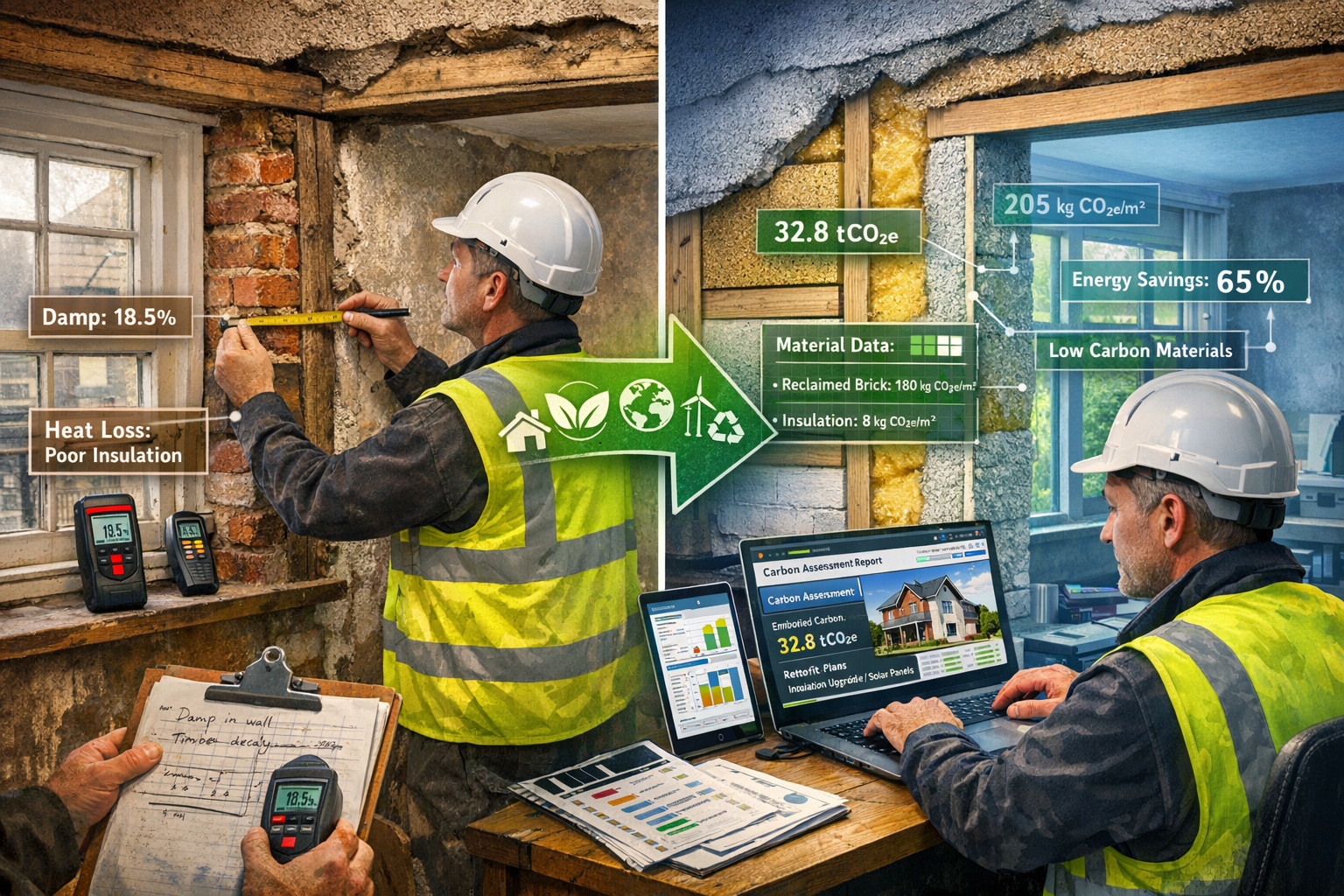
The surveyor calculates that the embodied carbon of the existing structure represents approximately 450 kgCO2e/m² (primarily in the masonry and timber elements). The operational carbon currently runs at 65 kgCO2e/m²/year due to poor thermal performance.
Retrofit Recommendations with Carbon Analysis:
| Intervention | Embodied Carbon Impact | Operational Saving | Carbon Payback |
|---|---|---|---|
| Internal wall insulation | +15 kgCO2e/m² | -18 kgCO2e/m²/year | 0.8 years |
| Secondary glazing | +8 kgCO2e/m² | -12 kgCO2e/m²/year | 0.7 years |
| Floor insulation | +5 kgCO2e/m² | -8 kgCO2e/m²/year | 0.6 years |
| Heat pump installation | +12 kgCO2e/m² | -25 kgCO2e/m²/year | 0.5 years |
| Total package | +40 kgCO2e/m² | -63 kgCO2e/m²/year | 0.6 years |
This analysis demonstrates that the carbon investment in improvements pays back in less than one year—a compelling argument for immediate action. Without this carbon perspective, clients might prioritize interventions based solely on financial payback, potentially missing optimal sustainability outcomes.
Regulatory Drivers and Market Demand
Several factors are accelerating the adoption of Whole Life Carbon Assessment in Building Surveys: RICS 2nd Edition Standard and Surveyor Implementation in 2026:
Building Regulations Updates 📜
- England's Part Z (expected 2027) will mandate WLC assessment for major projects
- Scotland's enhanced Section 7 already requires carbon consideration
- Local planning authorities increasingly request carbon statements
Mortgage and Insurance Considerations 🏦
- Lenders beginning to factor carbon risk into valuations
- Insurance premiums reflecting climate resilience
- Green mortgage products requiring carbon assessment
Corporate Sustainability Commitments 🌱
- Commercial property owners targeting net-zero portfolios
- ESG reporting requirements for institutional investors
- Supply chain carbon accounting extending to real estate
Buyer Expectations 🏡
- Increasing awareness among first-time buyers about environmental impact
- Premium values for low-carbon properties
- Carbon disclosure becoming standard in property marketing
Integration with Other Survey Services
Carbon assessment complements and enhances other surveying services:
Stock Condition Surveys 🏢
When conducting stock condition surveys for property portfolios, carbon assessment enables:
- Portfolio-level carbon baseline establishment
- Prioritization of interventions across multiple properties
- Long-term decarbonization pathway planning
- Investment optimization for sustainability goals
Dilapidations Assessments 📋
In dilapidations work, carbon considerations affect:
- Reinstatement versus retention decisions
- Material specification for remedial works
- Waste management and circular economy opportunities
- Schedule of condition carbon implications
Property Valuations 💰
RICS property valuations increasingly incorporate:
- Carbon risk assessment affecting value
- Premium for low-carbon buildings
- Obsolescence risk for high-carbon properties
- Future-proofing considerations
Best Practices for Client Communication
Effectively communicating carbon assessment findings requires translating technical data into actionable insights:
Visual Reporting 📊
- Use infographics showing carbon lifecycle breakdown
- Provide comparative benchmarks (similar properties, standards)
- Illustrate carbon payback timelines graphically
- Show cumulative carbon impact over building life
Plain Language Explanations 💬
- Avoid jargon like "kgCO2e/m²" without context
- Use relatable comparisons (car miles, tree planting equivalents)
- Explain why carbon matters for property value and performance
- Connect to client's stated objectives and concerns
Actionable Recommendations ✅
- Prioritize interventions by carbon impact and feasibility
- Provide phased implementation options
- Include cost-benefit analysis alongside carbon metrics
- Link to available grants and incentive schemes
Ongoing Support 🤝
- Offer post-survey consultation on implementation
- Connect clients with carbon-competent contractors
- Provide monitoring survey services to verify improvements
- Support with regulatory compliance documentation
Conclusion
The integration of Whole Life Carbon Assessment in Building Surveys: RICS 2nd Edition Standard and Surveyor Implementation in 2026 represents more than a technical update to professional standards—it reflects a fundamental evolution in how the built environment sector addresses climate responsibility. Surveyors now serve as critical advisors in the decarbonization journey, bridging traditional building assessment expertise with emerging sustainability imperatives.
For practitioners, successful implementation requires investment in training, tools, and methodologies. However, this investment positions surveyors at the forefront of an inevitable market transformation. Properties with comprehensive carbon assessment and optimization will command premium values, while high-carbon buildings face increasing obsolescence risk.
For property owners and buyers, carbon-informed surveys provide essential intelligence for making sustainable investment decisions. Whether purchasing a period property requiring sensitive retrofit or evaluating a modern development's environmental credentials, carbon assessment delivers actionable insights that protect long-term value while contributing to climate goals.
Next Steps for Surveyors
✅ Complete RICS-accredited WLC training and register for ongoing CPD updates
✅ Evaluate and implement carbon calculation software compatible with existing workflows
✅ Develop carbon assessment service offerings with clear pricing and scope definitions
✅ Update survey templates and reporting formats to incorporate carbon metrics
✅ Build relationships with carbon-competent contractors for client referrals
✅ Join professional networks focused on sustainable building assessment
Next Steps for Property Owners and Buyers
✅ Request carbon assessment when commissioning building surveys in 2026
✅ Use carbon data to inform renovation priorities and investment decisions
✅ Consider carbon implications when negotiating purchase prices
✅ Engage with surveyors who demonstrate carbon assessment competency
✅ Plan for future regulatory requirements by addressing carbon now
The RICS 2nd Edition standard provides the framework, but successful implementation depends on professional commitment and client engagement. As 2026 progresses, carbon-informed building surveys will transition from innovative practice to industry standard—positioning early adopters as leaders in sustainable property assessment.