
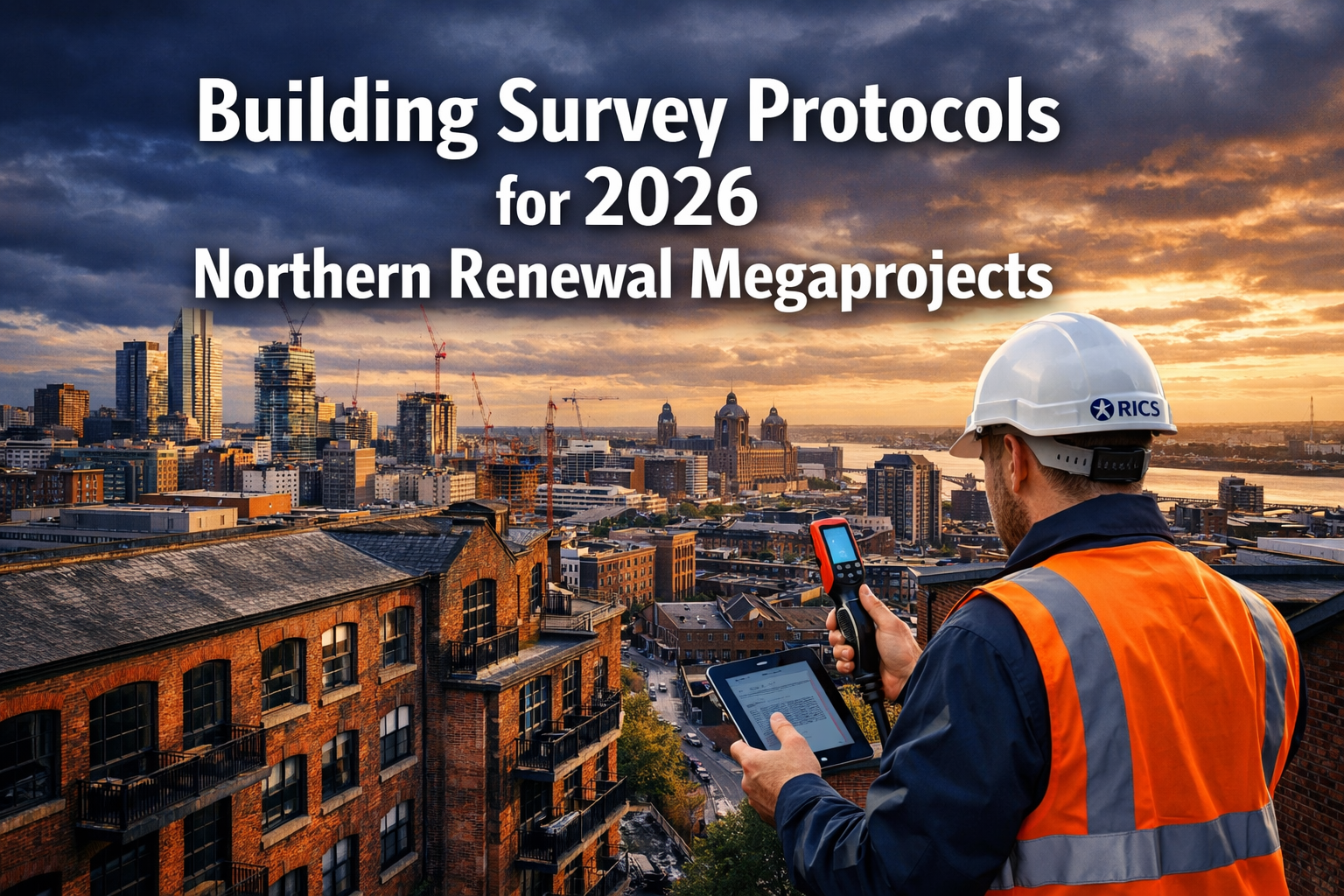
While London's property market stagnates, Manchester and Liverpool are experiencing explosive growth in 2026. The Northern Powerhouse renaissance has triggered unprecedented regeneration activity, transforming Victorian warehouses into luxury apartments and derelict industrial sites into thriving mixed-use developments. This boom brings unique challenges for building surveyors who must navigate complex structural assessments across megaprojects that blend heritage preservation with modern construction. Understanding Building Survey Protocols for 2026 Northern Renewal Megaprojects: RICS Guidance on Structural Assessments in Manchester and Liverpool Booms has become essential for property professionals operating in these rapidly evolving markets.
The Royal Institution of Chartered Surveyors (RICS) has responded to these regional shifts with updated standards specifically addressing the volume increases and technological innovations required for large-scale urban renewal projects. As surveying demand surges throughout 2026, professionals must master enhanced protocols that balance speed with thoroughness while maintaining the rigorous standards expected from RICS-accredited surveyors.
Key Takeaways
- 🏗️ RICS is developing a 2nd edition Home Survey Standard with enhanced regulatory frameworks, technology integration, and AI guidance specifically addressing high-volume regeneration markets[6]
- 📊 Level 3 Building Surveys require significantly more invasive inspections than Level 2, including lifted carpets, opened windows, roof space entry, and insulation assessment—critical for converted heritage buildings[3]
- 💰 Professional building survey assessments start at £320 for new builds in 2026, with comprehensive Level 3 surveys commanding higher fees for complex regeneration projects[5]
- 🚁 Drone inspections and AI-powered defect detection are now optional services under updated RICS guidance, enabling faster assessments across large development portfolios[6]
- 📍 RICS-accredited providers maintain dedicated offices in Altrincham and Liverpool, offering local expertise essential for understanding regional construction patterns and heritage building challenges[4]
Understanding the Northern Renewal Context: Why Building Survey Protocols Matter in 2026
The economic geography of UK property has fundamentally shifted. Manchester and Liverpool now lead national growth metrics, driven by substantial infrastructure investment, corporate relocations, and government-backed regeneration schemes. This transformation has created a perfect storm for surveying professionals: unprecedented project volumes, compressed timelines, and buildings with complex histories requiring specialist assessment.
The Scale of Northern Megaprojects
Northern renewal initiatives in 2026 encompass:
- Mixed-use developments combining residential, commercial, and leisure spaces
- Heritage conversions transforming Grade II listed warehouses and mills
- New-build high-rises on former industrial brownfield sites
- Infrastructure-linked projects connected to HS2 and Northern Powerhouse Rail
- Affordable housing schemes meeting government targets
Each project type demands tailored survey approaches. A Victorian cotton mill conversion in Manchester's Ancoats district requires fundamentally different assessment protocols than a glass-and-steel residential tower in Liverpool's Baltic Triangle. The surveying sector expects substantial volume increases throughout 2026, with potential government reforms to standardize property condition assessments[1].
Regional Structural Characteristics
North West England's building stock presents distinctive challenges:
| Building Type | Common Issues | Survey Priority |
|---|---|---|
| Victorian Warehouses | Load-bearing wall stability, timber decay, inadequate foundations | High |
| Industrial Conversions | Contaminated land, structural modifications, fire safety | Critical |
| Terraced Housing | Subsidence, damp penetration, shared structural elements | Medium-High |
| New-Build Apartments | Construction defects, cladding compliance, warranty coverage | Medium |
| Heritage Properties | Listed building constraints, original materials degradation | Critical |
Understanding these regional patterns enables surveyors to develop targeted inspection protocols that identify risks efficiently without compromising thoroughness.
RICS Home Survey Standards: The 2026 Framework for Structural Assessments
The RICS Home Survey Standard serves as the authoritative framework governing professional property assessments across the UK. As of February 2026, the 2nd edition is undergoing development with a promised update to members expected in Q1 2026[6]. This revision directly addresses the challenges posed by high-volume regeneration markets and introduces significant enhancements to existing protocols.
Key Updates in the 2nd Edition
The forthcoming RICS standards incorporate several transformative elements:
Enhanced Regulatory Framework: RICS is considering implementing a formal regulatory scheme requiring home survey members to meet specific requirements with dedicated compliance resources and additional auditing, expected to provide greater consumer assurance of standards[6]. This formalization responds to concerns about consistency across the profession, particularly important when assessing complex regeneration projects where structural risks carry higher financial consequences.
Technology and AI Integration: The updated standard includes guidance on the use of technology and artificial intelligence, along with optional drone inspections as additional services[6]. For megaprojects spanning multiple buildings or difficult-to-access heritage structures, drone technology enables comprehensive roof and facade assessments without expensive scaffolding or access equipment.
Volume Capacity Planning: Recognizing the anticipated surge in survey demand, the new standards provide guidance on managing workflow, quality control, and resource allocation during high-volume periods—directly relevant to practices operating in Manchester and Liverpool's booming markets.
The Three-Tier Survey System
RICS maintains three distinct survey levels, each suited to different property types and client needs. Understanding when to recommend each level is crucial for building surveyor services operating in renewal zones.
Level 1 – Condition Report: Basic assessment suitable only for new-build or conventional properties in good condition. Rarely appropriate for Northern renewal projects involving conversions or heritage buildings.
Level 2 – Homebuyer Report: Mid-range survey examining visible defects and providing condition ratings. Suitable for relatively modern properties or straightforward conversions without significant structural alterations.
Level 3 – Building Survey: Comprehensive investigation involving invasive inspection techniques. Essential for heritage conversions, properties with known defects, or buildings undergoing substantial structural modifications—the majority of Northern megaproject units.
For property buyers uncertain about which option suits their needs, resources explaining how to choose between a Homebuyer Report or structural survey provide valuable decision-making frameworks.
Building Survey Protocols for 2026 Northern Renewal Megaprojects: Detailed Assessment Requirements
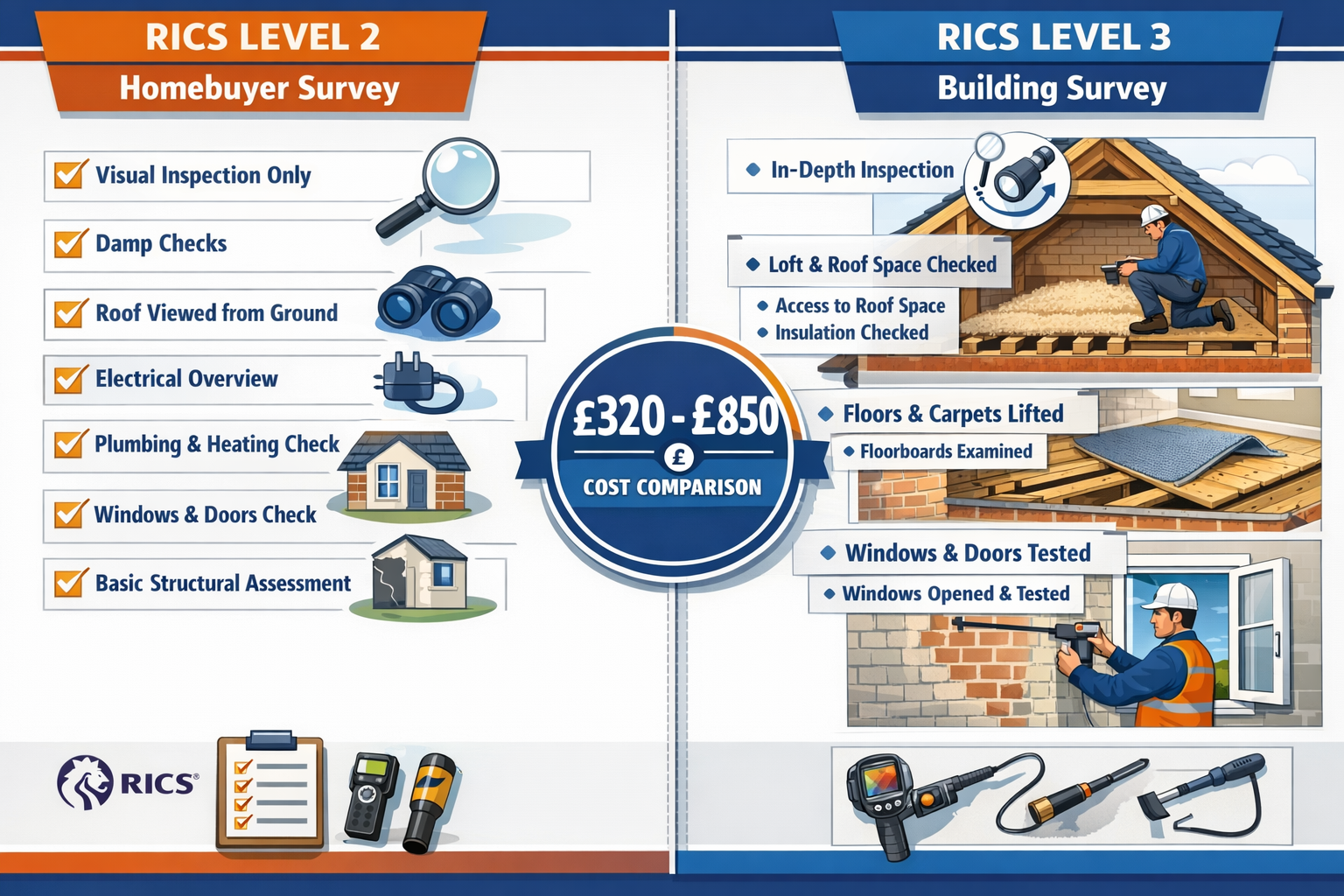
The distinction between Level 2 and Level 3 surveys becomes critical when assessing converted or regenerated properties. The enhanced inspection requirements of Level 3 surveys directly address the hidden defects common in heritage conversions and complex structural modifications.
Comprehensive Window Inspections
Level 3 Protocol: Surveyors must move possessions and curtains where feasible and attempt to open all windows to conduct detailed inspections. This enables assessment of:
- Window mechanism functionality and safety
- Frame condition and rot (particularly in timber sash windows)
- Glazing integrity and thermal performance
- Water ingress evidence around frames
- Structural movement affecting operation
Level 2 Limitation: Only opens one window of each type, potentially missing localized defects common in multi-unit conversions where individual windows may have different installation dates or quality standards[3].
In Manchester's Northern Quarter, where warehouse conversions often feature dozens of large industrial windows, this comprehensive approach identifies defects that could cost thousands to rectify post-purchase.
Detailed Roof Space Assessment
Level 3 Protocol: Surveyors must enter roof spaces and lift corners of insulation to assess both the insulation and ceiling condition, with repositioning of objects allowed for thorough inspection[3]. This reveals:
- Roof structure integrity and modifications
- Insulation type, condition, and adequacy
- Ventilation provision and condensation risks
- Electrical wiring condition and safety
- Evidence of water penetration or pest infestation
This invasive approach proves essential in converted buildings where roof structures may have been modified during conversion, potentially compromising structural integrity or creating concealed defects.
Floor Inspection Requirements
Level 3 Protocol: Surveys include lifting loose carpets and floor coverings to inspect floors, measuring slopes and deflections, and attempting detailed underfloor inspections using direct access, cameras, or mirrors[3]. These requirements address:
- Structural floor integrity and load capacity
- Timber condition and beetle infestation
- Concrete slab cracking or settlement
- Damp-proof membrane effectiveness
- Service installation quality
Critical for Conversions: Many warehouse conversions involve new mezzanine floors or structural modifications to existing floors. Without lifting coverings, surveyors cannot verify that structural calculations have been properly implemented or that adequate support exists.
External and Structural Elements
Level 3 surveys demand comprehensive assessment of:
- Foundation condition: Particularly relevant given Manchester and Liverpool's varied soil conditions and industrial contamination history
- Load-bearing walls: Assessment of structural modifications, lintel adequacy, and movement
- Drainage systems: Often inadequate in converted buildings not originally designed for residential use
- Damp-proofing: Critical in properties where original industrial damp-proofing has been compromised
For properties requiring detailed damp assessments, specialized reports complement comprehensive building surveys.
Technology-Enhanced Survey Protocols: Drones, AI, and Digital Reporting
The integration of technology into Building Survey Protocols for 2026 Northern Renewal Megaprojects represents one of the most significant advances in professional practice. RICS guidance now explicitly accommodates these innovations while maintaining quality standards.
Drone Inspection Capabilities
Optional drone inspections provide several advantages for megaproject assessments[6]:
✅ Roof condition assessment without scaffolding or access equipment
✅ Facade examination on high-rise buildings or difficult-to-reach elevations
✅ Thermal imaging identifying insulation defects or water ingress
✅ Photographic evidence creating comprehensive visual records
✅ Safety improvements reducing surveyor risk in hazardous environments
For a 20-story residential tower in Liverpool's waterfront regeneration zone, drone inspection can reduce assessment time by 40% while improving coverage quality compared to traditional methods.
AI-Powered Defect Detection
Artificial intelligence applications in surveying include:
- Image analysis identifying crack patterns, damp stains, or structural movement
- Predictive maintenance estimating component lifespan based on condition data
- Comparative analysis benchmarking against similar properties or conversions
- Report generation automating routine sections while maintaining professional oversight
Important caveat: RICS guidance emphasizes that technology supplements rather than replaces professional judgment. AI tools assist surveyors but cannot substitute for hands-on inspection and expert interpretation.
Digital Reporting Standards
Modern survey reports incorporate:
- Interactive floor plans with clickable defect markers
- Embedded photography with location metadata
- 3D building models illustrating structural concerns
- Video walkthroughs supplementing written descriptions
- Priority matrices categorizing defects by urgency and cost
These enhancements prove particularly valuable for overseas investors purchasing Northern regeneration properties remotely, providing comprehensive understanding without physical site visits.
Regional Expertise: Manchester and Liverpool-Specific Considerations
Building Survey Protocols for 2026 Northern Renewal Megaprojects: RICS Guidance on Structural Assessments in Manchester and Liverpool Booms must account for regional construction patterns, soil conditions, and heritage characteristics unique to the North West.
Manchester-Specific Factors
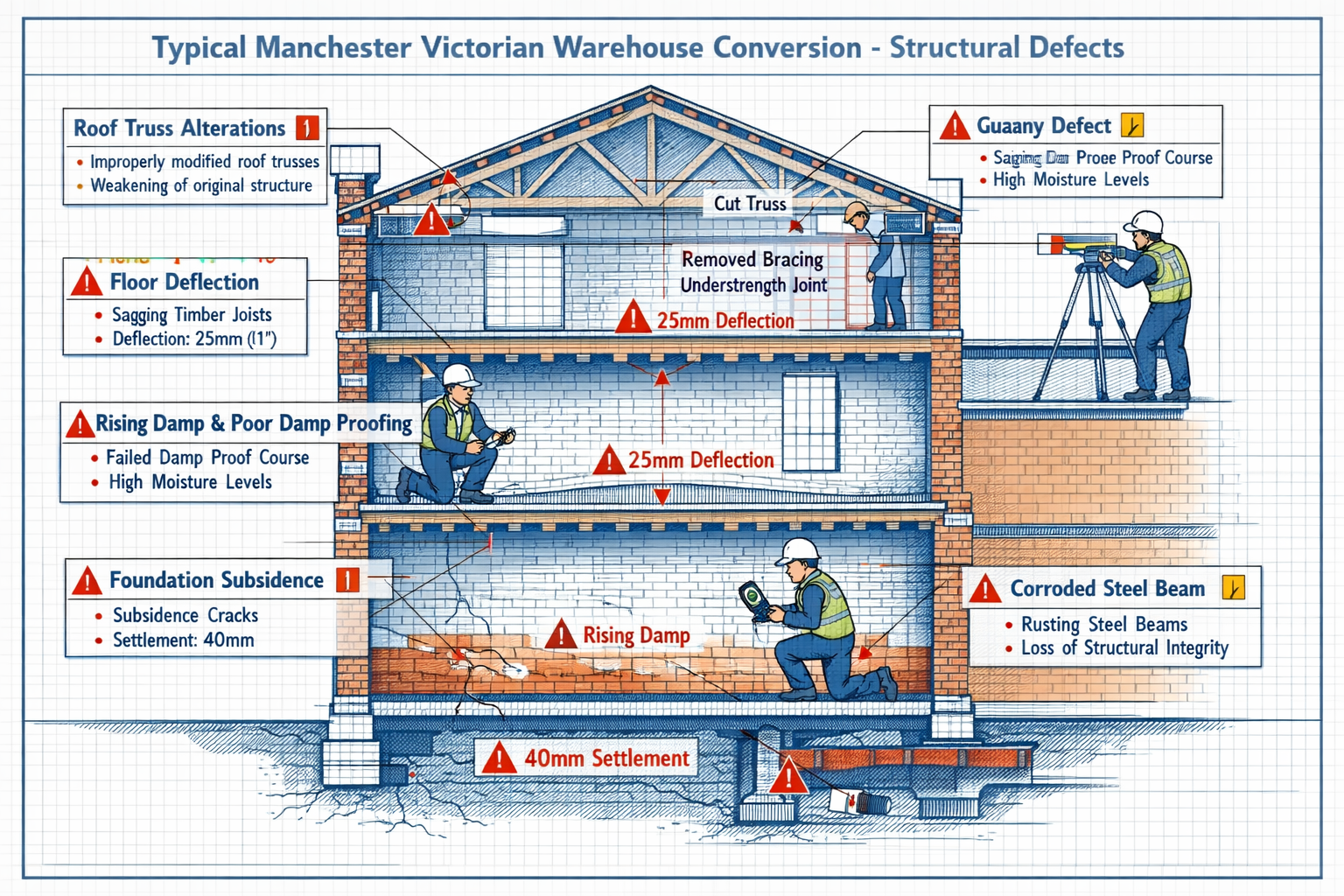
Construction Heritage: Manchester's industrial revolution legacy means many conversion projects involve:
- Red brick construction with lime mortar requiring specialist repointing
- Cast iron structural elements susceptible to corrosion in damp conditions
- Timber beam floors with varying load capacities and decay risks
- Inadequate foundations designed for different load patterns
Soil Conditions: Manchester sits on varied geology including:
- Boulder clay with high shrinkage potential
- Sandstone bedrock with variable quality
- Former industrial sites with contamination risks
- Areas with historical mining activity requiring subsidence assessment
Liverpool-Specific Factors
Maritime Influences: Liverpool's waterfront location creates unique challenges:
- Salt-laden air accelerating metal corrosion and masonry deterioration
- High water tables increasing damp risks and requiring robust tanking
- Dock basin proximity affecting foundation stability in some areas
- Wind exposure requiring enhanced facade and roof fixing standards
Heritage Constraints: Liverpool's UNESCO World Heritage status (though temporarily delisted) means many regeneration projects involve:
- Listed building requirements affecting repair methodologies
- Conservation area restrictions on external alterations
- Archaeological considerations on historically significant sites
- Planning constraints requiring specialist heritage expertise
Local RICS Providers
RICS-accredited survey providers maintain offices in Altrincham (Greater Manchester) and Liverpool (Rodney Street), providing essential local expertise[4]. These regional specialists understand:
- Typical defect patterns in local building types
- Appropriate repair methodologies for heritage structures
- Local authority planning requirements and building control standards
- Regional contractor capabilities and pricing
For projects requiring comprehensive building surveys, engaging surveyors with regional experience ensures protocols are appropriately tailored to local conditions.
Cost Considerations and Survey Pricing for Northern Megaprojects
Understanding the financial aspects of professional surveys enables better budgeting for regeneration projects and helps buyers make informed decisions about survey levels.
2026 Pricing Benchmarks
Independent professional building survey assessments start at £320 for new build properties in 2026[5]. However, pricing varies significantly based on:
| Property Type | Level 2 Survey | Level 3 Survey | Additional Services |
|---|---|---|---|
| New-build apartment | £320-£450 | £600-£850 | Drone: +£150-£250 |
| Standard conversion | £400-£600 | £750-£1,200 | Thermal imaging: +£200-£300 |
| Heritage conversion | £550-£800 | £1,000-£1,800 | Specialist testing: +£300-£600 |
| Large commercial conversion | £800-£1,500 | £1,500-£3,000+ | Multiple visits: +£500+ |
Value Perspective: While comprehensive surveys represent significant upfront costs, they routinely identify defects requiring £10,000-£50,000+ in remedial work. The survey fee typically represents less than 1% of property value while potentially saving 5-10% through:
- Negotiated price reductions based on identified defects
- Avoided purchases of fundamentally flawed properties
- Planned maintenance budgeting preventing emergency repairs
- Insurance claims supported by professional documentation
Resources on saving money with building surveys demonstrate the long-term financial benefits of thorough assessments.
What Influences Survey Costs?
Several factors affect pricing for Northern megaproject assessments:
Property Complexity:
- Single-aspect apartments: Lower complexity, faster assessment
- Multi-level conversions: Increased access requirements and inspection time
- Mixed-use buildings: Multiple survey disciplines required
Access Challenges:
- Scaffolding or lift requirements
- Restricted access periods in occupied buildings
- Security protocols on active construction sites
Additional Testing:
- Structural calculations verification
- Damp meter readings and laboratory analysis
- Electrical installation condition reports
- Asbestos surveys (common in pre-2000 buildings)
Urgency:
- Standard turnaround (7-10 days): Standard pricing
- Expedited reports (3-5 days): 20-30% premium
- Rush service (24-48 hours): 50-100% premium
Responding to Survey Findings: Action Protocols for Identified Defects
Receiving a comprehensive survey report is only the first step. Understanding how to respond to identified defects determines whether buyers proceed, negotiate, or withdraw from purchases.
Defect Categorization Systems
RICS surveys typically categorize defects using a traffic light system:
🟢 Condition Rating 1: No repair currently needed. Normal maintenance required.
🟠 Condition Rating 2: Defects requiring repair or replacement but not urgent. Budget for future work.
🔴 Condition Rating 3: Urgent defects requiring immediate attention. Serious problems affecting safety or causing ongoing deterioration.
For guidance on what to do after receiving a bad building survey report, professional resources outline negotiation strategies and decision frameworks.
Strategic Response Options
For Category 2 Defects (Amber):
- Request price reduction equivalent to repair costs plus 10-20% contingency
- Negotiate seller-funded repairs before completion
- Obtain detailed specialist quotes to support negotiations
- Adjust mortgage borrowing to cover immediate repairs
For Category 3 Defects (Red):
- Commission specialist structural engineer reports
- Obtain multiple contractor quotations for remedial work
- Consider whether defects affect property insurability
- Evaluate whether purchase remains viable given repair costs
For Heritage Conversions:
- Verify listed building consent for proposed repairs
- Confirm specialist contractors are available locally
- Check whether defects affect building warranty coverage
- Review developer remediation obligations for new conversions
Documentation and Evidence
Comprehensive surveys provide essential documentation for:
- Insurance claims: Professional evidence supporting subsidence, water damage, or structural movement claims
- Legal disputes: Expert testimony regarding defects discovered post-purchase
- Planning applications: Baseline condition assessments for renovation projects
- Warranty claims: Evidence of defects covered by NHBC or developer warranties
Future-Proofing Northern Renewal: Emerging Standards and Regulatory Changes
The surveying landscape continues to evolve as RICS responds to market demands, technological capabilities, and regulatory pressures. Understanding emerging trends enables professionals to adapt protocols proactively.

Anticipated Regulatory Developments
Mandatory Survey Requirements: Government consultations have explored requiring standardized property condition assessments for all transactions, potentially making professional surveys compulsory rather than optional[1]. This would:
- Increase survey volumes substantially
- Standardize assessment protocols across the sector
- Shift survey costs from buyers to sellers
- Reduce transaction fall-through rates due to late defect discovery
Enhanced Compliance Auditing: The proposed RICS regulatory scheme includes additional auditing of survey members, ensuring consistent quality standards across practices[6]. This addresses concerns about variable quality in high-volume markets where some firms prioritize speed over thoroughness.
Climate Resilience Assessments: Future survey protocols may incorporate:
- Flood risk evaluation beyond standard Environment Agency data
- Overheating risk in converted buildings with poor ventilation
- Energy efficiency ratings and retrofit potential
- Climate adaptation requirements for long-term property viability
Technology Adoption Trajectories
Artificial Intelligence Maturation: As AI tools improve, expect:
- Automated defect detection from photograph analysis
- Predictive maintenance algorithms estimating component lifespan
- Comparative market analysis identifying unusual defect patterns
- Natural language processing generating initial report drafts
Digital Twin Integration: Advanced projects may incorporate:
- 3D building models with embedded condition data
- Sensor networks monitoring structural movement over time
- Augmented reality overlays for maintenance planning
- Blockchain-verified survey records preventing fraud
Remote Assessment Capabilities: Post-pandemic technology enables:
- Virtual site visits supplementing physical inspections
- Remote specialist consultations during surveys
- Real-time client participation in inspection walkthroughs
- International investor access to UK property assessments
Professional Development Requirements
Surveyors operating in Northern renewal markets must maintain expertise through:
- Continuing Professional Development (CPD): RICS-mandated training on updated standards, technology, and regional building types
- Specialist Qualifications: Heritage building assessment, structural engineering principles, contaminated land evaluation
- Technology Proficiency: Drone operation certification, thermal imaging interpretation, AI tool utilization
- Regional Knowledge: Understanding local construction patterns, soil conditions, and planning frameworks
Conclusion: Excellence in Building Survey Protocols for Northern Megaprojects
The explosive growth of Building Survey Protocols for 2026 Northern Renewal Megaprojects demands rigorous adherence to RICS standards while embracing technological innovation and regional expertise. Manchester and Liverpool's regeneration boom presents unprecedented opportunities for property investment, but only when supported by comprehensive structural assessments that identify risks before they become costly problems.
The forthcoming RICS Home Survey Standard 2nd edition provides the framework for excellence, incorporating enhanced regulatory oversight, technology integration, and quality assurance mechanisms. The distinction between Level 2 and Level 3 surveys becomes critical when assessing converted heritage buildings, where invasive inspection techniques reveal hidden defects that surface-level assessments miss entirely.
Actionable Next Steps
For property buyers in Northern renewal zones:
- Commission Level 3 Building Surveys for any heritage conversion, substantial renovation, or property with visible defects
- Engage RICS-accredited surveyors with regional experience in Manchester or Liverpool markets
- Consider technology-enhanced services including drone inspections and thermal imaging for comprehensive assessment
- Budget appropriately for professional surveys, recognizing they typically cost less than 1% of property value while potentially saving 5-10%
- Respond strategically to findings using survey reports to negotiate price reductions or seller-funded repairs
For surveying professionals:
- Update protocols to align with the RICS Home Survey Standard 2nd edition requirements
- Invest in technology including drone capabilities, thermal imaging equipment, and AI-assisted analysis tools
- Develop regional expertise understanding Manchester and Liverpool construction patterns and heritage characteristics
- Enhance quality control preparing for increased regulatory auditing and compliance requirements
- Expand capacity to meet anticipated volume increases throughout 2026 and beyond
The Northern Powerhouse renaissance represents a generational opportunity for property investment and professional practice growth. Success requires combining traditional surveying rigor with modern technology, regional expertise, and unwavering commitment to RICS standards. By implementing robust Building Survey Protocols for 2026 Northern Renewal Megaprojects: RICS Guidance on Structural Assessments in Manchester and Liverpool Booms, professionals protect buyers, maintain industry standards, and support sustainable urban regeneration across the North West.
For those seeking expert building evaluation services or requiring professional surveyor guidance, engaging qualified RICS members ensures assessments meet the highest professional standards while addressing the unique challenges of Northern England's dynamic property markets.
References
[1] Building Survey Protocols For North West Englands Recovery Spotting Structural Risks In Rapid Growth Markets – https://nottinghillsurveyors.com/blog/building-survey-protocols-for-north-west-englands-recovery-spotting-structural-risks-in-rapid-growth-markets
[2] Rics Building Survey – https://masonwrightassociates.co.uk/surveys/rics-building-survey/
[3] Rics Surveys – https://www.allcottassociates.co.uk/rics-surveys/
[4] Choosing The Right House Survey In 2026 – https://www.house-survey.co.uk/news/choosing-the-right-house-survey-in-2026/
[5] Building Survey Protocols For New Build Properties In 2026 Spotting Defects Amid 2 5 Price Growth Forecasts – https://nottinghillsurveyors.com/blog/building-survey-protocols-for-new-build-properties-in-2026-spotting-defects-amid-2-5-price-growth-forecasts
[6] Home Survey Standards – https://www.rics.org/profession-standards/rics-standards-and-guidance/sector-standards/building-surveying-standards/home-surveys/home-survey-standards