Over 60% of party wall disputes in London could be avoided with proper surveyor involvement from the outset — yet thousands of homeowners each year proceed with extensions, basement digs, and structural alterations without understanding their legal obligations under the Party Wall etc. Act 1996.
Understanding the 7 key scenarios requiring party wall surveyors in 2026 urban extensions: foundations, underpinning, and new walls is not just good practice — it is a legal necessity for any homeowner in England or Wales undertaking qualifying construction work. This guide breaks down each trigger scenario, explains the Party Wall Act's mechanics, and gives you a practical checklist to avoid costly disputes, delays, and legal fallout.
💡 Pull Quote: "Failing to serve a party wall notice before breaking ground isn't just a neighbourly oversight — it's a legal breach that can halt your entire project."
Key Takeaways
- 🏗️ Seven distinct scenarios trigger the need for a party wall surveyor — from excavations to underpinning to new boundary walls.
- ⚖️ The Party Wall etc. Act 1996 applies only in England and Wales and carries real legal consequences for non-compliance.
- 💷 Building owners bear all reasonable costs, including their neighbour's surveyor fees.
- ⏱️ Deemed dissent can add 2–3 weeks of delay if neighbours don't respond to notices within 14 days.
- 📋 A Schedule of Condition survey before work begins is one of the most effective ways to prevent post-construction disputes.
What Is the Party Wall Act and Why Does It Matter in 2026?
The Party Wall etc. Act 1996 is the legal framework governing construction work that affects shared walls, boundary structures, and foundations between neighbouring properties in England and Wales [4]. It does not apply in Scotland or Northern Ireland [4].
As London and other UK cities continue to densify in 2026 — with rear extensions, loft conversions, and basement digs becoming increasingly common — the Act's relevance has never been greater. Urban extensions in particular create a dense web of shared structural interests that require careful management.
For a thorough overview of how the legislation works, the Party Wall Act 1996 guide by a party wall agreement surveyor is an excellent starting point.
The 7 Key Scenarios Requiring Party Wall Surveyors in 2026 Urban Extensions: Foundations, Underpinning, and New Walls
Here is a detailed breakdown of each scenario that legally requires party wall surveyor involvement [1]:
Scenario 1: 🧱 Building a New Party Wall on the Boundary Line
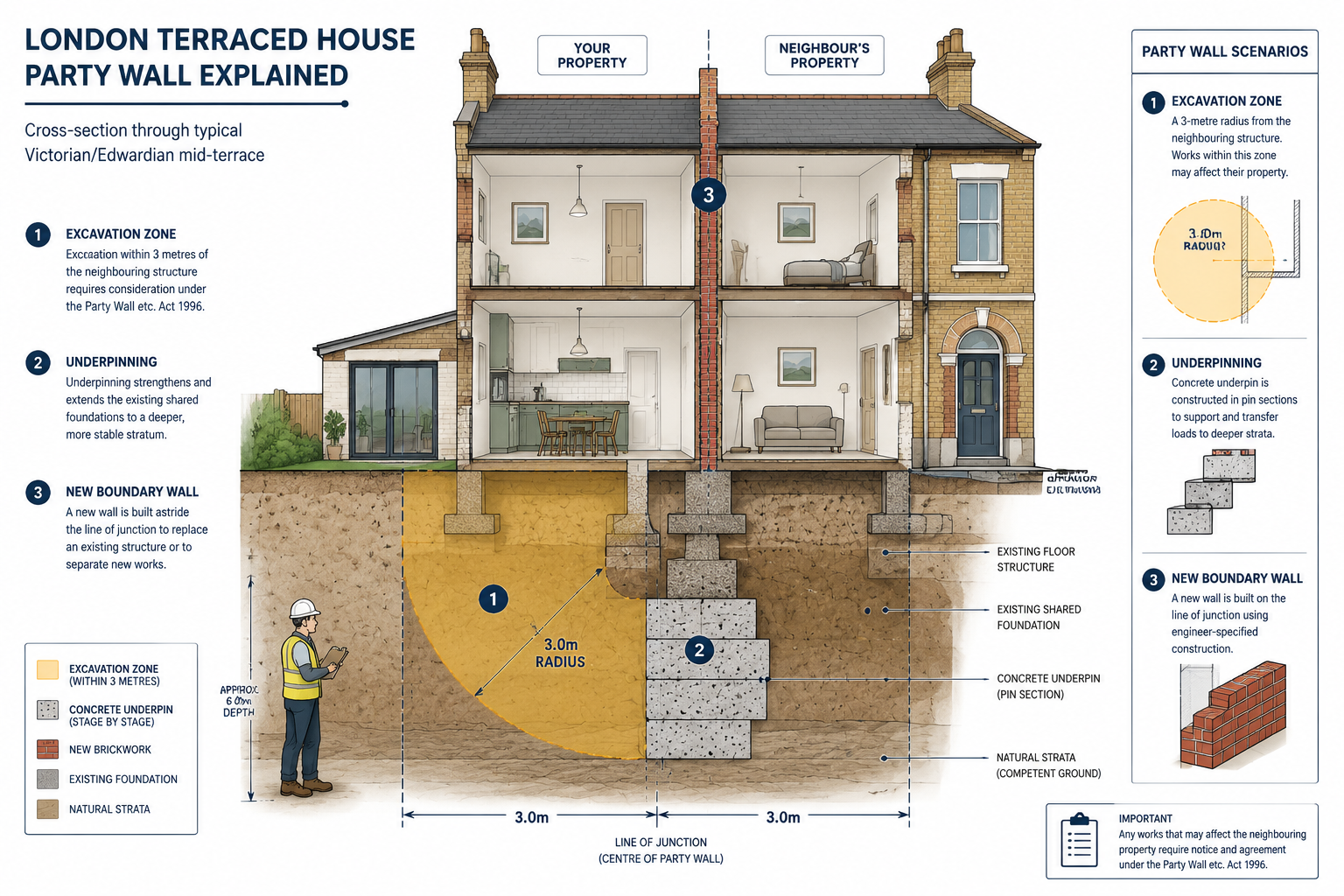
When a homeowner builds a new wall astride the boundary line between two properties, this automatically triggers the Party Wall Act. The wall becomes a shared structure the moment it straddles the legal boundary.
What's required:
- Serve a Party Wall Notice at least one month before work begins [1]
- The notice must include proposed start date, work duration, and construction details
- Neighbours may consent, dissent, or appoint their own surveyor
This is one of the most straightforward triggers, yet it is frequently overlooked during garden extensions and outbuilding construction. For guidance on party wall notice procedures, understanding the correct format and timeline is critical.
Scenario 2: 🔩 Structural Alterations to an Existing Party Wall
Removing a chimney breast, cutting into a shared wall to insert a steel beam, or making any structural modification to a party wall all require formal notification and surveyor involvement [1].
Common examples in 2026 urban extensions:
- Installing RSJ (rolled steel joist) beams into party walls for open-plan extensions
- Removing chimney breasts that form part of a shared stack
- Cutting pockets or chases into party walls for structural support
These alterations carry significant risk of cracking, settlement, or structural failure in the adjoining property. A party wall surveyor assesses the proposed method, specifies safeguards, and documents the existing condition of both properties.
Scenario 3: 🏚️ Underpinning a Party Wall or Shared Foundation
Underpinning — the process of strengthening or deepening existing foundations — is one of the most technically complex party wall scenarios. It is increasingly common in 2026 as homeowners seek to convert basements or address subsidence issues.
Underpinning directly affects the structural integrity of both properties sharing the foundation. This makes surveyor involvement non-negotiable [1].
💡 Pull Quote: "Underpinning without a Party Wall Award in place exposes building owners to unlimited liability for any structural damage caused to the adjoining property."
For properties showing signs of foundation movement, it's worth reading about subsidence and why it's a serious problem before proceeding with any underpinning works.
Scenario 4: ⛏️ Excavating Within 3 Metres of a Neighbouring Building
This is one of the top triggers for party wall disputes in 2026 [2]. The Act requires notification when:
| Excavation Distance | Depth Condition | Notice Required? |
|---|---|---|
| Within 3 metres of neighbour's building | Deeper than neighbour's foundations | ✅ Yes |
| Within 6 metres of neighbour's building | Meets a 45° line from their foundation | ✅ Yes |
| Beyond 6 metres | Any depth | ❌ No (unless other triggers apply) |
This scenario most commonly arises during basement extensions, which have surged across London boroughs including Fulham, Kensington, and Camden.
A surveyor must assess the potential impact on neighbouring foundations and specify protective measures before any excavation begins [2].
Scenario 5: 🔧 Carrying Out Repairs to a Party Wall
Not all party wall work involves new construction. Repairs to an existing party wall — particularly where the wall has deteriorated, cracked, or requires repointing — also fall under the Act if the work could affect the adjoining owner's property [1].
Checklist for repair scenarios:
- Is the wall shared with a neighbour?
- Will the repair involve cutting, removing, or replacing structural elements?
- Could vibration or temporary instability affect the adjoining property?
- Is scaffolding or access to the neighbour's land required?
If the answer to any of these is yes, a party wall notice is likely required.
Scenario 6: 🏗️ Raising the Height of a Party Wall
Extending upward — adding a loft conversion or an additional storey — often requires raising or modifying the height of a party wall. This is a direct trigger under the Act, as it changes the shared structure's load-bearing characteristics and appearance [1].
Key considerations:
- The additional weight placed on a shared wall affects the neighbour's structure
- Weatherproofing obligations arise where the raised wall creates a new junction
- A Schedule of Condition must be prepared before works commence to document the existing state of the neighbour's property
This scenario is particularly relevant in densely built areas like Hammersmith and Marylebone, where Victorian terraces are frequently subject to upward extensions.
Scenario 7: 🧱 Building a New Wall Close to (But Not On) the Boundary
Even when a new wall is built entirely on the building owner's own land but close to the boundary, the Act may still apply if excavation for the new wall's foundations falls within the 3–6 metre proximity zones outlined in Scenario 4 [1].
This catches many homeowners off guard. A new garden wall, outbuilding, or extension built just inside the property line can still trigger party wall obligations depending on foundation depth.
Understanding the 7 Key Scenarios: Costs, Timelines, and Dispute Resolution
Knowing which scenarios apply is only half the battle. Understanding the financial and procedural implications helps homeowners plan effectively.
💷 Party Wall Surveyor Costs in 2026
| Service | Typical Cost Range |
|---|---|
| Serving a Party Wall Notice | £75 – £200 |
| Simple Party Wall Award | £700 – £2,000 |
| Schedule of Condition | £300 – £1,000 |
| Complex projects (basement/multiple owners) | £1,500 – £4,000+ |
| Third Surveyor (deadlock resolution) | £500 – £1,500 |
| London hourly rates | £200 – £400/hour |
| Regional hourly rates | £80 – £200/hour |
Source: [2]
Important: The building owner (the person doing the work) is legally responsible for paying all reasonable costs — including their neighbour's surveyor fees [2]. This is a common surprise for homeowners who assume costs are shared.
For party wall surveyor quotes specific to London projects, it is advisable to obtain estimates before committing to a project timeline.
⏱️ The Deemed Dissent Problem
When a neighbour fails to respond to a party wall notice within 14 days, the law treats this as automatic dissent [2]. This triggers the formal dispute resolution process and adds approximately 2–3 additional weeks before a surveyor can be formally appointed on the unresponsive neighbour's behalf [2].
💡 Pull Quote: "A non-responding neighbour doesn't mean a consenting neighbour — deemed dissent can delay your project by weeks and add hundreds to your costs."
🔄 Third Surveyor Involvement
When two appointed surveyors reach a deadlock on award terms, a third surveyor — agreed upon at the outset — must be called in. Third surveyor fees typically range from £500–£1,500 depending on dispute complexity [2]. Fee allocation may follow fault-based principles, incentivising both parties to negotiate in good faith.
Practical Checklist: Appointing a Party Wall Surveyor
Use this checklist when planning any urban extension in 2026:
Before Serving Notice:
- Confirm whether your work falls within any of the 7 key scenarios
- Identify all adjoining owners (including upstairs/downstairs in flats)
- Obtain architectural drawings showing proximity to boundaries and foundations
- Research whether the Party Wall Act applies (England/Wales only) [4]
Serving the Notice:
- Serve notice in writing with correct statutory details
- Allow correct notice periods (1 month for party wall work; 2 months for line of junction work)
- Keep proof of service (recorded delivery or personal delivery with witness)
After Notice is Served:
- If consent is given: proceed, but consider a Schedule of Condition regardless
- If dissent or no response: appoint an expert party wall surveyor promptly
- Agree on a third surveyor name at the outset
- Obtain the Party Wall Award before work begins
During Construction:
- Ensure contractors work within the terms of the Award
- Report any unexpected structural findings immediately
- Maintain photographic records throughout
For a broader understanding of how the Act applies to specific situations, how the Party Wall Act 1996 applies to you is a valuable resource.
Real-World London Examples: Where These Scenarios Play Out
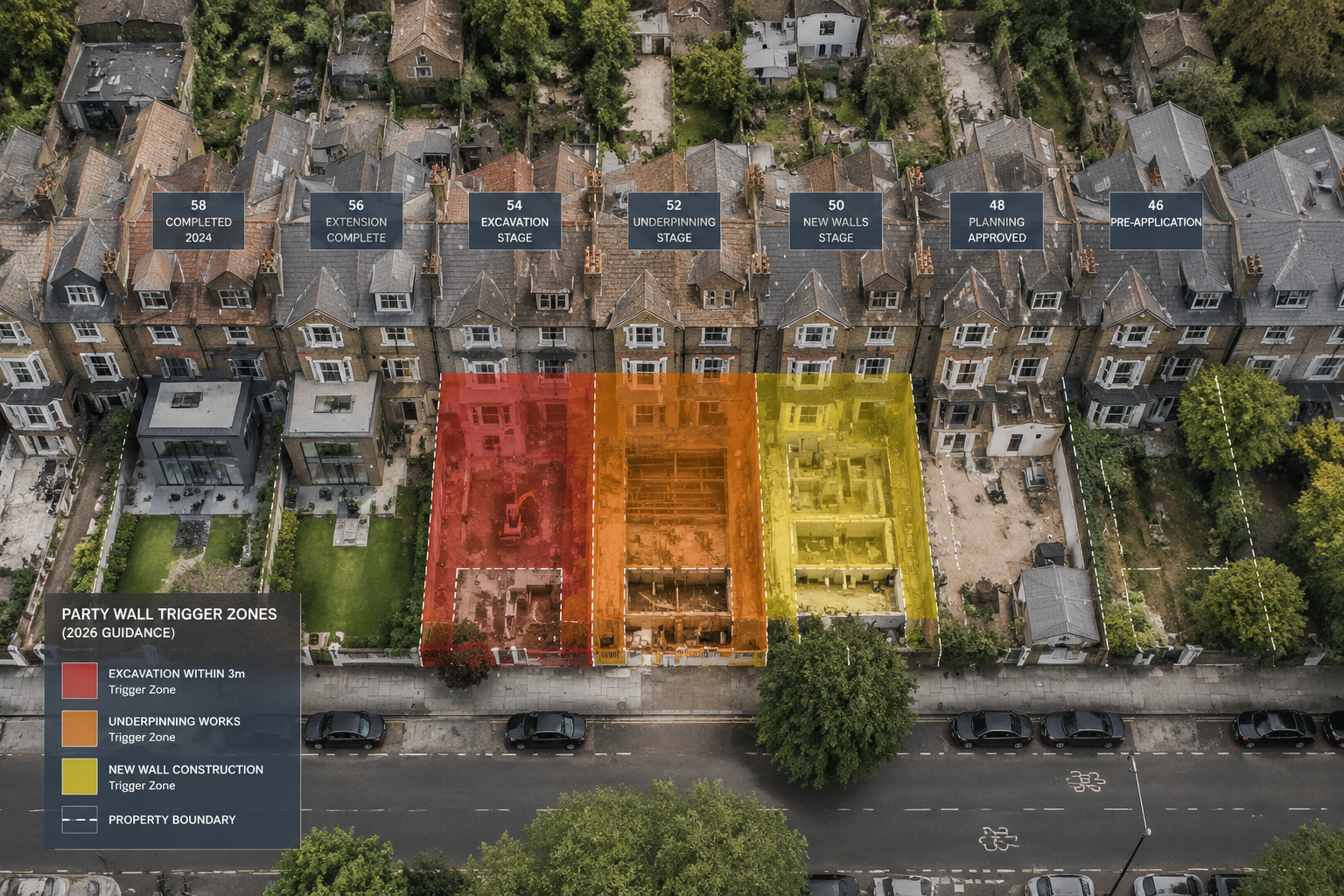
London's housing stock — dominated by Victorian and Edwardian terraces — creates near-constant party wall obligations for homeowners undertaking extensions. Here are typical 2026 scenarios:
🏘️ Scenario in Practice: Basement Dig in Kensington
A homeowner excavating a basement extension triggers Scenarios 4 and 3 simultaneously — excavating within 3 metres of the neighbour's foundations while also underpinning the shared party wall. Two separate notices may be required, and the Party Wall Award will specify excavation methodology, monitoring requirements, and reinstatement obligations.
🏘️ Scenario in Practice: Rear Extension in Fulham
A single-storey rear extension built up to the party wall triggers Scenario 2 (structural alteration — inserting a steel beam) and potentially Scenario 7 (new foundations near the boundary). A Schedule of Condition protects both parties if cracking appears post-construction.
🏘️ Scenario in Practice: Loft Conversion in Hammersmith
Raising the party wall to accommodate a new loft level triggers Scenario 6. The neighbour's surveyor will inspect the existing wall condition and specify the method for raising and weatherproofing the new parapet.
Understanding UK boundary wall rules is also essential context for any of these scenarios, particularly where the exact boundary position is uncertain.
Conclusion: Protect Your Project — and Your Neighbour — With the Right Expertise
The 7 key scenarios requiring party wall surveyors in 2026 urban extensions: foundations, underpinning, and new walls represent the full spectrum of construction activities that can affect shared structures and neighbouring properties. Each scenario carries specific legal obligations, notice requirements, and potential costs that can derail a project if ignored.
Actionable next steps for homeowners in 2026:
- Audit your project plans against all 7 scenarios before submitting planning applications.
- Serve notices early — the minimum notice periods are statutory, and delays compound quickly.
- Commission a Schedule of Condition regardless of whether your neighbour consents, to protect against false damage claims.
- Budget for all party wall costs including your neighbour's surveyor fees — these are your legal responsibility.
- Engage a qualified party wall surveyor early to navigate the process efficiently and avoid disputes.
The Party Wall Act exists to protect everyone — building owners and adjoining owners alike. Working with an experienced surveyor from the outset is not just a legal safeguard; it is the most cost-effective way to keep your 2026 urban extension on track.
References
[1] Scenarios That Require A Party Wall Surveyor – https://iconsurveyors.co.uk/blog/scenarios-that-require-a-party-wall-surveyor/
[2] Party Wall Dispute – https://onlinearchitecturalservices.com/party-wall-dispute/
[3] Avoiding Party Wall Disputes In 2026 Construction Boom Surveyor Best Practices For Notice Procedures And Early Neighbour Engagement – https://nottinghillsurveyors.com/blog/avoiding-party-wall-disputes-in-2026-construction-boom-surveyor-best-practices-for-notice-procedures-and-early-neighbour-engagement
[4] Party Wall Agreement – https://hoa.org.uk/advice/guides-for-homeowners/i-am-improving/party-wall-agreement/
[5] A Reasonable Party Wall Guide – https://howorth.uk/2026/03/04/a-reasonable-party-wall-guide/