
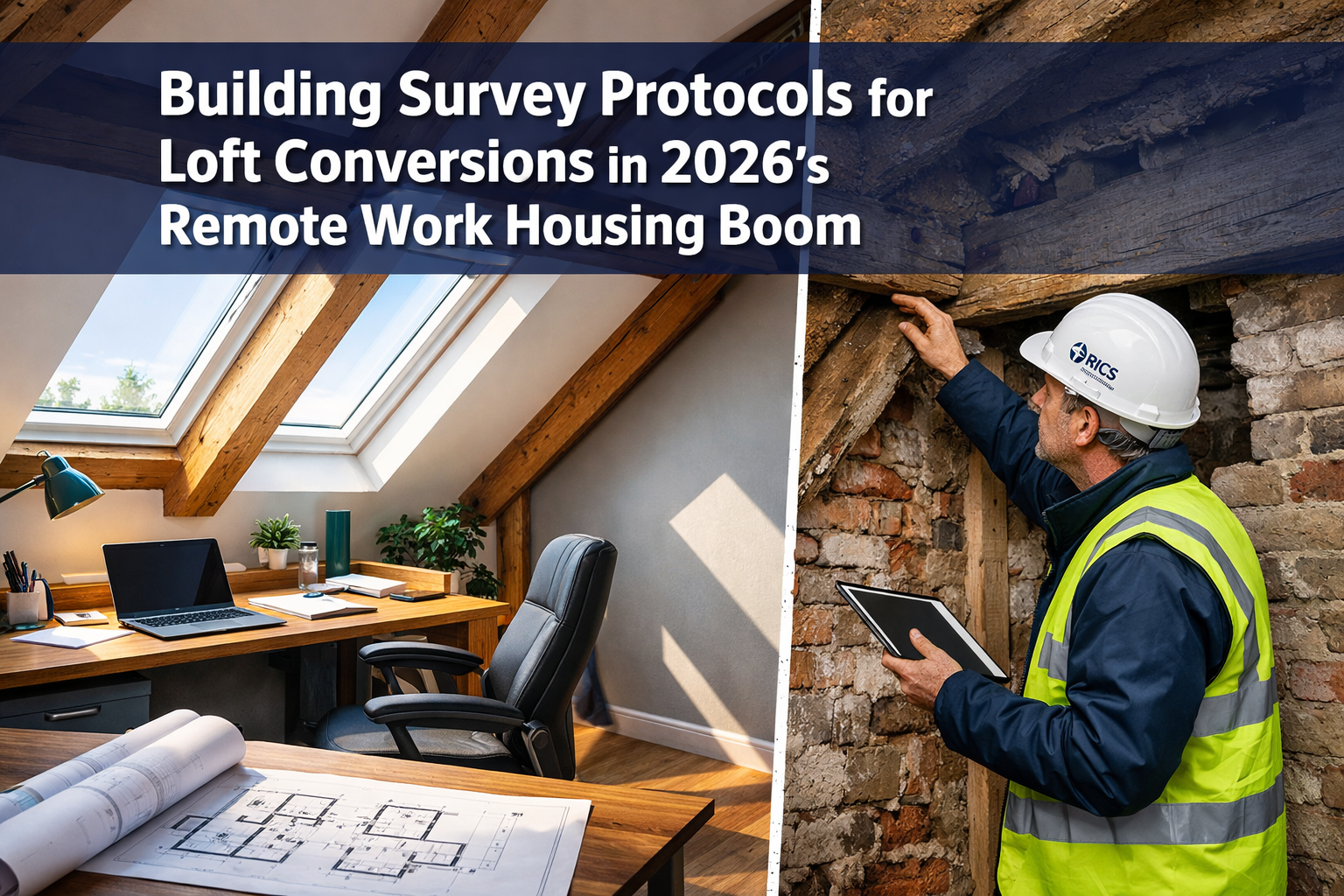
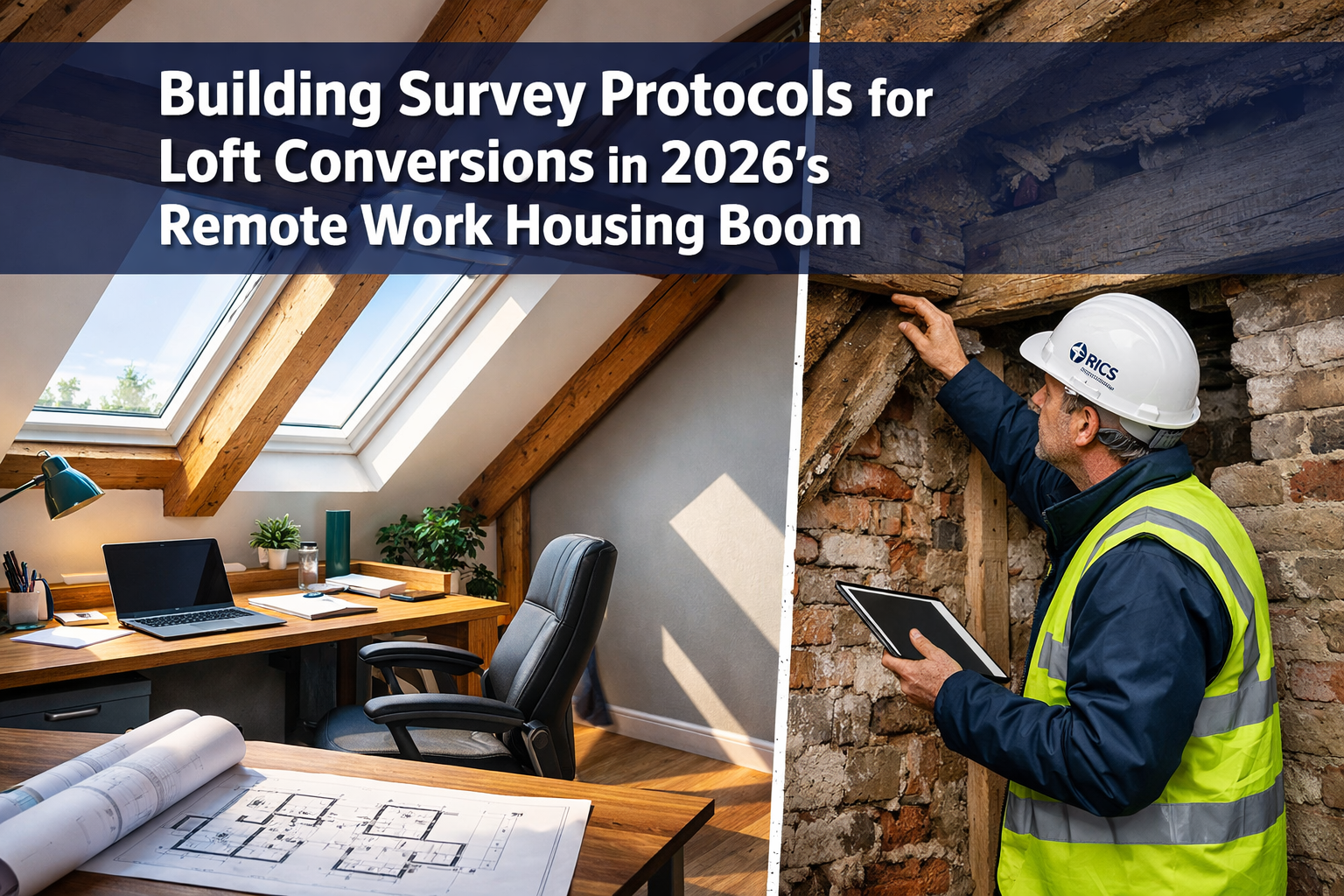
The remote work revolution has fundamentally transformed how homeowners view their properties. No longer satisfied with makeshift home offices in spare bedrooms or kitchen corners, professionals across the UK are investing in permanent workspace solutions—and loft conversions have emerged as the most popular choice. As we navigate 2026's stabilizing property market, Building Survey Protocols for Loft Conversions in 2026's Remote Work Housing Boom: RICS Standards for Structural Integrity and Value Uplift have become essential knowledge for homeowners, surveyors, and property professionals alike.
This comprehensive guide explores how updated RICS standards are shaping loft conversion assessments, ensuring structural safety while maximizing property value in an era where home workspace quality directly impacts market appeal.
Key Takeaways
- 🏗️ Structural integrity assessments must evaluate load-bearing capacity, roof structure adequacy, and compliance with updated 2026 building regulations before any loft conversion proceeds
- 📏 Minimum standards require 2.2m headroom, 270mm insulation thickness, and 30-minute fire resistance across all structural elements
- 💰 Value uplift potential ranges from 15-25% when loft conversions meet RICS standards and incorporate dedicated home office functionality
- 📋 RICS quality initiatives introduced in 2026 mandate enhanced CPD requirements and standardized survey protocols for loft conversion assessments
- ⚖️ Building regulations compliance now includes stricter U-value requirements (0.18W/m²K for walls, 1.4W/m²K for windows) and comprehensive energy efficiency standards
Understanding the Remote Work Housing Boom's Impact on Loft Conversions
The shift to permanent remote and hybrid work arrangements has created unprecedented demand for functional home office spaces. Unlike temporary pandemic-era solutions, homeowners in 2026 are investing in professional-grade workspaces that rival corporate environments in comfort and functionality.
Loft conversions offer several distinct advantages:
- Separation from living areas reduces distractions and maintains work-life boundaries
- Natural light through skylights and dormer windows creates productive environments
- Privacy for video calls and confidential work matters
- Property value enhancement that appeals to the growing remote workforce demographic
- Cost-effectiveness compared to moving to larger properties in the current market
According to market analysis, properties with dedicated home office spaces command premium pricing in 2026's housing market, with loft conversions representing one of the highest ROI home improvements available[3].
Market Drivers in 2026
Several factors are converging to accelerate loft conversion demand:
- Stabilizing property prices make home improvements more attractive than moving
- Employer remote work policies becoming permanent across sectors
- Rising energy costs driving demand for well-insulated additional spaces
- Planning permission reforms streamlining approval processes for qualifying conversions
- Enhanced mortgage products specifically designed for home improvement financing
RICS Standards for Structural Integrity in Loft Conversion Surveys
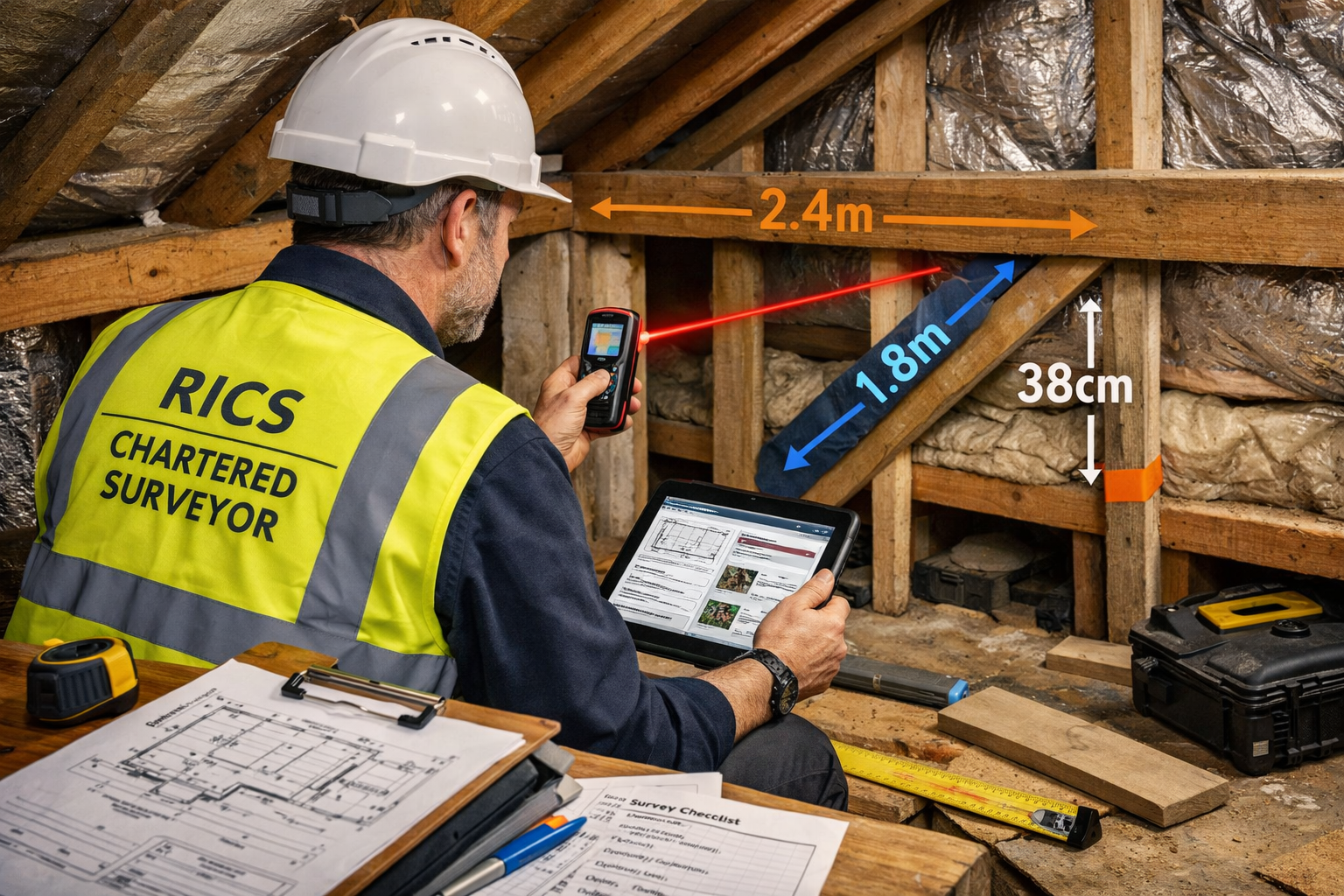
The Royal Institution of Chartered Surveyors (RICS) has updated its guidance for loft conversion assessments in response to both the remote work boom and evolving building safety regulations. Understanding these standards is crucial for anyone considering a loft conversion project.
Core Structural Assessment Components
When conducting building surveys for loft conversions, RICS-qualified surveyors must evaluate:
Roof Structure Adequacy
- Load-bearing capacity of existing roof trusses and rafters
- Structural modifications required to create habitable space
- Impact of removing or altering roof support members
- Additional support beam requirements
Floor Loading Capacity
- Existing ceiling joist strength and spacing
- Required reinforcement for increased live loads (typically 150kg/m²)
- Impact on supporting walls and foundations
- Distribution of additional weight throughout structure
Wall Structural Integrity
- Load-bearing wall identification and capacity
- Party wall considerations in semi-detached and terraced properties
- Gable wall stability and reinforcement needs
- New wall construction requirements
Foundation Assessment
- Adequacy of existing foundations for increased loads
- Settlement risk evaluation
- Underpinning requirements (if any)
- Ground conditions and soil bearing capacity
Updated 2026 RICS Quality Standards
RICS has implemented quality strengthening initiatives that directly impact how surveyors approach loft conversion assessments[6]. These changes include:
- Enhanced CPD requirements ensuring surveyors maintain current knowledge of building regulations
- Standardized reporting templates for consistency across the profession
- Mandatory competency assessments for surveyors conducting structural evaluations
- Digital survey tools integration for more accurate measurements and documentation
The revised CPD framework effective January 2026[7] requires surveyors to demonstrate ongoing competence in structural assessment methodologies, particularly for complex projects like loft conversions.
When to Commission a Full Building Survey
While a standard RICS Homebuyer Survey provides valuable property insights, loft conversion planning typically requires a more comprehensive assessment. Consider commissioning a full building survey when:
- The property was built before 1960 (older construction methods)
- Previous alterations or extensions are evident
- Visible structural concerns exist (cracks, sagging, movement)
- The loft space shows signs of previous water damage
- The property type is non-standard (timber frame, steel frame, unusual construction)
Building Regulations Compliance: 2026 Requirements for Loft Conversions
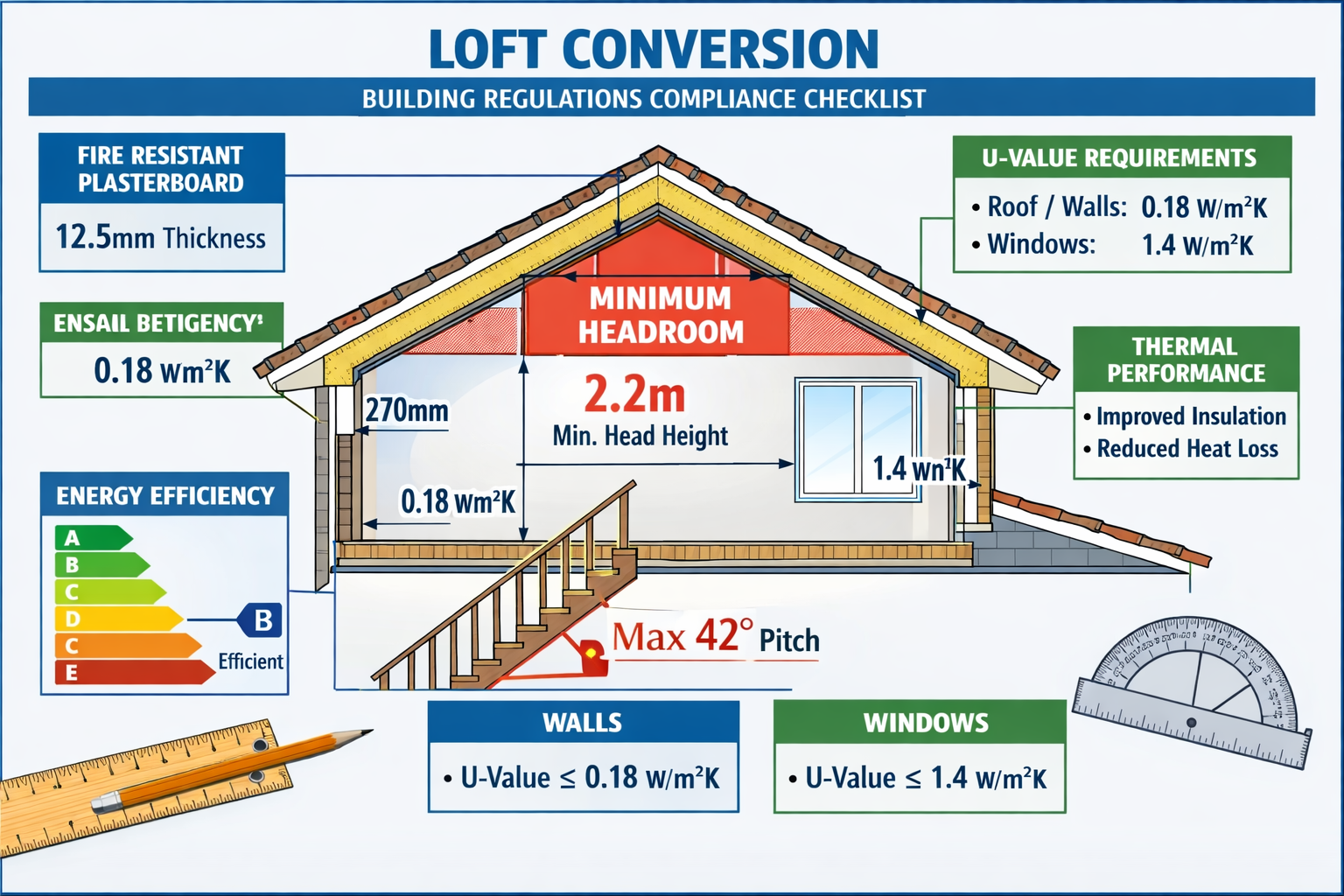
Compliance with current building regulations is non-negotiable for loft conversions. The standards have become increasingly stringent, particularly regarding energy efficiency and fire safety. Understanding these requirements during the survey phase prevents costly redesigns later.
Fire Safety Standards
Fire resistance is paramount in loft conversions, as the additional floor creates evacuation challenges. Current regulations mandate[1]:
| Component | Requirement | Implementation |
|---|---|---|
| Structural elements | 30-minute fire resistance | 12.5mm fire-resistant plasterboard or approved coating |
| Floor construction | Fire-resistant materials | Modified ceiling joists with fire-rated boarding |
| Escape route | Protected stairway | Fire doors, intumescent strips, self-closing mechanisms |
| Smoke detection | Interconnected alarms | Grade D, LD2 system minimum |
The fire escape route must provide safe egress from the loft level, typically requiring a protected stairwell with fire-resistant construction throughout[2].
Thermal Performance and Energy Efficiency
Energy efficiency standards have tightened significantly. All new loft construction must meet these specifications[1][2]:
Insulation Requirements:
- Minimum 270mm thickness for roof insulation
- Properties built before 1975 require approximately 245mm additional insulation
- Insulation must achieve thermal continuity without gaps or compression
U-Value Standards:
- New loft walls: 0.18W/m²K maximum
- Windows and roof lights: 1.4W/m²K maximum
- Existing roof elements upgraded to equivalent standards
- Energy rating of "B" or higher for all glazing
These specifications ensure loft conversions contribute to overall property energy efficiency rather than creating thermal weak points.
Headroom and Space Standards
Adequate headroom is essential for comfortable use and regulatory compliance[1]:
- Minimum 2.2 metres height for walls and ceiling
- Measurement taken from finished floor to finished ceiling
- Allowance must include insulation thickness and internal finishes
- Sloping ceilings permitted in specific areas with minimum 1.5m headroom
Properties with insufficient roof height may require roof raising or lowering of ceilings below—both significant structural interventions that must be identified during the survey phase.
Staircase Specifications
The staircase connecting the loft to the floor below must meet precise standards[1]:
- Maximum pitch: 42 degrees
- Minimum headroom: 2 metres (1.8m acceptable with sloping roofs)
- Riser height: 150-220mm
- Tread depth: 200-300mm minimum
- Handrail height: 900-1000mm
- Width: Minimum 800mm clear width
Space planning for compliant staircases often proves challenging in existing properties, making this a critical survey consideration.
Structural Calculations and Certification
Building Control requires structural engineer calculations for:
- New floor joists and support beams
- Roof structure modifications
- Load distribution through supporting walls
- Steel beam specifications and connections
- Foundation adequacy confirmation
These calculations must be prepared by qualified structural engineers and approved before construction begins. The survey should identify whether existing structural elements can accommodate modifications or require reinforcement.
Building Survey Protocols for Loft Conversions in 2026's Remote Work Housing Boom
Professional survey protocols have evolved to address the specific requirements of loft conversions designed for remote work. What to do before an RICS home survey includes preparing documentation and access to all areas requiring assessment.
Pre-Survey Preparation
Homeowners should prepare for the survey by:
- Clearing loft access and removing stored items
- Providing property documentation including previous surveys, building control certificates, and planning permissions
- Identifying specific requirements for the home office space (electrical outlets, data cabling, natural light preferences)
- Disclosing known issues such as previous leaks, repairs, or structural concerns
- Arranging full access to all relevant areas including adjacent properties for party wall assessment
Comprehensive Survey Checklist
A thorough loft conversion survey following Building Survey Protocols for Loft Conversions in 2026's Remote Work Housing Boom: RICS Standards for Structural Integrity and Value Uplift includes:
Structural Elements Assessment
- ✅ Roof construction type and condition
- ✅ Truss or rafter configuration
- ✅ Existing ceiling joist size, spacing, and condition
- ✅ Load-bearing wall identification
- ✅ Foundation type and visible condition
- ✅ Evidence of movement, settlement, or structural defects
- ✅ Previous alterations impact on structural integrity
Building Services Evaluation
- ✅ Electrical capacity and distribution board location
- ✅ Plumbing access for potential bathroom addition
- ✅ Heating system capacity and extension feasibility
- ✅ Ventilation requirements and options
- ✅ Natural light opportunities (skylight positions)
- ✅ Drainage provisions if bathroom planned
Regulatory Compliance Assessment
- ✅ Available headroom throughout proposed space
- ✅ Staircase location options and compliance feasibility
- ✅ Fire escape route adequacy
- ✅ Party wall considerations
- ✅ Planning permission requirements
- ✅ Conservation area or listed building restrictions
Remote Work Functionality
- ✅ Natural light quality and positioning
- ✅ Acoustic isolation from household activities
- ✅ Data cabling routes and broadband access points
- ✅ Electrical outlet positioning for office equipment
- ✅ Climate control requirements (heating/cooling)
- ✅ Storage solutions for work materials
Digital Survey Technologies in 2026
Modern survey protocols increasingly incorporate digital technologies for enhanced accuracy:
- 3D laser scanning for precise dimensional data
- Thermal imaging to identify insulation gaps and thermal bridges
- Moisture meters for detecting hidden damp issues
- Digital reporting platforms providing interactive survey results
- BIM (Building Information Modeling) integration for design coordination
These technologies enable surveyors to provide more detailed assessments and facilitate better communication with architects and builders.
Value Uplift Analysis: Maximizing ROI on Loft Conversions
Understanding the financial implications of loft conversions is essential for informed decision-making. RICS property valuations provide professional assessment of anticipated value increases.
Market Value Impact in 2026
Loft conversions typically deliver substantial value uplift:
- 15-20% property value increase for standard conversions
- 20-25% increase for conversions with en-suite facilities
- Premium pricing (5-10% additional) for dedicated home office features
- Faster sale times in markets with high remote worker concentrations
- Rental income potential if configured as self-contained space
The remote work boom has particularly enhanced values for loft conversions featuring:
- 📱 High-quality natural light through multiple windows or skylights
- 🔌 Extensive electrical outlets and dedicated data cabling
- 🎯 Acoustic insulation beyond minimum standards
- 🌡️ Independent climate control for year-round comfort
- 📚 Built-in storage and workspace organization
Cost-Benefit Analysis
Typical loft conversion costs in 2026 range from £30,000-£60,000 depending on complexity, with premium conversions exceeding £75,000. When evaluating ROI, consider:
Direct Costs:
- Structural work and building materials
- Professional fees (architect, structural engineer, building surveyor)
- Building Control and planning fees
- Specialist contractors (electricians, plumbers, roofers)
- Finishing and decoration
Indirect Benefits:
- Avoided moving costs (estate agent fees, stamp duty, removal expenses)
- Enhanced quality of life and work productivity
- Energy efficiency improvements reducing ongoing costs
- Flexibility to accommodate changing household needs
Market Positioning:
Properties with professional home office spaces appeal to the growing demographic of permanent remote workers, creating competitive advantages in 2026's market conditions.
Negotiation Leverage
Survey findings significantly impact project feasibility and costs. Understanding how an RICS survey can help you negotiate applies equally to loft conversion planning:
- Structural issues identified during surveys inform realistic budgets
- Building regulation challenges may require design modifications
- Party wall complications can delay projects and increase costs
- Foundation concerns might necessitate expensive underpinning
Professional surveys provide the evidence needed to negotiate with contractors and make informed decisions about project scope.
Selecting Qualified Surveyors for Loft Conversion Assessments
The complexity of loft conversion assessments requires specialized expertise. Why choose RICS surveyors becomes particularly relevant for these projects.
Essential Qualifications and Experience
Look for surveyors with:
- RICS chartered status (MRICS or FRICS designation)
- Building surveying specialization rather than general practice
- Demonstrated loft conversion experience in similar property types
- Current knowledge of 2026 building regulations
- Professional indemnity insurance adequate for project value
- Structural assessment competency or collaboration with structural engineers
Questions to Ask Prospective Surveyors
Before commissioning a survey, ask:
- How many loft conversion surveys have you conducted in the past year?
- Are you familiar with [property type]-specific structural considerations?
- Do you provide detailed recommendations for structural modifications?
- Can you coordinate with architects and structural engineers?
- What level of detail does your report include regarding building regulations compliance?
- Do you offer post-survey consultation to discuss findings?
- What is your typical turnaround time for report delivery?
Understanding Survey Reports
Comprehensive loft conversion survey reports should include:
- Executive summary highlighting key findings and recommendations
- Detailed structural assessment with photographic evidence
- Building regulations compliance analysis identifying potential challenges
- Cost implications of identified issues or required modifications
- Risk assessment categorizing concerns by severity
- Recommendations for further investigations or specialist input
- Valuation impact of proposed conversion
The report becomes a crucial document for project planning, contractor briefings, and Building Control applications.
Common Challenges and Solutions in Loft Conversion Projects
Understanding typical obstacles helps homeowners and professionals anticipate issues during the survey and planning phases.
Structural Challenges
Insufficient Roof Height
- Solution: Roof raising or lowering ceilings below (both requiring structural calculations)
- Survey role: Precise measurement and feasibility assessment
Inadequate Floor Joists
- Solution: Reinforcement with additional joists or steel beams
- Survey role: Load capacity evaluation and specification requirements
Truss Roof Construction
- Challenge: Modern truss roofs cannot have members removed without comprehensive redesign
- Solution: Complete truss replacement or alternative structural system
- Survey role: Truss type identification and modification feasibility
Party Wall Complications
- Challenge: Semi-detached and terraced properties require party wall agreements
- Solution: Engage party wall surveyors early in the process
- Survey role: Identify party wall impacts and agreement requirements
Building Regulations Obstacles
Staircase Space Constraints
- Challenge: Insufficient space for compliant staircase
- Solution: Alternative staircase designs, space reallocation, or dormer additions
- Survey role: Space analysis and feasibility of compliant access
Fire Escape Inadequacy
- Challenge: Existing layout doesn't provide safe escape route
- Solution: Protected stairwell creation, fire-resistant upgrades throughout
- Survey role: Escape route evaluation and compliance pathway identification
Energy Efficiency Standards
- Challenge: Achieving required U-values in constrained spaces
- Solution: High-performance insulation materials, careful detailing
- Survey role: Thermal performance assessment and specification recommendations
Planning and Legal Issues
Conservation Area Restrictions
- External alterations may face stringent planning requirements
- Survey should identify planning constraints early
Listed Building Considerations
- Extensive restrictions on structural modifications
- Specialist conservation surveyors may be required
Covenant Restrictions
- Property deeds may limit alterations
- Legal review essential before proceeding
Future-Proofing Loft Conversions for Evolving Work Patterns
As remote work continues evolving, forward-thinking homeowners are designing loft conversions with flexibility in mind.
Adaptable Design Considerations
Multi-Functional Spaces
- Convertible furniture systems
- Flexible storage solutions
- Lighting designed for various activities
- Acoustic treatments for video conferencing
Technology Infrastructure
- Extensive data cabling beyond current needs
- Electrical capacity for future equipment
- Smart home integration readiness
- High-quality broadband connectivity
Environmental Controls
- Superior ventilation for air quality
- Independent heating/cooling zones
- Natural light maximization with glare control
- Acoustic isolation for concentration
Sustainability and Energy Efficiency
2026's emphasis on environmental responsibility extends to loft conversions:
- Exceeding minimum insulation standards
- Solar panel integration on new roof surfaces
- Energy-efficient lighting and appliances
- Sustainable material selections
- Water conservation measures if bathroom included
These features enhance both environmental credentials and long-term property value.
Conclusion: Navigating Loft Conversion Success in 2026
Building Survey Protocols for Loft Conversions in 2026's Remote Work Housing Boom: RICS Standards for Structural Integrity and Value Uplift represent essential knowledge for homeowners pursuing these valuable home improvements. The convergence of permanent remote work patterns, updated building regulations, and enhanced RICS quality standards creates a complex landscape requiring professional expertise.
Key Success Factors
✅ Commission comprehensive surveys from RICS-qualified building surveyors with loft conversion experience
✅ Understand building regulations thoroughly before committing to project designs
✅ Prioritize structural integrity over aesthetic considerations—safety cannot be compromised
✅ Plan for remote work functionality specifically, not just general living space
✅ Consider long-term value rather than minimum compliance approaches
✅ Engage qualified professionals including structural engineers, architects, and specialist contractors
✅ Budget realistically including contingencies for unforeseen structural issues
Next Steps for Homeowners
If you're considering a loft conversion in 2026:
- Schedule an initial consultation with a qualified building surveyor to assess feasibility
- Research planning requirements for your specific location and property type
- Obtain preliminary structural assessments before investing in detailed designs
- Review financing options including specialized home improvement mortgages
- Engage party wall surveyors if applicable to your property type
- Develop a realistic timeline accounting for design, approvals, and construction phases
The remote work housing boom shows no signs of reversing, making loft conversions an increasingly attractive investment. By following proper survey protocols, adhering to RICS standards, and ensuring full building regulations compliance, homeowners can create valuable, functional spaces that enhance both lifestyle and property value.
Professional guidance throughout the process—from initial feasibility assessment through final Building Control certification—remains the most reliable path to successful loft conversion outcomes in 2026's dynamic housing market.
References
[1] Rules Regulations – https://www.greenmatch.co.uk/loft-conversion/rules-regulations
[2] Building Regulations For Loft Conversions 2025 – https://extensionarchitecture.co.uk/blog/building-regulations-for-loft-conversions-2025/
[3] How To Plan A Loft Conversion Step By Step Guide From Concept To Completion – https://theconversionkings.co.uk/blog/how-to-plan-a-loft-conversion-step-by-step-guide-from-concept-to-completion/
[4] Loft Conversions The Ultimate Guide – https://www.fmb.org.uk/find-a-builder/ultimate-guides-to-home-renovation/loft-conversions-the-ultimate-guide.html
[5] Home Extensions Improvements – https://www.rics.org/consumer-guides/home-extensions-improvements
[6] Building Survey Standards Evolution How Rics Quality Strengthening Initiatives Impact Surveyor Practice In 2026 – https://nottinghillsurveyors.com/blog/building-survey-standards-evolution-how-rics-quality-strengthening-initiatives-impact-surveyor-practice-in-2026
[7] Revised Cpd Framework Effective 2026 New App – https://www.rics.org/news-insights/revised-cpd-framework-effective-2026-new-app