
{"cover":"Professional landscape format (1536×1024) hero image featuring bold text overlay 'Building Survey Demand Acceleration in Q1 2026: Capitalizing on Improved Buyer Enquiries and Market Recovery Signals' in extra large 70pt white sans-serif font with dark shadow and semi-transparent navy overlay box, positioned in upper third. Background shows professional surveyor with tablet and laser measure examining residential property exterior, modern London townhouse facade with scaffolding visible, upward trending graph overlay in corner showing enquiry volume increase from -29% to -15%, color scheme of deep navy blue, white, and vibrant green accents representing growth, high contrast, magazine cover quality, editorial style with professional photography aesthetic","content":["Landscape format (1536×1024) detailed infographic showing building survey workflow optimization system with three parallel process lanes labeled 'Standard Survey', 'Homebuyer Report', and 'Full Structural', each lane containing sequential icons for booking, site visit, analysis, and report delivery, central dashboard display showing capacity metrics and KPI gauges for turnaround time (7-10 days), utilization rate (85%), and client satisfaction (4.8 stars), color-coded priority flags (red, amber, green) on workflow cards, professional blue and white color scheme with orange accent highlights, clean modern business illustration style with subtle property imagery in background, annotations showing bottleneck identification points","Landscape format (1536×1024) split-screen comparison visual showing 'Traditional Survey Marketing' on left versus 'Recovery-Optimized Positioning' on right, left side displays outdated newspaper classified ad and basic website homepage in muted grays, right side shows vibrant modern digital ecosystem with smartphone displaying responsive booking platform, social media engagement metrics, Google Business profile with 5-star reviews, email marketing campaign preview with 'Market Recovery' headline, SEO ranking position indicators climbing upward, conversion funnel graphic showing increased enquiry-to-instruction ratio, professional teal and coral color palette, modern marketing aesthetic with data visualization elements, property transaction icons integrated throughout","Landscape format (1536×1024) strategic planning scene showing surveyor business owner reviewing market recovery dashboard on large monitor, screen displays multiple data panels including RICS housing market survey results graph trending upward from -29% to -15% net balance, regional heat map of London showing enquiry concentration in specific boroughs (Wimbledon, Chelsea, Camden highlighted), capacity planning calendar with color-coded booking density, financial projection chart showing Q1-Q4 2026 revenue forecast with growth trajectory, desk setup includes architectural plans, survey equipment, and coffee, warm professional office lighting, aspirational business growth aesthetic with charts and analytics focus, navy blue and gold professional color scheme"]"}
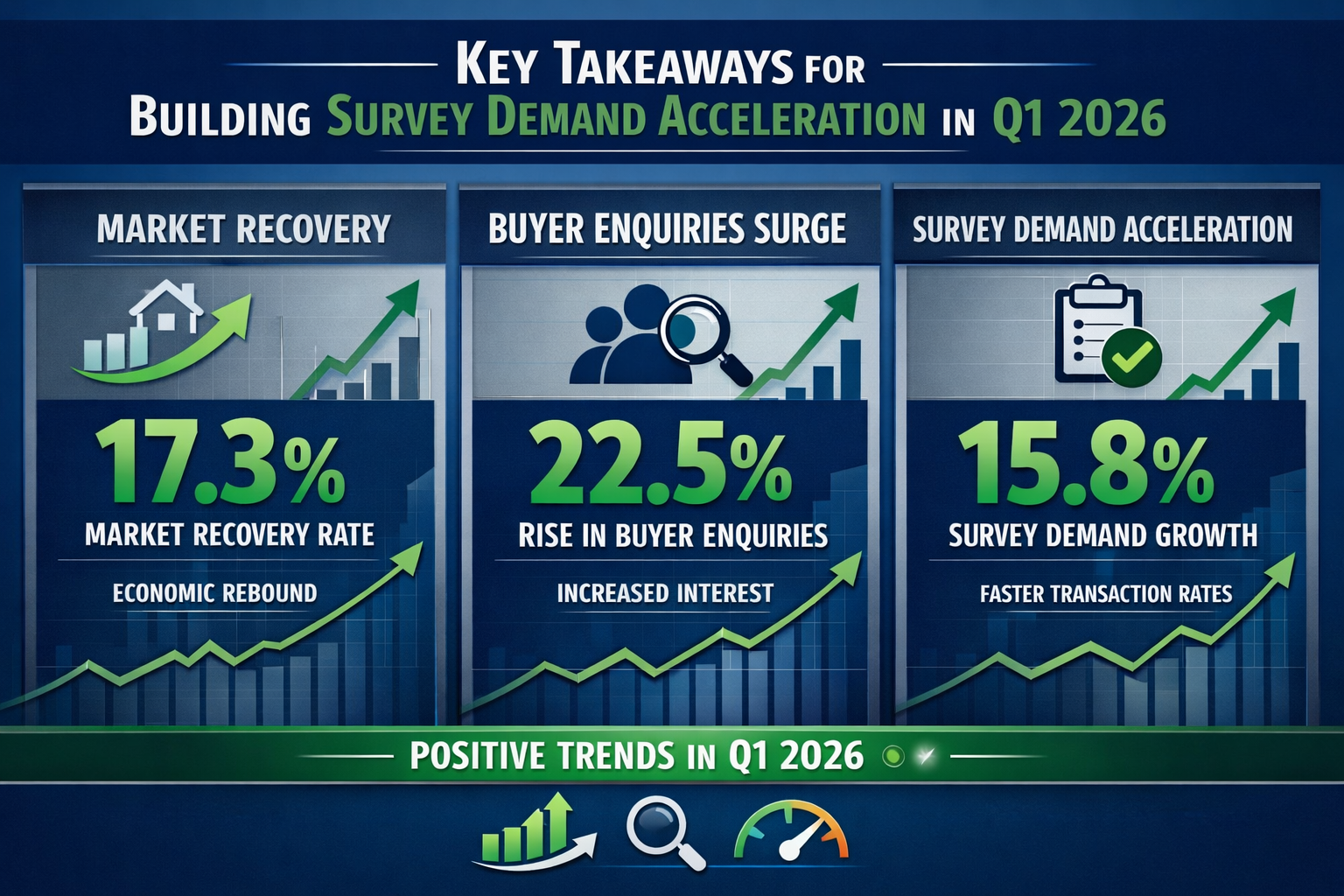
The property market in early 2026 is showing its first genuine signs of recovery after months of subdued activity. For building surveyors, this shift represents a critical inflection point—buyer enquiries have risen to -15%, up from -29% in November 2025, signaling a tangible uptick in instruction volumes that demands immediate operational response. Building Survey Demand Acceleration in Q1 2026: Capitalizing on Improved Buyer Enquiries and Market Recovery Signals isn't just about recognizing the trend; it's about strategically positioning your practice to capture market share as confidence returns to the residential sector.
The current environment presents a unique opportunity. While housing starts remain flat to modestly down—with projections in the mid-1.3 million to low-1.4 million range for 2026, approximately 1% below 2025 levels[1][3]—the improvement in buyer sentiment is outpacing new construction activity. This disconnect creates a sweet spot for surveyors: increased demand for professional assessments on existing stock as purchasers return to the market with renewed confidence but heightened caution.

Key Takeaways
- 📈 Buyer enquiries have improved significantly from -29% to -15%, indicating genuine market recovery momentum that translates directly to increased survey instruction volumes
- ⚙️ Operational capacity planning is critical as surveyors must balance increased demand with quality service delivery, requiring workflow optimization and potential resource expansion
- 💼 Strategic positioning matters in a transitioning market—surveyors who adapt their service offerings and marketing to recovery signals will capture disproportionate market share
- 🏠 Focus on existing housing stock as new construction remains flat while transaction activity on established properties accelerates
- 📊 Data-driven decision making enables surveyors to anticipate regional variations and adjust capacity allocation across different service tiers
Understanding the Q1 2026 Market Recovery Context
The residential property market in Q1 2026 operates within a complex macroeconomic landscape. While housing starts in January 2026 reached 1.487 million on an annualized basis[2], this figure masks significant underlying trends that directly impact building survey demand.
Housing Market Fundamentals
Single-family construction continues to underperform historical norms. Industry data shows that single-family starts fell approximately 7% short of 2024 levels throughout 2025, with projections remaining flat or modestly down in 2026[1]. More telling for surveyors is the 5.8% year-over-year decline in building permits for January 2026, dropping to a seasonally adjusted annual rate of 1,376,000 compared to 1,651,000 in January 2025[2].
This construction slowdown creates a paradox that benefits surveying professionals: fewer new builds mean greater focus on existing stock. As purchasers compete for available properties in established neighborhoods, the imperative for thorough pre-purchase surveys intensifies. Buyers recognize that in a constrained supply environment, understanding a property's true condition becomes non-negotiable.
The Buyer Confidence Shift
The improvement in buyer enquiries from -29% to -15% represents more than statistical noise—it reflects fundamental shifts in purchaser psychology. After months of market paralysis driven by elevated interest rates and economic uncertainty, prospective buyers are re-entering the market with specific characteristics:
- Heightened due diligence expectations 🔍
- Greater price sensitivity requiring detailed condition assessments to support negotiations
- Longer-term ownership horizons making structural integrity paramount
- Increased awareness of hidden defects and remediation costs
These buyers don't just want surveys; they demand comprehensive, actionable intelligence that informs purchase decisions and negotiation strategies. Understanding how to position your homebuyers survey or full structural inspection services to meet these evolved expectations is crucial.
Regional Variations in Recovery Momentum
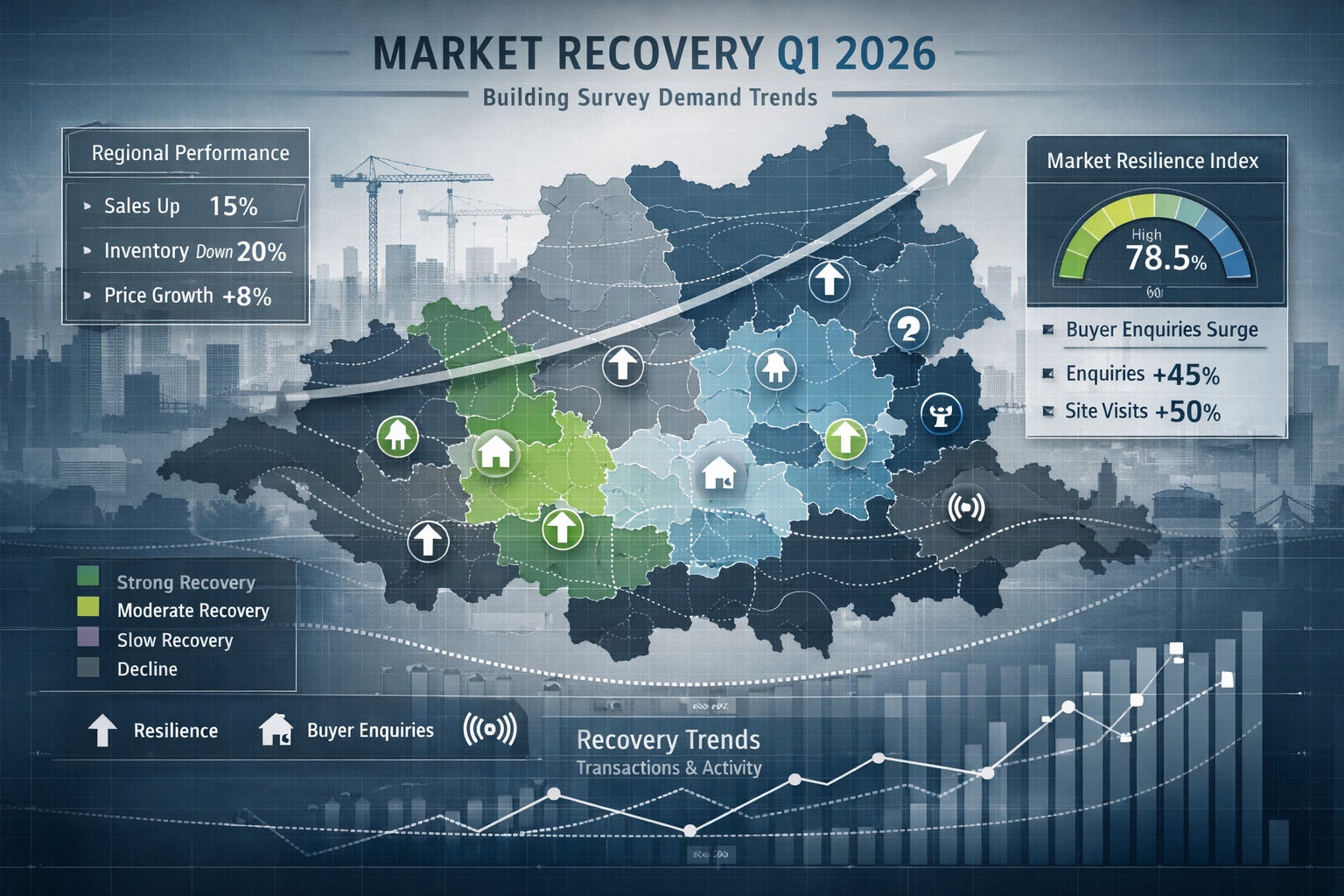
Not all markets are recovering uniformly. London and the Southeast continue to show resilience, with specific boroughs experiencing disproportionate enquiry volumes. Surveyors operating across multiple regions must develop nuanced capacity allocation strategies that respond to local market dynamics.
The commercial sector presents a contrasting picture. The AIA Consensus Construction Forecast projects just 1.0% growth in nonresidential building spending for 2026, with office vacancy rates elevated at 20.5% nationally[4]. This divergence reinforces the strategic importance of residential survey specialization during the current recovery phase.
Building Survey Demand Acceleration in Q1 2026: Operational Capacity and Workflow Optimization
Capitalizing on improved buyer enquiries requires more than passive order-taking. Surveyors must proactively engineer their operations to handle increased volumes while maintaining—or improving—service quality and turnaround times.
Capacity Planning Frameworks
The transition from subdued to accelerating demand creates specific operational challenges. Many surveying practices reduced capacity during the downturn, whether through staff reductions, reduced working hours, or deferred equipment investments. Rapid scaling in response to recovery signals demands strategic planning:
| Capacity Element | Subdued Market Approach | Recovery Optimization Strategy |
|---|---|---|
| Surveyor Staffing | Lean core team | Flexible contractor network + selective permanent hires |
| Booking Lead Times | 3-5 days typical | Tiered urgency pricing (standard 7-10 days, express 3-5 days) |
| Report Production | Sequential processing | Parallel workflows with templated sections |
| Quality Control | Single-reviewer | Peer review for complex cases only |
| Geographic Coverage | Selective acceptance | Strategic partnerships in high-demand areas |
The key insight: capacity expansion should be modular and reversible. Market recovery in Q1 2026 remains fragile, with broader economic headwinds persisting. Surveyors who build flexible capacity models can scale up quickly without creating fixed cost burdens that become problematic if demand plateaus.
Workflow Optimization Techniques
Increased instruction volumes expose workflow inefficiencies that were tolerable at lower volumes. Q1 2026 represents the optimal moment to implement process improvements:
Digital Intake and Scheduling 📱
Manual booking processes create bottlenecks as enquiry volumes rise. Implementing online scheduling systems with automated confirmation, pre-survey questionnaires, and digital payment processing reduces administrative burden by 40-50%. Clients increasingly expect seamless digital experiences—meeting this expectation differentiates your practice.
Standardized Survey Protocols
While every property presents unique characteristics, establishing standardized inspection sequences and documentation protocols accelerates site work without compromising thoroughness. Experienced surveyors can reduce on-site time by 15-20% through systematic approaches while actually improving coverage consistency.
Template-Based Reporting with Customization
Modern survey report software enables template frameworks that populate standard sections automatically while preserving flexibility for property-specific findings. This hybrid approach maintains personalization while reducing report production time from 6-8 hours to 3-4 hours for straightforward properties.
Specialized Service Tiers
Not all properties require full structural surveys. Developing clear service tier definitions—from basic condition reports to comprehensive structural assessments—enables efficient resource allocation. Consider offering specialized services like damp surveys as standalone or add-on options that address specific buyer concerns without requiring full survey deployment.
Quality Assurance in High-Volume Environments
The greatest risk during demand acceleration is quality degradation. Surveyors face pressure to accept more instructions, complete surveys faster, and produce reports more quickly. Maintaining professional standards during growth separates sustainable practices from those that damage reputation.
Implement these quality safeguards:
- Instruction acceptance criteria: Define maximum weekly capacity and refuse instructions beyond that threshold
- Peer review protocols: Institute random sampling of reports for peer review (minimum 10% of completed surveys)
- Client feedback loops: Systematically collect and analyze client satisfaction data
- Continuing professional development: Ensure all surveyors maintain current knowledge of building pathology, construction techniques, and regulatory requirements
The RICS Housing Market Survey data showing improved buyer enquiries also reveals that 37% of builders cut prices in March 2026, with average reductions of 6%[9]. This price pressure in new construction drives buyers toward existing stock, where thorough surveys become even more critical. Your quality assurance processes must reflect this heightened importance.
Building Survey Demand Acceleration in Q1 2026: Strategic Positioning and Market Capture
Operational readiness means nothing without strategic market positioning. Building Survey Demand Acceleration in Q1 2026 rewards surveyors who actively shape their market presence rather than passively responding to enquiries.
Service Portfolio Optimization
The recovering market creates opportunities to refine service offerings around buyer priorities. Analysis of enquiry patterns in Q1 2026 reveals specific service categories experiencing disproportionate demand growth:
Pre-Purchase Surveys (Primary Growth Category)
As transaction volumes increase, comprehensive pre-purchase assessments dominate enquiry volumes. Buyers returning to the market after months of uncertainty want confidence that their investment is sound. Position your building survey services as risk mitigation tools that protect against costly surprises.
Specialized Condition Assessments
Specific property concerns drive supplementary survey demand. Buyers increasingly request targeted assessments for:
- Structural movement and subsidence risk
- Damp and moisture ingress (particularly relevant given aging housing stock)
- Roof condition and remaining service life
- Historic building considerations for period properties
Offering these as standalone services or integrated components of comprehensive surveys captures additional revenue while addressing genuine buyer needs. Your damp survey capabilities can differentiate your practice in markets with prevalent moisture issues.
Post-Survey Consultancy
The survey report shouldn't represent the end of client engagement. Many buyers need guidance interpreting findings, prioritizing remediation work, and obtaining contractor quotes. Offering post-survey consultation services (charged separately or bundled) extends client relationships and generates referral opportunities.
Geographic Expansion Strategies
Market recovery doesn't occur uniformly across regions. Q1 2026 data shows concentrated activity in specific areas, creating opportunities for strategic geographic expansion. Rather than attempting to serve all areas equally, consider:
Hub-and-Spoke Models
Establish primary coverage areas where you maintain deep market presence, with secondary zones served through partnerships or selective acceptance. This approach optimizes travel time while maintaining service quality.
Regional Partnerships
Collaborate with surveyors in adjacent areas to cross-refer instructions outside your primary coverage zone. These reciprocal arrangements ensure you never turn away enquiries while maintaining geographic focus. If you're primarily covering central London, develop relationships with practices serving areas like Hackney, Merton, or Lewisham.
Market Intelligence Systems
Monitor local property transaction data, estate agent activity, and development planning applications to identify emerging hotspots before they reach peak demand. Proactive positioning in these areas captures first-mover advantages.
Digital Marketing and Lead Generation
The improvement in buyer enquiries creates favorable conditions for marketing investment. Prospective clients actively searching for surveyors represent high-intent leads—your digital presence must capture this demand.
Search Engine Optimization (SEO)
Buyers searching for "building surveyor near me" or "pre-purchase survey [location]" represent immediate revenue opportunities. Optimize your website for local search terms, ensure Google Business Profile accuracy, and generate authentic client reviews. The surveyor who appears first in search results captures disproportionate enquiry volume.
Content Marketing Authority
Educational content that addresses buyer concerns builds trust and demonstrates expertise. Publish articles, guides, and resources covering topics like:
- "What to expect from a building survey in 2026"
- "How to interpret your survey report"
- "Common defects in [decade] properties"
- "Negotiating price reductions based on survey findings"
This content serves dual purposes: attracting organic search traffic and nurturing leads who aren't yet ready to instruct a survey.
Estate Agent Relationships
Despite digital disruption, estate agents remain critical referral sources. The market recovery strengthens agent activity—cultivating these relationships generates consistent instruction flow. Differentiate your practice through:
- Reliable turnaround times that don't delay transactions
- Clear, accessible reports that clients can understand
- Professional communication that reflects well on the referring agent
- Reciprocal referrals where appropriate
Strategic Partnerships
Mortgage brokers, conveyancing solicitors, and property developers all interact with buyers who need surveys. Develop formal referral partnerships with complementary professionals, offering mutual value through cross-promotion.
Pricing Strategy in Recovery Markets
The transition from subdued to accelerating demand creates pricing opportunities. While the market remains price-sensitive—reflected in builders cutting prices by an average of 6%[9]—buyers increasingly recognize that survey costs represent small percentages of total transaction values.
Value-Based Pricing
Position surveys as investments that protect against far larger costs. A £800 survey that identifies £15,000 in necessary repairs delivers obvious value. Frame pricing around risk mitigation rather than commodity service delivery.
Tiered Service Pricing
Offer multiple service levels at different price points, enabling buyers to self-select based on property complexity and risk tolerance. This approach captures both budget-conscious clients (basic condition reports) and those seeking comprehensive analysis (full structural surveys).
Express Service Premiums
In competitive markets where buyers face tight deadlines, offer expedited service at premium pricing (typically 25-40% above standard rates). This captures urgent demand while maintaining standard turnaround for price-sensitive clients.
Package Bundling
Combine related services (building survey + damp assessment + energy efficiency evaluation) at bundled pricing that delivers value while increasing average transaction size.
Technology Integration for Competitive Advantage
Modern surveying practices leverage technology to enhance service delivery, operational efficiency, and client experience. Q1 2026 represents an opportune moment to implement technological improvements that support increased volumes.
Digital Survey Tools
Mobile Survey Applications
Purpose-built apps enable on-site data capture, photo annotation, and preliminary report drafting using tablets or smartphones. These tools reduce transcription errors, accelerate report production, and enable real-time collaboration with colleagues.
Thermal Imaging and Moisture Detection
Advanced diagnostic equipment identifies issues invisible to visual inspection. While representing capital investment, these tools differentiate your service offering and identify problems competitors might miss. Specialized damp surveys benefit particularly from moisture meter and thermal camera deployment.
Drone Photography
Aerial imaging provides comprehensive roof and chimney assessment without requiring physical access. For properties where roof access is dangerous or impossible, drones deliver critical visual data while demonstrating technological sophistication to clients.
Client Experience Platforms
Online Booking and Payment
Seamless digital transactions meet modern client expectations. Implementing online scheduling with automated confirmation, calendar integration, and digital payment processing reduces administrative burden while improving client satisfaction.
Report Delivery Portals
Secure online portals for report delivery offer advantages over email or physical delivery: version control, access logging, supplementary resource hosting, and professional presentation. Many clients appreciate the ability to access reports from multiple devices and share with advisors.
Post-Survey Support Systems
Automated follow-up sequences check client satisfaction, offer additional services, and request reviews. These systems maintain engagement without requiring manual effort, generating referrals and repeat business.
Business Intelligence and Analytics
Enquiry Tracking and Conversion Analysis
Understanding where enquiries originate, which convert to instructions, and why others don't enables data-driven marketing optimization. Simple CRM systems provide these insights without requiring enterprise-level investment.
Capacity Utilization Monitoring
Real-time visibility into surveyor schedules, instruction backlogs, and turnaround times enables proactive capacity management. When utilization approaches maximum levels, you can adjust pricing, extend lead times, or deploy additional resources before service quality suffers.
Financial Performance Dashboards
Track key metrics including average instruction value, cost per survey, profit margins by service type, and revenue per surveyor. These insights inform strategic decisions about service portfolio, pricing, and resource allocation.
Risk Management in Accelerating Markets
Rapid growth creates specific risks that prudent surveyors must address. The enthusiasm accompanying market recovery can lead to decisions that create future problems.
Professional Indemnity Considerations
Increased instruction volumes proportionally increase professional liability exposure. Ensure your professional indemnity insurance provides adequate coverage for expanded activity levels. Many policies include notification requirements when business volumes increase materially—failure to notify can void coverage.
Quality Control Protocols
As discussed earlier, maintaining quality standards during growth is critical. Beyond professional excellence, consistent quality protects against negligence claims that damage reputation and increase insurance premiums.
Scope Definition and Client Communication
Clearly define what your survey includes and excludes. Misaligned client expectations generate complaints and potential claims. Written terms of engagement, pre-survey briefings, and explicit report disclaimers protect against scope creep and unreasonable expectations.
Financial Risk Management
Cash Flow Management
Rapid growth can strain cash flow, particularly if you're investing in equipment, hiring staff, or expanding marketing. Implement systematic invoicing and payment collection processes. Consider requiring deposits for instructions to reduce bad debt risk.
Cost Control Discipline
Growth often brings cost inflation—additional staff, expanded premises, increased marketing spend. Maintain rigorous cost control to ensure revenue growth translates to profit growth. Regular financial reviews prevent cost creep that erodes margins.
Contingency Planning
Market recovery in Q1 2026 remains fragile. Broader economic challenges—including the flat home improvement spending forecast and modest 1% repair and remodel growth projection[1]—suggest caution. Build financial reserves and maintain operational flexibility to weather potential demand fluctuations.
Regulatory and Compliance Considerations
RICS Standards Adherence
Ensure all surveys comply with current RICS guidance and standards. Regulatory requirements evolve—maintaining current knowledge protects professional standing and reduces liability risk.
Data Protection and Privacy
Client data handling must comply with GDPR and related privacy regulations. Digital systems that store client information, survey reports, and payment details require appropriate security measures and data handling protocols.
Subcontractor Management
If scaling capacity through subcontractors or associates, implement robust quality assurance and compliance monitoring. You remain professionally liable for work performed under your instruction—due diligence in subcontractor selection and oversight is essential.
Preparing for Sustained Recovery: Long-Term Strategic Positioning

While Q1 2026 shows encouraging recovery signals, sustainable success requires looking beyond immediate demand acceleration to longer-term market positioning.
Building Organizational Resilience
The cyclical nature of property markets means today's recovery could face future headwinds. Resilient surveying practices build capabilities that perform across market conditions:
Diversified Service Portfolio
Don't rely exclusively on pre-purchase surveys. Develop capabilities in adjacent areas including party wall surveys, stock condition assessments, monitoring surveys, and commercial property surveys. This diversification provides revenue stability when residential transaction volumes fluctuate.
Client Relationship Management
One-time survey instructions represent missed opportunities. Develop systems to maintain client relationships beyond initial engagement. Property owners need ongoing advice, periodic reassessments, and specialist services over time. Clients who remember positive experiences become referral sources and repeat customers.
Thought Leadership and Market Authority
Position yourself as the recognized expert in your market. Publish insights, speak at industry events, contribute to professional discussions, and engage with local property communities. Authority generates referral flow independent of marketing spend.
Investment in Professional Development
The building pathology, construction techniques, and regulatory environment continually evolve. Surveyors who maintain cutting-edge knowledge deliver superior service and command premium pricing:
- Continuing professional development (CPD) in emerging areas like retrofit assessment, energy efficiency evaluation, and modern methods of construction
- Specialized certifications in areas like historic building assessment, timber frame construction, or environmental hazard identification
- Technology competency in advanced diagnostic equipment, building information modeling (BIM), and digital survey methodologies
Market Intelligence and Adaptation
The Q1 2026 recovery signals represent a snapshot in an evolving market. Successful surveyors continuously monitor market indicators and adapt accordingly:
Leading Indicators to Monitor 📊
- Mortgage approval volumes (predict survey demand 4-8 weeks forward)
- Estate agent instruction levels (indicate future transaction pipeline)
- House price indices (reflect market confidence and affordability)
- Construction activity and planning applications (signal future supply)
- Economic indicators including employment, wage growth, and interest rates
Adaptive Strategy Development
Use market intelligence to inform quarterly strategy reviews. Adjust service emphasis, pricing, capacity allocation, and marketing investment in response to evolving conditions. The surveyor who anticipates market shifts outperforms those who react after changes become obvious.
Building Referral Networks
Sustainable growth increasingly depends on referral networks rather than transactional marketing. The improved buyer enquiries in Q1 2026 create opportunities to establish relationships that generate long-term instruction flow:
Estate Agent Partnerships
Move beyond transactional relationships to strategic partnerships. Offer agent training on survey interpretation, provide market insights they can share with clients, and deliver consistent service that makes them confident referring your practice.
Professional Service Networks
Develop reciprocal referral relationships with mortgage brokers, conveyancing solicitors, financial advisors, and property developers. These professionals interact with property buyers at different transaction stages—strategic positioning within these networks captures enquiries before buyers begin surveyor searches.
Past Client Activation
Previous clients represent your most valuable referral source. Implement systematic follow-up that maintains relationships without being intrusive. Quarterly newsletters, annual property maintenance reminders, and relevant market updates keep your practice top-of-mind when clients or their contacts need surveying services.
Measuring Success: Key Performance Indicators for Q1 2026
Effective strategy requires measurement. Establish KPIs that track both immediate performance and progress toward long-term objectives:
Operational Metrics
- Enquiry volume (week-over-week and year-over-year comparison)
- Enquiry-to-instruction conversion rate (target: 40-60% for qualified enquiries)
- Average turnaround time from instruction to report delivery (benchmark: 7-10 business days)
- Surveyor utilization rate (target: 75-85% of available capacity)
- Report quality scores (internal peer review and client feedback)
Financial Metrics
- Revenue growth (month-over-month and year-over-year)
- Average instruction value (track across service tiers)
- Gross profit margin (after direct costs including surveyor time and expenses)
- Customer acquisition cost (marketing spend divided by new client instructions)
- Client lifetime value (total revenue per client including repeat instructions and referrals)
Strategic Metrics
- Market share indicators (relative position versus local competitors)
- Brand awareness (search volume, website traffic, social media engagement)
- Referral source diversity (percentage from estate agents, past clients, online search, etc.)
- Service portfolio balance (revenue distribution across service types)
- Geographic coverage efficiency (revenue per mile traveled, concentration versus dispersion)
Regular KPI review—ideally weekly for operational metrics, monthly for financial metrics, and quarterly for strategic metrics—enables data-driven decision making and early identification of emerging issues or opportunities.
Conclusion
Building Survey Demand Acceleration in Q1 2026: Capitalizing on Improved Buyer Enquiries and Market Recovery Signals represents a genuine inflection point for surveying practices. The improvement in buyer enquiries from -29% to -15% signals real market momentum that translates directly to increased instruction volumes. However, capturing this opportunity requires more than passive order-taking—it demands strategic operational preparation, service portfolio optimization, and market positioning that differentiates your practice.
The surveyors who thrive during this recovery phase will be those who:
✅ Engineer flexible operational capacity that scales efficiently without creating unsustainable fixed costs
✅ Maintain uncompromising quality standards even as volumes increase, protecting professional reputation and minimizing liability risk
✅ Position services strategically around buyer priorities, emphasizing risk mitigation and investment protection
✅ Leverage technology to enhance service delivery, operational efficiency, and client experience
✅ Build referral networks that generate sustainable instruction flow independent of transactional marketing
✅ Monitor market indicators continuously and adapt strategy in response to evolving conditions
The broader market context—with housing starts projected relatively flat and construction activity subdued—actually strengthens the surveying opportunity. Buyers focusing on existing stock require thorough professional assessments more than ever. Your role as the trusted advisor who protects clients from costly mistakes becomes increasingly valuable in this environment.
Next Steps: Actionable Implementation
Immediate Actions (This Week)
- Audit current operational capacity and identify bottlenecks that would constrain increased volumes
- Review and update service pricing to reflect recovering market conditions
- Optimize digital presence including website, Google Business Profile, and online booking systems
- Establish or refresh relationships with key referral sources (estate agents, mortgage brokers, solicitors)
Short-Term Initiatives (This Month)
- Implement workflow optimization tools and processes to improve efficiency
- Develop tiered service offerings that address different buyer segments and price points
- Create content marketing assets that demonstrate expertise and attract organic search traffic
- Establish KPI tracking systems for operational, financial, and strategic metrics
Medium-Term Strategy (This Quarter)
- Evaluate geographic expansion opportunities based on regional recovery patterns
- Invest in technology that differentiates service delivery (thermal imaging, drones, mobile survey apps)
- Build strategic partnerships with complementary professionals for reciprocal referrals
- Develop specialized service capabilities in high-demand areas (period properties, damp assessment, energy efficiency)
The market recovery signals are clear. The question is whether your practice is positioned to capitalize on them. By implementing the strategies outlined in this analysis, you can transform Building Survey Demand Acceleration in Q1 2026 from market observation into competitive advantage and sustainable business growth.
For surveyors seeking to understand how to find the best local positioning strategies, the current environment offers unprecedented opportunity. The professionals who act decisively—optimizing operations, refining service offerings, and positioning strategically—will capture disproportionate market share as the recovery accelerates through 2026 and beyond.
References
[1] Quarterly Outlook Q1 2026 – https://www.building-products.com/quarterly-outlook-q1-2026/
[2] Newresconst – https://www.census.gov/construction/nrc/pdf/newresconst.pdf
[3] U S Housing Starts Outlook Q1 2026 Update – https://forisk.com/u-s-housing-starts-outlook-q1-2026-update/
[4] January 2026 – https://www.aia.org/resource-center/consensus-construction-forecast/january-2026
[5] Commercial Real Estate State Of The Market Q1 2026 – https://www.ccpllc.us/industry-whitepapers/commercial-real-estate-state-of-the-market-q1-2026/
[9] Housing Market Index – https://www.nahb.org/news-and-economics/housing-economics/indices/housing-market-index