First-time buyers in 2026 are making a strategic shift. Rather than stretching budgets for larger properties, many are purchasing existing homes and investing in loft conversions and extensions to create their ideal living spaces. This trend presents a critical challenge: managing party wall compliance when structural work affects shared boundaries with neighboring properties.
Understanding Party Wall Surveys for 2026 Loft Conversions and Extensions: Managing Compliance as First-Time Buyers Invest in Existing Homes has never been more important. With improved housing affordability and increased property availability, the surge in home improvement projects means party wall surveyors are experiencing unprecedented demand. For first-time buyers unfamiliar with property law, navigating the Party Wall etc. Act 1996 can seem daunting—but proper compliance protects both your investment and your relationship with neighbors.
Key Takeaways
- 🏠 Notice requirements are strict: Serve written notice at least 2 months before starting party wall work, or 3 months for excavations near boundaries
- 💷 Building owners pay all costs: Expect to budget approximately £1,000 for a complete Party Wall Award, plus surveyor fees at £150-£200 per hour
- 📋 Schedule of condition is essential: Document neighboring property conditions before work begins to protect against future damage claims
- ⏰ Neighbors have 14 days to respond: No response counts as dissent and triggers the formal surveyor appointment process
- ✅ Most loft conversions and extensions require notices: Any structural work on or near party walls engages the Act, even if neighbors seem friendly
Understanding the Party Wall Act 1996 for Home Improvements
The Party Wall etc. Act 1996 governs construction work on shared walls, boundaries, and excavations near neighboring properties throughout England and Wales. For first-time buyers planning loft conversions or extensions in 2026, this legislation is unavoidable when your project involves structural modifications.
What Triggers Party Wall Requirements?
Three main scenarios require party wall notices for typical home improvement projects[5]:
- Building new walls on boundaries – Side extensions or garden walls constructed directly on the property line
- Works on existing party walls – Loft conversions requiring new steel beams inserted into shared walls, cutting into party walls, or raising party wall heights
- Excavations near neighboring structures – Foundation work for extensions within 3-6 meters of adjoining buildings
Most loft conversions involve structural alterations to party walls, particularly when installing steel beams for support or raising the roof height. Extensions almost always require notices when they share a boundary with neighboring properties or involve foundation excavations[5].
"The Act engages for new walls built on boundaries, works on existing party walls, and excavations near neighboring structures—covering the vast majority of loft conversion and extension projects undertaken by first-time buyers."
What Doesn't Require Party Wall Notices?
Not every home improvement triggers party wall requirements. Minor internal works such as plastering, electrical installations, or drilling for kitchen units don't require formal notices[4]. Purely cosmetic changes that don't affect the structural integrity of party walls fall outside the Act's scope.
Understanding what a party wall surveyor does helps clarify when professional involvement becomes necessary versus when you can proceed independently.
Party Wall Surveys for 2026 Loft Conversions and Extensions: The Notice Process
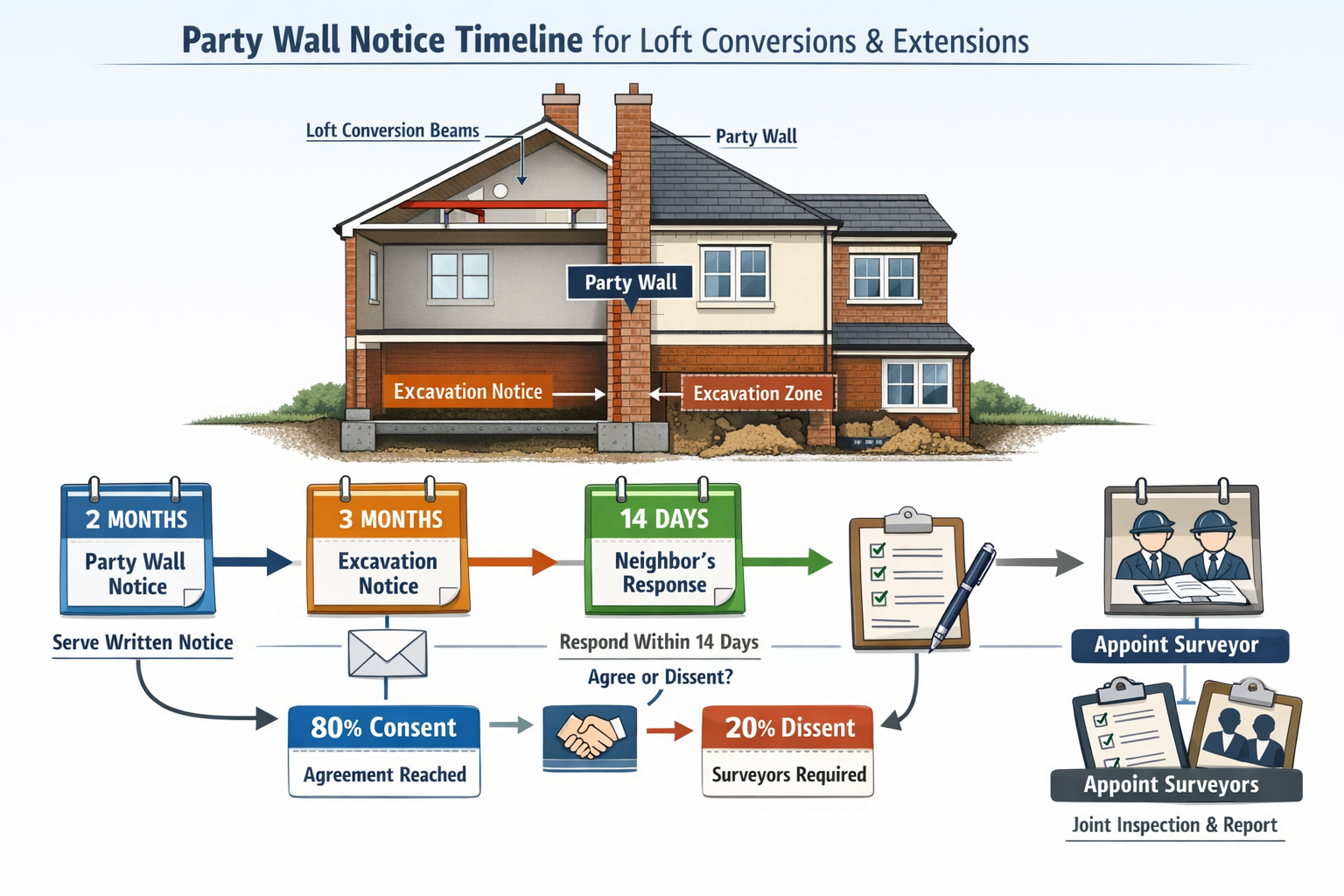
Proper notice procedures form the foundation of party wall compliance. First-time buyers must understand these timelines before scheduling contractors or finalizing project plans.
Serving Party Wall Notices: Critical Timelines
Written notice must be served well in advance of any construction work. The law mandates specific minimum periods[1][2]:
- 2 months' notice for work on party walls or constructing new walls on boundaries
- 3 months' notice for excavation work near neighboring foundations
These aren't suggested timelines—they're legal requirements. Starting work without proper notice or before the notice period expires can result in injunctions, legal action, and costly project delays.
Neighbor Response Requirements
Once you serve notice, adjoining owners have 14 days to respond in writing[1][2]. They have three options:
- Consent in writing – Work can proceed without appointing surveyors
- Dissent or raise concerns – Triggers the formal surveyor appointment process
- No response – Silence is treated as dissent, requiring surveyor involvement
Many first-time buyers mistakenly assume friendly neighbor relationships eliminate the need for formal processes. Even with verbal agreement, written consent is essential. Without it, you must proceed with surveyor appointments.
When you receive a party wall notice, understanding your options as either the building owner or adjoining owner helps manage the process efficiently.
Appointing Party Wall Surveyors
When neighbors dissent or don't respond within 14 days, both parties must appoint surveyors. You have two options:
Option 1: Agreed Surveyor – Both parties jointly appoint one independent surveyor to act impartially. This typically costs less but requires mutual agreement. The surveyor must be independent and not the same professional handling your project's structural design[4].
Option 2: Separate Surveyors – Each party appoints their own surveyor, who then jointly select a third surveyor to resolve any disagreements. This provides maximum protection but increases costs.
Importantly, the building owner (you) pays all surveyor fees, regardless of which appointment method is used[3][4]. This includes your surveyor's fees, your neighbor's surveyor's fees, and any third surveyor costs.
Cost Breakdown: Party Wall Surveys for 2026 Loft Conversions and Extensions
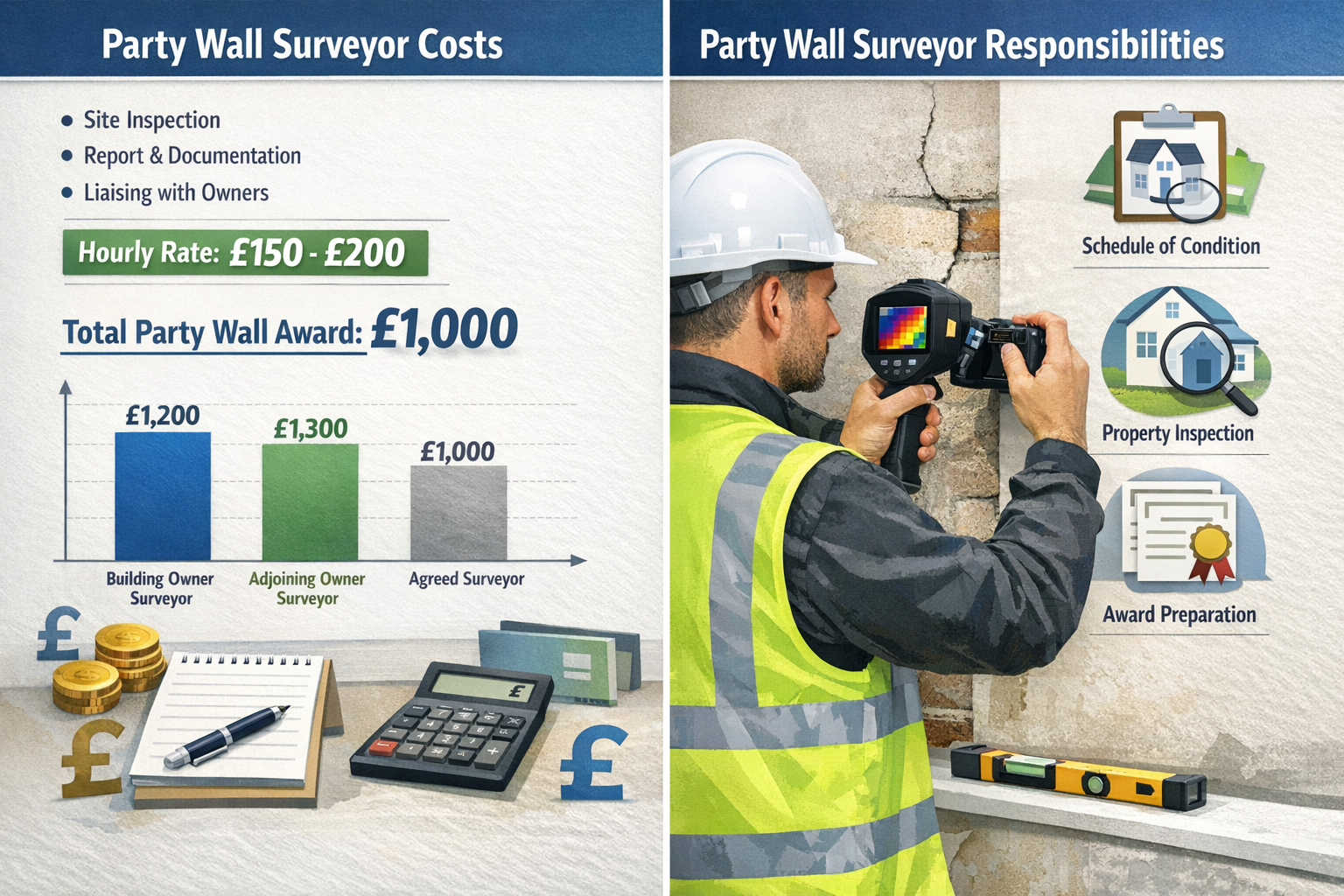
Understanding the financial commitment for party wall compliance helps first-time buyers budget accurately for their improvement projects in 2026.
Typical Party Wall Surveyor Costs
Hourly rates for party wall surveyors in 2026 typically range from £150 to £200 per hour[4]. However, most work is quoted as fixed-fee packages rather than hourly billing.
| Service | Typical Cost |
|---|---|
| Complete Party Wall Award | £1,000 (approximate)[4] |
| Schedule of Condition (per property) | £300-£500 |
| Simple agreed surveyor appointment | £800-£1,200 |
| Complex dispute with separate surveyors | £2,000-£3,500+ |
These costs cover the surveyor's time for:
- Reviewing your construction plans and notice
- Inspecting both properties and preparing schedules of condition
- Drafting the Party Wall Award document
- Serving the Award on all parties
- Monitoring work progress (if required)
For detailed information about pricing structures, review our guide on understanding party wall surveyor costs in London.
Who Pays for Party Wall Surveys?
This question causes considerable confusion among first-time buyers. The answer is straightforward: the building owner initiating the work pays all party wall costs[3][4].
This includes:
✅ Your own surveyor's fees
✅ Your neighbor's surveyor's fees
✅ Third surveyor fees (if appointed)
✅ Schedule of condition costs for adjoining properties
Even when neighbors seem unreasonable or appoint expensive surveyors, you remain financially responsible. Budget for these costs alongside your construction expenses to avoid unpleasant surprises.
Ways to Minimize Party Wall Costs
While you can't avoid party wall expenses entirely when they're required, several strategies help control costs:
- Obtain written consent – If neighbors agree, you avoid surveyor appointments entirely (though a schedule of condition remains advisable)[3]
- Propose an agreed surveyor – Single surveyor appointments cost significantly less than separate surveyors
- Provide clear, detailed plans – Comprehensive documentation reduces surveyor time reviewing and clarifying your intentions
- Maintain good neighbor relations – Cooperative neighbors are more likely to consent or agree to cost-effective surveyor arrangements
Understanding party wall agreements and associated costs before starting your project prevents budget overruns.
The Party Wall Award: What First-Time Buyers Need to Know
When surveyors are appointed, they prepare a Party Wall Award—a legally binding document that governs how your construction work proceeds. This Award protects both parties' interests and provides a framework for resolving disputes.
What's Included in a Party Wall Award?
A comprehensive Party Wall Award typically contains[2]:
- Detailed description of proposed works – Specifications for your loft conversion or extension
- Work commencement and completion dates – Timeline expectations for the project
- Working hours – Restrictions on noisy construction activities
- Access rights – When and how you can access neighboring property if necessary
- Schedule of condition – Photographic and written record of the adjoining property before work begins
- Dispute resolution procedures – Process for handling disagreements during construction
The Award must be served on all parties at least 14 days before work begins. Both you and your neighbor have the right to appeal to the County Court within this period if you disagree with the Award's terms.
Schedule of Condition: Your Protection Against Claims
The schedule of condition represents one of the most valuable components of party wall compliance. This detailed photographic and written record documents the neighboring property's condition before your construction work begins[2][3].
Why is this crucial? If your neighbor later claims your loft conversion caused cracks, subsidence, or other damage, the schedule of condition provides objective evidence of pre-existing conditions. Without this documentation, you're vulnerable to unfounded damage claims that can cost thousands to defend or settle.
Even when neighbors provide written consent and no formal Award is required, commissioning an independent schedule of condition protects your investment.
Practical Guidance for First-Time Buyers Planning Loft Conversions and Extensions

Managing Party Wall Surveys for 2026 Loft Conversions and Extensions: Managing Compliance as First-Time Buyers Invest in Existing Homes requires proactive planning and clear communication.
Step-by-Step Compliance Process
1. Develop detailed construction plans (3-4 months before intended start)
Work with your architect or structural engineer to finalize specifications for your loft conversion or extension. Party wall notices require specific technical details.
2. Identify affected neighbors (3 months before start)
Determine which properties share party walls or are within excavation notification distances. Don't overlook properties behind or diagonally adjacent to yours.
3. Serve formal written notices (2-3 months before start)
Prepare and deliver party wall notices following the Act's requirements. Consider using recorded delivery for proof of service[1].
4. Wait for neighbor responses (14-day response period)
Track response deadlines carefully. No response within 14 days counts as dissent and requires surveyor appointment.
5. Appoint surveyors if needed (6-8 weeks before start)
If neighbors dissent or don't respond, immediately begin the surveyor appointment process. This takes several weeks to complete.
6. Obtain Party Wall Award (minimum 2 weeks before start)
Surveyors prepare and serve the Award, which must be issued at least 14 days before construction begins.
7. Commission schedule of condition (1-2 weeks before start)
Even with neighbor consent, document adjoining property conditions before work commences.
8. Begin construction (only after all requirements met)
Ensure contractors understand any restrictions or requirements specified in the Party Wall Award.
Common Mistakes First-Time Buyers Make
❌ Starting work before notice periods expire – This violates the Act and can result in injunctions forcing work stoppage
❌ Assuming verbal agreements suffice – Only written consent from neighbors eliminates the need for formal surveyor involvement
❌ Failing to budget for party wall costs – Surveyor fees are mandatory expenses when neighbors dissent or don't respond
❌ Not obtaining schedules of condition – Without pre-work documentation, you're vulnerable to damage claims
❌ Ignoring party wall requirements entirely – Some first-time buyers proceed without notices, creating significant legal and financial risks
❌ Using their project surveyor as party wall surveyor – The agreed surveyor must be independent, not the professional already working on your project[4]
Working with Party Wall Surveyors Effectively
Choose experienced, qualified party wall surveyors who understand the Act's requirements and maintain professional impartiality. Look for RICS-qualified professionals with specific party wall expertise.
When discussing your project with surveyors:
- Provide complete, accurate construction plans and specifications
- Be transparent about project timelines and any constraints
- Ask questions about the process, costs, and your obligations
- Maintain professional communication throughout the process
- Respond promptly to surveyor requests for information or access
Finding the right professional support makes the compliance process significantly smoother. Consider consulting our guide on getting party wall agreement surveyor help in London for additional guidance.
Managing Neighbor Relations During Party Wall Compliance
The technical and legal aspects of party wall compliance matter, but maintaining positive neighbor relationships throughout your loft conversion or extension project proves equally important for long-term harmony.
Proactive Communication Strategies
Before serving formal notices, consider having informal conversations with neighbors about your plans. While this doesn't replace legal requirements, it demonstrates respect and allows you to address concerns early.
Effective communication includes:
- Explaining the project scope and anticipated timeline
- Acknowledging potential inconveniences (noise, dust, temporary access needs)
- Offering to share construction schedules so neighbors can plan accordingly
- Providing your contact information and contractor details
- Inviting questions and addressing concerns respectfully
Many disputes arise from misunderstandings or feeling blindsided by construction activity. Proactive communication prevents these issues.
Handling Neighbor Objections
When neighbors raise concerns or dissent to your party wall notice, remain calm and professional. Remember that they have legitimate rights to protect their property interests.
Common neighbor concerns include:
- Structural damage risks – Address through proper surveyor involvement and schedules of condition
- Noise and disruption – Offer to restrict working hours or provide advance notice of particularly disruptive activities
- Property value impacts – Explain how professional compliance protects their property
- Access requirements – Clarify exactly what access you need and when
The party wall surveyor's role includes mediating these concerns and finding reasonable solutions that protect both parties' interests.
When Disputes Escalate
Occasionally, neighbor disputes escalate beyond normal party wall procedures. If you encounter:
- Unreasonable objections to straightforward work
- Threats or harassment
- Refusal to allow necessary access despite Award provisions
- Claims of damage unsupported by schedule of condition evidence
Consult your party wall surveyor immediately. They can advise on dispute resolution procedures, including potential County Court appeals if necessary. Maintaining detailed records of all communications and following proper procedures protects your position.
For broader context on property surveying and professional standards, review our overview of what surveyors do and their responsibilities.
The 2026 Landscape: Why Party Wall Compliance Matters More Than Ever
The property market dynamics in 2026 create unique circumstances that make party wall compliance particularly critical for first-time buyers investing in home improvements.
Increased Home Improvement Activity
With improved affordability and more realistic property prices, first-time buyers are purchasing existing homes with renovation potential rather than competing for turnkey properties. This trend drives unprecedented demand for:
- Loft conversions adding valuable bedroom space
- Side and rear extensions expanding ground floor living areas
- Basement conversions creating additional functional space
Each project type typically involves party wall considerations, multiplying the number of notices served and Awards required across the UK.
Professional Surveyor Capacity
The surge in home improvement projects creates capacity challenges for qualified party wall surveyors. First-time buyers should:
- Engage surveyors early – Don't wait until neighbors dissent to start looking for professionals
- Expect longer timelines – Popular surveyors may have waiting lists
- Budget appropriately – High demand may pressure fees upward
- Verify qualifications – Ensure your surveyor has proper RICS credentials and party wall expertise
Legal and Financial Protection
Proper party wall compliance in 2026 provides essential protections:
Legal protection – Following the Act's requirements prevents injunctions, legal disputes, and forced work stoppages that derail renovation timelines.
Financial protection – Schedules of condition and properly drafted Awards protect against unfounded damage claims that can cost thousands to defend or settle.
Project certainty – Completed party wall procedures allow contractors to work without interruption, keeping projects on schedule and within budget.
Relationship preservation – Professional compliance demonstrates respect for neighbors' rights, maintaining harmony in your community for years after construction completes.
Integrating Party Wall Compliance with Your Overall Property Strategy
Party wall requirements shouldn't be viewed in isolation but as part of your comprehensive property improvement strategy.
Coordinating with Other Surveys
First-time buyers often need multiple survey types when purchasing and improving properties:
- Pre-purchase surveys – Homebuyer reports or building surveys identify existing issues before purchase
- Structural surveys – Assess feasibility of planned loft conversions or extensions
- Party wall surveys – Manage compliance when work affects shared boundaries
Coordinating these surveys with the same firm or related professionals can improve efficiency and reduce overall costs. Understanding which survey is right for you helps make informed decisions about your property investment.
Planning Permission and Building Regulations
Party wall compliance operates independently from planning permission and building regulations, but all three often apply to loft conversions and extensions:
Planning permission – Required for many extensions and loft conversions, depending on size and location
Building regulations – Always required for structural work, ensuring safety and compliance with construction standards
Party wall compliance – Required when work affects shared boundaries, regardless of planning status
You need all applicable approvals before starting construction. Don't assume planning permission eliminates party wall requirements—they're separate legal frameworks.
Timing Your Property Improvements
Strategic timing of renovations affects party wall compliance:
Before moving in – Completing major work before occupancy minimizes disruption to your daily life but requires careful coordination of purchase completion, notice periods, and construction schedules.
After settling in – Waiting allows you to understand your property's needs and build neighbor relationships before serving notices, but means living through construction disruption.
Phased improvements – Multiple projects over time may require separate party wall notices and Awards, increasing administrative burden and costs.
Consider these factors when planning your renovation timeline and budget.
Conclusion: Successful Party Wall Compliance for First-Time Buyers in 2026
Party Wall Surveys for 2026 Loft Conversions and Extensions: Managing Compliance as First-Time Buyers Invest in Existing Homes represents a critical knowledge area for the current generation of property owners. As first-time buyers increasingly choose to improve existing properties rather than stretching budgets for larger homes, understanding party wall requirements becomes essential for project success.
Key principles for successful compliance:
✅ Start early – Begin the party wall process 3-4 months before your intended construction start date
✅ Budget comprehensively – Include surveyor fees (approximately £1,000 for a complete Award) in your renovation budget[4]
✅ Communicate proactively – Maintain open, respectful dialogue with neighbors throughout the process
✅ Engage qualified professionals – Work with experienced RICS-qualified party wall surveyors
✅ Document everything – Obtain schedules of condition even when neighbors consent
✅ Follow procedures precisely – Serve proper notices with correct timelines and wait for required periods
✅ Understand your financial obligations – Accept that you'll pay all party wall costs as the building owner
Next Steps for Your Loft Conversion or Extension Project
If you're planning a loft conversion or extension in 2026, take these immediate actions:
- Review your construction plans with a structural engineer or architect to identify party wall implications
- Map affected properties to determine which neighbors require notices
- Research qualified party wall surveyors in your area before you need to appoint one
- Add party wall costs to your renovation budget (£1,000-£3,500 depending on complexity)
- Prepare your timeline accounting for 2-3 month notice periods before construction can begin
- Have preliminary conversations with neighbors about your plans (while understanding this doesn't replace formal notices)
The party wall compliance process may seem bureaucratic, but it serves important purposes: protecting your property investment, safeguarding your neighbors' interests, and preventing costly disputes that derail renovation projects. First-time buyers who approach party wall requirements professionally and proactively set themselves up for successful home improvements that enhance their properties' value and livability for years to come.
For personalized guidance on your specific project, consult with qualified party wall surveyors who can assess your situation and provide tailored advice. Understanding your obligations under the Party Wall etc. Act 1996 isn't just about legal compliance—it's about being a responsible property owner and good neighbor while achieving your home improvement goals.
References
[1] Party Wall Guide – https://www.squarepointsurveyors.co.uk/party-wall-guide/
[2] Understanding Party Walls – https://www.oakfieldsurveyors.co.uk/party-wall/understanding-party-walls/
[3] Party Wall Agreement – https://hoa.org.uk/advice/guides-for-homeowners/i-am-improving/party-wall-agreement/
[4] Party Wall Surveyor Cost – https://hoa.org.uk/advice/guides-for-homeowners/i-am-improving/party-wall-surveyor-cost/
[5] Party Wall Act Article Estates Gazette – https://tanfieldchambers.co.uk/party-wall-act-article-estates-gazette/