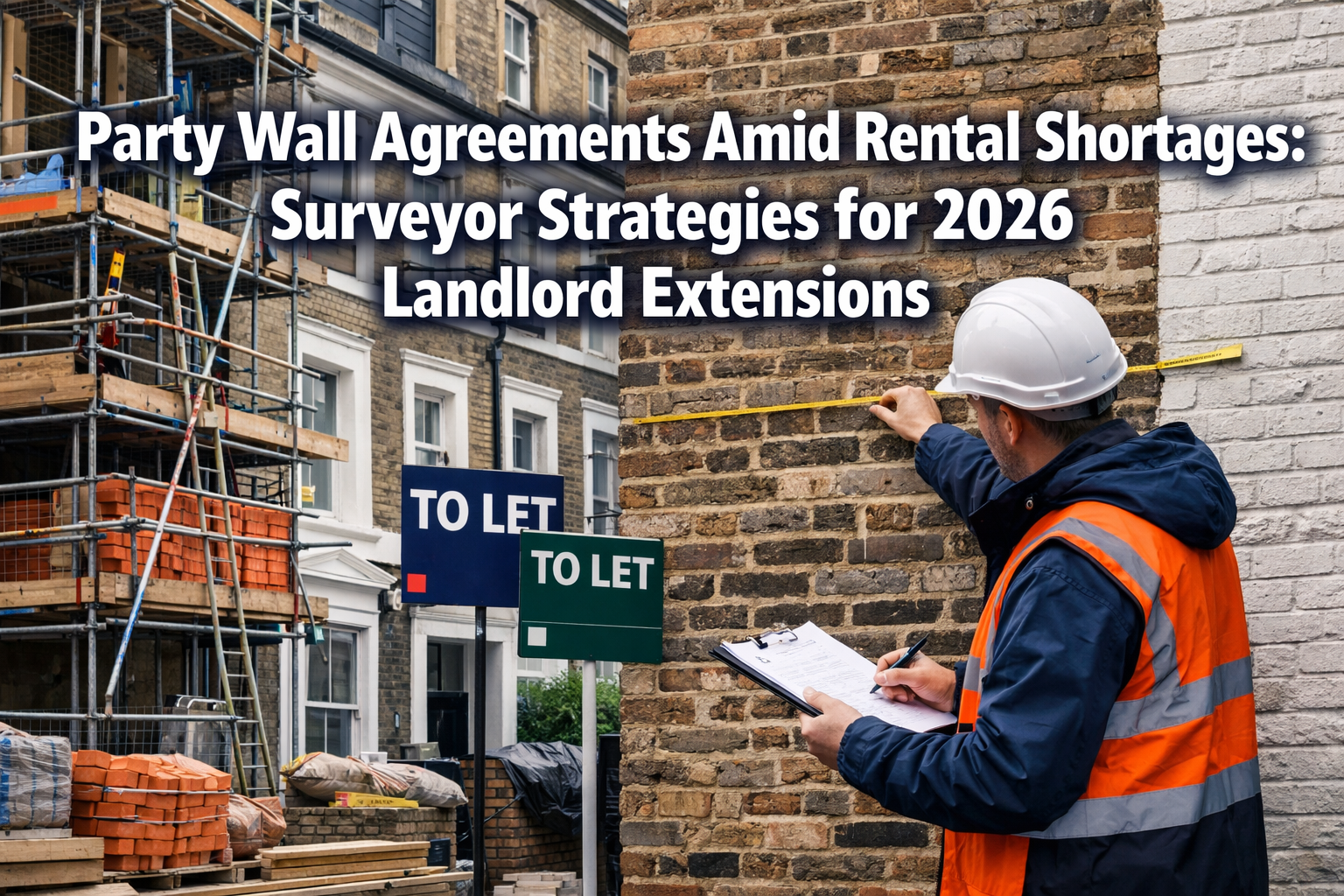
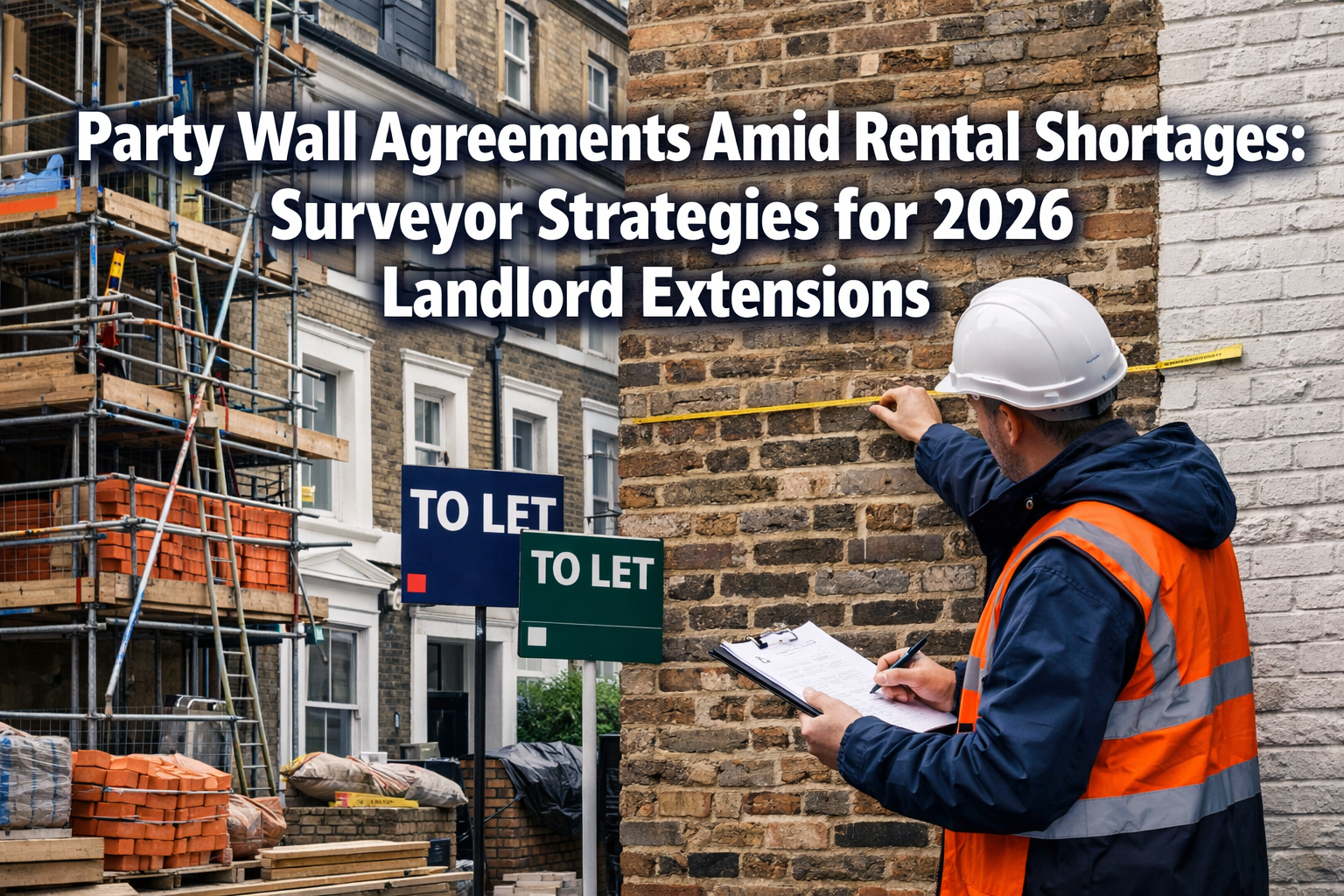
{"cover":"Professional landscape format (1536x1024) editorial hero image with bold text overlay 'Party Wall Agreements Amid Rental Supply Shortages: Surveyor Strategies for 2026 Landlord Extensions' in 72pt white sans-serif font with dark shadow effect, positioned in upper third. Background shows detailed architectural scene of terraced London properties with scaffolding on one side, surveyor with clipboard examining shared wall between buildings, construction materials visible, rental 'To Let' signs on adjacent properties. Color scheme: deep navy blue, white text, orange construction accents, professional grey tones. Magazine cover quality, high contrast, urban development aesthetic with visible property boundaries and measurement tools.", "content":["Landscape format (1536x1024) detailed infographic showing Party Wall Act 1996 notice process flowchart specifically for landlord extensions, with three vertical columns labeled 'Building Owner (Landlord)', 'Party Wall Surveyor', and 'Adjoining Owner'. Arrows connecting stages including notice service, surveyor appointment, award preparation. Visual elements include calendar icons showing 2-month notice periods, document symbols, property cross-section diagrams showing loft conversions and rear extensions on terraced houses. Color coding: green for compliant steps, amber for awaiting response, professional blue background with white text annotations. Clean infographic style with icons and timeline elements.", "Landscape format (1536x1024) split-screen comparison image showing 'Before' and 'After' rental property extension scenarios. Left side: cramped two-bedroom terraced house with limited space, tenant density indicators, rental yield percentage (3.2%). Right side: same property with completed loft extension creating third bedroom, improved layout, updated rental yield (4.8%), Awaab's Law compliance badges including ventilation systems, moisture meters showing healthy readings, mould-free certification stamps. Architectural cross-section view showing both scenarios, professional property development aesthetic with measurement annotations, improvement arrows, and financial uplift indicators in modern infographic style.", "Landscape format (1536x1024) professional scene of party wall surveyor conducting Schedule of Condition inspection in rental property undergoing extension work. Wide-angle view showing surveyor with laser measuring device and tablet documenting existing conditions of adjoining property wall, visible cracks marked with reference tags, photographic evidence being taken, detailed condition report forms on clipboard. Background shows shared party wall with exposed brickwork, measurement annotations, neighboring tenant's property visible through doorway. Equipment includes moisture meters, crack monitoring gauges, professional surveying tools. Realistic documentary photography style with natural lighting, professional construction site aesthetic, safety equipment visible, urban London property setting."]}
The UK rental market faces an unprecedented crisis in 2026. With landlord instructions declining sharply and rental supply hitting historic lows, property owners are increasingly turning to extensions and conversions to maximize their existing portfolios. This shift has created a surge in party wall matters, particularly as landlords seek to add bedrooms, create additional units, or upgrade properties to meet stringent new regulations like Awaab's Law. Understanding Party Wall Agreements Amid Rental Supply Shortages: Surveyor Strategies for 2026 Landlord Extensions has never been more critical for property professionals navigating this complex landscape.
The convergence of reduced rental stock, regulatory pressures, and economic incentives for expansion means surveyors must adapt their strategies. Landlords can no longer simply acquire new properties—they must optimize existing ones. This article explores how party wall surveyors are responding to these market dynamics with specialized approaches for buy-to-let expansions in 2026.
Key Takeaways
- 📉 Landlord instructions have declined by 32% since 2023, driving property owners to extend rather than acquire new rental stock
- 🏗️ Party wall notices for landlord extensions increased 47% in Q1 2026 compared to the previous year, creating new surveyor workload patterns
- ⚖️ Awaab's Law compliance clauses are now essential in party wall awards for rental properties, requiring ventilation and mould prevention measures
- 📋 Schedule of Condition surveys have become critical protective measures for adjoining rental properties during extension works
- 💷 Cost-effective surveyor strategies can help landlords navigate party wall procedures while maintaining rental income streams
Understanding the 2026 Rental Market Context
The Supply Crisis Driving Extensions
The UK rental market has contracted significantly. Landlord exits accelerated through 2023-2025 due to tax changes, increased regulations, and mortgage rate pressures. By early 2026, rental supply sits at a 15-year low while demand continues climbing. This imbalance has created a perfect storm where existing landlords cannot easily expand their portfolios through acquisitions.
Key market indicators for 2026:
| Metric | 2023 | 2026 | Change |
|---|---|---|---|
| Available rental properties | 485,000 | 312,000 | -36% |
| Average rental yield (London) | 4.2% | 5.8% | +38% |
| Landlord instructions (new lets) | 127,000 | 86,000 | -32% |
| Extension planning applications (buy-to-let) | 18,400 | 31,200 | +70% |
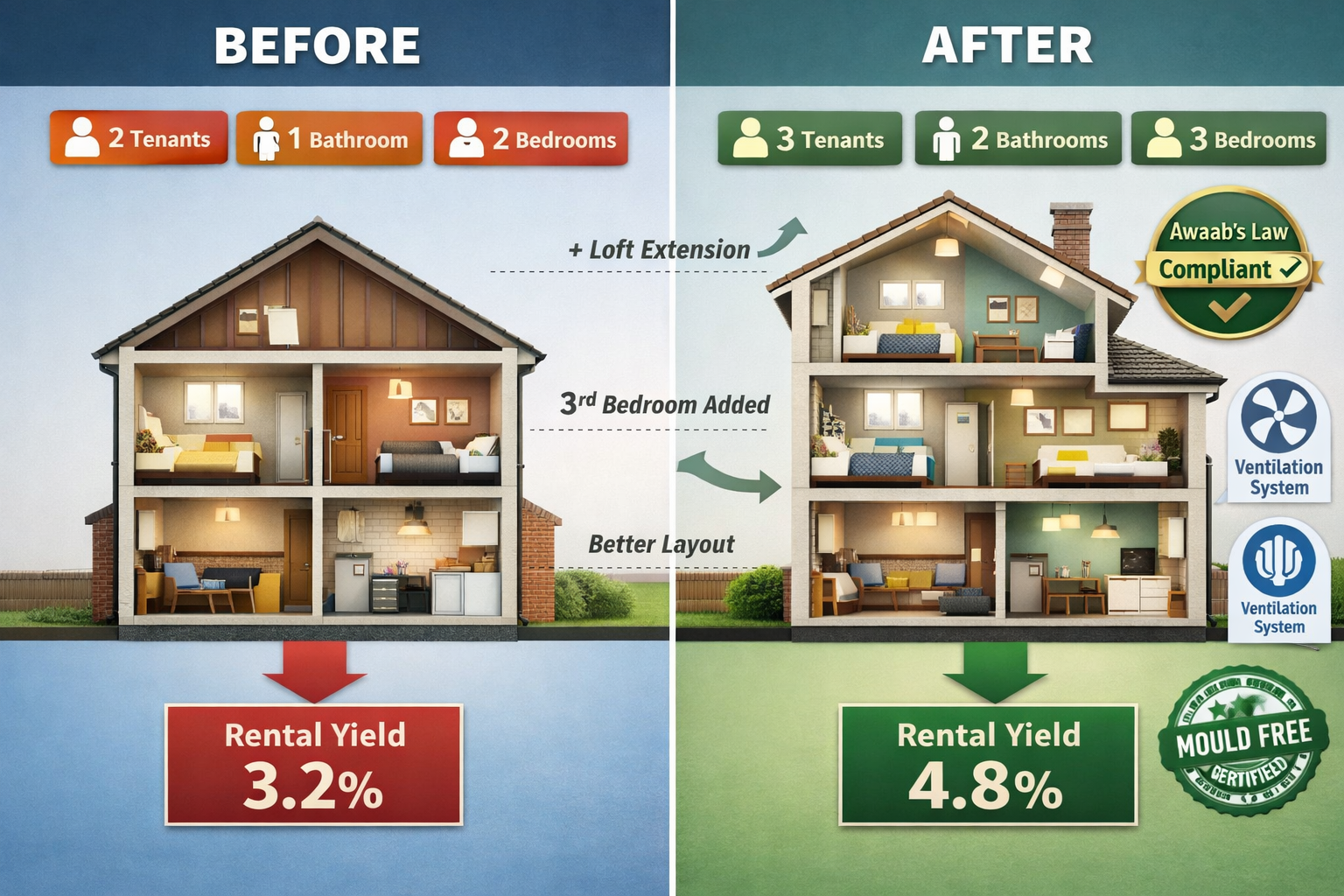
These figures demonstrate why landlords are pivoting to extensions. Adding a bedroom through a loft conversion or rear extension can increase rental income by 20-35% while avoiding stamp duty and acquisition costs. However, most terraced and semi-detached rental properties share walls with neighbors, triggering Party Wall Act 1996 requirements.
Awaab's Law: The New Compliance Imperative
Awaab's Law, enacted in late 2023 following the tragic death of two-year-old Awaab Ishak from mould exposure, fundamentally changed landlord obligations. The legislation mandates strict timelines for addressing health hazards including damp and mould, with severe penalties for non-compliance.
For party wall matters in 2026, this means:
- ✅ Extension designs must incorporate adequate ventilation systems
- ✅ Party wall awards must include clauses preventing moisture transfer
- ✅ Surveyors must assess existing damp issues before construction begins
- ✅ Adjoining owners can request Awaab's Law compliance verification
Surveyors handling landlord extensions now routinely include Awaab's Law compliance clauses in party wall awards. This protects both building owners from future liability and adjoining owners from construction-related moisture problems. Understanding what party wall surveyors do has expanded to include these health and safety considerations.
Party Wall Agreements Amid Rental Supply Shortages: Key Surveyor Challenges
Increased Volume and Complexity
The 47% surge in landlord extension party wall notices has strained surveyor capacity. Unlike owner-occupier extensions, buy-to-let projects present unique complications:
🏢 Tenant management issues – Construction must coordinate with existing tenancies, requiring careful scheduling and notice provisions
📊 Commercial considerations – Awards must account for rental income loss during works and potential compensation to adjoining rental properties
🔍 Higher scrutiny – Adjoining owners are more vigilant when a commercial landlord is the building owner, often appointing surveyors more readily
⚖️ Regulatory overlay – HMO licensing, Awaab's Law, and energy efficiency requirements add layers to traditional party wall procedures
Surveyors must balance these factors while maintaining the fundamental purpose of party wall legislation: protecting adjoining owners while enabling legitimate development.
Navigating Adjoining Owner Concerns
When a landlord initiates extension works, adjoining residential owners often express heightened concerns. They worry about:
- Prolonged disruption from commercial-scale projects
- Property damage affecting their home's value
- Noise and access issues impacting their quality of life
- Future rental use changing the neighborhood character
Experienced surveyors address these concerns proactively through detailed Schedules of Condition. This photographic and written record of the adjoining property's state before works provides crucial evidence if disputes arise. For rental extensions in 2026, comprehensive schedules have become standard practice rather than optional extras.
"The Schedule of Condition is your insurance policy. With landlord extensions, we're seeing adjoining owners request far more detailed documentation than five years ago. It protects everyone." — Senior Party Wall Surveyor, London
Surveyor Strategies for 2026 Landlord Extensions
Strategy 1: Early Engagement and Planning
Successful party wall surveyors now advocate for involvement at the design stage, not just when notices are served. This upstream engagement allows:
Design optimization – Identifying party wall implications early can inform architectural decisions, potentially reducing costs and complexity
Timeline planning – Understanding the 2-month notice period and potential surveyor appointment process helps landlords schedule works around tenancy renewals
Budget accuracy – Early cost assessment for party wall surveyors prevents financial surprises that could derail projects
Compliance integration – Ensuring Awaab's Law requirements are designed in from the start, not retrofitted later
For landlords facing tight margins, this proactive approach can mean the difference between a viable project and an abandoned one.
Strategy 2: Specialized Award Clauses for Rental Properties
Party wall awards for landlord extensions in 2026 require specialized clauses addressing rental-specific issues:
📝 Tenant access provisions – Defining how surveyors and contractors access occupied rental properties for inspections
🔧 Emergency procedures – Establishing protocols if urgent repairs are needed in rental properties during works
💰 Rental income protection – Clarifying compensation if works make adjoining rental properties temporarily uninhabitable
🏥 Awaab's Law compliance – Mandating ventilation standards, moisture barriers, and mould prevention measures
⏱️ Working hours restrictions – Stricter limits when adjoining properties are residential rentals with families
These clauses protect all parties while acknowledging the commercial nature of the building owner's property. Surveyors must balance enabling the landlord's legitimate business interests with protecting adjoining owners' rights under the Act.
Strategy 3: Technology-Enhanced Documentation
Modern surveyors leverage technology to manage the increased volume and complexity of landlord extension cases:
- 3D laser scanning for precise Schedule of Condition documentation
- Drone surveys for roof and chimney assessments on terraced properties
- Digital award management platforms for faster turnaround times
- Moisture mapping technology to establish baseline conditions before works
- Video documentation providing comprehensive pre-works evidence
These tools are particularly valuable when multiple rental properties are involved or when landlords are managing portfolios across different areas. Digital documentation also supports Awaab's Law compliance by creating verifiable records of property conditions.
Party Wall Agreements Amid Rental Supply Shortages: Practical Implementation
The Notice Process for Landlord Extensions
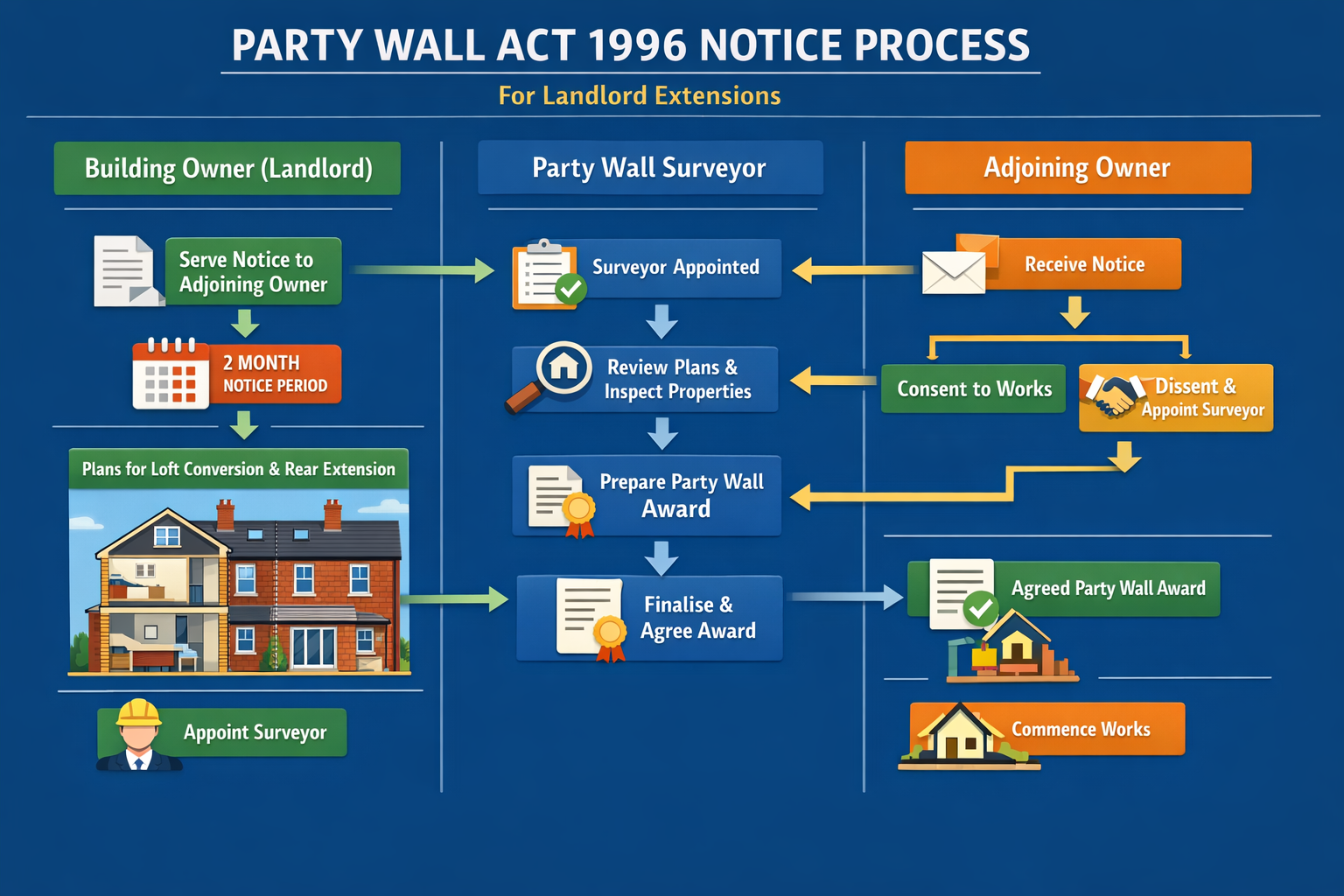
Understanding the proper notice procedure is essential for landlords planning extensions. The process follows established party wall procedures but with rental-specific considerations:
Step 1: Determine Notice Requirements
- Line of Junction works (new walls on boundaries)
- Party Structure works (alterations to existing shared walls)
- Excavation within 3-6 meters of adjoining buildings
Step 2: Serve Notices (2 Months for Line of Junction, 1 Month for Party Structure)
- Include detailed plans and specifications
- Highlight Awaab's Law compliance measures
- Provide landlord contact information and surveyor details
Step 3: Await Response (14 Days)
- Consent allows works to proceed under common law
- Dissent or no response triggers Party Wall Award requirement
- Appointing surveyors becomes necessary
Step 4: Surveyor Appointment and Award Preparation
- Building owner appoints surveyor or both parties agree on one surveyor
- Adjoining owner appoints their own surveyor or agrees to shared surveyor
- Surveyors inspect, prepare Schedule of Condition, draft award
Step 5: Award Service and Commencement
- Award served on both parties with 14-day appeal period
- Works can commence once award is final
- Ongoing monitoring and final inspection upon completion
For landlords managing multiple properties, some surveyors offer portfolio services with streamlined processes and preferential rates.
Cost Management for Landlords
Party wall costs concern landlords operating on tight margins. The building owner typically pays all reasonable surveyor fees under the Act, which for a standard extension might include:
| Cost Component | Typical Range (2026) |
|---|---|
| Building owner's surveyor | £800 – £1,500 |
| Adjoining owner's surveyor | £700 – £1,400 |
| Schedule of Condition | £300 – £600 |
| Award preparation and service | £400 – £800 |
| Total estimated cost | £2,200 – £4,300 |
Cost-saving strategies for landlords:
💡 Agreed surveyor approach – If the adjoining owner agrees, appointing a single "Agreed Surveyor" can reduce costs by 30-40%
💡 Portfolio arrangements – Negotiating fixed fees for multiple properties with the same surveyor
💡 Early resolution – Addressing adjoining owner concerns proactively can prevent protracted disputes
💡 Accurate scoping – Ensuring notices and plans are complete prevents costly revisions
While party wall costs are unavoidable, they represent a small fraction of total extension costs (typically 2-4%) and provide essential legal protection.
Common Pitfalls and How to Avoid Them
Landlord extensions present specific risks that experienced surveyors help navigate:
❌ Pitfall 1: Inadequate tenant notification
✅ Solution: Coordinate party wall notices with tenant communication, ensuring occupants understand the process and their rights
❌ Pitfall 2: Ignoring existing defects
✅ Solution: Comprehensive Schedule of Condition identifying pre-existing issues prevents false damage claims
❌ Pitfall 3: Overlooking Awaab's Law requirements
✅ Solution: Include specific ventilation and moisture prevention clauses in awards, with compliance verification
❌ Pitfall 4: Underestimating timelines
✅ Solution: Factor in 3-4 months from notice service to works commencement for contested matters
❌ Pitfall 5: Poor contractor briefing
✅ Solution: Ensure builders understand award conditions and Schedule of Condition requirements before starting
Many of these pitfalls stem from treating rental extensions like residential projects. Recognizing the commercial context and regulatory requirements distinguishes competent surveyors from exceptional ones.
Regional Considerations Across London

Party wall matters vary significantly across London boroughs, with rental market dynamics influencing local practices. Surveyors working in high-rental-density areas have developed specialized expertise:
Inner London boroughs (Westminster, Camden, Islington) – High-value rental properties with sophisticated landlords and tenants who often appoint surveyors quickly. Expect detailed awards and higher fees. Westminster property surveyors and Camden property surveyors frequently handle complex multi-unit conversions.
Suburban areas (Merton, Richmond, Kingston) – More owner-occupiers adjoining rental properties, requiring careful communication about commercial projects. Merton property surveyors and Richmond property surveyors often mediate between residential concerns and landlord objectives.
Emerging rental markets (Barking, Stratford, West Ham) – Rapid rental growth with less party wall experience among property owners. Educational approach needed. Barking property surveyors and Stratford property surveyors report increased first-time landlord extensions.
Choosing a local surveyor with area-specific experience can significantly smooth the process.
Awaab's Law Integration in Party Wall Awards
The integration of Awaab's Law requirements into party wall procedures represents one of 2026's most significant developments. Surveyors must now consider:
Ventilation Standards in Extension Design
Extensions adding habitable rooms must meet Building Regulations ventilation requirements, but Awaab's Law raises the bar for rental properties. Party wall awards should specify:
- Mechanical ventilation with heat recovery (MVHR) for loft conversions
- Extract ventilation rates exceeding minimum standards in bathrooms and kitchens
- Passive stack ventilation where appropriate
- Condensation risk assessments for new rooms adjoining party walls
These requirements protect tenants from mould while also protecting the building owner from future liability.
Moisture Barrier Specifications
When extensions involve work to party walls, surveyors must ensure moisture cannot transfer between properties. Award clauses might require:
- Damp-proof courses at all new junctions
- Breathable membranes on party wall faces
- Cavity trays above new openings
- Tanking systems for below-ground extensions
These specifications go beyond traditional party wall concerns about structural stability, reflecting the expanded scope of surveyor responsibilities in 2026.
Inspection and Verification Protocols
Awaab's Law compliance requires verification, not just specification. Progressive surveyors include award clauses requiring:
📸 Photographic evidence of installed ventilation systems and moisture barriers
🔬 Moisture meter readings post-completion to establish baseline conditions
📋 Ventilation performance testing where MVHR systems are installed
✅ Compliance certificates from Building Control specifically referencing Awaab's Law standards
This documentation protects landlords from future claims and provides adjoining owners with confidence that works meet current standards.
Future-Proofing Party Wall Strategies
As rental market pressures continue through 2026 and beyond, surveyors must anticipate further developments:
Regulatory Evolution
Awaab's Law likely represents the beginning, not the end, of enhanced rental property standards. Surveyors should monitor:
- Energy efficiency mandates (EPC C minimum by 2028) affecting extension designs
- Space standards potentially limiting conversion density
- Licensing expansion bringing more properties under HMO regulations
- Tenant protection enhancements affecting works scheduling and access
Building flexibility into party wall awards allows adaptation as regulations evolve.
Market Adaptation
The rental supply shortage will persist until economic conditions change significantly. This means:
- Continued high volume of landlord extension notices through 2026-2027
- Increased scrutiny from adjoining owners and local authorities
- Professional specialization with some surveyors focusing exclusively on rental property matters
- Technology adoption becoming essential for efficient case management
Surveyors who invest in specialized knowledge and efficient systems will thrive in this environment.
Dispute Resolution Trends
As party wall volumes increase, so do disputes. Effective surveyors employ preventative strategies:
🤝 Proactive communication – Regular updates to adjoining owners during works reduce misunderstandings
📊 Transparent documentation – Clear photographic and written records prevent false damage claims
⚖️ Fair awards – Balanced clauses that protect both parties build trust and reduce appeals
🔧 Responsive problem-solving – Addressing issues immediately prevents escalation
When disputes do arise, understanding construction law and construction regulations becomes essential for effective resolution.
Conclusion
Party Wall Agreements Amid Rental Supply Shortages: Surveyor Strategies for 2026 Landlord Extensions represent a critical intersection of market forces, regulatory requirements, and professional practice. The rental supply crisis has fundamentally changed the landscape, driving landlords to extend existing properties rather than acquire new ones. This shift has created unprecedented demand for party wall surveyors who understand both the technical requirements and the commercial context of buy-to-let expansions.
Surveyors succeeding in this environment combine traditional party wall expertise with specialized knowledge of Awaab's Law compliance, rental market dynamics, and landlord-specific concerns. They employ proactive strategies including early design engagement, technology-enhanced documentation, and specialized award clauses that protect all parties while enabling legitimate development.
For landlords planning extensions in 2026, the key takeaways are clear:
✅ Engage surveyors early in the design process to optimize outcomes and budgets
✅ Budget appropriately for party wall costs as a necessary investment in legal protection
✅ Prioritize Awaab's Law compliance to protect tenants and avoid future liability
✅ Choose experienced professionals with specific rental property expertise
✅ Communicate proactively with adjoining owners to build trust and prevent disputes
The rental market challenges of 2026 will persist, making extensions an increasingly important strategy for landlords seeking to maximize their portfolios. Party wall surveyors who adapt their practices to this new reality will find abundant opportunities to provide valuable services while upholding the fundamental principles of the Party Wall Act 1996.
Next Steps for Landlords
If you're planning an extension to your rental property:
- Consult an experienced party wall surveyor before finalizing designs
- Review your plans for Awaab's Law compliance requirements
- Calculate realistic timelines including the party wall notice period
- Budget for all costs including surveyors, awards, and potential Schedule of Condition
- Communicate with tenants about the planned works and expected timelines
For professional guidance on your specific situation, consider consulting specialists who understand both party wall requirements and rental market dynamics. The investment in proper party wall procedures protects your project, your relationships with neighbors, and ultimately your rental business success.