


The UK property market in 2026 presents a puzzle that would challenge even the most experienced valuers. While national headlines suggest stabilization, the reality beneath reveals a market fractured along regional lines. Valuation Challenges in Regional House Price Divides: RICS Strategies for North-South Disparities in 2026 have become critical concerns as London's price net balance plummeted to -40% in February, while Scotland and the North West continue showing resilience and upward momentum[2]. For chartered surveyors handling cross-regional instructions, these diverging trends demand sophisticated adjustment frameworks and region-specific methodologies that go far beyond traditional valuation approaches.
The February 2026 RICS data reveals a market where geography has become destiny. The national house price net balance declined to -12%, missing expectations and marking the first decline in four months[1]. Yet this headline figure masks profound regional disparities that create distinct valuation environments requiring fundamentally different strategies.
Key Takeaways
✅ Regional divergence intensifies: London's price sentiment crashed to -40% in February 2026, while northern regions and Scotland maintain positive momentum, creating distinct valuation environments[2]
✅ Twelve-month expectations collapse in capital: London's forward-looking price expectations dropped 49 percentage points from +56% to +7% between January and February 2026, signaling sudden confidence loss[1]
✅ Affordability drives the divide: The most affordable regions experience strongest price growth while high-cost Southern markets face continued pressure, requiring region-specific valuation adjustments[4]
✅ Mortgage rate uncertainty compounds challenges: Rising energy costs increase likelihood that mortgage rates remain elevated longer, directly impacting property valuations across all regions[2]
✅ RICS frameworks provide stability: Standardized methodologies and cross-regional adjustment protocols help surveyors maintain valuation accuracy despite volatile regional conditions
Understanding the 2026 Regional House Price Landscape
The current market represents one of the most regionally fragmented property landscapes in recent UK history. Understanding these divisions is essential for accurate valuation work.
The Southern Struggle: London and the South East
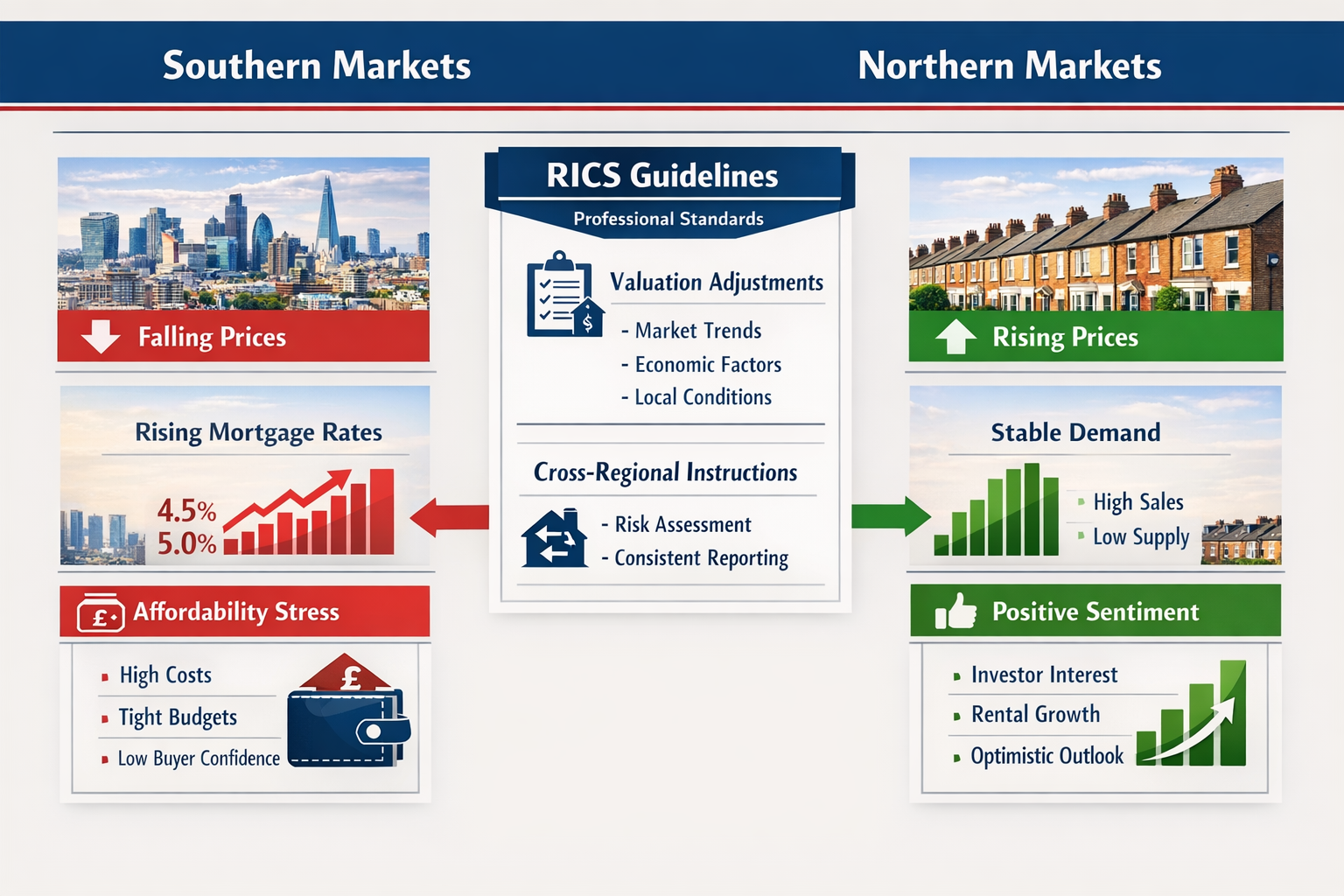
London's property market has experienced the most dramatic deterioration of any UK region. The capital's -40% price net balance in February 2026 represents a severe weakening from earlier optimism[2]. More concerning is the collapse in forward expectations—the twelve-month outlook plunged from +56% in January to just +7% in February, a staggering 49-percentage-point decline that reflects sudden loss of confidence[1].
The South East mirrors this pessimism with a -24% price pressure reading, while East Anglia recorded -26%[2]. These figures indicate persistent affordability challenges that continue constraining buyer demand despite broader market stabilization attempts.
For surveyors conducting expert building evaluation in these regions, the implications are clear: properties with over-ambitious pricing face extended marketing periods or mandatory price adjustments[3]. Valuation realism has become critical, particularly in counties like Hertfordshire, Essex, and Cambridgeshire where early stabilization signs emerge only when pricing aligns with current market realities.
Northern Resilience: Scotland and the North West
In stark contrast, Scotland, Northern Ireland, and the North West of England continue reporting firmer price trends and upward momentum as of February 2026[2]. These regions benefit from relative affordability, with lower absolute price levels enabling stronger buyer demand and market activity.
The regional affordability gap has become the primary driver of divergence. While Southern buyers struggle with mortgage affordability at elevated price points, Northern markets operate within ranges that remain accessible to a broader buyer pool. This fundamental difference creates distinct valuation environments that require region-specific approaches.
The Mortgage Rate Wildcard
Across all regions, the trajectory of mortgage rates remains the critical uncertainty. RICS analysis indicates that recent rises in oil and energy prices have increased the likelihood that mortgage rates will remain higher for longer[2]. This affects valuations nationwide but disproportionately impacts higher-priced Southern markets where mortgage affordability constraints are already acute.

Valuation Challenges in Regional House Price Divides: RICS Strategies for Cross-Regional Instructions
Chartered surveyors handling instructions across multiple regions face unprecedented challenges in 2026. The following RICS-aligned strategies provide frameworks for maintaining valuation accuracy amid regional divergence.
Strategy 1: Region-Specific Comparable Selection 🎯
Traditional comparable selection methodologies assume relatively uniform market conditions. In 2026, this assumption no longer holds. RICS best practice now requires explicit regional adjustment protocols when selecting comparables.
Southern Market Comparables:
- Prioritize recent transactions (within 3 months) due to rapid sentiment shifts
- Apply negative time adjustments for older comparables given declining trends
- Weight asking price reductions heavily in market evidence
- Consider extended marketing periods as negative value indicators
- Scrutinize vendor motivation and transaction circumstances
Northern Market Comparables:
- Accept slightly older comparables (3-6 months) given stable positive trends
- Apply modest positive time adjustments reflecting ongoing appreciation
- Focus on achieved prices rather than initial asking prices
- Consider multiple offers and quick sales as positive indicators
- Evaluate local employment and economic fundamentals
For surveyors working across regions, maintaining separate comparable databases with region-specific adjustment factors has become essential. Understanding how an RICS survey can help negotiate property prices requires this granular regional approach.
Strategy 2: Differential Risk Adjustment Frameworks
The volatility differential between regions necessitates distinct risk adjustment approaches in valuation work.
| Risk Factor | Southern Markets | Northern Markets |
|---|---|---|
| Price Volatility | High (±15-20% range) | Moderate (±5-10% range) |
| Buyer Confidence | Low and declining | Stable to improving |
| Mortgage Availability | Constrained at high LTV | More accessible |
| Marketing Period | Extended (12-20 weeks) | Normal (8-12 weeks) |
| Transaction Certainty | Lower fall-through rates | Higher completion rates |
These differential risk profiles should inform valuation ranges and confidence intervals. In Southern markets, wider valuation brackets (e.g., ±7-10%) reflect genuine market uncertainty, while Northern markets may justify tighter ranges (±3-5%) given greater stability.
Strategy 3: Forward-Looking Expectation Adjustments
The dramatic collapse in London's twelve-month expectations—from +56% to +7% in a single month[1]—demonstrates how rapidly sentiment can shift. RICS guidance emphasizes incorporating forward-looking market indicators into current valuations.
Key Forward Indicators to Monitor:
- Regional RICS net balance trends (monthly tracking)
- Mortgage approval rates by region
- New instruction volumes versus buyer enquiries
- Average time to sale by postcode
- Local employment and wage growth data
For properties in transitional areas or those with extended completion timelines, explicit expectation adjustments should be documented in valuation reports. A property valued in February 2026 for completion in June 2026 requires different treatment in London (-40% current sentiment, +7% twelve-month outlook) versus Manchester (positive current sentiment, stable outlook).
Strategy 4: Affordability Stress Testing
The affordability gap driving regional divergence[4] requires explicit stress testing in valuation work. RICS best practice in 2026 includes:
Affordability Calculation Framework:
- Calculate median household income for postcode area
- Apply standard 4.5x income mortgage multiplier
- Add typical 15% deposit assumption
- Compare to subject property valuation
- Calculate affordability index (available mortgage ÷ property value)
Properties with affordability indices below 0.85 (meaning typical buyers can only afford 85% of the property value) face structural demand constraints. This is particularly relevant in London property surveying where affordability indices frequently fall below 0.70.
Strategy 5: Rental Market Cross-Validation
While sales markets show volatility, the rental sector provides more stable valuation anchors. Tenant demand edged higher in the three months to January 2026, with landlord supply remaining constrained and rental prices expected to continue rising[5].
This rental resilience offers valuable cross-validation for sales valuations:
Rental Yield Analysis:
- Calculate gross rental yield (annual rent ÷ property value)
- Compare to regional averages and historical norms
- Identify properties where sales values have decoupled from rental fundamentals
- Use yield compression/expansion as leading indicator for value adjustments
In overheated Southern markets, expanding rental yields (rising rents, falling prices) may signal value overcorrection and future stabilization. In Northern markets, compressing yields (rising prices, stable rents) may indicate overheating requiring caution.
Implementing RICS Standards Across Regional Divides
The Royal Institution of Chartered Surveyors provides comprehensive frameworks for maintaining professional standards amid market volatility. Proper implementation requires systematic approaches.
Documentation and Transparency Requirements
RICS Red Book standards emphasize transparency in assumptions and methodology. In the context of regional disparities, this means:
Enhanced Disclosure Requirements:
- Explicit statement of regional market conditions at valuation date
- Documentation of regional adjustment factors applied
- Clear explanation of comparable selection rationale
- Sensitivity analysis showing valuation under alternative scenarios
- Statement of limitations given regional volatility
For surveyors conducting homebuyer surveys or full structural inspections, these enhanced disclosures protect both clients and professionals by establishing realistic expectations in uncertain markets.
Continuing Professional Development Focus Areas
The 2026 regional landscape demands updated skills and knowledge. RICS members should prioritize:
- Regional economic analysis capabilities 📊
- Advanced comparable adjustment techniques
- Mortgage market dynamics and affordability modeling
- Behavioral economics and sentiment indicators
- Technology tools for regional data analysis
Understanding what surveyors do and their evolving responsibilities in this complex environment is crucial for maintaining professional competence.
Technology-Enabled Regional Intelligence
Modern valuation practice increasingly relies on technology platforms that aggregate regional data. Best-in-class approaches include:
- Automated regional sentiment tracking: Systems that monitor RICS survey data, mortgage approvals, and transaction volumes by region
- Comparable databases with regional filters: Platforms enabling instant filtering by region, property type, and transaction date
- Heat mapping visualization: Tools that display regional price movements geographically for pattern identification
- Predictive analytics: Machine learning models trained on regional historical data to forecast near-term trends
While technology enhances capabilities, RICS standards emphasize that professional judgment remains paramount. Automated valuations require human oversight, particularly in volatile regional markets where algorithmic models may lag sudden sentiment shifts.
Quality Assurance and Peer Review Protocols
Given the complexity of cross-regional valuation work, enhanced quality assurance becomes essential:
Recommended QA Framework:
- Peer review for valuations exceeding regional median by >20%
- Secondary review for properties in transitional market areas
- Regional specialist consultation for unfamiliar territories
- Quarterly calibration exercises comparing valuations to achieved prices
- Regular review of regional adjustment factors against market outcomes
Firms operating across multiple regions should establish regional specialist networks where local market experts provide input on complex instructions. This approach aligns with RICS guidance on competence and ensures valuations reflect genuine local market knowledge.
Practical Applications: Case Studies from 2026
Real-world examples illustrate how these strategies operate in practice.
Case Study 1: Cross-Regional Portfolio Valuation
A commercial client required simultaneous valuation of residential investment properties in London, Manchester, and Edinburgh for refinancing purposes in February 2026.
Challenge: Identical property types (2-bedroom flats) but radically different regional dynamics.
RICS Strategy Applied:
- Separate comparable databases for each region with 3-month maximum age
- London valuations used 10% wider ranges (±10%) versus Manchester/Edinburgh (±5%)
- Rental yield cross-validation revealed London properties at 4.2% yield versus 6.1% in Manchester
- Forward expectation adjustments applied: -5% London, +2% Manchester, +3% Edinburgh
- Enhanced disclosure documented regional assumptions explicitly
Outcome: Client received realistic valuations reflecting regional realities, enabling informed refinancing decisions. The wider London ranges protected the surveyor when subsequent market softening validated the cautious approach.
Case Study 2: Relocation Valuation Complexity
A corporate relocation required valuation of an employee's London home (for sale) and purchase valuation of a Manchester property (for acquisition) in the same instruction.
Challenge: Advising on realistic pricing expectations across the North-South divide.
RICS Strategy Applied:
- London property valued with explicit marketing period caveat (16-20 weeks expected)
- Comparable analysis revealed similar London properties requiring 8-12% price reductions to achieve sales
- Manchester property showed multiple offer potential based on recent comparable activity
- Affordability analysis demonstrated Manchester property at 0.95 affordability index versus London at 0.68
- Client briefed on realistic timelines and pricing strategies for each region
Outcome: Employee set realistic expectations for extended London marketing period and competitive Manchester market. The London property eventually sold at 6% below initial valuation after 18 weeks, while Manchester purchase completed quickly at asking price.
Case Study 3: Development Appraisal in Transitional Market
A developer sought valuation advice for a mixed-use scheme in the South East with 18-month build program and forward sales planned.
Challenge: Valuing units for sale in late 2027 given current market uncertainty.
RICS Strategy Applied:
- Scenario modeling with three regional outlook assumptions: pessimistic (-10%), base case (0%), optimistic (+5%)
- Sensitivity analysis showing development viability under each scenario
- Explicit documentation that base case assumed mortgage rate stabilization
- Recommendation for phased release strategy to adjust pricing to market conditions
- Quarterly revaluation protocol built into development monitoring
Outcome: Developer proceeded with realistic expectations and flexible pricing strategy. The scenario framework enabled informed risk management and appropriate contingency planning.
Future Outlook: Regional Dynamics Beyond 2026
While this analysis focuses on 2026 conditions, understanding likely future trajectories helps inform current valuation decisions.
Potential Convergence Scenarios
Several factors could drive regional convergence:
Positive Convergence Drivers:
- Mortgage rate reductions improving Southern affordability
- Wage growth in London outpacing other regions
- Infrastructure investment improving Northern connectivity
- Remote work trends reducing London premium
Negative Convergence Drivers:
- Economic downturn affecting all regions
- Mortgage availability constraints spreading nationwide
- Structural oversupply in previously strong Northern markets
Persistent Divergence Factors
Alternatively, structural factors may sustain regional divides:
- Fundamental affordability gaps requiring multi-year wage growth to close
- Demographic shifts with younger buyers priced out of Southern markets permanently
- Economic geography with knowledge economy jobs concentrated in expensive regions
- Housing supply constraints more acute in Southern planning systems
RICS valuation strategies must remain adaptable to either trajectory. The frameworks outlined here—regional comparable selection, differential risk adjustment, forward expectation incorporation, affordability stress testing, and rental cross-validation—provide robust foundations regardless of whether regions converge or diverge further.
The Role of Policy Interventions
Government policy could significantly impact regional dynamics. Potential interventions include:
- Regional stamp duty variations to cool overheated markets or stimulate weaker areas
- First-time buyer support targeted at specific regions
- Planning reform affecting supply constraints differently by region
- Infrastructure investment altering regional connectivity and attractiveness
Surveyors should monitor policy developments and incorporate likely impacts into medium-term valuations. For properties with extended completion timelines or development projects, policy scenario analysis becomes an essential component of RICS-compliant valuation work.
Conclusion
Valuation Challenges in Regional House Price Divides: RICS Strategies for North-South Disparities in 2026 represent some of the most complex professional challenges chartered surveyors face today. The dramatic divergence between London's -40% price sentiment and the resilience of Scotland and Northern regions creates fundamentally different valuation environments requiring sophisticated, region-specific approaches[2].
The RICS frameworks outlined here—from enhanced comparable selection and differential risk adjustment to affordability stress testing and rental market cross-validation—provide practical tools for maintaining valuation accuracy amid regional volatility. The February 2026 data showing national house price net balance at -12% masks the reality that surveyors must navigate[1]. Success requires moving beyond national averages to embrace granular regional analysis.
Actionable Next Steps for Surveyors 🎯
- Audit your regional capabilities: Identify regions where you lack current market knowledge and establish specialist networks or referral relationships
- Implement regional data systems: Invest in technology platforms that provide real-time regional sentiment tracking and comparable analysis
- Enhance documentation protocols: Update valuation report templates to include explicit regional assumption disclosure and sensitivity analysis
- Pursue targeted CPD: Focus professional development on regional economic analysis, affordability modeling, and advanced comparable adjustment techniques
- Establish peer review networks: Create regional specialist consultation arrangements for complex cross-regional instructions
- Monitor RICS guidance updates: Stay current with evolving professional standards as RICS responds to regional market dynamics
For property buyers, sellers, and investors navigating these regional divides, engaging qualified chartered surveyors who understand these complexities has never been more important. Finding the best local surveyor near you with specific regional expertise should be the first step in any property transaction.
The regional house price divide of 2026 will eventually pass, but the professional frameworks developed to navigate it will endure. By embracing RICS standards, maintaining regional expertise, and applying sophisticated adjustment methodologies, chartered surveyors can continue providing the accurate, reliable valuations that property markets depend upon—regardless of how regional dynamics evolve.
References
[1] tradingeconomics – https://tradingeconomics.com/united-kingdom/rics-house-price-balance/news/532749
[2] Uk Residential Survey February 2026 – https://www.rics.org/news-insights/uk-residential-survey-february-2026
[3] Uk Residential Market Survey January 2026 – https://www.navah-consulting.co.uk/news/uk-residential-market-survey-january-2026
[4] Uk Economy Property Update February 2026 – https://www.rics.org/content/dam/ricsglobal/documents/market-surveys/uk-economy-property-update-february-2026.pdf
[5] Uk Resi Survey Jan 2026 Report Shows Early Signs Market Recovery Despite Caution – https://www.rics.org/news-insights/uk-resi-survey-jan-2026-report-shows-early-signs-market-recovery-despite-caution