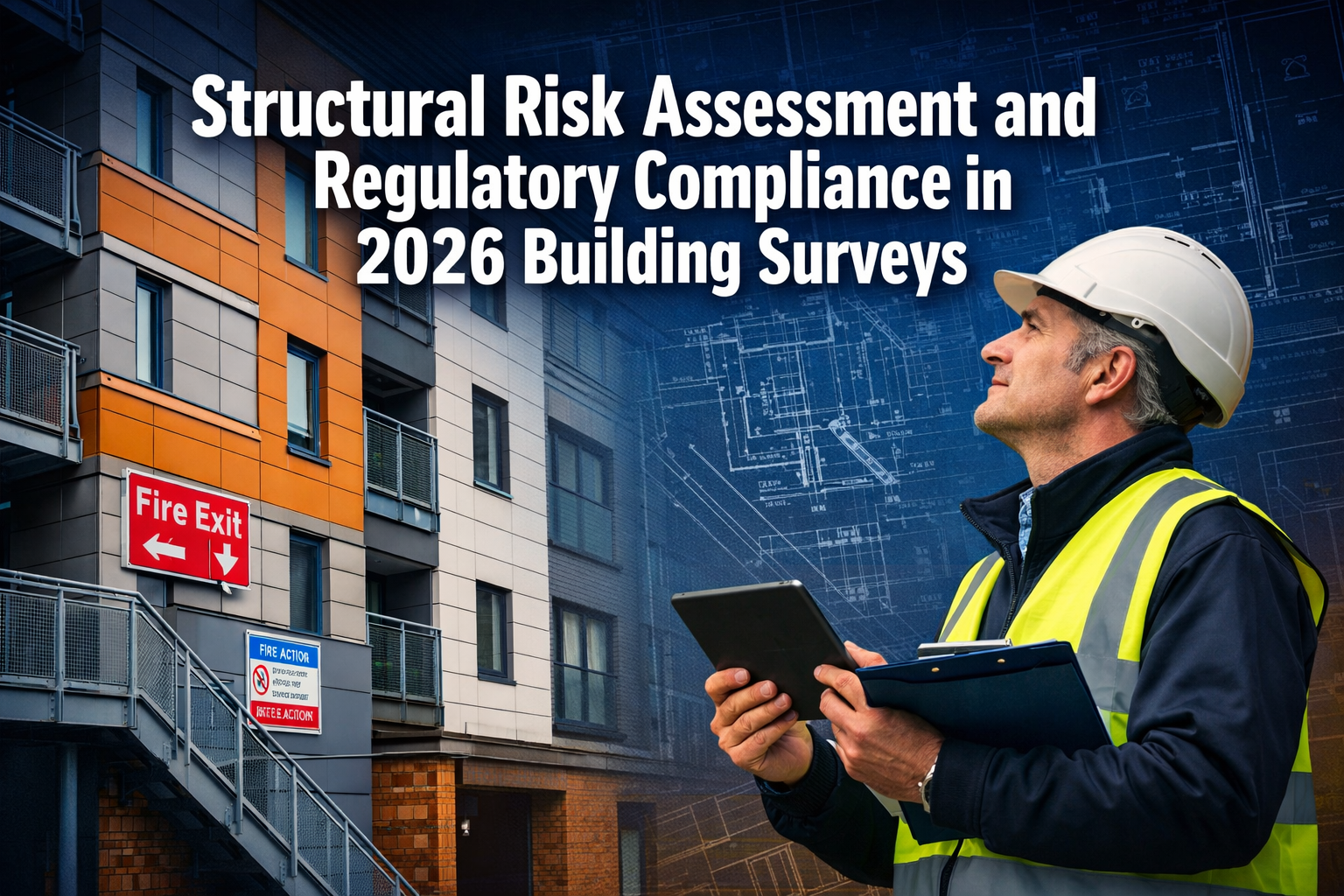
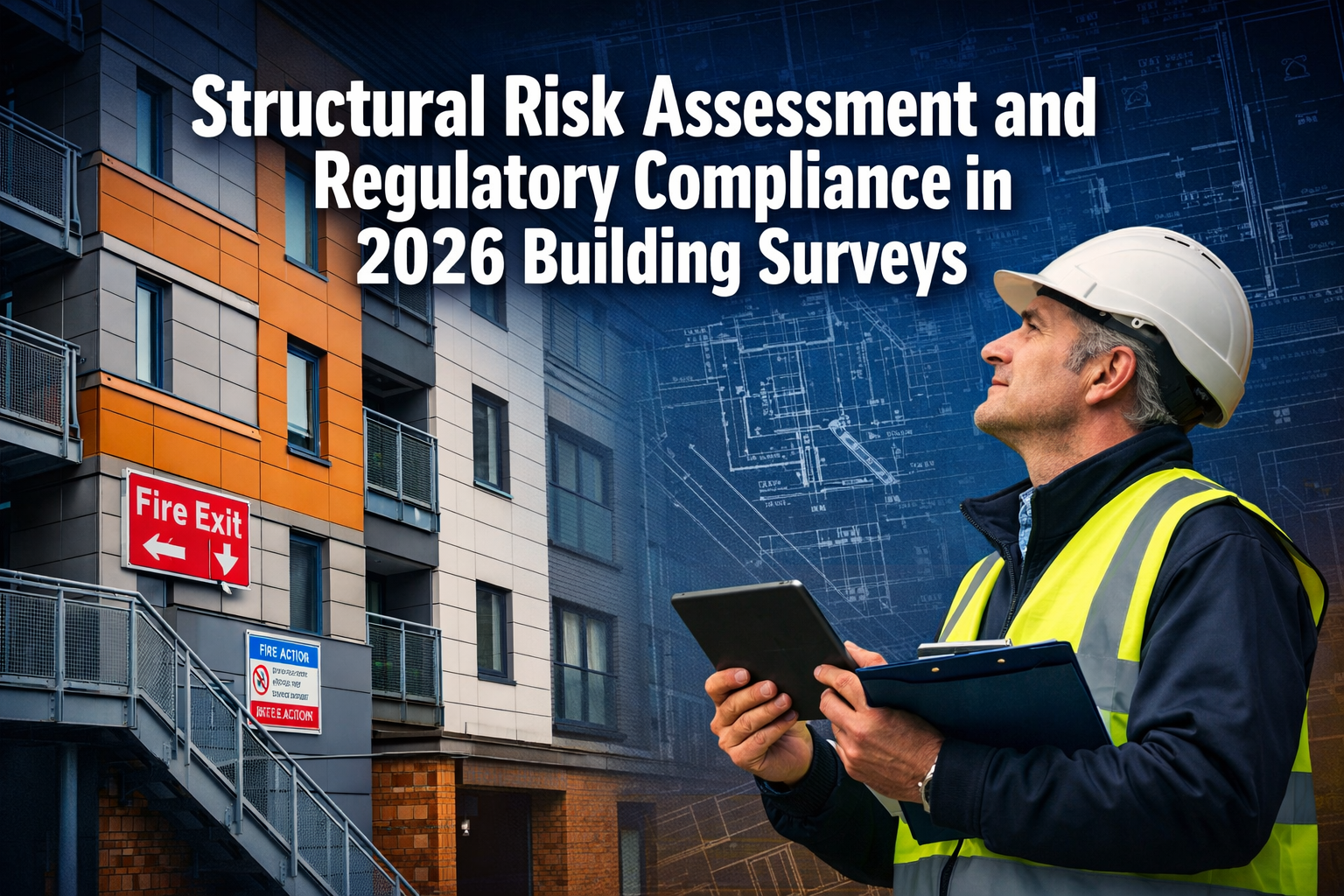
The landscape of building surveys has transformed dramatically. As surveyors examine properties in 2026, they face an unprecedented regulatory environment where fire safety compliance, cladding restrictions, and conversion protocols demand meticulous attention. The enforcement of new regulations—particularly the Fire Safety (Residential Evacuation Plans) Regulations effective April 6, 2026—means that structural risk assessment and regulatory compliance in 2026 building surveys now carries heightened legal significance and professional responsibility.
For chartered surveyors, property buyers, and building managers, understanding these changes isn't optional. It's essential for protecting investments, ensuring occupant safety, and avoiding costly post-completion surprises. This comprehensive guide examines how to document high-risk features, communicate compliance gaps, and provide clear specialist referral guidance in today's complex regulatory framework.
Key Takeaways
- 🔥 New fire safety regulations became enforceable April 6, 2026, requiring Personal Emergency Evacuation Plans (PEEPs) for vulnerable residents in buildings 11 metres and higher
- 📏 Height thresholds have been lowered from 15m to 11m for material change of use compliance, expanding the scope of buildings requiring enhanced fire safety measures
- 🏗️ Combustible cladding restrictions now apply to residential buildings between 11-18 metres, with complete bans extended to hostels, hotels, and boarding houses
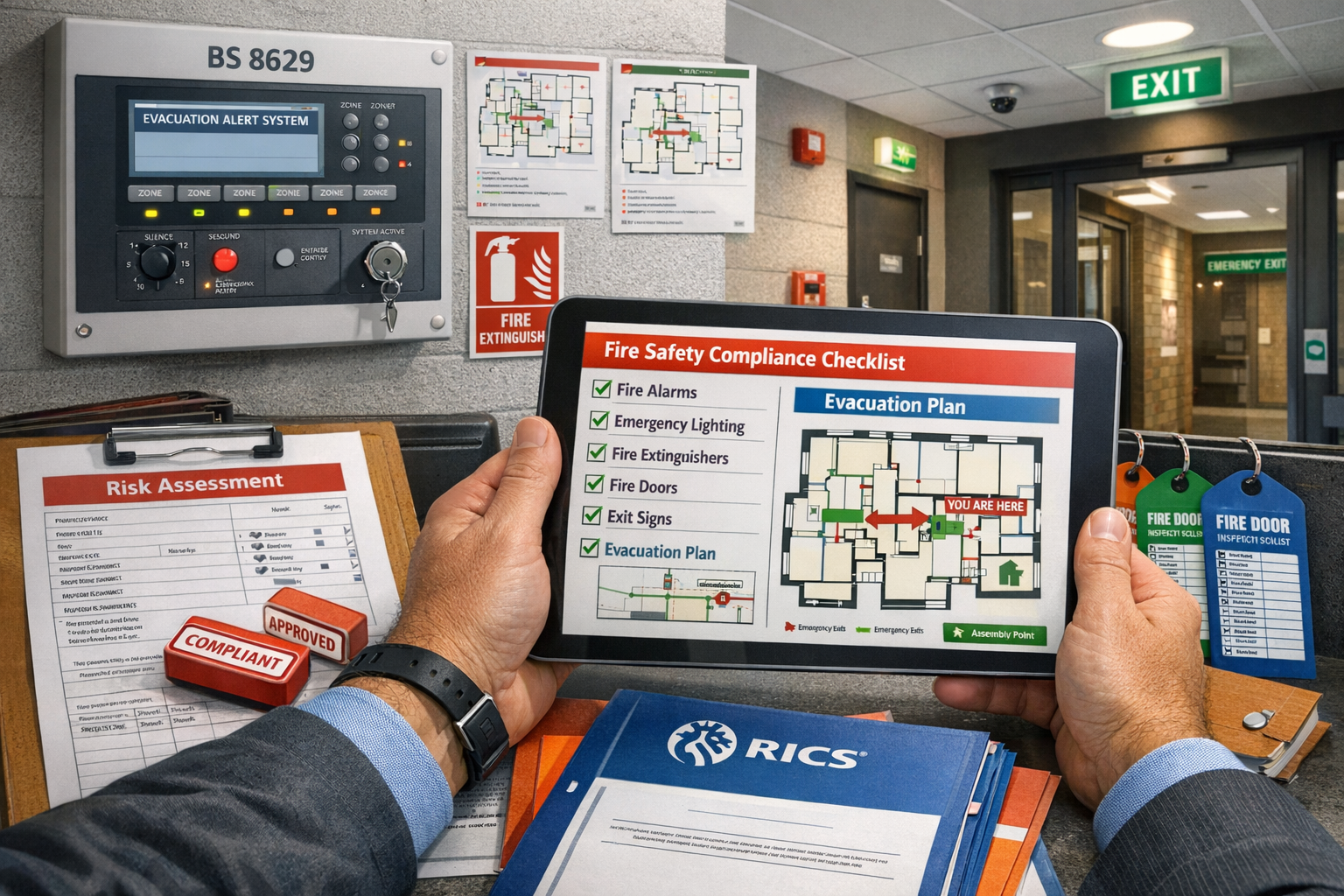
- 🚨 Evacuation alert systems meeting BS 8629 standards are mandatory for blocks with top storey exceeding 18 metres above ground level
- ✅ Surveyors must provide structured risk assessments that clearly identify compliance gaps and recommend specialist referrals to protect buyers from regulatory liabilities
Understanding the 2026 Fire Safety Regulatory Landscape
The regulatory framework governing fire safety in residential buildings underwent substantial revision between 2024 and 2026, creating new obligations for building owners, managers, and surveyors conducting property assessments.
Fire Safety (Residential Evacuation Plans) Regulations 2025
The Fire Safety (Residential Evacuation Plans) (England) Regulations 2025 became legally enforceable on April 6, 2026, marking a watershed moment in residential fire safety management.[1] These regulations apply to:
- Buildings that are 18 metres or 7 storeys high
- Buildings of 11 metres or higher using simultaneous evacuation strategies[1]
The "Responsible Person"—typically the building owner or property manager—must now identify and support vulnerable residents during fire emergencies. This includes elderly individuals, those with mobility impairments, and people with sensory disabilities.[1]
Personal Emergency Evacuation Plans (PEEPs)
PEEPs have become mandatory for residents in buildings between 11-18 metres who require evacuation support.[2] These individualized plans must:
- Assess each vulnerable resident's specific needs
- Identify required assistance during evacuation
- Document communication methods during emergencies
- Establish clear evacuation routes and assembly points
- Be reviewed and updated regularly
For surveyors conducting building surveys, the presence or absence of compliant PEEPs represents a significant risk factor that must be documented and communicated to buyers.
Approved Document B Amendments
Effective September 30, 2026, amendments to Approved Document B introduce substantial changes to building design and safety requirements:[2][3]
Second Staircase Requirements
- Now apply to all new residential buildings above 18 metres
- Provide alternative escape routes during emergencies
- Reduce reliance on single evacuation pathways
Evacuation Lifts
- Required in tall residential blocks to support safe egress
- Must meet specific fire-resistance standards
- Designed to assist mobility-impaired residents
Evacuation Alert Systems
- Mandatory for blocks with top storey more than 18 metres above ground level
- Must comply with BS 8629 standard[3]
- Ensure simultaneous notification across all floors
"The introduction of mandatory evacuation alert systems represents a fundamental shift in how we approach fire safety communication in residential buildings. Surveyors must now assess whether existing systems meet the BS 8629 standard or identify the need for installation." — Fire Safety Compliance Expert
Structural Risk Assessment and Regulatory Compliance in 2026 Building Surveys: Cladding and External Wall Systems
The tragic Grenfell Tower fire catalyzed sweeping changes to cladding regulations. By 2026, these restrictions have expanded significantly, creating new assessment obligations for surveyors examining residential properties.
Combustible Materials Restrictions
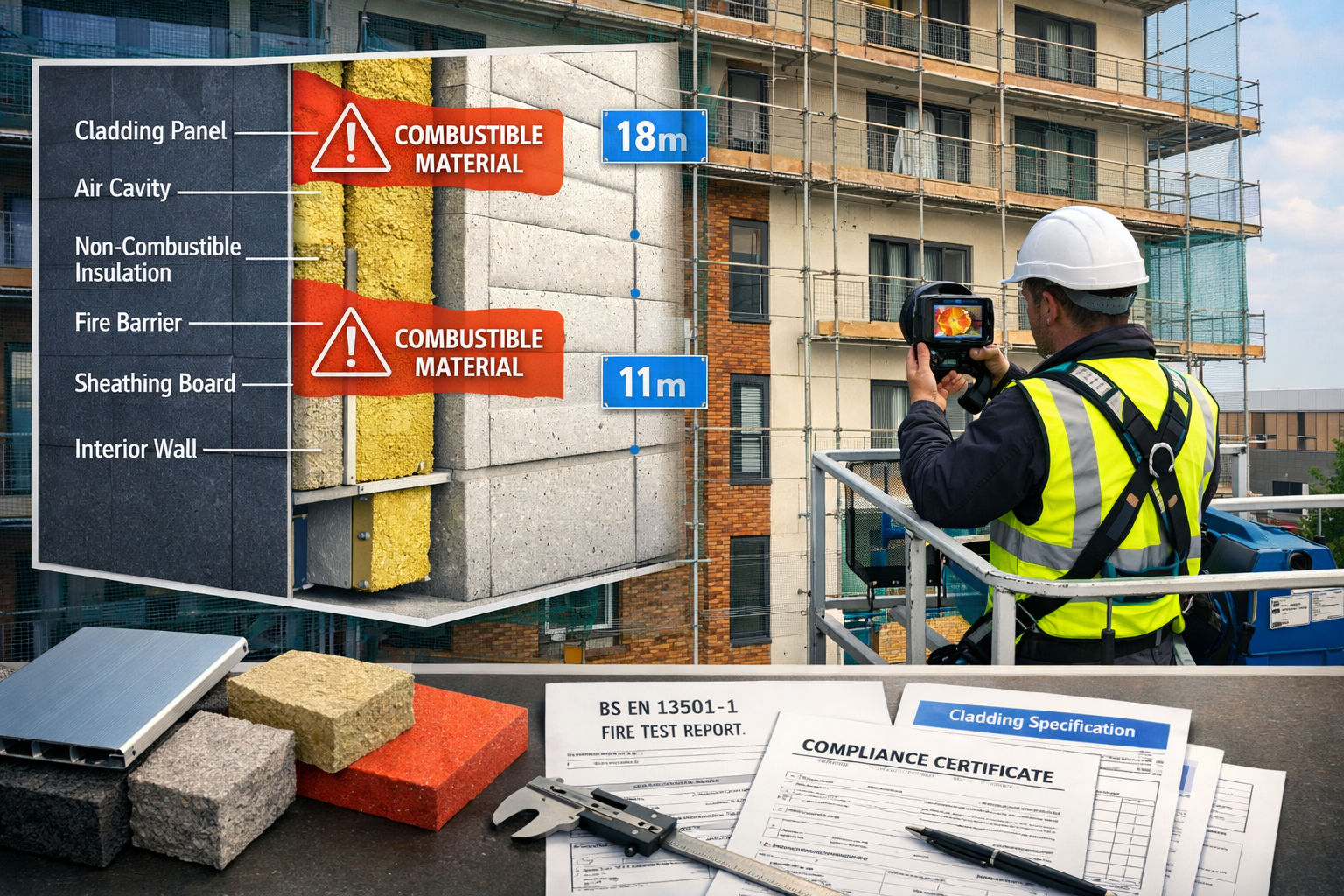
New regulations set strict limits on combustible products for residential buildings with a storey between 11 and 18 metres in height.[3] This represents a significant expansion from previous thresholds and affects a much larger portion of the residential building stock.
The restrictions are even more stringent for specific building types:
| Building Type | Combustible Material Restriction |
|---|---|
| Standard residential (11-18m) | Limited combustible materials permitted |
| Standard residential (18m+) | Complete ban on combustible external walls |
| Hostels, hotels, boarding houses | Complete ban regardless of height[3] |
| Care homes and student housing | Enhanced restrictions with sprinkler requirements |
BS EN 13501 Roofing Standard
As of March 2, 2025, Building Regulation 38 updates removed references to BS 476-22, leaving BS EN 13501 as the only acceptable standard for roofs.[3] This change:
- Adopts a more robust, internationally recognized approach
- Undergoes regular review and updates
- Provides more comprehensive fire performance classification
- Requires surveyors to verify roof material compliance
When conducting structural surveys, chartered surveyors must now specifically identify roofing materials and confirm they meet BS EN 13501 standards, particularly for properties constructed or re-roofed after March 2025.
Material Change of Use Threshold
One of the most significant regulatory changes affects building conversions. Regulation 6(1)(c) now requires that any necessary work from material change of use in buildings exceeding 11 metres in height must ensure external walls comply with Part B4(1) of Schedule 1.[3]
This threshold was previously set at 15 metres, meaning thousands of additional buildings now fall under enhanced compliance requirements when undergoing conversion.
Practical Implications for Surveyors
When assessing cladding and external wall systems, surveyors must:
✅ Document cladding type and composition with photographic evidence
✅ Measure building height to determine applicable regulations
✅ Identify combustible materials in external wall assemblies
✅ Review fire safety certificates and compliance documentation
✅ Recommend specialist fire engineering assessments when concerns arise
✅ Clearly communicate compliance gaps to buyers and stakeholders
For buyers considering properties with questionable cladding, understanding the average price reduction after survey findings can provide leverage for negotiation or informed withdrawal from the purchase.
Conversion Protocols and Material Change of Use Compliance
The lowered threshold for material change of use compliance has created new assessment requirements for properties undergoing conversion from commercial to residential use, or between different residential classifications.
Understanding Material Change of Use
A material change of use occurs when a building's function changes in ways that affect fire safety requirements. Common scenarios include:
- Commercial to residential conversion (offices to apartments)
- Single dwelling to multiple occupancy (house to flats)
- Hotel to residential (serviced accommodation to permanent housing)
- Educational to residential (school buildings to apartments)
Under the revised regulations, any building exceeding 11 metres in height undergoing such changes must ensure external walls comply with current Part B4(1) standards—even if the building was compliant under its previous use classification.
Enhanced Fire Safety Requirements for Conversions
Buildings undergoing conversion now face substantially enhanced requirements:
Sprinkler System Expansion
New guidelines expand sprinkler system requirements, particularly in high-risk buildings including:[4]
- Care homes
- Student housing
- Taller residential blocks
- Buildings with vulnerable occupants
Smoke and Heat Detector Standards
Detectors must now meet higher sensitivity requirements, with interlinked alarms becoming mandatory in certain buildings to ensure every floor receives immediate alert in case of fire.[4]
Secure Information Boxes
New blocks of flats with a floor of 11 metres or more above ground level must install secure information boxes.[3] These boxes contain:
- Building layout plans
- Fire safety system information
- Emergency contact details
- Access codes for fire services
Surveyor's Role in Conversion Assessments
When assessing properties that have undergone or are planned for conversion, surveyors must:
- Verify compliance with current standards rather than standards applicable at original construction
- Identify whether Building Control approval was obtained for the conversion
- Assess whether fire safety upgrades were implemented as required
- Document any compliance gaps that create liability for the buyer
- Recommend specialist consultations with fire engineers or building control officers
For first-time buyers considering converted properties, understanding these compliance requirements is particularly crucial, as remediation costs can be substantial.
Red Flags in Conversion Properties
Surveyors should be particularly alert to these warning signs:
🚩 Absence of Building Control completion certificates for conversion work
🚩 Missing or inadequate fire doors between units
🚩 Lack of fire detection systems meeting current standards
🚩 Inadequate means of escape from upper floors
🚩 Non-compliant external wall systems on buildings over 11m
🚩 Absence of evacuation plans or signage
🚩 Missing sprinkler systems in high-risk conversions
When these issues are identified, buyers should be clearly advised to seek specialist assessment and understand that renegotiation after a poor building survey result may be necessary.
Documenting High-Risk Features in Building Survey Reports
The 2026 regulatory environment demands that surveyors provide structured risk assessments rather than general observations. This protects both the buyer and the surveyor's professional liability.
Structured Risk Assessment Framework
A comprehensive risk assessment in building surveys should follow this framework:
1. Identification Phase
- Document all fire safety features present
- Identify regulatory requirements applicable to the building
- Note any obvious compliance gaps
2. Analysis Phase
- Assess severity of identified deficiencies
- Evaluate potential remediation costs
- Consider legal and insurance implications
3. Communication Phase
- Clearly explain compliance gaps in plain language
- Provide specific recommendations for specialist referrals
- Quantify risks where possible
4. Referral Phase
- Recommend appropriate specialists (fire engineers, cladding specialists, building control consultants)
- Suggest timeline for additional assessments
- Clarify scope limitations of the building survey
Critical Documentation Elements
Every building survey report addressing fire safety and regulatory compliance should include:
📋 Building Height Measurement
Precise measurement to determine applicable regulations (11m, 15m, 18m thresholds)
📋 Cladding Material Identification
Type, composition, and location of all external wall materials
📋 Fire Safety System Inventory
Complete list of detection systems, alarms, sprinklers, and evacuation equipment
📋 Evacuation Route Assessment
Number and condition of staircases, emergency exits, and signage
📋 Compliance Documentation Review
Fire safety certificates, Building Control approvals, evacuation plans
📋 Photographic Evidence
Comprehensive visual documentation of all high-risk features
Communicating Compliance Gaps
When compliance gaps are identified, surveyors must communicate them with appropriate urgency and clarity. Consider this hierarchy:
Category 1: Immediate Safety Concerns
- Non-compliant combustible cladding on buildings over 11m
- Missing or non-functional fire detection systems
- Blocked or inadequate means of escape
- Recommendation: Immediate specialist assessment before purchase completion
Category 2: Regulatory Non-Compliance
- Missing evacuation plans or PEEPs
- Non-compliant roofing materials (not meeting BS EN 13501)
- Inadequate fire doors or compartmentation
- Recommendation: Specialist assessment and remediation cost estimate
Category 3: Future Compliance Risks
- Systems approaching end of service life
- Regulations likely to tighten further
- Maintenance deficiencies that could lead to non-compliance
- Recommendation: Budget for future upgrades and regular inspections
For buyers receiving condition survey reports, understanding these categories helps prioritize remediation efforts and negotiate purchase terms appropriately.
Specialist Referral Protocols and Professional Collaboration
Modern building surveys increasingly require collaboration with specialists. Knowing when and how to refer clients to appropriate experts is essential for comprehensive risk assessment.
When to Recommend Specialist Assessment
Surveyors should recommend specialist fire safety assessment when:
- Buildings exceed 11 metres in height with questionable cladding
- Conversion work lacks clear Building Control approval
- Fire safety systems appear non-compliant or inadequate
- Multiple high-risk features are identified
- Building has history of fire safety enforcement action
- Client is purchasing for investment/rental purposes with landlord obligations
Types of Specialists and Their Roles
Fire Safety Engineers
- Conduct detailed fire risk assessments
- Design remediation strategies for non-compliant buildings
- Provide expert witness testimony if disputes arise
- Cost: £1,500-£5,000 depending on building complexity
Cladding Specialists
- Perform intrusive testing of external wall systems
- Identify material composition and fire performance
- Recommend replacement or remediation options
- Cost: £2,000-£8,000 for comprehensive assessment
Building Control Consultants
- Review compliance with current Building Regulations
- Identify gaps in documentation or approvals
- Liaise with local authority Building Control
- Cost: £800-£2,500 for consultation and review
Approved Inspectors
- Provide independent Building Regulation compliance verification
- Issue completion certificates for remediation work
- Conduct ongoing compliance monitoring
- Cost: Varies by scope and building size
Creating Effective Referral Documentation
When referring clients to specialists, provide:
✅ Clear scope definition of what needs to be assessed
✅ Relevant survey findings that triggered the referral
✅ Building specifications (height, age, construction type, use)
✅ Photographic evidence from your survey
✅ Timeline recommendations for completing specialist assessment
✅ Contact information for recommended specialists (where appropriate)
This documentation ensures specialists can provide accurate quotes and efficient assessments without duplicating work.
Insurance and Liability Considerations
The enhanced regulatory environment has significant implications for professional indemnity insurance and surveyor liability.
Professional Indemnity Coverage
Surveyors must ensure their professional indemnity insurance:
- Covers fire safety and cladding assessments
- Reflects the increased regulatory complexity of 2026
- Includes adequate coverage limits for potential claims
- Addresses specialist referral protocols
Typical coverage requirements:
- Minimum £1 million per claim for residential surveys
- £5-10 million for commercial or high-value residential
- Run-off cover for at least 6 years after ceasing practice
Limiting Liability Through Clear Scope Definition
Survey reports should clearly define:
What is included:
- Visual inspection of accessible areas
- Identification of obvious fire safety features
- Assessment against known regulatory requirements
- Recommendations for specialist referral where appropriate
What is excluded:
- Intrusive testing of cladding materials
- Detailed fire engineering calculations
- Legal compliance certification
- Hidden defects not visible during inspection
This clarity protects surveyors from liability for matters outside their scope while ensuring clients understand the limitations of the survey.
Documentation Best Practices
To minimize liability exposure:
📝 Use standardized templates that incorporate 2026 regulatory requirements
📝 Maintain detailed inspection notes and photographic records
📝 Document all specialist referral recommendations clearly
📝 Obtain client acknowledgment of report limitations
📝 Keep records for minimum 6 years (longer for leasehold properties)
📝 Participate in continuing professional development on regulatory changes
Practical Guidance for Property Buyers
For buyers navigating the complex landscape of structural risk assessment and regulatory compliance in 2026 building surveys, several practical steps can protect their interests.
Pre-Purchase Due Diligence
Before commissioning a survey, buyers should:
- Request existing fire safety documentation from the seller
- Check building height against regulatory thresholds (11m, 18m)
- Inquire about any conversion work and associated approvals
- Research building's fire safety history (enforcement notices, previous incidents)
- Verify presence of evacuation plans and PEEPs if applicable
Selecting the Right Survey Level
The complexity of 2026 regulations means buyers should carefully consider which home survey is right for their property:
- Level 2 (HomeBuyer Report): Suitable for conventional properties under 11m built after 1990
- Level 3 (Building Survey): Essential for properties over 11m, conversions, or buildings with visible fire safety concerns
- Specialist Fire Safety Survey: Required for high-risk buildings or investment properties
Acting on Survey Findings
When a survey identifies compliance gaps:
Option 1: Negotiate Price Reduction
- Obtain specialist quotes for remediation work
- Request price reduction reflecting full remediation cost plus contingency
- See guidance on negotiating purchase price with building survey findings
Option 2: Request Seller Remediation
- Require seller to complete compliance work before completion
- Obtain Building Control certification for all work
- Verify completion with independent inspection
Option 3: Walk Away
- Sometimes the most prudent decision for high-risk properties
- Particularly if remediation costs exceed property value reduction
- Consider implications for future resale and insurance
For guidance on what to do after a bad building survey report, buyers should consult both their surveyor and legal advisor.
Ongoing Compliance Obligations
Buyers must understand that purchasing a property creates ongoing obligations:
- Landlords must maintain fire safety systems and evacuation plans
- Leaseholders may face service charges for building-wide remediation
- Freeholders bear ultimate responsibility for compliance
- All owners must allow access for fire safety inspections
Future Regulatory Trends and Preparing for Change
The regulatory landscape continues to evolve. Surveyors and property owners should anticipate further changes:
Anticipated Developments
Expanded Building Passport Systems
- Digital records of all building materials and fire safety features
- Mandatory for new builds and major renovations
- Facilitates future compliance verification
Stricter Retrofit Requirements
- Potential mandatory upgrades for existing buildings
- Phased implementation based on building height and risk
- Government funding schemes may be available
Enhanced Enforcement
- Increased building safety inspections
- Stricter penalties for non-compliance
- Greater scrutiny of conversion projects
Technology Integration
- Smart fire detection systems with remote monitoring
- Digital evacuation management platforms
- AI-assisted compliance verification
Staying Current
Surveyors should:
- Participate in regular CPD on fire safety regulations
- Subscribe to RICS technical updates
- Join professional networks focused on building safety
- Maintain relationships with specialist consultants
- Review and update survey templates quarterly
Conclusion
Structural risk assessment and regulatory compliance in 2026 building surveys represents a fundamental evolution in how surveyors approach property inspection. The enforcement of new fire safety regulations, expanded cladding restrictions, and lowered compliance thresholds mean that every survey must now incorporate systematic assessment of regulatory compliance alongside traditional structural evaluation.
Key actions for surveyors:
✅ Update survey templates to incorporate 2026 regulatory requirements
✅ Develop specialist referral networks for fire safety, cladding, and building control expertise
✅ Implement structured risk assessment frameworks that clearly communicate compliance gaps
✅ Maintain comprehensive documentation of all high-risk features identified
✅ Ensure professional indemnity coverage reflects the enhanced regulatory environment
Key actions for property buyers:
✅ Commission appropriate survey levels based on building height, age, and conversion history
✅ Request existing fire safety documentation before survey
✅ Budget for specialist assessments when compliance concerns arise
✅ Understand ongoing compliance obligations before purchase
✅ Seek legal advice on compliance gaps identified in surveys
The regulatory changes of 2026 ultimately serve a critical purpose: protecting building occupants from fire safety risks. By conducting thorough structural risk assessments, communicating compliance gaps clearly, and facilitating appropriate specialist referrals, surveyors play an essential role in this safety framework while protecting buyers from costly post-completion surprises.
For professional guidance on navigating these complex requirements, consider consulting expert building evaluation services that specialize in regulatory compliance assessment.
References
[1] New Fire Safety Regulations Coming April 2026 Are You Prepared – https://totalsafeuk.com/blog/uncategorised/new-fire-safety-regulations-coming-april-2026-are-you-prepared/
[2] Preparing For 2026 The Future Of Fire Safety Legislation And What It Means For You – https://www.totalfiregroup.org/preparing-for-2026-the-future-of-fire-safety-legislation-and-what-it-means-for-you/
[3] Part B Changes England Wales – https://ww3.rics.org/uk/en/journals/built-environment-journal/part-b-changes-england-wales.html
[4] Fire Safety Regulations Whats New In 2026 – https://www.jensengroup.co.uk/fire-safety-regulations-whats-new-in-2026/