
The landscape of luxury property ownership in England is undergoing a seismic shift in 2026. For the first time, properties valued over £2 million face a new High Value Council Tax Surcharge (HVCTS) that fundamentally changes the economics of ultra-high-net-worth real estate investment. As the Valuation Office Agency (VOA) conducts targeted valuations throughout 2026, Building Surveys for High-Value Properties Over £2 Million: Navigating Wealth Tax Implications and Premium Valuation Strategies in 2026 has become essential for property owners, buyers, and investors seeking to understand their true cost of ownership.
This comprehensive guide examines how specialized surveying approaches, strategic valuation timing, and expert property assessments can help navigate the complex intersection of building condition analysis and wealth tax planning in today's transformed market.

Key Takeaways
- 2026 is the critical valuation benchmark year: VOA assessments conducted throughout 2026 will determine HVCTS liability for the next five years, making accurate property valuations essential for tax planning[1]
- Surcharge bands create significant tax thresholds: Properties valued at £2.0M-£2.5M face £2,500 annual surcharges, while those over £5M incur £7,500 annually—understanding precise valuation becomes crucial[1]
- Building surveys must now integrate tax considerations: Comprehensive property assessments need to evaluate not just structural condition but also features that could push valuations across critical tax thresholds[1]
- Renovation timing affects five-year tax liability: Significant improvements undertaken during 2026 could elevate properties into higher surcharge bands for the entire five-year lock-in period[1]
- Total property tax burden roughly doubles for many owners: A £3.5M Kensington property will see annual tax increase from £2,000-£3,000 to £7,000-£8,000 when HVCTS takes effect in April 2028[1]
Understanding the 2026 High-Value Property Tax Landscape
The introduction of the High Value Council Tax Surcharge represents the most significant change to property taxation for luxury homeowners in decades. Unlike traditional Council Tax, which relies on 1991 valuations and band classifications, the HVCTS uses current market valuations as of April 2026 to determine liability.[1]
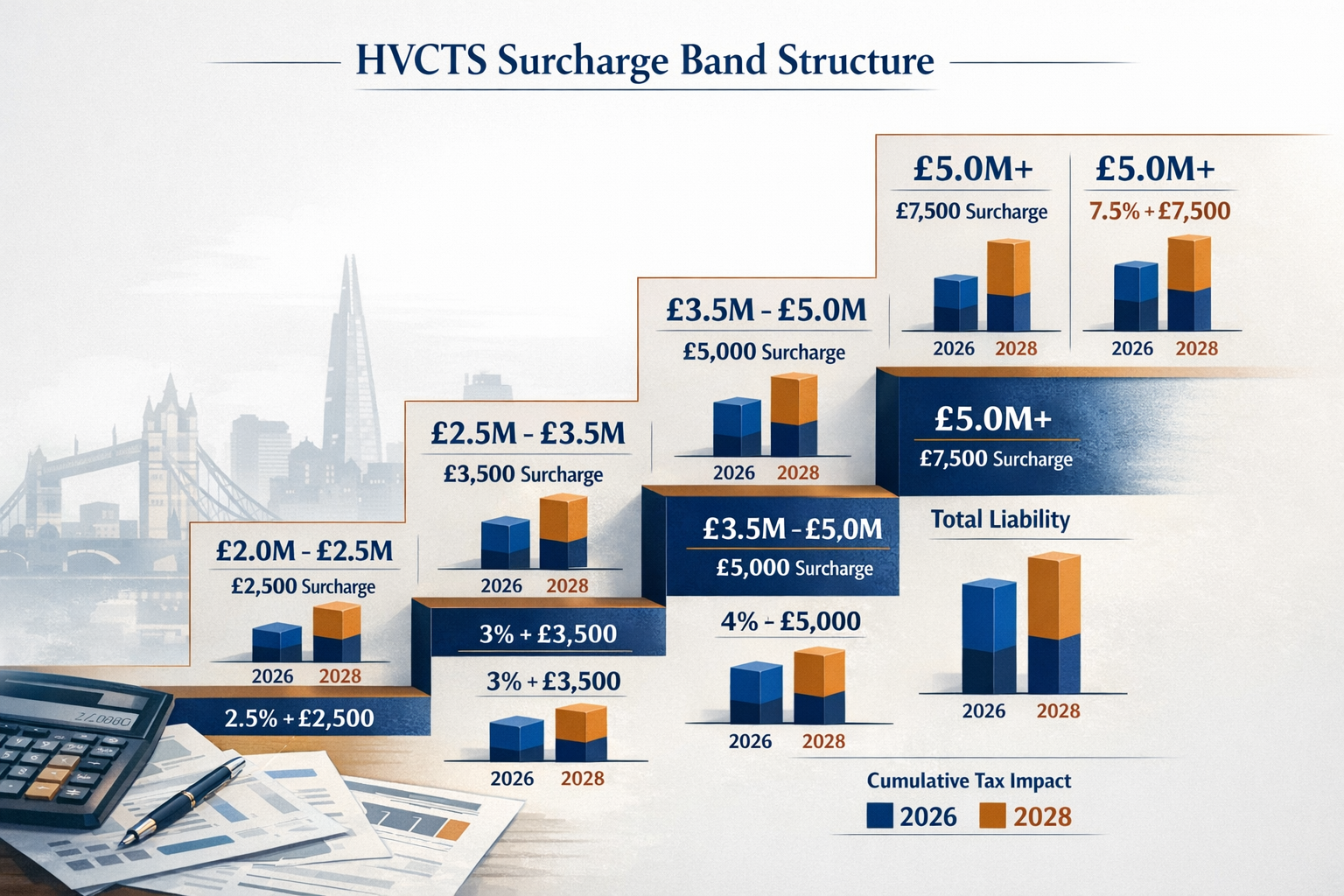
The HVCTS Surcharge Structure
The surcharge operates on a tiered system with four distinct bands:
| Property Value Range | Annual Surcharge | Cumulative Impact (5 Years) |
|---|---|---|
| £2.0M – £2.5M | £2,500 | £12,500 |
| £2.5M – £3.5M | £3,500 | £17,500 |
| £3.5M – £5.0M | £5,000 | £25,000 |
| £5.0M+ | £7,500 | £37,500 |
These figures represent additional charges on top of existing Council Tax obligations, fundamentally altering the economics of high-value property ownership.[1]
The Five-Year Lock-In Period
Perhaps the most critical aspect of the HVCTS is the five-year valuation lock-in. Once the VOA establishes a property's value in 2026, that assessment remains fixed until the next revaluation cycle. This creates both opportunities and risks:
✅ Opportunity: Properties valued just below threshold levels avoid surcharges for five years, even if market values subsequently rise
⚠️ Risk: Properties that cross thresholds due to 2026 improvements remain in higher bands for five years, even if market conditions deteriorate
This mechanism makes 2026 valuations extraordinarily consequential for long-term financial planning.
Specialized Building Survey Approaches for £2M+ Properties
Traditional RICS building surveys focus primarily on structural condition, defects, and repair obligations. However, Building Surveys for High-Value Properties Over £2 Million: Navigating Wealth Tax Implications and Premium Valuation Strategies in 2026 requires a fundamentally expanded scope that integrates tax planning considerations.
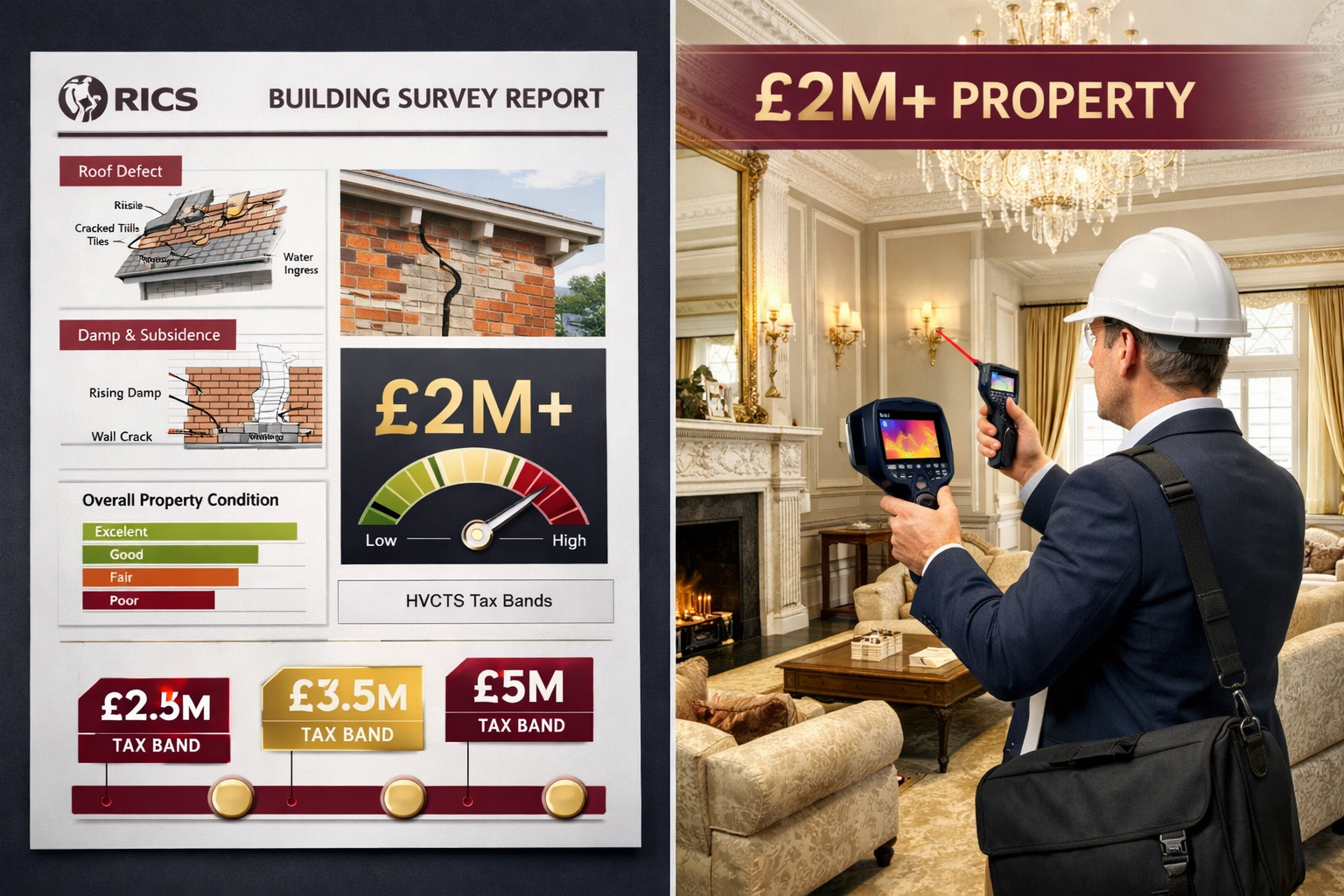
Enhanced Valuation-Aware Survey Components
Premium property surveys in 2026 must now include:
1. Threshold Proximity Analysis 📊
- Precise current market valuation assessment
- Identification of property position relative to HVCTS bands
- Analysis of features that could push valuation across thresholds
2. Improvement Impact Modeling
- Quantification of how planned renovations affect valuation
- Assessment of whether improvements justify crossing tax thresholds
- Strategic timing recommendations for major works
3. Comparable Property Research
- Analysis of similar properties and their VOA valuations
- Identification of valuation precedents in local area
- Documentation supporting valuation challenges if needed
4. Defect-Based Valuation Adjustments
- Detailed cataloging of structural issues that reduce property value
- Quantification of repair costs and their impact on market value
- Strategic documentation for potential VOA appeals
The Role of RICS Chartered Surveyors
For properties approaching or exceeding £2 million, engaging chartered surveyors with specific expertise in high-value assessments becomes essential. These professionals bring:
- Red Book Valuation Expertise: Understanding of RICS Valuation Standards that VOA assessors also follow
- Market Intelligence: Deep knowledge of luxury property transactions and pricing dynamics
- Strategic Advisory: Ability to recommend timing and scope of improvements to optimize tax position
- Documentation Standards: Preparation of reports that withstand VOA scrutiny and support appeals
When selecting a surveyor for properties in this category, verify their experience with expert building evaluation of comparable high-value assets.
Integrating Structural Assessment with Tax Planning
A comprehensive 2026 survey for a £2M+ property should deliver:
Core Structural Analysis
- Foundation condition and subsidence risk assessment
- Roof structure, covering, and rainwater systems
- External walls, windows, and weatherproofing
- Internal structural elements and load-bearing walls
- Services condition (electrical, plumbing, heating)
- Damp, timber, and environmental hazards
Tax-Optimized Valuation Intelligence
- Current market value assessment with supporting evidence
- Identification of value-reducing defects and their quantified impact
- Analysis of improvement opportunities and their valuation consequences
- Strategic recommendations for renovation timing relative to VOA assessment cycles
- Documentation suitable for VOA correspondence and potential appeals
This dual-purpose approach ensures property owners understand both the physical condition and tax positioning of their assets.
Premium Valuation Strategies Under the New Tax Regime
The HVCTS fundamentally changes how high-net-worth individuals should approach property valuation. Strategic considerations now extend far beyond simple market pricing.
Strategic Valuation Timing Considerations
Pre-Purchase Due Diligence
For buyers considering properties near valuation thresholds, timing becomes critical:
- Q1-Q2 2026 Purchases: Properties acquired early in 2026 will be valued based on their condition at the April 2026 benchmark, potentially before planned improvements
- Q3-Q4 2026 Purchases: Later acquisitions may capture improvements in the baseline valuation, affecting the entire five-year period
- Post-2026 Purchases: Properties bought after the valuation exercise may have established HVCTS liability, creating pricing negotiation opportunities
"The 2026 valuation benchmark creates a unique window where strategic timing of purchases and improvements can generate five-figure tax savings over the lock-in period."
Renovation Impact Analysis
Property modifications during 2026 carry outsized consequences. Consider a property valued at £2.4 million:
Scenario A: Basic Maintenance Only
- Remains in £2.0M-£2.5M band
- Annual surcharge: £2,500
- Five-year cost: £12,500
Scenario B: £200K Kitchen and Bathroom Renovation
- New valuation: £2.7 million
- Moves to £2.5M-£3.5M band
- Annual surcharge: £3,500
- Five-year cost: £17,500
- Additional tax burden: £5,000 over five years
This £5,000 additional tax represents a 2.5% tax on the improvement investment—a factor that must be incorporated into renovation ROI calculations.[1]
Defect Documentation for Valuation Support
Comprehensive building surveys provide crucial documentation for property owners seeking to demonstrate value-reducing factors:
High-Impact Defects for Valuation Purposes
- Structural issues: Foundation movement, wall cracking, subsidence evidence
- Major systems failures: Roof replacement requirements, heating system obsolescence
- Environmental hazards: Damp penetration, timber decay, asbestos presence
- Regulatory compliance gaps: Building regulation violations, planning permission issues
Detailed building condition assessments that quantify repair costs provide objective evidence supporting lower valuations.
The 2.5% Market Dampening Effect
Treasury estimates predict that the HVCTS will create an average 2.5% dampening effect on high-end property values as buyers "price in" the cumulative surcharge cost over typical holding periods.[1]
For a £3 million property, this translates to:
- Expected value reduction: £75,000
- Cumulative 5-year surcharge (£3.5M band): £17,500
- Buyer's implicit capitalization rate: 4.3x annual surcharge
This market adjustment creates both challenges and opportunities:
For Sellers: Properties may achieve lower prices than pre-HVCTS comparables suggest
For Buyers: Negotiating power increases, particularly for properties near threshold boundaries
For Owners: Strategic improvements may not deliver traditional value uplift if they push properties into higher surcharge bands
Communicating Total Cost of Ownership to UHNW Buyers
The introduction of HVCTS fundamentally changes how property advisors must present investment cases to ultra-high-net-worth (UHNW) clients. Traditional purchase price analysis is no longer sufficient.
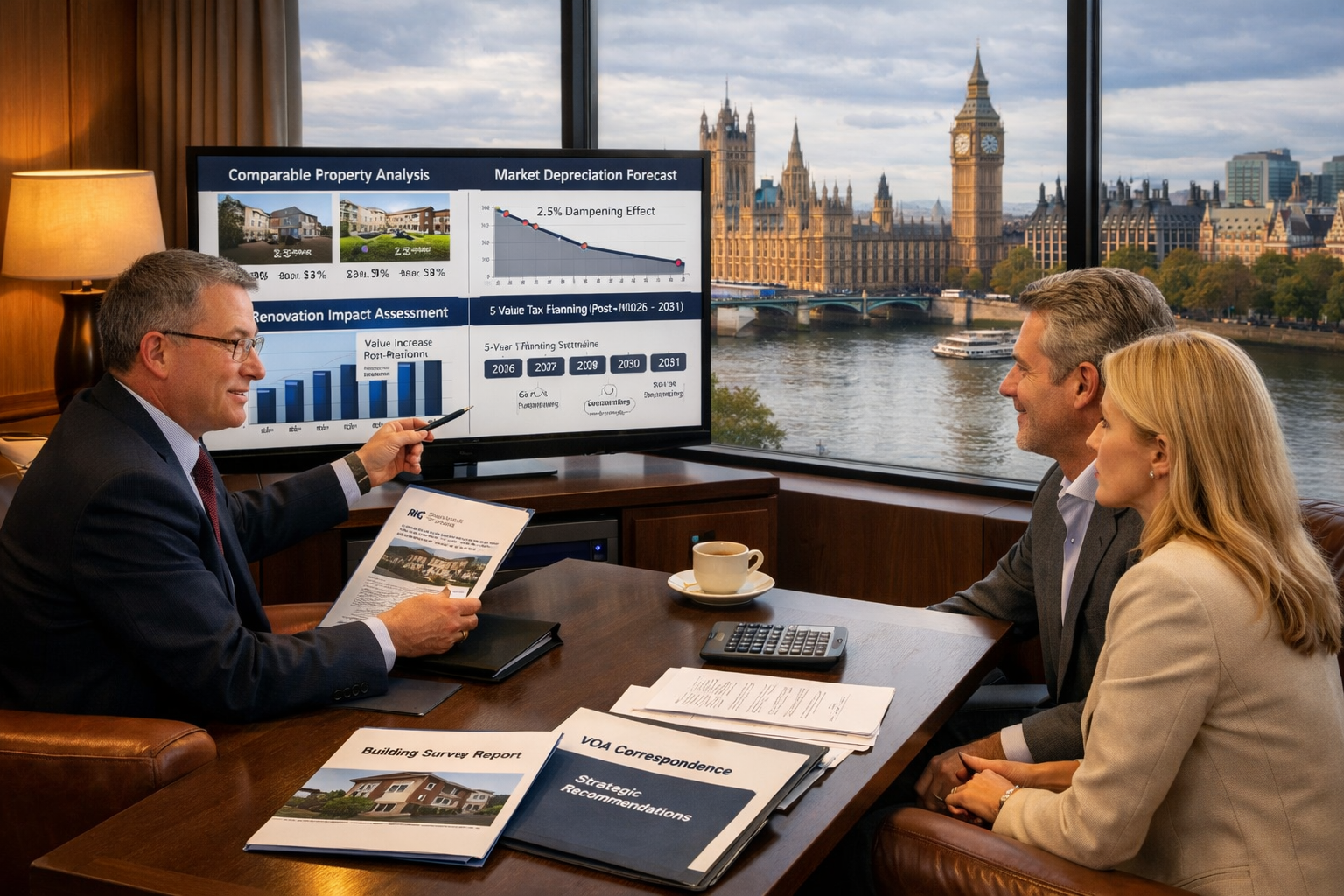
Comprehensive Ownership Cost Modeling
Modern property presentations for £2M+ assets must include:
Year 1-5 Total Tax Liability Projection
| Cost Component | Annual | 5-Year Total |
|---|---|---|
| Council Tax (Band H) | £2,500 | £12,500 |
| HVCTS Surcharge (£3.5M property) | £5,000 | £25,000 |
| Combined Annual Tax | £7,500 | £37,500 |
This represents a 200% increase in property taxation for many luxury homeowners.[1]
Second Home and Investment Property Considerations
The HVCTS applies based on asset value, not usage status. This creates compounding tax burdens for:
Second Homes
- Local authority second home premium: +50-100% Council Tax
- HVCTS surcharge: Fixed amount based on value
- Combined effect: Triple the baseline Council Tax in some cases
Investment Properties
- Standard Council Tax (if unfurnished)
- HVCTS surcharge (regardless of rental status)
- No relief for rental income generation
For first-time buyers entering the luxury market, understanding these cumulative costs is essential for informed decision-making.
Building Survey Insights for Buyer Negotiations
Comprehensive building surveys provide powerful negotiation leverage in the HVCTS environment:
Defect-Based Price Reductions
- Structural repairs required: £50,000
- Systems replacements needed: £30,000
- Total documented defects: £80,000
Tax-Adjusted Negotiation Strategy
- Original asking price: £2.45M (£2.0M-£2.5M band)
- Defect-adjusted value: £2.37M (remains in same band)
- Negotiated reduction: £80,000
- Tax savings: Buyer avoids potential band escalation while securing repair discount
This approach requires detailed survey documentation that quantifies repair costs and their valuation impact—a service that expert building evaluations provide.
Long-Term Financial Planning Integration
UHNW buyers increasingly require property advisors to integrate real estate decisions into comprehensive wealth management strategies:
10-Year Ownership Projection (£3.5M Property)
- Purchase price: £3,500,000
- Acquisition costs (SDLT, legal, survey): £350,000
- Years 1-5 total tax: £37,500
- Years 6-10 total tax (assuming revaluation): £40,000
- Maintenance and improvements: £200,000
- Total 10-year cost of ownership: £4,127,500
This holistic view transforms property from a simple asset purchase into a comprehensive financial commitment requiring strategic planning.
Navigating VOA Valuation Processes and Appeals
Understanding how the Valuation Office Agency conducts assessments is crucial for property owners seeking to optimize their tax position.
The 2026 VOA Valuation Exercise
Throughout 2026, the VOA is conducting a targeted identification exercise to catalog every English property worth £2 million or more, with April 2026 serving as the likely valuation benchmark date.[1]
Key Process Elements:
- Data gathering: VOA reviews Land Registry transactions, local authority records, and market intelligence
- Comparable analysis: Assessment based on similar property sales and rental values
- Physical inspection: May include external surveys or requests for internal access
- Valuation determination: Final assessment communicated to property owners
- Appeal window: Limited timeframe to challenge assessments
Preparing for VOA Assessment
Property owners can proactively prepare by:
1. Commissioning Independent Valuations
Engage RICS-qualified surveyors to provide Red Book valuations that establish market value using recognized professional standards.
2. Documenting Property Condition
Comprehensive building surveys create timestamped records of defects, required repairs, and condition issues that justify lower valuations.
3. Gathering Comparable Evidence
Research recent sales of similar properties in the local area, particularly those with documented valuations below threshold levels.
4. Identifying Value-Reducing Factors
Catalog elements that negatively impact value:
- Proximity to transport infrastructure or commercial properties
- Planning restrictions or conservation area limitations
- Structural defects or deferred maintenance
- Obsolete building systems or poor energy efficiency
Strategic Appeal Considerations
If VOA valuations appear excessive, property owners have appeal rights:
Grounds for Successful Appeals:
- Factual errors: Incorrect property details (size, bedrooms, features)
- Comparable disparities: Significantly higher valuation than similar local properties
- Condition issues: Failure to account for structural defects or required repairs
- Market evidence: Recent sales data supporting lower valuations
Detailed building survey reports provide essential supporting documentation for appeals, particularly when they quantify repair costs and condition-based value reductions.
Strategic Recommendations for Property Owners in 2026
As the critical valuation year unfolds, property owners should take specific actions to optimize their position.
Immediate Actions for Current Owners
Q1-Q2 2026 Priorities:
✅ Commission comprehensive building surveys that document current condition and identify value-reducing defects
✅ Obtain independent RICS valuations to establish baseline market values before VOA assessments
✅ Defer major improvements until after April 2026 valuation benchmark if property is near threshold boundaries
✅ Document all defects with photographs, specialist reports, and repair cost estimates
✅ Review renovation plans to assess whether improvements justify crossing into higher surcharge bands
Strategic Planning for Prospective Buyers
Purchase Decision Framework:
For Properties Valued £1.8M-£2.2M (Near Lower Threshold):
- Request detailed building surveys to identify defects supporting sub-£2M valuations
- Negotiate purchase prices that account for potential HVCTS liability
- Consider timing completion for post-April 2026 to capture established valuations
For Properties Valued £2.4M-£2.6M (Near Mid-Threshold):
- Analyze whether defects or negotiations could reduce valuation below £2.5M
- Calculate five-year tax differential (£5,000) when evaluating offers
- Assess improvement potential and its tax implications
For Properties Valued £4.8M-£5.2M (Near Upper Threshold):
- Evaluate whether strategic deferrals could avoid £5M+ band
- Consider phased improvement approach spreading works across valuation cycles
- Factor £12,500 five-year surcharge differential into purchase decisions
Long-Term Tax Planning Integration
Property decisions should align with broader wealth management strategies:
Portfolio Optimization
- Assess whether concentrating value in single properties or diversifying across multiple lower-value assets optimizes tax position
- Consider geographic diversification to jurisdictions without equivalent surcharges
- Evaluate rental property portfolios for potential restructuring
Succession Planning
- Review how HVCTS affects estate planning and inheritance tax strategies
- Consider trust structures and their interaction with property taxation
- Assess timing of intergenerational transfers relative to valuation cycles
Renovation Strategy
- Develop five-year improvement roadmaps that optimize value creation while managing tax escalation
- Prioritize improvements that enhance livability without significantly increasing valuation
- Consider energy efficiency upgrades that may qualify for future tax incentives
The Role of Professional Survey Services in Tax-Optimized Property Decisions
The complexity of Building Surveys for High-Value Properties Over £2 Million: Navigating Wealth Tax Implications and Premium Valuation Strategies in 2026 demands professional expertise that extends beyond traditional surveying.
Selecting the Right Survey Level
For properties in the £2M+ category, Level 3 RICS Building Surveys provide the comprehensive analysis required:
Level 3 Survey Components:
- Detailed inspection of all accessible areas
- Comprehensive defect identification and condition assessment
- Repair cost estimates and prioritization
- Advice on maintenance and future considerations
- Enhanced valuation intelligence for tax planning purposes
This contrasts with Level 2 Homebuyer Reports, which may not provide sufficient detail for high-value property tax optimization.
Specialized Survey Add-Ons for Luxury Properties
Premium properties often benefit from supplementary specialist investigations:
- Structural engineering assessments for period properties or those with movement evidence
- Damp surveys using thermal imaging and moisture detection technology
- Building services evaluations for complex mechanical and electrical systems
- Energy efficiency audits identifying improvement opportunities and EPC impacts
These specialized reports provide granular documentation supporting valuation positions and renovation planning.
What to Do After Receiving Survey Results
What to do after a bad report on building survey becomes particularly important in the HVCTS context:
Strategic Response Framework:
If Significant Defects Identified:
- Obtain specialist repair cost estimates
- Quantify impact on property valuation
- Assess whether defects reduce value below HVCTS thresholds
- Use findings to negotiate purchase price reductions
- Document for potential VOA appeals
If Property Condition Excellent:
- Evaluate whether condition supports higher valuation band
- Consider strategic deferral of planned improvements
- Assess timing of enhancement works relative to valuation cycles
- Plan phased improvement approach to manage tax escalation
Cost-Benefit Analysis of Comprehensive Surveys
While premium building surveys for £2M+ properties typically cost £2,000-£5,000, the potential tax savings far exceed this investment:
Survey Investment ROI Example:
- Survey cost: £3,500
- Defects identified supporting £100K price reduction
- Negotiated reduction: £75,000
- Property value reduced from £2.52M to £2.45M
- Avoided band escalation: Remains in £2.0M-£2.5M bracket
- Five-year tax savings: £5,000
- Total financial benefit: £80,000
- ROI: 2,186%
This calculation demonstrates why saving money with building surveys becomes exponentially more valuable in the HVCTS environment.
Conclusion: Strategic Property Assessment in the New Tax Era
The introduction of the High Value Council Tax Surcharge in 2026 has fundamentally transformed the landscape of luxury property ownership in England. For properties valued over £2 million, comprehensive building surveys are no longer simply due diligence tools—they are essential strategic instruments for wealth preservation and tax optimization.
Building Surveys for High-Value Properties Over £2 Million: Navigating Wealth Tax Implications and Premium Valuation Strategies in 2026 requires a sophisticated approach that integrates:
🏛️ Detailed structural and condition assessment using RICS Level 3 survey standards
💰 Precise valuation intelligence that positions properties relative to critical tax thresholds
📊 Strategic renovation planning that optimizes value creation while managing tax escalation
📋 Comprehensive documentation supporting VOA negotiations and potential appeals
🎯 Long-term financial modeling that presents total cost of ownership to buyers and owners
Actionable Next Steps
For Current Owners of £2M+ Properties:
- Commission a comprehensive RICS Building Survey before the April 2026 valuation benchmark
- Obtain an independent Red Book Valuation to establish your baseline position
- Document all property defects with photographs and specialist reports
- Review planned improvements and assess their tax implications
- Consult with tax advisors to integrate property strategy into wealth planning
For Prospective Buyers:
- Request detailed building surveys for any property approaching threshold values
- Negotiate purchase prices that account for HVCTS liability and market dampening effects
- Calculate total five-year ownership costs including combined tax burdens
- Time completions strategically relative to the 2026 valuation exercise
- Engage RICS chartered surveyors with high-value property expertise
For Property Professionals:
- Enhance survey reports to include tax-relevant valuation intelligence
- Develop client communication frameworks that present total cost of ownership
- Build expertise in VOA processes and appeal procedures
- Create strategic advisory services that integrate building assessment with tax planning
- Establish professional networks connecting surveyors, valuers, and tax specialists
The five-year valuation lock-in period makes 2026 decisions extraordinarily consequential. Property owners who invest in comprehensive professional assessments, strategic planning, and expert advisory services will be positioned to minimize tax burdens while maximizing the value and enjoyment of their high-value assets.
In this new era of wealth-conscious property taxation, the integration of building survey expertise with tax planning intelligence is not optional—it is essential for informed decision-making and long-term financial success.
References
[1] Hvcts Guide – https://www.crownluxuryhomes.com/hvcts-guide/