


As London's property market rebounds and extension activity surges in 2026, homeowners and developers face a critical challenge: understanding and managing the escalating costs of party wall awards. With approximately 95% of London extension projects requiring party wall compliance[1], the financial implications have never been more significant. Party wall surveyor fees have risen sharply—up 8–12% since 2024—creating pressure on building owners who must navigate complex fee structures while maintaining positive neighbour relations[1].
This comprehensive guide examines Party Wall Awards and Fee Structures in 2026: Navigating Increased Demand and Cost Pressures, providing property owners, developers, and construction professionals with essential insights into current costs, fair pricing models, and strategies for managing expenses during this period of market volatility.

Key Takeaways
✅ Surveyor fees now range £750–£1,800 per surveyor per affected neighbour, with total costs varying significantly based on project complexity and number of neighbours involved[1]
✅ Building owners bear all reasonable party wall costs, including fees for their own surveyor, adjoining owners' surveyors, and potential third surveyor fees if disputes arise[1]
✅ Hourly rates have increased to £90–£450 per hour in 2026, with complex structural projects commanding premium rates at the higher end of this spectrum[2][3]
✅ Process timelines require 2–4 months minimum from notice service to award completion, making early planning essential for project budgeting[1]
✅ Fee reasonableness is legally protected under the Party Wall etc. Act 1996, allowing building owners' surveyors to formally challenge excessive charges[1]
Understanding Party Wall Awards and Their Cost Components
A party wall award is the formal document produced by party wall surveyors that sets out the rights and responsibilities of building and adjoining owners when construction work affects shared structures. This legally binding agreement protects both parties and ensures compliance with the Party Wall etc. Act 1996.
What Triggers a Party Wall Award?
Several common construction activities require party wall procedures:
- Structural alterations to shared walls between semi-detached or terraced properties
- Loft conversions affecting party walls or roof structures
- Basement excavations within 3–6 meters of neighbouring foundations
- Extensions requiring work on or near boundary walls
- New walls built on the boundary line between properties
The award process becomes necessary when neighbours do not consent to the proposed works or fail to respond within 14 days of receiving a party wall notice. Understanding party wall agreements and associated costs is crucial for proper project planning.
Core Cost Components in 2026
Party wall expenses comprise several distinct elements:
| Cost Component | Typical Range (2026) | Who Pays |
|---|---|---|
| Building Owner's Surveyor | £750–£1,800 per neighbour | Building Owner |
| Adjoining Owner's Surveyor | £750–£1,800 per neighbour | Building Owner |
| Third Surveyor (if required) | £1,500–£4,000 | Split or assigned |
| Schedule of Condition | £200–£500 per property | Building Owner |
| Additional Inspections | £150–£300 per visit | Building Owner |
These figures represent current market rates in London and surrounding areas, though regional variations exist[1][2].
Current Fee Structures and Market Trends in 2026
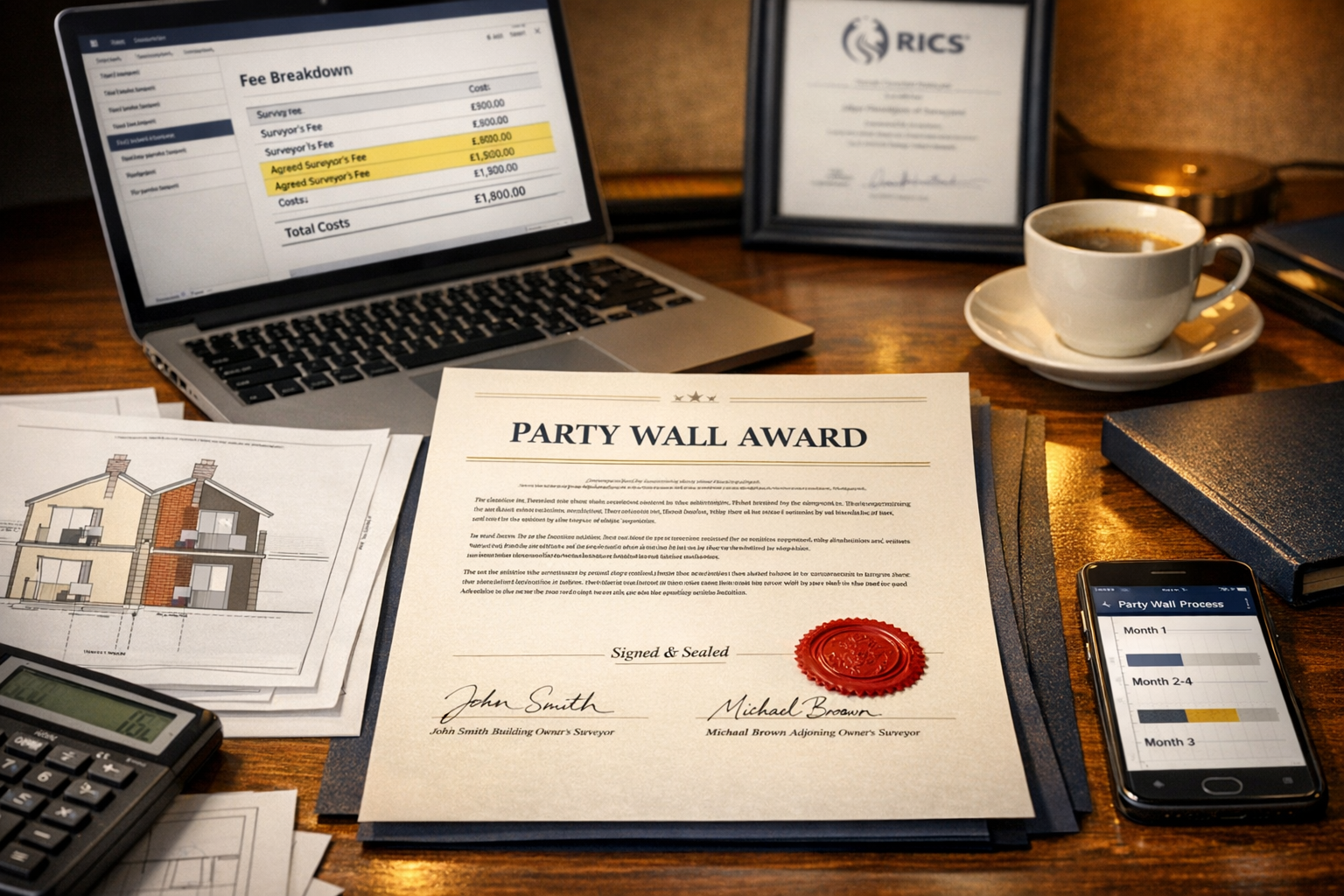
Surveyor Fee Models: Fixed vs. Hourly Rates
Party wall surveyors in 2026 typically operate under two primary fee structures:
Fixed Fee Arrangements 🔒
Fixed fees provide cost certainty for straightforward projects. Surveyors quote a single price covering all standard services, including:
- Initial consultation and notice review
- Site inspection and assessment
- Award preparation and service
- Standard follow-up correspondence
- Final inspection upon completion
For simple loft conversions or single-storey extensions affecting one neighbour, fixed fees typically range £900–£1,200 per surveyor[3]. This model works well when project scope is clearly defined and complications are unlikely.
Hourly Rate Structures ⏱️
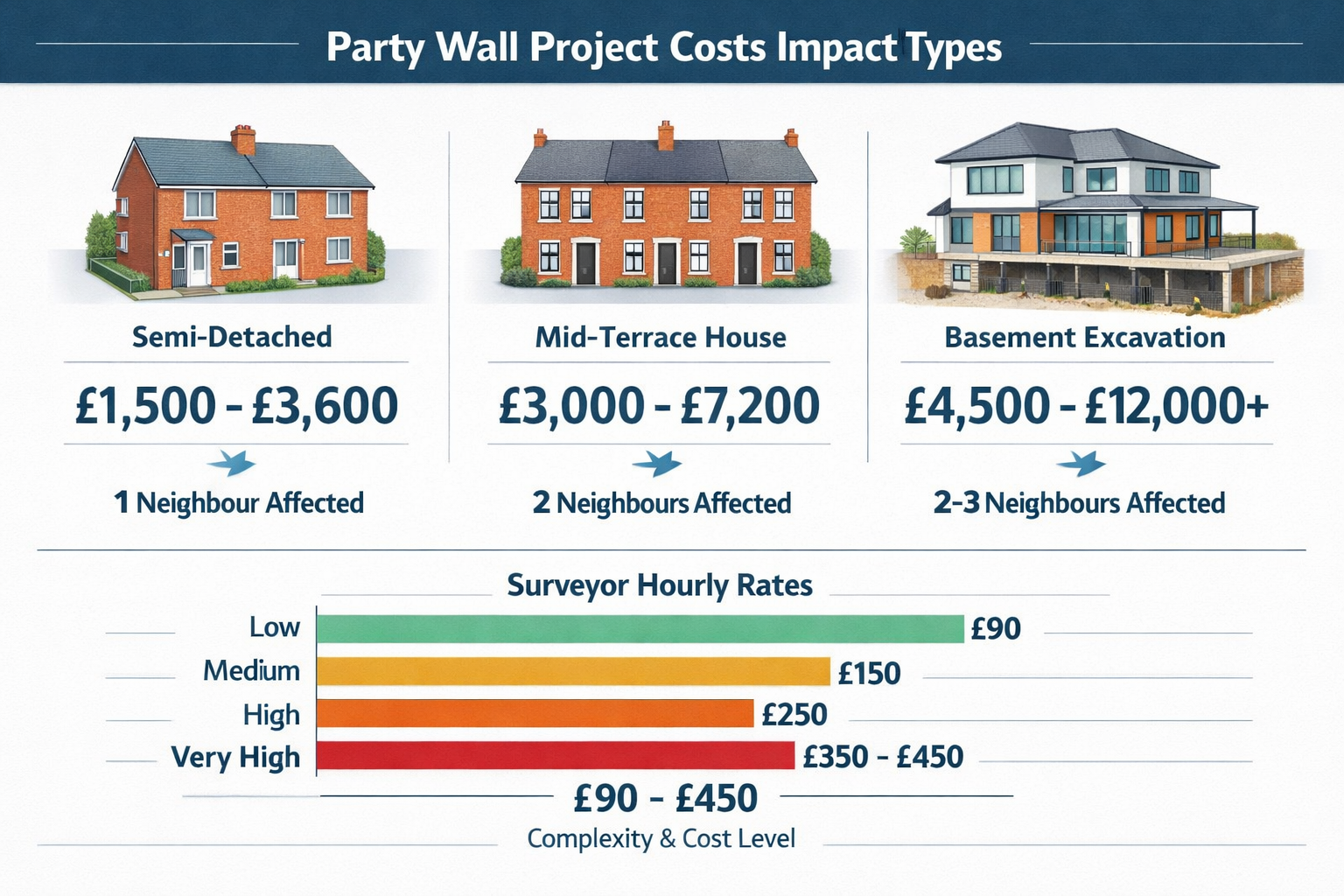
Complex projects often require hourly billing to account for unpredictable workload. Current hourly rates in 2026 span £90–£450, with variation based on:
- Surveyor experience and qualifications (RICS members command premium rates)
- Project complexity (basement excavations require extensive technical analysis)
- Location (central London rates exceed outer borough pricing)
- Dispute likelihood (contentious relationships increase time requirements)
Senior chartered surveyors handling complex basement projects with multiple neighbours typically charge £250–£450 per hour, while junior surveyors managing straightforward extensions may bill £90–£150 per hour[2][3].
Project-Specific Cost Scenarios
Understanding typical costs for common project types helps with accurate budgeting:
Semi-Detached Properties (One Neighbour) 🏠
- Total cost range: £1,500–£3,600
- Breakdown: £750–£1,800 per surveyor × 2 surveyors
- Typical projects: Single-storey rear extensions, loft conversions
- Timeline: 2–3 months from notice to award[1]
Mid-Terrace Houses (Two Neighbours) 🏘️
- Total cost range: £3,000–£7,200
- Breakdown: Fees for building owner's surveyor plus two adjoining owners' surveyors
- Typical projects: Extensions affecting both party walls
- Timeline: 3–4 months due to coordination complexity[1]
Complex Basement Projects (2–3 Neighbours) 🏗️
- Total cost range: £4,500–£12,000+
- Breakdown: Multiple surveyors, extensive technical analysis, numerous inspections
- Typical projects: Full basement excavations, structural underpinning
- Timeline: 4–6 months including detailed structural assessments[1]
These ranges reflect 2026 market conditions and assume cooperative neighbours without significant disputes. When working with a qualified party wall surveyor in London, requesting detailed fee breakdowns upfront prevents unexpected costs.
The 8–12% Fee Increase Since 2024
Several factors drive the recent surge in party wall surveyor fees:
Increased Market Demand 📈
The property market recovery has triggered substantial extension activity. Homeowners who delayed projects during economic uncertainty are now proceeding simultaneously, creating surveyor capacity constraints. Basic supply-demand economics pushes fees upward when qualified professionals face scheduling pressures.
Inflation and Operating Costs 💷
Professional indemnity insurance, office expenses, and surveyor salaries have risen in line with broader inflation. Surveyors must increase fees to maintain service quality and business viability.
Regulatory Complexity 📋
Building regulations continue evolving, requiring surveyors to invest in ongoing professional development. Enhanced technical requirements for basement excavations and structural alterations demand greater expertise, justifying higher fees.
Extended Project Timelines ⌛
Supply chain disruptions and labour shortages extend construction periods, requiring more follow-up inspections and prolonged surveyor involvement. What once required two site visits may now need four or five, directly impacting costs.
Managing Party Wall Award Costs: Strategies for Building Owners
Ensuring Fee Reasonableness Under the Act
The Party Wall etc. Act 1996 explicitly requires that all surveyor fees must be "reasonable." This legal protection prevents adjoining owners from appointing surveyors who charge excessive fees, knowing the building owner must pay.
When Fees Become Unreasonable ⚠️
Red flags indicating potentially excessive charges include:
- Hourly rates significantly above market norms (£450+ for standard extensions)
- Excessive site visit frequency without justification
- Duplicate charges for standard services
- Fees disproportionate to project complexity
- Lack of detailed fee breakdowns or time records
Challenging Excessive Fees ⚖️
Building owners' surveyors can formally challenge unreasonable fees through several mechanisms:
- Direct negotiation with the adjoining owner's surveyor
- Formal written objection citing specific fee concerns
- Third surveyor referral if agreement cannot be reached
- Court proceedings as a last resort (rarely necessary)
Most fee disputes resolve through professional dialogue between surveyors. Experienced practitioners understand market rates and typically negotiate fair compromises without formal intervention.
Appointing the Right Surveyor
Selecting qualified, reasonably-priced surveyors significantly impacts total costs. Consider these factors:
Essential Qualifications 🎓
- RICS membership (Royal Institution of Chartered Surveyors)
- Specialist party wall experience (minimum 5 years preferred)
- Local market knowledge (familiar with regional building practices)
- Professional indemnity insurance (minimum £1 million coverage)
Fee Transparency 💎
Request detailed fee proposals including:
- Clear hourly rates or fixed fee amounts
- Estimated total costs with range scenarios
- Itemized service inclusions and exclusions
- Payment terms and milestone billing
- Additional cost triggers (disputes, extra inspections)
Comparing proposals from 2–3 qualified surveyors provides market context. However, selecting solely on lowest price often proves counterproductive—inexperienced surveyors may create delays or errors that ultimately increase total project costs.
The Agreed Surveyor Approach
When relationships with neighbours are positive, appointing a single agreed surveyor offers substantial cost savings. This professional acts impartially for both parties, eliminating the need for separate surveyors.
Cost Benefits 💰
- Single surveyor fee instead of two separate fees
- Typical cost: £900–£1,500 total for straightforward projects
- Savings of 40–60% compared to two-surveyor scenarios
When This Works Best ✅
The agreed surveyor approach succeeds when:
- Neighbours have good existing relationships
- Projects are relatively straightforward
- Both parties trust the surveyor's impartiality
- No significant property value concerns exist
- Previous positive party wall experiences
However, adjoining owners retain the right to appoint their own surveyor at any time, even after initially agreeing to a single surveyor. Building owners should budget conservatively, assuming two surveyors may ultimately be required.
Proactive Communication and Early Planning
Starting party wall procedures early reduces costs through several mechanisms:
Timeline Benefits 📅
- 2–4 months minimum required from notice to award completion[1]
- Early starts prevent rushed fees for expedited service
- Adequate time for surveyor selection and comparison
- Flexibility to address neighbour concerns before formal disputes
Neighbour Relations 🤝
Informal discussions before serving formal notices often prevent disputes entirely. When neighbours understand project benefits and mitigation measures, they're more likely to consent, potentially eliminating surveyor costs altogether.
Consider these communication strategies:
- Pre-notice meetings to explain project scope and benefits
- Visual materials (drawings, 3D renderings) showing minimal impact
- Written assurances addressing specific concerns (noise, access, timing)
- Goodwill gestures (offering to repair cosmetic damage, coordinating work schedules)
For guidance on boundary-related construction issues, review our article on how close neighbours can build to your fence.
Budgeting for Contingencies
Conservative budgeting prevents financial surprises. Recommended contingency provisions include:
Standard Projects 📊
Add 20–25% contingency above estimated surveyor fees to account for:
- Additional site inspections if construction extends
- Minor scope changes requiring award amendments
- Unexpected technical issues discovered during work
Complex or Contentious Projects 🔴
Add 40–50% contingency for projects involving:
- Multiple neighbours with varying cooperation levels
- Basement excavations or significant structural work
- Properties with previous dispute history
- High-value properties where stakes are elevated
Third surveyor fees (£1,500–£4,000) represent a significant additional cost if surveyors cannot agree[1]. While uncommon, this possibility warrants budget consideration for complex projects.
The Role of Third Surveyors in Dispute Resolution
When appointed surveyors cannot reach agreement on award terms or fee disputes, the third surveyor mechanism provides resolution without court proceedings.
When Third Surveyors Become Necessary
Third surveyor appointments occur in approximately 5–10% of party wall cases, typically involving:
- Technical disagreements about structural methodology or protection measures
- Fee disputes where surveyors cannot agree on reasonableness
- Timeline conflicts regarding work scheduling or access
- Scope interpretation of what the Act requires
Third Surveyor Selection and Costs
Both appointed surveyors must agree on the third surveyor selection, choosing an experienced professional with strong technical credentials and dispute resolution skills. Current third surveyor fees range £1,500–£4,000 depending on dispute complexity[1].
Cost Allocation 💷
The third surveyor determines how their fees are divided:
- Equal split between building and adjoining owners (most common)
- Full allocation to the party deemed unreasonable
- Proportional split based on fault assessment
Third surveyor decisions are final and binding, providing certainty without expensive court proceedings.
Regional Variations and Market Context
While this article focuses primarily on London market conditions, party wall costs vary significantly by region.
London and Southeast 🏙️
- Highest fees nationally due to property values and demand
- Extensive basement excavation activity drives complex cases
- Surveyor availability constraints support premium pricing
Regional Markets 🌳
- Fees typically 20–40% lower than London equivalents
- Less basement work means simpler average projects
- Greater surveyor availability moderates pricing pressure
When planning projects outside London, consult local surveyors for accurate fee estimates rather than extrapolating from metropolitan rates.
Future Outlook: Party Wall Awards and Fee Structures Beyond 2026
Several trends will likely influence party wall costs in coming years:
Continued Fee Pressure 📈
Ongoing construction activity and surveyor capacity constraints suggest fees will continue rising at 5–8% annually through 2027–2028. Building owners should budget accordingly for projects planned beyond 2026.
Technology Integration 💻
Digital tools for condition surveys, virtual inspections, and automated award generation may eventually reduce surveyor time requirements, potentially moderating fee growth. However, significant adoption remains several years away for most practitioners.
Regulatory Evolution 📜
Potential legislative updates to the Party Wall etc. Act 1996 could alter procedural requirements and cost structures. Industry consultations suggest possible reforms around fee transparency and dispute resolution, though implementation timelines remain uncertain.
Professional Standards 🎯
Enhanced RICS guidance on fee structures and service standards may improve market transparency, helping building owners make informed surveyor selections and challenge unreasonable charges more effectively.
Conclusion
Party Wall Awards and Fee Structures in 2026: Navigating Increased Demand and Cost Pressures requires informed planning, strategic surveyor selection, and realistic budgeting. With surveyor fees ranging £750–£1,800 per surveyor per affected neighbour and total project costs spanning £1,500–£12,000+ depending on complexity, understanding these financial implications is essential for successful project delivery[1][2][3].
Building owners who invest time in early planning, maintain positive neighbour relationships, and select qualified surveyors with transparent fee structures will navigate this challenging market most effectively. The legal requirement that fees remain "reasonable" provides important protection, but proactive cost management delivers superior outcomes.
Recommended Next Steps
- Assess your project scope and identify how many neighbours will be affected
- Budget conservatively using the ranges provided, adding appropriate contingencies
- Research qualified surveyors with strong credentials and transparent fee structures
- Initiate early neighbour dialogue to explore agreed surveyor possibilities
- Serve notices promptly allowing the full 2–4 month timeline before construction
- Document all communications to support fee reasonableness if disputes arise
For comprehensive guidance on party wall procedures, explore our detailed guide to party wall agreements. When you're ready to proceed, working with experienced professionals ensures your project advances smoothly while managing costs effectively in this demanding market environment.
References
[1] Party Wall Agreement London 2026 – https://www.mayfairstudio.co.uk/blog/party-wall-agreement-london-2026
[2] Party%20wall%20surveyor%20costs – https://www.designingbuildings.co.uk/wiki/Party%20Wall%20Surveyor%20Costs
[3] Party Wall Surveyor Cost – https://hoa.org.uk/advice/guides-for-homeowners/i-am-improving/party-wall-surveyor-cost/