
Manchester's transformation into Britain's leading artificial intelligence hub is reshaping the city's architectural landscape at an unprecedented pace. As tech giants and AI startups convert Victorian warehouses into cutting-edge data centres and expand commercial properties into neighbouring spaces, party wall surveyors face increasingly complex challenges navigating shared boundaries in this rapidly evolving urban environment. The intersection of historic building stock and futuristic technology infrastructure has created a unique demand for Party Wall Surveys in Manchester's Tech-Driven Development Boom: RICS Protocols for AI-Hub Expansion that protect both property owners and developers.
With Manchester recording a staggering 184% growth in AI company registrations between April 2020 and April 2025—the highest percentage growth of any UK city—the pressure on existing building infrastructure has never been greater. 🏗️ The city's designation as the UK's most AI-ready city according to the SAS AI Cities 2025 Index has accelerated commercial-to-residential conversions, major renovations, and new construction projects that frequently involve shared walls with adjacent properties.

Key Takeaways
- Manchester leads UK AI growth with 184% increase in AI company registrations, driving unprecedented construction and renovation activity requiring party wall expertise
- RICS protocols provide essential frameworks for managing complex party wall agreements during large-scale tech infrastructure projects like data centres and AI hubs
- Tech development projects require specialized surveying approaches that account for unique structural demands, vibration concerns, and utility infrastructure associated with data centres
- Early engagement with qualified party wall surveyors prevents costly delays and disputes in Manchester's fast-paced development environment
- Brownfield site conversions dominate Manchester's tech expansion, creating complex party wall scenarios involving historic structures and modern requirements
Understanding Party Wall Surveys in Manchester's Tech-Driven Development Boom
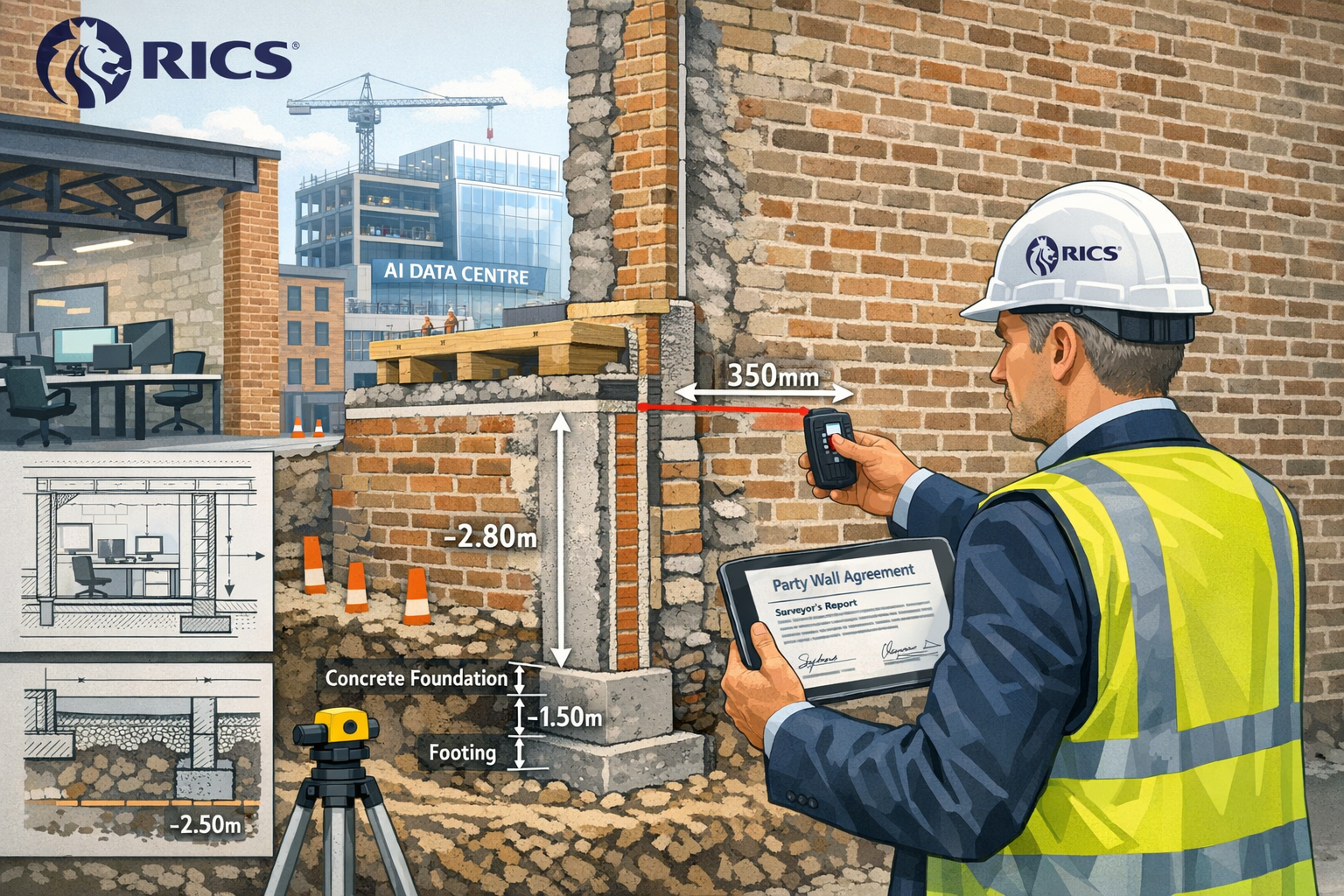
The Legal Framework: Party Wall Act 1996
The Party Wall Act 1996 establishes the legal foundation for all party wall matters in England and Wales, including Manchester's burgeoning tech sector developments. This legislation governs three primary scenarios:
- New walls built on boundary lines between properties
- Work on existing shared (party) walls between buildings
- Excavation within three or six metres of neighbouring structures
For Manchester's tech-driven development boom, these provisions become particularly relevant when:
- Converting adjacent Victorian warehouses into collaborative tech workspaces
- Excavating for underground cooling systems required by data centres
- Reinforcing shared walls to support additional floors for office expansion
- Installing heavy equipment that may affect neighbouring properties
What Makes Tech Development Projects Unique
AI hubs and data centres present distinctive challenges that traditional party wall surveys may not fully address:
Structural Load Considerations 💪
Modern data centres house thousands of servers creating concentrated floor loads far exceeding typical commercial buildings. When these facilities share walls with adjacent properties, surveyors must assess whether existing party walls can withstand vibration, heat transfer, and potential structural stress.
Utility Infrastructure Requirements
Tech facilities demand substantial electrical capacity, cooling systems, and fibre-optic connectivity. Installing these utilities often requires excavation near party walls or penetrations through shared structures, triggering party wall procedures.
24/7 Operational Demands
Unlike standard commercial developments, AI hubs operate continuously. Construction work affecting party walls must be carefully scheduled to minimize disruption while maintaining compliance with party wall agreement protocols.
RICS Protocols for AI-Hub Expansion Projects
The Role of RICS Chartered Surveyors
The Royal Institution of Chartered Surveyors (RICS) sets professional standards that ensure Party Wall Surveys in Manchester's Tech-Driven Development Boom: RICS Protocols for AI-Hub Expansion maintain the highest quality and impartiality. Qualified party wall surveyors following RICS guidance provide:
| RICS Protocol Element | Application to Tech Projects | Benefit |
|---|---|---|
| Pre-construction surveys | Detailed condition assessment of adjacent properties before data centre construction | Establishes baseline to resolve future disputes |
| Technical specifications | Structural calculations for server room loads on party walls | Ensures safety and compliance |
| Notice procedures | Formal communication to neighbouring property owners | Legal compliance and relationship management |
| Award preparation | Binding agreements outlining work scope and protections | Clarity for all parties |
| Dispute resolution | Independent arbitration when owners disagree | Prevents costly litigation |
Case Study: Latos Data Centres' East Manchester Project
The Latos Data Centres' East Manchester project exemplifies how RICS protocols guide major AI infrastructure developments. Currently in public consultation (open until March 16, 2026), this 28,000 sq ft neural edge AI data centre on a brownfield site at Bower Street and Ten Acres Lane presents multiple party wall considerations:
Brownfield Site Challenges 🏭
Former industrial sites often have unknown foundation conditions and potential contamination. Party wall surveyors must conduct thorough investigations to ensure excavation and construction won't destabilize neighbouring properties.
Scale and Proximity
A 28,000 sq ft facility in an urban environment inevitably sits close to existing structures. RICS protocols require comprehensive schedules of condition documenting the state of all nearby buildings before work commences.
Stakeholder Engagement
The public consultation process aligns with RICS best practices for transparent communication with affected property owners, allowing concerns to be addressed proactively.
Key RICS Guidelines for Tech Development Party Wall Surveys
1. Enhanced Structural Assessment
RICS guidance recommends structural engineers work alongside party wall surveyors when projects involve:
- Significant load increases (server equipment)
- Vibration-generating machinery
- Deep excavations for cooling infrastructure
2. Environmental Impact Documentation
Tech facilities generate heat and electromagnetic fields. Surveyors must document baseline conditions and specify monitoring protocols to ensure neighbouring properties aren't adversely affected.
3. Extended Monitoring Periods
Unlike residential renovations, data centre construction may span 12-18 months. RICS protocols suggest regular interim inspections rather than just pre- and post-construction surveys.
4. Specialized Insurance Requirements
Given the high value of tech infrastructure and potential business interruption costs, RICS recommends enhanced insurance coverage beyond standard party wall agreement provisions.

Navigating Manchester's Unique Development Landscape
The Commercial-to-Tech Conversion Trend
Manchester's tech boom has triggered a wave of adaptive reuse projects converting former mills, warehouses, and commercial buildings into AI hubs and tech offices. These conversions present distinct party wall challenges:
Historic Building Considerations 🏛️
Victorian-era structures often share walls built before modern building codes. Surveyors must balance preservation requirements with the structural modifications needed for contemporary tech use.
Mixed-Use Adjacencies
Tech developments frequently neighbour residential properties, retail spaces, or other commercial uses. Party wall agreements must account for varying tolerance levels for noise, vibration, and construction disruption.
Rapid Timeline Pressures
Manchester's competitive tech sector drives developers to move quickly. However, proper party wall procedures require minimum notice periods (typically two months for major works) that cannot be circumvented.
Geographic Hotspots for Tech Development
Several Manchester districts have emerged as AI and tech development centres, each with unique party wall considerations:
Northern Quarter
Dense urban fabric with closely spaced buildings means virtually every tech conversion affects multiple neighbours. Party wall surveyors here manage complex multi-party agreements.
East Manchester (including Bower Street/Ten Acres Lane)
Brownfield regeneration sites offer larger footprints but may involve contaminated land remediation alongside party wall compliance.
Spinningfields
Premium commercial district where high-value properties demand meticulous party wall documentation to protect substantial investments.
Ancoats
Former industrial area experiencing rapid gentrification, mixing tech startups with residential conversions—creating diverse party wall scenarios.
Regulatory Compliance Beyond Party Wall Legislation
Party Wall Surveys in Manchester's Tech-Driven Development Boom: RICS Protocols for AI-Hub Expansion must integrate with broader regulatory frameworks:
- Planning permission requirements for material changes of use
- Building regulations for structural alterations
- Environmental permits for cooling systems and energy consumption
- Fire safety regulations for high-density equipment installations
- Accessibility standards for commercial premises
Experienced RICS surveyors coordinate with planning consultants, structural engineers, and building surveyors to ensure comprehensive compliance.
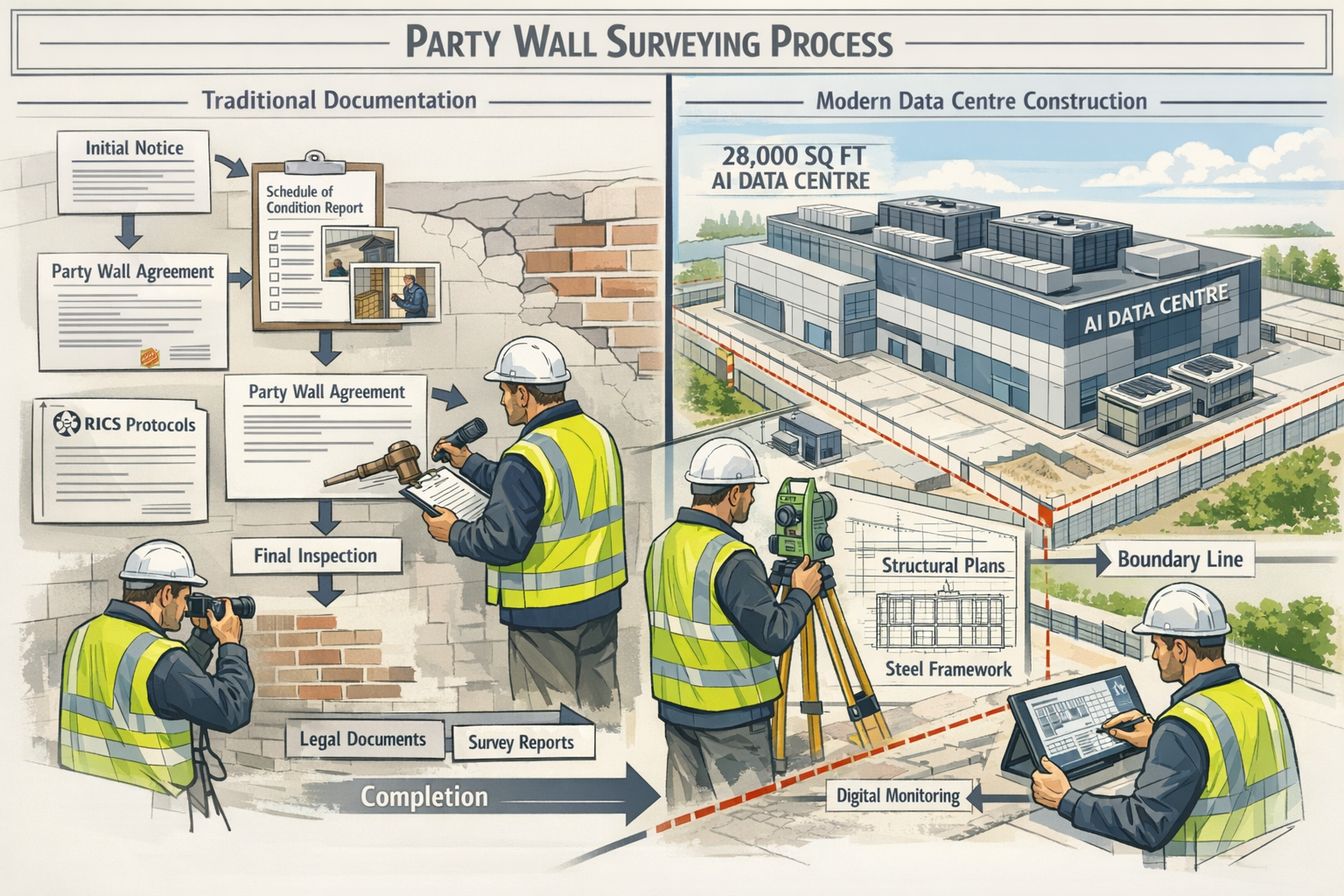
The Party Wall Survey Process for Tech Projects
Step 1: Initial Assessment and Notice (Months 1-2)
The building owner (developer) must serve formal notice on adjoining owners at least two months before commencing work. For tech projects, this notice should include:
✅ Detailed construction plans showing server room layouts and equipment specifications
✅ Structural engineering calculations for load-bearing walls
✅ Proposed excavation depths and foundation details
✅ Timeline for phased construction
✅ Contact information for the appointed party wall surveyor
Step 2: Appointing Surveyors (Month 2-3)
Adjoining owners have three options upon receiving notice:
- Consent to the works (no surveyor needed, but rarely advisable for major projects)
- Appoint their own surveyor to represent their interests
- Agree to use the building owner's surveyor (acting for both parties)
For significant tech developments, most neighbouring owners choose option 2 to ensure independent representation. The two surveyors then collaborate to prepare the party wall award.
Step 3: Condition Survey and Documentation (Month 3-4)
Before any construction begins, surveyors conduct comprehensive schedules of condition documenting:
- Photographic evidence of all rooms in adjoining properties
- Structural condition noting existing cracks, settlement, or defects
- Utility locations including electrical, plumbing, and HVAC systems
- Decorative finishes to establish baseline for damage claims
For data centre projects, surveyors pay special attention to:
- Foundation stability indicators
- Vibration-sensitive equipment in neighbouring properties
- Existing temperature and humidity levels
- Electromagnetic interference baseline readings
Step 4: Award Preparation and Agreement (Month 4-5)
The party wall award is a legally binding document specifying:
| Award Component | Tech Project Considerations |
|---|---|
| Scope of works | Detailed description of structural modifications, equipment installation, excavation |
| Working hours | May restrict noisy activities during business hours for adjacent offices |
| Access rights | Provisions for surveyors to inspect neighbouring properties during construction |
| Protection measures | Vibration monitoring, dust control, structural support requirements |
| Dispute resolution | Process for addressing issues arising during construction |
| Cost allocation | Who pays for what aspects of the work and surveying fees |
Step 5: Construction Monitoring (Duration of Project)
Throughout the construction phase, party wall surveyors:
🔍 Conduct periodic inspections to ensure compliance with the award
📊 Monitor vibration levels if specified in the agreement
📸 Document any changes or unexpected conditions
⚖️ Mediate disputes between building and adjoining owners
📝 Prepare interim reports for stakeholders
Step 6: Post-Construction Assessment (Final Month)
After construction completion, surveyors perform final inspections comparing the current condition of adjoining properties to the pre-construction schedule. Any damage attributable to the works must be remedied by the building owner according to the award terms.
Cost Considerations and Financial Planning
Typical Costs for Party Wall Surveys in Tech Projects
Party wall surveyor costs vary based on project complexity, but tech developments typically fall at the higher end due to technical requirements:
Building Owner's Surveyor Fees: £1,500 – £5,000+
- Depends on project size and number of adjoining properties
- Includes notice preparation, award drafting, and construction monitoring
Adjoining Owner's Surveyor Fees: £1,200 – £4,000+
- Paid by the building owner (not the adjoining owner)
- Covers independent assessment and representation
Schedule of Condition: £500 – £2,000 per property
- Comprehensive documentation of pre-construction state
- Essential for resolving damage claims
Specialist Consultants: £2,000 – £10,000+
- Structural engineers for complex load calculations
- Vibration monitoring specialists
- Environmental impact assessors
Total Budget Estimate: For a medium-sized AI hub conversion affecting 3-4 neighbouring properties, budget £15,000 – £30,000 for comprehensive party wall compliance.
Who Pays What?
Under the Party Wall Act 1996:
- The building owner pays all reasonable surveyor fees for both their own surveyor and the adjoining owner's surveyor
- The building owner pays for remedying any damage caused by the works
- Adjoining owners pay nothing unless they request enhancements beyond simple damage repair
This cost structure protects neighbouring property owners while ensuring building owners factor party wall expenses into project budgets from the outset.
Common Challenges and Solutions
Challenge 1: Accelerated Timelines vs. Legal Requirements
Problem: Tech developers often want to start construction immediately to meet market opportunities, but party wall procedures require minimum two-month notice periods.
Solution: Engage party wall surveyors during the planning phase, serving notices before final planning permission is secured. This parallel processing minimizes delays once approvals are obtained.
Challenge 2: Multiple Adjoining Owners with Varying Concerns
Problem: A single data centre project might affect 5-10 neighbouring properties with different priorities—some residential, some commercial, some owner-occupied, some tenanted.
Solution: Experienced surveyors facilitate group meetings where common concerns are addressed collectively, while handling property-specific issues through individual negotiations. Clear communication prevents misunderstandings that could derail projects.
Challenge 3: Unforeseen Structural Issues
Problem: Excavation for cooling systems or server room foundations reveals unexpected conditions like inadequate foundations in neighbouring Victorian buildings.
Solution: RICS protocols require surveyors to halt work, reassess the situation, and potentially amend the party wall award to include additional protective measures. While this may cause delays, it prevents catastrophic structural failures.
Challenge 4: Balancing Innovation with Heritage Protection
Problem: Manchester's tech boom often involves listed buildings or conservation areas where structural modifications face additional scrutiny.
Solution: Party wall surveyors collaborate with conservation officers and heritage consultants to design solutions that satisfy both technological requirements and preservation standards. This might include reversible modifications or minimal intervention approaches.
Best Practices for Developers and Property Owners
For Building Owners (Developers)
- Budget realistically for party wall compliance from project inception—don't treat it as an afterthought
- Engage RICS-qualified surveyors with specific experience in commercial and construction projects
- Communicate proactively with neighbours before formal notices, building goodwill
- Allow adequate time for the full party wall process—rushing creates disputes
- Document everything through professional surveys and photographic records
- Maintain insurance that specifically covers party wall liabilities
For Adjoining Owners
- Take party wall notices seriously—seek professional advice immediately upon receipt
- Appoint your own surveyor for significant projects rather than relying on the building owner's surveyor
- Understand your rights under the Party Wall Act 1996, including the right to compensation for damage
- Document your property's condition independently before works commence
- Maintain communication with your appointed surveyor throughout the construction period
- Know that costs are covered—you won't pay surveyor fees for proper party wall procedures
For Party Wall Surveyors
- Develop technical expertise in data centre and AI hub construction requirements
- Build relationships with structural engineers and specialist consultants
- Stay current with RICS guidance updates and tech industry trends
- Use technology for documentation—digital surveys, drone photography, vibration monitoring apps
- Mediate proactively to prevent disputes from escalating to formal resolution procedures
- Educate clients about realistic timelines and cost expectations
The Future of Party Wall Surveys in Manchester's Tech Sector
Emerging Trends Through 2026 and Beyond
Increased AI-Driven Surveying Tools 🤖
Ironically, the same AI technology driving Manchester's development boom is transforming how party wall surveys are conducted. Machine learning algorithms now assist in:
- Analyzing structural data to predict settlement patterns
- Processing thousands of condition survey photographs to identify defects
- Generating automated reports from survey data
- Monitoring construction progress through computer vision
Sustainability Integration
As tech companies prioritize environmental credentials, party wall agreements increasingly address:
- Green roof installations affecting structural loads
- Solar panel mounting on shared walls
- Rainwater harvesting systems requiring excavation
- Energy efficiency retrofits in historic buildings
Modular Construction Approaches
Prefabricated data centre components reduce on-site construction time but require careful party wall planning for crane access, temporary works, and vibration during installation.
Regulatory Evolution
Manchester City Council is developing specific planning guidance for tech sector developments that may influence party wall procedures, particularly regarding:
- Cooling system noise standards
- Emergency power generator placement
- Cybersecurity infrastructure requirements
Conclusion
Party Wall Surveys in Manchester's Tech-Driven Development Boom: RICS Protocols for AI-Hub Expansion represent a critical intersection of traditional property law and cutting-edge technological innovation. As Manchester solidifies its position as the UK's leading AI hub—with 184% growth in AI company registrations and major projects like the Latos Data Centres' 28,000 sq ft neural edge facility—the demand for expert party wall surveying will only intensify.
The unique challenges of tech infrastructure projects—concentrated loads, continuous operations, complex utility requirements, and accelerated timelines—demand surveyors who understand both RICS protocols and the specific needs of AI hubs and data centres. Whether converting Victorian warehouses in the Northern Quarter or developing brownfield sites in East Manchester, proper party wall compliance protects all stakeholders while enabling the city's technological transformation.
Actionable Next Steps
For Developers Planning Tech Projects:
- Contact a RICS-qualified party wall surveyor during initial project planning
- Budget 1-2% of construction costs for comprehensive party wall compliance
- Serve party wall notices at least 2-3 months before desired construction start
- Consider building surveys to assess structural capacity for tech equipment loads
For Property Owners Receiving Notices:
- Don't ignore party wall notices—respond within 14 days
- Appoint an independent RICS surveyor to represent your interests
- Request detailed schedules of condition before works commence
- Understand that the building owner pays all reasonable surveyor fees
For All Stakeholders:
The tech-driven transformation of Manchester's built environment offers tremendous economic opportunities, but sustainable growth requires respecting property rights and following established legal frameworks. By embracing RICS protocols and engaging qualified professionals, Manchester can continue its AI leadership while protecting the interests of all property owners in this dynamic urban landscape. 🏗️💻