
Commercial tenants in England and Wales face dilapidations claims averaging tens of thousands of pounds at lease end, yet many sign leases without a single photograph of the property's condition on day one. The question of Dilapidations Report vs Schedule of Condition: Which Document Protects a Commercial Tenant? is not academic. Get the timing wrong and the wrong document becomes the only evidence in a costly dispute.
This article explains what each document does, when it is prepared, how it is used, and, critically, which one a tenant should insist on before handing over a deposit.
Key Takeaways
- A Schedule of Condition is prepared at the start of a lease and records the property's existing state, limiting what a tenant can later be asked to repair.
- A Dilapidations Report (or schedule) is prepared near or at lease end and sets out the landlord's claim for breaches of repair covenants.
- The Schedule of Condition is the primary protective tool for tenants; the Dilapidations Report is largely a landlord instrument.
- RICS professional standards govern both documents and set out the process surveyors must follow [1][2].
- Tenants who do not commission a Schedule of Condition at lease start may be liable for repairs to defects that pre-dated their occupation.
What Each Document Actually Is
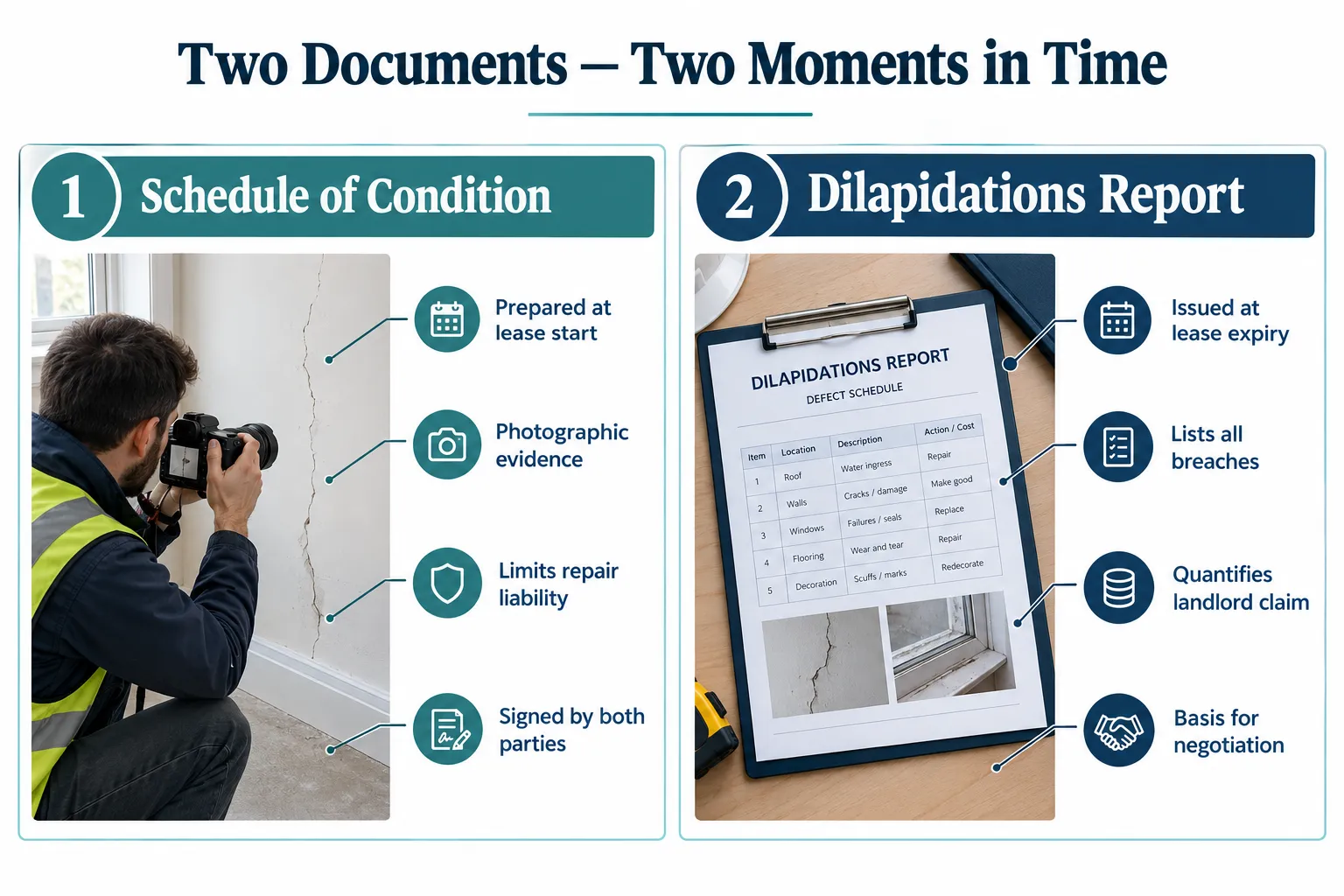
The two documents serve entirely different purposes and arise at opposite ends of a lease.
Schedule of Condition
A Schedule of Condition is a factual record of a property's physical state at a specific point in time, almost always the date a lease is granted or assigned. It typically contains:
- Written descriptions of each element (walls, floors, ceilings, roof, services)
- Photographs with date stamps and reference numbers
- A condition rating for each element
- Signatures from both landlord and tenant (or their surveyors)
Once attached to the lease as a formal document, it limits the tenant's repairing obligation. The tenant cannot be required to hand back the property in a better condition than that recorded at the start [1].
RICS consumer guidance is explicit on this point: a Schedule of Condition is one of the most effective steps a commercial tenant can take to protect themselves before signing [1].
Dilapidations Report
A Dilapidations Report, more precisely called a Schedule of Dilapidations, is a document prepared on behalf of a landlord (or occasionally a tenant) that identifies breaches of the lease's repair, decoration and reinstatement covenants. It is a claim document, not a neutral record.
There are three main types:
| Type | When issued | Purpose |
|---|---|---|
| Interim schedule | During the lease term | Prompt tenant to carry out repairs |
| Terminal schedule | In the final three years | Quantify anticipated end-of-lease claim |
| Final schedule | At or after lease expiry | Formal basis for settlement or litigation |
RICS professional standards require that a terminal or final schedule include a Section 18(1) valuation, a cap that limits any financial claim to the actual diminution in the property's value, preventing landlords from claiming more than the property has actually lost [2][6].
Timing: Why the Order of Events Matters
The fundamental difference between these two documents is when they are created, and that timing determines everything about their usefulness to a tenant.

A Schedule of Condition must be prepared before or on the date the lease is signed. Once a tenant has taken occupation without one, the opportunity is gone. Any subsequent record is not a true baseline, it merely documents a state that already includes the tenant's own use and any deterioration during that period.
A Dilapidations Report arrives at the other end of the lease, often as an unwelcome surprise. By that stage, the tenant has no baseline evidence to challenge items that were already defective when they moved in, unless a Schedule of Condition was prepared at the outset.
This asymmetry is the core of the Dilapidations Report vs Schedule of Condition question for tenants. The Schedule is a proactive, preventive instrument. The Dilapidations Report is reactive, it is the document a tenant has to respond to, not one they initiate for their own benefit.
RICS standards set out a structured protocol for the dilapidations process, including timescales for issuing schedules and the requirement for a landlord's surveyor to negotiate in good faith before litigation [2][6].
Repair Obligations: What the Lease Actually Says
Neither document exists in isolation. Both are read against the repairing covenants in the lease itself.

Most commercial leases contain one or more of the following obligations:
- Full repairing and insuring (FRI): The tenant bears all repair costs, including pre-existing defects, unless qualified by a Schedule of Condition.
- Keep in repair: Maintain the property throughout the term.
- Yield up in repair: Return the property at expiry in the condition required by the lease.
- Reinstatement: Remove alterations and return the property to its original layout.
An FRI lease without a Schedule of Condition attached is the highest-risk position for a tenant. Under an unqualified FRI covenant, a tenant can theoretically be required to put a dilapidated property into full repair even if it was in poor condition on day one. A Schedule of Condition attached to the lease changes the obligation to "no worse than the condition shown in the Schedule," which is a materially different, and far more manageable, standard [1][2].
For tenants taking on older commercial premises, this distinction can represent a difference of tens of thousands of pounds at lease end.
Those negotiating a new commercial lease should also consider how survey negotiation tips apply to the pre-lease inspection stage, where condition evidence is gathered.
Photographic Evidence and Its Weight in Disputes
A Schedule of Condition lives or dies on the quality of its photographic record. A written description alone, "wall in fair condition", is almost worthless in a dispute five or ten years later. Photographs with:
- Date and time stamps
- Location references (room name, elevation)
- Close-up detail of cracks, staining, or deterioration
- Wide shots establishing context
…create an evidential record that is genuinely difficult to challenge. RICS guidance on dilapidations practice emphasises that photographic schedules should be systematic and comprehensive, not selective [2][6].
A dilapidations schedule prepared by a landlord's surveyor will similarly rely on photographs to substantiate each alleged breach. The tenant's surveyor will then compare those photographs against the Schedule of Condition, if one exists, to identify which items were pre-existing.
Where no Schedule of Condition was prepared, the tenant's surveyor must rely on:
- Age and construction of the building (to argue inherent defects)
- Historical planning records
- Previous tenancy correspondence
- Expert opinion on the likely condition at lease start
This is a weaker position than a contemporaneous photographic record, and it increases the cost and uncertainty of any negotiation.
For a broader understanding of how surveyors assess building defects, the RICS Level 3 Building Survey process illustrates the level of detail a thorough condition inspection involves.
How the Dilapidations Report Quantifies Tenant Risk
When a landlord's surveyor issues a terminal or final Schedule of Dilapidations, it will typically set out:
- The specific clause of the lease alleged to have been breached
- A description of the defect or failure
- The surveyor's proposed remedy
- An estimated cost of that remedy
The total of those costs forms the headline claim. However, RICS standards require the landlord's surveyor to also prepare a Section 18(1) diminution valuation, which caps the claim at the actual reduction in the property's market value caused by the disrepair [2][6]. In practice, this cap often reduces the headline figure significantly, particularly where the landlord intends to redevelop or substantially refurbish the property anyway.
A tenant's surveyor will scrutinise the schedule item by item, challenging:
- Items that were pre-existing (supported by the Schedule of Condition)
- Over-specified remedies (e.g., full replacement where repair would suffice)
- Costs that exceed market rates
- Items that fall outside the lease covenants
- The Section 18(1) cap where the landlord's valuation appears inflated
This negotiation process is standard practice and is explicitly anticipated by RICS professional standards [2]. Most dilapidations claims settle without litigation.
Where disputes do reach court, a surveyor may be required to act as an expert witness. The expert witness surveyors role in property disputes is a specialist area governed by Civil Procedure Rules.
Dilapidations Report vs Schedule of Condition: The Tenant's Practical Checklist
The following table summarises the key differences from a tenant's perspective.
| Factor | Schedule of Condition | Dilapidations Report |
|---|---|---|
| Who prepares it | Tenant's surveyor (ideally) | Landlord's surveyor |
| When prepared | Before or at lease start | During or at lease end |
| Primary purpose | Limit repair liability | Quantify breach and claim |
| Photographic content | Systematic, comprehensive | Focused on alleged defects |
| Legal attachment | Annexed to the lease | Served on the tenant |
| Tenant benefit | High, direct protection | Low, primarily a claim against the tenant |
| RICS standards apply | Yes [2] | Yes [2][6] |
Scotland: The Same Dynamic, Different Legal Framework
In Scotland, the legal framework for dilapidations differs from England and Wales. The concepts of keep in repair and put in repair covenants exist, but the remedies and court procedures are governed by Scots law. RICS has published separate professional standards for Scotland [4][5].
The practical dynamic, however, is the same. A Schedule of Condition prepared at lease start limits a Scottish commercial tenant's liability. A Schedule of Dilapidations served at lease end sets out the landlord's claim. Tenants in Scotland should instruct a surveyor familiar with both the RICS Scotland guidance and the relevant Scots law provisions.
Dilapidations Report vs Schedule of Condition: Protecting Yourself When Negotiating a New Lease
The single most effective step a commercial tenant can take is to make the Schedule of Condition a condition of signing the lease, not an afterthought. Practical steps include:
- Instruct a RICS-registered building surveyor before heads of terms are agreed, not after.
- Negotiate the wording of the repairing covenant to reference the Schedule of Condition explicitly, "no worse than the condition shown in the annexed Schedule."
- Ensure both parties sign the Schedule before the lease is executed.
- Retain a copy with the lease documents for the entire term.
- Review the Schedule before any subletting or assignment, as the same evidence base will be relevant to any future dilapidations claim.
A surveyor instructed to prepare a Schedule of Condition should have experience of commercial property and familiarity with RICS dilapidations guidance [2]. The level of detail required is closer to a full structural survey than a basic visual inspection, thoroughness at this stage pays dividends at lease end.
Tenants who receive a dilapidations schedule and need to understand their options should also read about using an RICS survey to negotiate, the principles of evidence-based negotiation apply equally to lease-end settlements.
FAQ
What is the difference between a Schedule of Condition and a Schedule of Dilapidations?
A Schedule of Condition records the property's state at lease start and limits the tenant's repair liability. A Schedule of Dilapidations is a claim document served by the landlord at or near lease end, setting out alleged breaches and their cost.
Does a Schedule of Condition need to be prepared by a RICS surveyor?
It does not have to be, but RICS-registered surveyors follow professional standards that make the document more credible in a dispute. A poorly prepared schedule may be challenged or disregarded [2].
Can a tenant commission their own dilapidations assessment?
Yes. A tenant can instruct a surveyor to prepare a Wants of Repair schedule, an independent assessment of the property's condition, at any point during the term. This helps identify obligations before they accumulate.
What is a Section 18(1) valuation?
It is a statutory cap under the Landlord and Tenant Act 1927 that limits a dilapidations claim to the actual diminution in the property's value caused by the disrepair. RICS requires this valuation to accompany any terminal or final schedule [2][6].
What happens if no Schedule of Condition was prepared?
The tenant's repairing obligation is assessed against the full terms of the lease, without any baseline limitation. This typically increases the tenant's exposure to a dilapidations claim, particularly in older or poorly maintained buildings.
Is a Schedule of Condition relevant in Scotland?
Yes. The same protective principle applies, though the legal framework differs. RICS has published Scotland-specific guidance [4][5].
How much does a Schedule of Condition cost?
Fees vary with property size and complexity. A RICS surveyor will typically quote on the basis of floor area and the level of detail required. The cost is almost always modest relative to the potential dilapidations liability it limits.
Conclusion
The Dilapidations Report vs Schedule of Condition question resolves clearly in favour of the Schedule of Condition as the primary protective instrument for commercial tenants. The Dilapidations Report is a claim tool, it arrives when the lease is ending and the tenant's options are limited. The Schedule of Condition is a prevention tool, it must be in place before the lease starts.
Tenants negotiating a new commercial lease should treat the Schedule of Condition as non-negotiable. Instruct a RICS-registered surveyor, ensure the document is comprehensive and photographic, attach it formally to the lease, and retain it for the full term.
At lease end, if a dilapidations schedule arrives, instruct a surveyor immediately. Check every item against the Schedule of Condition, challenge over-specified remedies, and ensure the Section 18(1) cap is applied. Most claims settle, but the quality of the evidence gathered at lease start determines the strength of the tenant's position throughout.
For tenants who want to understand how surveyor-led evidence shapes property negotiations more broadly, the expert witness surveyor role illustrates how formal condition records are used in disputed property matters.
References
[1] Dilapidations England Wales – rics.org
[2] Dilapidations In England And Wales – rics.org
[3] September 2016 Dilapidations In England And Wales 7th Edition – rics.org
[4] Dilapidations In Scotland – rics.org
[5] Dilapidations In Scotland 2nd Edition – rics.org
[6] Dilapidations Rebrand 2024 – rics.org