
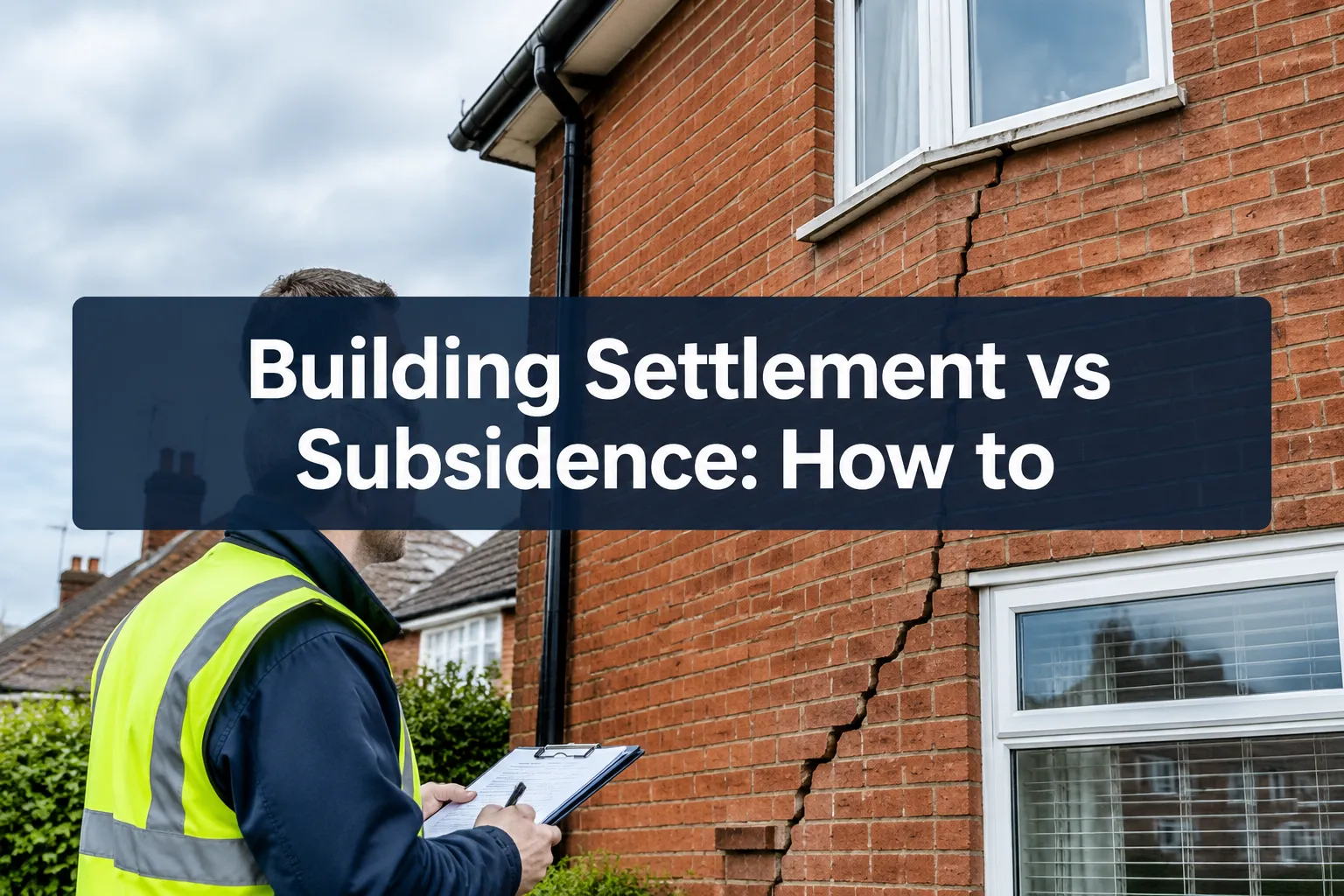
UK domestic subsidence claims reached a record £307 million in 2025, a 10% annual rise, and the average claim size climbed a further 9% to £17,820 in Q1 2026 [1][2]. Yet many of the cracks that trigger those claims are, in fact, entirely normal building settlement. Knowing the difference between building settlement vs subsidence is one of the most consequential judgements a surveyor makes during a UK property survey, and it directly affects what happens next for buyers, sellers, lenders, and insurers. This guide explains the signs, causes, and diagnostic methods that separate the two conditions, so that anyone facing a crack-filled survey report can understand what it actually means.
Key Takeaways
- Settlement is expected, gradual compression of the ground under a building's load; subsidence is the ground moving away beneath the foundations due to external causes.
- Settlement typically stabilises within one to three years and produces minor Category 1-2 cracking; subsidence is progressive, localised, and associated with Category 3 or worse cracking (5 mm or wider).
- A surveyor assessing building settlement vs subsidence will examine crack patterns, building age, soil type, nearby trees, and drainage to reach a diagnosis.
- Labelling movement as subsidence in a survey report triggers insurer involvement, potential underpinning, and lender scrutiny, making accurate diagnosis critical.
- Updated British Geological Survey datasets and postcode-level hazard tools now give surveyors stronger evidence to cross-check on-site observations against mapped ground risk.
What Are Building Settlement and Subsidence?
Before examining how to tell the difference in a UK property survey, it is worth establishing precise definitions, because the two terms are frequently confused in everyday conversation.
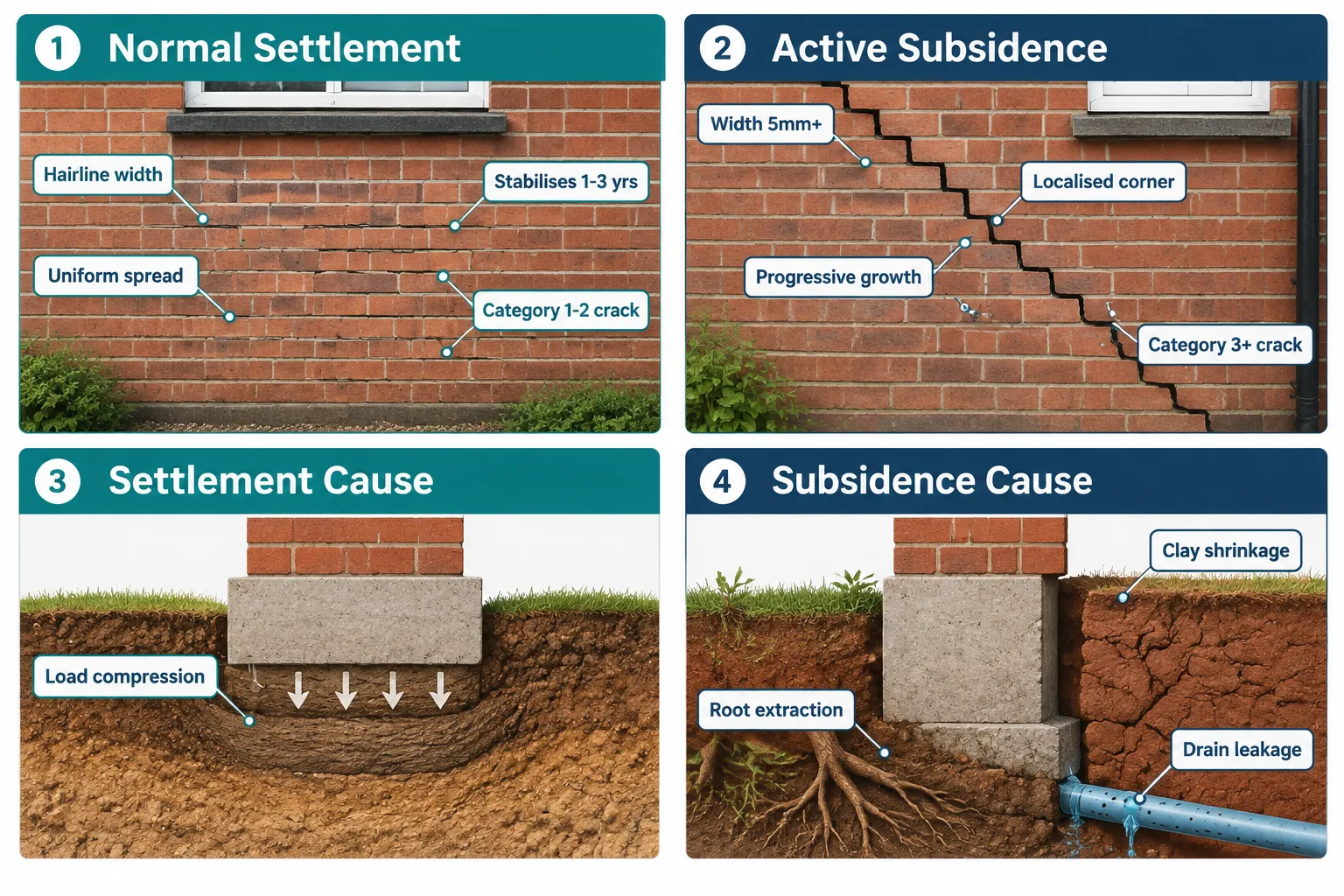
Building settlement is the downward movement that occurs when a structure compresses the ground beneath its foundations under its own weight. This is a normal, expected process. UK standards, including NHBC guidance 6.4 and Building Regulations Part A, treat settlement as an anticipated behaviour that is managed through monitoring rather than urgent structural repair [8]. Settlement typically occurs within the first one to three years after a new build or an extension is completed, decelerates steadily, and eventually stops [8].
Subsidence, by contrast, is defined by RICS as downward movement of foundations caused by changes in the supporting strata, and explicitly distinguished from settlement [6][8]. The ground is not simply compressing under load; it is moving away or losing its load-bearing capacity due to an external cause. RICS advises that unexplained cracking, distortion of openings, or other structural symptoms warrant prompt specialist assessment [8].
"The surveyor's choice of the word 'subsidence' in a report is not merely technical, it can trigger insurer involvement, lender concern, and potentially underpinning or ground stabilisation works." [8][10]
This distinction matters enormously in practice. Settlement is a managed condition; subsidence is a defect requiring investigation.
The Main Causes: Why Each Condition Happens
Understanding the causes helps buyers and surveyors interpret what they see on site.
Causes of Normal Building Settlement
- New construction loading: Fresh foundations compress soft or made-ground soils as the structure reaches its full weight.
- Extensions and conversions: Adding a storey or a rear extension introduces new loads that cause localised initial movement.
- Seasonal moisture variation: Minor, reversible movement in the first few years as the ground adjusts to the building's presence.
Causes of Subsidence
Subsidence has several distinct triggers, and identifying the right one shapes the remediation approach [9][14]:
| Cause | Mechanism | Common Indicators |
|---|---|---|
| Clay shrinkage | Hot, dry summers cause shrink-swell clay to contract | Cracking worsens in drought years |
| Tree root extraction | Roots draw moisture from clay, accelerating shrinkage | Mature trees within 5-15 m of the building |
| Leaking drains | Water washes fine particles from beneath foundations | Cracking near soil pipes or inspection chambers |
| Mining or made ground | Historic voids or loosely compacted fill collapse | Property in former mining area or on brownfield land |
| Sinkhole or natural void | Dissolution of chalk or limestone beneath the site | Sudden, dramatic movement |
Clay shrinkage is the dominant cause in southern England, where shrink-swell clays are widespread. The British Geological Survey (BGS) updated its Property Subsidence Assessment (PSA) datasets in August 2026, providing postcode and property-scale shrink-swell hazard information for England, Wales, and Great Britain [3][5]. Surveyors can now cross-check on-site crack patterns against mapped ground risk, rather than relying solely on visual inspection [3][5][7].
For properties near mature trees, the relationship between root systems and clay movement is a key diagnostic consideration. The guide to whether trees cause subsidence explains how surveyors assess root influence during a site visit.
How to Tell the Difference in a UK Property Survey: Diagnostic Signs
This is the core question in any assessment of building settlement vs subsidence: how to tell the difference in a UK property survey. Surveyors use a combination of visual inspection, measurement, and contextual analysis.
Crack Pattern Analysis
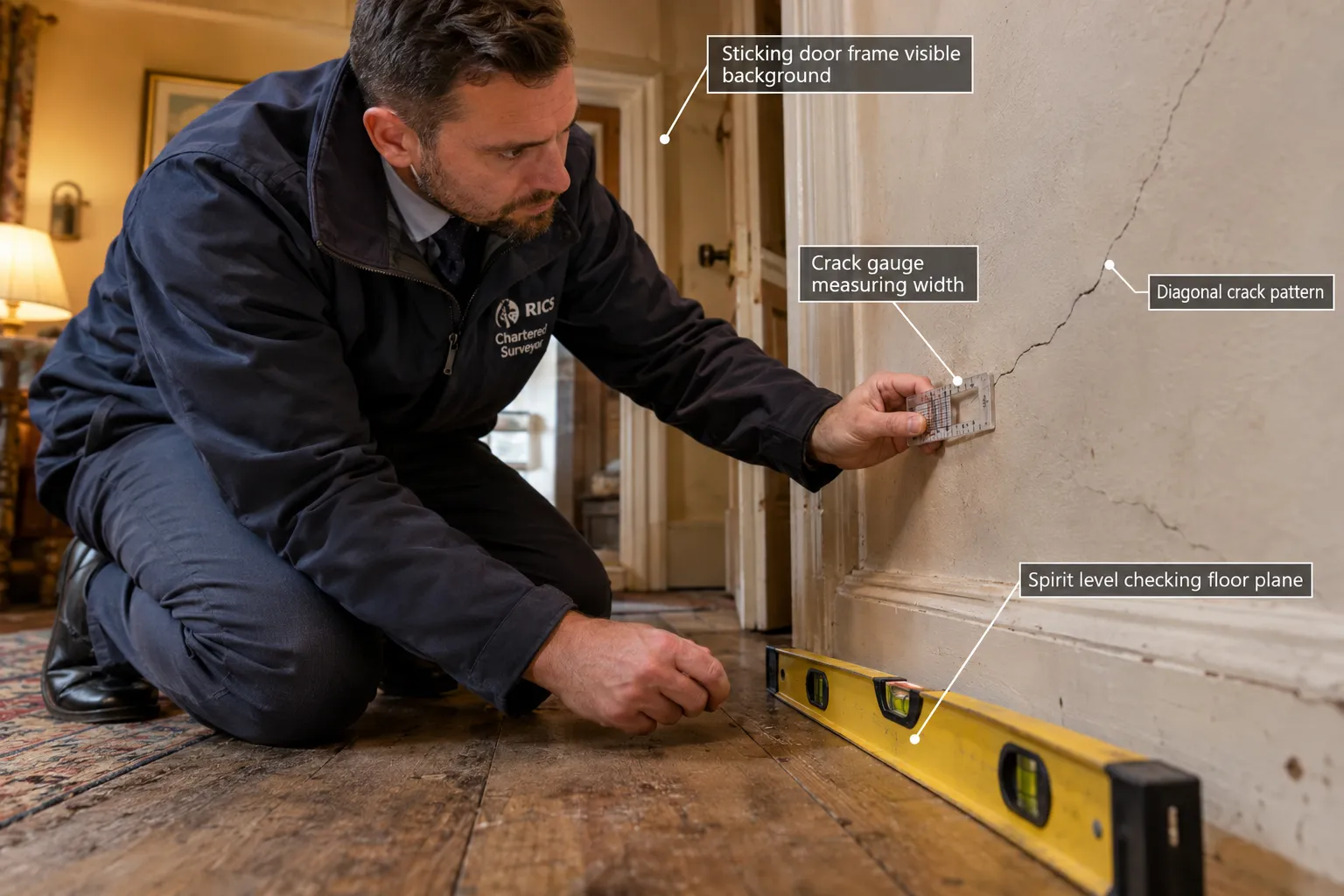
The pattern, width, and location of cracks are the primary diagnostic tool.
Settlement cracks:
- Tend to be uniform across the building rather than concentrated at one corner or wall
- Are typically hairline to 1 mm wide (Category 1) or up to 5 mm wide (Category 2)
- Run in predictable positions: above door and window lintels, at junctions between different materials
- Are usually old, filled, and not reopening, a sign of historic, stable movement [14]
Subsidence cracks:
- Are localised, often affecting one part of the building disproportionately
- Reach Category 3 (5 mm or more) or worse, with visible gaps through the wall in severe cases
- Follow a diagonal or stepped pattern through mortar joints in brickwork
- May be accompanied by distorted window or door frames, sloping floors, or bulging masonry [11]
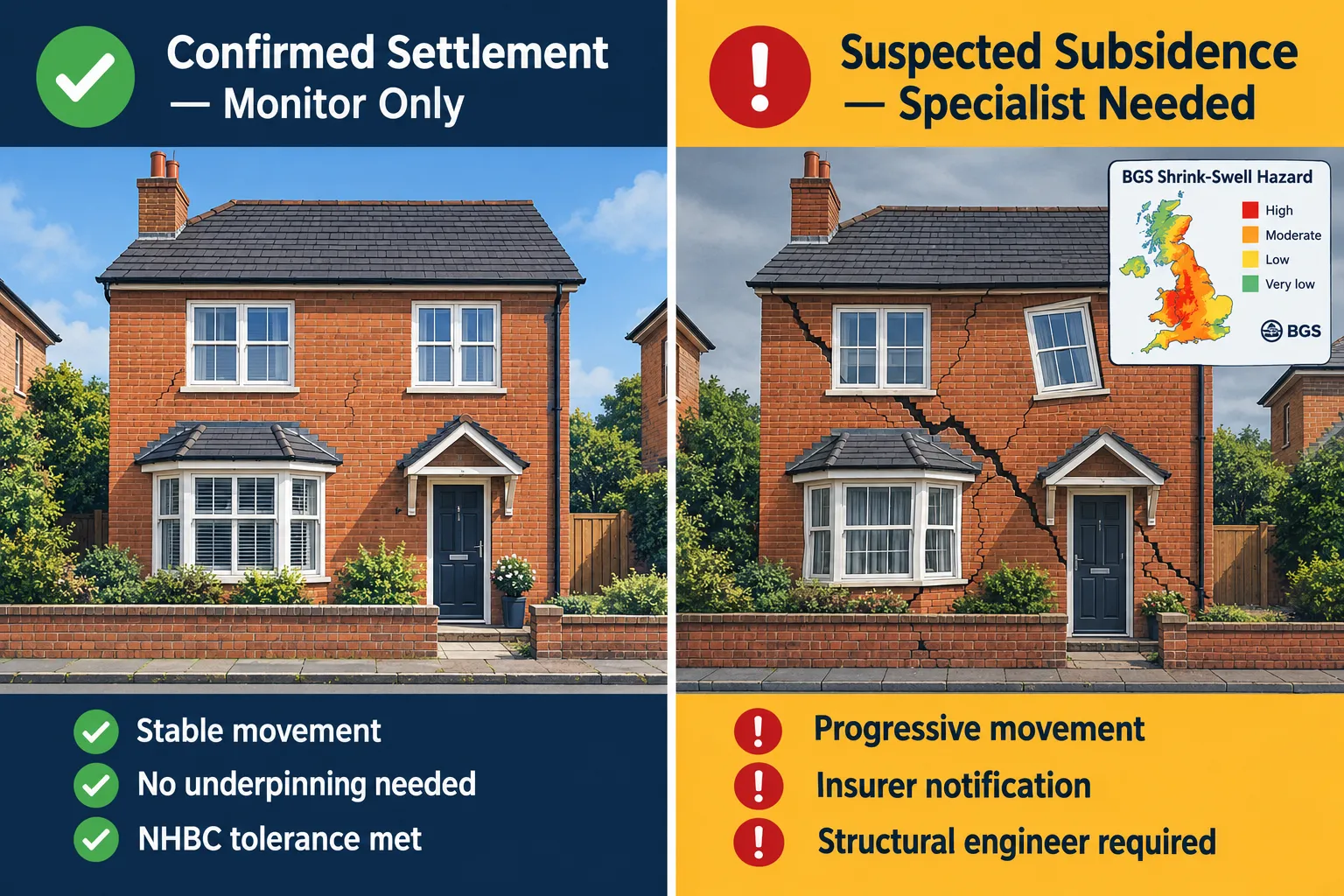
The referral threshold used by professional surveyors is clear: Category 3 cracking or above, ongoing differential movement, horizontal cracking with bulging masonry, or sagging roof structures all warrant specialist investigation [11].
Building Age and History
A crack in a building constructed three years ago is far more likely to represent normal settlement than the same crack in a 100-year-old property. Surveyors consider:
- Whether the building's age aligns with the expected settlement period
- Whether any extensions or conversions have been carried out recently
- Whether there is evidence of previous subsidence investigations, underpinning, or crack monitoring
Environmental and Site Factors
Surveyors assess the site context carefully:
- Soil type: Clay soils, particularly those with high shrink-swell potential, raise subsidence risk significantly [3][5]
- Nearby trees: Species, size, and proximity to the foundations are assessed
- Drainage: Leaking underground drains can wash fine particles from beneath foundations, causing progressive movement
- Topography: Sloping sites, retaining walls, and proximity to watercourses introduce additional risk
Monitoring Over Time
Where the diagnosis is uncertain, crack gauges are installed and readings are taken over weeks or months. Settlement movement decelerates and stops; subsidence movement continues or accelerates, particularly during dry summers [15]. Environmental factors such as rainfall and drought are logged alongside crack measurements to establish whether movement correlates with seasonal clay behaviour.
For buyers who want to understand what level of survey is appropriate when cracks are present, the comparison of Level 2 vs Level 3 survey options sets out the key differences between a homebuyer report and a full building survey.
What a Surveyor Checks During a UK Property Survey
A structured methodology guides how surveyors and engineers differentiate between the two conditions in practice [15].
Step 1, Initial site survey: The surveyor documents all visible symptoms: crack locations, widths, patterns, and associated distortion. Site conditions including drainage, vegetation, and ground topography are recorded.
Step 2, Foundation and soil analysis: The surveyor considers the likely foundation type for the building's age and construction, cross-referenced against soil data. BGS PSA datasets provide shrink-swell hazard ratings at postcode and property level [3][5][7].
Step 3, Crack measurement and monitoring: Crack gauges are installed where active movement is suspected. Readings are taken at intervals and correlated with weather data.
Step 4, Multi-disciplinary assessment: For suspected subsidence, a structural engineer may be engaged alongside the RICS surveyor. Heritage properties may also require conservation specialists [15].
Step 5, Report and recommendations: The surveyor's report uses precise terminology. Describing movement as settlement leads to monitoring recommendations; describing it as subsidence triggers insurer notification, potential underpinning, and lender scrutiny [10][15].
A thorough guide to subsidence signs, causes, and when to worry provides additional context on what surveyors look for and when the situation becomes serious.
Survey Costs for Suspected Subsidence
When cracking raises concerns, a specialist structural survey is typically commissioned. Current market data for London indicates the following typical fee ranges:
- Flat or single-floor property: approximately £350-£500
- Two to three bedroom terrace or semi-detached: approximately £400-£700
- Larger detached or multi-storey home: approximately £600-£1,000
- Survey plus monitoring package: approximately £700-£1,200 [12]
A subsidence-focused survey, often costing £400-£800, is particularly appropriate where there is concern about ground-related movement or an active insurance claim [12]. For a broader view of how survey investment can protect buyers financially, the article on saving money with building surveys is worth reading.
Buyers who receive a survey flagging potential subsidence also have options when it comes to negotiating the purchase price. The guide to average price reductions after a survey explains how to approach that conversation with evidence.
Insurance, Legal, and Lender Implications
The settlement vs subsidence distinction is not purely technical, it has significant financial and legal consequences.
Insurance
Subsidence is a covered peril under most standard UK buildings insurance policies, but the claim process is demanding. Insurers require evidence of active, ongoing movement rather than historic, stable cracking. The RICS professional standards framework for subsidence practice covers causes, policy coverage, claim handling, recoveries, and voluntary agreements between insurers [10]. A surveyor who labels movement as subsidence in a report effectively initiates that process.
The financial stakes are rising. Average domestic subsidence claim size reached £17,820 in Q1 2026, up from £16,295 in Q1 2025 [1]. Total UK domestic subsidence claims hit a record £307 million in 2025 [2]. These figures explain why insurers scrutinise survey reports carefully and why precise professional language matters.
Mortgage Lenders
Lenders treat confirmed subsidence as a material risk. A survey report that identifies active subsidence can lead to:
- A mortgage offer being withdrawn or conditioned on remediation
- A requirement for specialist structural engineer sign-off
- Retention of funds until repairs are completed
Settlement, by contrast, does not normally trigger lender concern provided the surveyor confirms it is historic and stable.
Legal Notifications
For properties subject to party wall agreements or listed building consent, confirmed subsidence requires formal notifications and sign-off processes [15]. Buyers and sellers should be aware that a subsidence diagnosis can complicate or delay a transaction significantly.
For properties in London and surrounding areas, local surveyors with knowledge of regional soil conditions provide valuable context. The London property surveyors service covers RICS surveys and valuations across the capital.
Using Ground Risk Data to Strengthen the Diagnosis
One of the most significant developments in 2026 for evidence-based subsidence assessment is the update of the BGS Property Subsidence Assessment datasets, published on 28 August 2026 [3][4][5][7]. These datasets provide shrink-swell hazard information at both postcode and individual property scale for England, Wales, and Great Britain.
Surveyors can now approach a site visit with a clearer picture of the ground risk profile before they arrive. A subsidence risk postcode checker updated in September 2026 integrates BGS GeoSure data with mining context, made-ground information, building age, and local setting to generate address-specific ground-stability indicators [13]. The recommended workflow is:
- Obtain property-focused ground data before the survey
- Add mining and made-ground context for the specific address
- Use the combined indicator to brief the surveyor on likely subsidence mechanisms
- Interpret on-site cracking patterns against local risk rather than assuming simple settlement [13]
This approach reduces the risk of misclassifying subsidence as settlement, or, equally, of alarming buyers unnecessarily about cracks that are entirely consistent with normal building behaviour for the soil type and building age.
Conclusion: Actionable Next Steps for Buyers and Owners
The distinction between building settlement and subsidence is one of the most consequential judgements in a UK property survey, carrying implications for insurance, mortgage finance, legal obligations, and remediation costs. Understanding the diagnostic signs, crack patterns, building age, soil type, environmental context, and monitoring data, helps buyers engage meaningfully with survey findings rather than reacting to alarming language without context.
If you are buying a property with visible cracking:
- Commission at least a Level 2 homebuyer survey; consider a Level 3 full building survey if the property is older, extended, or shows significant cracking.
- Ask the surveyor to specify whether observed movement is historic and stable or active and progressive.
- Request that the surveyor cross-reference findings against BGS shrink-swell hazard data for the postcode.
- If subsidence is suspected, commission a specialist structural survey and crack monitoring before exchanging contracts.
- Use the survey findings as the basis for price renegotiation if remediation costs are identified.
If you own a property showing new cracks:
- Photograph and measure cracks immediately and monitor for changes over four to six weeks.
- Check whether the property is in a high shrink-swell clay area using the BGS PSA data.
- Contact your buildings insurer promptly if cracks are widening, diagonal, or accompanied by distorted doors and windows.
- Engage a RICS chartered surveyor for a professional assessment before instructing any repair works.
Precise diagnosis protects buyers, informs lenders, and ensures that the right level of intervention, monitoring for settlement, specialist investigation for subsidence, is applied from the outset.
References
[1] UK Property Insurance Subsidence Event 2026 – uk.milliman.com
[2] FOIL Update Subsidence – foil.org.uk
[3] Property Subsidence Assessment Dataset 2025 – data.gov.uk
[4] Property Subsidence Assessment Dataset 2023 3 – data.gov.uk
[5] Property Subsidence Assessment Dataset – data.gov.uk
[6] RICS Consumer Guide Subsidence – rics.org
[7] Property Subsidence Assessment Dataset 20231 – data.gov.uk
[8] Subsidence – rics.org
[9] Beginners Guide To Subsidence – self-build.co.uk
[10] RICS Standards – isurv.com