

Nearly one in five UK properties is estimated to be underinsured for buildings cover, often by a significant margin. That gap exists not because homeowners are careless, but because a building survey and a reinstatement cost assessment serve fundamentally different purposes, and many property owners assume one replaces the need for the other. Understanding whether you should get a reinstatement cost assessment after a building survey could be the difference between a full insurance payout and a shortfall that leaves you funding a rebuild from your own pocket.
Key Takeaways
- A building survey assesses the physical condition of a property; a reinstatement cost assessment (RCA) establishes the correct rebuild figure for insurance purposes, they are not interchangeable.
- Professional bodies, including RICS, treat RCAs as a distinct instruction that must be commissioned separately from a structural or homebuyer survey [1].
- Sharp rebuild-cost inflation in 2026 means that insurance figures based on older surveys or generic calculators are likely to understate actual rebuild costs [6].
- RCAs should be reviewed at least every three to five years, and immediately after significant extensions, refurbishments, or when a building survey reveals major defects [3].
- The cost of a professional RCA is modest compared with the financial risk of a material underinsurance shortfall at the point of a claim [10].
What a Building Survey Actually Tells You
A building survey, whether a Level 2 or Level 3 inspection, is designed to report on the physical condition of a property. It identifies defects, flags maintenance needs, highlights structural concerns, and helps buyers or owners make informed decisions about purchase price, repair budgets, and future works.
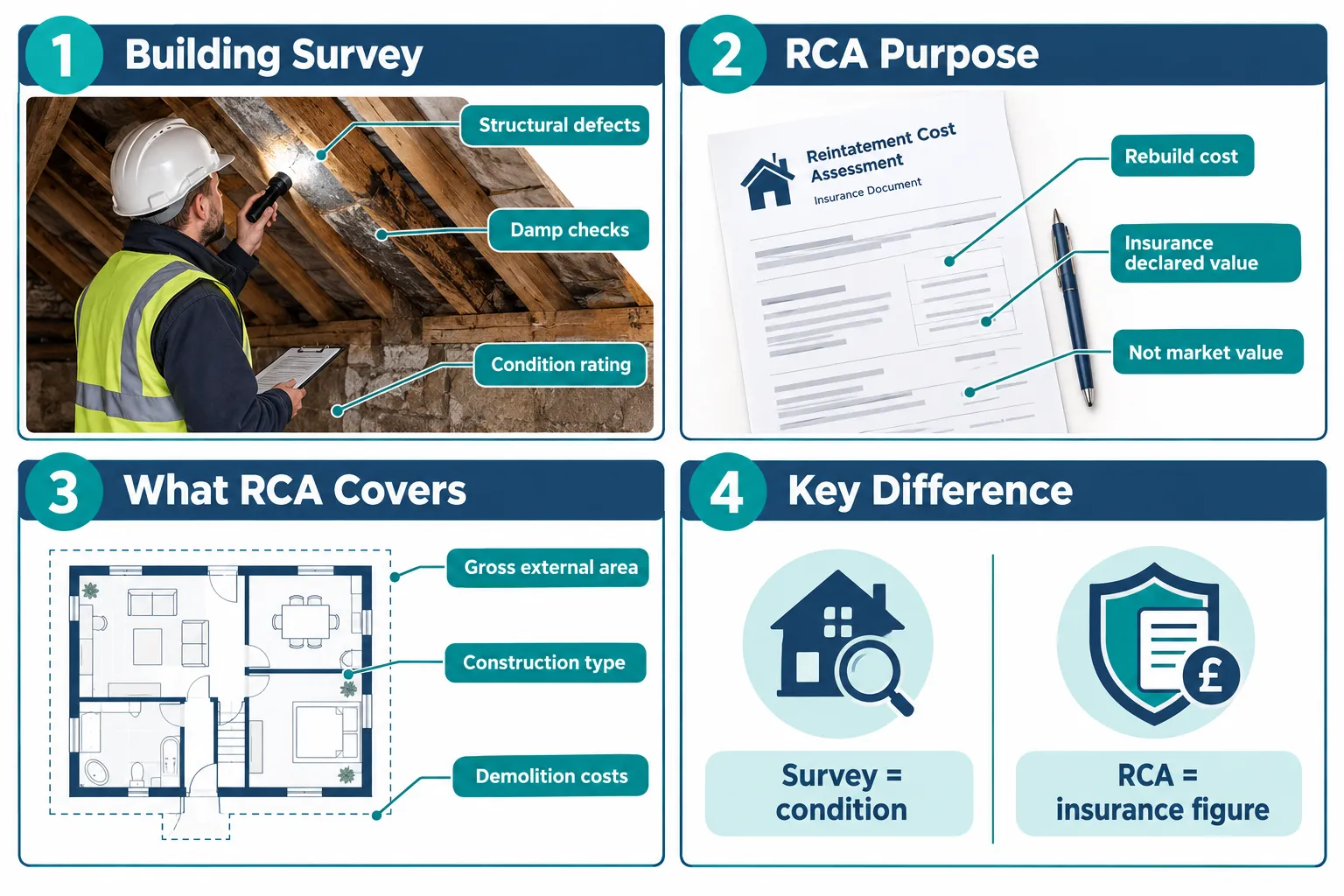
What it does not do is calculate how much it would cost to demolish the building and rebuild it to its current specification from the ground up. That figure, the reinstatement cost, is what insurers use to set the declared value on a buildings policy. The two exercises draw on entirely different data sets and professional disciplines [1].
A building surveyor inspecting a Victorian terrace will note damp penetration, failed pointing, and a sagging roof slope. Those findings are critical for negotiation and repair planning. But they say nothing about the cost per square metre to reconstruct that terrace using period-appropriate lime mortar, reclaimed slate, and specialist joinery, all of which drive the insurance rebuild figure.
The core distinction:
| Building Survey | Reinstatement Cost Assessment |
|---|---|
| Reports on condition and defects | Calculates rebuild cost for insurance |
| Informs purchase or maintenance decisions | Sets the declared value on a buildings policy |
| Covers visible and accessible elements | Covers gross external area, spec, and demolition |
| Produced by a building surveyor | Produced by a chartered surveyor or cost consultant |
| Not a substitute for insurance valuation | The authoritative basis for insurance cover [1] |
Why a Building Survey Alone Is Not Enough for Insurance
Professional bodies are explicit on this point. RICS standards confirm that an RCA is a distinct professional service that must be instructed specifically, it cannot be assumed to form part of a standard building survey instruction [1][4]. The scope, methodology, and output of the two services are different.
A buildings insurance policy requires an accurate declared value. If that value is set too low, whether because it was based on an online calculator, an outdated estimate, or a misreading of what a building survey provides, the insurer may apply average (proportional reduction) to any claim. Under the principle of average, a property insured for 60% of its true rebuild cost may receive only 60% of a valid claim, regardless of the policy limit [9].
"The reinstatement cost is not the market value, the purchase price, or the rateable value. It is a specialist calculation that accounts for construction costs, professional fees, demolition, and site clearance, and it changes as build costs change." [5]
Government guidance is equally clear that rating cost guides and asset cost tools are not suitable substitutes for a professionally conducted RCA [7]. The BCIS (Building Cost Information Service) publishes rebuild cost indices that inform professional RCAs, but those indices require professional interpretation and application to a specific property, they are not a self-service tool for setting insurance values [8].
Should You Get a Reinstatement Cost Assessment After a Building Survey? The Key Triggers
The question of whether you should get a reinstatement cost assessment after a building survey is best answered by looking at the specific circumstances that make an RCA not just advisable but essential.
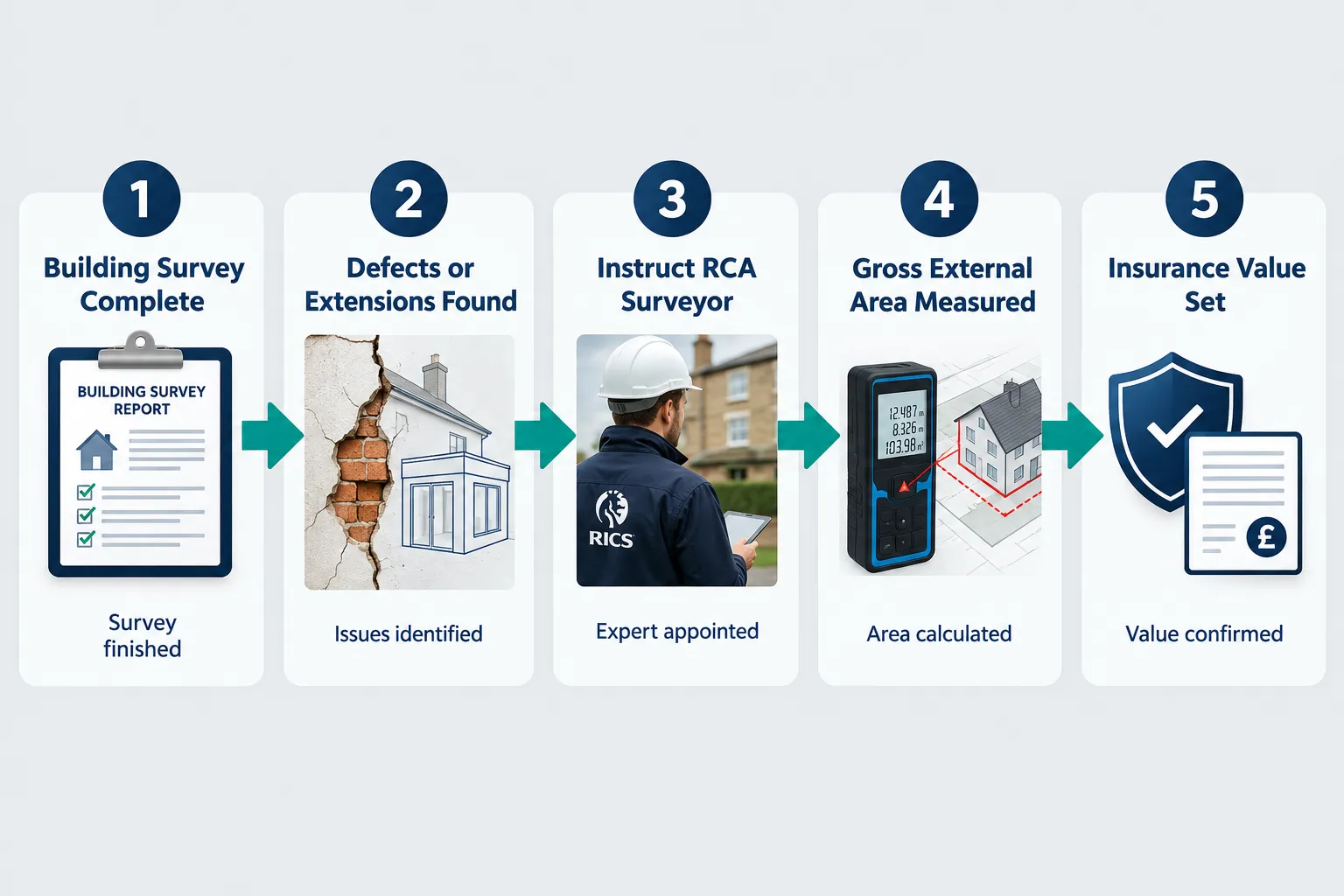
After a Survey Reveals Significant Defects
When a building survey identifies major structural issues, subsidence, roof failure, extensive damp, or fire damage, the cost to repair those elements forms part of the rebuild calculation. A property with known structural vulnerabilities may require specialist construction techniques, which increase rebuild costs above standard rates. An RCA commissioned after a survey that flags serious defects ensures the insurance figure reflects the true complexity of the building [3].
After an Extension or Major Refurbishment
Extensions, loft conversions, basement excavations, and significant internal reconfigurations all change the gross external area and specification of a building. Each of these changes the rebuild cost. Many homeowners update their market value estimate after works but forget to update their insurance declared value. Building renovations of any material scale should trigger a fresh RCA [3][10].
When Purchasing a Non-Standard Property
Period properties, listed buildings, properties with unusual construction materials (thatched roofs, timber frames, stone walls), and large detached houses all carry rebuild costs that diverge significantly from standard BCIS rates. For these property types, a generic online calculator is especially unreliable. A professional RCA is the only appropriate basis for insurance [4].
For Landlords and Block Managers
Landlords and block managers carry a specific duty to ensure that buildings insurance cover is adequate. For a block of flats, the consequences of underinsurance fall on all leaseholders. RICS guidance and lease terms frequently require that declared values are based on a professional RCA, reviewed at regular intervals [1][2]. After any survey of a managed block, whether a property assessment or a full structural review, an RCA review should be a standard follow-up step.
When the Last RCA Is More Than Three Years Old
Professional guidance recommends that RCAs are reviewed at least every three to five years as a minimum [3]. In a period of elevated construction cost inflation, and 2026 data from BCIS and industry sources confirm that rebuild costs remain significantly above pre-2020 levels, even a three-year-old RCA may materially understate current costs [6]. If a building survey has just been completed and the last RCA predates it by several years, commissioning a fresh assessment is strongly advisable.
How a Reinstatement Cost Assessment Is Conducted
Understanding the process helps property owners appreciate why it requires a separate instruction and a specialist approach.
A qualified surveyor or cost consultant will:
- Measure the gross external area (GEA) of the building, including all floors, outbuildings, and attached structures.
- Assess the construction specification, including materials, structural form, age, and any non-standard features.
- Apply current BCIS rebuild cost rates, adjusted for location, property type, and specification [8].
- Add allowances for demolition and site clearance, professional fees (architects, structural engineers, planning consultants), and VAT where applicable.
- Produce a formal written report stating the reinstatement cost, the methodology used, and the date of assessment.
The output is a specific figure, the declared value, which the property owner provides to their insurer. This figure is not the market value, not the purchase price, and not the rateable value. It is the cost to rebuild the property in its current form, from scratch, at today's construction prices [5][9].
RICS has maintained an authoritative professional standard for RCAs, most recently updated in its third edition guidance, which sets out the expected methodology, scope, and professional competencies required [4]. Surveyors conducting RCAs are expected to follow this standard, and instructing parties should confirm that their chosen professional operates within it [1].
The Cost of Getting It Wrong: Underinsurance in 2026
Expert commentary in 2026 has highlighted that underinsurance remains a widespread and growing problem across both residential and commercial property sectors [6]. The combination of post-pandemic supply chain disruption, labour cost increases, and ongoing material price inflation has pushed rebuild costs well above the figures that many older insurance policies reflect.
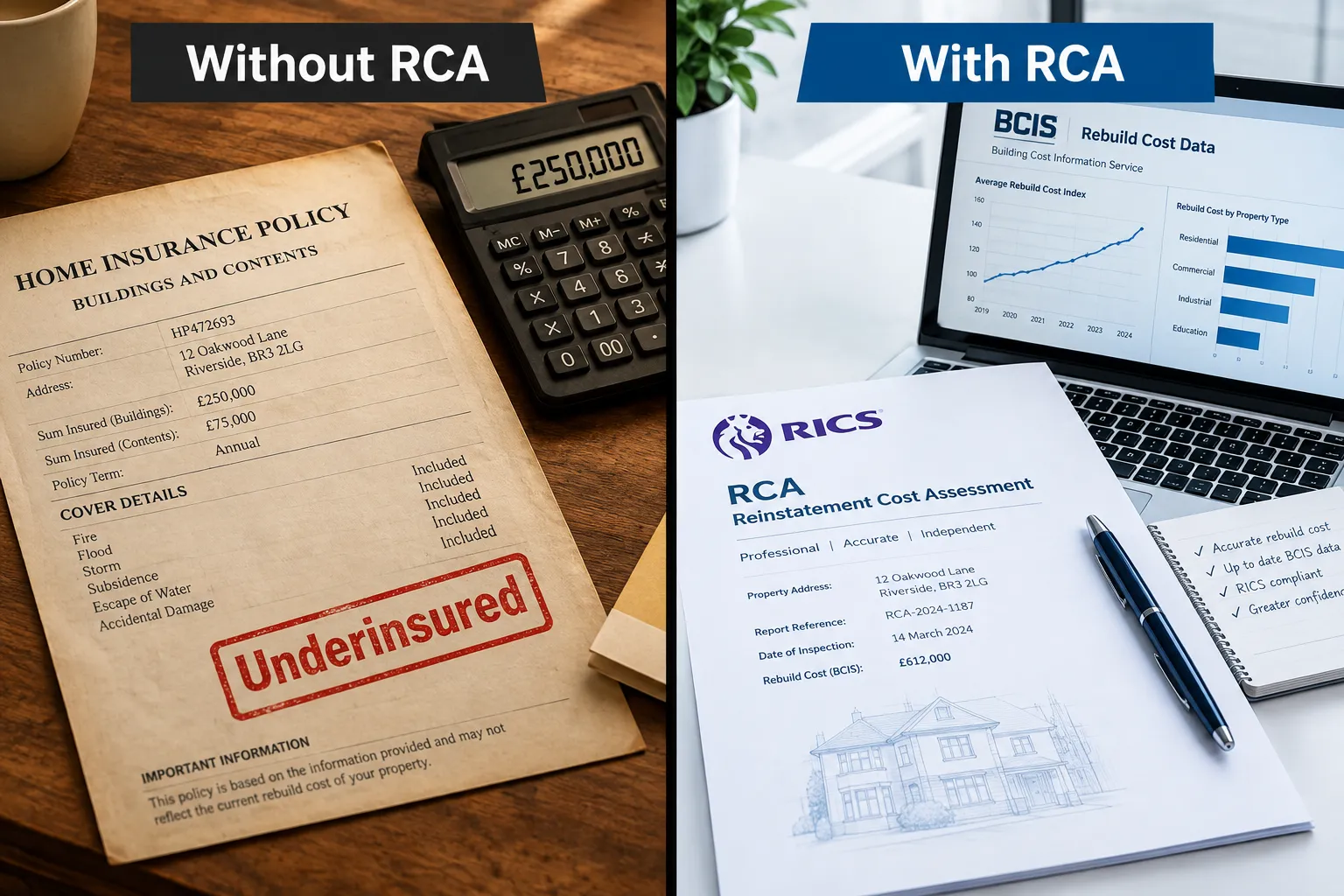
A property insured on the basis of a five-year-old RCA, or worse, an online calculator estimate, may be carrying a declared value that is 20-30% below the actual current rebuild cost. In a total loss scenario, fire, flood, or structural collapse, that gap translates directly into an out-of-pocket shortfall for the owner.
The financial exposure is not limited to total loss events. Even partial claims, replacing a roof, rebuilding a damaged extension, reinstating fire-damaged interiors, can trigger the average clause if the declared value is materially below the true reinstatement cost [9].
Common sources of underinsurance:
- Using the purchase price or market value as the insurance figure
- Relying on a mortgage lender's valuation (which is a market value, not a rebuild cost)
- Using an online rebuild cost calculator without professional adjustment
- Failing to update the declared value after extensions or refurbishments
- Allowing an RCA to become outdated without review
The cost of a standalone RCA from a qualified surveyor is typically modest, often a few hundred pounds for a standard residential property, rising for larger or more complex buildings [10]. Set against the potential shortfall in a major claim, the investment is straightforward to justify.
Choosing the Right Professional for an RCA
Not every building surveyor automatically offers RCAs as part of their standard service. When commissioning a building survey, it is worth asking explicitly whether the surveyor also provides reinstatement cost assessments, or whether a separate instruction to a cost consultant or specialist valuer is required.
Key questions to ask:
- Is the surveyor a RICS member and familiar with the current RCA professional standard?
- Will the assessment be based on current BCIS rebuild cost data?
- Does the report clearly state the gross external area, the methodology, and the date of assessment?
- Will the surveyor flag any non-standard construction features that affect the rebuild cost?
For first-time buyers, understanding the full range of professional services available, from structural surveys through to insurance valuations, is an important part of the buying process. First-time buyer building surveys often focus on condition, but the insurance question deserves equal attention from day one of ownership.
For landlords and those managing commercial property, the role of a chartered surveyor extends well beyond condition reporting into insurance compliance, dilapidations, and declared value management, all areas where an RCA is a foundational document.
Conclusion
The answer to whether you should get a reinstatement cost assessment after a building survey is, in most cases, yes, and the circumstances in which it becomes urgent are clear. A building survey tells you what is wrong with a property. A reinstatement cost assessment tells your insurer what it would cost to rebuild it. These are different questions requiring different professional expertise, and one does not substitute for the other.
Actionable next steps:
- If a building survey has recently been completed and no RCA exists, or the last one is more than three years old, commission a fresh assessment before renewing or setting up buildings insurance.
- If the survey revealed defects, extensions, or non-standard construction, treat an RCA as an urgent follow-up, not an optional extra.
- Confirm that the professional conducting the RCA is RICS-qualified and working to current BCIS cost data.
- Review the declared value on any existing buildings policy against the RCA figure and update it if a gap exists.
- Set a calendar reminder to review the RCA every three years, or immediately after any material change to the building.
Underinsurance is a risk that is entirely avoidable. A professionally conducted reinstatement cost assessment, commissioned at the right time and reviewed regularly, is the most reliable way to ensure that buildings insurance cover reflects the true cost of rebuilding, not an outdated estimate that leaves a damaging gap at the moment it matters most.
References
[1] Reinstatement Cost Assessment Of Buildings – rics.org
[2] Reinstatement Insurance Valuation – community.rics.org
[3] Reinstatement Cost Assessment A Professional Guide To Building Insurance Valuations 2026 – winfieldssurveyors.co.uk
[4] Oct18 Reinstatement Cost Assessment Of Buildings 3rd Edition – rics.org
[5] Reinstatement Cost Assessment – build-estimate.com
[6] February 2026 Round Up – navah-consulting.co.uk
[7] Rating Cost Guide 2023 – gov.uk
[8] Help – crt.bcis.co.uk
[9] Reinstatement Cost Assessment Property Insurance Uk – housey.co.uk
[10] What Are Reinstatement Cost Assessments And How Are They Conducted – eddisons.com