

At the end of a commercial lease, disputes over the condition of a property account for some of the most costly and time-consuming conflicts in the UK property market. Dilapidations surveys for commercial properties represent the structured, professional mechanism through which those disputes are identified, quantified, and resolved. Whether the premises in question is a city-centre office suite, a high-street retail unit, or a mixed-use development, understanding how the dilapidations process works can mean the difference between a clean handover and years of expensive litigation.
This guide breaks down the dilapidations process from inspection through to settlement, explains the common liabilities that arise for both landlords and tenants, and outlines how qualified surveyors assess repair obligations at lease end.
Key Takeaways
- A dilapidations survey is a detailed inspection comparing a commercial property's condition against the tenant's lease obligations, typically commissioned 6 to 12 months before lease expiry.
- The RICS professional standard for dilapidations in England and Wales was reissued in February 2024, making its guidance binding on RICS members.
- Landlords face real risk of partial or total loss of dilapidations claims where tenants become insolvent, making early action essential.
- Commercial dilapidations survey costs typically range from around £500 for smaller properties to £5,000 or more for large or complex premises.
- Both landlords and tenants benefit from engaging a qualified building surveyor early, before lease expiry, to manage liability and negotiate effectively.
What Is a Dilapidations Survey and Why Does It Matter for Commercial Properties
A dilapidations survey is a formal, independent inspection of a commercial property carried out by a qualified building surveyor. Its purpose is to compare the actual condition of the building against the standard required by the lease. The resulting document, a Schedule of Dilapidations, lists every item of disrepair, reinstatement, legal compliance and decoration that falls short of the tenant's obligations [4].
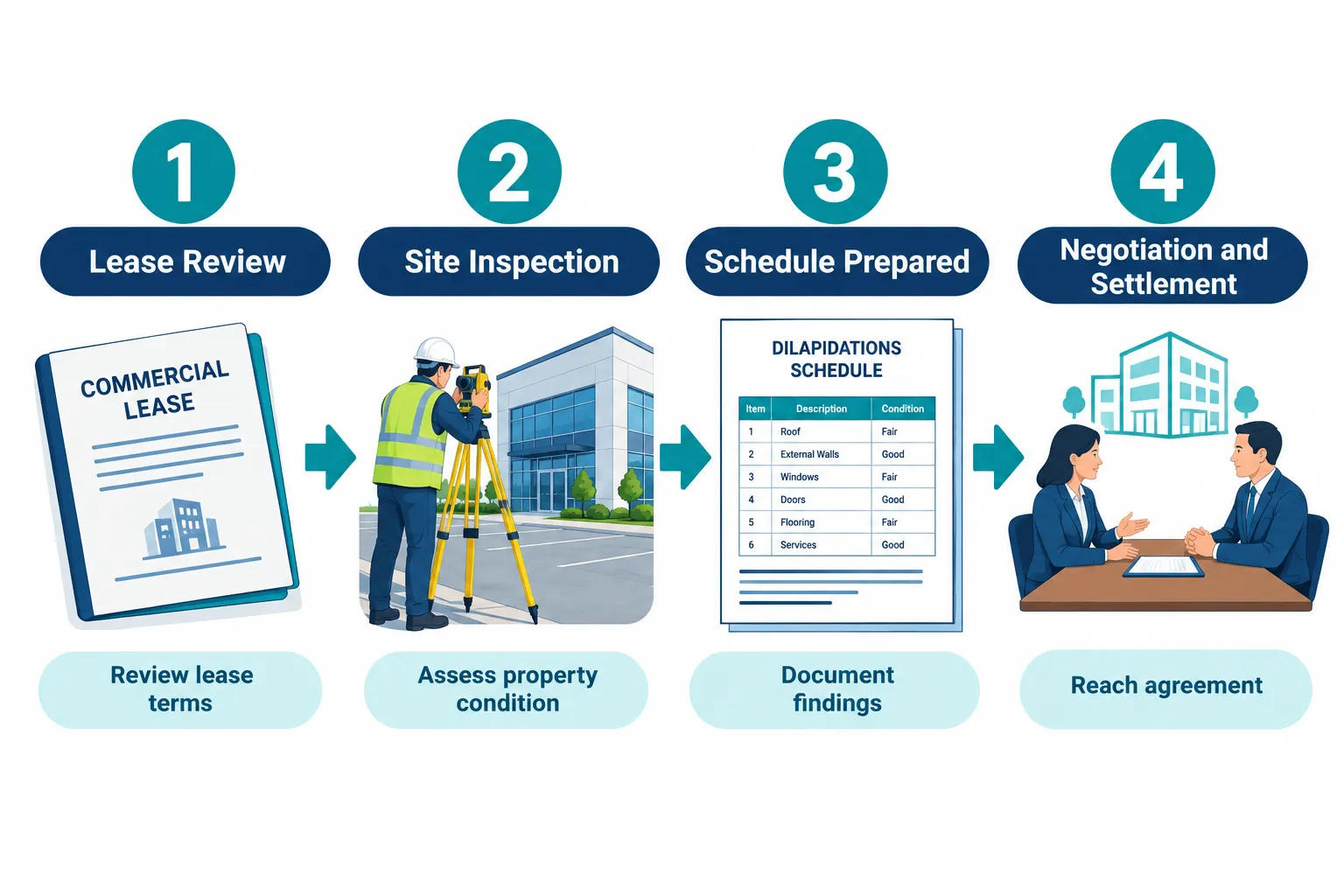
The survey matters because commercial leases routinely impose significant repairing obligations on tenants. At lease end, landlords are entitled to seek compensation or require works to restore the property to the condition specified in the lease. Without a professionally prepared survey, neither party has a reliable basis for negotiating a fair settlement.
The RICS professional standard "Dilapidations in England and Wales" was formally reissued on 29 February 2024, replacing the earlier guidance note format. This standard is now binding on RICS members as a matter of professional conduct and covers schedules of dilapidations, quantified demands, tenant responses, Scott Schedules and diminution valuations [4]. A parallel standard, "Dilapidations in Scotland (2nd edition)," was published on the same date, recognising that Scottish practice and law differ materially from England and Wales [8].
"Procedures and law described apply to commercial property in England and Wales. Other UK jurisdictions follow different rules.", RICS Consumer Guide on Dilapidations [4]
For landlords and tenants of office, retail, and mixed-use premises, understanding this framework is not optional, it is a commercial necessity.
The Dilapidations Process: From Lease to Settlement
When Should a Survey Be Commissioned
Timing is one of the most important practical decisions in the dilapidations process. Market guidance updated in 2026 recommends that landlords or tenants arrange a dilapidations survey between 6 and 12 months before lease expiry [7]. This window allows enough time to:
- Identify all potential liabilities before the tenant vacates
- Plan and price any remedial works
- Open negotiations without the pressure of an imminent handover deadline
- Avoid disputes about the condition of the property at the actual date of expiry
Commissioning a survey too late, or not at all, leaves both parties exposed. Landlords may miss items of disrepair that are harder to evidence once the tenant has left. Tenants may lose the opportunity to carry out cheaper remedial works themselves rather than paying the landlord's higher contractor rates.
For a broader understanding of how survey timing and scope affect property decisions, the guide on Delap Meaning: Dilapidation Surveys and Costs Explained provides useful context on the survey process and associated costs.
What a Dilapidations Survey Covers
A modern commercial dilapidations survey is a detailed, independent inspection that examines the building systematically against the lease obligations [7]. The key areas assessed typically include:
| Area of Inspection | Examples of Items Assessed |
|---|---|
| Structural integrity | Walls, roof structure, floors, foundations |
| Internal fit-out | Partitioning, ceilings, floor finishes, internal doors |
| Building services | Heating, ventilation, air conditioning, plumbing, electrical systems |
| External elements | Windows, external doors, drainage, car parking surfaces |
| Tenant alterations | Unauthorised works, reinstatement obligations |
| Decoration | Internal and external redecoration requirements |
The surveyor produces a written and photographic record of every defect. This record underpins either a programme of reinstatement works or a financial claim by the landlord [7].
The Schedule of Dilapidations Explained
The Schedule of Dilapidations is the central document in any commercial dilapidations dispute. It is prepared by the landlord's surveyor and sets out:
- Each item of disrepair or breach of the lease covenant
- The remedial works required to address each item
- Estimated costs for those works
The tenant's surveyor then responds, typically with a counter-schedule or a Scott Schedule, a tabular document setting out the parties' respective positions on each item side by side. This format is widely used in negotiations and, where disputes proceed to tribunal, provides a clear record of the areas of agreement and disagreement [4].
Common Liabilities: What Landlords and Tenants Need to Know About Dilapidations Surveys for Commercial Properties
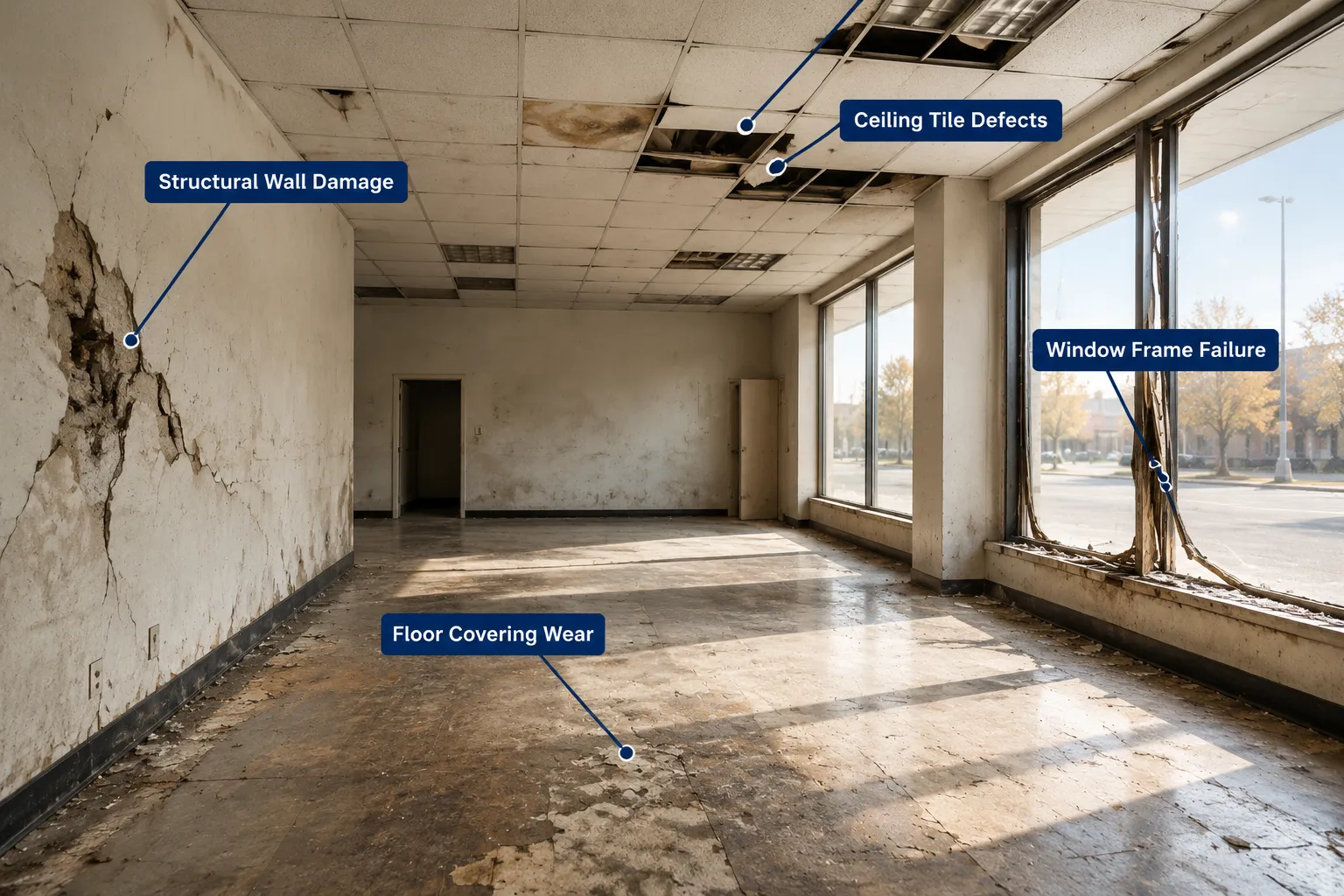
Understanding the most common sources of liability helps both parties prepare effectively. The following categories account for the majority of dilapidations claims across office, retail, and mixed-use commercial premises.
Repairing Obligations
Most commercial leases impose a full repairing and insuring (FRI) obligation on the tenant. This means the tenant is responsible for keeping the entire property, including the structure, in good repair throughout the lease term, not just at the end. Common items arising under repairing covenants include:
- Roof defects, including failed flashings and blocked gutters
- Cracked or damaged external masonry
- Defective windows and external doors
- Internal floor and ceiling damage
- Failed building services, including heating and ventilation plant
Reinstatement of Tenant Alterations
Where a tenant has carried out alterations during the lease, installing partitioning, adding a mezzanine floor, or fitting specialist retail equipment, the lease will often require those alterations to be removed and the property reinstated to its original condition at lease end. Failure to reinstate is one of the most frequently disputed areas in commercial dilapidations [7].
Decoration Covenants
Most leases require the tenant to redecorate internal and external surfaces at specified intervals and at lease end. Decoration claims are often significant in retail and hospitality premises, where the standard of finish expected is high.
Legal Compliance
Where a property has fallen out of compliance with statutory requirements during the tenancy, for example, fire safety systems that have not been maintained or updated, the landlord may include compliance items in the Schedule of Dilapidations.
The Diminution Cap
A critical protection for tenants is the Section 18(1) cap under the Landlord and Tenant Act 1927. This limits the landlord's claim to the diminution in the value of the landlord's reversion caused by the disrepair, in other words, the actual financial loss to the landlord, not simply the cost of works. Where a landlord intends to redevelop or significantly alter the property after the lease ends, the diminution cap can substantially reduce the recoverable claim [1][2].
Surveyors on both sides must therefore consider not only the cost of remedial works but also the effect of any planned redevelopment on the landlord's actual loss. This is where a diminution valuation, a formal assessment of the reduction in property value, becomes essential.
For situations where a formal property valuation is required as part of a dilapidations or lease-end process, understanding when a Red Book valuation is needed can be relevant to both landlords and their surveyors.
Key Risks for Landlords and Tenants in 2026
Tenant Insolvency and Dilapidations Recovery
Rising tenant insolvency levels present a serious and growing risk for landlords. Legal analysis published in 2025 warns that where a tenant becomes insolvent, dilapidations claims may be only partly recoverable or not recoverable at all [6]. Options available to landlords include:
- Seeking court orders for specific performance of repairing obligations during the lease term
- Enforcing security deposits or guarantees
- Taking action against former guarantors
The key lesson is that early action matters. Landlords who wait until lease expiry to address dilapidations are most exposed when tenant financial failure is a realistic risk. Careful lease drafting, including robust rent deposit and guarantee provisions, is the first line of defence [6].
Accounting for Dilapidations Liabilities
Under modern lease accounting standards, dilapidations provisions are often recognised at the outset of the lease as part of the right-of-use asset and lease liability on the balance sheet [10]. This means that for tenants subject to these accounting standards, the financial impact of dilapidations is not simply a lease-end concern, it affects financial reporting from day one.
RICS guidance also advises that reinstatement cost assessments should be updated at least every three years, reinforcing the need for regular review of repair obligations and potential dilapidations exposure throughout the lease term [10].
Sectoral Differences in Settlement Outcomes
Data from Hollis, covering more than 1,500 dilapidations instructions, highlights that average settlement levels vary significantly by property sector [9]. Office, industrial, and retail premises each present different negotiating dynamics. Market conditions, the age and specification of the building, and the extent of tenant alterations all influence the proportion of the landlord's initial claim that is ultimately recovered.
This underlines the importance of instructing a surveyor with specific experience in the relevant property sector, rather than treating all commercial dilapidations claims as interchangeable.
How Surveyors Assess Repair Obligations: A Practical Guide for Landlords and Tenants Navigating Dilapidations Surveys for Commercial Properties

The Role of the RICS Professional Standard
The RICS professional standard reissued in February 2024 sets the framework within which all RICS-registered surveyors must operate when handling dilapidations matters [4]. Practitioners are expected to work to the edition in force at the time of instruction. The standard provides guidance on:
- Preparing schedules of dilapidations
- Issuing and responding to quantified demands
- Conducting negotiations
- Providing expert evidence in tribunal proceedings
The RICS UK and Ireland Dilapidations Conference, most recently held at County Hall, London, concluded on 19 March 2026, offering practitioners updates on case law, valuation issues and negotiation strategies [3]. This annual event signals that the field continues to evolve, and both landlords and tenants should expect ongoing refinement of practice as new disputes and economic conditions emerge.
Choosing the Right Surveyor
Not all building surveyors have equal experience in commercial dilapidations. When selecting a surveyor, landlords and tenants should look for:
- RICS membership and familiarity with the current professional standard
- Sector-specific experience, office, retail, or industrial as appropriate
- Experience in negotiation and dispute resolution, including Scott Schedules and expert witness work
- Local market knowledge, particularly for properties in areas with active redevelopment pipelines
For complex or high-value disputes, a surveyor with dilapidations expert witness experience may be essential if the matter proceeds to tribunal.
Survey Costs: What to Budget
Commercial dilapidations survey fees vary considerably depending on the size and complexity of the property [7]:
- Small to medium commercial properties: approximately £500 to £1,500
- Larger or more complex premises: approximately £2,000 to £5,000 or more
These figures reflect the surveyor's fee for the inspection and preparation of the schedule. They do not include the cost of any remedial works, legal fees, or the cost of a diminution valuation if one is required. For landlords and tenants planning their lease-end budgets, these costs should be factored in well in advance of the expiry date.
Related Surveying Considerations
Dilapidations surveys sit within a broader landscape of professional surveying services. Where a commercial property has structural concerns, understanding the scope of a full structural survey versus a homebuyers survey can help parties understand the depth of investigation available. Similarly, where works carried out by a tenant may have affected a shared wall, the obligations under the Party Wall Act may also be relevant, see what a party wall surveyor does and their duties for further detail.
For properties where subsidence or structural movement is suspected, a dilapidations survey may need to be supplemented by specialist investigation, the guide on what is subsidence, its signs and causes provides a useful reference for identifying when additional assessment is warranted.
Conclusion: Actionable Next Steps for Landlords and Tenants
Dilapidations surveys for commercial properties are not a bureaucratic formality, they are a financially significant process that determines who pays for what at the end of a lease. The stakes are high on both sides: landlords risk unrecovered losses if they act too late or instruct poorly, while tenants risk paying inflated claims if they fail to challenge schedules effectively.
For landlords:
- Commission a dilapidations survey at least 6 to 12 months before lease expiry
- Ensure the surveyor is RICS-registered and experienced in the relevant property sector
- Take early action where tenant insolvency is a concern, including enforcing guarantees and deposits
- Obtain a diminution valuation where redevelopment is planned, to understand the true recoverable claim
For tenants:
- Review the lease carefully at the outset and maintain records of the property's condition throughout the term
- Obtain consent for alterations in writing and keep records of any reinstatement obligations
- Instruct an independent surveyor to review any Schedule of Dilapidations received from the landlord
- Consider carrying out remedial works before lease expiry rather than accepting a cash settlement, which may be more expensive
Both parties benefit from engaging qualified professionals early, understanding the RICS framework that governs the process, and approaching negotiations with a clear, evidence-based position. The dilapidations process rewards preparation and penalises delay.
References
[1] Dilapidations Reviewing The 7th Edition – isurv.com
[2] September 2016 Dilapidations In England And Wales 7th Edition – rics.org
[3] Building Surveying Standards – rics.org
[4] Dilapidations In England And Wales – rics.org
[6] Dilapidations Claims At Risk As Tenant Insolvency Rises – charlesrussellspeechlys.com
[7] What Is A Dilapidation Survey – jarvale.co.uk
[8] Dilapidations In Scotland – rics.org
[9] Dilapidationsin2025theclockisticking – hollisglobal.com
[10] Taken Into Account – ww3.rics.org