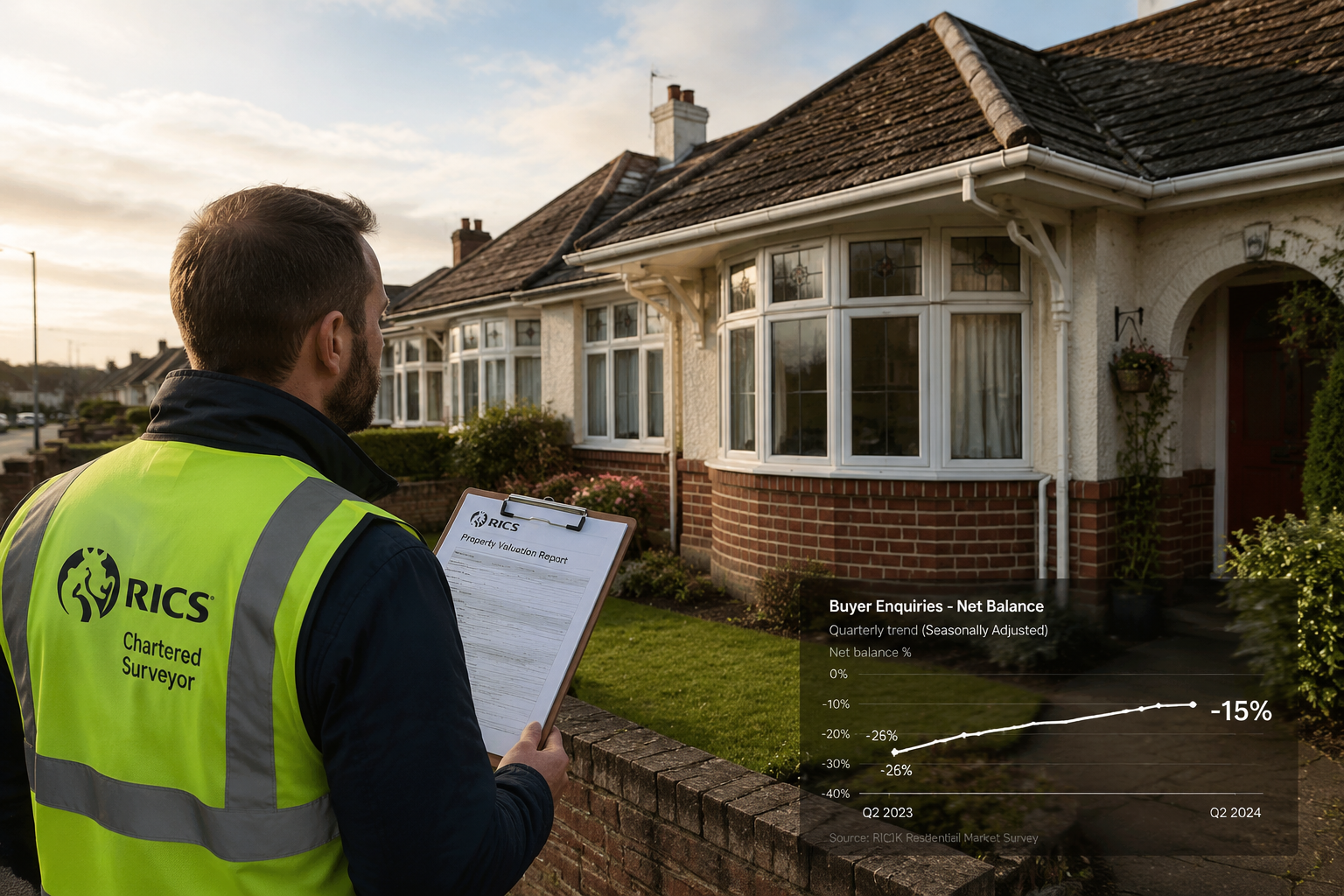
Buyer enquiries for bungalows have shifted from a net balance of -26% in February 2026 to an improving -15% by mid-year, a movement that RICS member surveyors describe as one of the most technically demanding valuation challenges in the current residential market. Valuing Bungalows in 2026 Buyer Uptick: Surveyor Insights from RICS Member Feedback reveals a nuanced picture: demand is recovering, but the structural complexity and demographic specificity of bungalows mean that standard valuation approaches frequently fall short. This article draws directly on RICS survey data and member respondent notes to explain why bungalows require specialist treatment, what methods are proving most reliable, and what buyers and sellers should expect from a professional valuation in 2026.
Key Takeaways
- Bungalow buyer enquiries are recovering in 2026, moving toward a net balance of -15%, but remain below pre-2024 levels.
- RICS member feedback consistently flags roof spread, subsidence, and rising damp as the primary structural risks that affect bungalow valuations.
- Regional divergence is significant: Northern England and Scotland show stronger bungalow demand than London and the South East.
- Level 3 building surveys are strongly recommended by RICS for bungalows built before 1990 or those with extensions.
- Energy efficiency ratings (EPC) are now a measurable value driver, with upgraded bungalows commanding premiums in cautious 2026 markets.
Why Bungalow Valuation Demands Specialist Expertise in 2026
Bungalows account for approximately 9% of UK housing stock, yet they generate a disproportionate share of surveyor queries and valuation disputes [7]. The reasons are structural, demographic, and market-driven all at once.
Unlike two-storey properties, bungalows concentrate all living space on a single floor. This creates a larger footprint relative to internal area, which has direct implications for land value calculations. It also means the roof structure covers the entire habitable space, making any defect in the roof spread, ridge, or rafter system immediately significant to the overall valuation.
RICS member respondents in 2026 have noted that automated valuation models (AVMs) are particularly unreliable for bungalows. During periods of market volatility, AVMs struggle to capture nuanced market realities [2], and bungalows present precisely the kind of nuance that algorithms miss: irregular plot ratios, single-storey premium in retirement-oriented locations, and condition-sensitive pricing that varies sharply by decade of construction.
For buyers seeking clarity before committing, understanding which home survey is right for you is an essential first step, particularly given the structural complexity that bungalows present.
The Demographic Factor Driving 2026 Demand
Bungalows attract a specific buyer profile: older purchasers, those with mobility considerations, and downsizers releasing equity from larger family homes. This demographic concentration means that bungalow demand is partly insulated from the interest-rate sensitivity that affects first-time buyer activity. RICS respondents in early 2026 noted that even as national new buyer enquiries fell to a net balance of -26% in February [2], bungalow-specific enquiries in suburban and semi-rural locations held up comparatively well.
The medium-term outlook adds further context. A net balance of +43% of surveyors anticipated price rises over the next 12 months as of January 2026, the strongest reading since February 2025 [4]. For bungalow valuers, this forward-looking confidence matters because it affects how comparable sales evidence is weighted when the transaction pool is thin.
Surveyor Insights from RICS Member Feedback on Valuation Methods
Valuing Bungalows in 2026 Buyer Uptick: Surveyor Insights from RICS Member Feedback points to a clear consensus among RICS members: the comparable sales method remains the primary tool, but it requires significant adjustment for bungalows due to limited transaction volumes and wide condition variance.
Comparable Sales: Adjustments That Matter
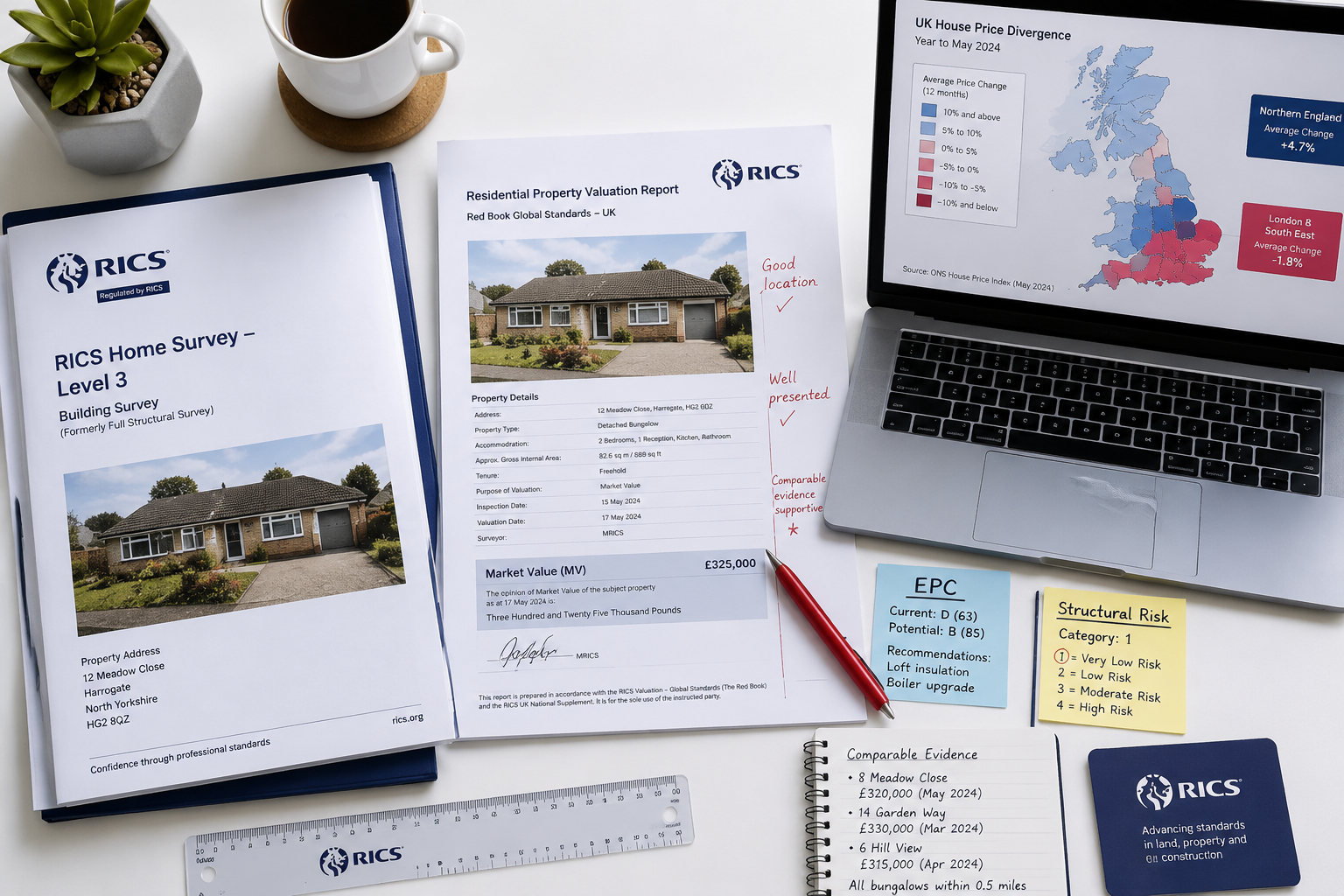
When applying the comparable sales approach to bungalows, RICS-accredited surveyors in 2026 are making the following standard adjustments:
| Adjustment Factor | Typical Impact on Value |
|---|---|
| Roof condition (spread or sagging) | -5% to -15% |
| EPC rating improvement (D to B) | +3% to +8% |
| Extended footprint without planning compliance | -8% to -20% |
| Proximity to retirement amenities | +4% to +10% |
| Subsidence history (resolved) | -10% to -18% |
| Modern kitchen/bathroom fit-out | +2% to +6% |
These figures are drawn from member feedback patterns and reflect the cautious market of early-to-mid 2026. The proportion of UK properties receiving lower-than-expected valuations fell by 65% between late 2025 and early 2026 [5], which suggests that the worst of downward pressure has passed. However, bungalows with unresolved structural issues still attract significant downward adjustments.
The Role of the Level 3 Survey
RICS guidance is explicit: bungalows built before 1990, or those with any extension, should receive a Level 3 building survey rather than a Level 2 homebuyer report [7]. The distinction matters for valuation because a Level 3 survey uncovers the kind of latent defects that directly affect market value.
The three most commonly flagged issues in RICS member feedback for bungalows are:
- Roof spread: Single-storey construction places the full load of a large roof on external walls. Without adequate restraint, rafters can push outward, causing wall bowing that is expensive to remediate.
- Subsidence: Bungalows often sit on shallow foundations. Garden trees, particularly willows and poplars, can cause soil shrinkage that leads to differential settlement. Surveyors working in areas with clay-heavy soils should be aware of how garden trees can cause subsidence and factor this into their inspection methodology.
- Rising damp: The single-storey format and often older damp-proof courses mean rising damp is more prevalent in bungalows than in post-war two-storey housing.
A thorough understanding of the homebuyers survey versus full structural survey distinction helps buyers make informed decisions before instructing a surveyor.
Regional Divergence and Its Valuation Implications
The April 2026 RICS UK Residential Market Survey confirmed that Northern England, Scotland, and Northern Ireland are outperforming other regions, while London, the South East, South West, and East Anglia continue to lag [3]. For bungalow valuers, this divergence is particularly sharp.
In London and the South East, bungalows compete directly with flats and terraced houses for land value. The premium that a bungalow commands in a Northern market for its single-storey lifestyle appeal may be partially offset in London by the higher opportunity cost of the plot. Surveyors working across London property markets need to apply regionally calibrated adjustments rather than relying on national averages.
In outer London boroughs such as Harrow and Bromley, where bungalow stock is more prevalent and the buyer demographic skews older, the lifestyle premium can be meaningful. RICS respondents from these areas noted that well-maintained bungalows with level access and good EPC ratings were attracting multiple offers even in the cautious Q1 2026 market.
Structural Risks, EPC Ratings, and the 2026 Valuation Framework
Valuing Bungalows in 2026 Buyer Uptick: Surveyor Insights from RICS Member Feedback would be incomplete without addressing the two forces that are reshaping bungalow valuations most significantly in 2026: structural risk disclosure and energy efficiency.
Structural Risk Disclosure in Practice
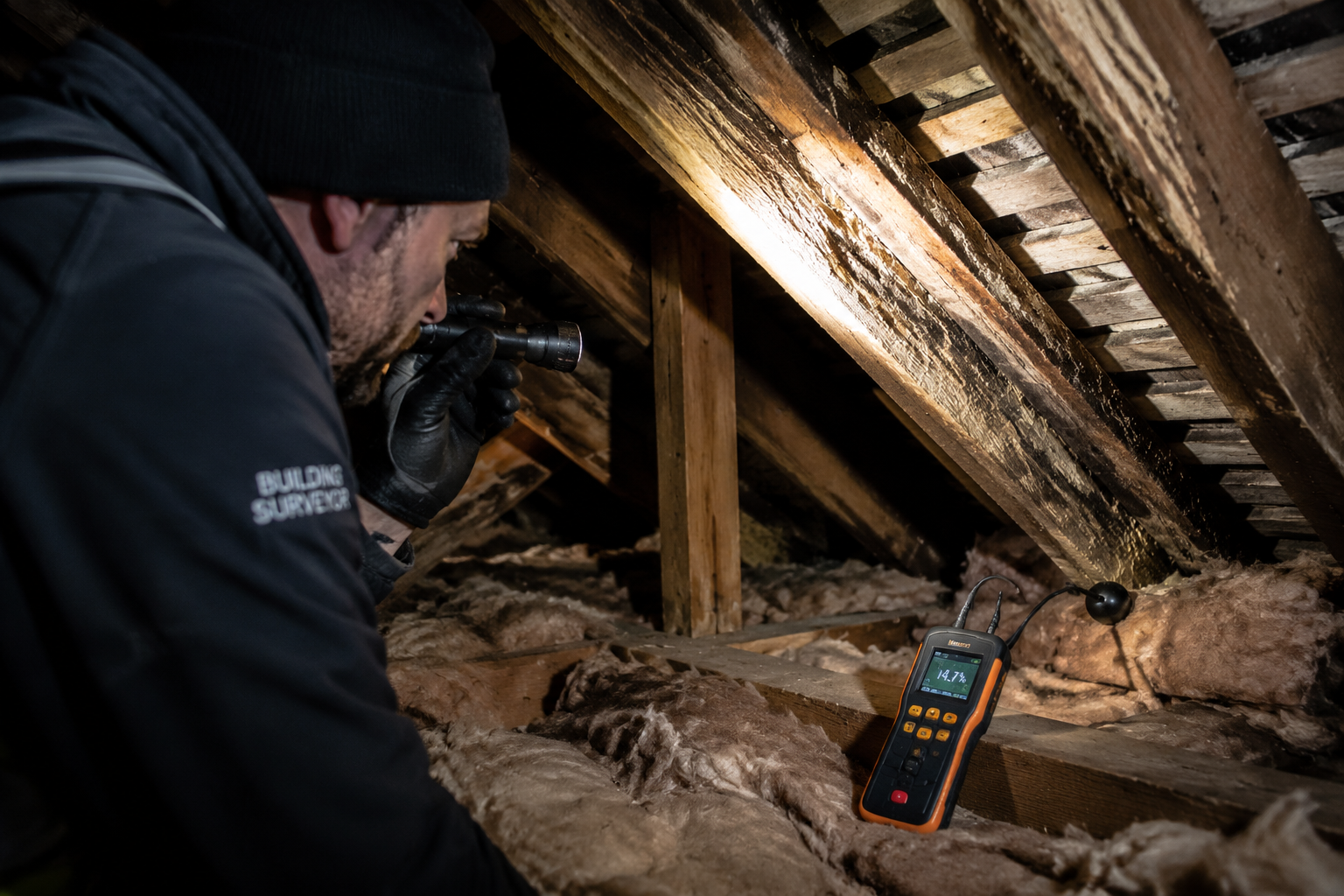
RICS emphasises that accurate residential property valuations are vital for a healthy property market and a stable economy [8]. For bungalows, this means surveyors cannot rely on visual inspections alone. Member feedback from 2026 highlights an increasing use of:
- Moisture meters to identify rising damp behind wall finishes
- Crack monitoring gauges to assess whether subsidence is active or historic
- Loft inspections as a non-negotiable element, given the frequency of roof spread in pre-1980 bungalows
- Drain surveys where the property is older than 40 years, as collapsed clay drainage is a common hidden cost
When a survey returns adverse findings, buyers need a clear strategy. Understanding what to do after a bad report on a building survey is essential for negotiating a revised purchase price or requesting remediation before exchange.
Energy Efficiency as a Value Driver
In cautious 2026 markets, properties with energy efficiency upgrades are better positioned for both current buyers and future regulatory environments [6]. For bungalows, the EPC challenge is acute: large roof areas relative to floor space mean heat loss is proportionally higher than in multi-storey properties.
RICS member respondents note that bungalows with:
- Upgraded loft insulation (minimum 270mm depth)
- Double or triple glazing throughout
- Air source heat pumps replacing oil or LPG boilers
- Solar PV panels on south-facing roof pitches
…are achieving measurable premiums over comparable properties with EPC ratings of D or below. The valuation uplift is not uniform, but surveyors are now expected to quantify it rather than treat it as a qualitative footnote.
Surveyor note from RICS member feedback (2026): "Bungalows with EPC ratings of B or above are selling in an average of 18 fewer days than equivalent D-rated stock in our patch. That is a liquidity premium that has to be reflected in the valuation."
Market Stabilisation and What It Means for Bungalow Pricing
The RICS January 2026 survey reported a national net balance of -10%, indicating that more surveyors observed falling prices than rising ones, but this marks a clear improvement from the deeper declines of mid-2023 [1]. For bungalow valuers, market stabilisation creates both opportunity and risk.
The opportunity: as the transaction pool begins to recover and buyer enquiries improve toward -15%, more recent comparable evidence becomes available. This reduces the need to rely on stale sales data from a weaker market, which had been artificially suppressing valuations.
The risk: a recovering market can create upward pressure on asking prices before transaction volumes fully recover. Surveyors must resist the temptation to chase asking prices and instead anchor valuations to verifiable comparable evidence, adjusted for the specific structural and energy characteristics of the subject bungalow.
Practical Valuation Checklist for Bungalows in 2026
RICS member feedback suggests the following checklist for surveyors and buyers approaching a bungalow transaction in 2026:
Pre-inspection:
- Confirm construction date and whether a Level 3 survey is appropriate
- Request planning history to identify any extensions or conversions
- Check Land Registry for any restrictive covenants affecting development potential
During inspection:
- Inspect loft space fully, noting rafter condition, insulation depth, and any signs of spread
- Test all accessible wall surfaces with a moisture meter
- Examine external walls for bowing, cracking, or repointing patterns that suggest movement
- Confirm EPC rating and identify which measures have been installed
Post-inspection valuation:
- Apply regional comparable evidence, not national averages
- Adjust for structural condition using the adjustment matrix above
- Quantify EPC premium or discount explicitly in the report
- Note any planning development potential that a developer buyer might price in
Conclusion
The improving buyer enquiry trend captured in Valuing Bungalows in 2026 Buyer Uptick: Surveyor Insights from RICS Member Feedback is a genuine signal of recovery, but it does not simplify the valuation task. If anything, a recovering market raises the stakes: buyers are more willing to compete, which means overpaying for a structurally compromised bungalow becomes a more likely outcome without rigorous professional oversight.
Actionable next steps for buyers:
- Always commission a Level 3 building survey for any bungalow built before 1990, regardless of apparent condition.
- Request that the surveyor explicitly addresses roof spread, rising damp, and subsidence risk in their report.
- Ask for a quantified EPC adjustment in the valuation, not a qualitative comment.
- Use regional comparable evidence when challenging or negotiating a valuation, and seek a chartered surveyor with demonstrable local knowledge.
- If the survey returns significant defects, do not withdraw automatically. Understand the remediation costs and negotiate accordingly.
For surveyors:
The RICS member feedback from 2026 is clear: bungalows reward methodical, evidence-based valuation practice. As buyer enquiries recover and transaction volumes increase, the temptation to shortcut the inspection process will grow. Resisting that temptation, and applying the full structural and energy efficiency framework outlined above, is what separates a defensible valuation from one that creates liability.
Buyers and surveyors operating in Barnet, Enfield, and other outer London boroughs with significant bungalow stock should treat 2026 as a year to establish rigorous valuation standards, not to relax them in the face of improving sentiment.
References
[1] Valuing Stabilised National Prices In Early 2026 Rics Techniques From January Survey Insights – https://kingstonsurveyors.com/valuing-stabilised-national-prices-in-early-2026-rics-techniques-from-january-survey-insights/?utm_source=openai
[2] Defending Surveyor Valuations Against Avms In Cautious Q2 2026 Markets Rics Insights From February Residential Survey – https://wimbledonsurveyors.com/defending-surveyor-valuations-against-avms-in-cautious-q2-2026-markets-rics-insights-from-february-residential-survey/?utm_source=openai
[3] Uk Residential Survey April 2026 – https://www.rics.org/news-insights/uk-residential-survey-april-2026?utm_source=openai
[4] Uk Resi Survey Jan 2026 Report Shows Early Signs Market Recovery Despite Caution – https://www.rics.org/news-insights/uk-resi-survey-jan-2026-report-shows-early-signs-market-recovery-despite-caution?utm_source=openai
[5] Valuation Adjustments In Early 2026 Market Recovery Rics Survey Insights For Expert Witness Credibility – https://manchestersurveyors.com/valuation-adjustments-in-early-2026-market-recovery-rics-survey-insights-for-expert-witness-credibility/?utm_source=openai
[6] Valuing Energy Efficiency Upgrades In Cautious 2026 Markets Rics Insights On Buyer Demand Dip – https://manchestersurveyors.com/valuing-energy-efficiency-upgrades-in-cautious-2026-markets-rics-insights-on-buyer-demand-dip/?utm_source=openai
[7] Building Survey Checklists For Bungalow Purchases 2026 Rics Guidance On Structural Risks And Costs – https://nottinghillsurveyors.com/blog/building-survey-checklists-for-bungalow-purchases-2026-rics-guidance-on-structural-risks-and-costs?utm_source=openai
[8] Guide Residential Property Valuations – https://www.ricsfirms.com/residential/moving-home/buying/guide-residential-property-valuations/?utm_source=openai