
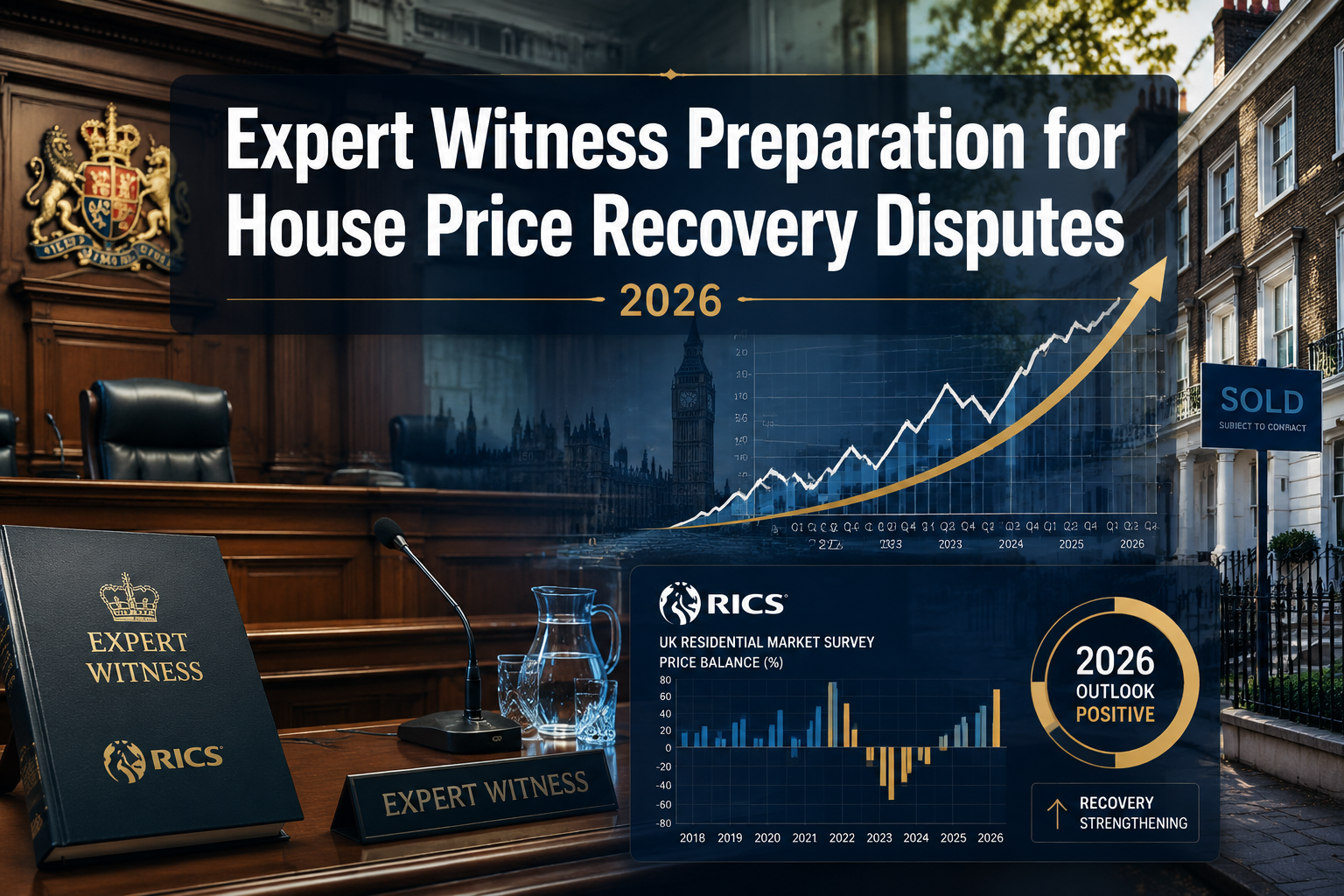
The RICS January 2026 Residential Market Survey recorded a net balance of +18 for house price expectations over the next twelve months — the strongest forward-looking reading since mid-2022 — yet the same report described the current recovery as "slow and uneven." [1] That tension between cautious optimism and fragile fundamentals is precisely where property disputes are born, and where expert witnesses must be most rigorous.
Expert Witness Preparation for House Price Recovery Disputes: Using RICS January 2026 Data has become a pressing professional concern for chartered surveyors in 2026. Courts and arbitration panels increasingly expect expert evidence to be grounded in independently published, reproducible market data rather than subjective professional opinion alone. The RICS survey, published monthly and freely accessible, provides exactly that kind of objective benchmark — but only if the expert knows how to deploy it correctly.
Key Takeaways
- The RICS January 2026 survey confirms early signs of house price recovery, but characterises it as slow and uneven — a distinction that materially affects valuation assumptions in dispute work.
- Net balance figures are the core analytical tool in RICS survey data; expert witnesses must understand how to read, contextualise, and present them to a court or tribunal.
- RICS professional standards for expert witnesses impose strict duties of independence and transparency; surveyors must comply with the current practice statement before accepting instructions.
- Corroborating the RICS data with independent sources such as Reuters economic reporting strengthens evidential weight and reduces the risk of challenge.
- Regional variation within the January 2026 data is significant; a national recovery narrative may not hold at the local level relevant to a specific dispute.
Understanding the RICS January 2026 Data in the Context of House Price Disputes
What the Net Balance Figure Actually Means
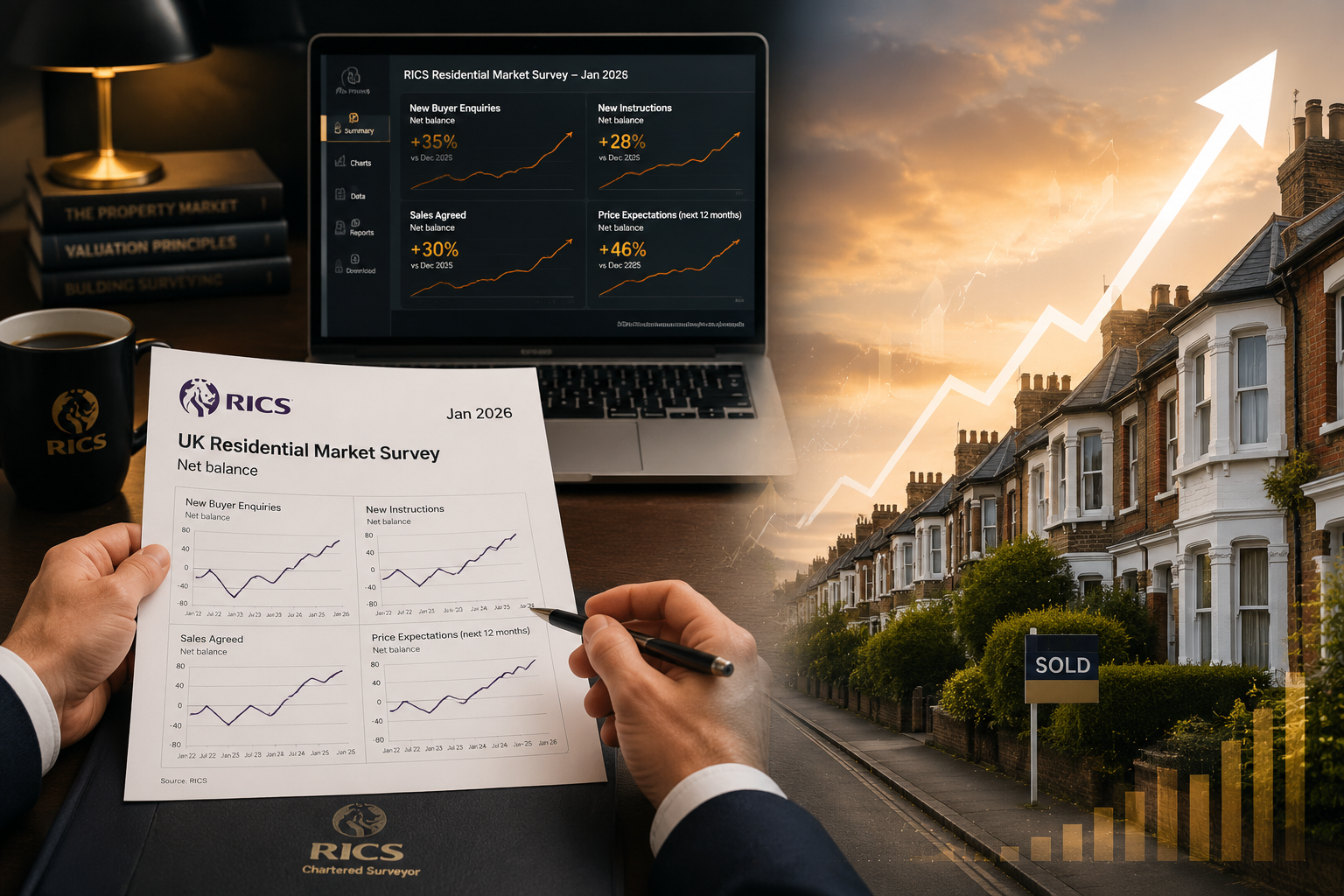
The RICS Residential Market Survey uses a net balance methodology. Surveyors across the UK report whether conditions have improved, worsened, or remained the same. The net balance is the percentage reporting improvement minus the percentage reporting deterioration. A positive figure signals more surveyors see prices rising than falling; a negative figure signals the reverse.
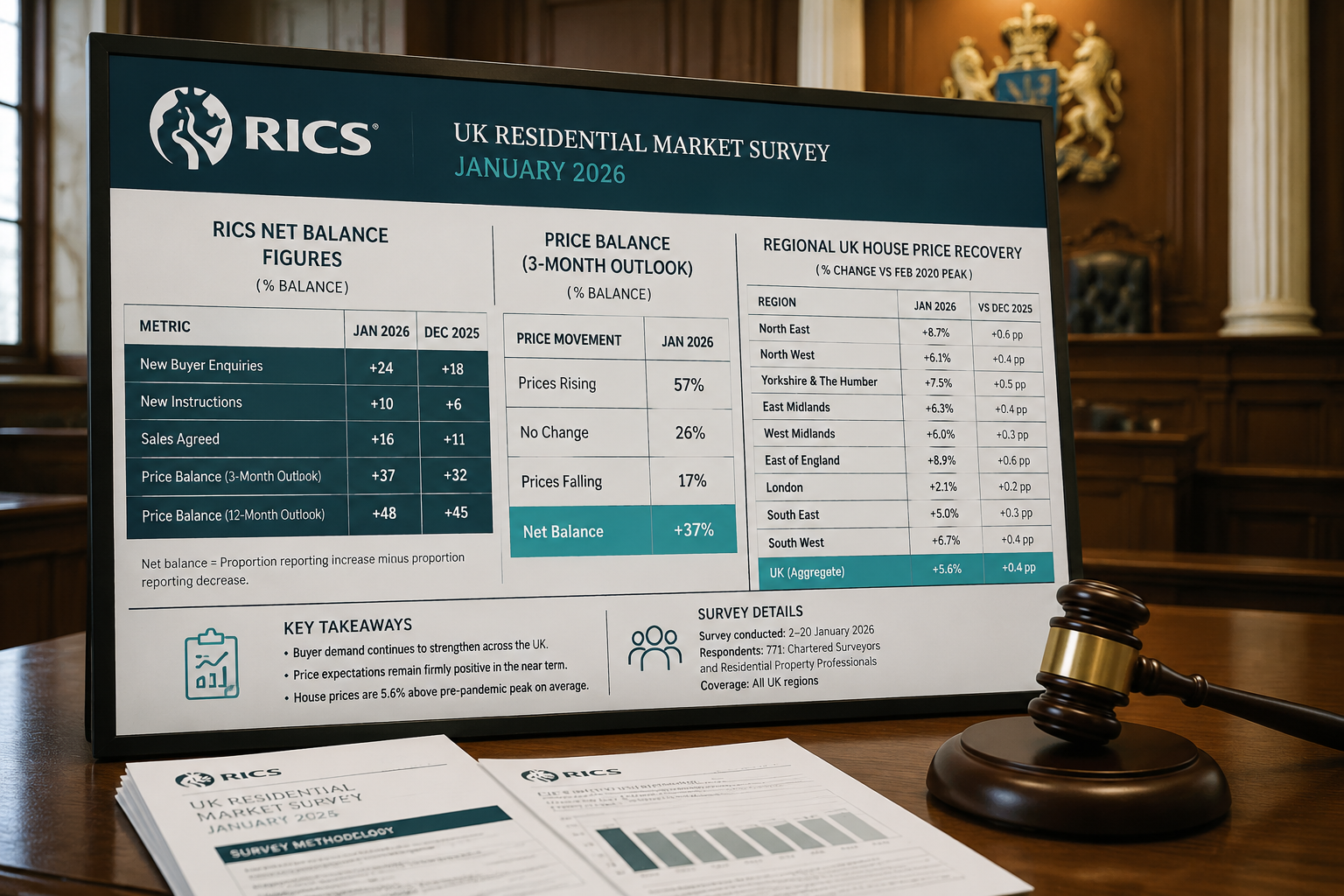
For January 2026, the headline price balance moved into positive territory, with a net balance suggesting modest but genuine upward pressure on values. [1] Reuters independently confirmed this reading, reporting that the UK housing market was showing early signs of recovery based on the same survey data. [2] Capital Economics, analysing the same release, described the trajectory as a "slow, uneven recovery" — cautioning against over-interpreting a single month's positive reading. [3]
Why this matters in dispute work: When a claimant argues that a property was undervalued at a specific point in time, or that a negligent valuation failed to account for an emerging recovery, the expert witness must be able to place that moment within the market cycle accurately. A net balance reading does not tell a court what a specific property is worth. It tells the court what direction the market was moving — and how confidently surveyors perceived that movement.
Regional Variation: A Critical Caveat
One of the most important — and most frequently overlooked — aspects of the RICS survey is its regional breakdown. The January 2026 data showed meaningful divergence between London and the South East, where activity indicators were firmer, and parts of the North and Midlands, where the recovery signal was weaker. [1]
This matters enormously for Expert Witness Preparation for House Price Recovery Disputes: Using RICS January 2026 Data. A dispute concerning a property in South West London, for example, cannot rely solely on a national net balance figure. The expert must drill into regional data and, where available, local comparable evidence to support any assertion about the direction or pace of price movement at the relevant date.
| Region | January 2026 Signal | Practical Implication for Expert Evidence |
|---|---|---|
| London and South East | Positive net balance, firmer activity | Stronger basis for recovery arguments |
| North West and Midlands | Neutral to marginally positive | Caution required; recovery less established |
| Scotland and Wales | Mixed signals | Requires additional local comparable data |
For surveyors covering specific London boroughs, RICS property valuations grounded in local comparable analysis remain the most defensible foundation for any expert report.
RICS Professional Standards for Expert Witnesses: The Compliance Framework
The Duty of the Expert Witness
Before turning to how data is used, the expert must understand the framework within which they operate. RICS publishes a professional practice statement — "Surveyors Acting as Expert Witnesses" — that sets out mandatory obligations. [6] The most recent amendment reinforces that the expert's overriding duty is to the court or tribunal, not to the instructing party. Independence is not optional; it is a professional and legal requirement.
RICS has also issued a specific practice alert on housing disrepair expert witness work, which, while focused on disrepair claims, articulates principles of evidence presentation and impartiality that apply broadly to any property dispute. [4] Surveyors should read both documents before accepting instructions in any contested valuation matter.
"The expert's duty to the court overrides any obligation to the person from whom the expert has received instructions or by whom the expert is paid." — RICS Professional Practice Statement [6]
RICS has also launched a global consultation on updating its expert witness standard, signalling that the framework is evolving and practitioners must stay current. [10] The Expert Witness Accreditation Service (EWAS) provides a formal route to demonstrating competence, and instructing solicitors increasingly request EWAS-accredited surveyors for high-value disputes. [5]
What Courts Expect from Valuation Evidence
Civil courts in England and Wales operate under the Civil Procedure Rules (CPR), Part 35, which governs expert evidence. The key requirements are:
- Independence: The report must represent the expert's genuine opinion, not an advocacy position.
- Transparency: The data sources, methodology, and any limitations must be disclosed.
- Reproducibility: Another qualified expert should be able to follow the reasoning and reach the same conclusion from the same data.
- Proportionality: The level of analysis must be proportionate to the value of the dispute.
The RICS January 2026 survey data satisfies the transparency and reproducibility criteria well. It is publicly available, independently compiled, and carries institutional authority. [1] The expert's job is to apply it correctly and honestly — including acknowledging where it does not support the case being advanced.
For surveyors involved in property disputes of any kind, understanding these procedural requirements is as important as the technical valuation skill itself.
Practical Steps for Expert Witness Preparation for House Price Recovery Disputes: Using RICS January 2026 Data
Step 1: Establish the Relevant Date
Every valuation dispute turns on a specific date — the date of the alleged negligent valuation, the date of a transaction, or the date of a relevant event. The expert must identify that date precisely and then locate the RICS survey data that was available at that time.
For disputes where the relevant date falls in early 2026, the January 2026 RICS survey is directly applicable. However, the expert should also reference the preceding months' data to demonstrate the trajectory of the market, not just a snapshot. Trading Economics maintains a historical record of the RICS House Price Balance, which allows experts to construct a credible time-series narrative. [9]
Step 2: Contextualise the Net Balance Within Broader Economic Commentary
A single survey figure, presented in isolation, is vulnerable to challenge. The expert should corroborate the RICS data with independent economic commentary. Reuters reported in February 2026 that the UK housing market was showing early signs of recovery, directly referencing the RICS survey. [2] Quiddity Group's analysis of the same data described rents rising alongside recovering prices, providing additional context for mixed-use or investment property disputes. [7]
This triangulation approach — RICS primary data, plus independent news coverage, plus economic analysis — creates a layered evidential foundation that is far more resistant to cross-examination than a single source.
Step 3: Apply the Data to the Specific Property Type and Location
The RICS survey covers the residential market broadly. The expert must bridge from the macro data to the specific property in dispute. This requires:
- Comparable sales analysis: Recent transactions in the same postcode or comparable area, adjusted for property type, condition, and date.
- RICS survey regional data: The relevant regional net balance, not just the national figure.
- Local market intelligence: Evidence from local agents, auction results, and mortgage lending data where available.
For properties in South West London, for example, a RICS HomeBuyer Survey conducted around the relevant date can itself serve as contemporaneous evidence of market conditions and property condition, provided it was prepared by a competent surveyor.
Step 4: Structure the Expert Report to Address the Recovery Narrative Directly
Where a dispute involves an argument that a valuer failed to anticipate or account for an emerging price recovery, the expert report must address this directly. The structure should:
- Set out the state of the market at the relevant date, using RICS net balance data.
- Explain what a reasonably competent valuer should have known at that date — not with hindsight, but based on information available at the time.
- Distinguish between a "slow, uneven recovery" (the January 2026 characterisation) [3] and a robust, sustained upswing. Courts are alert to hindsight bias, and the expert must be too.
- Quantify the impact on value, if any, with reference to comparable evidence.
The data analysis skills required for this work go beyond standard valuation practice. The expert must be comfortable presenting statistical concepts — net balances, confidence intervals, trend lines — to a lay tribunal in plain language.
Step 5: Prepare for Cross-Examination on the Data
Cross-examination in property disputes often targets the expert's data sources. Opposing counsel may argue that the RICS survey is a sentiment indicator rather than a hard price index, or that regional variation undermines the national narrative. The expert should be prepared to:
- Explain the methodology of the RICS survey clearly and without jargon.
- Acknowledge the limitations of net balance data as a valuation tool.
- Demonstrate why, despite those limitations, the survey remains a reliable and widely accepted market indicator.
- Distinguish the RICS data from other indices (Land Registry, Halifax, Nationwide) and explain why each source is or is not applicable to the specific dispute.
A house evaluation that relies on multiple independent data sources is inherently more defensible than one that depends on a single metric.
Common Pitfalls in Using RICS January 2026 Data for Dispute Work
Overstating the Recovery Signal
The January 2026 data is encouraging but explicitly qualified. RICS itself described the recovery as cautious, and Capital Economics reinforced the "slow and uneven" characterisation. [1][3] An expert who presents the data as evidence of a strong, broad-based recovery will face justified challenge. The honest position is that the data supports a modest, emerging recovery — and that the pace and extent varied significantly by region and property type.
Ignoring the Lag Between Survey and Transaction
RICS survey data reflects surveyor sentiment at a point in time. Actual transaction prices, as recorded by the Land Registry, typically lag by six to twelve weeks. An expert who conflates survey sentiment with completed transaction prices is making a methodological error that opposing counsel will exploit.
Failing to Address Counter-Evidence
If the opposing expert relies on different data — for example, a local comparable showing a price decline in the same period — the expert must engage with that evidence directly. Ignoring inconvenient data is a serious professional failing and will damage credibility with the tribunal.
Neglecting RICS Professional Standards
The RICS practice statement on expert witnesses is not optional guidance. [6] Surveyors who accept expert witness instructions without familiarising themselves with the current standards risk both professional sanction and adverse judicial comment. The EWAS accreditation process provides structured training that addresses these requirements. [5]
For surveyors who also provide RICS property valuations in a non-litigation context, it is important to maintain a clear distinction between the valuation role and the expert witness role. The duties and obligations differ materially.
Conclusion
The RICS January 2026 Residential Market Survey provides a credible, independently published, and institutionally authoritative benchmark for house price conditions at the start of 2026. For expert witnesses preparing evidence in house price recovery disputes, it is a valuable tool — but only when used with precision, honesty, and full awareness of its limitations.
Actionable next steps for surveyors preparing expert witness reports in 2026:
- Download and read the full RICS January 2026 survey report and the Capital Economics analysis to understand the nuances of the "slow, uneven recovery" characterisation before forming any opinion.
- Review the current RICS professional practice statement on surveyors acting as expert witnesses and the HDR practice alert to ensure full compliance with mandatory standards.
- Consider RICS Expert Witness Accreditation Service registration if not already accredited, particularly for high-value or complex disputes.
- Build a triangulated evidential base: RICS net balance data, independent economic commentary, regional data, and local comparable transactions.
- Structure the expert report to address the recovery narrative directly, distinguishing between what was knowable at the relevant date and what became apparent only with hindsight.
- Engage proactively with any counter-evidence in the report, rather than waiting for cross-examination to expose gaps.
The tension between an emerging recovery and persistent market caution is not a weakness in the evidential picture — it is the reality of the market in early 2026, and an expert who presents it honestly will be far more persuasive to any tribunal than one who oversimplifies it.
References
[1] UK Resi Survey Jan 2026 Report Shows Early Signs Market Recovery Despite Caution – https://www.rics.org/news-insights/uk-resi-survey-jan-2026-report-shows-early-signs-market-recovery-despite-caution
[2] UK Housing Market Shows Early Signs Recovery RICS Survey Shows 2026-02-12 – https://www.reuters.com/world/uk/uk-housing-market-shows-early-signs-recovery-rics-survey-shows-2026-02-12/
[3] UK RICS Residential Market Survey Jan 2026 – https://www.capitaleconomics.com/publications/uk-housing-market-update/uk-rics-residential-market-survey-jan-2026
[4] HDR Expert Witness Practice Alert – https://www.rics.org/content/dam/ricsglobal/documents/regulation/HDR-expert-witness-practice-alert.pdf
[5] Expert Witness Accreditation Service – https://www.rics.org/dispute-resolution-service/panel-of-experts/expert-witness-accreditation-service
[6] Surveyors Acting as Expert Witnesses (Feb 2023 Amendment) – https://www.rics.org/content/dam/ricsglobal/documents/standards/Surveyors%20acting%20as%20expert%20witnesses_Feb2023amend.pdf
[7] RICS Rents Rising Prices Recovering February 2026 – https://www.quidditygroup.co.uk/insights/rics-rents-rising-prices-recovering-february-2026
[9] RICS House Price Balance – https://tradingeconomics.com/united-kingdom/rics-house-price-balance
[10] RICS Launches Global Consultation on Updated Expert Witness Standard – https://www.rics.org/news-insights/rics-launches-global-consultation-on-updated-expert-witness-standard