The private rental sector valuation landscape experienced a seismic shift on May 1, 2026, when Section 21 'no fault' evictions were formally abolished across England. This legislative change, affecting approximately 2.3 million landlords and 11 million private renters, fundamentally altered how chartered surveyors approach property valuations in the private rented sector. Valuation Adjustments for Section 8 Eviction Grounds in Periodic Tenancies: RICS Tactics Post-Renters' Rights Act 2026 have become essential knowledge for property professionals navigating this transformed regulatory environment.[1]
With Section 8 of the Housing Act 1988 now the sole legal mechanism for landlords to recover possession, the valuation profession faces unprecedented challenges in determining appropriate market values for rental properties operating under mandatory periodic tenancies. The Royal Institution of Chartered Surveyors (RICS) has issued guidance maintaining that vacant possession assumptions remain reasonable, yet surveyors must now apply sophisticated adjustment methodologies to account for enhanced tenant protections, extended notice periods, and stricter eviction criteria.
Key Takeaways
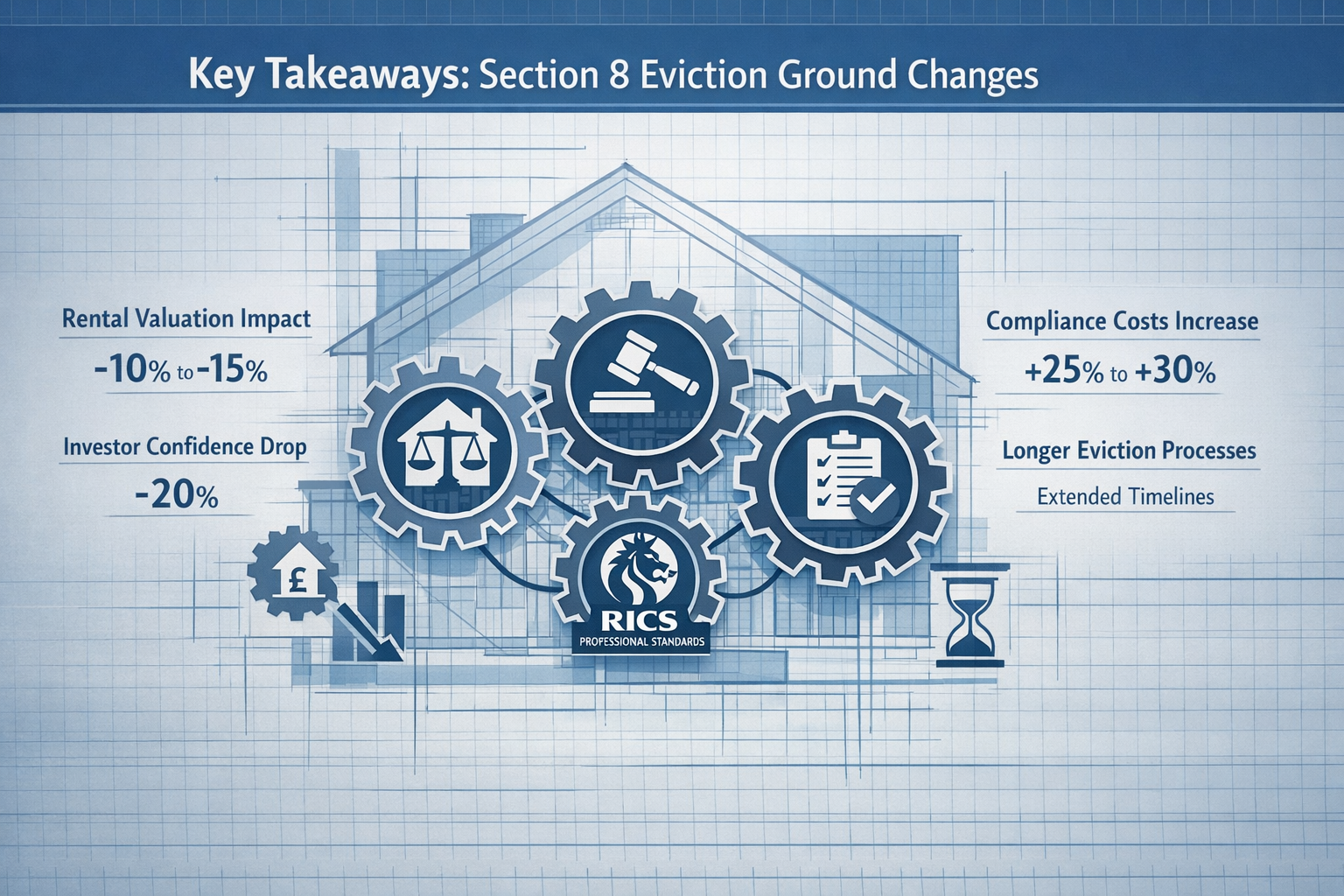
- Section 21 abolition forces all possession claims through Section 8 grounds requiring court hearings, eliminating the previous accelerated paperwork-only route and extending possession timelines
- Mandatory periodic tenancies replace all Assured Shorthold Tenancies (ASTs), giving tenants enhanced flexibility while restricting landlord control over property recovery
- RICS maintains vacant possession assumptions remain reasonable but requires case-by-case professional judgment and careful adjustment of comparable evidence obtained before and after Act implementation
- Ground-specific valuation adjustments range from -5% to -15% depending on property type, tenant profile, and applicable Section 8 grounds available to landlords
- Compliance costs and registration requirements from September 2026 create additional downward pressure on investment property valuations in the private rented sector
Understanding the New Section 8 Landscape for Property Valuations
The Renters' Rights Act, which received Royal Assent on October 27, 2025, fundamentally restructured the legal framework governing private tenancies in England.[1] For property valuers, this transformation requires recalibrating traditional valuation methodologies to reflect diminished landlord control and enhanced tenant security.
The Shift from Section 21 to Section 8 Possession Grounds
Previously, landlords could regain possession of their properties through Section 21 notices without providing any reason, using an accelerated court process that required minimal judicial involvement. This mechanism provided significant flexibility for landlords and supported higher property valuations based on predictable vacancy timelines.
Section 8 evictions, conversely, require landlords to prove specific statutory grounds in court hearings where both parties attend. This procedural change introduces several valuation-relevant factors:
- Extended timelines: Every Section 8 claim now requires a full court hearing, eliminating the paperwork-only route[2]
- Evidential burden: Landlords must demonstrate grounds with supporting documentation and testimony
- Judicial discretion: For discretionary grounds, judges assess reasonableness, introducing outcome uncertainty
- Compliance prerequisites: Multiple regulatory requirements must be satisfied before notices are valid
Mandatory Periodic Tenancies and Their Valuation Impact
All new and existing Assured Shorthold Tenancies automatically converted to periodic monthly tenancies under the new regime. These rolling contracts contain no minimum term and allow tenants to terminate with just two months' notice at any time.[1]
For property valuations, this creates a paradox: increased tenant flexibility paired with decreased landlord control. While properties can theoretically achieve faster tenant turnover, landlords face significantly higher barriers to regaining possession for strategic purposes such as:
- Sale of the property (now restricted by Ground 1A)
- Personal or family occupation (limited by Ground 1)
- Major renovation works requiring vacant possession
- Portfolio restructuring or refinancing activities
Surveyors conducting house evaluation must now factor these constraints into their comparable analysis and adjustment calculations.
Key Section 8 Grounds Affecting Valuations in 2026
Understanding the specific Section 8 grounds available to landlords is essential for appropriate valuation adjustments. The most relevant grounds for Valuation Adjustments for Section 8 Eviction Grounds in Periodic Tenancies: RICS Tactics Post-Renters' Rights Act 2026 include:
Ground 8 (Serious Rent Arrears) – Mandatory 💰
The threshold increased from two months to three months of rent arrears, required at both notice service and court hearing dates. Critically, arrears caused by Universal Credit payment delays must be excluded from calculations.[2] This higher threshold reduces the reliability of this ground as a possession mechanism, particularly in areas with high benefit claimant populations.
Ground 1A (Sale of Property) – Mandatory 🏠
This newly introduced ground permits eviction based on intention to sell but cannot be used within the first 12 months of tenancy. Landlords face a 12-month prohibition on re-letting or marketing after the notice period ends, with violations constituting criminal offences.[2]
Ground 1 (Landlord/Family Moving In) – Mandatory 👨👩👧
Notice periods extended to four months, and the ground cannot be invoked within the first 12 months. A 12-month re-letting prohibition applies after notice expiry.[2]
Discretionary Grounds (Various) ⚖️
Grounds including anti-social behaviour, property damage, and persistent rent delays remain available but require judicial assessment of reasonableness, introducing outcome uncertainty that impacts valuation confidence.
RICS Valuation Methodology Adjustments for Section 8 Compliance
The Royal Institution of Chartered Surveyors has provided guidance that the vacant possession assumption remains reasonable despite the legislative changes, yet emphasizes that valuers must exercise professional judgment on a case-by-case basis.[1] This position creates both flexibility and responsibility for chartered surveyors conducting building evaluation in the private rented sector.
Comparable Evidence Adjustment Techniques
When applying the comparative method of valuation—the primary approach for residential investment properties—surveyors must now distinguish between comparable transactions completed before and after May 1, 2026. This temporal adjustment accounts for market repricing following the Act's implementation.
Pre-Act Comparables Adjustment Framework 📊
| Property Type | Tenant Profile | Suggested Adjustment Range | Justification |
|---|---|---|---|
| Single-let family home | Professional tenants | -5% to -8% | Lower arrears risk, Ground 1/1A remain viable |
| HMO (House in Multiple Occupation) | Mixed tenants | -8% to -12% | Complex possession scenarios, higher management burden |
| Flat with benefit tenants | Universal Credit claimants | -10% to -15% | Ground 8 weakened by UC exclusion, higher arrears risk |
| Portfolio properties | Various | -7% to -10% | Reduced portfolio flexibility, strategic repositioning constrained |
These adjustments reflect the diminished landlord control and extended possession timelines inherent in the Section 8-only regime. Surveyors should document their adjustment rationale thoroughly, referencing specific grounds applicable to the subject property's tenant demographic and location characteristics.
Incorporating Compliance Costs into Valuations
The Act introduces substantial compliance obligations that create ongoing cost pressures affecting net operating income and, consequently, capital values. When conducting valuations, RICS surveyors must account for:
Decent Homes Standards Compliance 🏘️
Properties must meet enhanced habitability standards covering heating, insulation, facilities, and repair conditions. Upgrading non-compliant properties can cost £3,000-£15,000 per unit depending on existing conditions.
Private Rented Sector Database Registration 📝
From September 2026, landlords must register on the PRS Database before serving Section 8 notices. Unregistered landlords face notice invalidation.[2] Registration involves fees, ongoing compliance monitoring, and potential enforcement action for non-compliance.
Enhanced Due Diligence Documentation 📋
Pre-conditions for serving Section 8 notices include providing valid gas safety certificates, Energy Performance Certificates (EPCs), and the How to Rent guide.[2] Failure to maintain these documents bars certain grounds from being used, creating valuation risk where landlord compliance is uncertain.
These compliance costs should be reflected in either reduced net rental income projections or capital value adjustments, depending on the valuation purpose and methodology employed.
Yield Adjustment Strategies Post-Renters' Rights Act
Investment property valuations typically employ yield-based approaches, capitalizing net rental income at appropriate rates reflecting risk and return expectations. The Renters' Rights Act 2026 necessitates yield adjustments to account for:
- Increased void risk: Extended possession timelines create longer void periods when tenant relationships deteriorate
- Reduced exit flexibility: Constraints on Grounds 1 and 1A limit strategic portfolio management options
- Enhanced regulatory risk: Non-compliance penalties and notice invalidation create downside exposure
- Tenant empowerment effects: Strengthened tenant rights may correlate with increased disputes and legal costs
Surveyors should consider increasing yields by 25-50 basis points (0.25%-0.50%) for typical buy-to-let investments, with higher adjustments for properties facing elevated Section 8 possession challenges. This yield expansion reflects the increased risk premium investors require for diminished control and flexibility.
Practical RICS Tactics for Valuation Adjustments in Periodic Tenancies
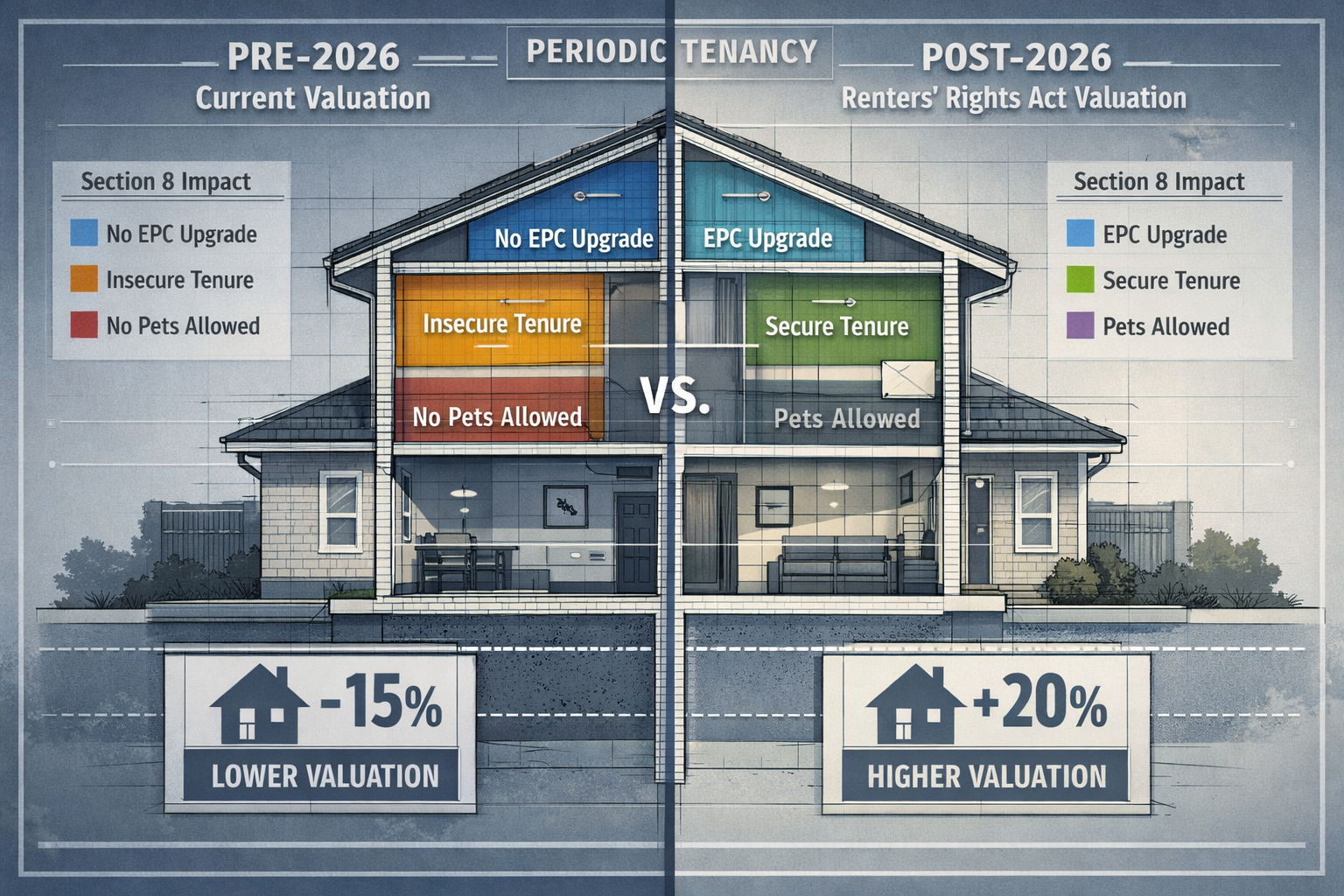
Implementing Valuation Adjustments for Section 8 Eviction Grounds in Periodic Tenancies: RICS Tactics Post-Renters' Rights Act 2026 requires systematic approaches that balance professional judgment with evidence-based analysis. The following tactics provide chartered surveyors with practical frameworks for navigating this complex valuation environment.
Tenant Profile Risk Assessment Matrix
Not all periodic tenancies present equal valuation risk under the Section 8 regime. Developing a tenant profile risk assessment helps surveyors apply appropriate adjustments based on possession ground viability.
Low Risk Tenant Profiles ✅
- Professional couples or families with stable employment
- Strong payment history and minimal arrears likelihood
- Properties where Grounds 1 and 1A remain practically viable
- Suggested adjustment: -5% to -7% on pre-Act comparables
Medium Risk Tenant Profiles ⚠️
- Mixed employment status or self-employed tenants
- Some historical payment irregularities
- Properties in areas with moderate possession timelines
- Suggested adjustment: -7% to -10% on pre-Act comparables
High Risk Tenant Profiles 🚨
- Significant Universal Credit dependency
- History of arrears or disputes
- Properties where Ground 8 effectiveness is compromised
- HMOs with complex possession scenarios
- Suggested adjustment: -10% to -15% on pre-Act comparables
This risk-stratified approach allows surveyors to justify valuation positions with reference to specific possession ground availability and effectiveness for the subject property's circumstances.
Documentation Requirements for Valuation Reports
Given the complexity of Valuation Adjustments for Section 8 Eviction Grounds in Periodic Tenancies: RICS Tactics Post-Renters' Rights Act 2026, comprehensive documentation becomes essential for professional defensibility. Valuation reports should include:
Legislative Context Section 📄
- Explicit reference to Renters' Rights Act 2026 implementation
- Summary of relevant Section 8 grounds applicable to subject property
- Discussion of abolished Section 21 route and implications
Comparable Evidence Analysis 🔍
- Clear identification of pre-Act versus post-Act transactions
- Documented adjustment rationale for temporal differences
- Market evidence of yield movements in comparable properties
Compliance Status Assessment ✓
- Review of landlord's PRS Database registration status (post-September 2026)
- Verification of gas safety, EPC, and How to Rent guide provision
- Assessment of Decent Homes Standards compliance
Risk Factors and Assumptions ⚡
- Explicit statement of tenant profile and associated possession risks
- Discussion of applicable Section 8 grounds and their effectiveness
- Assumptions regarding possession timelines and void periods
Surveyors should reference their building surveyor services experience and maintain detailed working papers supporting all adjustment decisions.
Scenario Analysis for Investment Valuations
For investment property valuations, scenario analysis provides clients with valuable insight into value sensitivity under different possession and regulatory outcomes. Consider presenting:
Base Case Scenario
- Current tenancy continues with compliant tenant
- Normal void periods and re-letting timelines
- Standard Section 8 ground availability
Downside Scenario
- Tenant arrears develop requiring Ground 8 possession
- Extended court timelines and legal costs
- Compliance issues discovered during possession process
Upside Scenario
- Tenant provides notice under two-month termination right
- Smooth transition to new tenancy
- Property benefits from rent increase after 12-month restriction period
This approach helps clients understand the range of potential outcomes and supports more informed investment decisions in the post-Renters' Rights Act environment.
Regional Variation Considerations
Valuation adjustments should reflect regional differences in court processing times, tenant demographics, and local rental market conditions. Properties in areas with:
- Longer court backlogs: Apply higher adjustments due to extended possession timelines
- Higher benefit claimant populations: Increase adjustments reflecting Ground 8 weakness
- Stronger rental demand: Moderate adjustments due to faster re-letting potential
- Lower compliance rates: Increase adjustments for regulatory risk exposure
Surveyors operating across multiple regions should develop location-specific adjustment guidelines informed by local market intelligence and court performance data.
Rent Review Implications Under Annual Increase Restrictions
The Act prohibits rent increases in the first 12 months of tenancy and limits subsequent increases to one per year subject to market value.[1] These restrictions affect valuation approaches by:
Limiting Rental Growth Projections 📈
- First-year rent freeze reduces immediate income potential
- Annual-only increases constrain income growth in rising markets
- Market rent limitation prevents above-market positioning
Affecting Comparable Analysis 🔎
- Recently let properties may show below-market rents due to 12-month freeze
- Comparable properties at different tenancy stages require adjustment
- Market rent evidence becomes more critical for income projections
Surveyors should explicitly address rent review restrictions in their income approach valuations and adjust comparable rental evidence for tenancy timing differences.
Integration with Broader RICS Surveying Services
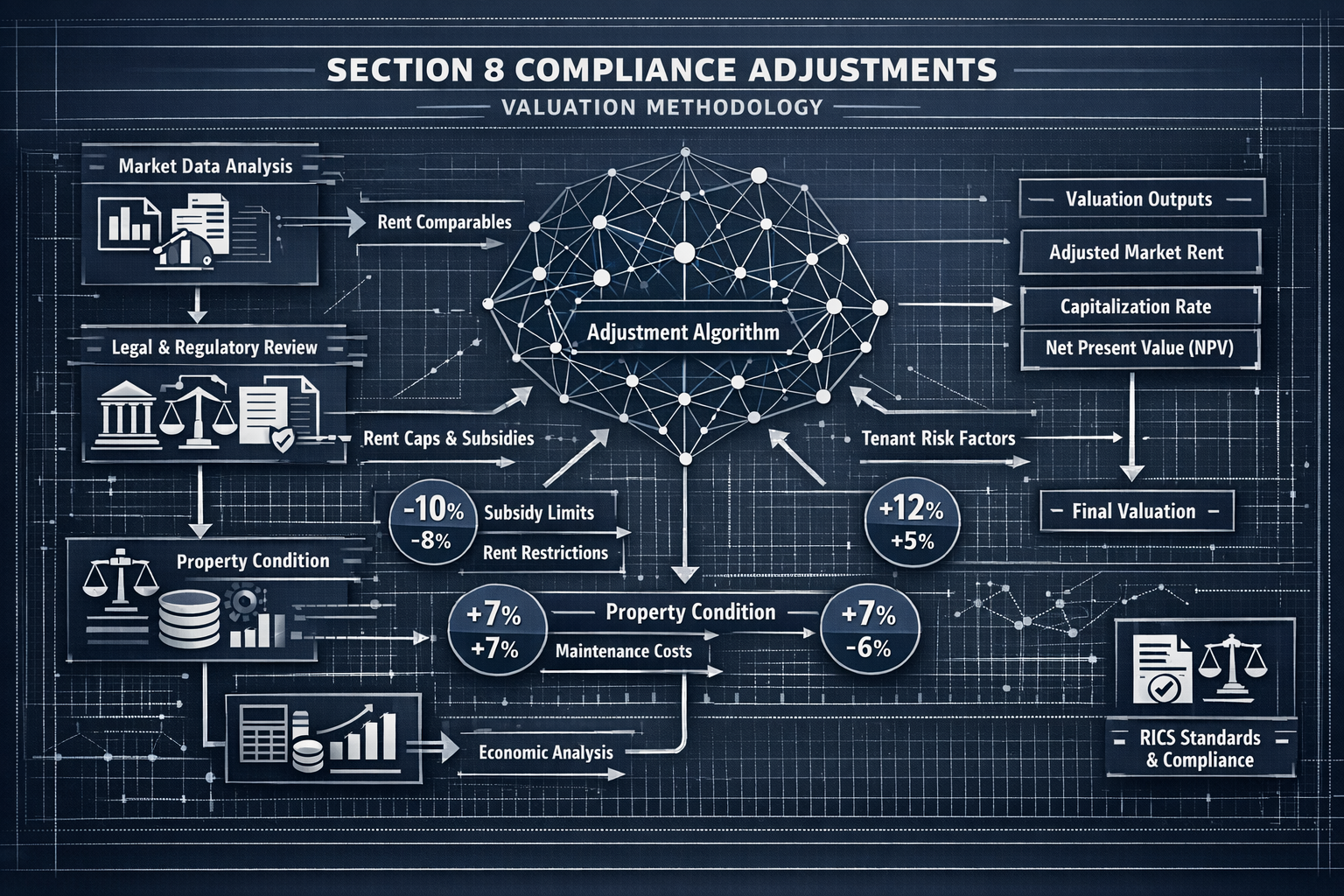
Valuation Adjustments for Section 8 Eviction Grounds in Periodic Tenancies: RICS Tactics Post-Renters' Rights Act 2026 don't exist in isolation. They intersect with multiple surveying disciplines and client advisory services that chartered surveyors provide.
Pre-Purchase Survey Implications
When conducting RICS homebuyer surveys for investment properties, surveyors should now incorporate Renters' Rights Act considerations into their advisory comments. Potential buyers need to understand:
- How Section 8 ground availability affects exit strategy flexibility
- Compliance upgrade costs required for PRS Database registration
- Decent Homes Standards deficiencies and remediation expenses
- Tenant profile risks and possession ground viability
This integrated approach helps clients make informed purchase decisions with full awareness of the post-Act valuation landscape. Those considering whether they need a homebuyers report or structural survey should understand how tenancy status affects property value.
Post-Survey Negotiation Strategies
The enhanced regulatory burden and diminished landlord control create legitimate grounds for price renegotiation when purchasing tenanted investment properties. Buyers can reference Valuation Adjustments for Section 8 Eviction Grounds in Periodic Tenancies: RICS Tactics Post-Renters' Rights Act 2026 to support reduced offers, particularly where:
- Existing tenancies present high-risk profiles under Section 8 criteria
- Compliance deficiencies require immediate remediation
- Comparable evidence shows post-Act market repricing
Surveyors familiar with renegotiating after poor survey results can advise clients on leveraging valuation adjustments in purchase negotiations.
Portfolio Valuation and Strategic Advisory
For landlords with substantial property portfolios, the Renters' Rights Act necessitates strategic reviews of holdings to identify:
High-Risk Properties 🎯
- Assets with challenging tenant profiles or compliance deficiencies
- Properties where Section 8 grounds are weakest
- Candidates for disposal before further market repricing
Optimization Opportunities 💡
- Properties suitable for repositioning to lower-risk tenant segments
- Assets where compliance upgrades deliver value protection
- Holdings where Ground 1A (sale) provides viable exit routes
Chartered surveyors can provide valuable strategic advisory services helping clients navigate portfolio optimization in the transformed regulatory environment.
Compliance Auditing Services
The pre-conditions for serving valid Section 8 notices create opportunities for surveyors to offer compliance auditing services. These reviews assess whether properties meet the documentation and standards requirements necessary for possession ground availability, including:
- Gas safety certificate validity and record-keeping
- EPC compliance and upgrade requirements
- How to Rent guide provision documentation
- Decent Homes Standards assessment
- PRS Database registration status (post-September 2026)
These audits protect landlords from notice invalidation and support accurate valuation assumptions regarding possession ground availability.
Future Outlook and Market Adaptation
The private rented sector continues adapting to the Renters' Rights Act 2026, with market repricing ongoing throughout 2026. Several trends are emerging that will influence future Valuation Adjustments for Section 8 Eviction Grounds in Periodic Tenancies: RICS Tactics Post-Renters' Rights Act 2026:
Market Segmentation and Tenant Selectivity
Landlords increasingly focus on tenant profiles offering lower Section 8 possession risks, creating market segmentation between:
- Professional tenant properties: Premium pricing due to lower possession risk
- Benefit tenant properties: Discounted pricing reflecting Ground 8 weakness
- Family properties: Moderate pricing with Ground 1 availability
- HMO properties: Significant discounts due to complex possession scenarios
This segmentation will likely intensify, requiring surveyors to apply increasingly differentiated valuation approaches based on target tenant demographics.
Yield Expansion and Investment Returns
Initial market evidence suggests yields expanding by 25-75 basis points across different property types and locations, reflecting increased risk premiums. This yield adjustment represents the market's repricing of diminished landlord control and enhanced regulatory burden.
Surveyors should monitor transaction evidence closely to calibrate their adjustment methodologies as market pricing stabilizes throughout 2026 and beyond.
Compliance-Driven Value Differentiation
Properties with robust compliance documentation and PRS Database registration will command premium pricing relative to non-compliant comparables. This compliance premium reflects:
- Reduced possession ground invalidation risk
- Lower regulatory enforcement exposure
- Enhanced marketability to risk-averse investors
Surveyors should explicitly recognize compliance status in their valuation analyses, adjusting comparable evidence for documentation and registration differences.
Court System Performance Impact
Section 8 possession timelines depend heavily on court system capacity and processing efficiency. Regional variations in court performance will create geographic value differentials, with properties in areas offering faster possession processes commanding premium pricing.
Monitoring court performance data and incorporating regional possession timeline assumptions into valuation models will become increasingly important for accurate property assessment.
Conclusion
Valuation Adjustments for Section 8 Eviction Grounds in Periodic Tenancies: RICS Tactics Post-Renters' Rights Act 2026 represent a fundamental shift in how chartered surveyors approach private rented sector property valuations. The abolition of Section 21 'no fault' evictions and the introduction of mandatory periodic tenancies have permanently altered the risk-return profile of residential investment properties across England.
RICS guidance maintains that vacant possession assumptions remain reasonable, yet surveyors must now apply sophisticated adjustment methodologies accounting for extended possession timelines, stricter eviction criteria, and enhanced compliance obligations. Adjustment ranges typically span -5% to -15% on pre-Act comparables, depending on property type, tenant profile, and applicable Section 8 grounds.
Key Action Steps for Property Professionals
For Chartered Surveyors 📋
- Develop property-specific tenant risk assessment frameworks
- Document all valuation adjustments with explicit reference to Section 8 grounds
- Monitor post-Act transaction evidence to calibrate adjustment methodologies
- Integrate compliance auditing into survey service offerings
For Property Investors 💼
- Commission professional valuations explicitly addressing Renters' Rights Act implications
- Prioritize properties with low-risk tenant profiles and strong compliance documentation
- Factor extended possession timelines into investment return projections
- Consider portfolio rebalancing toward properties with viable Section 8 grounds
For Landlords 🏠
- Ensure PRS Database registration completion before September 2026 deadline
- Maintain comprehensive compliance documentation for all properties
- Conduct tenant profile assessments to understand possession ground viability
- Engage RICS surveyors for strategic portfolio reviews
For Property Buyers 🔑
- Request valuations explicitly addressing Section 8 ground implications
- Verify seller compliance with gas safety, EPC, and documentation requirements
- Negotiate purchase prices reflecting post-Act market repricing
- Understand tenant profiles and associated possession risks before acquisition
The transformation of England's private rented sector creates both challenges and opportunities for property professionals. Those who develop sophisticated understanding of Valuation Adjustments for Section 8 Eviction Grounds in Periodic Tenancies: RICS Tactics Post-Renters' Rights Act 2026 will be best positioned to provide valuable advisory services, make informed investment decisions, and navigate this complex regulatory environment successfully.
As market adaptation continues throughout 2026 and beyond, ongoing professional development and market intelligence gathering remain essential for maintaining valuation accuracy and professional competence in this transformed landscape.
References
[1] Consideration Of Implications Of Renters Rights Act On Valuation – https://www.rics.org/news-insights/consideration-of-implications-of-renters-rights-act-on-valuation
[2] Section 8 Notice 2026 New Rules – https://www.beyourbestlawyer.com/blog/section-8-notice-2026-new-rules
[3] Party Wall Surveys For Renters Rights Act Compliance Managing Notices When Landlord Initiated Works Face New Section 8 Ground Requirements – https://nottinghillsurveyors.com/blog/party-wall-surveys-for-renters-rights-act-compliance-managing-notices-when-landlord-initiated-works-face-new-section-8-ground-requirements
[4] Party Wall Implications Of Renters Rights Act 2026 Survey Protocols For Prs Database And Section 8 Notice Compliance – https://nottinghillsurveyors.com/blog/party-wall-implications-of-renters-rights-act-2026-survey-protocols-for-prs-database-and-section-8-notice-compliance