


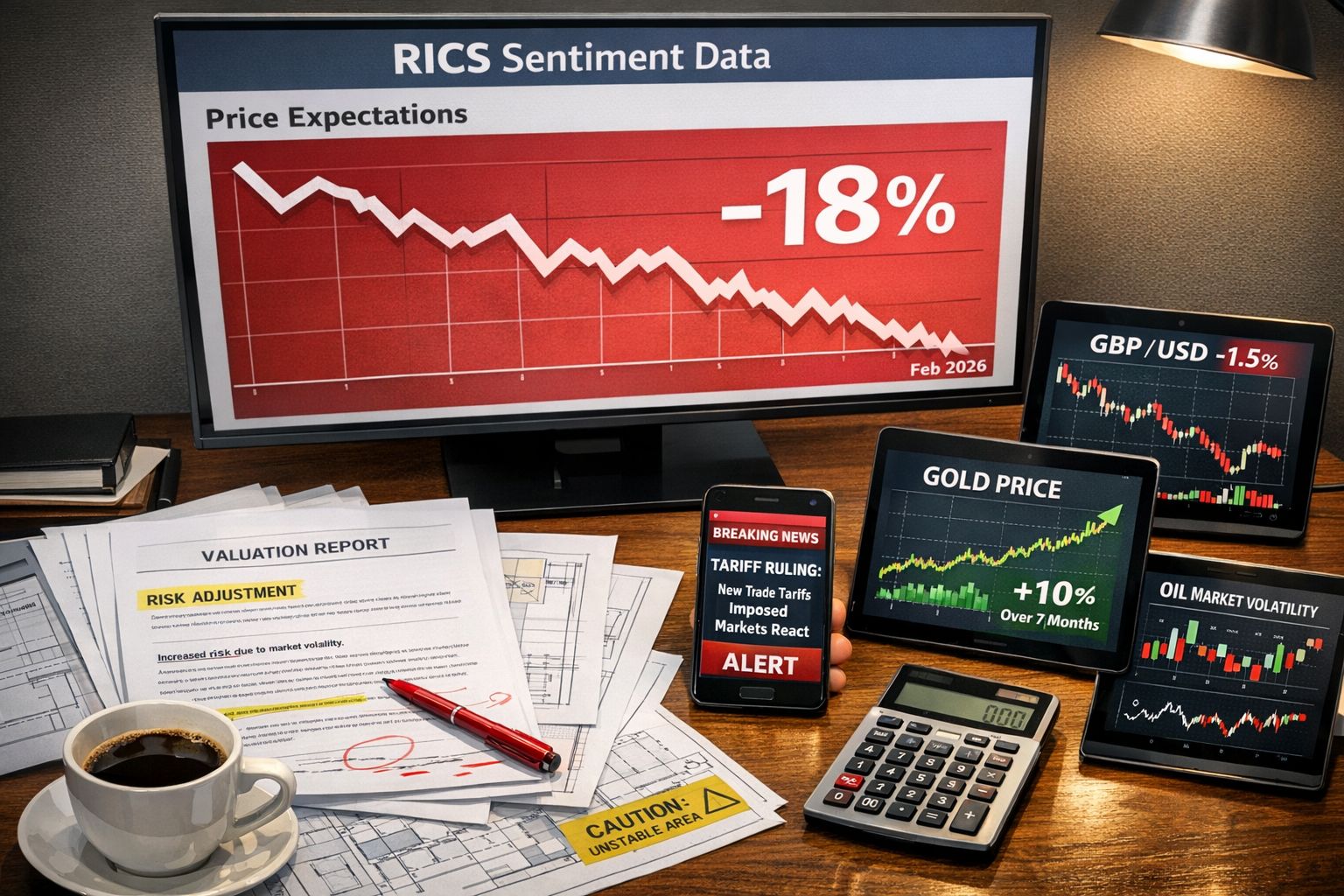
February 2026 has delivered a stark reminder that optimism in property markets can evaporate overnight. After a cautiously hopeful January, geopolitical shocks and macroeconomic turbulence have sent surveyor confidence plummeting, with RICS data revealing near-term price expectations falling to a striking -18% [5]. This dramatic shift demands that property professionals recalibrate their valuation methodologies to maintain credibility with lenders, clients, and stakeholders while navigating unprecedented volatility.
The challenge facing surveyors in February 2026 centers on Valuation Accuracy Under Geopolitical Uncertainty: Surveyor Tactics for February 2026's Volatile Market Conditions—a critical intersection where traditional valuation principles meet the harsh realities of tariff disputes, currency fluctuations, and Middle East tensions. The stakes have never been higher for professionals tasked with providing reliable property assessments in an environment where yesterday's assumptions no longer hold.

Key Takeaways
- 📉 RICS near-term price expectations dropped to -18% in February 2026, marking a sharp reversal from January optimism and requiring immediate valuation methodology adjustments
- ⚖️ U.S. Supreme Court tariff ruling on February 20, 2026 injected fresh uncertainty into global trade, directly impacting commercial property valuations and supply chain-dependent assets
- 💷 Sterling fell 1.5% against the dollar in its biggest monthly decline since October 2025, creating currency risk considerations for international property investors
- 🛡️ Flight-to-safety indicators strengthened with gold rising over 10% for a seventh consecutive month, signaling investor anxiety that affects property market liquidity
- 🎯 Scenario-based valuation frameworks have become essential tools for maintaining accuracy while acknowledging the wide range of potential market outcomes
Understanding February 2026's Geopolitical Landscape and Market Impact
The geopolitical environment in February 2026 has created a perfect storm of uncertainty that directly challenges traditional valuation approaches. Multiple simultaneous pressures have converged to create market conditions that demand heightened analytical rigor from property professionals.
The Tariff Uncertainty Shock
On February 20, 2026, the U.S. Supreme Court delivered a 6-3 ruling striking down President Trump's IEEPA tariffs, forcing the administration to pursue alternative legal pathways [4]. This decision injected immediate uncertainty into global trade relationships and supply chain planning. For surveyors, the implications extend beyond abstract policy debates:
- Commercial property valuations tied to import/export businesses face increased tenant risk
- Industrial and logistics assets dependent on predictable trade flows require additional risk premiums
- Retail properties stocking imported goods face margin compression concerns
- Development projects relying on international materials encounter cost uncertainty
The tariff ruling exemplifies how geopolitical events create cascading valuation challenges that require surveyors to think beyond traditional comparable analysis.
Currency Volatility and Cross-Border Investment
Sterling's 1.5% monthly decline against the dollar—its largest drop since October 2025—reflects deeper concerns about UK economic stability and Bank of England policy direction [4]. This currency movement has direct implications for property valuations:
| Impact Area | Valuation Consideration | Surveyor Response |
|---|---|---|
| Foreign Investment | Reduced purchasing power for dollar-based buyers | Adjust demand assumptions downward |
| Debt Servicing | Increased costs for foreign currency loans | Factor higher refinancing risk |
| Income Streams | Currency translation effects on international tenants | Apply currency hedging discounts |
| Exit Strategies | Uncertainty in repatriation values | Widen cap rate ranges |
For professionals conducting condition surveys across London, currency considerations have become an essential component of comprehensive valuation analysis.
Commodity Price Volatility as Market Signal
Oil prices rose throughout February 2026 amid volatile headlines surrounding U.S.-Iran negotiations and broader Middle East tensions [4]. Simultaneously, gold continued its remarkable appreciation, rising more than 10% and ending higher for a seventh consecutive month [4]. These commodity movements provide crucial signals for property valuations:
Rising oil prices suggest:
- Increased operational costs for property management
- Higher commuting expenses potentially affecting suburban demand
- Inflationary pressures requiring rent growth adjustments
Sustained gold appreciation indicates:
- Flight-to-safety behavior reducing risk appetite
- Potential liquidity constraints in property markets
- Investor preference for liquid assets over illiquid property
These indicators help surveyors contextualize market sentiment beyond property-specific data, providing essential background for valuation judgments.
Valuation Accuracy Under Geopolitical Uncertainty: Core Challenges for Surveyors
The volatile conditions of February 2026 have exposed fundamental tensions in traditional valuation methodologies. Surveyors face multiple simultaneous challenges that require sophisticated tactical responses.
The Confidence Crisis in Comparable Evidence
RICS data showing near-term price expectations at -18% creates a critical problem for comparable-based valuations [5]. When market sentiment shifts this dramatically, recent transaction evidence becomes questionable:
- Time lag issues: Transactions from 3-6 months ago reflect different market psychology
- Buyer motivation questions: Were recent purchases based on assumptions that no longer hold?
- Distressed sale risk: Are current transactions representative or panic-driven?
- Regional divergence: National sentiment may mask significant local variations
Surveyors must now weight comparable evidence differently, giving greater consideration to transaction context and buyer sophistication. The building survey process becomes more complex when market fundamentals are shifting rapidly.
The Scenario Planning Imperative
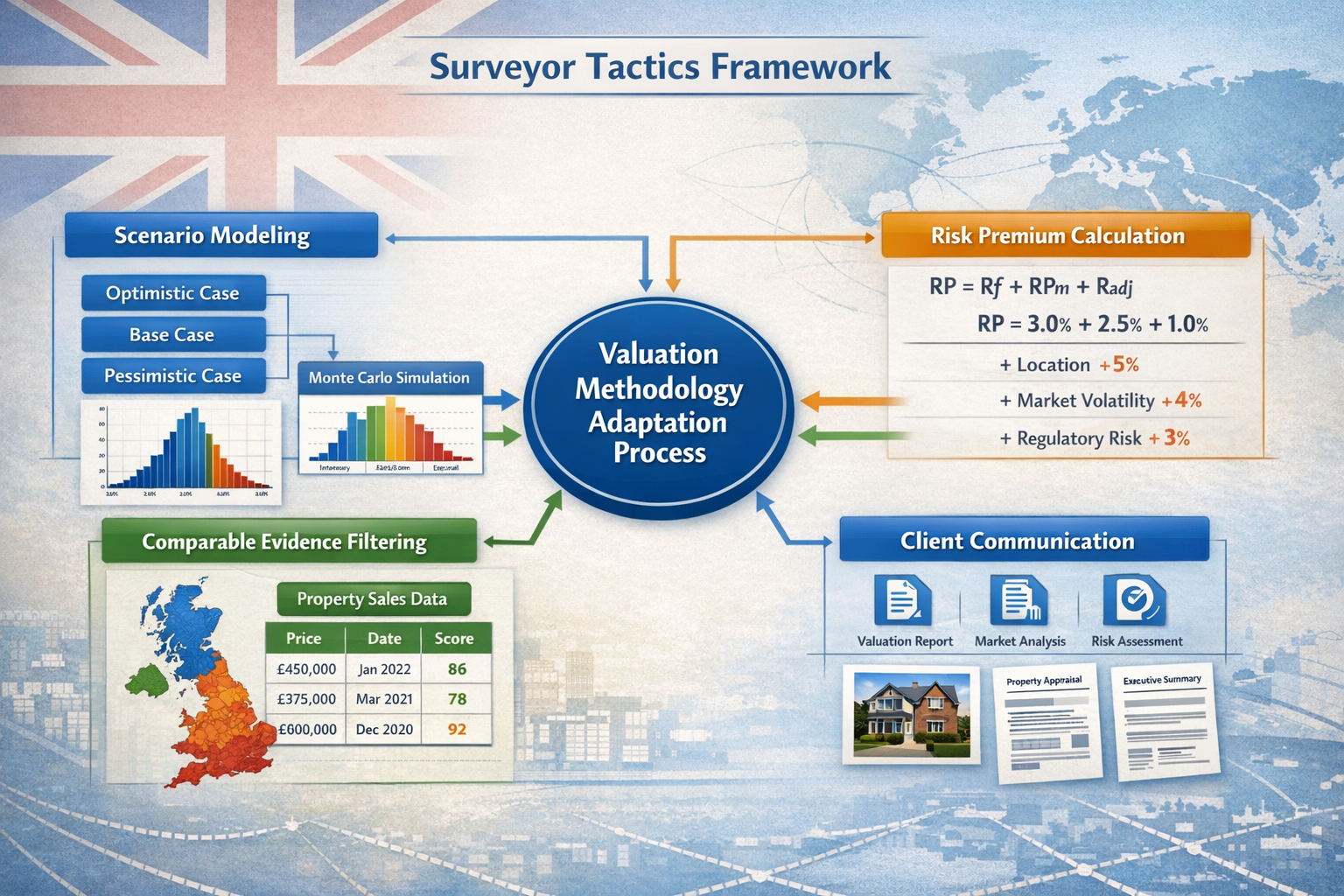
Traditional single-point valuations have become inadequate for February 2026's conditions. Geopolitical volatility is expected to persist throughout 2026, with the U.S. role in reshaping the global operating environment being highly significant [3]. This reality demands scenario-based approaches:
Optimistic Scenario (Probability: 25%)
- Geopolitical tensions ease by Q3 2026
- Trade agreements stabilize post-tariff ruling
- Sterling recovers to 1.30 against dollar
- Property prices stabilize with modest growth
Base Scenario (Probability: 50%)
- Continued uncertainty through 2026
- Gradual adaptation to new trade realities
- Currency volatility persists but moderates
- Property prices remain flat to slightly negative
Pessimistic Scenario (Probability: 25%)
- Escalation of geopolitical conflicts
- Further trade disruptions and tariff implementations
- Sterling declines below 1.20 against dollar
- Property prices decline 10-15%
Presenting weighted scenario valuations provides clients with realistic expectations while maintaining professional credibility. This approach acknowledges uncertainty rather than pretending it doesn't exist.
Risk Premium Quantification
Geopolitical uncertainty demands explicit risk adjustments in valuation calculations. Risk management teams increasingly need geopolitical risk insights and context-rich geopolitical data to inform resilience metrics as headwinds become more unpredictable and frequent [1].
For property valuations, this translates to:
- Increased yield requirements: Adding 25-75 basis points to cap rates depending on exposure
- Shortened cash flow horizons: Reducing terminal value confidence beyond 5 years
- Tenant covenant stress testing: Applying higher vacancy assumptions for exposed sectors
- Liquidity discounts: Acknowledging reduced market depth in uncertain conditions
When conducting Level 2 or Level 3 surveys, these risk adjustments must be transparently documented to support valuation conclusions.
The Lender Credibility Challenge
Mortgage lenders and institutional investors require valuations that balance realism with defensibility. February 2026's conditions create tension between:
- Conservative approaches that protect lenders but may kill viable transactions
- Optimistic valuations that facilitate deals but expose professionals to liability
- Overly complex methodologies that confuse rather than clarify
- Simplified approaches that ignore material risks
Surveyors must navigate this terrain by clearly articulating assumptions, documenting market conditions, and providing sensitivity analysis that shows how valuations change under different scenarios.
Surveyor Tactics for Maintaining Valuation Accuracy in February 2026
Professional surveyors have developed practical tactical responses to February 2026's challenges. These approaches maintain valuation integrity while acknowledging unprecedented uncertainty.
Tactic 1: Enhanced Market Evidence Filtering 🔍
Not all comparable evidence deserves equal weight in volatile conditions. Surveyors should implement rigorous filtering criteria:
High-Confidence Transactions:
- Completed in last 60 days with full market exposure
- Arm's-length sales between sophisticated parties
- Financing confirmed at market rates
- Property condition and lease terms fully documented
Medium-Confidence Transactions:
- Completed 60-90 days ago with some uncertainty about current relevance
- One party potentially under time pressure
- Limited information on financing terms
- Minor differences in property characteristics
Low-Confidence Transactions:
- Completed more than 90 days ago
- Distressed sales or related-party transactions
- Unusual financing arrangements
- Significant property or lease differences
This tiered approach allows surveyors to acknowledge data limitations while still providing evidence-based valuations. When conducting property surveys in areas like Westminster or Knightsbridge, transaction quality becomes paramount.
Tactic 2: Real-Time Geopolitical Monitoring Systems
Operations and supply chains have remained the most impacted functional areas by geopolitics, a trend expected to continue in 2026 [3]. Surveyors must establish systematic monitoring processes:
Daily Monitoring:
- Currency exchange rates (GBP/USD, GBP/EUR)
- Commodity prices (oil, construction materials)
- Major geopolitical developments
- Central bank announcements
Weekly Analysis:
- RICS sentiment indicators
- Transaction volume trends
- Mortgage approval rates
- Tenant demand signals
Monthly Review:
- Portfolio-wide valuation assumption updates
- Risk premium recalibration
- Scenario probability adjustments
- Client communication on market shifts
This disciplined approach ensures valuations reflect current market reality rather than outdated assumptions from more stable periods.
Tactic 3: Transparent Assumption Documentation
February 2026's volatility requires exceptional transparency in valuation reports. Surveyors should explicitly document:
✅ Macroeconomic assumptions: Interest rate expectations, inflation forecasts, GDP growth scenarios
✅ Geopolitical assumptions: Expected duration of current tensions, probability of escalation, trade policy stability
✅ Market-specific assumptions: Supply pipeline, demand drivers, competitive dynamics, regulatory changes
✅ Property-specific assumptions: Tenant retention, capex requirements, lease renewal probabilities, operational costs
✅ Methodology choices: Why specific approaches were selected, what alternatives were considered, sensitivity to key inputs
This documentation protects surveyors professionally while educating clients about the complexity of current market conditions. When preparing homebuyer reports, this transparency builds trust and manages expectations.
Tactic 4: Regional Differentiation and Local Expertise
National sentiment indicators mask significant regional variations in market conditions. RICS data reveals substantial North-South divides in price expectations and market activity [5]. Effective surveyors leverage local expertise:
London Market Considerations:
- International buyer exposure to currency fluctuations
- Financial services employment concentration
- Prime vs. secondary market divergence
- Transport infrastructure investment impacts
Regional Market Considerations:
- Local employment base resilience
- Affordability dynamics vs. London
- Domestic buyer dominance reducing currency risk
- Regional development initiatives
Surveyors operating across diverse London locations from Romford to Richmond must customize approaches rather than applying uniform national assumptions.
Tactic 5: Client Communication and Expectation Management
Perhaps the most critical tactic involves proactive client engagement. February 2026's conditions require surveyors to:
📞 Pre-valuation consultations: Discuss market conditions, methodology choices, and realistic outcome ranges before fieldwork begins
📊 Interim updates: For complex valuations, provide progress updates if market conditions shift during the assignment
📋 Detailed reporting: Explain valuation conclusions in context of current uncertainty, avoiding false precision
🔄 Post-valuation support: Offer to discuss how changing conditions might affect valuations over coming months
This approach positions surveyors as trusted advisors rather than mere report producers. When clients understand the challenges surveyors face, they appreciate the sophistication required to deliver accurate valuations.
Tactic 6: Portfolio-Level Risk Assessment
For clients with multiple properties, portfolio-level analysis provides valuable insights beyond individual valuations:
- Correlation analysis: How properties respond to different geopolitical scenarios
- Diversification benefits: Geographic and sector spread reducing overall risk
- Liquidity profiling: Which assets could be sold quickly if needed
- Stress testing: Portfolio value under adverse scenarios
This holistic perspective helps clients make strategic decisions about asset allocation, refinancing priorities, and acquisition opportunities in uncertain markets.
Practical Implementation: A February 2026 Case Study
Consider a surveyor valuing a mixed-use commercial property in Central London in late February 2026:
Property Details:
- Ground floor retail (40% of income)
- Upper floor offices (60% of income)
- Freehold interest
- Recent lease renewals at market rents
Traditional Approach:
- Apply standard yield of 5.5%
- Use comparable evidence from Q4 2025
- Project 2% annual rental growth
- Deliver single-point valuation
February 2026 Enhanced Approach:
1️⃣ Filter comparables by transaction quality, identifying only three high-confidence sales from January-February 2026
2️⃣ Apply scenario framework:
- Optimistic: 5.25% yield, 2.5% growth → £X valuation
- Base: 5.75% yield, 0% growth → £Y valuation (15% lower)
- Pessimistic: 6.25% yield, -2% growth → £Z valuation (28% lower)
3️⃣ Weight scenarios (25%/50%/25%) for probability-weighted valuation
4️⃣ Document assumptions including currency risk (international retail tenants), tariff impact (office tenant in import business), and liquidity constraints
5️⃣ Present range rather than single point, with clear explanation of driving factors
6️⃣ Recommend monitoring triggers for valuation updates (e.g., sterling below 1.22, further tariff announcements)
This approach maintains professional standards while acknowledging market realities, providing the client with actionable intelligence rather than false certainty.
Technology and Data Tools for Enhanced Accuracy
Modern surveyors can leverage technology solutions to improve valuation accuracy under uncertainty:
Market Intelligence Platforms:
- Real-time transaction databases
- Automated comparable filtering
- Sentiment analysis tools
- Geopolitical risk scoring systems
Financial Modeling Software:
- Monte Carlo simulation for scenario analysis
- Sensitivity analysis automation
- Currency risk modeling
- Portfolio optimization tools
Communication Technologies:
- Interactive valuation reports
- Client portals for ongoing market updates
- Video conferencing for complex explanations
- Collaborative platforms for multi-party transactions
These tools don't replace professional judgment but enhance analytical capabilities and improve client service delivery. When preparing detailed condition surveys, technology integration streamlines data collection and analysis.
Regulatory and Professional Standards Considerations
RICS and other professional bodies have adapted guidance for volatile market conditions:
- Red Book valuation standards emphasize uncertainty disclosure and assumption documentation
- Material uncertainty clauses may be appropriate for February 2026 valuations in certain sectors
- Valuation review frequency recommendations increased for commercial portfolios
- Professional indemnity insurance considerations for valuations in uncertain conditions
Surveyors must stay current with evolving professional standards while maintaining independence and objectivity. The Red Book valuation framework provides essential guidance for navigating these challenges.
Looking Forward: Preparing for Continued Volatility
Geopolitical volatility is expected to persist throughout 2026 [3], suggesting February's conditions represent a new normal rather than temporary disruption. Surveyors should:
🎯 Invest in ongoing education about geopolitical risk assessment and macroeconomic analysis
🎯 Build relationships with economists, political analysts, and risk management professionals
🎯 Develop flexible methodologies that can adapt to changing conditions without complete overhaul
🎯 Strengthen client relationships through transparent communication and value-added advisory services
🎯 Participate in industry discussions about best practices for valuation under uncertainty
The surveyors who thrive in 2026's environment will be those who embrace complexity, communicate effectively, and maintain unwavering professional standards despite unprecedented challenges.
Conclusion
Valuation Accuracy Under Geopolitical Uncertainty: Surveyor Tactics for February 2026's Volatile Market Conditions represents one of the most significant professional challenges in recent memory. The dramatic shift from January optimism to February pessimism—reflected in RICS data showing -18% near-term price expectations—demands fundamental changes in how surveyors approach their work [5].
The tactics outlined in this article provide a practical framework for maintaining valuation integrity:
✅ Enhanced market evidence filtering to ensure comparable quality
✅ Scenario-based valuation frameworks acknowledging multiple potential outcomes
✅ Transparent assumption documentation protecting professionals and educating clients
✅ Regional differentiation recognizing local market variations
✅ Proactive client communication managing expectations realistically
✅ Portfolio-level risk assessment providing strategic insights
These approaches don't eliminate uncertainty—nothing can in February 2026's environment. Instead, they acknowledge uncertainty explicitly while providing clients with the information needed for informed decision-making.
Actionable Next Steps
For surveyors navigating February 2026's volatile conditions:
-
Review existing valuation methodologies against the tactics outlined above, identifying gaps and enhancement opportunities
-
Establish systematic monitoring processes for geopolitical developments, market indicators, and transaction evidence
-
Upgrade reporting templates to include scenario analysis, assumption documentation, and sensitivity testing
-
Schedule client education sessions explaining how current market conditions affect valuation approaches
-
Invest in professional development focusing on geopolitical risk assessment and advanced valuation techniques
-
Network with peers to share insights and develop industry best practices for uncertain conditions
-
Consider technology investments that enhance analytical capabilities and improve client communication
The property professionals who adapt quickly and thoughtfully to February 2026's challenges will emerge stronger, with enhanced reputations and deeper client relationships. Those who cling to outdated methodologies risk irrelevance in a market that demands sophisticated, nuanced analysis.
For property buyers, sellers, and investors, the message is equally clear: seek surveyors who demonstrate understanding of current market complexities and provide transparent, well-documented valuations. Whether you're a first-time buyer in Wimbledon or managing a commercial portfolio across London, the quality of your surveyor's analysis has never been more critical.
February 2026's volatile conditions will pass, but the lessons learned about valuation accuracy under geopolitical uncertainty will shape professional practice for years to come. The surveyors who master these challenges today are building the foundation for long-term success in an increasingly complex global property market.
References
[1] Risk Management In 2026 Key Predictions For An Uncertain Year – https://www.verdantix.com/client-portal/blog/risk-management-in-2026–key-predictions-for-an-uncertain-year
[2] Geopolitical Risk Brief February 2026 – https://www.spglobal.com/market-intelligence/en/news-insights/research/2026/02/geopolitical-risk-brief-february-2026
[3] Geostrategic Outlook – https://www.ey.com/en_us/insights/geostrategy/geostrategic-outlook
[4] Market Moves Themes That Mattered February 2026 – https://www.janushenderson.com/en-us/advisor/article/market-moves-themes-that-mattered-february-2026/
[5] Valuing Regional Price Disparities In 2026 Surveyor Insights From Rics Data On North South Divides – https://nottinghillsurveyors.com/blog/valuing-regional-price-disparities-in-2026-surveyor-insights-from-rics-data-on-north-south-divides