

A property can sit at the same asking price for five years running and still have lost real value every single one of those years. That is precisely the story UBS told about London in its Global Real Estate Bubble Index 2026, published on 22 September 2026, and it is the story Wimbledon owners need to understand before pricing a home for sale this autumn.
The UBS Global Real Estate Bubble Index 2026 London low risk Wimbledon house prices story is not one of crisis. It is one of quiet, prolonged stagnation, and that distinction changes almost everything about how sellers should price, how lenders value, and how buyers negotiate across SW19 and the wider Merton borough this October.
Key Takeaways
- UBS rates London low bubble risk in its 2026 index, but real (inflation-adjusted) home prices have fallen more than 15% since the 2021 peak.
- London's market has been "weak for a fifth consecutive year", a slow bleed, not a crash, which matters for how Wimbledon sellers set expectations.
- Nationwide's September 2026 data shows annual UK price growth roughly halving and affordability at its best since 2015, yet Zoopla puts average mortgage rates near 5.2%, a three-year high.
- Thin transaction volumes make RICS Red Book valuations harder, more reliance on adjusted comparables and explicit valuation uncertainty.
- The mansion tax from April 2028 and the 28 October 2026 Autumn Budget both weigh on pricing decisions for higher-value Wimbledon homes now.
What the UBS Global Real Estate Bubble Index 2026 Actually Says About London
UBS analysed 23 global cities for its 2026 index, including newcomers Lisbon and Seoul. Zurich and Tokyo carry the highest bubble-risk scores, while Miami slipped to "elevated" risk. London, by contrast, sits firmly in the low risk category, but UBS is careful to explain why that label should not be read as a bullish signal.
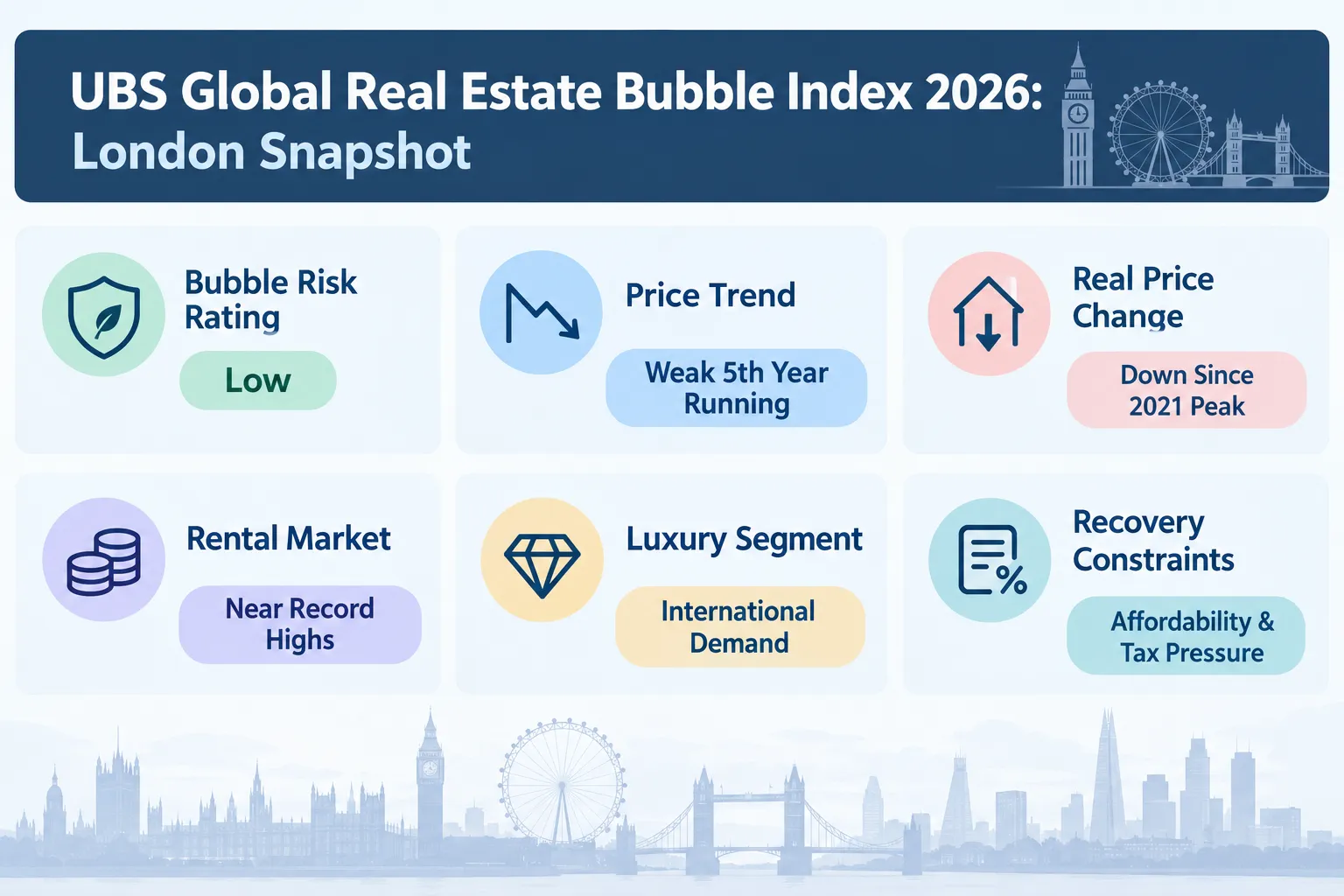
According to UBS, London real home prices have fallen more than 15% since their 2021 peak once inflation is stripped out. The bank describes a market that "has remained weak for a fifth consecutive year." Rents, meanwhile, sit close to record highs because of chronic housing shortages, and the luxury segment continues to draw international investor demand even as the mainstream market stalls. UBS attributes the slow recovery to stretched affordability, higher taxes on expensive properties, and recent population decline.
| UBS London Finding (2026 Index) | What It Means |
|---|---|
| Bubble risk rating | Low, not elevated, not a crash signal |
| Real price change since 2021 peak | Down more than 15% after inflation |
| Market trend | Weak for a fifth consecutive year |
| Rental market | Close to record highs, driven by housing shortages |
| Luxury segment | Supported by international investor demand |
| Constraints on recovery | Stretched affordability, higher taxes on expensive homes, population decline |
For homeowners in Wimbledon, Raynes Park and across Merton, the practical translation is this: a home whose nominal value is unchanged since 2021 has lost more than 15% of its purchasing power in real terms. It has quietly lost purchasing power every year inflation outpaced price growth.
Low Bubble Risk Is Not the Same as Low Prices in Wimbledon
"Low risk" in UBS's methodology measures the chance of a sudden, disorderly price collapse, not whether prices are rising, falling, or flat. London scoring low risk simply means London does not carry the same risk rating UBS gives to Zurich and Tokyo, the cities it rates highest risk.
That is an important reassurance for anyone worried about a 2008-style crash in SW19. But it says nothing about affordability, growth, or whether now is a good moment to sell. A market can be low bubble risk and simultaneously stagnant, overpriced relative to local incomes, or slow to transact, which is exactly the combination UBS describes for London.
The nominal-versus-real distinction matters most for sellers who have not revalued their property mentally since before 2021. A home whose nominal value is unchanged since 2021 has lost more than 15% of its purchasing power in real terms, against a backdrop of inflation, higher mortgage rates and weaker demand, even without a headline price fall on the for-sale board.
Five Years of Stagnation: Resetting Pricing Expectations This Autumn
UBS's "fifth consecutive year" of weakness lines up with separate UK-wide data. Nationwide's September 2026 index showed annual house price growth roughly halving, with the house-price-to-earnings ratio at its lowest level since 2015, on paper, an affordability improvement. Yet Zoopla puts average mortgage rates at around 5.2%, a three-year high, and several major lenders withdrew sub-5% fixed deals in the week to 2 October 2026.
Put together, this is a market where theoretical affordability is improving but practical borrowing costs are rising, a confusing backdrop for anyone pricing a Wimbledon property this autumn. Overpricing against outdated 2021-era expectations risks a long, stale listing. Sellers are better served by current, locally specific comparable evidence rather than memory of a previous peak. A professional valuation, rather than an online estimate, becomes far more valuable in a market this uneven. Our guide on when you need a Red Book valuation explains when a formal, defensible figure matters most.
How RICS Red Book Valuations Handle a Thin, Slow Market
Thin transaction volumes are a direct consequence of the stagnation UBS describes. Fewer sales mean fewer directly comparable properties, which forces RICS-regulated valuers to work harder on three fronts:
- Comparable evidence, widening the search for similar sold properties, sometimes across a longer time window or slightly broader geography within Merton.
- Adjustments, correcting for condition, size, lease terms and timing differences between the comparable sale and the subject property.
- Valuation uncertainty, where evidence is genuinely scarce, RICS Red Book practice requires the valuer to state a degree of uncertainty rather than present a single misleadingly precise figure.
This rigour protects everyone relying on the valuation, whether that is a lender, an executor, or a solicitor. A desktop house valuation can be useful for quick benchmarking, but in a slow, low-liquidity market like the one UBS describes, a full inspection-based Red Book report carries far more evidential weight.
Remortgaging, Down-Valuations and the Mortgage Rate Squeeze
With average mortgage rates near 5.2% and sub-5% fixes disappearing from lenders' shelves in early October 2026, remortgaging activity is likely to stay elevated across Wimbledon as fixed-rate deals mature into a pricier market. Lenders instructing valuations in a thin market are statistically more likely to down-value against the price a borrower expects, simply because comparable evidence is older or less directly matching.

Homeowners facing a down-valuation should ask for the comparable evidence behind the figure and consider commissioning an independent survey or valuation to challenge it where genuinely justified. Understanding how an RICS survey can support a negotiation applies equally to pushing back on a lender's figure as it does to buyer-side price negotiations.
Probate and Matrimonial Valuations in a Flat Market
Executors and family lawyers handling probate or matrimonial valuations face a particular challenge when the market has been flat for five years: there is less recent, directly comparable sale data to anchor a defensible figure. A formal Red Book valuation, prepared by a RICS-registered valuer with clearly stated assumptions and uncertainty, is the standard widely accepted by HMRC, courts and co-executors, far more robust than an informal estate agent appraisal, which is not built to the same evidential standard.
Buyers: Using Surveys to Negotiate When Prices Aren't Falling
Buyers sometimes assume that "low risk, weak market" headlines mean sellers will simply drop their price. In practice, Wimbledon Surveyors' analysis suggests sellers are more likely to hold firm on nominal price while accepting slower sales. That makes a detailed building survey one of the few genuine levers buyers have: identified defects, damp, or structural issues provide concrete, evidenced grounds for renegotiation that a seller clinging to a 2021-anchored price point cannot easily dismiss. First-time buyers in particular benefit from understanding what a building survey covers before making an offer, and experienced buyers should be alert to the risks explained in our guide on how to avoid gazumping during slow but competitive negotiations.
Policy Watch: Mansion Tax and the Autumn Budget
Two policy dates sit on the horizon that specifically affect higher-value Wimbledon homes. The High Value Council Tax Surcharge, commonly called the mansion tax, applies from April 2028 to homes over £2 million, starting at £2,500 a year and rising to £7,500 above £5 million. The Autumn Budget on 28 October 2026 may bring further detail or adjustment. UBS specifically names "higher taxes on expensive properties" as a factor constraining London's recovery, so owners of higher-value Wimbledon property should factor this into any long-term hold-versus-sell decision. Anyone assessing a property near this council tax threshold should seek an accurate, professionally supported valuation rather than relying on informal estimates.
FAQ
Does UBS's "low risk" rating mean Wimbledon prices will rise soon?
No. Low bubble risk measures crash probability, not growth prospects. UBS describes London as weak for a fifth consecutive year, with recovery constrained by affordability, taxation and population factors.
Is London's house price fall in the UBS index the same as a crash?
No. UBS describes a real-terms decline of more than 15% since 2021, spread gradually across five years, a slow stagnation, not a sudden collapse.
Why would my home's nominal value stay flat but still "lose value"?
Inflation erodes purchasing power even when the asking price number does not change. A flat nominal price over several inflationary years represents a real-terms loss.
Why might my remortgage valuation come in lower than expected?
In a thin market with fewer recent sales, valuers have less direct comparable evidence, which can lead to more cautious figures and explicit valuation uncertainty statements.
Should I delay selling until after the Autumn Budget?
This article is not financial advice. Decisions about timing a sale should reflect personal circumstances and, where relevant, professional financial or tax guidance alongside an independent valuation.
Conclusion
The UBS Global Real Estate Bubble Index 2026 places London in the low-risk category, but that reassurance sits alongside a less comfortable truth: five years of real-terms decline, a thin transaction market, rising mortgage rates and a looming mansion tax all shape how Wimbledon property should be priced, valued and negotiated this October. Sellers need pricing grounded in current evidence, not 2021-era assumptions. Buyers have genuine negotiating leverage through detailed surveys. Lenders, executors and separating couples all need valuations that can withstand scrutiny in a market with fewer comparables to lean on.
This article is for general information only and does not constitute financial, legal or tax advice. For a defensible, evidence-based figure on a Wimbledon or Merton property, whether for sale, remortgage, probate or matrimonial purposes, speak to Wimbledon Surveyors about a RICS Red Book valuation or building survey tailored to today's market conditions.