


The Party Wall Act: Your Complete Guide to Understanding Your Rights and Obligations in 2025

Imagine waking up to the sound of drilling next door, only to discover your neighbour has started building an extension that shares your property boundary—without giving you any notice. This scenario plays out across England and Wales every day, leading to disputes, damaged relationships, and costly legal battles. Fortunately, the party wall act exists to protect both property owners and prevent such conflicts from escalating.
The party wall act is one of the most important pieces of legislation affecting homeowners, yet it remains widely misunderstood. Whether you’re planning a loft conversion, digging a basement, or simply repairing a shared wall, understanding this legislation could save you thousands of pounds and months of stress.
Key Takeaways
- 📋 The party wall act requires property owners to serve formal notice to neighbours before carrying out specific building works affecting shared walls or boundaries
- 🏗️ Three main types of work are covered: work directly to party walls, new walls at boundaries, and excavations within three or six metres of neighbouring structures
- 💷 Building owners are responsible for all reasonable costs associated with party wall procedures, including appointing surveyors and resolving disputes
- ⏰ Strict timeframes apply: two months’ notice for party wall works and one month for excavations must be given before work commences
- 🤝 Professional surveyors play a crucial role in creating party wall awards that protect the interests of all parties involved
What Is the Party Wall Act?
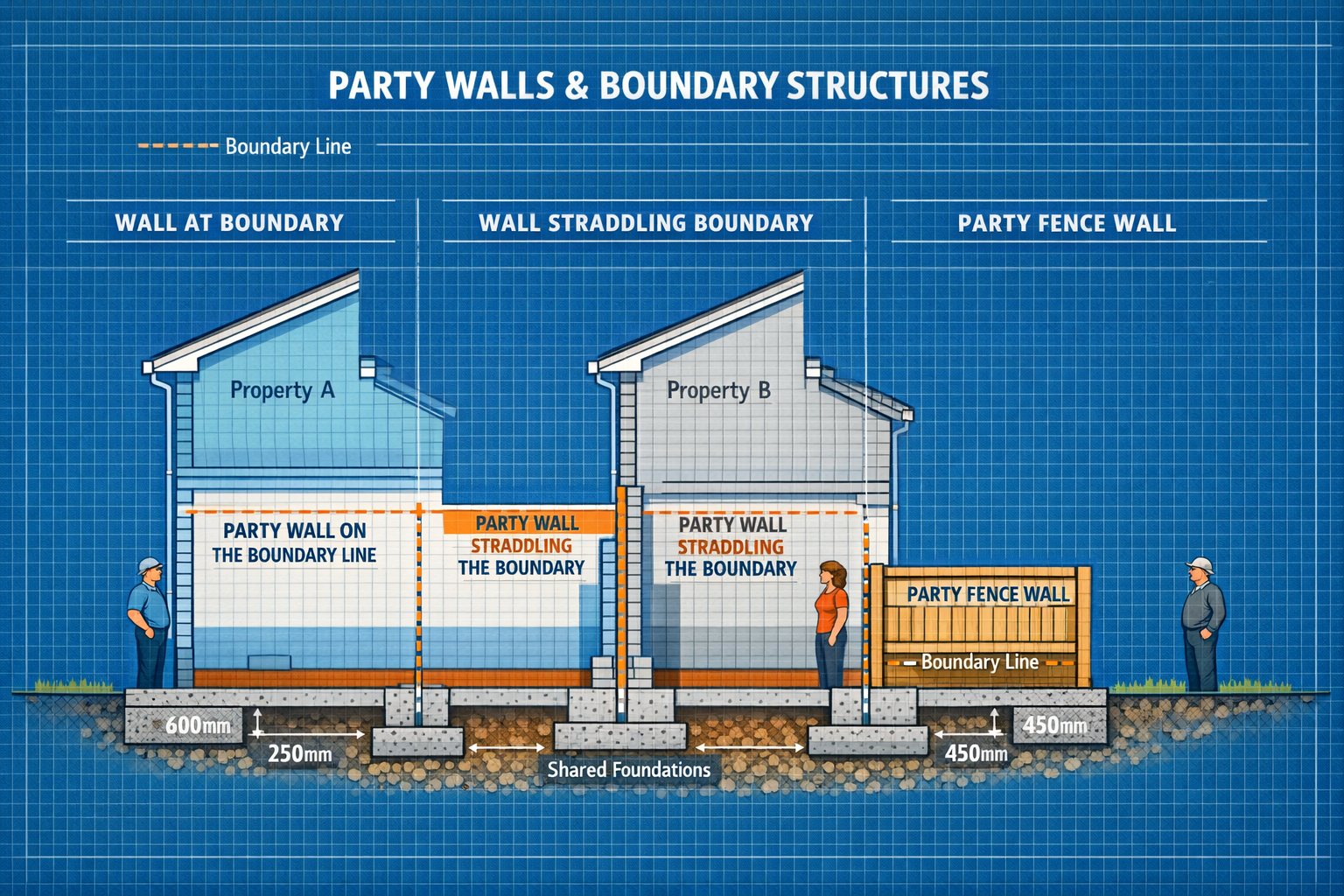
The Party Wall etc. Act 1996 is a piece of legislation that provides a framework for preventing and resolving disputes in relation to party walls, boundary walls, and excavations near neighbouring buildings. The Act came into force in England and Wales on 1 July 1997, extending protections that had previously only applied in Inner London to the entire region.
The primary purpose of the party wall act is to balance the rights of property owners who wish to carry out building work with the rights of their neighbours whose properties might be affected. It establishes a clear procedure that must be followed, ensuring that adjoining owners receive proper notice and have the opportunity to protect their interests.
Why Was the Party Wall Act Created?
Before the party wall act was introduced across England and Wales, property owners had limited legal recourse when neighbours undertook building work that could potentially damage their property. The legislation was designed to:
- ✅ Provide a clear legal framework for notifying neighbours about planned building works
- ✅ Establish formal procedures for resolving disputes without resorting to expensive court proceedings
- ✅ Protect the structural integrity of adjoining properties during construction work
- ✅ Create a record of condition for properties before work commences
- ✅ Ensure fair compensation if damage occurs as a result of building works
The Act recognizes that in densely populated areas, particularly in cities like London, properties are often built in close proximity. Understanding how close your neighbour can build to your fence is essential for knowing when the party wall act applies.
Understanding the Party Wall Act: Key Definitions
To properly navigate the party wall act, it’s essential to understand the specific terminology used within the legislation. These definitions determine when and how the Act applies to your building project.
What Is a Party Wall?
A party wall is a wall that stands on the land of two or more owners and forms part of a building. This typically includes:
- 🏘️ Walls separating semi-detached or terraced houses
- 🏢 Walls dividing flats within the same building
- 🧱 Walls separating commercial properties
- 🏗️ Garden walls built astride a boundary (party fence walls)
What Is a Party Structure?
A party structure is a broader term that includes party walls but also encompasses:
- Floors and ceilings between different properties (such as in flats)
- Partitions separating different parts of a building in different ownership
What Is a Building Owner?
The building owner is the person (or people) who wish to carry out the building work covered by the party wall act. This could be a homeowner, developer, or contractor acting on behalf of the property owner.
What Is an Adjoining Owner?
The adjoining owner is any person who owns property that shares a party wall or party structure with the building owner, or whose property is within the specified distance from proposed excavations.
Types of Work Covered by the Party Wall Act
The party wall act covers three distinct categories of building work. Understanding which category your project falls into is crucial for ensuring compliance with the legislation.
Section 1: New Building on the Boundary Line
This section covers situations where you want to build a new wall on the boundary line between your property and your neighbour’s. This includes:
- Building a new party wall or party fence wall on the boundary
- Placing footings or foundations for a new wall on your neighbour’s land (with their consent)
Important note: You cannot build astride the boundary line without your neighbour’s express written consent. If consent is refused, you must build the wall entirely on your own land.
Section 2: Work to Existing Party Walls
Section 2 is the most commonly used part of the party wall act and covers a wide range of works to existing party structures, including:
| Type of Work | Examples |
|---|---|
| Structural repairs | Underpinning, rebuilding, or strengthening a party wall |
| Alterations | Cutting into a party wall to insert beams or damp-proof courses |
| Demolition and rebuilding | Taking down and rebuilding a party wall |
| Raising or thickening | Adding height to a party wall or increasing its thickness |
| Cutting away | Removing chimney breasts or projections from a party wall |
| Special foundations | Installing special foundations on your land within certain distances of the boundary |
When planning significant property improvements, many homeowners work with professional surveyors to ensure all party wall requirements are properly addressed.
Section 6: Excavation Near Neighbouring Buildings
Section 6 applies when you plan to excavate within a certain distance of a neighbouring building. Notice must be served if you intend to:
- Excavate within three metres of a neighbouring structure, where the excavation will go deeper than the neighbour’s foundations
- Excavate within six metres of a neighbouring structure, where the excavation will cut a line drawn downward at 45 degrees from the bottom of the neighbour’s foundations
This section is particularly relevant for:
- 🏗️ Basement conversions and extensions
- 🏡 New build projects with deep foundations
- 🌳 Swimming pool installations
- 💧 Underground drainage works
The Party Wall Notice Process: Step-by-Step Guide
Navigating the party wall act requires following a specific procedure with strict timelines. Here’s a comprehensive breakdown of the process from start to finish.
Step 1: Determine If the Act Applies
Before beginning any building work, assess whether your project falls under one of the three categories covered by the party wall act. Consider:
- Does your work involve an existing party wall or party structure?
- Are you building a new wall on or near the boundary?
- Will you be excavating within three or six metres of a neighbouring building?
If the answer to any of these questions is yes, you’ll need to serve a party wall notice. Professional advice from experienced building surveyors can help you determine whether the Act applies to your specific circumstances.
Step 2: Prepare and Serve the Party Wall Notice
The building owner must serve the appropriate notice to all adjoining owners:
For Section 1 and 2 works (party walls):
- Serve a Party Structure Notice at least two months before the intended start date
- Include detailed information about the proposed works
- Provide drawings and specifications where applicable
For Section 6 works (excavations):
- Serve a Notice of Adjacent Excavation at least one month before the intended start date
- Include plans showing the excavation depth and proximity to the neighbour’s building
The notice must be served on all adjoining owners, which may include:
- Direct neighbours sharing a party wall
- Neighbours whose properties are within the excavation zone
- Landlords (if the adjoining property is rented)
- Leaseholders with sufficient remaining lease term
Step 3: Await the Adjoining Owner’s Response
Once served with a party wall notice, the adjoining owner has 14 days to respond. They have three options:
✅ Consent to the works – If the adjoining owner consents in writing, the building owner can proceed with the work as described in the notice, though it’s still advisable to have a schedule of condition prepared.
❌ Dissent or fail to respond – If the adjoining owner objects to the works or doesn’t respond within 14 days, this constitutes a “dispute” under the Act, triggering the formal dispute resolution process.
📝 Request additional information – The adjoining owner may ask for clarification or additional details about the proposed works before making a decision.
Step 4: Appoint Party Wall Surveyors
When a dispute arises (either through active dissent or non-response), both parties must appoint surveyors to resolve the matter. There are two options:
Option 1: Agreed Surveyor
- Both parties agree to appoint a single surveyor to act impartially for both sides
- This is often the most cost-effective approach
- The agreed surveyor must remain neutral and protect both parties’ interests
Option 2: Two Surveyors
- The building owner appoints their own surveyor
- The adjoining owner appoints a separate surveyor
- The two surveyors then jointly appoint a third surveyor who will resolve any disagreements between them
Understanding the cost of party wall surveyors is important for budgeting your project, as the building owner is responsible for all reasonable costs.
Step 5: The Party Wall Award
The appointed surveyor(s) will prepare a Party Wall Award, which is a legally binding document that sets out:
- 📋 Details of the work to be carried out
- 🛡️ How the adjoining owner’s property will be protected
- 📸 A schedule of condition documenting the state of the adjoining property before work begins
- ⏰ When and how the work will be carried out
- 💰 How any damage will be compensated
- 📞 Access arrangements for inspections
The Award must be served on both parties, and either party has 14 days to appeal to the County Court if they disagree with its contents.
Step 6: Commence Work and Ongoing Obligations
Once the Award is in place, the building owner can proceed with the work, but they must:
- Follow the conditions set out in the Award
- Allow the adjoining owner’s surveyor reasonable access to inspect the work
- Notify the surveyors when work commences and when it’s completed
- Address any damage that occurs as a result of the works
Common Scenarios Where the Party Wall Act Applies
Understanding real-world applications of the party wall act helps clarify when you need to follow the formal procedures. Here are the most common scenarios:
Loft Conversions
When converting a loft in a semi-detached or terraced property, you’ll typically need to serve party wall notices if you’re:
- Raising the height of the party wall
- Cutting into the party wall to insert steel beams
- Underpinning or strengthening the party wall
- Adding dormer windows that require structural alterations to the party wall
Basement Extensions and Conversions
Basement projects almost always trigger the party wall act because they involve:
- Excavating below the level of neighbouring foundations (Section 6)
- Underpinning party walls (Section 2)
- Cutting into party walls for access or structural support (Section 2)
Rear and Side Extensions
Building an extension may require party wall notices when:
- The extension is built up against or close to the boundary
- Foundations extend beneath the neighbour’s land or within the excavation zones
- Work involves raising, thickening, or cutting into an existing party wall
Removing Chimney Breasts
Removing a chimney breast from a party wall requires a party wall notice because it involves:
- Cutting away part of the party structure
- Potentially affecting the structural stability of the neighbour’s chimney breast
- Making alterations to the party wall
Garden Walls and Boundary Works
Building or repairing a garden wall on the boundary requires notice under Section 1 of the party wall act. This includes:
- Building a new party fence wall
- Repairing or rebuilding an existing boundary wall
- Raising the height of a boundary wall
Similar to boundary dispute considerations, party wall matters require careful documentation and professional guidance.
Rights and Responsibilities Under the Party Wall Act
The party wall act creates specific rights and obligations for both building owners and adjoining owners. Understanding these helps ensure smooth project completion.
Building Owner’s Rights
As the building owner, the party wall act gives you the right to:
- ✅ Carry out necessary building work to your property, even if it affects party structures
- ✅ Enter your neighbour’s property (with reasonable notice) to carry out work covered by the Act
- ✅ Appoint a surveyor to prepare a Party Wall Award if a dispute arises
- ✅ Proceed with work once proper procedures have been followed
Building Owner’s Responsibilities
However, these rights come with significant responsibilities:
- 💰 Bear all costs associated with the party wall process, including both surveyors’ fees (even the adjoining owner’s surveyor)
- 📝 Serve proper notice within the required timeframes
- 🛡️ Minimize inconvenience to adjoining owners during the work
- 💵 Compensate for damage caused by the building works
- 🔍 Allow inspections by the adjoining owner’s surveyor at reasonable times
- 📊 Make good any damage resulting from the works
Adjoining Owner’s Rights
As an adjoining owner, the party wall act protects you by giving you the right to:
- ✅ Receive proper notice of proposed works
- ✅ Appoint a surveyor (at the building owner’s expense) to protect your interests
- ✅ Have a schedule of condition prepared documenting your property’s state before work begins
- ✅ Receive compensation for any damage caused by the works
- ✅ Refuse consent to certain works (though this may not prevent them if they’re covered by the Act)
Adjoining Owner’s Responsibilities
Adjoining owners also have responsibilities:
- 📅 Respond to notices within the 14-day timeframe
- 🚪 Allow reasonable access for surveyors to inspect and for workers to carry out the work
- 🤝 Act reasonably in the dispute resolution process
- 📋 Appoint a surveyor promptly if dissenting to the works
The Role of Party Wall Surveyors
Party wall surveyors play a crucial role in ensuring the party wall act process runs smoothly and fairly. Understanding their function helps both building owners and adjoining owners navigate the system effectively.
What Does a Party Wall Surveyor Do?
A qualified party wall surveyor will:
- Advise on whether the Act applies to your proposed works
- Prepare and serve notices on behalf of building owners
- Inspect properties to create schedules of condition
- Draft Party Wall Awards that balance the interests of both parties
- Resolve disputes between building and adjoining owners
- Monitor works to ensure compliance with the Award
- Assess and resolve damage claims if issues arise during or after construction
Qualifications and Selection
When selecting a party wall surveyor, look for:
- 🎓 Professional qualifications (RICS, CIOB, or Faculty of Party Wall Surveyors membership)
- 📚 Specific experience and training in party wall matters
- 🏆 Good reputation and professional indemnity insurance
- 🗣️ Clear communication skills and local knowledge
- ⚖️ Impartiality and fairness (especially for agreed surveyors)
Many property owners work with established firms like Wimbledon Surveyors who have extensive experience with party wall matters across London.
Surveyor Fees and Who Pays
A common point of confusion concerns who pays for party wall surveyors. The general principle is:
The building owner pays all reasonable costs, including:
- Their own surveyor’s fees
- The adjoining owner’s surveyor’s fees
- The third surveyor’s fees (if appointed)
- Costs of preparing schedules of condition
- Reasonable costs of the Award preparation
The only exception is if the adjoining owner requests additional work beyond what’s reasonably necessary to protect their interests—in such cases, they may be liable for those extra costs.
Common Myths and Misconceptions About the Party Wall Act
Despite being in force since 1997, the party wall act remains surrounded by myths that can lead property owners astray. Let’s address the most common misconceptions.
Myth 1: “I Don’t Need to Serve Notice If My Neighbour Agrees”
Reality: Even if your neighbour verbally agrees to your building work, you must still follow the formal party wall notice procedure if the Act applies. Verbal agreements aren’t sufficient—you need written consent or a formal Party Wall Award.
Myth 2: “My Neighbour Can Stop My Building Work”
Reality: The party wall act gives adjoining owners rights to protect their property, but they cannot unreasonably prevent you from carrying out permitted development or work for which you have planning permission. The Act provides a framework for the work to proceed safely, not a veto for neighbours.
Myth 3: “I Can’t Afford Party Wall Surveyors”
Reality: While surveyor fees are an additional cost, they’re a necessary part of protecting both parties’ interests. The building owner must pay these fees, but they’re typically far less expensive than the legal costs and damages that can result from not following the proper procedure. Similar to understanding survey costs and negotiations, party wall expenses should be factored into project budgets.
Myth 4: “The Party Wall Act Only Applies in London”
Reality: While the party wall act originated in London, it now applies throughout England and Wales. Scotland and Northern Ireland have different legislation.
Myth 5: “I Don’t Need to Bother With Party Walls for Small Jobs”
Reality: The Act applies based on the type and location of work, not its size. Even relatively minor works like removing a chimney breast or inserting a single beam may require party wall notices if they affect a party structure.
Myth 6: “Party Wall Awards Take Forever”
Reality: While the process has specific timeframes, most party wall matters are resolved within 4-8 weeks. The two-month notice period for party structure works allows time for the surveyor appointment and Award preparation to proceed smoothly.
Consequences of Not Following the Party Wall Act

Failing to comply with the party wall act can have serious consequences for building owners. Understanding these risks emphasizes why proper procedure is essential.
Legal Action and Injunctions
If you proceed with work covered by the party wall act without serving proper notice, the adjoining owner can:
- ⚖️ Apply for a court injunction to stop the work immediately
- 💰 Sue for damages if their property is affected
- 📋 Force you to retrospectively follow the party wall procedure
- 🏗️ Require you to undo work already completed
Court proceedings are expensive and time-consuming, often costing far more than following the proper procedure from the outset.
Insurance Issues
Many building insurance policies and professional indemnity policies for contractors contain exclusions for work carried out in breach of the party wall act. This means:
- Your insurer may refuse to cover damage claims from neighbours
- Contractors may face uninsured liability for damage they cause
- You could be personally liable for all costs and damages
Project Delays
Discovering mid-project that you should have served party wall notices can cause:
- ⏸️ Complete work stoppages while notices are served and Awards prepared
- 📅 Delays of 2-3 months or more
- 💸 Additional costs for contractors standing idle
- 😤 Damaged relationships with neighbours and contractors
Difficulties Selling Your Property
If you complete work without following the party wall act:
- 🏠 Future buyers’ solicitors will identify the breach during conveyancing
- 📉 Property value may be affected
- 🔍 You may need to obtain retrospective Awards or indemnity insurance
- ⏱️ Sales may be delayed or fall through entirely
The Party Wall Act and Dispute Resolution
While the party wall act is designed to prevent disputes, disagreements can still arise. Understanding how the Act handles these situations is important for all parties involved.
When Do Disputes Arise?
Common sources of party wall disputes include:
- 🏗️ Scope of works – Disagreement about what work is necessary or appropriate
- 💰 Costs – Disputes over surveyor fees or compensation amounts
- ⏰ Timing – Concerns about when work will be carried out and noise/disruption
- 🏚️ Damage – Disagreement about whether damage was caused by the works
- 🔍 Access – Disputes over access requirements and frequency of inspections
The Three-Surveyor System
When building and adjoining owners each appoint their own surveyor, those two surveyors must work together to produce a Party Wall Award. If they cannot agree on any aspect:
- The third surveyor (appointed jointly by the two surveyors) will make the final decision
- The third surveyor’s determination is binding on both parties
- This system ensures that disputes are resolved without court proceedings
Appealing a Party Wall Award
Either party can appeal a Party Wall Award to the County Court within 14 days of receiving it. However, appeals are only successful if:
- The surveyor(s) acted outside their powers under the Act
- The Award contains a serious procedural error
- The surveyor(s) failed to consider relevant factors
Courts generally give significant weight to surveyors’ professional judgment, so appeals on technical matters rarely succeed.
Alternative Dispute Resolution
Before resorting to court appeals, parties can consider:
- 🤝 Mediation – A neutral mediator helps parties reach agreement
- 💬 Direct negotiation – Building and adjoining owners discuss concerns directly
- 📞 Surveyor discussions – Surveyors work to find middle ground on contentious issues
Party Wall Act Best Practices for Building Owners
Following best practices when navigating the party wall act can save time, money, and relationships with neighbours.
Plan Ahead
- 📅 Factor party wall procedures into your project timeline
- 💷 Budget for surveyor fees (typically £700-2,000+ depending on project complexity)
- 🗓️ Serve notices well in advance of your planned start date
- 📋 Gather all necessary drawings and specifications before serving notices
Communicate Openly
- 🗣️ Speak to your neighbours before serving formal notices
- 📝 Explain what work you’re planning and why
- 👂 Listen to their concerns and address them where possible
- 🤝 Maintain a positive relationship throughout the process
Appoint Qualified Professionals
- 🎓 Use experienced party wall surveyors with proper qualifications
- 🏗️ Ensure your builders understand party wall requirements
- 📐 Work with architects who factor party wall issues into designs
- 🔍 Consider having a pre-commencement survey to document existing conditions
Document Everything
- 📸 Take photographs of your neighbour’s property before work begins
- 📋 Keep copies of all notices, responses, and correspondence
- 🗂️ Maintain records of when notices were served
- 💼 Store Party Wall Awards and schedules of condition safely
Follow the Award
- ✅ Comply with all conditions in the Party Wall Award
- 🚧 Work within the specified hours and methods
- 🔔 Notify surveyors when work commences and completes
- 🛠️ Address any damage promptly and professionally
Party Wall Act Best Practices for Adjoining Owners
Adjoining owners also benefit from understanding how to protect their interests effectively under the party wall act.
Respond Promptly
- ⏰ Don’t ignore party wall notices—respond within the 14-day timeframe
- 📞 Contact the building owner if you need clarification
- 🤔 Consider whether you genuinely need to dissent or can consent with conditions
- 📝 Put all responses in writing
Appoint a Qualified Surveyor
- 🎯 Choose a surveyor with specific party wall experience
- 🆓 Remember that the building owner pays your surveyor’s reasonable fees
- 🗣️ Ensure your surveyor understands your concerns
- 📊 Ask your surveyor to explain the Award before it’s finalized
Understand Your Rights
- 📚 Read the party wall notice carefully
- ❓ Ask questions about anything you don’t understand
- 🛡️ Ensure a comprehensive schedule of condition is prepared
- 🔍 Request access for your surveyor to inspect the work
Be Reasonable
- ⚖️ Don’t use the party wall act to try to stop work unreasonably
- 💬 Communicate concerns clearly to your surveyor
- 🤝 Consider whether requests are proportionate to the risk
- 🏗️ Remember that the building owner has legitimate rights to carry out work
Monitor the Work
- 👀 Keep an eye on work progress (from your own property)
- 📸 Document any concerns with photographs
- 📞 Report issues to your surveyor promptly
- ✍️ Keep records of any damage or problems
The Party Wall Act in 2025: Recent Developments
As we move through 2025, several trends and developments are shaping how the party wall act is applied and interpreted.
Increased Awareness
More homeowners and builders are now aware of party wall requirements, thanks to:
- 🌐 Better information available online
- 📺 Property television programs highlighting party wall issues
- 🏛️ Stricter enforcement by local authorities
- 📰 High-profile cases receiving media attention
Technology Integration
Modern party wall practice increasingly uses technology:
- 📱 Digital schedules of condition with high-resolution photographs and videos
- 🖥️ Electronic service of notices and Awards
- 📊 3D modeling to illustrate proposed works
- 🎥 Virtual inspections and consultations
Professional Standards
The Faculty of Party Wall Surveyors and RICS continue to develop:
- 📘 Updated guidance notes and best practice documents
- 🎓 Enhanced training and qualification requirements
- ⚖️ Clearer fee guidelines and dispute resolution procedures
- 🔍 Improved standards for schedules of condition
Case Law Development
Recent court cases continue to clarify aspects of the party wall act, including:
- Interpretation of “reasonable” surveyor fees
- Requirements for proper service of notices
- Scope of surveyors’ powers and duties
- Compensation calculations for damage
Frequently Asked Questions About the Party Wall Act
Do I need party wall agreement for a single-storey extension?
It depends on the location and design of your extension. If the extension is built up against or close to a party wall, or if excavations for foundations fall within the Section 6 distances, you’ll need to serve party wall notices.
How long does the party wall process take?
The minimum timeframe is two months for party structure works (one month for excavations), but the entire process from serving notice to receiving an Award typically takes 6-12 weeks, depending on complexity and whether disputes arise.
Can I do the party wall notice myself?
Yes, you can prepare and serve party wall notices yourself, but many building owners use surveyors to ensure notices are properly drafted and served, reducing the risk of errors that could delay your project.
What happens if my neighbour refuses to appoint a surveyor?
If the adjoining owner doesn’t appoint a surveyor within 10 days of being requested to do so, the building owner’s surveyor can appoint a surveyor on their behalf under Section 10(4) of the Act.
Does the party wall act apply to flats?
Yes, the party wall act applies to flats where party structures (walls, floors, ceilings) separate different properties in different ownership.
Can I claim compensation for inconvenience?
The party wall act doesn’t provide for compensation for inconvenience alone. Compensation is only payable for actual damage, loss, or expense caused by the works.
Conclusion: Navigating the Party Wall Act Successfully
The party wall act may seem complex, but it serves a vital purpose in protecting the interests of all property owners when building work affects shared structures or boundaries. By establishing clear procedures, timeframes, and dispute resolution mechanisms, the Act enables necessary construction work to proceed while safeguarding neighbours’ rights.
Success with the party wall act comes down to three key principles:
- Early planning – Identify party wall requirements at the start of your project and factor them into timelines and budgets
- Professional guidance – Work with qualified party wall surveyors who understand the legislation and can navigate it efficiently
- Open communication – Maintain positive relationships with neighbours through transparent, respectful dialogue
Whether you’re a building owner planning an extension or an adjoining owner who’s received a party wall notice, understanding your rights and responsibilities under the Act empowers you to protect your interests effectively.
Next Steps
If you’re planning building work:
- ✅ Assess whether the party wall act applies to your project
- ✅ Contact experienced surveyors to discuss your requirements
- ✅ Budget for party wall costs in your overall project finances
- ✅ Serve notices with appropriate lead time before your planned start date
- ✅ Maintain good relationships with neighbours throughout the process
If you’ve received a party wall notice:
- ✅ Read the notice carefully and note the response deadline
- ✅ Speak to the building owner if you have questions or concerns
- ✅ Appoint a qualified surveyor to protect your interests (at the building owner’s expense)
- ✅ Ensure a comprehensive schedule of condition is prepared
- ✅ Monitor the work and report any issues promptly to your surveyor
The party wall act exists to facilitate necessary building work while protecting all parties involved. With proper understanding, professional guidance, and good faith cooperation, the process can proceed smoothly, enabling property improvements while preserving neighbourly relationships and protecting property values.
For expert guidance on party wall matters and comprehensive property surveying services across London, professional surveyors can provide the support you need to navigate the party wall act with confidence.