
The UK housing market is showing its first genuine signs of recovery after months of uncertainty, and building surveyors who understand these shifting patterns stand to benefit significantly. January 2026 delivered the largest monthly price rise in 25 years of analysis, with asking prices jumping by an impressive £9,893[1]. This remarkable surge signals that The 2026 UK Housing Market Recovery: What Building Surveyors Need to Know About Shifting Demand Patterns is not just a theoretical discussion—it's happening right now, and professionals need to adapt quickly.
After the autumn budget uncertainty that kept many sellers on the sidelines, the market has roared back to life with renewed confidence. Building surveyors must now navigate a landscape where buyer enquiries are improving, transaction volumes are rising, and regional variations are creating distinct opportunities across the country. Understanding these dynamics is essential for surveyors looking to position their services effectively and capitalize on the growing momentum.
Key Takeaways
- 📈 January 2026 saw exceptional market activity with the largest monthly price rise in 25 years, signaling strong recovery momentum that building surveyors can leverage for increased business opportunities
- 🏴 Regional variations are creating distinct opportunities, with Scotland and Northern England significantly outperforming London and the South, requiring surveyors to tailor their services geographically
- 💰 Improved affordability is driving demand, as wage growth of 17% over three years has vastly outpaced property price growth of just 1.5%, bringing more buyers into the market
- 🏦 FCA regulatory changes are enabling higher borrowing, particularly for first-time buyers, creating new client segments that require comprehensive survey services
- 📊 Long-term optimism exceeds short-term caution, with 12-month sales expectations at +35% despite near-term hesitation, indicating sustained demand for surveying services throughout 2026
Understanding the 2026 UK Housing Market Recovery Fundamentals
The housing market recovery in 2026 represents a fundamental shift from the challenging conditions that characterized much of 2024 and 2025. Building surveyors need to grasp the underlying mechanics driving this change to effectively position their services.
Price Stabilization Across the Nation
The RICS net balance for house prices over the past three months stands at -10%, a significant improvement from -19% in October 2025[2]. This steady progression indicates that prices are stabilizing at the national level, creating a more predictable environment for property transactions. For building surveyors, this stabilization means clients are more confident in proceeding with purchases, knowing that dramatic price fluctuations are less likely.
UK house prices rose 1% annually in January 2026, up from 0.6% in December, with average UK house prices now sitting at £271,000[3]. This modest but consistent growth pattern differs markedly from the volatile swings of previous years, providing a foundation for sustained transaction activity.
The January Surge and February Adjustment
The exceptional January performance—with asking prices jumping £9,893 and recording a 2.8% increase since December—represents pent-up demand released after autumn budget uncertainty[1]. Many sellers who had delayed listing their properties returned to market simultaneously, creating an unusual concentration of activity.
However, building surveyors should note that February saw a more cautious approach as the market normalized. This pattern suggests that while recovery is genuine, it won't necessarily maintain January's exceptional pace. Understanding this rhythm helps surveyors manage client expectations and plan resource allocation throughout the year.
Transaction Volume Recovery
Agreed sales reached a net balance of -9% in January, the least negative reading since June 2025[2]. This improvement in transaction volumes directly impacts surveying workload, as each agreed sale typically requires professional assessment before completion.
The improvement in building survey demand correlates directly with these rising transaction numbers. Surveyors should prepare for increased enquiries, particularly as buyers become more confident in proceeding with purchases.
Regional Variations in The 2026 UK Housing Market Recovery
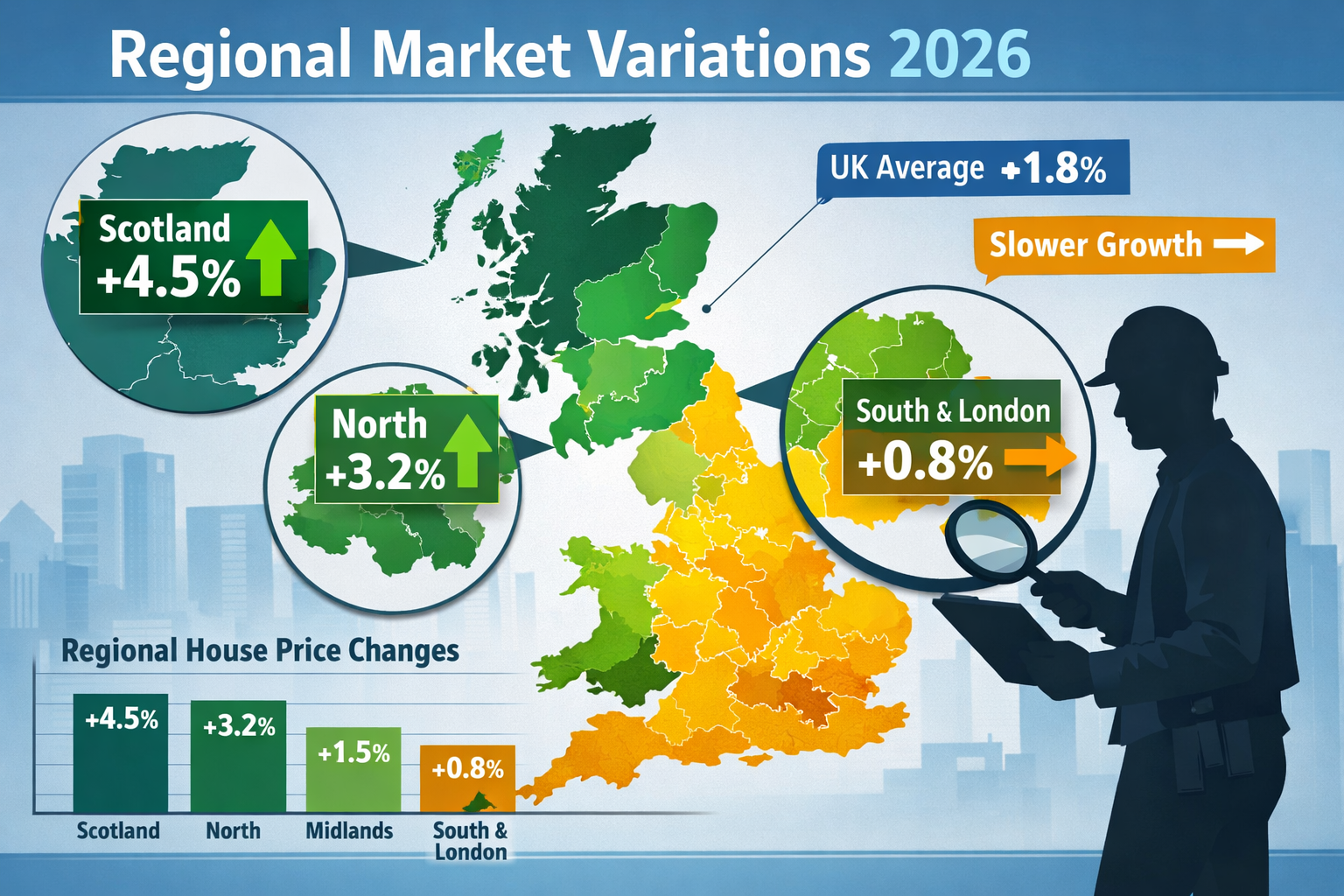
Understanding regional performance differences is crucial for building surveyors operating across multiple areas or considering geographic expansion. The 2026 recovery is notably uneven, with distinct patterns emerging across the UK.
Scotland and Northern England Leading Growth
Scotland continues to demonstrate the strongest performance with a 4.5% annual increase in house prices, significantly outpacing the national average[2][4]. Scotland's average house price stands at £193,000 as of November 2025, offering better affordability than many southern regions[4].
Northern Ireland and the North West and North of England are also experiencing upward price trends, driven by stronger affordability ratios and steady local economies. For building surveyors, these regions represent growth markets where demand for comprehensive structural surveys is likely to increase as transaction volumes rise.
Southern Regions Facing Affordability Challenges
London, the South East, South West, and East Anglia continue to lag in the recovery due to persistent affordability challenges[2]. England's average house price stands at £293,000, considerably higher than Scotland and Wales[4], creating barriers for many potential buyers.
Despite slower growth, these regions still generate significant surveying activity due to their large property markets. However, surveyors operating in these areas should expect more price-sensitive clients and potentially longer decision-making processes as buyers navigate affordability constraints.
Wales Showing Moderate Growth
Wales presents a middle ground with an average house price of £209,000 and a 0.7% annual increase[4]. This moderate performance suggests steady, sustainable growth that may appeal to buyers seeking value outside England's more expensive markets.
| Region | Average Price (Nov 2025) | Annual Growth Rate | Market Characteristics |
|---|---|---|---|
| Scotland | £193,000 | 4.5% | Strong growth, best affordability |
| Northern Ireland | N/A | Strong positive trend | Upward momentum |
| North England | Part of £293,000 England avg | Positive trend | Improving demand |
| Wales | £209,000 | 0.7% | Moderate, steady growth |
| London & South East | Part of £293,000 England avg | Lagging | Affordability challenges |
Building surveyors should tailor their service offerings based on these regional characteristics. High-growth areas may require faster turnaround times and capacity expansion, while slower markets may benefit from enhanced value propositions and detailed reporting that helps buyers make confident decisions despite affordability concerns.
Shifting Demand Patterns Building Surveyors Must Understand
The 2026 UK Housing Market Recovery: What Building Surveyors Need to Know About Shifting Demand Patterns extends beyond simple price movements to fundamental changes in buyer behavior and market dynamics.
Improving Buyer Enquiries Signal Growing Confidence
New buyer enquiries improved to a net balance of -15% in January, up from -21% in December and -29% in November[2]. This consistent improvement indicates easing downward pressure on demand and growing buyer confidence.
For building surveyors, this trend translates to earlier engagement in the property purchase process. Buyers making enquiries are increasingly likely to proceed to viewings and, subsequently, to commissioning surveys. Surveyors should prepare for lead times to shorten as buyers move more decisively through the purchase journey.
Understanding what to do before an RICS home survey becomes increasingly important as buyers seek to streamline their purchase process and avoid delays.
The First-Time Buyer Surge
One of the most significant demand shifts in 2026 is the renewed strength of the first-time buyer segment. The FCA's 2025 review of the loan-to-income cap and flexibility reminders to lenders have enabled typical buyers to borrow more[1]. Multiple lenders are actively developing new products to help eligible first-time buyers access larger sums, reflecting a positive shift in the lending environment.
This demographic shift has important implications for building surveyors:
- First-time buyers typically require more guidance during the survey process, creating opportunities for surveyors who offer educational resources and clear communication
- These buyers often purchase properties requiring renovation, increasing demand for detailed building condition assessments
- Budget consciousness is higher, making transparent pricing and value demonstration essential
- Digital engagement is preferred, requiring surveyors to offer online booking, digital reports, and responsive communication channels
Wage Growth Fundamentally Improving Affordability
Over the past three years, average wages have increased by approximately 17%, significantly outstripping property price growth of just 1.5%[1]. This dramatic improvement in affordability ratios represents the most significant structural change in the market.
This wage-to-price improvement means:
✅ More buyers qualify for mortgages at current price levels
✅ Deposit requirements become more achievable
✅ Monthly payment affordability improves substantially
✅ Buyer confidence increases as financial stress decreases
Building surveyors should recognize that this affordability improvement is driving genuine demand growth rather than speculative activity. Clients are more likely to be committed purchasers with solid financial foundations, reducing the risk of survey-related transaction collapses.
Short-Term Caution Versus Long-Term Optimism
An interesting pattern emerges when examining market expectations. Sales expectations for the next three months stand at +4%, reflecting near-term caution, but 12-month expectations surge to +35%—the strongest since December 2024[2].
This divergence tells building surveyors several important things:
- Buyers are positioning for future activity rather than rushing immediate purchases
- Market participants expect conditions to improve throughout 2026
- Transaction volumes may build gradually rather than spiking suddenly
- Long-term business planning should be optimistic while maintaining flexibility for short-term fluctuations
Surveyors should use this insight to balance immediate capacity with strategic growth planning. The strong 12-month outlook justifies investments in staff training, technology upgrades, and marketing initiatives that will pay dividends as the year progresses.
Adapting Survey Services for The 2026 UK Housing Market Recovery

Building surveyors who adapt their service offerings to match shifting demand patterns will capture disproportionate market share during the recovery. Several strategic adjustments can maximize opportunities.
Emphasizing Speed and Responsiveness
With agreed sales improving and buyer confidence growing, transaction timelines are accelerating. Surveyors who can offer rapid turnaround times without compromising quality will win more business.
Practical steps include:
- 🔧 Implementing digital booking systems that allow instant appointment scheduling
- 🔧 Offering priority service tiers for time-sensitive transactions
- 🔧 Streamlining report production with standardized templates and efficient workflows
- 🔧 Providing preliminary verbal feedback immediately after site visits
- 🔧 Utilizing mobile technology for on-site report drafting
Finding the best local surveyor near you increasingly depends on responsiveness and availability, making these operational improvements essential competitive advantages.
Tailoring Services to Regional Markets
Given the significant regional variations in market performance, surveyors should customize their approach based on local conditions.
In high-growth regions (Scotland, Northern England):
- Focus on capacity and volume handling
- Develop relationships with local estate agents experiencing increased activity
- Consider expanding service areas to capture growing demand
- Emphasize quick turnaround to match faster-moving markets
In slower-growth regions (London, South East):
- Emphasize detailed reporting that justifies the investment
- Highlight how surveys enable price negotiations in competitive markets
- Develop expertise in specific property types common in these areas
- Offer flexible payment options to address affordability concerns
Developing First-Time Buyer Packages
The surge in first-time buyer activity creates opportunities for surveyors to develop specialized service packages that address this demographic's specific needs.
Effective first-time buyer packages should include:
- Educational resources explaining the survey process and what to expect
- Clear, jargon-free reporting that non-experts can understand
- Budget-friendly pricing tiers without compromising essential coverage
- Renovation guidance identifying priority repairs versus cosmetic issues
- Follow-up consultation to answer questions after report delivery
Choosing between a homebuyers report or structural survey can be confusing for first-time buyers, making clear guidance a valuable service differentiator.
Expanding Specialist Survey Offerings
The recovery creates demand for specialized survey types that address specific property concerns increasingly important to buyers.
Damp surveys remain particularly relevant given the UK's climate and the prevalence of moisture issues in older properties. Understanding what a damp survey report contains and how to get one helps surveyors position this service effectively.
Party wall surveys become more important as renovation activity increases alongside the housing recovery. Knowing what a party wall surveyor does and their duties to homeowners enables surveyors to identify cross-selling opportunities.
Energy efficiency assessments are increasingly requested as buyers focus on running costs and environmental impact. Incorporating energy performance insights into standard surveys adds value without significant additional effort.
Leveraging Technology for Competitive Advantage
Modern building surveyors must embrace technology to meet client expectations and operate efficiently in a recovering market.
Key technology investments include:
| Technology | Benefit | Implementation Priority |
|---|---|---|
| Thermal imaging cameras | Detect hidden damp and insulation issues | High |
| Drone surveys | Assess roofs and chimneys safely and thoroughly | Medium |
| Digital report platforms | Deliver professional, interactive reports instantly | High |
| Customer relationship management (CRM) | Track leads and follow-ups systematically | High |
| Online booking systems | Reduce administrative burden and improve accessibility | Medium |
| Mobile survey apps | Complete reports on-site, reducing turnaround time | High |
Pricing Strategies for the Recovery Market
The 2026 recovery requires thoughtful pricing strategies that balance competitiveness with profitability.
Considerations for pricing in the recovery:
- Value-based pricing that emphasizes the financial protection surveys provide rather than competing solely on cost
- Tiered service levels allowing clients to choose appropriate depth of investigation for their circumstances
- Package deals combining multiple survey types (e.g., building survey plus damp assessment) at attractive rates
- Transparent pricing with no hidden fees, building trust with price-sensitive first-time buyers
- Regional adjustments reflecting local market conditions and competition
Demonstrating how an RICS survey can help negotiate property prices helps justify fees by showing surveys as investments rather than expenses.
Marketing Strategies for Building Surveyors in 2026
Capitalizing on The 2026 UK Housing Market Recovery: What Building Surveyors Need to Know About Shifting Demand Patterns requires effective marketing that reaches buyers at the right moment in their property journey.
Digital Marketing Fundamentals
The modern property buyer begins their journey online, making digital presence essential for building surveyors.
Essential digital marketing elements:
- Search engine optimization (SEO) ensuring your surveying practice appears when buyers search for services in your area
- Google Business Profile optimization with reviews, photos, and accurate service descriptions
- Educational content answering common buyer questions about surveys and property assessment
- Local landing pages targeting specific geographic areas you serve
- Mobile-optimized website providing seamless experience on smartphones and tablets
Building Strategic Partnerships
The housing transaction involves multiple professionals, creating partnership opportunities for surveyors.
High-value partnerships include:
- 🤝 Estate agents who can recommend your services to buyers they're working with
- 🤝 Mortgage brokers who understand when buyers need survey reports for lending decisions
- 🤝 Solicitors who can refer clients requiring specialist surveys during conveyancing
- 🤝 Property developers needing regular building condition assessments
- 🤝 Landlords and property managers requiring periodic inspections and compliance surveys
Content Marketing for Authority Building
Establishing authority through valuable content helps surveyors stand out in a competitive market.
Effective content topics for 2026:
- Regional market analysis showing local price trends and transaction volumes
- Case studies demonstrating how surveys identified significant issues and saved buyers money
- Seasonal property maintenance guides helping homeowners protect their investments
- First-time buyer education explaining the survey process step-by-step
- Common defects found in specific property types or construction periods
Leveraging Client Reviews and Testimonials
Social proof becomes increasingly important as buyers seek reassurance about service quality.
Review strategy essentials:
✨ Request reviews systematically after every successful survey completion
✨ Respond to all reviews professionally, thanking positive reviewers and addressing concerns constructively
✨ Showcase testimonials prominently on your website and marketing materials
✨ Use video testimonials when possible for greater authenticity and impact
✨ Highlight specific outcomes such as successful price negotiations or major issues identified
Seasonal Marketing Adjustments
The housing market exhibits seasonal patterns that surveyors should anticipate in their marketing.
Spring (March-May): Traditionally the busiest period, requiring maximum marketing investment and capacity preparation. Emphasize quick turnaround times and availability.
Summer (June-August): Sustained activity continues, though August may slow. Focus on maintaining visibility and capturing market share from competitors who reduce marketing.
Autumn (September-November): Second peak season as buyers aim to complete before Christmas. Highlight deadline-meeting capabilities and efficient service.
Winter (December-February): Traditionally slower, but 2026 started exceptionally strong. Use this period for relationship building, content creation, and strategic planning.
Operational Excellence for Sustained Growth
Building surveyors must establish operational foundations that support growth during the recovery while maintaining service quality.
Quality Assurance and Professional Standards
Maintaining high standards becomes more challenging as workload increases, but it's essential for long-term reputation and client satisfaction.
Quality assurance measures:
- 📋 Standardized inspection checklists ensuring comprehensive coverage of all property elements
- 📋 Peer review processes for complex or high-value surveys
- 📋 Continuing professional development keeping skills current with industry best practices
- 📋 RICS compliance maintaining professional standards and ethical requirements
- 📋 Insurance adequacy protecting both surveyor and client against potential issues
Capacity Planning and Resource Management
The improving market requires careful capacity planning to avoid being overwhelmed by demand or missing opportunities.
Capacity considerations:
- Hiring and training additional surveyors to handle increased workload
- Subcontractor relationships providing flexibility during peak periods
- Geographic coverage deciding which areas to serve and how to organize territories
- Appointment scheduling systems that maximize efficiency without overcommitting
- Administrative support ensuring surveyors focus on inspections rather than paperwork
Financial Management During Growth
Growth periods present both opportunities and risks that require careful financial management.
Financial priorities:
💷 Cash flow management ensuring survey fees are collected promptly to fund operations
💷 Investment decisions balancing growth spending with financial stability
💷 Pricing reviews adjusting fees to reflect market conditions and cost increases
💷 Profitability analysis understanding which services and client types generate best margins
💷 Reserve building creating financial cushion for potential market downturns
Client Communication Excellence
Superior communication differentiates excellent surveyors from average ones, particularly important when serving first-time buyers.
Communication best practices:
- Set clear expectations about timeline, process, and deliverables from initial contact
- Provide progress updates during the survey process, especially if delays occur
- Explain findings clearly using plain language supplemented by technical detail where appropriate
- Be available for questions after report delivery to ensure clients understand recommendations
- Follow up post-transaction to maintain relationships and encourage reviews
Future-Proofing Your Surveying Practice

While The 2026 UK Housing Market Recovery: What Building Surveyors Need to Know About Shifting Demand Patterns focuses on current conditions, successful surveyors must also prepare for longer-term evolution.
Sustainability and Energy Efficiency Expertise
Environmental concerns and energy costs are increasingly important to buyers, creating opportunities for surveyors who develop relevant expertise.
Developing sustainability capabilities:
- Understanding EPC ratings and how property features affect energy performance
- Identifying retrofit opportunities that improve efficiency and property value
- Recognizing renewable energy system installations and their condition
- Assessing insulation adequacy and thermal performance
- Evaluating sustainable building materials and construction methods
Technology Adoption and Innovation
The surveying profession continues to evolve technologically, with early adopters gaining competitive advantages.
Emerging technologies to monitor:
- Artificial intelligence for defect pattern recognition and report generation assistance
- Building information modeling (BIM) integration for new construction surveys
- Virtual reality property tours supplementing physical inspections
- Advanced moisture detection using non-invasive scanning technologies
- Automated measurement tools improving accuracy and efficiency
Regulatory and Legislative Awareness
Changes in building regulations, safety standards, and professional requirements affect surveying practice.
Key regulatory areas:
- Building safety legislation following Grenfell Tower tragedy
- Energy performance requirements and minimum standards
- Fire safety regulations for different property types
- Accessibility standards for residential properties
- Professional indemnity insurance requirements
Diversification Opportunities
While residential property surveys form the core business for many surveyors, diversification can provide stability and growth.
Potential service expansions:
- Commercial property surveys for business clients
- Expert witness services for property disputes
- Project monitoring for renovations and extensions
- Homebuyer consultancy beyond standard surveys
- Property investment due diligence for landlords and investors
Conclusion
The 2026 UK Housing Market Recovery: What Building Surveyors Need to Know About Shifting Demand Patterns represents a genuine opportunity for surveying professionals who understand and adapt to changing market dynamics. With January 2026 delivering the largest monthly price rise in 25 years, buyer enquiries improving consistently, and transaction volumes reaching their strongest levels since mid-2025, the recovery is real and building momentum[1][2].
Building surveyors must recognize that this recovery is characterized by distinct regional variations, with Scotland and Northern England significantly outperforming London and the South due to better affordability ratios[2][4]. The surge in first-time buyer activity, enabled by improved wage-to-price ratios and supportive lending conditions, creates new client segments requiring tailored service approaches[1].
The divergence between short-term caution (+4% three-month expectations) and strong long-term optimism (+35% twelve-month expectations) suggests sustained demand growth throughout 2026[2]. Surveyors who invest now in capacity, technology, marketing, and service quality will be positioned to capture disproportionate market share as the recovery progresses.
Actionable Next Steps for Building Surveyors
Immediate Actions (Next 30 Days):
- Review and optimize your digital presence, ensuring your website and Google Business Profile accurately reflect your services and availability
- Analyze your current pricing strategy and adjust if necessary to remain competitive while maintaining profitability
- Implement or improve your client review collection process to build social proof
- Assess your current capacity and identify potential bottlenecks that could limit growth
Medium-Term Actions (Next 90 Days):
- Develop specialized service packages targeting first-time buyers and other growing market segments
- Build strategic partnerships with estate agents, mortgage brokers, and solicitors in your area
- Invest in technology upgrades that improve efficiency and service quality
- Create educational content addressing common buyer questions and concerns
Long-Term Strategic Actions (Next 12 Months):
- Develop expertise in sustainability and energy efficiency to meet evolving buyer priorities
- Consider geographic expansion into high-growth regions if operationally feasible
- Build financial reserves to weather potential market fluctuations while maintaining growth investments
- Establish systematic quality assurance processes that scale with business growth
The 2026 housing market recovery is underway, creating conditions more favorable for building surveyors than any time since 2020. Those who act decisively to adapt their services, operations, and marketing to shifting demand patterns will thrive in this improving environment. The data clearly shows that buyers are returning to the market with improving confidence and financial capacity—building surveyors must be ready to serve them with excellence, efficiency, and expertise.
For surveyors seeking to maximize their success in this recovery, understanding that long-term optimism significantly exceeds short-term caution should inform strategic planning. The +35% twelve-month sales expectation indicates that conditions will continue improving throughout 2026, justifying investments in growth that may take time to generate returns[2].
The combination of price stabilization, improving transaction volumes, regional growth opportunities, and fundamental affordability improvements creates the strongest foundation for sustained housing market activity in years. Building surveyors who position themselves strategically now will not only benefit from the 2026 recovery but establish competitive advantages that extend well beyond this year.
References
[1] February House Prices Fall Uk B2920773 – https://www.the-independent.com/news/uk/home-news/february-house-prices-fall-uk-b2920773.html
[2] Uk Resi Survey Jan 2026 Report Shows Early Signs Market Recovery Despite Caution – https://www.rics.org/news-insights/uk-resi-survey-jan-2026-report-shows-early-signs-market-recovery-despite-caution
[3] House Prices – https://moneyweek.com/investments/house-prices/house-prices
[4] January2026 – https://www.ons.gov.uk/economy/inflationandpriceindices/bulletins/privaterentandhousepricesuk/january2026
[5] Uk Rics Residential Market Survey Jan 2026 – https://www.capitaleconomics.com/publications/uk-housing-market-update/uk-rics-residential-market-survey-jan-2026