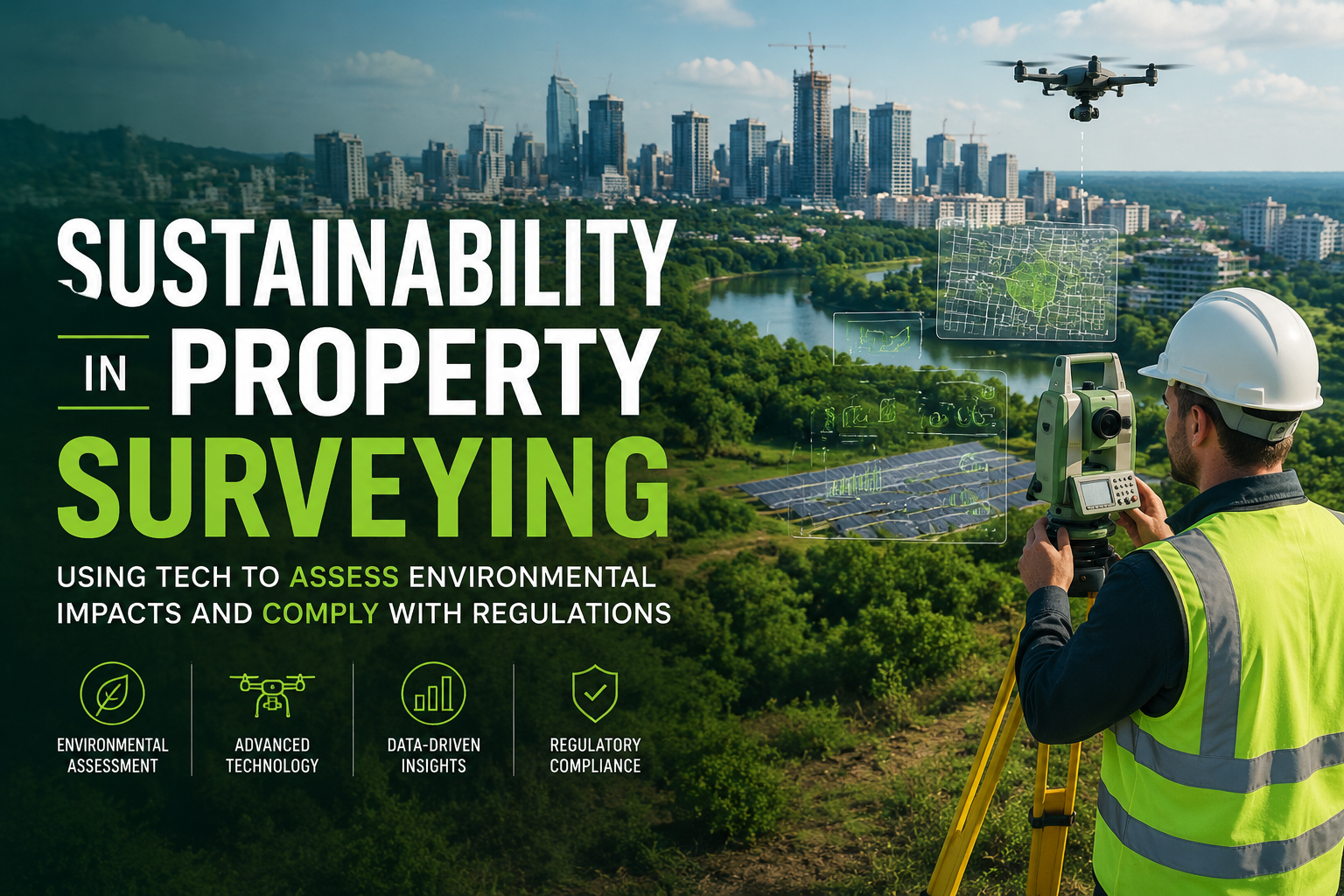
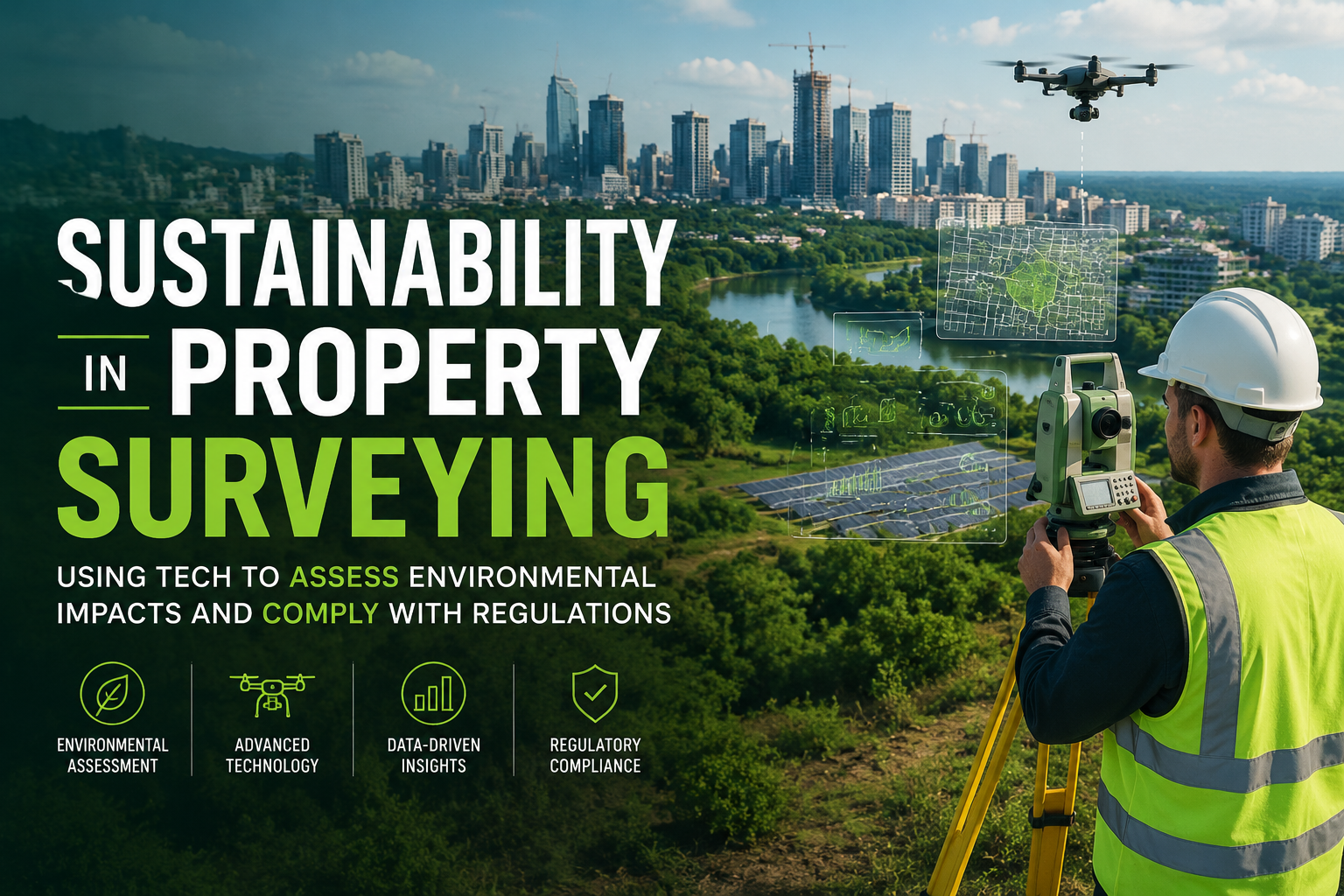
{"cover":"Professional landscape format (1536×1024) hero image with bold text overlay: 'Sustainability in Property Surveying: Tech, Ecology & Compliance in 2026' in extra large 72pt white bold sans-serif font with dark semi-transparent background panel, centered upper-third composition. Background shows aerial drone view of a green urban development site with solar panels, wetland buffer zones, and a surveyor using a tablet with GIS overlays visible on screen. Color palette: deep forest green, white, and slate blue accents. Magazine cover aesthetic, editorial quality, high contrast, cinematic lighting.","content":["Wide-angle landscape format (1536×1024) showing a property surveyor in high-visibility vest operating a drone above a mixed-use development site, with a laptop displaying GIS flood-risk and habitat-connectivity overlays in the foreground. Background features green rooftops, biodiversity corridors, and urban wetland areas. Soft golden-hour lighting, rich greens and blues, photorealistic editorial style. Text annotation overlay: 'Ecological Forecasting Tools 2026' in small caption font bottom-left.","Landscape format (1536×1024) close-up infographic-style image of a digital twin interface on a large monitor showing a 3D building model with color-coded energy performance zones, IoT sensor data streams, carbon emissions metrics, and EPC compliance trajectory charts. A professional surveyor's hands are visible on the keyboard. Background: modern clean office with sustainability certification plaques (BREEAM, LEED) on the wall. Color scheme: teal, white, dark charcoal. Data-rich, tech-forward, editorial quality.","Landscape format (1536×1024) showing a split-scene composition: left half features a property surveyor reviewing a sustainability compliance checklist on a tablet at a construction site with prefabricated components visible; right half shows a clean infographic panel with icons representing EPC ratings, biodiversity net gain metrics, embodied carbon scores, and CSRD reporting logos. Warm natural light on site, cool blue tones on the infographic panel. Professional, editorial quality, clear visual contrast between field work and regulatory reporting."}
Two-thirds of global real estate investors still rank sustainability as central to their investment strategy in 2026 — and nearly half plan to increase sustainability activity this year, according to a GRESB–MIPIM survey of approximately 200 investors [3]. That is not a marginal trend. It is a structural shift that is rewriting what a property survey must deliver. Sustainability in property surveying: using tech to assess environmental impacts and comply with regulations is no longer a niche specialism — it is fast becoming the baseline expectation for any credible survey report.
From ecological forecasting tools that model habitat corridors before a single spade breaks ground, to AI-enhanced GIS platforms that overlay flood-risk and soil-stability data in real time, the surveying profession is undergoing a quiet but profound transformation. This article unpacks the tools, the regulations, and the practical steps that property surveyors — and the clients who rely on them — need to understand right now.
Key Takeaways 🌿
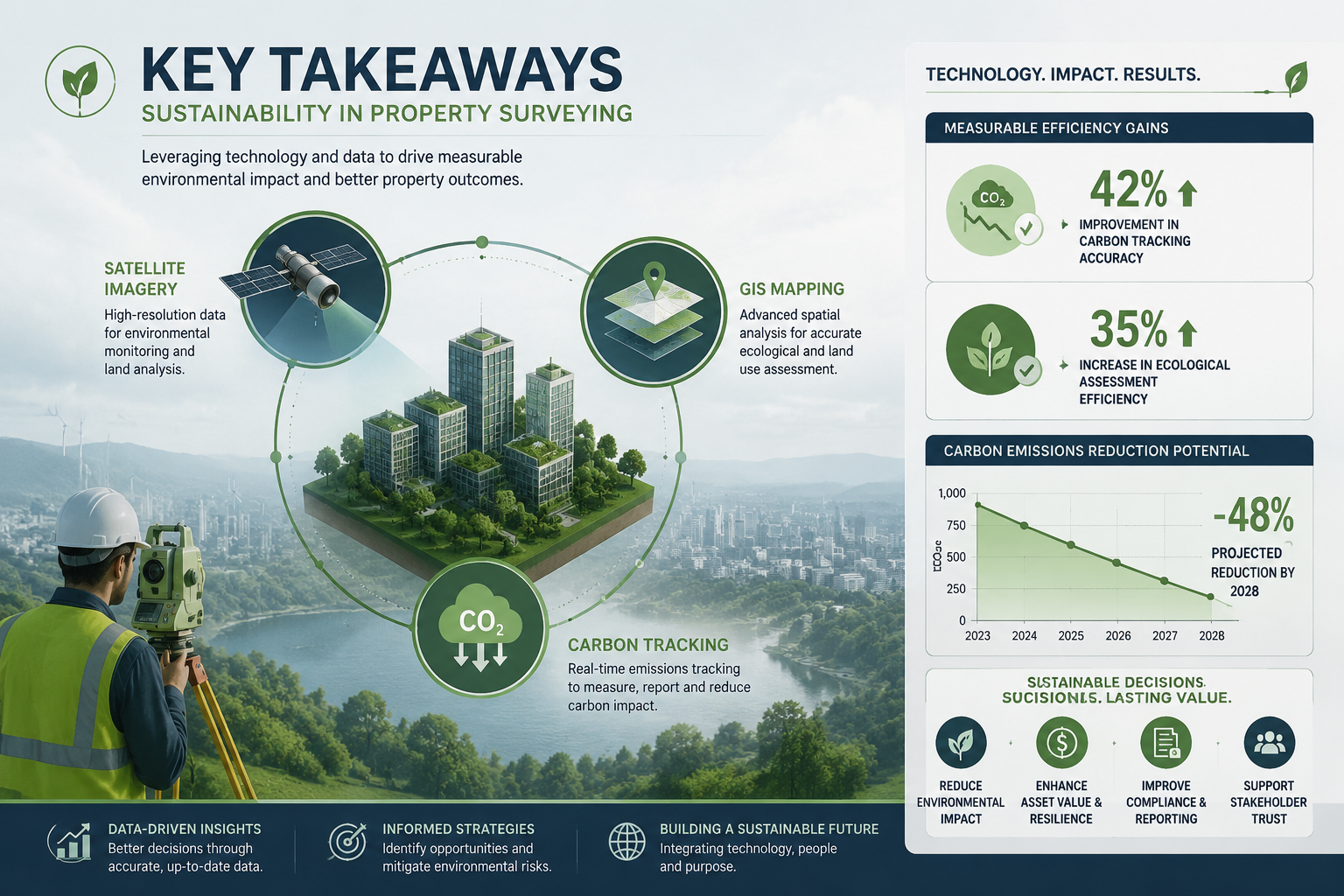
- Ecological forecasting tools (GIS, LiDAR, AI models) now allow surveyors to simulate development impacts on habitats and biodiversity before site disturbance occurs [4].
- Digital twins and IoT sensors feed operational carbon and energy data directly into compliance platforms, supporting CSRD, BREEAM, and LEED reporting [6].
- Stranded-asset risk is rising sharply; surveyors must now include EPC trajectory checks and climate-resilience assessments alongside traditional condition reporting [9].
- Drones and LiDAR are cutting field time while delivering richer environmental datasets — including drainage modelling and solar-exposure mapping — at accessible price points [8].
- Green building verification is a growing surveyor role: 78% of builders now minimise construction waste by design, and surveyors are increasingly asked to verify these practices on-site [2].
Why Sustainability in Property Surveying Is Reshaping the Profession in 2026
The Regulatory Pressure Is Real — and Tightening
The days when an energy performance certificate felt like a box-ticking exercise are over. Across Europe, minimum energy-performance standards are tightening on fixed timelines, carbon-pricing mechanisms are expanding, and biodiversity net-gain requirements are becoming statutory conditions of planning consent. The ULI/PwC Emerging Trends in Real Estate® Europe analysis confirms that both transition risk (tightening rules) and physical climate risk (flooding, heatwaves, wildfires) are now among the top threats to asset values [9].
For property surveyors, this creates a clear mandate: surveys must go beyond describing current condition and start quantifying regulatory alignment. That means checking an asset's EPC trajectory against minimum-standard deadlines, identifying the capital expenditure needed to reach compliance, and flagging local flood-zone or urban-heat constraints that could affect insurability or value.
The International Valuation Standards Council's 2025–26 ESG/Sustainability Survey reinforces this point, noting growing expectations that valuation professionals explicitly incorporate ESG and climate-risk factors — and that the evidence must be standardised and audit-ready for regulators, lenders, and investors [5].
From Condition to Consequence: A New Survey Scope
Traditional building surveys focused on physical condition: dampness, structural movement, roof integrity, services. That scope is expanding. A sustainability-focused survey in 2026 is expected to address:
| Traditional Survey Element | Sustainability Extension |
|---|---|
| Roof condition | Solar-PV suitability, thermal bridging |
| Drainage assessment | SuDS compatibility, flood-path modelling |
| Wall construction | Embodied carbon, material passport data |
| Services condition | Smart-meter/BMS data, operational carbon baseline |
| Site boundaries | Ecological buffer zones, no-build areas |
| Structural integrity | Climate-resilience rating, subsidence risk from tree roots |
💬 "Sustainability must be embedded at the core of projects at every stage — not bolted on at the end." — RICS guidance on evolving building standards [1]
This expanded scope is not optional for surveyors working on assets targeted by institutional investors or subject to planning conditions. It is the new professional standard.
Ecological Forecasting and GIS: The Tech Toolkit for Environmental Impact Assessment
Modelling Impacts Before Ground Is Broken
One of the most significant advances in sustainability in property surveying: using tech to assess environmental impacts is the ability to forecast ecological consequences before any physical work begins. AI-enhanced GIS platforms can now overlay flood-risk layers, soil-stability data, and protected-habitat maps on top of topographic surveys, producing combined "constraints and opportunities" maps that planners and environmental regulators increasingly expect to see [4].
Specific capabilities now available to surveyors include:
- 🗺️ Erosion pattern modelling — simulating how site disturbance will affect soil loss and sediment movement
- 🦔 Habitat connectivity analysis — assessing how development will fragment or preserve species-movement corridors
- 💧 Flood-path simulation — identifying how altered drainage will affect downstream properties and wetlands
- 🌿 Biodiversity net-gain calculations — quantifying baseline habitat value and modelling post-development outcomes
These tools are not just useful for large commercial schemes. Even residential developments face stricter biodiversity net-gain requirements under current planning policy, meaning that building regulations compliance now has an ecological dimension that surveyors must be equipped to address.
Drones, LiDAR, and High-Resolution Environmental Data
Drones and LiDAR are transforming the economics of environmental data capture. Where a traditional topographic survey might take days of manual fieldwork, drone-mounted LiDAR can produce high-resolution terrain models in hours — at a price point that developers and individual property owners can absorb [8].
The environmental applications of this technology are substantial:
- Drainage and runoff modelling for sustainable drainage systems (SuDS) design
- Solar-exposure mapping to assess photovoltaic potential on rooftops and open land
- Tree canopy analysis to identify root-spread zones that may cause subsidence or affect drainage
- Wetland boundary delineation for environmental-impact assessments
GNSS receivers, robotic total stations, and integrated field software are now routinely combined with cloud platforms for data sharing and quality assurance. These tools capture the precise spatial context needed for environmental-impact assessments — including wetland boundaries, buffer zones, and no-build areas required by planning and environmental regulators [10].
Geographic Information Systems in Practice
GIS is the connective tissue of modern environmental surveying. By layering multiple datasets — land registry boundaries, flood-zone maps, habitat surveys, soil classifications, air-quality data — surveyors can produce outputs that go far beyond a traditional site plan. For clients navigating planning permission guidelines, a GIS-based constraints map can be the difference between a smooth application and a costly objection.
The practical workflow typically looks like this:
- Data ingestion — importing OS base maps, Environment Agency flood data, Natural England habitat layers
- Field capture — drone survey, GNSS points, site photographs with geotagged metadata
- AI-assisted analysis — automated identification of protected species indicators, erosion risk zones, connectivity gaps
- Output generation — constraints maps, biodiversity metric calculations, planning-condition evidence packs
Digital Twins, IoT, and Carbon Compliance: Sustainability in Property Surveying Meets Smart Building Data
Operational Carbon: From Estimate to Evidence
For years, operational carbon figures in survey reports were educated estimates based on construction type and age. That is changing rapidly. Smart meters, building management systems (BMS), and IoT sensor networks now generate continuous, granular data on energy consumption, heating profiles, and indoor environmental quality. Integrating these datasets into survey reports is increasingly expected by building owners aiming to comply with net-zero-aligned regulations [1].
The business case is compelling. Leading firms are turning data-driven sustainability reporting into measurable ROI, using software platforms that consolidate energy, emissions, and waste data from assets [6]. Digital twins — virtual replicas of buildings fed by live sensor data — allow surveyors to:
- Identify retrofit opportunities with the highest carbon-reduction yield
- Model the impact of proposed improvements before committing capital expenditure
- Generate audit-ready evidence for disclosure frameworks such as CSRD, GRESB, and national building-performance standards
For clients considering a stock condition survey across a portfolio of properties, digital twin integration can dramatically reduce the cost of ongoing compliance monitoring while improving data quality.
Embodied Carbon and Material Passports
Operational carbon is only half the picture. Embodied carbon — the emissions locked into building materials during manufacture, transport, and construction — is now a focus of both voluntary frameworks and emerging regulation. RICS guidance stresses the transition towards circular-economy design, including material passports and design for disassembly, as core elements of sustainability-focused surveying [1].
In practice, this means surveyors are increasingly asked to:
- Document material origins and carbon coefficients during property condition assessments
- Verify prefabrication usage and waste-diversion rates on construction sites
- Assess the reuse potential of existing building fabric before recommending demolition
NAHB survey data shows that 78% of builders now minimise construction waste by design and 64% use prefabricated components on more than half of projects [2]. Surveyors who can verify these practices on-site add direct value to green-building certification processes and lender ESG requirements.
ESG Metrics and the Stranded-Asset Problem
The concept of a "brown discount" — a reduction in asset value for properties that fail to meet evolving energy and carbon standards — is moving from theory to transaction reality. Commercial real estate commentary for 2026 is clear: sustainability performance is now closely tied to asset value, with ESG-driven retrofits becoming a key differentiator for investors seeking to avoid stranded-asset risk [7].
For surveyors, this translates into a new set of questions that every pre-acquisition report should address:
- ✅ What is the current EPC rating, and what is the trajectory to meet future minimum standards?
- ✅ What capital expenditure is required to reach compliance by the relevant deadline?
- ✅ Are there physical climate risks (flooding, overheating, subsidence) that could affect insurability or value?
- ✅ Does the asset meet the indoor-environmental-quality standards that occupiers increasingly demand?
- ✅ Are there ecological constraints on the site that could restrict future development or change of use?

Supporting Green Building Certifications and Regulatory Compliance
What Surveyors Need to Verify for BREEAM, LEED, and Beyond
Green building certifications such as BREEAM and LEED are no longer the preserve of flagship commercial developments. They are increasingly required by institutional investors, public-sector clients, and major occupiers as a condition of lease or funding. Surveyors play a critical role in the evidence-gathering process that underpins these certifications.
Key areas where surveyor input is required include:
| Certification Area | Surveyor Role |
|---|---|
| Energy performance | BMS/smart-meter data review, EPC assessment |
| Water efficiency | Fixture specification verification, leak detection |
| Materials and waste | Waste-diversion rate verification, material passport review |
| Land use and ecology | Biodiversity metric calculation, habitat survey |
| Indoor environment | Air quality, daylight, and acoustic measurement |
| Transport | Proximity to public transport, cycle infrastructure |
Navigating the Regulatory Landscape in 2026
The regulatory environment for property sustainability is complex and evolving quickly. Surveyors operating across different local authority areas need to stay current with:
- Minimum Energy Efficiency Standards (MEES) — ongoing tightening of EPC thresholds for let properties
- Biodiversity Net Gain — now a statutory requirement for most new developments in England
- Future Homes Standard — setting new benchmarks for new-build energy performance
- CSRD (Corporate Sustainability Reporting Directive) — requiring large companies to disclose building-level environmental data
- Local planning conditions — increasingly including requirements for green roofs, SuDS, and ecological management plans
For clients navigating neighbour and building regulations alongside sustainability requirements, the interactions between these frameworks can be complex. A surveyor with strong technical knowledge of both traditional regulatory compliance and emerging sustainability standards is an invaluable guide.
Practical Steps for Surveyors and Clients
The shift towards sustainability-integrated surveying does not happen overnight. Here are actionable steps for both surveyors and their clients:
For Surveyors:
- Invest in GIS and drone-survey capability, or build relationships with specialist ecological surveyors
- Develop familiarity with digital-twin platforms and IoT data integration
- Build sustainability checklists into standard survey templates — EPC trajectory, flood risk, biodiversity constraints
- Stay current with RICS guidance on embodied carbon, material passports, and circular-economy design [1]
- Develop the ability to produce audit-ready ESG data that feeds directly into valuation models [5]
For Property Owners and Investors:
- Commission sustainability-extended surveys before acquisition, not after
- Request EPC trajectory analysis and climate-resilience assessments as standard deliverables
- Use digital-twin and IoT data to build continuous compliance monitoring into asset management
- Engage surveyors who can verify green-building practices on-site to support certification and lender requirements
- Factor stranded-asset risk into acquisition pricing and hold-period planning [7]
Conclusion: The Surveyor as Environmental Intelligence Provider
The role of the property surveyor is expanding in a direction that was barely imaginable a decade ago. Sustainability in property surveying: using tech to assess environmental impacts and comply with regulations is not a future aspiration — it is the current competitive frontier. Surveyors who master ecological forecasting tools, GIS-based environmental analysis, digital-twin integration, and carbon-compliance reporting will be indispensable to clients navigating an increasingly demanding regulatory and investment landscape.
The tools are available. The regulations are tightening. The investor demand is documented. What remains is the professional commitment to embed sustainability intelligence into every survey, at every stage, for every client.
Actionable next steps:
- 🔍 Review your current survey templates against the sustainability checklist above
- 📊 Explore GIS and drone-survey partnerships if in-house capability is limited
- 📋 Request a sustainability-extended survey scope on your next acquisition or property inspection
- 💬 Speak to a qualified surveyor about how digital-twin and IoT data can support your compliance obligations
References
[1] Navigating The Landscape Of Evolving Building Standards While Excelling In Sustainability – https://www.rics.org/news-insights/navigating-the-landscape-of-evolving-building-standards-while-excelling-in-sustainability
[2] How Green Building Is Shaping The Future Of Construction – https://www.nahb.org/blog/2024/11/how-green-building-is-shaping-the-future-of-construction
[3] Sustainability Remains Central For Real Estate Investors Despite Esg Pushback Gresb Mipim Survey Finds – https://www.gresb.com/insights/sustainability-remains-central-for-real-estate-investors-despite-esg-pushback-gresb-mipim-survey-finds/
[4] Sustainability Driven Ecological Forecasting In Property Surveys Tools For 2026 Green Development Compliance – https://princesurveyors.co.uk/blog/sustainability-driven-ecological-forecasting-in-property-surveys-tools-for-2026-green-development-compliance/
[5] Esg Sustainability Survey 2025 26 – https://ivsc.org/esg-sustainability-survey-2025-26/
[6] The State Of Sustainability In 2026 Progress Pressure And The Path Forward – https://www.sweep.net/blog/the-state-of-sustainability-in-2026-progress-pressure-and-the-path-forward
[7] Brad Dockser 83467018 2026 Outlook The Trends Reshaping Commercial Activity – https://www.linkedin.com/posts/brad-dockser-83467018_2026-outlook-the-trends-reshaping-commercial-activity-7417232069082243072-3dRq
[8] Land Survey Costs In 2026 Price Trends Technologys Impact And Budget Planning For Property Owners – https://wimbledonsurveyors.com/land-survey-costs-in-2026-price-trends-technologys-impact-and-budget-planning-for-property-owners/
[9] Emerging Trends In Real Estate® Europe – ULI / PwC – https://europe.uli.org/research/emerging-trends/
[10] Trimble Survey 2026 Market Survey – https://www.facebook.com/TrimbleSurvey/posts/our-2026-market-survey-is-now-open-the-tools-and-technologies-defining-our-indus/1437123845121843/