
Surveyor Social Housing: The Complete Professional Guide for 2026

When thousands of families depend on safe, well-maintained homes, the role of a surveyor social housing specialist becomes absolutely critical. These professionals stand between potential disasters and secure living conditions, ensuring that affordable housing stock remains fit for purpose across the United Kingdom. In 2026, as housing associations manage over 2.5 million properties nationwide, the demand for qualified surveyors who understand the unique challenges of social housing has never been greater.
Key Takeaways
- Surveyor social housing professionals specialize in inspecting, maintaining, and improving affordable housing stock for local authorities and housing associations
- Qualifications require RICS accreditation, specialized knowledge of building pathology, and understanding of social housing regulations and tenant welfare considerations
- Career opportunities in this sector offer competitive salaries ranging from £28,000 for trainees to £65,000+ for senior chartered surveyors with specialist expertise
- Social housing surveyors address unique challenges including high-volume inspections, diverse property types, regulatory compliance, and balancing cost-efficiency with quality standards
- The sector faces growing demand due to building safety legislation, decarbonization targets, and increased focus on housing quality following recent regulatory changes
What Is a Surveyor Social Housing Specialist?
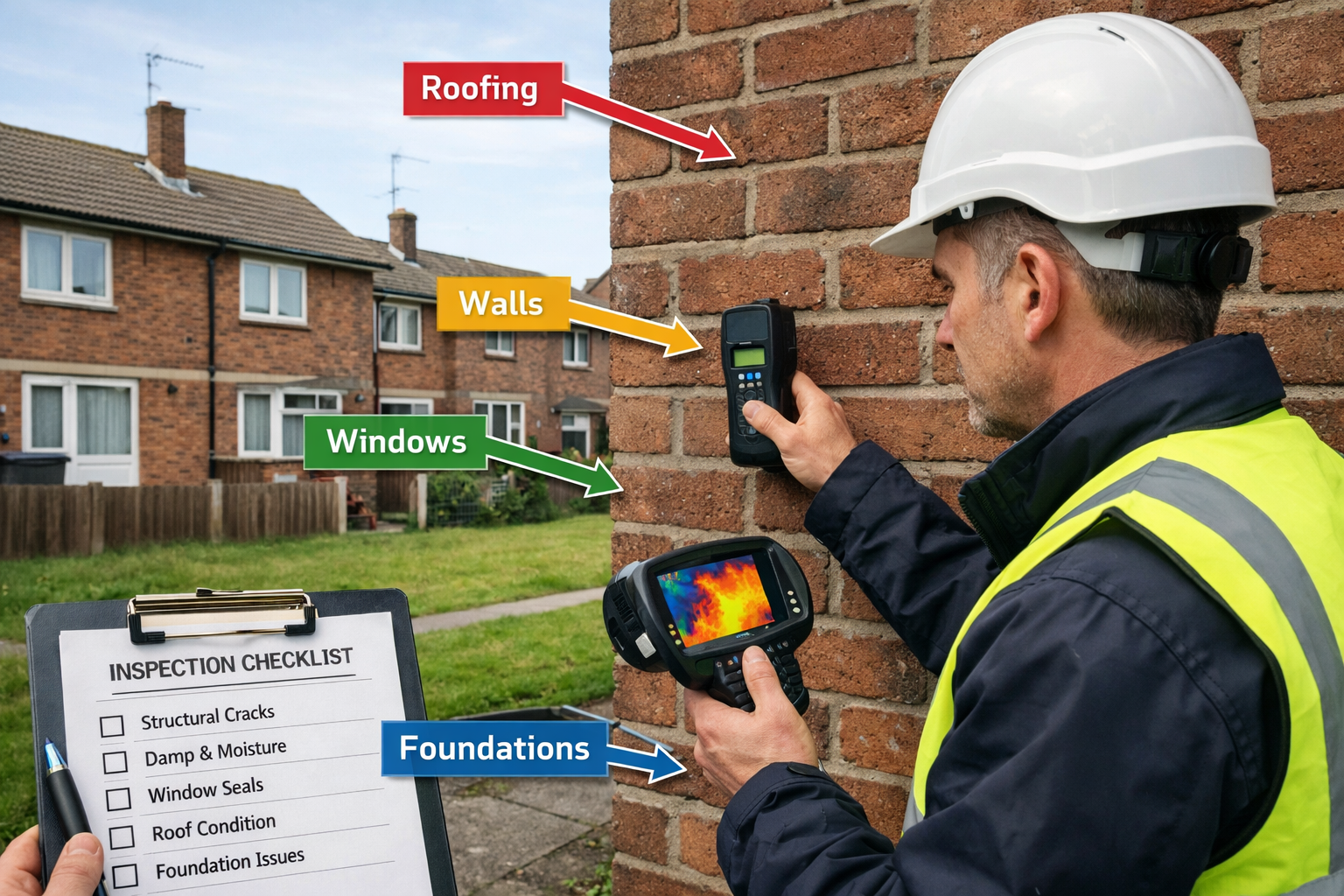
A surveyor social housing professional is a qualified building surveyor who specializes in the inspection, maintenance, and strategic management of affordable housing properties. Unlike surveyors working in the private residential sector, these specialists work primarily with local authorities, housing associations, and registered providers to ensure their housing stock meets regulatory standards while remaining cost-effective to maintain.
These professionals combine traditional surveying skills with specialized knowledge of:
✅ Social housing regulations and compliance requirements
✅ Decent Homes Standard and quality benchmarks
✅ Stock condition surveys across large property portfolios
✅ Planned maintenance programs and lifecycle costing
✅ Building safety and fire risk assessment
✅ Energy efficiency and decarbonization strategies
The role extends far beyond simple property inspections. Social housing surveyors must balance technical expertise with social responsibility, understanding that their assessments directly impact vulnerable residents’ quality of life.
The Distinction from Private Sector Surveyors
While all qualified surveyors share fundamental competencies, social housing specialists develop expertise in areas rarely encountered in private practice. They manage portfolio-wide strategies rather than individual transactions, working with properties that may include:
- Post-war council estates with non-traditional construction
- High-rise residential blocks requiring specialized access equipment
- Sheltered housing schemes with accessibility considerations
- Mixed-tenure developments with complex management structures
Professional chartered surveyors working in this sector must also navigate the political and social dimensions of affordable housing, understanding funding mechanisms, tenant consultation requirements, and the broader policy landscape.
Core Responsibilities of a Surveyor Social Housing Professional
The day-to-day work of a surveyor social housing specialist encompasses a diverse range of technical and strategic responsibilities. Understanding these duties helps clarify why this specialization requires such comprehensive training and expertise.
Property Inspections and Condition Surveys
Stock condition surveys form the backbone of social housing asset management. Surveyors systematically inspect properties to:
- Identify defects, disrepair, and maintenance requirements
- Assess compliance with health and safety standards
- Evaluate remaining life expectancy of building components
- Prioritize repair and replacement programs
- Estimate costs for planned maintenance schedules
These inspections differ significantly from standard building surveys conducted for property purchases. Social housing surveyors must process high volumes efficiently while maintaining rigorous standards, often inspecting 8-12 properties daily across geographically dispersed portfolios.
Planned Maintenance and Lifecycle Management
Strategic planning represents a crucial aspect of the role. Surveyors develop 30-year maintenance plans that forecast when major components (roofs, windows, heating systems, kitchens, bathrooms) will require replacement. This involves:
| Component | Typical Lifecycle | Survey Considerations |
|---|---|---|
| Roof coverings | 40-60 years | Weather exposure, material type, previous repairs |
| Windows & doors | 25-35 years | Thermal performance, security, condition of frames |
| Heating systems | 15-20 years | Efficiency ratings, maintenance history, fuel type |
| Kitchens & bathrooms | 20-25 years | Functionality, accessibility, tenant satisfaction |
| External decorations | 5-7 years | Material type, exposure, aesthetic standards |
This lifecycle approach enables housing providers to budget effectively and avoid reactive maintenance crises that prove far more expensive.
Compliance and Regulatory Oversight
Following the Grenfell Tower tragedy and subsequent Building Safety Act 2022, regulatory compliance has become paramount. Social housing surveyors ensure properties meet:
- Building Safety Act requirements for higher-risk buildings
- Fire Risk Assessment standards and remediation programs
- Electrical Installation Condition Reports (EICR) every five years
- Gas safety annual certification requirements
- Legionella risk assessments for water systems
- Asbestos management in pre-2000 properties
The surveyor acts as the technical expert ensuring landlords fulfill their legal obligations while protecting residents from harm.
Disrepair Claims and Legal Support
When tenants raise complaints about property conditions, surveyors provide crucial technical evidence. They:
🔍 Investigate reported defects objectively
🔍 Determine whether issues constitute disrepair under tenancy agreements
🔍 Specify appropriate remedial works
🔍 Provide expert witness testimony in legal proceedings
🔍 Recommend preventative measures to avoid future claims
This aspect requires excellent communication skills, as surveyors must explain technical matters clearly to legal teams, housing officers, and sometimes courts. Similar to resolving boundary disputes, precision and impartiality prove essential.
Energy Efficiency and Sustainability Projects
The government’s commitment to achieving net-zero carbon emissions by 2050 has placed social housing at the forefront of decarbonization efforts. Surveyors now lead initiatives to:
- Conduct Energy Performance Certificate (EPC) assessments across portfolios
- Design retrofit programs to improve thermal efficiency
- Specify insulation upgrades, heating system replacements, and renewable technologies
- Balance carbon reduction with cost-effectiveness and resident comfort
- Access government funding through schemes like the Social Housing Decarbonisation Fund
This emerging responsibility requires surveyors to stay current with evolving technologies and funding opportunities while maintaining practical focus on achievable improvements.
Qualifications and Career Path for Surveyor Social Housing Roles
Becoming a qualified surveyor social housing professional requires dedication, formal education, and structured professional development. The pathway combines academic study with practical experience, culminating in professional accreditation.
Educational Requirements
The journey typically begins with a degree in building surveying or a related discipline accredited by the Royal Institution of Chartered Surveyors (RICS). Relevant degree programs include:
- BSc Building Surveying
- BSc Quantity Surveying (with building pathology modules)
- BSc Construction Management
- MSc Building Surveying (for graduates from non-accredited programs)
These programs cover fundamental topics including construction technology, building pathology, contract administration, and professional practice. Specialized modules in social housing, asset management, and stock condition surveying provide sector-specific knowledge.
RICS Assessment of Professional Competence (APC)
After completing academic requirements, aspiring chartered surveyors must undertake the RICS APC—a structured training program typically lasting 24 months. This combines:
- Practical experience working under a qualified supervisor
- Competency development across mandatory and optional areas
- Continuing Professional Development (CPD) logging and reflection
- Final Assessment including case study submission and professional interview
For social housing specialists, optional competencies might include stock condition surveys, planned maintenance, housing management, or building pathology—areas directly relevant to the sector.
Specialist Certifications and Additional Qualifications
Beyond RICS chartership, social housing surveyors often pursue additional credentials:
📜 Chartered Institute of Housing (CIH) qualifications
📜 Building Research Establishment (BRE) accreditations
📜 Domestic Energy Assessor (DEA) certification
📜 Fire Risk Assessment specialist training
📜 Asbestos awareness and management courses
These supplementary qualifications demonstrate commitment to professional excellence and open doors to specialized roles within the sector.
Career Progression and Salary Expectations
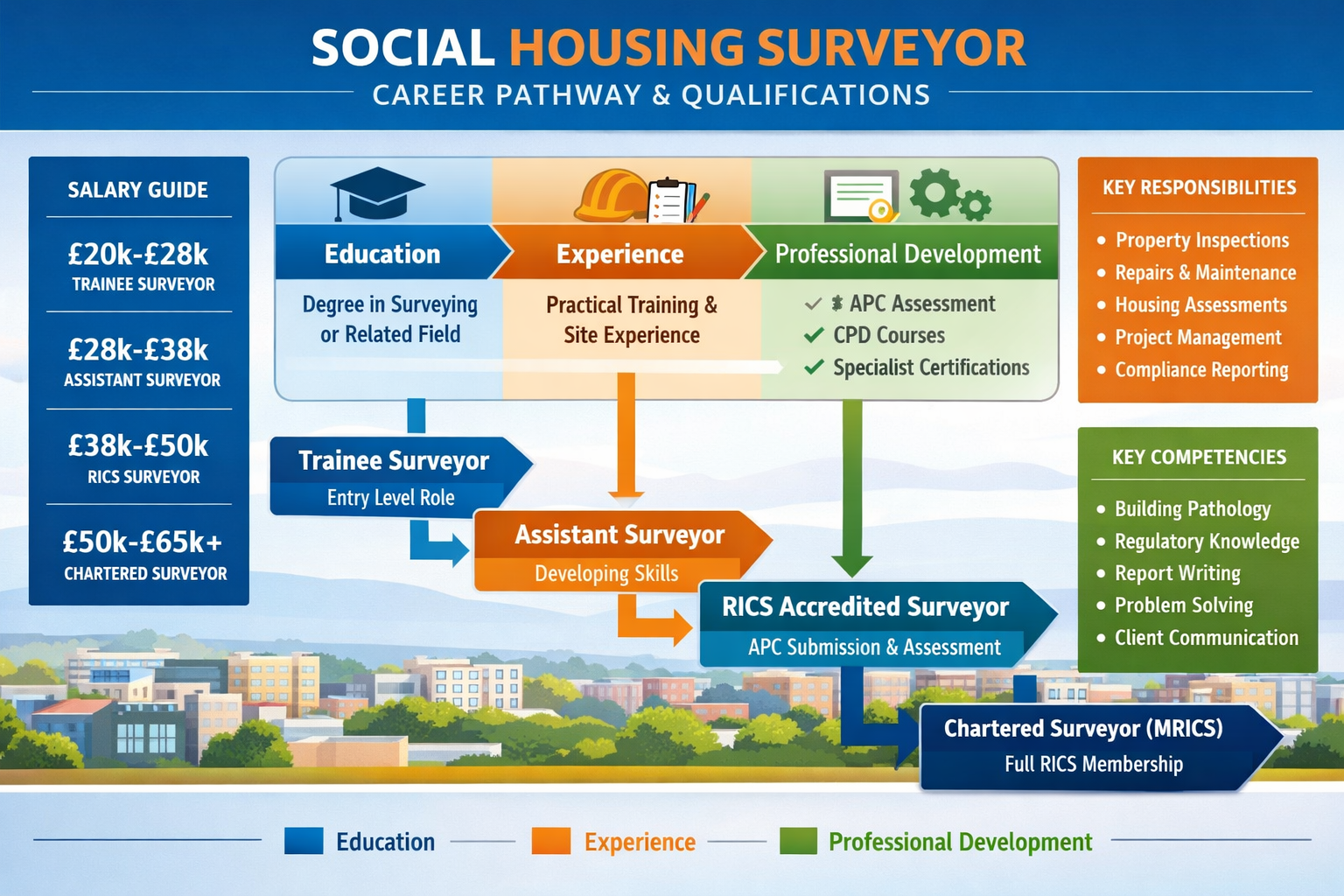
The surveyor social housing career pathway offers clear progression opportunities:
Trainee/Graduate Surveyor (£28,000-£35,000)
- Conducting inspections under supervision
- Learning stock condition survey methodologies
- Assisting with planned maintenance programs
- Developing technical report writing skills
Surveyor (£35,000-£45,000)
- Managing own caseload of inspections
- Specifying repair works independently
- Contributing to asset management strategies
- Handling straightforward disrepair cases
Senior Surveyor (£45,000-£55,000)
- Leading complex projects and programs
- Mentoring junior staff
- Managing contractor relationships
- Providing expert technical advice
Principal/Lead Surveyor (£55,000-£65,000+)
- Strategic portfolio management
- Policy development and implementation
- Budget oversight and financial planning
- Senior stakeholder engagement
Many experienced professionals also transition into consultancy roles, offering specialized expertise to multiple housing providers, or move into asset management and executive leadership positions.
Unique Challenges in Surveyor Social Housing Work
Working as a surveyor social housing specialist presents distinctive challenges that set this career path apart from general building surveying practice. Understanding these complexities helps professionals prepare for the realities of the role.
Managing High-Volume Workloads
Social housing surveyors typically manage significantly larger caseloads than their private sector counterparts. Where a surveyor conducting homebuyer reports might complete 2-3 detailed inspections weekly, social housing professionals often inspect 40-50 properties monthly.
This volume creates pressure to:
⚡ Maintain consistent quality standards despite time constraints
⚡ Develop efficient inspection methodologies and templates
⚡ Prioritize effectively when resources are limited
⚡ Use technology to streamline data collection and reporting
Successful surveyors develop systematic approaches that ensure thoroughness without unnecessary duplication, often using mobile survey applications and standardized assessment frameworks.
Dealing with Non-Traditional Construction
The UK’s social housing stock includes numerous properties built using non-traditional construction methods during the post-war housing boom (1945-1970). These present unique challenges:
Prefabricated Reinforced Concrete (PRC) systems like Airey, Wimpey No-Fines, and Reema require specialist knowledge of structural behavior and common defects. Unlike traditional brick and block construction, these systems may suffer from:
- Carbonation of concrete reducing structural integrity
- Corrosion of steel reinforcement causing spalling
- Thermal bridging and condensation issues
- Designation as defective under the Housing Defects Act 1984
Timber-framed construction from various periods requires understanding of moisture management, structural movement, and common failure points that differ markedly from masonry buildings.
Surveyors must recognize these construction types, understand their specific vulnerabilities, and specify appropriate inspection and remediation approaches—expertise rarely needed in standard residential surveying.
Balancing Cost Constraints with Quality Standards
Social housing providers operate within tight budgetary constraints while maintaining legal obligations to provide decent, safe accommodation. Surveyors navigate this tension daily, making decisions that balance:
💰 Immediate repair costs vs. long-term lifecycle value
💰 Minimum compliance standards vs. enhanced quality improvements
💰 Individual property needs vs. portfolio-wide priorities
💰 Tenant expectations vs. available resources
This requires commercial awareness alongside technical expertise. Recommendations must be practical, achievable, and defensible, considering the broader financial context of social housing provision. Similar to negotiating price reductions after surveys, surveyors must justify expenditure with clear evidence.
Tenant Welfare and Vulnerable Residents
Unlike private residential surveying where client interaction is limited, social housing surveyors regularly engage directly with residents during inspections. Many tenants are vulnerable individuals including:
- Elderly residents with mobility limitations
- Families with young children
- People with disabilities or health conditions
- Individuals experiencing financial hardship
- Those with mental health challenges
This human dimension requires:
🤝 Excellent interpersonal and communication skills
🤝 Sensitivity to diverse needs and circumstances
🤝 Ability to explain technical matters in accessible language
🤝 Awareness of safeguarding responsibilities
🤝 Professional boundaries while showing empathy
Surveyors often identify issues beyond building defects—hoarding, self-neglect, domestic abuse—requiring appropriate referrals to support services. This social responsibility distinguishes the role from purely technical surveying positions.
Navigating Political and Media Scrutiny
Social housing operates within a politically charged environment, particularly following high-profile failures like Grenfell Tower and the subsequent spotlight on housing quality. Surveyors’ work may face:
📰 Media attention during building safety scandals
📰 Political pressure to accelerate improvement programs
📰 Tenant advocacy group scrutiny of standards
📰 Regulatory investigations and inquiries
📰 Public accountability for decision-making
This visibility demands rigorous professional standards, comprehensive documentation, and ability to defend technical judgments under external examination. Surveyors must maintain objectivity and integrity even when findings prove politically or financially inconvenient.
The Future of Surveyor Social Housing Careers in 2026 and Beyond
The surveyor social housing profession faces significant transformation as regulatory, technological, and environmental pressures reshape the sector. Understanding these trends helps current and aspiring professionals prepare for evolving demands.
Building Safety and Regulatory Reform
The Building Safety Act 2022 fundamentally changed accountability for residential buildings, particularly those over 18 meters or seven stories. For social housing surveyors, this means:
- Enhanced competency requirements and professional registration
- Mandatory building safety management systems for higher-risk buildings
- Detailed golden thread documentation throughout building lifecycles
- Regular safety case reviews and resident engagement
- Potential personal liability for safety failures
These requirements create demand for surveyors with specialist building safety expertise, opening new career pathways in fire safety engineering, structural assessment, and safety case development.
Digital Transformation and PropTech
Technology is revolutionizing how surveyors collect, analyze, and utilize property data. Emerging tools include:
🔧 Mobile survey applications with offline capability and photo annotation
🔧 Drone technology for roof and high-level inspections
🔧 Thermal imaging for identifying insulation defects and moisture ingress
🔧 Building Information Modeling (BIM) for asset data management
🔧 Artificial intelligence analyzing survey data to predict maintenance needs
🔧 Internet of Things (IoT) sensors monitoring building performance continuously
Surveyors who embrace these technologies gain competitive advantages, improving efficiency and analytical capabilities. However, technology complements rather than replaces professional judgment—the human expertise to interpret findings and recommend appropriate action remains irreplaceable.
Decarbonization and Retrofit Programs
The government’s commitment to upgrading social housing energy efficiency creates unprecedented opportunities. By 2030, all social housing must achieve minimum EPC Band C performance, requiring extensive retrofit programs.
Surveyors lead this transformation by:
- Assessing current energy performance across portfolios
- Designing fabric-first improvement strategies
- Specifying appropriate technologies (heat pumps, solar panels, ventilation systems)
- Managing retrofit projects from design through completion
- Evaluating performance outcomes and lessons learned
This work requires new competencies in building physics, renewable technologies, and whole-house retrofit approaches. Surveyors with these skills command premium salaries and enjoy diverse career opportunities across social housing, consultancy, and government programs.
Growing Emphasis on Resident Satisfaction
The Social Housing (Regulation) Act 2023 introduced new consumer standards emphasizing tenant voice and satisfaction. Surveyors contribute by:
- Conducting post-inspection resident consultations
- Designing improvements that reflect tenant priorities
- Communicating clearly about planned works and timescales
- Measuring satisfaction with completed projects
- Identifying patterns in complaints and disrepair claims
This shift toward resident-centered service delivery requires surveyors to develop stronger engagement skills alongside technical expertise, viewing properties not merely as assets but as homes where people build their lives.
Career Opportunities and Employer Diversity
The surveyor social housing job market in 2026 offers diverse opportunities across:
Local Authorities – Traditional employers managing retained housing stock
Housing Associations – Registered providers ranging from small local organizations to national groups
Arms-Length Management Organizations (ALMOs) – Managing council housing on behalf of local authorities
Consultancies – Providing specialist services to multiple clients
Contractors – Major works specialists requiring surveying expertise
Government Agencies – Regulatory bodies and funding organizations
This diversity enables professionals to find roles matching their interests, values, and career goals, whether preferring direct public service, commercial consultancy, or policy development.
Conclusion: Building a Rewarding Career as a Surveyor Social Housing Professional
The role of a surveyor social housing specialist offers a uniquely rewarding career combining technical expertise with meaningful social impact. These professionals ensure that millions of families across the United Kingdom live in safe, decent, well-maintained homes—work that directly improves lives and strengthens communities.
In 2026, the profession faces unprecedented challenges and opportunities. Building safety reform, decarbonization targets, and digital transformation are reshaping what surveyors do and how they do it. Those entering or advancing in this field must commit to continuous professional development, embracing new technologies and competencies while maintaining the fundamental values of technical rigor and social responsibility.
Next Steps for Aspiring Social Housing Surveyors
If you’re considering this career path, take these actionable steps:
- Research RICS-accredited degree programs in building surveying or related disciplines, focusing on those with social housing modules
- Seek work experience with local authorities, housing associations, or consultancies specializing in affordable housing
- Network with professionals through RICS events, CIH conferences, and sector-specific forums
- Develop complementary skills in communication, project management, and digital technologies
- Stay informed about regulatory changes, industry trends, and emerging best practices through professional publications and CPD activities
For qualified surveyors looking to specialize in social housing, consider pursuing additional certifications, volunteering for sector working groups, or taking on secondments with housing providers to build specialized expertise.
The Broader Impact of Your Work
Remember that behind every survey report, every maintenance specification, and every compliance assessment are real people depending on professional expertise to protect their homes and wellbeing. The surveyor social housing profession offers not just a career but a vocation—an opportunity to apply technical skills toward social good while building a stable, rewarding professional life.
As housing quality, building safety, and environmental sustainability dominate the national agenda, surveyors specializing in affordable housing will play increasingly vital roles. Whether you’re just beginning your journey or advancing your established career, this specialization offers intellectual challenge, professional recognition, and the satisfaction of work that truly matters.
For more information about professional surveying services and expert guidance, contact our team or explore our comprehensive resources on property surveys and building inspections.