
House price-to-earnings ratios in England have dropped to their lowest level since 2015. Yet rents have kept climbing for many tenants, which is exactly the gap the Green Party says it wants to close. On 5 October 2026, party leader Zack Polanski used his conference speech in Brighton to propose a three-year cap on private rent increases, a move that has landlords and letting agents across the country, including in SW19, asking hard questions. The Green Party rent cap Wimbledon landlords October 2026 debate is not yet law, but it signals where housing policy pressure is building, and both sides of the rental market should understand what is actually on the table.
This article breaks down the proposal, the pushback from industry bodies, and what it practically means for anyone renting or letting property in Wimbledon right now.
Key Takeaways
- The Green Party has proposed capping private rent rises at the lowest of CPI inflation, wage growth, or 2 percent, for three years, while government designs a permanent "fair rents" system.
- This is a policy proposal from an opposition party, not current law, the Renters' Rights Act already limits rent increases to once per year via Section 13 notices.
- Propertymark warns that rent caps historically reduce investment and shrink rental supply, pointing to Scotland's experience with temporary rent controls.
- Wimbledon landlords should document property condition now with a schedule of condition, inventory, and building survey, regardless of how this policy debate unfolds.
- Tenants can and should check whether a proposed rent increase matches local market evidence before deciding whether to challenge it at tribunal.
What the Green Party Rent Cap Proposal Actually Says
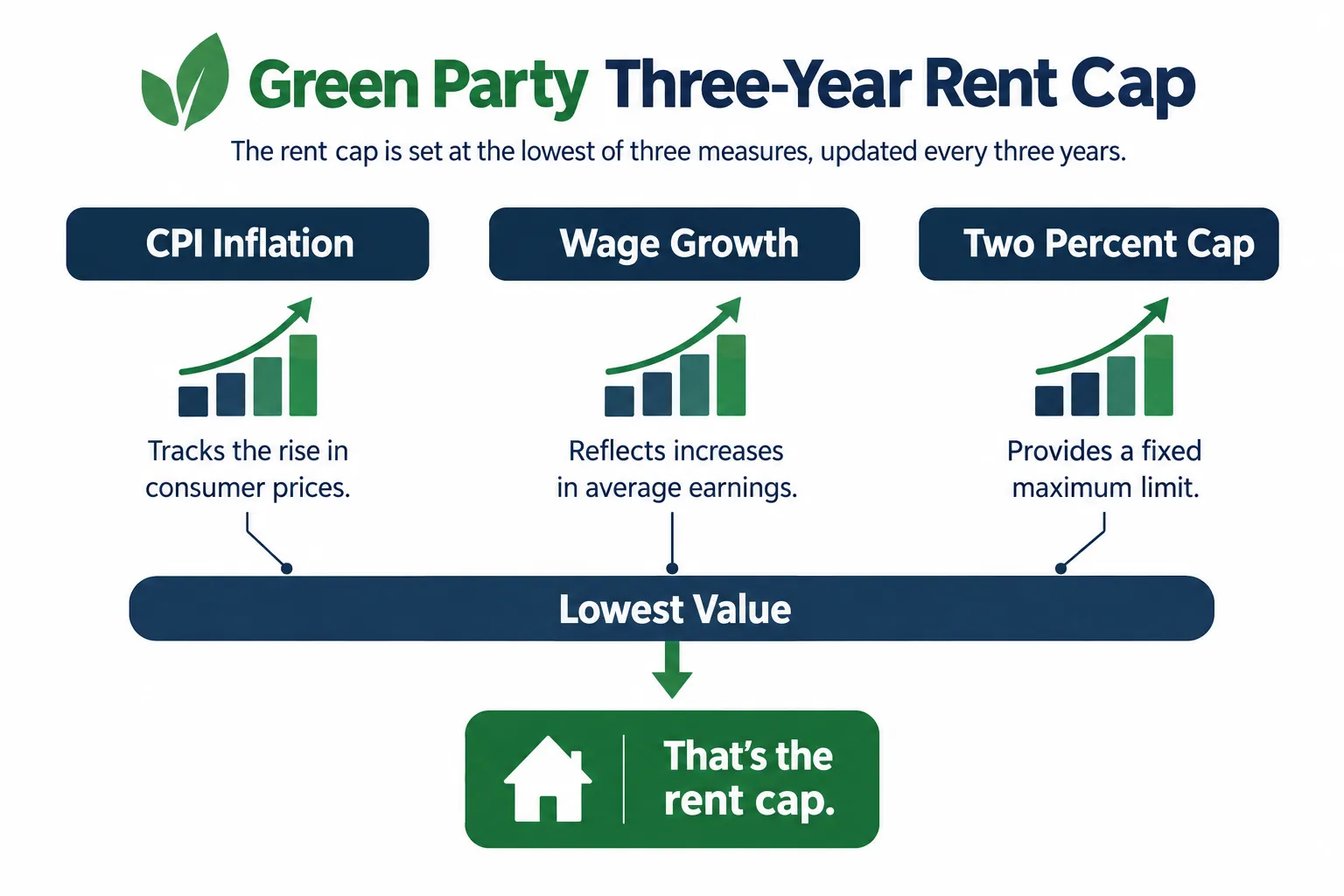
Polanski framed the policy as an "emergency brake," not a permanent fix. Under the plan, private rent increases would be capped at whichever is lowest: CPI inflation, average wage growth, or 2 percent. The cap would run for three years, giving ministers time to build what the Greens call a national "fair rents guarantee."
His stated reasoning was blunt. "For too long, landlords have been able to hike prices way beyond wages," Polanski said, arguing that renters have been "forced to meet the cost" of increases disconnected from what they actually earn. The party also says the cap is designed to stop two specific problems: sudden, steep rent hikes, and what it calls "evictions under the guise of rent rises", where a landlord raises rent to a level a tenant cannot afford, effectively forcing them out without a formal eviction notice.
The Greens describe the three-year window as "vital breathing space" for tenants while a longer-term system is designed. Importantly, this is a proposal from an opposition party announced at a party conference. It has not been tabled as legislation, has not been debated in Parliament, and is not current government policy.
Why This Matters for Wimbledon Landlords and Tenants in October 2026
Wimbledon's rental market has historically attracted strong tenant demand, driven by transport links, schools, and the area's proximity to central London. Any national policy that touches rent-setting power has outsized relevance here because yields in high-demand pockets like SW19 are closely tied to landlords' ability to adjust rents to market conditions.
It is worth being precise about what already exists. The Renters' Rights Act currently limits most private landlords to one rent increase per year, delivered through a formal Section 13 notice. Tenants who believe a proposed increase is above market rate can already challenge it at a property tribunal. The Green Party rent cap Wimbledon landlords October 2026 proposal would layer a much stricter numerical ceiling on top of that existing framework, a significant shift from "once a year, challengeable" to "once a year, capped at a fixed formula."
Industry Pushback: What Propertymark and Critics Are Saying
Not everyone agrees the cap would help the renters it is designed to protect. Timothy Douglas, Head of Policy and Campaigns at Propertymark, offered a direct rebuttal: "Tenants are facing genuine affordability pressures but rent caps do not address the underlying shortage" of rental homes.
Propertymark's argument rests on two pieces of evidence:
- Scotland's experience. During its temporary rent cap, Propertymark says landlords responded by raising rents sharply between tenancies, when a new tenant moved in, since in-tenancy increases were restricted. The policy also appears to have stalled new investment in rental property, and some landlords reportedly exited the market altogether.
- International precedent. Broader international evidence, according to Propertymark, consistently links rent controls to reduced investment in rental housing and a shrinking supply of homes to let over time.
The core tension is this: a rent cap can protect existing tenants from sudden increases, but if it discourages landlords from maintaining or expanding their rental stock, it may tighten supply further, pushing up competition, and potentially rents, for the next tenant who needs a home.
| Viewpoint | Core Argument |
|---|---|
| Green Party | Caps stop sudden hikes and give renters breathing space while a fairer system is built |
| Propertymark | Caps don't fix the housing shortage and can reduce investment and supply |
| Existing law | Renters' Rights Act already caps increases to once yearly, with tribunal challenge rights |
What a Rent Cap Could Mean for Wimbledon Landlord Yields
No one should assume this proposal becomes law, but it is sensible for landlords to understand the mechanics if a similar policy ever advanced. A cap tied to the lowest of CPI, wage growth, or 2 percent would, in most economic environments, sit below typical market rent growth in high-demand areas. That compression would most directly affect landlords who rely on periodic rent reviews to offset rising mortgage costs, maintenance expenses, or service charges on flats.
In areas like Wimbledon, where demand has traditionally outpaced supply in certain postcodes, any mismatch between controlled rents and market rents tends to create secondary effects, longer tenancies, less turnover, and potentially more scrutiny on property condition at the point a tenancy does end, since landlords have fewer opportunities to reset rent between periods.
Why Documentation Matters Now, Regardless of the Outcome
Whether or not a cap ever becomes policy, Wimbledon landlords benefit from having clear, independent records of property condition. This protects both parties in any dispute over deposits, damage, or disrepair claims, and it becomes even more valuable if rent-setting flexibility is reduced in future.
Practical steps worth taking now:
- Commission a schedule of condition before a new tenancy begins, with dated photographs and written notes on every room.
- Keep a detailed inventory covering fixtures, fittings, and furnishings, signed by both landlord and tenant.
- Consider a building survey for older Wimbledon properties, particularly period conversions, to flag maintenance issues before they become costly disputes.
- Review service charge and insurance costs annually so any future rent review reflects actual running costs, not guesswork.
"A rent cap limits the number on the page. It does not limit the value of having clear, independent evidence of a property's condition before and after a tenancy."
How Tenants Can Check if a Proposed Rent Is Fair
Tenants facing a Section 13 notice do not have to accept a proposed increase at face value. The existing tribunal route remains available regardless of how the Green Party rent cap Wimbledon landlords October 2026 debate develops. Before deciding to challenge a rise, tenants should:
- Compare the proposed rent against current listings for similar properties in the same postcode.
- Check how long the property has been let at the current rent and whether a large jump reflects genuine market movement or an attempt to encourage a move-out.
- Request a breakdown from the landlord or agent explaining what has changed, service charges, mortgage costs, or local comparables.
- Seek advice from a local advice service or solicitor if the proposed increase seems disconnected from nearby market evidence.

Timing: Why the Autumn Budget Matters
The Autumn Budget lands on 28 October 2026, shortly after this proposal was announced. Housing policy commentary around major fiscal events often signals which ideas government is willing to adopt from opposition parties, and which it will leave aside. Landlords and tenants watching this space should treat the Budget date as a near-term checkpoint for whether rent cap discussion gains any formal traction, rather than remaining conference rhetoric.
FAQ: Green Party Rent Cap and Wimbledon Rentals
Is the Green Party rent cap already law?
No. It is a policy proposal announced by party leader Zack Polanski at the Green Party's Brighton conference in October 2026. The Greens are an opposition party, and the proposal has not been introduced as legislation.
What rent increase rules currently apply in Wimbledon?
Under the Renters' Rights Act, most private landlords can raise rent once per year using a formal Section 13 notice. Tenants can challenge an increase they believe is above market rate at a property tribunal.
How would the proposed cap be calculated?
The Green Party proposes capping increases at whichever is lowest of three measures: CPI inflation, average wage growth, or 2 percent, for a three-year period.
Why does Propertymark oppose the cap?
Propertymark argues rent caps do not fix the underlying housing shortage and can reduce landlord investment, citing Scotland's rent cap experience and wider international evidence of reduced rental supply.
Should Wimbledon landlords act now because of this proposal?
There is no immediate legal requirement to change anything. However, maintaining a schedule of condition, inventory, and up-to-date building survey is good practice regardless, and becomes more valuable if rent-setting rules tighten in future.
Where can tenants check if a rent increase is fair?
Tenants can compare similar local listings, request justification from the landlord or agent, and use the property tribunal process already available under current rent increase rules.
Conclusion
The Green Party rent cap Wimbledon landlords October 2026 proposal is an early-stage political idea, not a settled rule. It reflects genuine pressure on renters facing fast-rising costs, but it also raises real questions about supply, investment, and how landlords in high-demand areas like Wimbledon would adapt. For now, the existing Renters' Rights Act framework, annual increases via Section 13, with tribunal oversight, remains the operative law.
The sensible move for landlords is not to panic, but to prepare: get a current schedule of condition, keep inventories accurate, and consider a professional building survey for older stock. Tenants should use the market-comparison tools already available to them before accepting or challenging a rent increase. Both groups should watch the Autumn Budget on 28 October 2026 closely, since it will offer the clearest early signal of whether this proposal gains any real political momentum, or stays a conference talking point.
Green Party rent cap, Wimbledon landlords, rent control policy, Renters Rights Act, Section 13 notice, Propertymark, rental market SW19, buy to let yields, property tribunal, schedule of condition, tenant rights UK, housing policy 2026