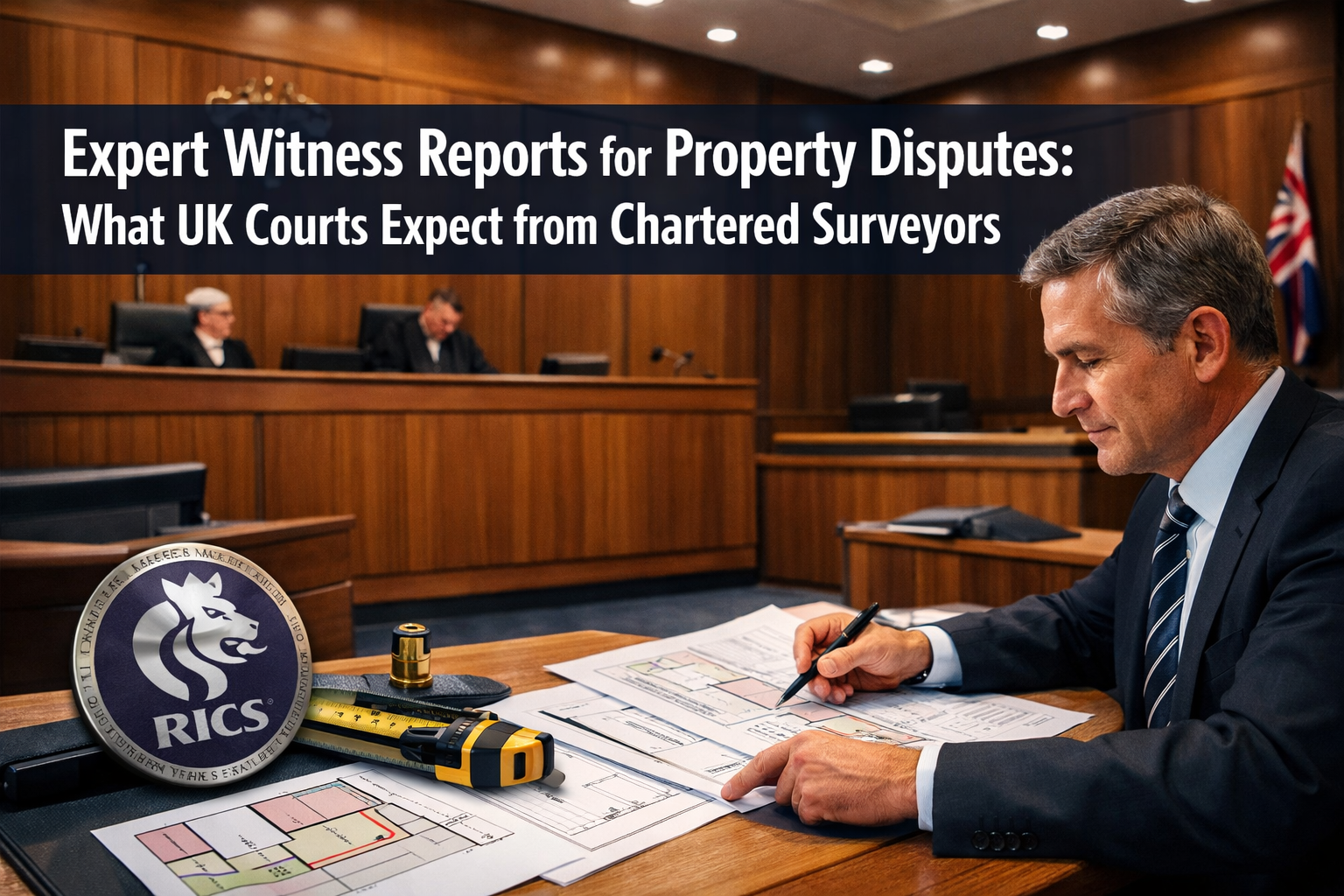
{"cover":"Professional landscape format (1536x1024) hero image featuring bold text overlay 'Expert Witness Reports for Property Disputes: What UK Courts Expect from Chartered Surveyors' in extra large 72pt white sans-serif font with dark shadow and semi-transparent navy overlay box, positioned in upper third. Background shows modern UK courtroom interior with wooden paneling, judge's bench, and professional chartered surveyor in business attire reviewing technical documents and architectural plans. Foreground elements include RICS accreditation badge, measuring tools, and property boundary diagrams. Color palette: deep navy blue, white, gold accents. High contrast, magazine cover quality, editorial style with professional legal and surveying aesthetic. Photorealistic rendering with depth of field.","content":["Landscape format (1536x1024) editorial image showing close-up of professional expert witness report document with 'CPR Part 35 Compliance' header visible, overlaid with transparent checklist graphic highlighting key sections: Statement of Truth, Expert Declaration, Methodology, and Conclusions. Background features UK Civil Procedure Rules book, RICS professional standards manual, and chartered surveyor's stamp. Include visual elements of scales of justice symbol, magnifying glass over technical property drawings, and highlighted text showing 'Overriding Duty to the Court'. Color scheme: professional burgundy, cream, and gold. Clean, organized composition with document authenticity focus and legal precision aesthetic.","Landscape format (1536x1024) detailed infographic-style image depicting three distinct property dispute scenarios side-by-side: left panel shows boundary dispute with fence line measurements and surveyor using theodolite equipment; center panel displays party wall cross-section diagram with structural annotations and damage assessment markers; right panel features rights of light analysis with Waldram diagram overlay showing light angle calculations and building shadows. Each panel includes technical measurement tools, property plans, and expert annotations. Professional color coding: green for boundaries, orange for party walls, blue for rights of light. Technical drawing aesthetic with real-world photography elements blended seamlessly.","Landscape format (1536x1024) professional scene showing courtroom preparation meeting with chartered surveyor presenting expert witness report to legal team. Wide conference table displays multiple documents including expert report drafts, photographic evidence of property defects, technical drawings, and laptop showing digital site survey data. Surveyor pointing to specific sections while solicitor reviews notes. Background shows law library shelves and framed RICS certifications. Foreground includes professional briefcase, measurement equipment, and highlighted sections of Civil Procedure Rules Part 35. Warm professional lighting, collaborative atmosphere, high-end business photography style with sharp focus on documentation and professional interaction."]}
When property disputes escalate to litigation, the quality and compliance of expert witness reports can make or break a case. In 2026, UK courts have introduced significant changes to how Expert Witness Reports for Property Disputes: What UK Courts Expect from Chartered Surveyors are handled, including new public accessibility requirements that began on January 1st. Understanding these expectations isn't just important for chartered surveyors—it's essential for property owners, solicitors, and anyone involved in boundary disputes, valuation disagreements, or construction conflicts.
The landscape of expert testimony has evolved considerably, with courts demanding greater transparency, stricter adherence to Civil Procedure Rules (CPR) Part 35, and an unwavering commitment to the expert's overriding duty to assist the court. Whether you're instructing an expert for the first time or preparing to give evidence yourself, this comprehensive guide demystifies what UK courts truly expect.
Key Takeaways
- Expert reports filed in 2026 are now publicly accessible under a two-year pilot scheme affecting Commercial Court, London Circuit Commercial Court, and the Financial List, with potential expansion to Business and Property Courts[1]
- CPR Part 35 establishes the expert's overriding duty to the court, which supersedes any obligation to the instructing party, requiring complete independence and objectivity[2]
- Court permission is mandatory before expert testimony can be admitted, and courts will only grant permission when expert evidence is reasonably required to resolve proceedings[2]
- Proper instruction is critical—lay clients must provide comprehensive, unbiased information to enable experts to fulfill their duties effectively
- Single joint experts may be appointed by courts as a cost-effective alternative to each party engaging separate experts[2]
Understanding CPR Part 35: The Foundation of Expert Evidence
The Overriding Duty to the Court
The cornerstone principle governing Expert Witness Reports for Property Disputes: What UK Courts Expect from Chartered Surveyors is the expert's overriding duty to assist the court. This fundamental obligation, enshrined in CPR Part 35, means that a chartered surveyor's primary responsibility is to provide independent, objective evidence on matters within their expertise—not to advocate for the party who instructed them[2].
This duty manifests in several practical ways:
- Complete independence: Experts must not allow their opinions to be influenced by the pressures of litigation or loyalty to the instructing party
- Balanced reporting: All relevant facts must be disclosed, including those that may undermine the instructing party's position
- Transparency about limitations: Experts must clearly state when questions fall outside their expertise or when insufficient information prevents definitive conclusions
- Willingness to change opinions: If new evidence emerges or cross-examination reveals flaws in reasoning, experts must acknowledge this honestly
"The expert's duty to assist the court on matters within their expertise overrides any obligation to the person from whom they have received instructions or by whom they are paid." — CPR Part 35.3
Permission Requirements and Proportionality
Courts don't automatically accept expert evidence. Since the introduction of stricter case management protocols, court permission is required before experts can testify. Permission will only be granted when expert testimony is "reasonably required to resolve the proceedings"[2].
This threshold means courts carefully consider:
- Whether the issues truly require specialist knowledge beyond the judge's understanding
- The proportionality of expert costs relative to the dispute's value
- Whether a single joint expert would suffice instead of separate experts for each party
- The complexity and technical nature of the disputed matters
For property disputes involving boundary issues, structural defects, or valuation disagreements, expert evidence is typically deemed necessary. However, courts increasingly favor single joint experts for straightforward matters to control costs and streamline proceedings.
Essential Components of Compliant Expert Witness Reports
Mandatory Declarations and Statements
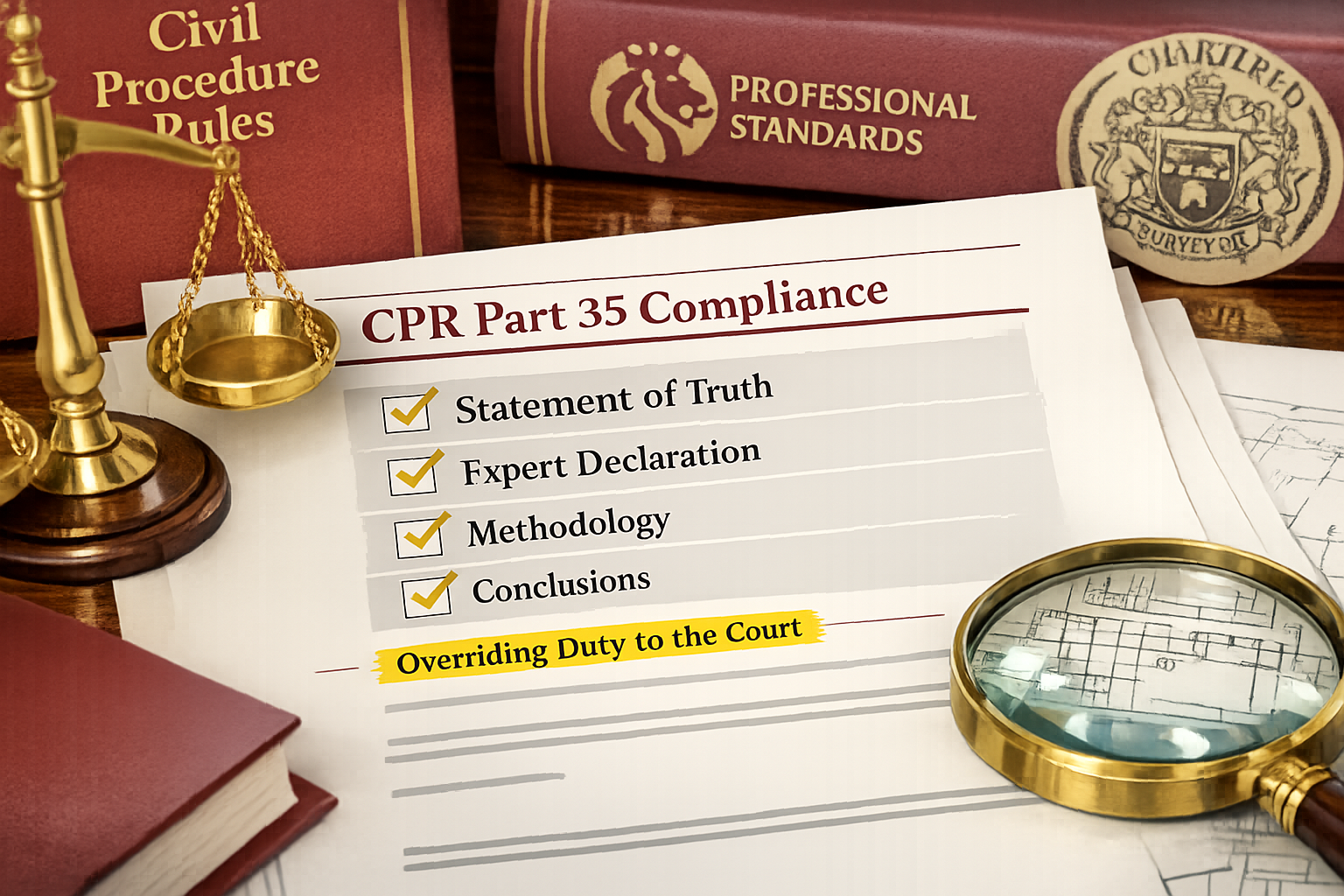
Expert Witness Reports for Property Disputes: What UK Courts Expect from Chartered Surveyors must include specific formal declarations to comply with CPR Part 35. These aren't mere formalities—they're binding commitments that courts take seriously.
Required elements include:
| Component | Purpose | Location |
|---|---|---|
| Statement of Truth | Confirms the expert believes the facts stated are true and opinions expressed are genuinely held | End of report |
| Expert Declaration | Acknowledges understanding of duties to the court and compliance with CPR Part 35 | Beginning or end |
| Qualifications Summary | Establishes expertise and relevant experience in the specific dispute area | Early in report |
| Instructions Summary | Discloses what the expert was asked to do and documents received | Early section |
| Statement of Substance | Confirms all material facts have been stated and none omitted | Within or end of report |
Structure and Content Requirements
A compliant expert report follows a logical structure that enables courts to understand the methodology, reasoning, and conclusions clearly. The typical framework includes:
1. Introduction and Qualifications
- Expert's professional background and relevant experience
- RICS membership status and specialist accreditations
- Previous expert witness experience
2. Instructions and Scope
- Summary of what the expert was asked to determine
- Documents and evidence reviewed
- Site inspections conducted (dates, conditions, limitations)
3. Factual Background
- Objective description of the property and dispute
- Relevant planning history, construction details, or ownership matters
- Photographs, plans, and measurements (properly referenced)
4. Methodology
- Technical approaches used (e.g., condition survey protocols)
- Industry standards applied (RICS guidance, British Standards)
- Assumptions made and their justification
5. Analysis and Findings
- Detailed examination of technical issues
- Application of expertise to the facts
- Consideration of alternative explanations
6. Opinion and Conclusions
- Clear, definitive opinions on matters within expertise
- Acknowledgment of uncertainties or limitations
- Range of outcomes where precision isn't possible
7. Statement of Truth and Declarations
- Formal compliance statements
- Expert's signature and date
The 2026 Public Accessibility Pilot
A significant development affecting Expert Witness Reports for Property Disputes: What UK Courts Expect from Chartered Surveyors is the public accessibility pilot that commenced on January 1, 2026. Expert reports filed and referred to in public hearings are now accessible to the public in the Commercial Court, London Circuit Commercial Court, and the Financial List[1].
Key implications:
📋 What's included: Expert reports qualify as "Public Domain Documents" along with their annexes and appendices (though exhibits may be excluded)[3]
⏰ Duration: The pilot runs for two years with a review after six months[1]
🔄 Potential expansion: If successful, the scheme is expected to extend to other courts, with the Business and Property Courts likely next[1]
⚠️ Confidentiality considerations: Experts and instructing parties must be more cautious about sensitive commercial information included in reports
This transparency initiative reinforces the importance of producing reports that withstand public scrutiny and demonstrate complete objectivity.
Common Property Dispute Scenarios and Expert Requirements
Boundary Disputes and Encroachment Claims
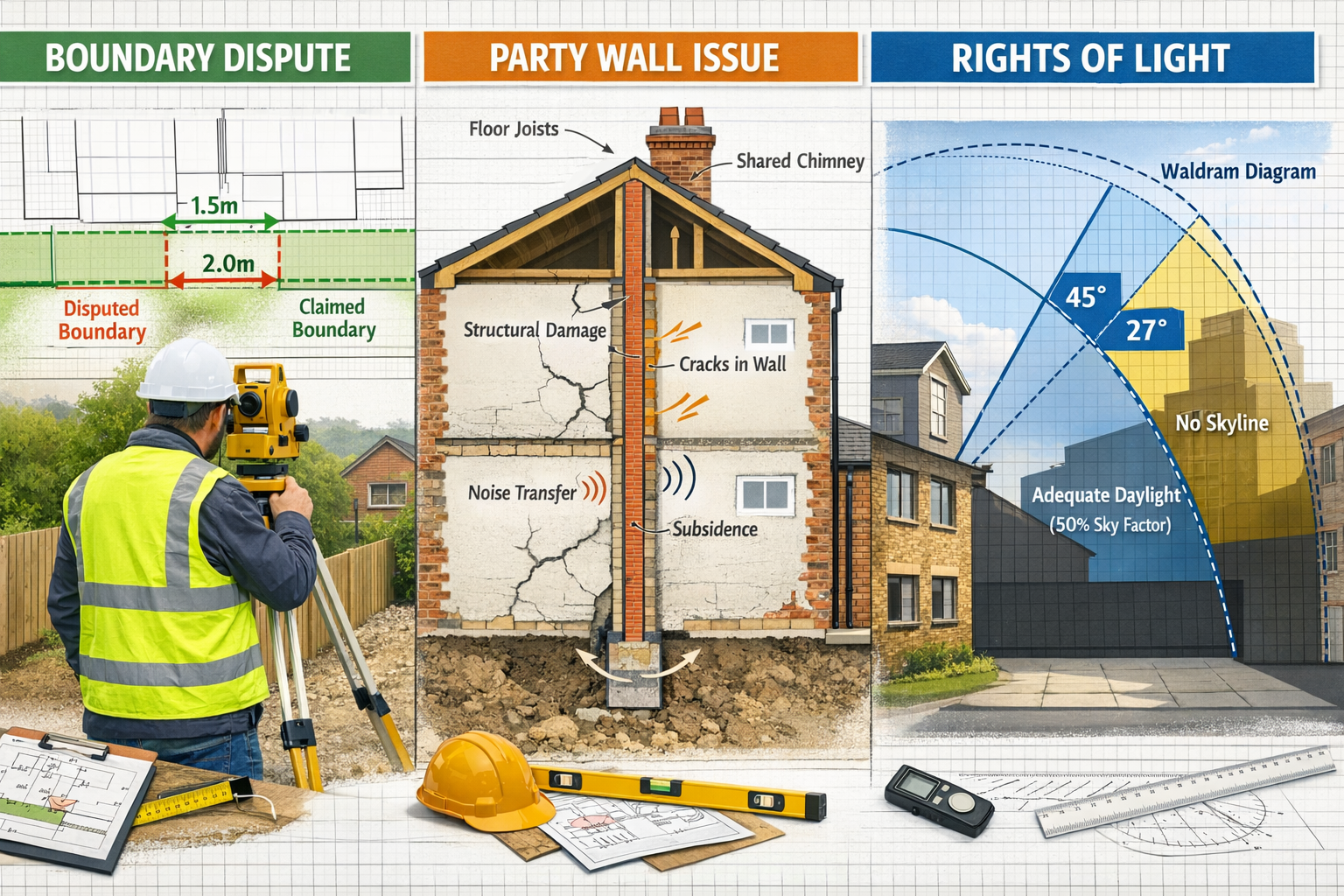
Boundary disputes remain among the most common property conflicts requiring expert surveying evidence. With the UK Government's "build, build, build" strategy increasing development density in urban centers, boundary disputes, party wall issues, nuisance and restrictive covenant claims are expected to increase in 2026[1].
What courts expect from boundary experts:
✅ Precise measurements: Use of modern surveying equipment (total stations, GPS) to establish accurate boundary positions
✅ Historical analysis: Review of title deeds, historical OS maps, and conveyancing plans to determine intended boundaries
✅ Physical evidence assessment: Examination of existing fences, walls, hedges, and their relationship to legal boundaries
✅ Interpretation of ambiguous plans: Expert opinion on resolving discrepancies between different historical documents
Chartered surveyors providing boundary expertise should reference the average cost implications and potential resolution methods in their reports, helping courts understand proportionate remedies.
Rights of Light Disputes
Rights of light claims have gained prominence as urban densification continues. The landmark 2025 Supreme Court case Cooper v Ludgate House Ltd confirmed that the Waldram method remains the preferred approach for assessing light interference[1].
Expert requirements for rights of light cases:
- Waldram methodology application: Proper use of the "grumble point" approach and 50/50 rule
- Before and after analysis: Detailed comparison of light levels pre and post-development
- Room-by-room assessment: Individual analysis of affected spaces with technical drawings
- Injury quantification: Expert opinion on whether interference constitutes actionable injury
- Mitigation possibilities: Assessment of design modifications that could reduce impact
Surveyors must stay current with evolving case law and demonstrate familiarity with the Cooper decision when preparing rights of light reports.
Party Wall Matters and Construction Disputes
Party wall disputes often escalate beyond the Party Wall etc. Act 1996's dispute resolution mechanisms into full litigation. When this occurs, expert evidence becomes crucial.
Key areas for party wall experts:
🏗️ Damage causation: Determining whether construction work caused alleged damage or if pre-existing defects are responsible
🏗️ Structural adequacy: Assessing whether party wall works comply with structural engineering principles
🏗️ Schedule of condition accuracy: Evaluating the reliability of pre-work condition surveys
🏗️ Remedial works specification: Expert opinion on appropriate repairs and their reasonable cost
Experts should understand how close neighbours can build to boundaries and the interaction between party wall legislation and broader construction law.
Valuation Disputes
Property valuation disagreements arise in various contexts—matrimonial proceedings, compulsory purchase, lease renewals, and negligence claims against surveyors. Courts expect valuers to provide robust, defensible opinions.
Valuation expert report essentials:
💰 Methodology transparency: Clear explanation of valuation approach (comparative, investment, residual, profits method)
💰 Comparable evidence: Detailed analysis of comparable transactions with adjustments explained
💰 Market context: Discussion of market conditions at the relevant valuation date
💰 Assumptions and special assumptions: Explicit statement of basis of valuation
💰 Range or point estimate: Justification for precision level offered
Experts should reference relevant RICS guidance (Red Book standards) and explain departures from standard methodology when necessary. Understanding how surveys influence price negotiations provides useful context for valuation disputes.
How to Properly Instruct and Brief an Expert Surveyor
The Importance of Comprehensive Instructions
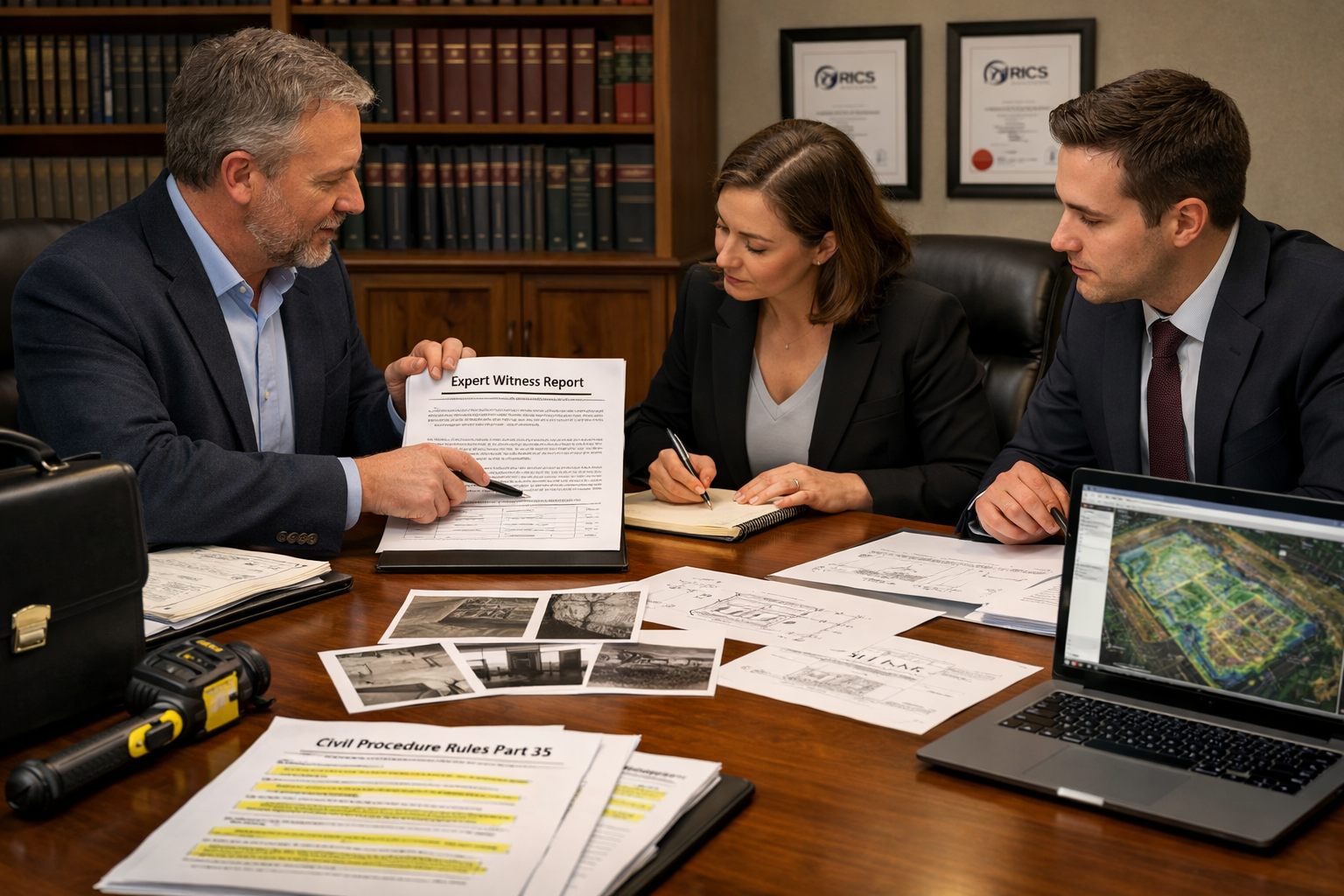
The quality of an expert report depends significantly on the quality of instructions provided. Lay clients and solicitors must understand that Expert Witness Reports for Property Disputes: What UK Courts Expect from Chartered Surveyors can only be as good as the information and guidance provided at the outset.
Essential elements of proper instructions:
📝 Clear questions: Specific issues the expert should address, framed as questions where possible
📝 Complete documentation: All relevant plans, surveys, correspondence, photographs, and technical reports
📝 Factual background: Chronology of events, previous negotiations, and relevant history
📝 Access arrangements: Provision for site inspections with appropriate notice and cooperation
📝 Timetable: Realistic deadlines aligned with court directions
📝 Budget clarity: Understanding of fee structure and cost estimates
What to Avoid When Instructing Experts
Equally important is understanding what not to do when instructing a chartered surveyor for expert witness work:
❌ Don't ask for advocacy: Requesting the expert to "support our case" or "find evidence against the other side" compromises independence
❌ Don't withhold unfavorable information: Selective disclosure prevents the expert from fulfilling their duty to the court
❌ Don't draft the expert's opinions: While you can suggest structure, the conclusions must be the expert's own
❌ Don't pressure for particular conclusions: The expert must reach opinions independently based on evidence
❌ Don't communicate improperly: After reports are exchanged, communications with experts may need court permission or disclosure to the other side
Single Joint Experts vs. Party-Appointed Experts
Courts have discretion to direct that evidence be given by a single joint expert rather than each party appointing their own[2]. Understanding when each approach is appropriate helps manage expectations and costs.
Single joint experts are typically appropriate when:
- The technical issues are relatively straightforward
- The dispute value doesn't justify multiple expert costs
- The parties can agree on a suitable expert
- The evidence needed is primarily factual rather than opinion-based
Separate experts may be justified when:
- Issues are complex with legitimate scope for different professional opinions
- The dispute value warrants additional cost
- Parties have fundamentally different positions requiring separate analysis
- One party has already commissioned work that would be wasted
Even with separate experts, courts encourage expert discussions to narrow issues and identify areas of agreement, reducing trial time and costs.
Preparing for Cross-Examination and Court Attendance
The Expert's Role in Court
Providing a written report is often just the first step. Experts must be prepared to defend their opinions under cross-examination, which tests not only their conclusions but their methodology, independence, and credibility.
Preparation best practices:
🎯 Know your report intimately: Be able to explain every statement, calculation, and assumption without hesitation
🎯 Understand the other expert's position: Review opposing reports carefully and identify genuine areas of disagreement
🎯 Prepare for challenges: Anticipate weaknesses in your position and have reasoned responses ready
🎯 Stay within expertise: Don't be drawn into commenting on matters outside your professional knowledge
🎯 Maintain composure: Cross-examination can be adversarial, but experts must remain professional and objective
Common Pitfalls to Avoid
Experienced litigators know the warning signs of problematic expert evidence. Chartered surveyors should avoid these common mistakes:
⚠️ Overreaching conclusions: Stating opinions with certainty when evidence only supports a range or qualified view
⚠️ Ignoring contrary evidence: Failing to address facts or alternative explanations that undermine your position
⚠️ Advocacy creep: Gradually shifting from objective analysis to supporting "your side"
⚠️ Insufficient methodology: Reaching conclusions without explaining the technical process used
⚠️ Outdated knowledge: Relying on superseded standards or failing to consider recent case law developments
Understanding what surveyors do in different contexts helps experts stay within appropriate professional boundaries.
The Future of Expert Evidence in Property Disputes
Technological Advances and Digital Evidence
The surveying profession continues to evolve with technology, and courts are increasingly comfortable with digital evidence formats. Modern expert reports may include:
- 3D laser scanning data: Precise spatial measurements and visualizations
- Drone photography: Aerial perspectives of property and boundary issues
- Digital modeling: Building Information Modeling (BIM) for construction disputes
- GIS mapping: Sophisticated boundary analysis using geographic information systems
- Thermal imaging: Evidence of defects, damp, or energy performance issues
Experts must ensure digital evidence is properly authenticated, explained in layperson's terms, and presented in formats accessible to courts.
Continuing Professional Development
Maintaining expertise requires ongoing professional development. RICS members providing expert witness services should pursue:
- CPD in expert witness skills: Training specific to court procedures and report writing
- Technical updates: Staying current with industry standards and methodologies
- Case law awareness: Understanding how recent decisions affect expert approaches
- Cross-disciplinary knowledge: Appreciating how surveying expertise intersects with legal principles
The role of chartered surveyors continues to expand, requiring adaptability and commitment to excellence.
Conclusion
Expert Witness Reports for Property Disputes: What UK Courts Expect from Chartered Surveyors in 2026 reflect an environment of increased transparency, stricter compliance requirements, and heightened scrutiny. The new public accessibility pilot for expert reports reinforces the critical importance of producing work that demonstrates complete independence, robust methodology, and unwavering commitment to assisting the court.
For chartered surveyors, success as an expert witness requires more than technical competence—it demands understanding of CPR Part 35, meticulous report preparation, and the ability to withstand cross-examination while maintaining professional objectivity. The overriding duty to the court isn't merely a procedural formality; it's the ethical foundation that gives expert evidence its credibility and value.
For lay clients and solicitors instructing experts, the key to effective use of surveying expertise lies in comprehensive briefing, providing complete documentation, and understanding that the expert's role is to assist the court, not to advocate for your position. Whether dealing with boundary disputes, rights of light claims, party wall matters, or valuation disagreements, choosing the right expert and instructing them properly can be decisive.
Next Steps
✅ For property owners: If you're involved in a dispute requiring expert evidence, consult with solicitors experienced in property litigation before instructing a surveyor
✅ For solicitors: Ensure expert instructions are comprehensive, unbiased, and allow sufficient time for thorough investigation
✅ For chartered surveyors: Invest in expert witness training, maintain CPD in relevant technical areas, and ensure professional indemnity insurance covers expert witness work
✅ For all parties: Consider whether disputes might be resolved through alternative dispute resolution before incurring expert costs
The property disputes landscape in 2026 presents both challenges and opportunities. With proper understanding of court expectations and professional standards, expert witness evidence from chartered surveyors can illuminate complex technical issues and facilitate just outcomes. Whether you're preparing your first expert report or your hundredth, maintaining independence, transparency, and commitment to assisting the court remains the unwavering standard.
For assistance with property surveys, expert witness services, or guidance on dispute resolution, consider consulting experienced chartered surveyors who understand both the technical and legal dimensions of property conflicts.
References
[1] Commercial Real Estate Disputes In 2026 Whats Coming Into View – https://www.ashurst.com/en/insights/commercial-real-estate-disputes-in-2026-whats-coming-into-view/
[2] England Wales – https://practiceguides.chambers.com/practice-guides/litigation-2026/england-wales
[3] Predictions 2026 Disputes And Investigations – https://www.simmons-simmons.com/en/publications/cmj28qvjt00eouj4gwocfl0mg/predictions-2026-disputes-and-investigations