Council Property Surveyor: Your Complete Guide to Roles, Responsibilities, and Career Pathways
When council housing requires inspection, maintenance planning, or compliance verification, a specialized professional steps in to ensure public assets remain safe, habitable, and properly managed. The council property surveyor serves as a critical guardian of social housing stock, protecting both taxpayer investments and tenant welfare through expert property assessment and strategic maintenance planning.
Local authorities across the UK manage millions of residential properties, and each requires regular professional oversight to maintain standards, comply with regulations, and plan for long-term sustainability. Council property surveyors bridge the gap between regulatory requirements, financial constraints, and the fundamental need to provide safe, decent housing for communities.
Key Takeaways
- Council property surveyors are specialized professionals who inspect, assess, and manage local authority housing stock to ensure safety, compliance, and proper maintenance
- These surveyors typically hold RICS qualifications and earn between £25,000-£55,000 annually depending on experience and location
- Core responsibilities include conducting building surveys, planning maintenance programs, ensuring regulatory compliance, and managing capital improvement projects
- The role differs significantly from private sector surveying, with emphasis on social housing standards, public accountability, and long-term asset management
- Career progression opportunities exist from assistant surveyor positions through to senior management roles overseeing entire housing portfolios
What Is a Council Property Surveyor?
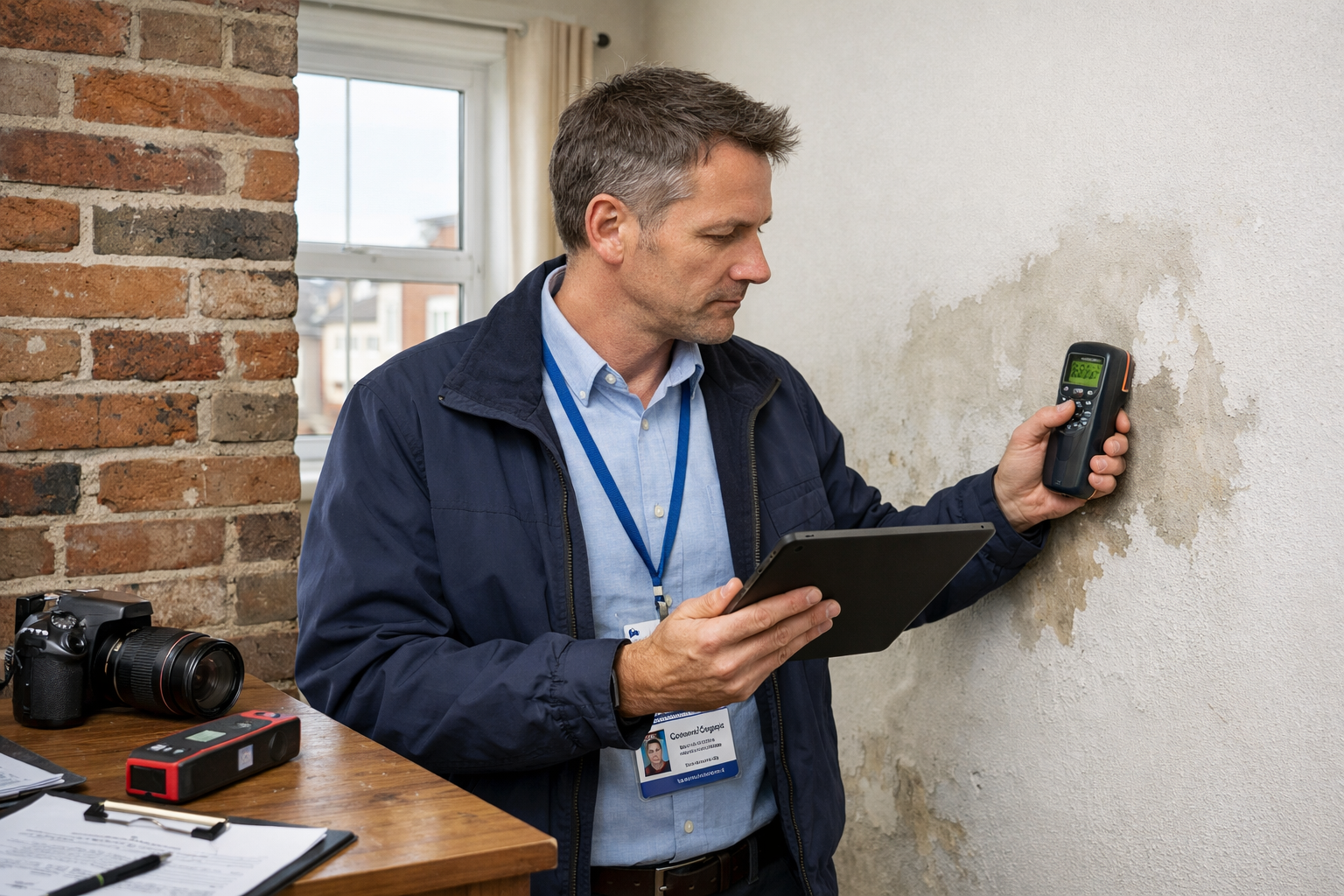
A council property surveyor is a qualified professional employed by local authorities to assess, inspect, and manage the condition of publicly-owned residential properties. Unlike private sector surveyors who primarily serve individual homebuyers and commercial clients, council surveyors focus exclusively on social housing stock managed by local government entities.
Primary Functions and Responsibilities
Council property surveyors wear multiple professional hats throughout their working week:
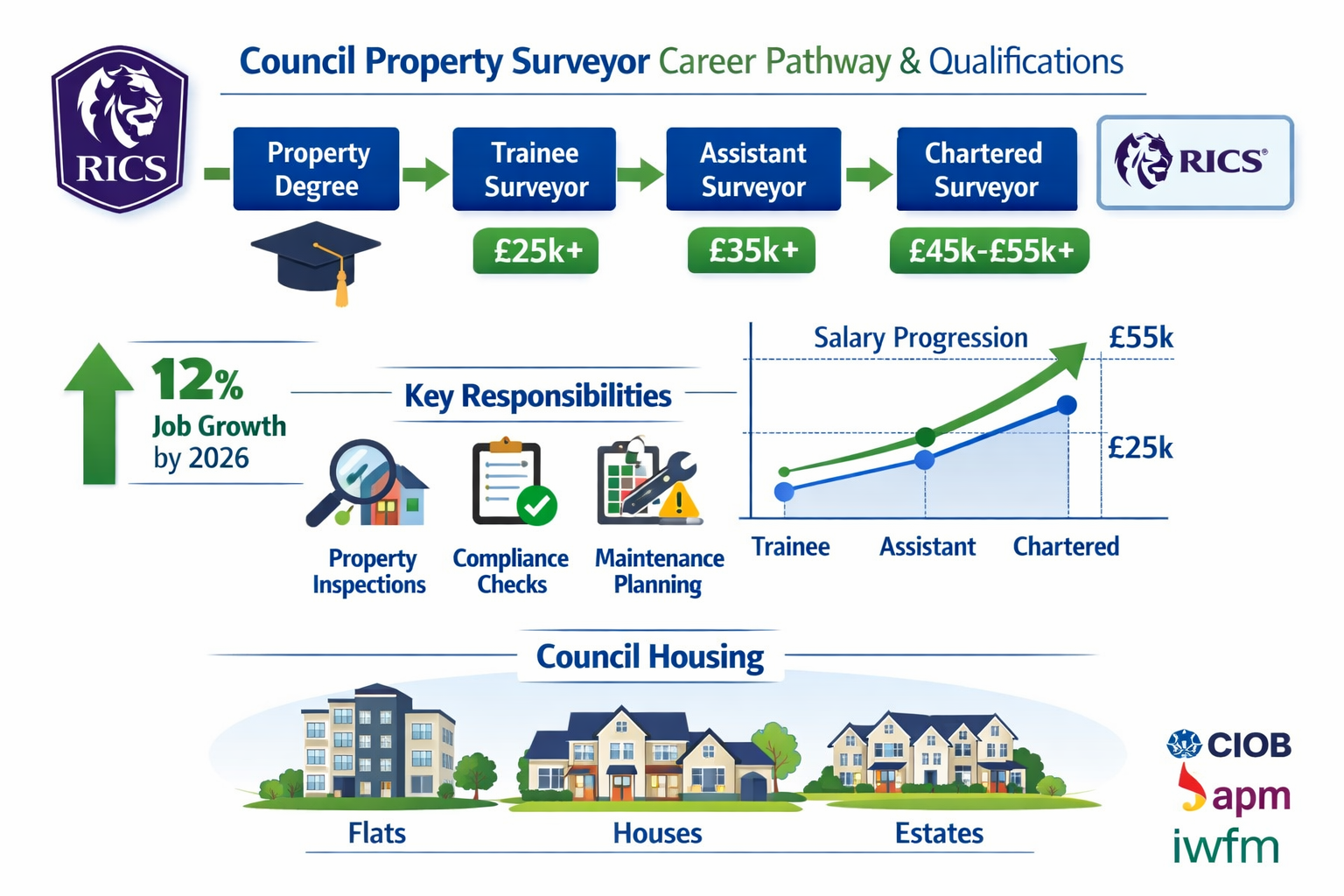
🏘️ Property Inspections: Conducting detailed assessments of council-owned homes, flats, and estates to identify structural issues, maintenance needs, and safety concerns.
📋 Compliance Monitoring: Ensuring all properties meet current building regulations, health and safety standards, and housing quality requirements.
💰 Budget Planning: Preparing cost estimates for repairs, renovations, and capital improvement programs while working within public sector financial constraints.
🔧 Maintenance Programming: Developing strategic maintenance schedules that prioritize urgent repairs while planning for long-term property sustainability.
📊 Asset Management: Maintaining comprehensive records of property conditions, repair histories, and lifecycle planning for entire housing portfolios.
How Council Surveyors Differ from Private Surveyors
The distinction between council and private practice surveyors extends beyond employment structure:
| Aspect | Council Property Surveyor | Private Surveyor |
|---|---|---|
| Client Base | Single employer (local authority) | Multiple individual clients |
| Property Focus | Social housing stock | Residential and commercial properties |
| Survey Types | Stock condition, planned maintenance | Homebuyer reports, building surveys |
| Accountability | Public sector transparency | Private client confidentiality |
| Regulatory Focus | Social housing standards, Decent Homes | General property market standards |
| Career Stability | Pension benefits, job security | Variable income, entrepreneurial |
Understanding these differences helps clarify why council property surveying represents a distinct career pathway within the broader surveying profession. Those interested in different types of property surveys will find that council work emphasizes volume assessment and strategic planning over individual transaction support.
Core Responsibilities of a Council Property Surveyor
The daily workload of a council property surveyor balances reactive problem-solving with proactive strategic planning. These professionals must navigate competing priorities while maintaining rigorous professional standards.
Stock Condition Surveys
Stock condition surveys form the foundation of effective council housing management. These comprehensive assessments involve:
- Systematic inspection of building exteriors, roofs, and structural elements
- Interior assessments covering electrical systems, plumbing, heating, and fixtures
- Identification of damp issues, timber decay, and moisture-related problems
- Documentation of subsidence risks and foundation concerns
- Assessment of energy efficiency and thermal performance
Council surveyors typically conduct these surveys on a rolling program, ensuring every property receives regular professional attention. The data collected feeds directly into maintenance planning and budget allocation decisions.
Planned Maintenance Programs
Beyond reactive repairs, council property surveyors develop planned maintenance programs that:
✅ Extend property lifespan through preventative interventions before minor issues become major failures
✅ Optimize budgets by scheduling work efficiently and avoiding emergency repair premiums
✅ Minimize tenant disruption through coordinated, planned interventions rather than crisis responses
✅ Ensure compliance with evolving building regulations and safety standards
✅ Support decarbonization goals by integrating energy efficiency improvements into routine maintenance cycles
These programs require surveyors to balance immediate needs against long-term strategic objectives, often working with limited budgets and competing priorities.
Regulatory Compliance and Safety
Council property surveyors serve as compliance gatekeepers, ensuring properties meet:
- Decent Homes Standard: The government benchmark for social housing quality
- Housing Health and Safety Rating System (HHSRS): Assessment framework for potential hazards
- Fire Safety Regulations: Particularly critical following regulatory changes in recent years
- Gas Safety Certificates: Annual inspection requirements for all properties with gas appliances
- Electrical Installation Condition Reports: Five-yearly electrical safety assessments
- Asbestos Management: Identification and safe management of asbestos-containing materials
Failure to maintain compliance can result in legal action, reputational damage, and most importantly, risk to tenant safety. Council surveyors must stay current with evolving regulations and ensure their authorities meet all statutory obligations.
Tenant Liaison and Communication
Unlike private surveyors who rarely interact with property occupants, council property surveyors regularly engage with tenants to:
- Explain survey findings and planned works
- Address concerns about property conditions
- Coordinate access for inspections and repairs
- Manage expectations regarding timelines and disruption
- Gather feedback on completed works
This public-facing dimension requires strong communication skills and empathy, particularly when delivering unwelcome news about repair delays or necessary disruptions.
Qualifications and Skills Required
Becoming a council property surveyor requires a combination of formal education, professional accreditation, and practical competencies.
Educational Pathways
Degree Requirements: Most council surveyors hold degrees in:
- Building Surveying
- Construction Management
- Architectural Technology
- Civil Engineering
- Related built environment disciplines
RICS Accreditation: The Royal Institution of Chartered Surveyors (RICS) provides the gold standard professional qualification. The pathway includes:
- RICS-accredited degree (undergraduate or postgraduate)
- Assessment of Professional Competence (APC): Structured training period combining practical experience with formal assessment
- Final assessment: Professional interview demonstrating competence across required areas
- Chartered status: MRICS designation upon successful completion
Some councils employ trainee surveyors without full RICS qualification, supporting them through the APC process while they gain practical experience.
Essential Technical Skills
Successful council property surveyors demonstrate proficiency in:
🔍 Building Pathology: Understanding how buildings deteriorate, identifying defects, and diagnosing underlying causes
📐 Construction Technology: Knowledge of traditional and modern building methods, materials, and systems
💻 Digital Tools: Competence with surveying software, asset management systems, and digital reporting platforms
📊 Data Analysis: Ability to interpret condition data, identify trends, and prioritize interventions
⚖️ Regulatory Knowledge: Comprehensive understanding of building regulations, housing standards, and safety legislation
💷 Cost Estimation: Skill in preparing accurate budget forecasts and evaluating contractor quotations
Soft Skills and Attributes
Beyond technical competence, effective council surveyors possess:
- Problem-solving ability: Creative thinking when addressing complex building issues with budget constraints
- Communication skills: Clear written reports and confident verbal explanations for technical and non-technical audiences
- Time management: Juggling multiple properties, deadlines, and priorities simultaneously
- Ethical judgment: Making decisions that balance cost, quality, and public interest
- Resilience: Managing challenging situations, difficult conversations, and bureaucratic complexities
Those considering this career should also explore how to find the best local surveyor to understand the broader professional landscape.
Career Progression and Salary Expectations
The council property surveyor career pathway offers clear progression opportunities within the public sector framework.
Entry-Level Positions
Assistant/Trainee Surveyor (£25,000-£32,000)
- Supporting senior surveyors with inspections
- Learning building pathology and defect identification
- Conducting basic condition surveys under supervision
- Preparing draft reports and cost estimates
- Working toward RICS qualification
Mid-Career Roles
Surveyor/Building Surveyor (£32,000-£45,000)
- Independent responsibility for property inspections
- Managing defined geographical areas or property types
- Developing maintenance programs and specifications
- Liaising with contractors and monitoring works
- Mentoring junior staff
Senior Surveyor/Principal Surveyor (£45,000-£55,000)
- Overseeing teams of surveyors
- Managing major capital projects
- Strategic planning for housing stock
- Budget responsibility and financial management
- Policy development and implementation
Leadership Positions
Head of Property Services/Asset Management (£55,000-£75,000+)
- Executive responsibility for entire housing portfolio
- Strategic asset management planning
- Senior leadership team membership
- Political liaison and committee reporting
- Service-wide budget accountability
Benefits Beyond Salary
Council employment typically includes:
✨ Pension schemes: Generous Local Government Pension Scheme (LGPS) contributions
✨ Job security: Greater stability than private sector roles
✨ Work-life balance: Standard working hours with limited out-of-hours requirements
✨ Professional development: Funded training, qualifications, and CPD opportunities
✨ Annual leave: Typically 25-30 days plus bank holidays
✨ Sick pay: Comprehensive occupational sick pay arrangements
These benefits often compensate for salaries that may be lower than equivalent private sector positions, particularly at senior levels.
Challenges Facing Council Property Surveyors in 2026
The role of council property surveyor comes with distinctive challenges that require resilience and adaptability.
Budget Constraints
Limited resources represent perhaps the most persistent challenge. Council surveyors must:
- Prioritize essential safety works over desirable improvements
- Justify every expenditure with robust evidence
- Find creative solutions to achieve compliance within tight budgets
- Balance immediate needs against long-term strategic planning
- Navigate political pressures regarding spending decisions
The gap between identified needs and available funding creates constant professional tension, requiring surveyors to make difficult prioritization decisions that directly impact tenant welfare.
Aging Housing Stock
Much of the UK’s council housing dates from the 1950s-1980s, presenting specific challenges:
- Structural deterioration: Concrete cancer, steel corrosion, and material failure in system-built properties
- Energy inefficiency: Poor insulation and outdated heating systems requiring comprehensive retrofitting
- Obsolete systems: Electrical and plumbing installations beyond economic repair
- Design defects: Inherent problems in construction methods popular during mass housing construction
- Asbestos presence: Widespread use of asbestos-containing materials requiring careful management
Addressing these issues requires substantial investment and technical expertise, often complicated by properties remaining occupied throughout improvement works.
Regulatory Evolution
The regulatory landscape continues to evolve, with council surveyors navigating:
- Building Safety Act: Enhanced requirements following Grenfell Tower tragedy
- Energy Performance Standards: Pressure to improve thermal efficiency and reduce carbon emissions
- Accessibility Requirements: Adapting properties for aging populations and disabled tenants
- Fire Safety: Ongoing changes to fire safety regulations, particularly for multi-story buildings
- Damp and Mould: Heightened scrutiny following high-profile cases linking poor housing conditions to health outcomes
Staying current requires continuous professional development and proactive engagement with emerging standards. Understanding issues like Japanese knotweed and boundary disputes also forms part of the broader knowledge base required.
Political and Public Accountability
Unlike private surveyors who answer primarily to individual clients, council surveyors operate within a framework of public accountability:
- Committee scrutiny: Survey findings and spending proposals reviewed by elected members
- Media attention: High-profile issues attracting local and national press coverage
- Freedom of Information requests: Public access to survey reports and decision-making processes
- Tenant advocacy: Active tenant groups challenging decisions and demanding improvements
- Ombudsman investigations: External review of complaints and service failures
This transparency, while essential for democratic accountability, adds complexity and pressure to the surveyor’s role.
The Future of Council Property Surveying
The profession continues to evolve, with several trends shaping the future of council property surveying.
Digital Transformation
Technology is revolutionizing how council surveyors work:
📱 Mobile inspection apps: Real-time data capture, photo documentation, and cloud-based reporting
🤖 Artificial intelligence: Automated defect identification from drone and photographic surveys
🏗️ Building Information Modeling (BIM): Digital twins of housing stock enabling predictive maintenance
📊 Data analytics: Pattern recognition identifying systemic issues across property portfolios
🌡️ IoT sensors: Continuous monitoring of property conditions, particularly moisture and temperature
These technologies promise greater efficiency, more comprehensive data, and proactive rather than reactive maintenance approaches.
Sustainability and Decarbonization
Council surveyors increasingly focus on environmental performance:
- Retrofitting insulation and renewable energy systems
- Specifying sustainable materials for repairs and improvements
- Planning whole-house approaches to energy efficiency
- Balancing heritage conservation with thermal performance
- Supporting net-zero carbon targets for social housing
This sustainability agenda requires new technical knowledge and creative problem-solving to upgrade existing stock cost-effectively.
Integrated Service Delivery
Progressive councils are breaking down traditional silos, with surveyors working more closely with:
- Housing management teams
- Social services supporting vulnerable tenants
- Environmental health officers
- Community development workers
- External partners including health services
This integrated approach recognizes that housing quality fundamentally impacts health, education, and social outcomes, positioning surveyors as key contributors to broader community wellbeing.
How to Become a Council Property Surveyor
For those considering this career pathway, several routes lead to council property surveying roles.
Step 1: Educational Foundation
University Route:
- Research RICS-accredited degree programs in building surveying or related disciplines
- Consider location, teaching quality, and industry connections
- Explore undergraduate and postgraduate options depending on existing qualifications
Apprenticeship Route:
- Investigate degree apprenticeships combining work and study
- Some councils offer apprenticeship programs supporting entry into the profession
- Provides income while gaining qualifications and practical experience
Step 2: Gaining Experience
Work placements: Seek summer internships or year-in-industry opportunities with local authorities
Volunteering: Community housing organizations may offer exposure to social housing issues
Related roles: Consider starting in housing management, estate management, or technical assistant positions
Networking: Attend professional events, join RICS student membership, and connect with practicing surveyors
Step 3: Professional Qualification
Enroll in APC: Register with RICS and begin structured training program
Find supervisor: Identify experienced chartered surveyor to guide professional development
Document competencies: Maintain detailed records of experience across required competency areas
Prepare for assessment: Study for final assessment interview demonstrating professional capability
Step 4: Securing Council Employment
Research authorities: Identify councils with active recruitment and good professional development reputations
Tailor applications: Emphasize public service motivation, understanding of social housing, and relevant technical skills
Prepare for interviews: Expect questions about budget constraints, prioritization, and public accountability
Consider location: Opportunities vary geographically, with larger urban authorities typically offering more positions
Those exploring surveying services can gain insights into the broader profession before specializing in council work.
Working with Council Property Surveyors: A Tenant Perspective
For council tenants, understanding the surveyor’s role helps manage expectations and improve communication.
When Will a Surveyor Visit?
Council property surveyors typically visit properties for:
- Routine stock condition surveys: Periodic inspections on rolling programs
- Pre-planned maintenance: Assessing properties before major improvement works
- Repair requests: Investigating significant defects reported by tenants
- Compliance inspections: Checking safety standards and regulatory requirements
- Pre-allocation surveys: Assessing void properties before new tenancies
Tenants should receive advance notice of planned inspections, with appointments arranged at mutually convenient times.
What to Expect During Inspections
Professional council surveyors will:
✅ Arrive with identification and explain the inspection purpose
✅ Conduct systematic examination of property elements
✅ Use specialist equipment (moisture meters, thermal cameras, etc.)
✅ Take photographs for documentation purposes
✅ Ask questions about property performance and any concerns
✅ Explain findings in accessible language
✅ Provide information about next steps and timelines
Tenants should prepare by ensuring access to all areas and noting any specific concerns to raise during the visit.
Understanding Survey Outcomes
Following inspections, surveyors prepare reports that:
- Identify defects and categorize by urgency
- Recommend repair approaches and specifications
- Estimate costs for budgeting purposes
- Set priorities based on risk and available resources
- Feed into maintenance programming and capital planning
Tenants may not receive detailed survey reports, but should be informed of significant findings and planned actions. Those interested in understanding survey processes might explore common myths about property surveys to better understand professional assessment methods.
Comparing Council and Private Sector Surveying
Professionals considering their career direction often weigh council employment against private practice.
Advantages of Council Employment
Stability and security: Permanent contracts with pension benefits and job security
Meaningful impact: Direct contribution to community welfare and social housing quality
Work-life balance: Predictable hours with limited weekend or evening work
Professional development: Funded training, qualifications, and continuous learning opportunities
Diverse portfolio: Exposure to wide range of property types, ages, and construction methods
Team environment: Collaborative working with colleagues rather than competitive practice
Advantages of Private Practice
Higher earning potential: Particularly at senior levels and for successful practice owners
Client variety: Working with diverse clients across residential and commercial sectors
Entrepreneurial opportunity: Potential to establish own surveying practice
Specialized focus: Ability to concentrate on specific survey types or property sectors
Market responsiveness: Direct connection between service quality and business success
Flexible working: Potential for self-employment and portfolio careers
Neither pathway is inherently superior—the choice depends on individual priorities, values, and career aspirations. Some surveyors move between sectors throughout their careers, gaining diverse experience and perspectives.
Key Takeaways for Property Professionals
Whether you’re an aspiring surveyor, current professional, or someone interested in understanding council property management, several key points emerge:
🏛️ Essential public service: Council property surveyors perform critical work safeguarding social housing quality and tenant welfare
📚 Professional qualification matters: RICS accreditation provides credibility, competence, and career progression opportunities
💼 Unique challenges: Budget constraints, aging stock, and public accountability create distinctive professional pressures
🔄 Evolving profession: Digital technology, sustainability requirements, and regulatory changes continually reshape the role
🎯 Clear career pathway: Structured progression from trainee through to senior management positions
⚖️ Balance required: Successful council surveyors balance technical expertise with communication skills, empathy, and ethical judgment
For those exploring whether to commission surveys for property purchases, understanding the difference between Level 2 and Level 3 surveys provides valuable context, even though council surveyors typically conduct different survey types focused on stock condition rather than pre-purchase assessment.
Conclusion: The Vital Role of Council Property Surveyors
The council property surveyor occupies a unique position at the intersection of technical expertise, public service, and community welfare. These professionals ensure that millions of UK residents live in safe, decent, and well-maintained homes, often working with limited resources to achieve maximum impact.
As social housing faces mounting challenges—aging stock, tightening budgets, evolving regulations, and rising tenant expectations—the surveyor’s role becomes increasingly critical. Their professional judgment directly influences the quality of life for vulnerable populations, the sustainability of public assets, and the effectiveness of public spending.
For those considering this career pathway, council property surveying offers meaningful work, professional development, and the satisfaction of contributing to essential public services. The role demands technical competence, ethical commitment, and resilience, but rewards practitioners with stable employment, continuous learning, and genuine social impact.
Next Steps
For aspiring council property surveyors:
- Research RICS-accredited degree programs and apprenticeship opportunities
- Seek work experience with local authorities or housing associations
- Connect with practicing surveyors to understand day-to-day realities
- Begin building technical knowledge through self-study and professional reading
For council tenants:
- Understand the surveyor’s role in maintaining your home
- Engage constructively during inspections and communicate concerns clearly
- Recognize budget and regulatory constraints affecting repair timelines
- Participate in tenant consultation processes influencing maintenance priorities
For local authorities:
- Invest in professional development to retain skilled surveyors
- Provide adequate resources for comprehensive stock condition assessment
- Embrace digital technologies improving efficiency and data quality
- Foster collaborative working between surveyors and other housing services
The future of social housing depends significantly on the expertise, dedication, and professional judgment of council property surveyors. As the sector navigates complex challenges in 2026 and beyond, these professionals remain indispensable guardians of housing quality and community wellbeing.
For more information about professional surveying services and expert property assessments, contact experienced chartered surveyors who can provide guidance tailored to your specific needs.