
On 27 January 2026, the Building Safety Regulator (BSR) ceased to operate as a division of the Health and Safety Executive and became a fully independent statutory body — a change that carries consequences far beyond high-rise towers. [1][5] For surveyors working across the mid-rise and lower-risk residential sector, the Building Safety Regulator 2026 Reforms: Implications for Surveyors in Lower-Risk Residential Assessments represent a fundamental shift in professional obligations, documentation standards, and regulatory exposure. This article breaks down exactly what has changed, why it matters for day-to-day surveying practice, and what firms must do to stay compliant.
Key Takeaways 📋
- The BSR became an independent non-departmental public body on 27 January 2026, with direct enforcement powers and the authority to bring legal proceedings. [5]
- Registration requirements now extend to residential buildings 11–18 metres high, significantly expanding the pool of properties subject to BSR oversight. [2]
- The Building Safety Levy launches 1 October 2026, affecting most new residential developments of 10 or more dwellings. [2]
- Surveyors must shift from intention-based to evidence-based compliance, treating documentation, QA processes, and reporting templates as core regulatory tools. [1]
- Digital workflow systems with traceable audit trails are no longer optional — they are a compliance requirement. [1]
The BSR's New Independent Status: What Changed on 27 January 2026
From HSE Division to Standalone Regulator
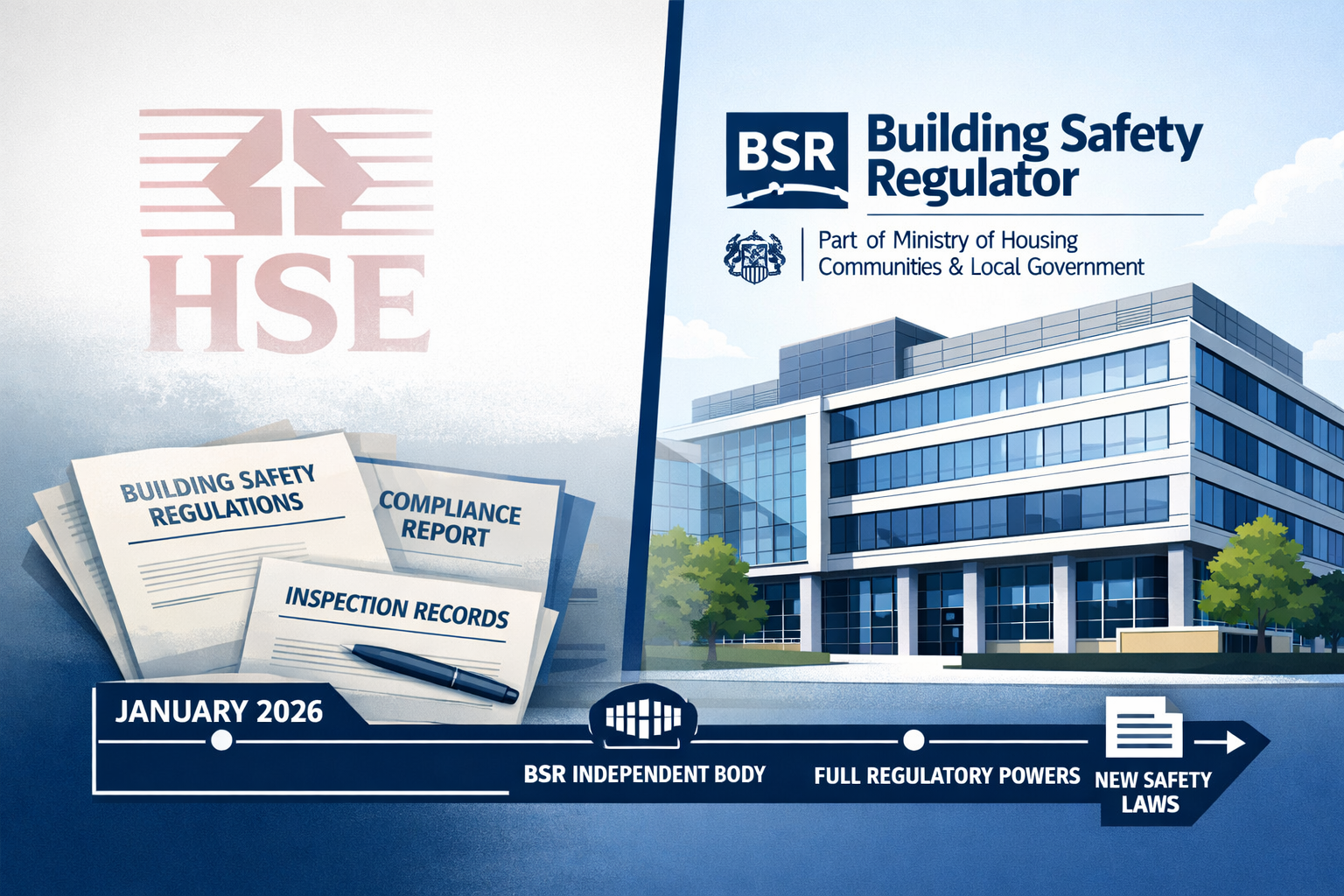
Before 27 January 2026, the Building Safety Regulator operated within the Health and Safety Executive. That arrangement is now history. The BSR transitioned to an independent executive non-departmental public body, sponsored directly by the Ministry of Housing, Communities and Local Government (MHCLG). [5] This restructuring implements a core recommendation from the Grenfell Tower Inquiry — that building safety oversight must be structurally independent and robustly accountable.
The practical implications are significant:
| Former Status | New Status (from Jan 2026) |
|---|---|
| Division of HSE | Independent non-departmental public body |
| HSE enforcement powers | Direct BSR enforcement powers |
| No independent legal standing | Can bring legal proceedings independently |
| Could not charge for services | Can charge for advice and services |
| Could not enter contracts independently | Full contracting authority |
The BSR's leadership now comprises a chair, 3–8 board members appointed by the Secretary of State, and a chief executive. The HSE will continue to provide administrative support until December 2026, after which the BSR operates fully under its own structures. [5]
Why Independent Status Matters for Surveyors
An independent BSR with direct enforcement powers is a fundamentally different regulatory actor than a sub-division of a larger body. It can pursue legal proceedings, charge for regulatory services, and operate with strategic autonomy. For surveyors, this means regulatory decisions are less likely to be filtered through broader HSE priorities and more likely to reflect BSR-specific enforcement objectives. [5]
The BSR's 2026–2027 strategic plan signals a move toward proactive oversight — meaning surveyors should expect more targeted engagement, not less. [4] Firms that have treated compliance as a box-ticking exercise are now operating in a higher-risk environment.
💬 "The shift from intention-based to evidence-based compliance means demonstrating how decisions were reached now matters as much as the decisions themselves." [1]
Expanded Registration Thresholds: How Building Safety Regulator 2026 Reforms Affect Lower-Risk Residential Assessments
The 11–18 Metre Threshold: A Game-Changer for Mid-Rise Properties
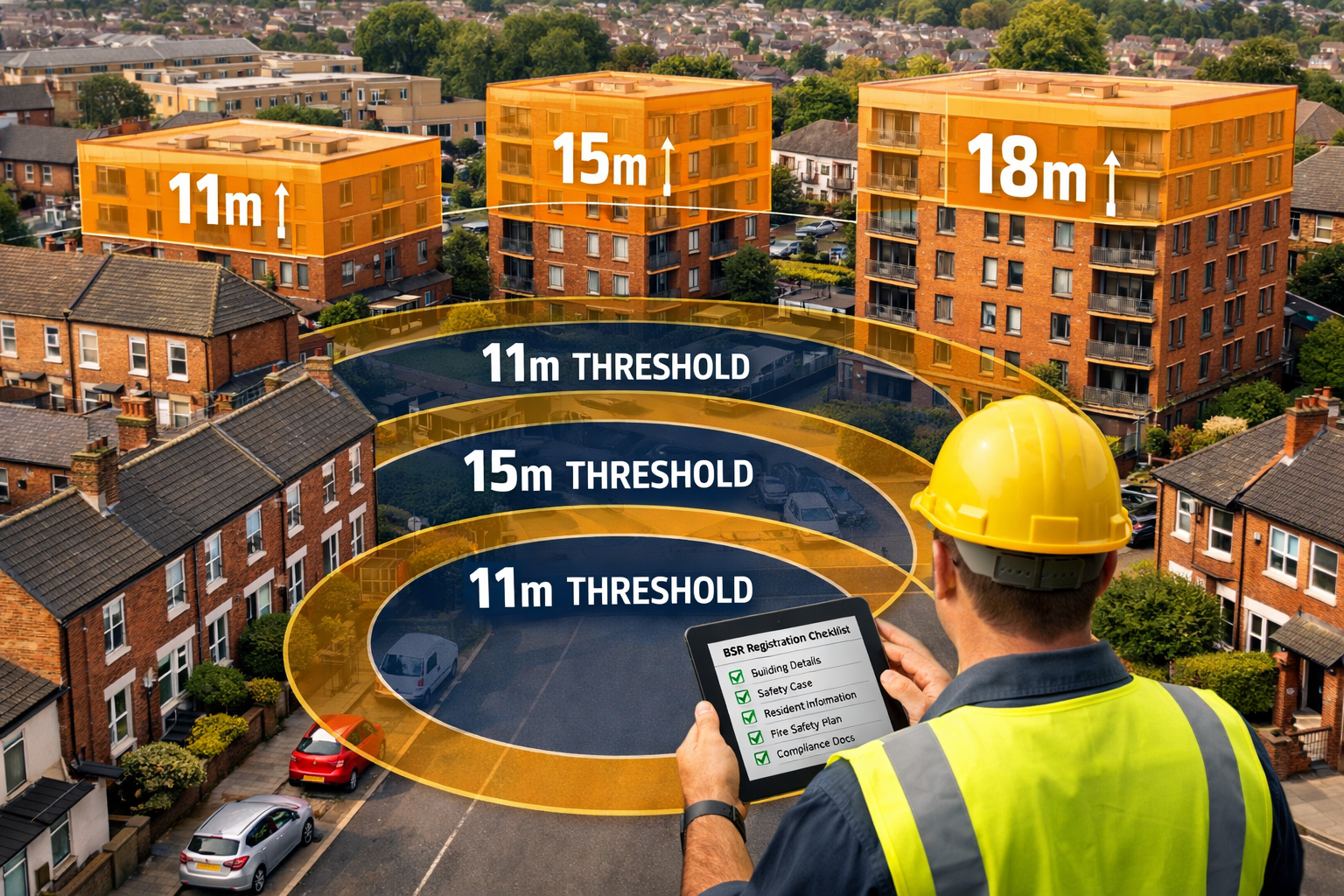
Perhaps the most consequential change for practising surveyors is the extension of registration requirements to residential buildings between 11 and 18 metres in height. [2] Previously, BSR oversight was concentrated on higher-risk buildings (HRBs) exceeding 18 metres or seven storeys. The expanded threshold captures a substantial volume of mid-rise residential stock — the kind of property that many surveying firms handle as routine, lower-risk work.
This matters because:
- 🏢 More buildings now require formal registration with the BSR, triggering associated documentation obligations.
- 📋 Surveyors assessing these properties must align their checklists with the updated regulatory framework.
- ⚖️ Principal Accountable Persons (PAPs) for these buildings have a 28-day deadline to submit Building Assessment Certificate applications once directed by the BSR. [3]
- 📁 PAPs must maintain a resident engagement strategy, safety case report, and occurrence reporting systems documentation regardless of whether the BSR has formally called them in. [3]
For surveyors working in areas with significant mid-rise residential stock — such as those covered by London property surveyors — the volume of properties now falling under expanded BSR scrutiny is substantial.
The Building Safety Levy: October 2026 and Beyond
Alongside the registration changes, the Building Safety Levy launches on 1 October 2026. [2] This levy applies to most new residential developments of 10 or more dwellings, with the aim of raising £3.4 billion to fund the remediation of unsafe buildings across England.
Key levy details:
- Exemptions: Social housing providers are exempt.
- Discounts: Brownfield site developments receive a reduced rate.
- Timing: No transitional provisions — developers must factor levy costs into land appraisals immediately. [2]
For surveyors advising clients on new residential developments or conducting pre-purchase assessments, understanding the levy's impact on project viability and land values is now part of the professional brief. The levy also reinforces the broader regulatory direction: building safety costs are being systematically internalised into the development process.
Updated Surveyor Checklists and Compliance Obligations Under the 2026 Reforms
Evidence-Based Compliance: The New Standard
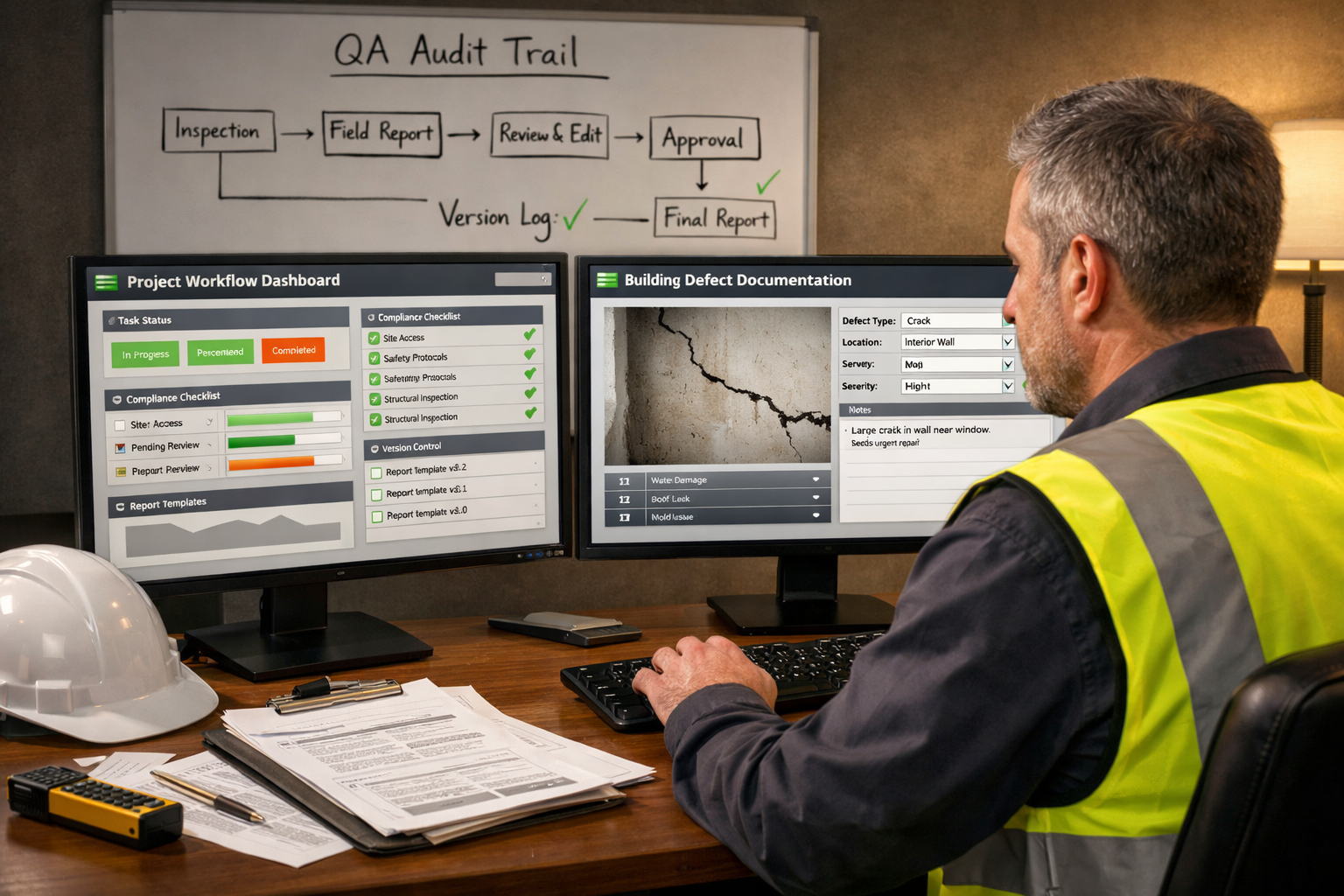
The most operationally significant shift for surveying firms under the Building Safety Regulator 2026 Reforms: Implications for Surveyors in Lower-Risk Residential Assessments is the move from intention-based to evidence-based compliance. [1] Under the old approach, demonstrating that a surveyor intended to follow best practice was often sufficient. Under the 2026 framework, firms must demonstrate how every decision was reached, documented, and reviewed.
This requires four core elements to be embedded in every assessment:
- Methodology documentation — The approach taken must be explicitly recorded, not assumed.
- Risk categorisation records — How a property was classified and why must be traceable.
- Assumptions log — Any assumptions made during the assessment must be formally noted.
- Amendment traceability — Changes to reports must follow formalised version control. [1]
These are no longer administrative preferences. They are compliance requirements that can be scrutinised by the BSR under its new enforcement powers.
Reporting Templates as Risk Controls
One of the clearest practical changes is the reclassification of reporting templates. Under the 2026 framework, templates are no longer treated as administrative tools — they are risk controls. [1] This means:
- Templates must be standardised across the firm, not left to individual surveyor preference.
- Terminology must be consistent to ensure comparability across reports and audit trails.
- Field data capture must follow a consistent protocol, not vary by project or surveyor. [1]
For firms conducting homebuyers surveys or full structural inspections, this means reviewing existing templates against the new standard and updating them where necessary.
Quality Assurance as Compliance Evidence
Internal QA processes have been elevated from good practice to compliance evidence. [1] The BSR's proactive oversight model means that a firm's QA system may be subject to external audit. Systems must be structured to demonstrate:
- ✅ Who reviewed each report and when
- ✅ What criteria were applied in the review
- ✅ How discrepancies or concerns were resolved
- ✅ That the review process was completed before the report was issued
For surveyors handling moisture damage assessments or damp surveys on mid-rise residential properties now captured by the expanded threshold, QA documentation is no longer optional.
Digital Workflow: From Convenience to Regulatory Requirement
The BSR has signalled a clear direction toward structured information management and digital traceability. [1] Surveying firms relying on paper-based or ad hoc digital processes face meaningful compliance risk. The requirements now include:
- Digital systems that produce decision audit trails — showing the sequence and basis of assessments.
- Traceability of all amendments — who changed what, when, and why.
- Consistent field data capture — ensuring data collected on-site meets the same standard regardless of which surveyor conducted the assessment. [1]
This is particularly relevant for firms managing high volumes of residential assessments across multiple locations. Whether working in Westminster, Knightsbridge, or Hounslow, the same digital standards apply.
Practical Steps for Surveyors: Aligning with the 2026 Regulatory Framework
Updated Checklist for Lower-Risk Residential Assessments
The following checklist reflects the updated obligations under the Building Safety Regulator 2026 Reforms: Implications for Surveyors in Lower-Risk Residential Assessments:
Pre-Assessment 🗂️
- Confirm building height — does it fall within the 11–18 metre threshold?
- Identify the Principal Accountable Person and confirm registration status with BSR.
- Review any existing safety case reports or resident engagement strategies held by the PAP.
- Select the appropriate survey type — see the guide on homebuyers survey vs full structural for reference.
During Assessment 🔍
- Follow standardised field data capture protocol.
- Log all assumptions made during the inspection.
- Document risk categorisation decisions with explicit reasoning.
- Record methodology applied, including any deviations from standard approach.
Report Production 📄
- Use firm-approved, standardised reporting template.
- Apply consistent terminology throughout.
- Ensure version control is active — all amendments must be traceable.
- Complete internal QA review before issuing.
Post-Assessment 📬
- Retain full documentation package including field notes, assumptions log, and QA sign-off.
- Ensure digital audit trail is complete and accessible.
- Advise clients on any BSR registration obligations triggered by the assessment findings.
Regulatory Engagement: What to Expect
The BSR's 2026–2027 strategic plan confirms that regulatory engagement will become more targeted. [4] Dutyholders and their professional advisers — including surveyors — should anticipate:
- Increased scrutiny for properties newly captured by the expanded registration threshold. [5]
- More frequent requests for documentation demonstrating compliance with the evidence-based standard. [1]
- Proactive outreach from the BSR to registered buildings, rather than waiting for incidents to trigger oversight. [6]
Surveyors who have already aligned their documentation and QA processes with the new standard will be significantly better positioned to respond to regulatory engagement without disruption to their practice.
The Importance of Finding a Qualified Local Surveyor
With expanded obligations now applying to a broader range of residential properties, the importance of working with a qualified, regulation-aware surveyor has never been greater. Clients and building owners should understand how to find the best local surveyor near them — prioritising those who have updated their processes to reflect the 2026 reforms.
For surveyors themselves, the reforms represent an opportunity to differentiate on the basis of compliance capability and documentation quality, not just technical expertise.
Conclusion: Actionable Next Steps for Surveyors in 2026
The Building Safety Regulator 2026 Reforms: Implications for Surveyors in Lower-Risk Residential Assessments are not a distant concern for high-rise specialists — they are an immediate operational reality for any surveying firm working with mid-rise residential properties of 11 metres or above.
The key actions for surveying firms right now:
- Audit existing templates and QA processes against the evidence-based compliance standard — identify gaps before the BSR does.
- Implement or upgrade digital workflow systems to ensure decision audit trails, amendment traceability, and consistent field data capture are in place.
- Train all surveyors on the updated documentation requirements, including methodology recording, risk categorisation, and assumptions logging.
- Review your property portfolio — identify all buildings in the 11–18 metre range and confirm their BSR registration status with clients.
- Factor the Building Safety Levy into advice given to developer clients on new residential schemes of 10+ dwellings from 1 October 2026.
- Engage proactively with the BSR's strategic direction — the 2026–2027 plan signals increased oversight, and early alignment is far preferable to reactive compliance.
The regulatory landscape has fundamentally shifted. Surveyors who treat these reforms as an administrative burden will struggle. Those who embed the new standards into their professional practice will be better protected, more credible, and better positioned to serve clients in an increasingly regulated market.
References
[1] Building Safety Act 2026 What Surveying Firms Must Do Now – https://goreport.com/building-safety-act-2026-what-surveying-firms-must-do-now/
[2] Building Safety Act 2026 Developers Guide – https://www.procterandstreet.co.uk/post/building-safety-act-2026-developers-guide
[3] Building Safety Act 2022 What To Expect In 2026 – https://gowlingwlg.com/en/insights-resources/articles/2025/building-safety-act-2022-what-to-expect-in-2026
[4] Building Safety Regulator Strategic Plan 2026 To 2027 – https://www.gov.uk/government/publications/building-safety-regulator-strategic-plan-2026-to-2027/building-safety-regulator-strategic-plan-2026-to-2027
[5] Building Safety Regulator Key Changes From January 2026 – https://connections.nortonrosefulbright.com/post/102m2l3/building-safety-regulator-key-changes-from-january-2026
[6] Inside The Building Safety Regulators 2026 Plan – https://www.riba.org/work/insights-and-resources/professional-features/inside-the-building-safety-regulators-2026-plan/
[7] Building Safety Act Compliance In 2026 Building Surveys Gateway Processes And Surveyor Checklists For Higher Risk Properties – https://nottinghillsurveyors.com/blog/building-safety-act-compliance-in-2026-building-surveys-gateway-processes-and-surveyor-checklists-for-higher-risk-properties
[8] Building Safety Regulator Strategic Plan 2026 To 2027 (Designing Buildings) – https://www.designingbuildings.co.uk/wiki/Building%20Safety%20Regulator%20strategic%20plan%202026%20to%202027