

Agreed Surveyor Party Wall: Your Complete Guide to Streamlined Dispute Resolution
When planning building work that affects a shared wall with your neighbor, the prospect of navigating party wall legislation can feel overwhelming. However, appointing an agreed surveyor party wall professional can transform what seems like a complex legal minefield into a straightforward, cost-effective process. This collaborative approach not only saves money but also helps maintain positive relationships with neighbors during construction projects.
Understanding the agreed surveyor option under the Party Wall etc. Act 1996 is essential for property owners undertaking extensions, loft conversions, or structural alterations in England and Wales. This comprehensive guide explores everything you need to know about the agreed surveyor party wall process, from initial appointment through to final award.
Key Takeaways
- ✅ An agreed surveyor party wall arrangement involves one impartial surveyor representing both property owners, reducing costs by up to 50% compared to appointing separate surveyors
- 📋 Both neighbors must consent in writing to the agreed surveyor appointment, and either party can withdraw consent at any time
- 💷 The building owner typically pays all surveyor fees, even in an agreed surveyor arrangement, though costs are significantly lower than dual appointments
- ⚖️ The agreed surveyor must remain completely impartial and act in both parties’ best interests throughout the process
- 🏗️ This approach works best when neighbors have a good relationship and the proposed works are relatively straightforward
What Is an Agreed Surveyor Party Wall Arrangement?
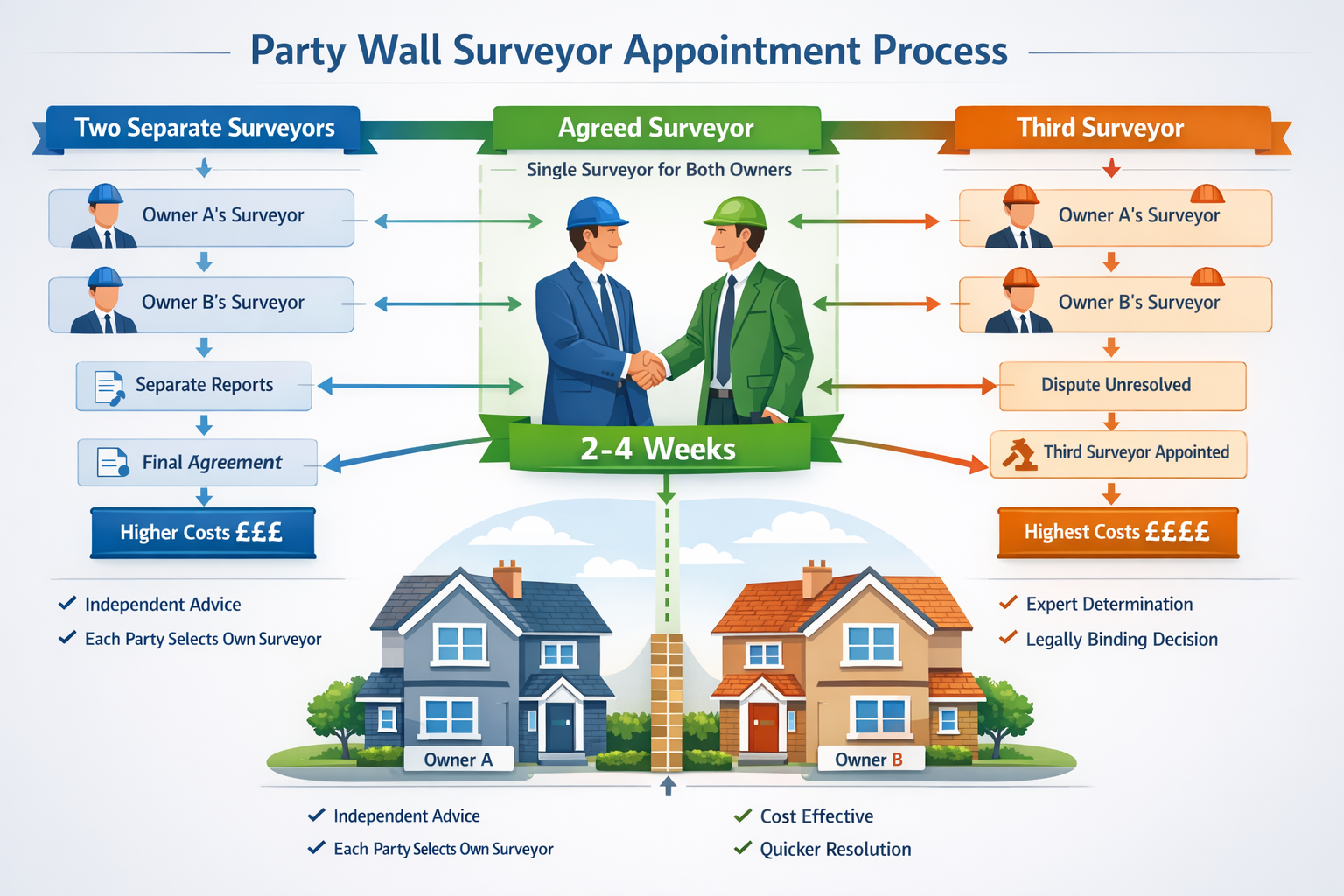
An agreed surveyor party wall appointment represents one of three possible routes for resolving party wall matters under the Party Wall etc. Act 1996. When a building owner serves notice on their neighbor regarding proposed works affecting a shared wall, boundary, or excavations near the neighboring property, the adjoining owner has several response options.
The Three Surveyor Options Explained
The legislation provides three distinct pathways for appointing surveyors:
Option 1: Agreed Surveyor 🤝
Both parties jointly appoint a single surveyor to act impartially for both sides. This professional prepares the party wall award and ensures both parties’ interests are protected.
Option 2: Two Separate Surveyors 👥
Each party appoints their own surveyor, and these two professionals work together (often appointing a third surveyor in case of disagreement) to prepare the award.
Option 3: Building Owner’s Surveyor Acts Alone 📝
If the adjoining owner doesn’t respond within 14 days, the building owner can appoint a surveyor to act on behalf of both parties.
The agreed surveyor party wall route offers significant advantages when both neighbors are willing to cooperate and trust a single professional to handle the matter fairly.
Legal Framework and Requirements
The Party Wall etc. Act 1996 specifically provides for agreed surveyor appointments under Section 10. The Act states that “the two owners may concur in the appointment of one surveyor” to act for both parties. This surveyor must be:
- Impartial and act in both parties’ interests equally
- Qualified with appropriate experience in party wall matters
- Independent with no conflicts of interest
- Competent to prepare legally compliant party wall awards
Many property owners working with professional surveyors find that the agreed surveyor route provides the most efficient resolution to party wall matters.
Benefits of Using an Agreed Surveyor Party Wall Professional
Choosing the agreed surveyor party wall option delivers numerous advantages for both building owners and adjoining owners. Understanding these benefits helps property owners make informed decisions about their party wall matters.
Cost Savings and Financial Efficiency 💰
The most immediate benefit is substantial cost reduction. When appointing separate surveyors, the building owner must pay fees for:
- Their own surveyor’s time and expertise
- The adjoining owner’s surveyor’s fees
- Potentially a third surveyor if disputes arise
| Surveyor Arrangement | Typical Cost Range | Who Pays |
|---|---|---|
| Agreed Surveyor | £800 – £1,500 | Building Owner |
| Two Surveyors | £1,600 – £3,000+ | Building Owner (both fees) |
| Two Surveyors + Third | £2,400 – £5,000+ | Building Owner (all fees) |
With an agreed surveyor, you’re paying for one professional’s time rather than two or three. This can reduce total costs by 40-60%, making it an attractive option for straightforward projects. For more detailed information about party wall costs, explore our guide on the cost of party wall surveyor services.
Faster Resolution Timeline ⏱️
The agreed surveyor party wall process typically moves more quickly than dual appointments because:
- Only one surveyor needs to inspect the properties
- No need for coordination between multiple professionals
- Fewer scheduling conflicts and delays
- Streamlined communication with both parties
- Single award preparation rather than negotiated document
Most agreed surveyor appointments result in awards being issued within 2-4 weeks, compared to 4-8 weeks for separate surveyor arrangements.
Simplified Communication
Working with a single surveyor creates a clear communication channel for both parties. Rather than messages passing between multiple professionals, both neighbors deal directly with one impartial expert who:
- Explains the process clearly to both sides
- Answers questions from either party
- Provides consistent information
- Reduces misunderstandings
- Maintains transparency throughout
Relationship Preservation 🏘️
Perhaps the most undervalued benefit is maintaining good neighbor relations. The agreed surveyor approach signals:
- Mutual trust and cooperation
- Willingness to work together
- Shared commitment to fair resolution
- Recognition of each other’s interests
This collaborative spirit often prevents the adversarial atmosphere that can develop when separate surveyors are appointed, helping neighbors maintain positive relationships long after construction completes.
How the Agreed Surveyor Party Wall Process Works
Understanding the step-by-step process for appointing and working with an agreed surveyor party wall professional helps property owners navigate their obligations confidently.
Step 1: Serving the Party Wall Notice 📬
The building owner must serve appropriate notice on the adjoining owner before commencing works. The notice type depends on the work category:
- Party Structure Notice: For works directly to a shared wall (alterations, underpinning, etc.)
- Line of Junction Notice: For new walls built on or astride the boundary
- Adjacent Excavation Notice: For excavations within 3-6 meters of neighboring structures
The notice must include specific details about the proposed works, including drawings, timings, and the building owner’s contact information.
Step 2: Adjoining Owner’s Response
Upon receiving notice, the adjoining owner has 14 days to respond in one of three ways:
- Consent to the works (ending the party wall process)
- Dissent and agree to appoint an agreed surveyor
- Dissent and appoint their own surveyor
For the agreed surveyor party wall route to proceed, the adjoining owner must consent in writing to a joint appointment.
Step 3: Selecting and Appointing the Agreed Surveyor
Both parties must agree on the surveyor’s identity. This professional should be:
✓ A chartered surveyor with party wall expertise
✓ Experienced in preparing party wall awards
✓ Familiar with local building practices
✓ Completely independent from both parties
✓ Properly insured for professional indemnity
Many property owners find qualified professionals through local surveyor services who specialize in party wall matters.
Step 4: Property Inspection and Assessment
Once appointed, the agreed surveyor will:
- Inspect both properties to assess the current condition
- Photograph the party wall and surrounding areas
- Document any existing cracks, defects, or damage
- Review the proposed works in detail
- Assess potential impacts on the adjoining property
This inspection creates a baseline record protecting both parties’ interests.
Step 5: Preparing the Party Wall Award
The agreed surveyor drafts a comprehensive party wall award that includes:
- Description of the proposed works
- Schedule of condition (photographic record)
- Rights and responsibilities of both parties
- Working hours and access arrangements
- Security measures and protections
- Dispute resolution procedures
“The party wall award is a legally binding document that protects both the building owner’s right to carry out necessary works and the adjoining owner’s right to have their property protected from damage.” – Party Wall Surveyors
Step 6: Award Delivery and Implementation
The agreed surveyor serves the award on both parties, who then have 14 days to appeal to the county court if they disagree with any provisions. If no appeal is lodged, the award becomes binding and works can proceed according to its terms.
Throughout construction, the agreed surveyor remains available to:
- Address concerns from either party
- Inspect works in progress
- Resolve minor disputes
- Ensure compliance with the award
When an Agreed Surveyor Party Wall Appointment Makes Sense
While the agreed surveyor party wall option offers clear benefits, it’s not appropriate for every situation. Understanding when this approach works best helps property owners make strategic decisions.
Ideal Scenarios for Agreed Surveyors ✅
Good Neighbor Relations
The agreed surveyor route works best when neighbors have a positive, trusting relationship. If you regularly communicate with your neighbor and have resolved past issues amicably, this collaborative approach is likely to succeed.
Straightforward Works
Simple projects with minimal risk to the adjoining property are ideal for agreed surveyor appointments:
- Single-story rear extensions
- Loft conversions with standard party wall works
- Internal alterations affecting party walls
- Minor underpinning or foundation works
- Chimney breast removal
Mutual Understanding
When both parties understand the proposed works and agree they’re reasonable, an agreed surveyor can efficiently formalize the arrangement without unnecessary complexity.
Cost-Conscious Projects
For building owners working within tight budgets, the cost savings from an agreed surveyor appointment can be significant, freeing up resources for the actual construction work.
Situations Requiring Separate Surveyors ⚠️
Complex or High-Risk Works
Large-scale projects with significant structural implications may benefit from separate surveyors:
- Extensive basement excavations
- Major structural alterations
- Works affecting multiple party walls
- Projects with unusual engineering challenges
Strained Relationships
If neighbors have a history of disputes or mistrust, separate surveyors provide independent advocacy for each party’s interests. This can actually improve outcomes by ensuring both sides feel properly represented.
Significant Property Value Differences
When neighboring properties have vastly different values, the adjoining owner of a more valuable property may prefer their own surveyor to ensure adequate protection.
Previous Damage or Concerns
If the adjoining property has existing structural issues or the neighbor has concerns about potential damage, they may feel more comfortable with independent representation. Understanding boundary disputes can help contextualize these concerns.
Commercial vs. Residential
When works involve commercial properties or mixed-use buildings, the complexity often warrants separate surveyors with specific expertise.
Costs and Fees for Agreed Surveyor Party Wall Services
Understanding the financial implications of the agreed surveyor party wall process helps building owners budget appropriately and make informed decisions.
Typical Fee Structures
Agreed surveyors typically charge fees based on:
Hourly Rates ⏰
£150 – £300 per hour depending on:
- Surveyor’s experience and qualifications
- Geographic location (London rates higher)
- Complexity of the works
- Urgency of the project
Fixed Fees 💷
Many surveyors offer fixed-fee packages for standard works:
- Simple extension: £800 – £1,200
- Loft conversion: £1,000 – £1,500
- Basement excavation: £1,500 – £2,500
- Multiple notices: £1,800 – £3,000
Percentage-Based Fees
Some surveyors charge a percentage of construction costs (typically 0.5-1%) for large projects, though this is less common for agreed surveyor appointments.
What’s Included in Agreed Surveyor Fees?
A comprehensive agreed surveyor party wall service should include:
✓ Initial consultation and advice
✓ Review of party wall notices
✓ Property inspections (both sides)
✓ Photographic schedule of condition
✓ Party wall award preparation
✓ Award service on both parties
✓ Post-award support during construction
✓ Final inspection upon completion
Who Pays the Agreed Surveyor Fees?
Under the Party Wall etc. Act 1996, the building owner is responsible for all reasonable surveyor fees, even in an agreed surveyor arrangement. This includes:
- The agreed surveyor’s fees for all work
- Any costs associated with award preparation
- Reasonable expenses incurred during inspections
However, the building owner only pays for reasonable fees. If either party believes fees are excessive, they can challenge them through the dispute resolution process.
Cost Comparison: Real-World Example
Scenario: Single-story rear extension requiring party structure notice
| Approach | Surveyor Fees | Total Cost |
|---|---|---|
| Agreed Surveyor | £1,200 | £1,200 |
| Two Surveyors | £1,200 + £1,200 | £2,400 |
| Two + Third Surveyor | £1,200 + £1,200 + £1,500 | £3,900 |
The agreed surveyor route saves £1,200-£2,700 in this scenario, representing 50-67% cost reduction.
Hidden Costs to Consider
While agreed surveyor fees are lower, building owners should budget for:
- Potential additional inspections if issues arise during construction
- Award amendments if works change significantly
- Dispute resolution if either party challenges the award
- Reinstatement costs if damage occurs despite precautions
Rights and Responsibilities Under Agreed Surveyor Arrangements
Both building owners and adjoining owners have specific rights and obligations when working with an agreed surveyor party wall professional.
Building Owner’s Rights 🏗️
Right to Undertake Necessary Works
Once the party wall award is in place, the building owner can proceed with works described in the notice, provided they:
- Comply with award conditions
- Work within specified hours
- Provide required notice before commencing
- Allow surveyor inspections
Right to Access
The building owner (and their contractors) may require access to the adjoining property for:
- Initial inspection and condition survey
- Carrying out the works safely
- Making good any damage
- Final inspection
The award will specify reasonable access arrangements and timing.
Right to Fair Treatment
The agreed surveyor must act impartially, ensuring the building owner’s legitimate interests are protected alongside the adjoining owner’s concerns.
Building Owner’s Responsibilities 📋
Financial Obligations
The building owner must:
- Pay all reasonable surveyor fees promptly
- Cover costs of making good any damage
- Provide adequate insurance
- Compensate for loss or inconvenience if applicable
Compliance Requirements
Building owners must:
- Serve proper notice with adequate detail
- Follow award conditions precisely
- Work within permitted hours
- Maintain safety standards
- Allow surveyor access for inspections
Communication Duties
Building owners should:
- Respond promptly to surveyor requests
- Notify the surveyor of work commencement
- Report any issues or variations
- Coordinate contractor compliance
Adjoining Owner’s Rights 🛡️
Right to Protection
The adjoining owner is entitled to:
- Have their property protected from damage
- Receive compensation for any damage that occurs
- Have existing structures properly supported
- Refuse unnecessary inconvenience
Right to Information
Adjoining owners can:
- Review proposed works in detail
- Question the agreed surveyor about protections
- Request additional safeguards if reasonable
- Access the party wall award documentation
Right to Withdraw Consent
Importantly, either party can withdraw consent to the agreed surveyor arrangement at any time before the award is finalized, triggering the appointment of separate surveyors.
Adjoining Owner’s Responsibilities ⚖️
Cooperation Requirements
Adjoining owners must:
- Allow reasonable access for inspections and works
- Respond to surveyor communications promptly
- Not unreasonably obstruct the works
- Permit necessary temporary inconvenience
Good Faith Participation
Adjoining owners should:
- Engage constructively with the process
- Raise genuine concerns rather than obstructing
- Accept reasonable working arrangements
- Trust the agreed surveyor’s impartiality
The Agreed Surveyor’s Duties
The agreed surveyor party wall professional owes duties to both parties equally:
Impartiality – Must not favor either party
Competence – Must possess appropriate expertise
Diligence – Must act promptly and thoroughly
Transparency – Must communicate clearly with both sides
Compliance – Must follow the Act’s requirements precisely
If the agreed surveyor fails in these duties, either party can challenge the award or seek a replacement surveyor.
Common Challenges and How to Overcome Them
Even with the best intentions, agreed surveyor party wall arrangements can encounter obstacles. Understanding common challenges and their solutions helps ensure smooth processes.
Challenge 1: Neighbor Refuses Agreed Surveyor Approach 🚫
The Problem
Your neighbor insists on appointing their own surveyor despite your preference for an agreed surveyor to save costs.
The Solution
- Explain the benefits: Share information about cost savings and efficiency
- Offer choice: Let them suggest potential agreed surveyors
- Respect their decision: If they’re uncomfortable, separate surveyors may be necessary
- Focus on relationship: Maintaining good relations is worth the extra cost
Remember, the adjoining owner has every right to appoint their own surveyor, and pushing too hard can damage relationships.
Challenge 2: Disagreement Over Surveyor Selection
The Problem
Both parties want an agreed surveyor but can’t agree on which professional to appoint.
The Solution
- Research together: Review several surveyors’ credentials jointly
- Interview candidates: Meet with 2-3 surveyors together
- Check qualifications: Ensure RICS membership and party wall experience
- Review testimonials: Look for evidence of impartiality
- Consider location: Local surveyors often have better area knowledge
Many property owners find success by each suggesting two candidates and jointly selecting from those four options.
Challenge 3: Concerns About Impartiality
The Problem
One party worries the agreed surveyor might favor the other side.
The Solution
- Verify independence: Ensure no prior relationship with either party
- Request regular updates: Ask the surveyor to communicate equally with both sides
- Document everything: Keep written records of all communications
- Know your rights: Remember you can withdraw consent if concerns arise
- Seek reassurance: Discuss concerns directly with the surveyor
Professional surveyors understand these concerns and should actively demonstrate impartiality through their actions and communications.
Challenge 4: Award Conditions Seem Unfair
The Problem
Either party feels the draft party wall award contains unreasonable conditions.
The Solution
- Discuss concerns: Raise specific issues with the agreed surveyor
- Request explanations: Ask the surveyor to justify questioned provisions
- Suggest alternatives: Propose different approaches that address concerns
- Seek second opinion: Consult another professional informally
- Consider appeal: Remember the 14-day appeal right if necessary
The agreed surveyor should be willing to discuss and explain all award provisions. If you’re considering property improvements, understanding the negotiation process after surveys can provide useful context.
Challenge 5: Works Deviate from Notice
The Problem
During construction, the building owner needs to modify the works beyond what was notified.
The Solution
- Stop work immediately: Don’t proceed with unauthorized changes
- Notify the surveyor: Inform them of required modifications
- Serve supplementary notice: If changes are significant, new notice may be needed
- Amend the award: The surveyor can issue an amended award if appropriate
- Communicate with neighbor: Keep the adjoining owner informed
Proceeding with unauthorized variations can invalidate the award and create legal liability.
Challenge 6: Damage Disputes
The Problem
Damage occurs during works, but parties disagree about cause or extent.
The Solution
- Reference schedule of condition: Compare current state to pre-works photographs
- Independent assessment: The agreed surveyor investigates and determines cause
- Document thoroughly: Photograph and record all damage immediately
- Obtain quotes: Get repair estimates from qualified contractors
- Follow award procedures: Use dispute resolution mechanisms in the award
This is where the pre-works schedule of condition becomes invaluable, providing objective evidence of the property’s state before construction began.
Alternatives to the Agreed Surveyor Party Wall Route
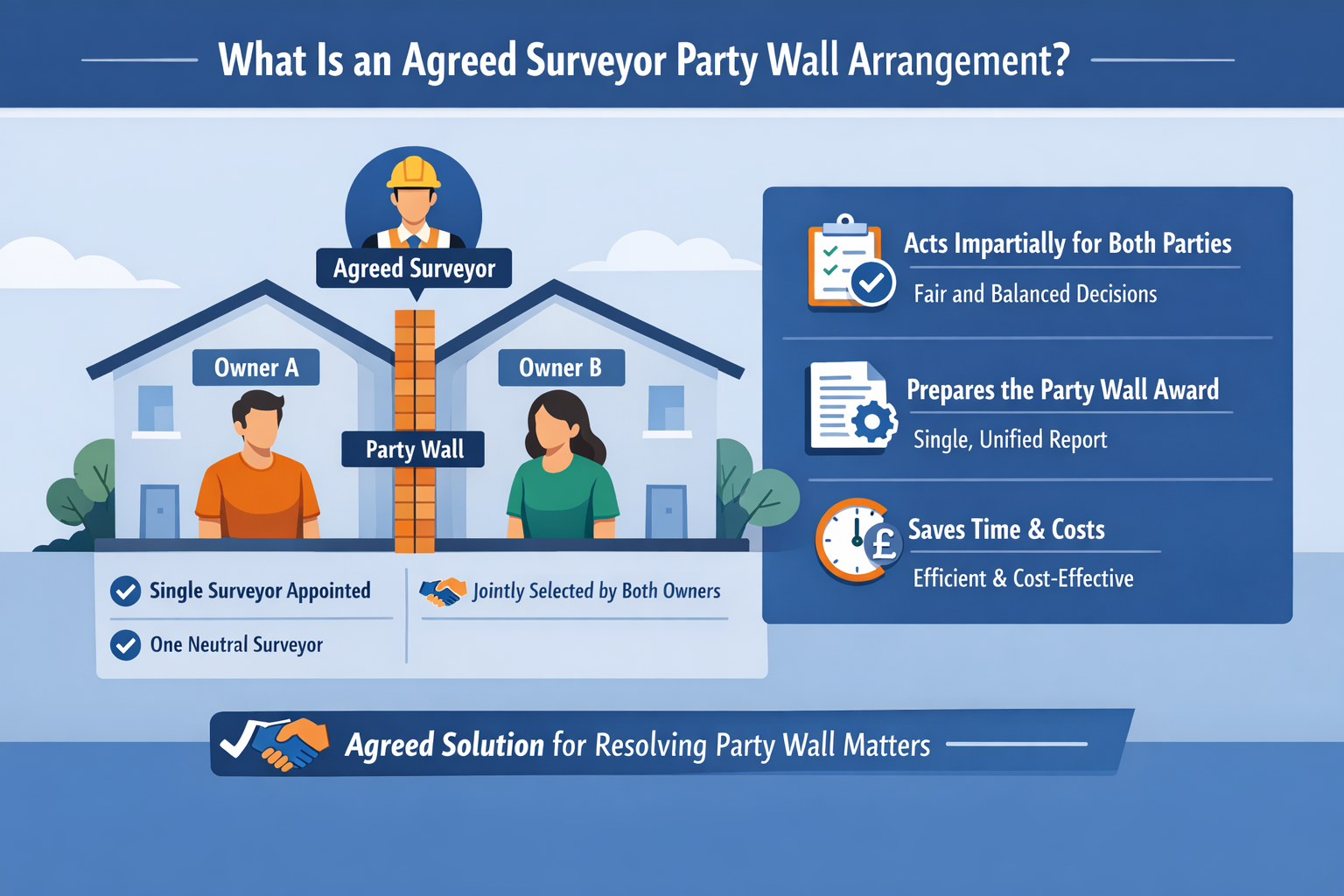
While the agreed surveyor party wall approach offers significant advantages, understanding alternative options helps property owners make informed strategic decisions.
Option 1: Separate Surveyors (Two Surveyor Approach)
How It Works
Each party appoints their own surveyor, and these two professionals work together to prepare a joint party wall award.
Advantages ✅
- Independent advocacy for each party
- Specialized expertise for complex works
- Greater confidence for risk-averse neighbors
- Built-in checks and balances
- Established dispute resolution (third surveyor)
Disadvantages ❌
- Significantly higher costs (building owner pays both)
- Longer timescales for coordination
- Potential for adversarial atmosphere
- More complex communication chains
- Risk of requiring third surveyor (additional cost)
Best For
- Complex structural works
- High-value properties
- Strained neighbor relationships
- Commercial projects
- Works with significant risk
Option 2: Party Wall Agreement (Consent Route)
How It Works
The adjoining owner consents to the works in writing, ending the party wall process without surveyors.
Advantages ✅
- Zero surveyor costs
- Fastest possible resolution
- Maximum simplicity
- Preserves good relationships
- Minimal paperwork
Disadvantages ❌
- No independent record of condition
- No formal protection if damage occurs
- Disputes harder to resolve
- No clear framework for access or timing
- Risk for both parties
Best For
- Very minor works
- Extremely trusting relationships
- Works with negligible risk
- Experienced property developers
- Short-term projects
Warning: The consent route leaves both parties vulnerable. Without a schedule of condition, proving damage causation becomes nearly impossible. Most property professionals recommend against this approach.
Option 3: Building Owner’s Surveyor Acting Alone
How It Works
If the adjoining owner doesn’t respond to the notice within 14 days, the building owner appoints a surveyor to act for both parties.
Advantages ✅
- Resolves non-responsive neighbor situations
- Single surveyor cost (like agreed surveyor)
- Allows works to proceed despite silence
- Creates legal protection
Disadvantages ❌
- Surveyor chosen by building owner only
- Potential for neighbor dissatisfaction
- May damage relationships
- Adjoining owner can still appoint their own surveyor later
Best For
- Absent or unresponsive neighbors
- Situations where contact is impossible
- Time-sensitive projects
- When other options have failed
Comparing All Options: Decision Matrix
| Factor | Agreed Surveyor | Two Surveyors | Consent | Default Appointment |
|---|---|---|---|---|
| Cost | £800-£1,500 | £2,000-£4,000 | £0 | £800-£1,500 |
| Timeline | 2-4 weeks | 4-8 weeks | Immediate | 2-4 weeks |
| Protection | High | Highest | None | Medium |
| Relationship Impact | Positive | Neutral | Very Positive | Negative |
| Complexity | Low | High | Very Low | Low |
| Both Parties’ Input | Yes | Yes | Limited | No |
Finding and Selecting the Right Agreed Surveyor
Choosing the right agreed surveyor party wall professional is crucial for a successful outcome. Both parties must trust this individual to act fairly and competently.
Essential Qualifications and Credentials 🎓
RICS Membership
Look for surveyors who are members of the Royal Institution of Chartered Surveyors (RICS), indicated by:
- MRICS (Member)
- FRICS (Fellow)
- AssocRICS (Associate)
RICS members must adhere to professional standards and maintain continuing professional development.
Party Wall Expertise
Verify specific party wall experience:
- Membership in the Faculty of Party Wall Surveyors (FPWS)
- Pyramus & Thisbe Club membership
- Demonstrated track record with similar projects
- Knowledge of local building practices
Professional Indemnity Insurance
Ensure the surveyor carries adequate professional indemnity insurance (typically minimum £1 million coverage) to protect both parties if errors occur.
Questions to Ask Potential Agreed Surveyors
Experience and Expertise 🔍
- How many party wall awards have you prepared?
- Do you have experience with projects similar to ours?
- What’s your approach to maintaining impartiality?
- Can you provide references from previous clients?
Process and Timeline ⏱️
- What’s your typical timeline for this type of project?
- How do you communicate with both parties?
- What happens if disputes arise during works?
- Do you conduct post-completion inspections?
Fees and Costs 💰
- What’s your fee structure for this project?
- What exactly is included in your fee?
- Are there potential additional costs we should anticipate?
- When do you require payment?
Availability and Responsiveness 📞
- How quickly can you start this project?
- What’s your typical response time to queries?
- Will you personally handle this matter or delegate?
- How do you handle urgent issues during construction?
Red Flags to Avoid ⚠️
Avoid surveyors who:
- Have prior relationships with either party
- Refuse to meet both parties together
- Cannot provide evidence of qualifications
- Offer unusually low fees (may indicate inexperience)
- Are vague about their process or timeline
- Pressure quick decisions without explanation
- Don’t carry adequate insurance
- Have complaints or disciplinary actions
Where to Find Qualified Agreed Surveyors
Professional Directories
- RICS Find a Surveyor tool
- Faculty of Party Wall Surveyors directory
- Pyramus & Thisbe Club member list
Local Recommendations
- Professional surveying firms with party wall expertise
- Recommendations from architects or builders
- Referrals from neighbors who’ve used party wall surveyors
- Local property forums and community groups
Online Research
- Google searches for “party wall surveyor [your area]”
- Review websites and testimonials
- Professional websites with detailed service information
- LinkedIn profiles showing qualifications and experience
Making the Final Selection
Joint Decision Process
For an agreed surveyor party wall appointment to work, both parties should:
- Shortlist together: Each party suggests 2-3 candidates
- Review credentials: Verify qualifications jointly
- Interview candidates: Meet together if possible
- Discuss preferences: Share thoughts openly
- Reach consensus: Agree on the final choice
- Formalize appointment: Both parties sign appointment letter
This collaborative selection process sets a positive tone for the entire party wall matter and increases both parties’ confidence in the outcome.
Legal Protections and Dispute Resolution
Understanding the legal framework surrounding agreed surveyor party wall arrangements helps both parties know their rights and remedies if issues arise.
The Party Wall etc. Act 1996: Your Legal Foundation
The Act provides comprehensive legal protections for both building and adjoining owners:
Statutory Rights ⚖️
- Right to undertake necessary works (building owner)
- Right to protection from damage (adjoining owner)
- Right to fair and impartial surveyor treatment
- Right to appeal awards to county court
- Right to compensation for damage or loss
Statutory Obligations 📜
- Duty to serve proper notice (building owner)
- Duty to respond within 14 days (adjoining owner)
- Duty to act impartially (agreed surveyor)
- Duty to pay reasonable costs (building owner)
- Duty to allow necessary access (both parties)
Challenging an Agreed Surveyor’s Award
If either party believes the party wall award is unfair or incorrect, they have 14 days from service to appeal to the county court.
Grounds for Appeal
Valid reasons include:
- Award contains factual errors
- Conditions are unreasonable or disproportionate
- Surveyor exceeded their authority
- Surveyor failed to act impartially
- Award doesn’t comply with the Act
- Fees are excessive or unreasonable
Appeal Process 🏛️
- File notice of appeal within 14 days
- Serve notice on other party and surveyor
- Prepare evidence and arguments
- Attend county court hearing
- Court issues binding decision
Important: Appeals are relatively rare and should only be pursued for genuine concerns, not tactical delays. Courts generally defer to surveyors’ professional judgment unless clear errors exist.
Replacing an Agreed Surveyor
Either party can withdraw consent to the agreed surveyor arrangement before the award is finalized. This might happen if:
- One party loses confidence in the surveyor’s impartiality
- The surveyor fails to communicate adequately
- Conflicts of interest emerge
- The surveyor lacks necessary expertise
- Unreasonable delays occur
Replacement Process
- Notify the surveyor and other party in writing
- Appoint your own surveyor instead
- The other party keeps the original surveyor or appoints their own
- Process continues with two (or three) surveyors
Once an award is issued, however, it can only be challenged through the court appeal process, not by changing surveyors.
Enforcing Party Wall Awards
Party wall awards are legally binding documents. If either party fails to comply:
Building Owner Non-Compliance
If the building owner:
- Proceeds without an award
- Violates award conditions
- Refuses to make good damage
- Doesn’t pay surveyor fees
The adjoining owner can:
- Seek an injunction to stop works
- Sue for damages or specific performance
- Report to local authority building control
- Claim costs of rectification
Adjoining Owner Non-Compliance
If the adjoining owner:
- Refuses reasonable access
- Obstructs permitted works
- Violates award terms
The building owner can:
- Seek court order for access
- Claim damages for delays
- Apply for injunctive relief
Insurance Considerations 🛡️
Building Owner’s Insurance
Building owners should:
- Notify their insurer about party wall works
- Ensure adequate public liability coverage
- Consider specific party wall insurance
- Verify contractor insurance is adequate
- Keep insurance current throughout works
Adjoining Owner’s Insurance
Adjoining owners should:
- Inform their insurer about neighboring works
- Understand their coverage for party wall damage
- Document the pre-works condition thoroughly
- Keep records of all communications
Surveyor’s Insurance
The agreed surveyor must maintain professional indemnity insurance covering potential errors or omissions in the award or advice.
Practical Tips for a Smooth Agreed Surveyor Experience
Drawing on real-world experience, these practical tips help ensure your agreed surveyor party wall arrangement proceeds smoothly from start to finish.
Before Appointing the Agreed Surveyor 📝
Talk to Your Neighbor First
Before serving formal notice:
- Discuss your plans informally
- Show drawings or plans
- Explain the timeline and process
- Gauge their comfort level
- Suggest the agreed surveyor option
This early communication often prevents misunderstandings and sets a collaborative tone.
Prepare Comprehensive Information
Gather all relevant documents:
- Detailed architectural drawings
- Structural engineer calculations
- Builder contact information
- Proposed timeline
- Previous party wall awards (if any)
Complete information helps the agreed surveyor work efficiently and reduces delays.
Budget Realistically
Include in your budget:
- Agreed surveyor fees (£800-£1,500 typically)
- Potential additional inspections
- Making good any damage
- Contingency for unexpected issues (10-15%)
Understanding property survey costs in general can help contextualize party wall expenses.
During the Party Wall Process 🔄
Communicate Proactively
- Respond promptly to surveyor requests
- Keep your neighbor informed of progress
- Share relevant updates about the project
- Address concerns quickly and openly
- Document all communications in writing
Be Flexible and Reasonable
- Accept reasonable conditions in the award
- Accommodate your neighbor’s legitimate concerns
- Work within standard hours unless emergency
- Minimize disruption where possible
- Show respect for your neighbor’s property
Maintain Detailed Records 📸
- Photograph everything before works begin
- Keep copies of all notices and correspondence
- Document the schedule of condition thoroughly
- Record any issues or variations
- Save receipts for all party wall expenses
During Construction Works 🏗️
Notify Before Commencing
Give your neighbor and the agreed surveyor advance notice of:
- Exact start date
- Expected duration
- Working hours
- Contractor contact details
- Any particularly noisy or disruptive phases
Ensure Contractor Compliance
Your contractors must:
- Understand and follow award conditions
- Work within permitted hours
- Maintain site safety and security
- Respect the neighboring property
- Allow surveyor inspections
Brief your contractors on party wall requirements before they start.
Monitor for Issues
Watch for:
- New cracks in either property
- Structural movement or settlement
- Damage to finishes or fixtures
- Drainage or damp problems
- Any neighbor concerns
Report issues to the agreed surveyor immediately—early intervention prevents small problems becoming major disputes.
After Works Complete ✅
Request Final Inspection
Ask the agreed surveyor to conduct a final inspection comparing the properties’ condition to the pre-works schedule.
Make Good Promptly
If any damage occurred:
- Repair it to the agreed surveyor’s satisfaction
- Use qualified contractors
- Match existing materials and finishes
- Complete work within reasonable timeframe
- Obtain neighbor’s acceptance
Maintain Good Relations
After works complete:
- Thank your neighbor for their cooperation
- Address any remaining concerns
- Keep the surveyor’s contact details for future reference
- Consider the experience if planning future works
Keep Documentation
Retain permanently:
- Original party wall award
- Schedule of condition
- All correspondence
- Final inspection report
- Receipts for damage repairs
These documents may be valuable for future works or property sales.
Future-Proofing: Party Wall Considerations for Property Owners
Understanding how agreed surveyor party wall matters might affect your property’s future helps you make strategic long-term decisions.
Impact on Property Value and Saleability 🏠
Positive Impacts
Properly completed party wall matters can:
- Demonstrate professional approach to development
- Provide documentation for future buyers
- Show good neighbor relations
- Prove works were properly authorized
- Add value through improvements
Potential Concerns
Buyers and their solicitors may investigate:
- Whether party wall procedures were followed
- If awards are still in effect
- Whether conditions were complied with
- If any disputes remain unresolved
- Whether damage was properly made good
Documentation for Sale
When selling, provide buyers with:
- Copies of all party wall notices
- The party wall award
- Schedule of condition
- Evidence of compliance
- Confirmation of damage repairs
Planning for Future Works
If you anticipate future projects:
Keep Award Documentation
Previous awards may inform future party wall matters, showing:
- Baseline property conditions
- Successful working arrangements
- Established precedents
- Trusted surveyor relationships
Maintain Neighbor Relationships
Good relations make future party wall matters easier:
- Address issues promptly
- Communicate about property changes
- Respect boundaries and agreements
- Be a considerate neighbor
Consider Cumulative Effects
Multiple projects over time may:
- Require separate party wall processes
- Create compounded disruption
- Affect neighbor patience
- Increase total costs
Plan strategically to minimize repeated party wall procedures where possible.
Changes to Party Wall Legislation
While the Party Wall etc. Act 1996 has remained largely stable, property owners should:
Stay Informed
- Monitor for legislative changes
- Review case law developments
- Understand evolving best practices
- Consult current guidance
Professional Advice
For significant projects, always seek current professional advice as:
- Interpretation evolves through court decisions
- Best practices develop over time
- Local authority requirements may change
- Building regulations interact with party wall matters
Working with experienced professionals ensures compliance with current requirements.
Conclusion: Making the Agreed Surveyor Party Wall Route Work for You
The agreed surveyor party wall approach represents an efficient, cost-effective solution for property owners undertaking building works affecting shared walls or boundaries. By appointing a single impartial professional to represent both parties’ interests, neighbors can navigate party wall requirements while maintaining positive relationships and controlling costs.
Key Success Factors 🎯
Mutual Trust and Cooperation
The agreed surveyor route thrives on collaborative spirit. When both neighbors approach the process with goodwill and reasonable expectations, outcomes are consistently positive.
Professional Expertise
Selecting a qualified, experienced agreed surveyor ensures both parties receive competent, impartial service that protects their interests and complies with legal requirements.
Clear Communication
Open, honest communication between all parties—building owner, adjoining owner, and agreed surveyor—prevents misunderstandings and resolves concerns before they escalate.
Realistic Expectations
Understanding that some disruption is inevitable, costs must be paid, and compromise may be necessary helps both parties approach the process constructively.
Taking Action: Your Next Steps
If you’re planning works requiring party wall procedures:
- Assess Your Situation 📋
- Review your proposed works
- Consider your relationship with your neighbor
- Evaluate project complexity and risk
- Determine if agreed surveyor route is appropriate
- Engage Early 🗣️
- Discuss plans with your neighbor informally
- Explain the party wall process
- Suggest the agreed surveyor option
- Address concerns proactively
- Find Qualified Professionals 🔍
- Research RICS-qualified party wall surveyors
- Check credentials and experience
- Interview potential agreed surveyors
- Verify professional indemnity insurance
- Formalize the Arrangement ✍️
- Serve proper party wall notice
- Obtain neighbor’s consent to agreed surveyor
- Jointly appoint your chosen professional
- Cooperate fully with the process
- Execute Professionally 🏗️
- Follow award conditions precisely
- Communicate throughout construction
- Address issues immediately
- Complete works and make good damage
Final Thoughts
The agreed surveyor party wall process need not be intimidating or adversarial. With the right approach, professional support, and mutual goodwill, it becomes a straightforward administrative procedure that protects both parties while allowing necessary works to proceed.
Whether you’re planning a simple extension or more complex structural works, understanding your options under the Party Wall etc. Act 1996 empowers you to make informed decisions that balance cost, protection, and neighbor relations. The agreed surveyor route often provides the optimal balance of these factors, delivering professional expertise and legal compliance at reasonable cost while preserving the good relationships that make neighborhoods thrive.
By approaching party wall matters with preparation, professionalism, and respect for all parties’ interests, you can transform what might seem like a legal obstacle into a smooth, efficient process that benefits everyone involved. For expert guidance on your specific party wall needs, consider consulting with qualified surveyors who can assess your situation and recommend the best approach for your project.