As of 9 March 2026, every RICS member and regulated firm worldwide is legally obligated to comply with a brand-new professional standard — one that fundamentally changes how artificial intelligence can be used in property surveying. RICS' new Responsible Use of AI in Surveying standard and what it means for building surveys and valuation reports is not a distant policy debate; it is an active compliance requirement reshaping how surveyors collect data, write reports, and justify valuations right now. Firms that fail to adapt risk disciplinary action, reputational damage, and — more critically — harm to the clients who rely on their professional judgment.
Key Takeaways
- The RICS Responsible Use of AI standard became mandatory for all RICS members and regulated firms on 9 March 2026.
- Surveyors must maintain professional oversight of all AI outputs and cannot delegate accountability to an algorithm.
- Clients must be informed in writing whenever AI materially affects the delivery of a surveying service, with options to opt out.
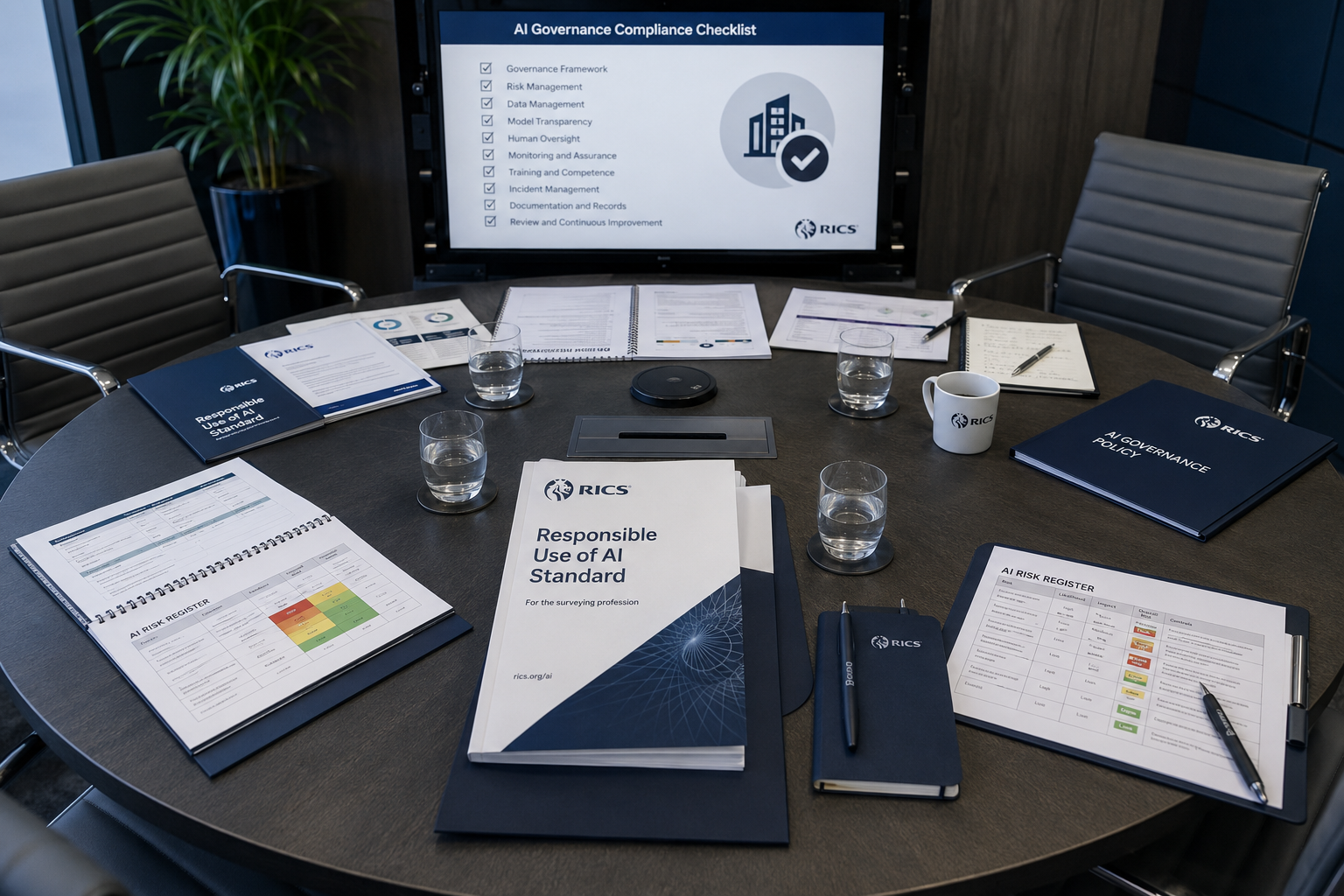
- Firms must establish governance frameworks, risk registers, and data protection procedures specific to AI use.
- The standard applies across valuation, building surveys, construction, infrastructure, and land services.
What the RICS Responsible Use of AI Standard Actually Requires
The standard was developed with input from an Expert Working Group co-chaired by Sophia Adams-Bhatti and Christopher de Gruben, bringing together expertise in public policy, regulation, and professional surveying practice [2]. Its scope is deliberately broad: it applies to any AI use that materially impacts the delivery of surveying services, covering valuation, building surveys, construction, infrastructure, and land services [1].
The Core Obligations at a Glance
| Requirement | What It Means in Practice |
|---|---|
| Governance framework | Firms must create clear policies on AI system selection, data usage, and oversight |
| Risk registers | Documented records of AI-related risks must be maintained and reviewed |
| Professional judgment | Surveyors must assess AI outputs critically, not accept them at face value |
| Client transparency | Written disclosure required when AI materially affects service delivery |
| Data protection | Client data must be anonymised before AI input; no upload without written consent |
| Knowledge baseline | All members using AI must understand its types, limitations, and biases |
The standard does not prohibit AI use. Rather, it sets the conditions under which AI can responsibly support professional work. This distinction matters enormously for firms already using automated valuation models, AI-assisted defect detection tools, or machine-learning platforms for comparable sales analysis.
What Counts as "Material Impact"?
One of the most practically significant aspects of the standard is the concept of material impact. Members must document their own determinations about whether a given AI system materially affects their service delivery [3]. This is not a passive exercise. A surveyor who uses an AI tool to flag potential damp in a building survey must ask: does this output meaningfully shape the advice given to the client? If the answer is yes, the full range of standard obligations applies.
For firms wondering which home survey is right for a particular property, the introduction of AI tools into the assessment process adds a new layer of professional responsibility that must be factored into service delivery from the outset.
How the Standard Affects Building Surveys in Practice
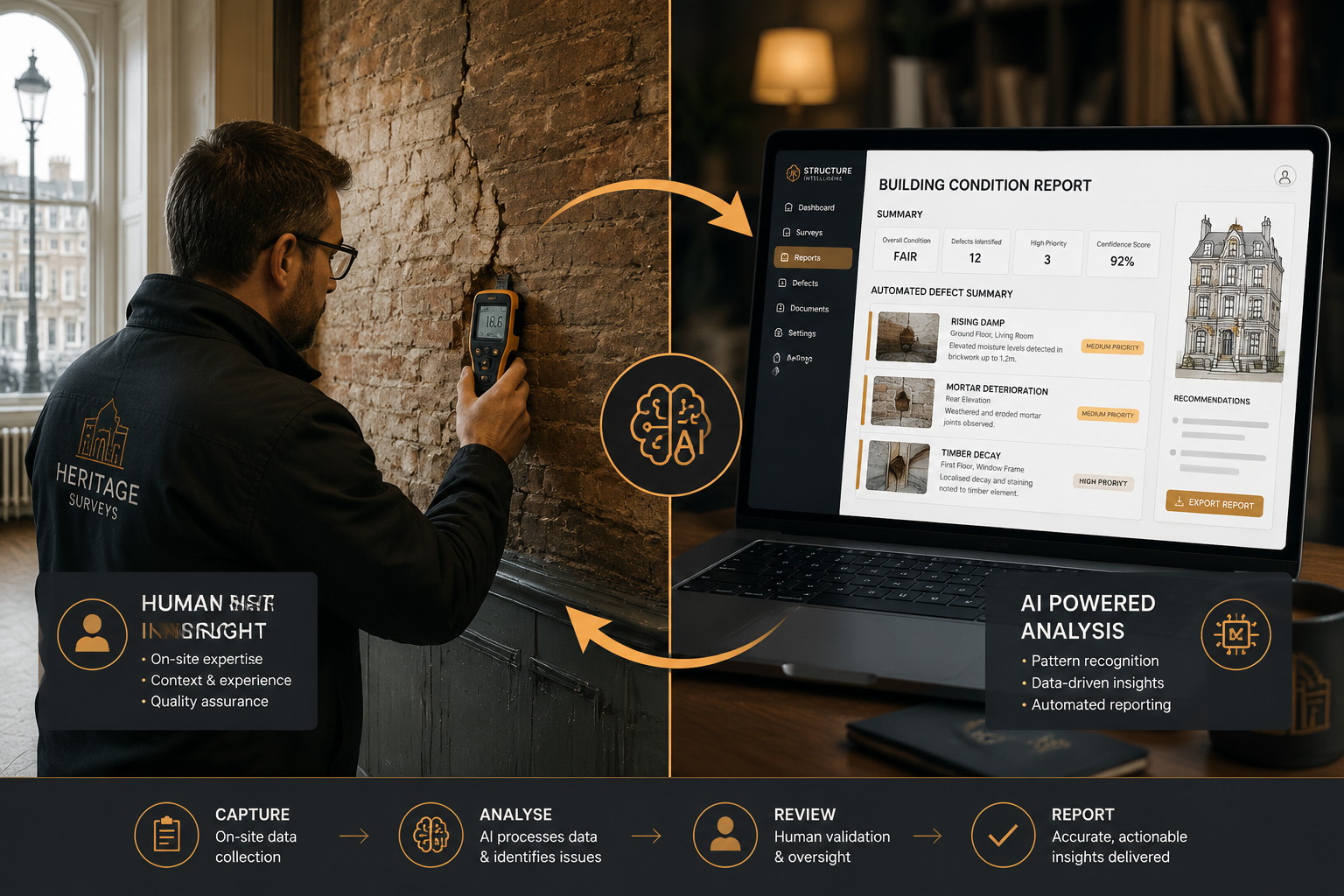
Building surveys are among the most detail-intensive services in the RICS portfolio. A Level 3 building survey involves a thorough inspection of structure, fabric, and services, with a written report that must clearly communicate condition ratings, risks, and recommended actions. AI tools are increasingly being used to assist with defect identification, thermal imaging analysis, and report drafting — and the new standard directly governs all of these applications.
Professional Skepticism Is Now a Formal Requirement
The standard explicitly requires surveyors to apply professional skepticism when reviewing AI outputs [1]. This means:
- Checking AI-generated defect flags against physical inspection findings
- Not relying solely on AI-produced condition ratings without independent verification
- Documenting where AI outputs were accepted, modified, or rejected — and why
"Surveyors are obligated to assess the reliability of AI outputs and maintain accountability for all work." — RICS Responsible Use of AI Standard [1]
This has direct implications for how building survey reports are written and evidenced. A surveyor cannot simply reproduce an AI-generated summary of roof condition or structural movement without applying their own professional judgment to validate it. The professional remains accountable for every line of the report, regardless of how it was produced.
AI-Assisted Damp Detection and Timber Surveys
AI tools capable of analysing thermal images or moisture sensor data are already in use across the industry. Under the new standard, firms using these tools for damp survey assessments must ensure that:
- The AI system has been assessed for data quality and known biases
- Any AI-generated findings are reviewed by a qualified surveyor before inclusion in a report
- Clients are informed in writing that AI-assisted analysis has been used
This does not diminish the value of AI-enhanced damp detection. It simply ensures that the professional — not the algorithm — takes responsibility for the conclusions. For clients receiving a damp and timber report, this means greater confidence that the findings reflect genuine expert judgment, not an unchecked automated output.
Condition Surveys and Automated Report Generation
Automated report generation tools — which can draft condition descriptions, populate standard clauses, and suggest repair priorities — are particularly relevant to condition survey reports. The standard requires that surveyors review and take ownership of any AI-generated text before it is sent to a client. Firms must also be able to demonstrate, if challenged, that a qualified professional reviewed and approved the content.
Valuation Reports, Client Transparency, and Data Governance
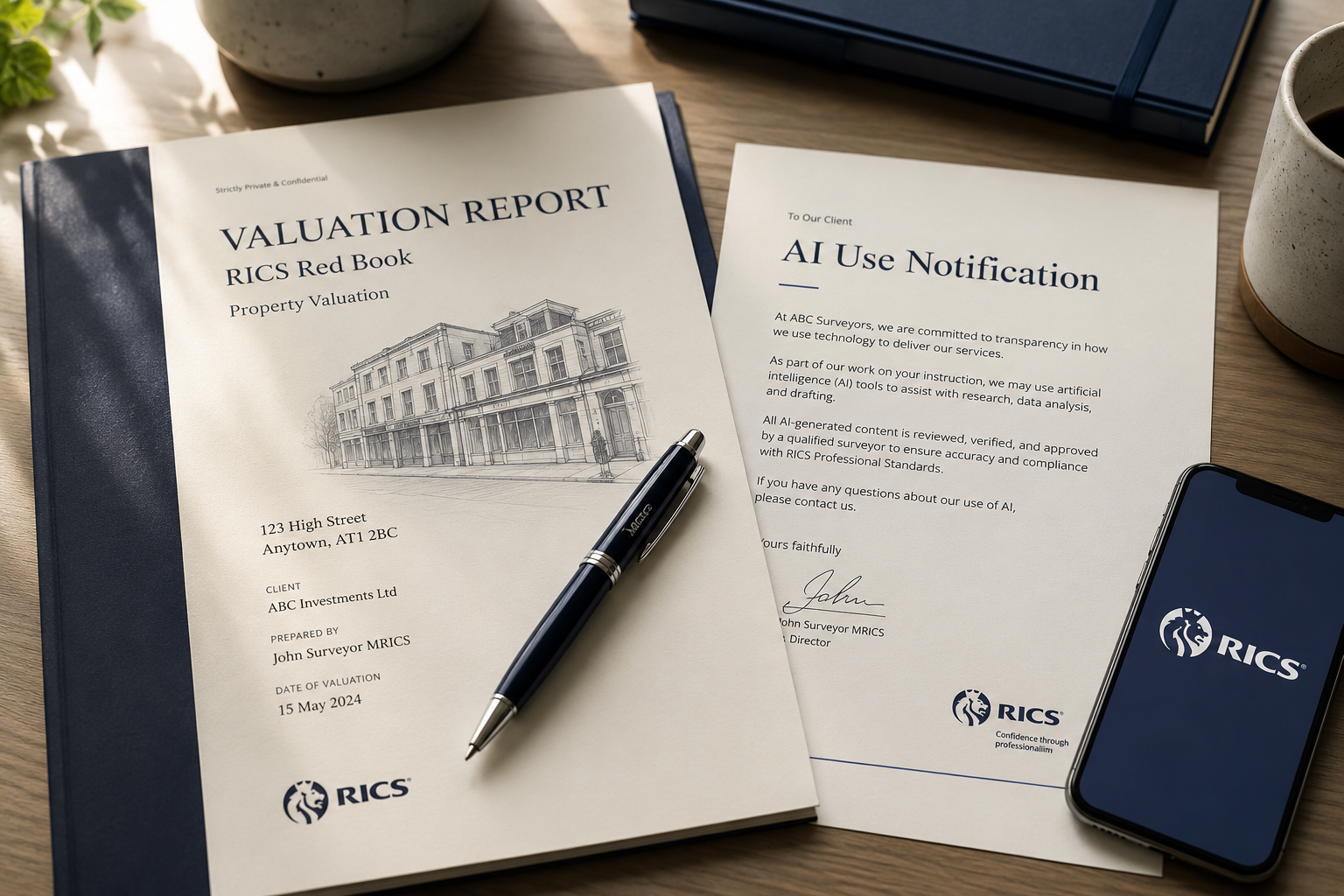
Valuation is perhaps the area where AI adoption has moved fastest. Automated valuation models (AVMs) have been used by lenders and estate agents for years, but their integration into formal RICS-regulated valuation reports raises significant questions about accuracy, bias, and accountability. RICS' new Responsible Use of AI in Surveying standard and what it means for building surveys and valuation reports is particularly pointed in the valuation context.
Written Disclosure to Clients Is Mandatory
One of the clearest and most immediately actionable requirements is the obligation to inform clients in writing when AI will be used in service delivery [1][4]. This disclosure must:
- Explain what AI systems will be used and for what purpose
- Describe how the AI output will be reviewed by a professional
- Offer clients the option to raise concerns or, where appropriate, opt out
This is a significant shift from current practice at many firms, where AI tools are used as background efficiency aids without any formal client notification. From March 2026 onwards, that approach is no longer compliant.
Data Privacy and Client Confidentiality
The standard's data governance requirements are stringent. Firms must [4]:
- Anonymise client data before it is used as AI input
- Obtain express written consent before uploading private or confidential client data to any AI system
- Take reasonable steps to ensure that AI platforms do not expose client data to unacceptable risk
For valuation firms handling sensitive financial information, property ownership details, and transaction data, these requirements demand a thorough review of existing AI tool contracts and data processing agreements. The obligation sits alongside existing GDPR requirements but goes further in some respects by requiring active consent for AI-specific data use.
Governance Frameworks and Risk Registers
Firms must establish formal governance structures for AI use, including documented risk registers that identify the specific AI systems in use, the risks they present, and the controls in place to manage those risks [1]. This is not a one-time exercise. Given that RICS has committed to regularly reviewing and updating the standard as AI technology evolves [3], firms should treat their governance frameworks as living documents.
For firms that develop their own AI tools — rather than using third-party platforms — the obligations are even more extensive. The standard requires assessments of data quality, stakeholder involvement, sustainability impact, and legal compliance before any proprietary AI system is deployed [1].
Why This Matters for Clients Buying Property in 2026
For property buyers, the new standard offers meaningful protections. When commissioning a building survey or valuation report, clients can now expect:
- Clear written information about any AI tools used in their assessment
- Assurance that a qualified RICS-regulated professional has reviewed all AI outputs
- Confidence that their personal and financial data has been handled with appropriate care
Buyers who are first-time purchasers booking a building survey or those looking to understand what to do before an RICS home survey should now ask their surveyor directly whether AI tools will be used and what disclosures will be provided. This is a legitimate and encouraged question under the new standard.
The Broader Picture: Surveying Technology and Professional Accountability
RICS' new Responsible Use of AI in Surveying standard and what it means for building surveys and valuation reports sits within a wider industry conversation about the role of technology in professional services. Surveyors widely recognise AI's potential to enhance efficiency, support sustainability assessments, and improve consistency in planning, design, construction, and maintenance activities [5]. The concern has never been about whether AI should be used — it is about ensuring that its use does not erode the professional accountability that clients and the public depend upon.
Baseline Knowledge Requirements for All Members
The standard sets a minimum knowledge threshold for any RICS member who uses AI tools. Members must understand [2]:
- The different types of AI systems and how they work
- The limitations of AI, including its tendency to produce confident-sounding but incorrect outputs
- The risk of inherent biases in AI training data, particularly in valuation contexts where historical data may reflect past market inequalities
- Relevant data usage risks and legal obligations
This knowledge requirement applies regardless of whether a member is using a sophisticated machine-learning valuation model or a simple AI-powered report-drafting tool. The principle is consistent: professionals must understand the tools they use well enough to exercise genuine oversight.
Choosing an RICS Surveyor in 2026
For clients seeking assurance, working with a qualified RICS surveyor has always provided a baseline of professional protection. The new AI standard strengthens that protection significantly. RICS-regulated firms are now required to demonstrate not just technical competence, but also responsible governance of the technology they deploy.
Whether a client needs a homebuyer's report or a full structural survey, the choice between survey types now also involves understanding how AI may be used in each service — and what protections are in place. Clients should not hesitate to ask firms directly about their AI governance policies before instructing them.
Conclusion
The RICS Responsible Use of AI standard represents a landmark moment for the surveying profession. It acknowledges that AI is already embedded in professional practice while establishing clear, enforceable boundaries around how it can be used. For building surveys and valuation reports, the practical implications are immediate and far-reaching.
Actionable next steps for surveyors and firms:
- Audit all AI tools currently in use and determine whether each one materially impacts service delivery
- Draft or update client disclosure templates to meet the written notification requirement
- Build or revise risk registers to document AI-specific risks and the controls in place
- Invest in staff training to meet the baseline knowledge requirements for all members using AI
- Review data processing agreements with AI tool providers to ensure compliance with the data privacy obligations
- Establish a review schedule for governance frameworks, in line with RICS' commitment to updating the standard as technology evolves
Actionable next steps for property buyers and clients:
- Ask any surveyor you instruct whether AI tools will be used in your survey or valuation
- Request written confirmation of how AI outputs will be reviewed by a qualified professional
- Confirm that your personal data will be anonymised or protected before any AI processing
- If you receive a survey report that concerns you, understand that the professional — not the AI — is accountable for its contents, and explore your options after a poor survey result
The standard does not make AI in surveying risk-free. It makes the risks visible, manageable, and professionally owned. That is a significant step forward for an industry where the stakes — financial, structural, and personal — are always high.
References
[1] Rics Launches Landmark Global Standard On Responsible Use Of Ai In Surveying – https://www.rics.org/news-insights/rics-launches-landmark-global-standard-on-responsible-use-of-ai-in-surveying?utm_source=openai
[2] Responsible Use Of Ai – https://www.rics.org/profession-standards/rics-standards-and-guidance/conduct-competence/responsible-use-of-ai?utm_source=openai
[3] Ai Responsible Use Standard – https://ww3.rics.org/uk/en/journals/construction-journal/ai-responsible-use-standard.html?utm_source=openai
[4] Client Information Note – https://www.rics.org/profession-standards/rics-standards-and-guidance/conduct-competence/responsible-use-of-ai/client-information-note?utm_source=openai
[5] What Surveyors Think Ai – https://ww3.rics.org/uk/en/modus/technology-and-data/surveying-tools/what-surveyors-think-ai.html?utm_source=openai