
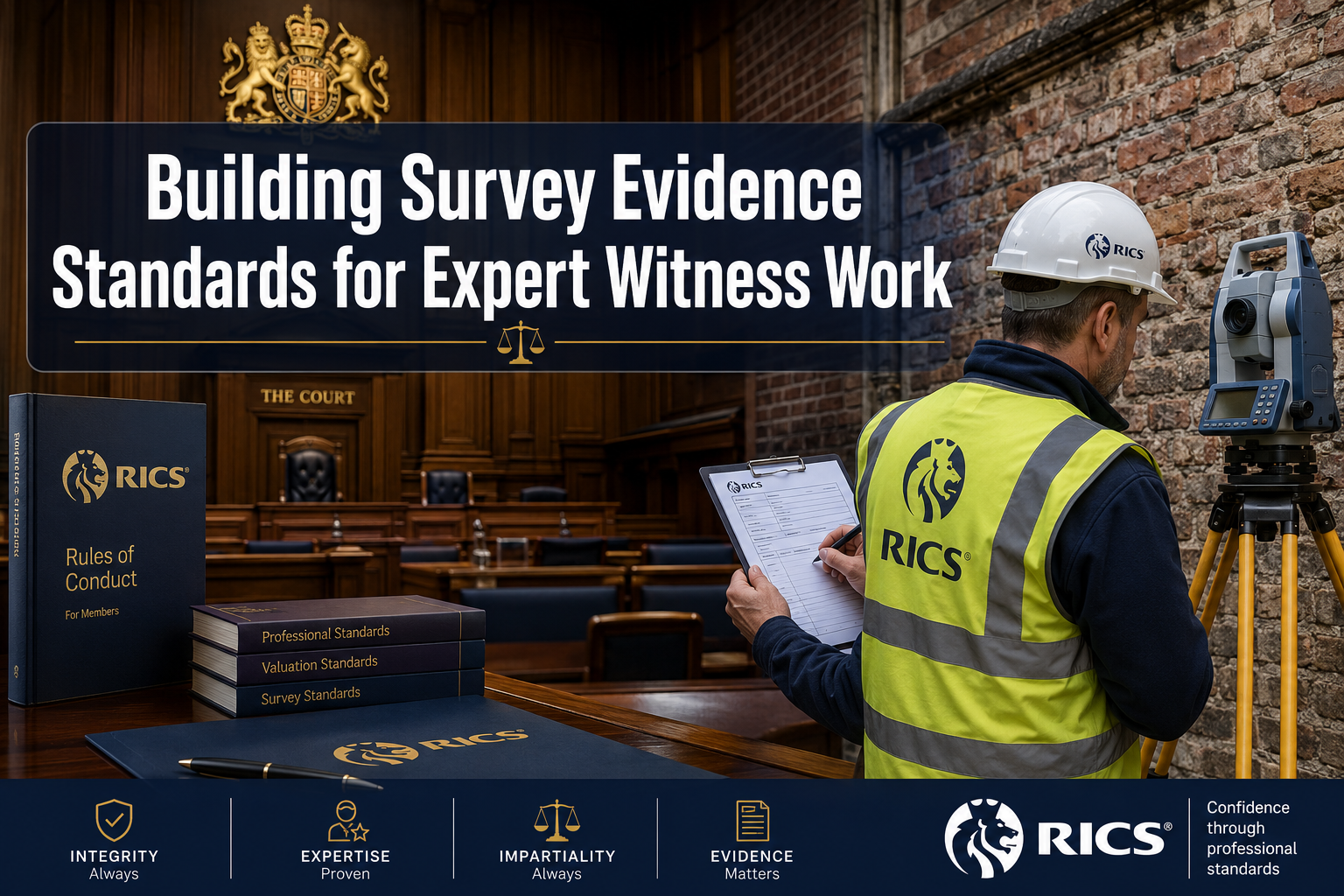
Expert witness evidence is excluded from court proceedings more often than most practitioners realise — not because the surveyor lacked knowledge, but because the documentation failed to meet legal and professional standards. For building surveyors, the gap between a thorough site inspection and a court-ready expert report can be the difference between decisive influence and complete irrelevance in a dispute. Understanding building survey evidence standards for expert witness work: court-ready documentation and RICS protocols is therefore not optional — it is a professional necessity for any surveyor who may be called upon to support litigation or tribunal proceedings.
Key Takeaways
- RICS released the fifth edition of "Surveyors Acting as Expert Witnesses" in 2025, setting updated standards for independence, report format, and scope of expertise.
- Expert witness reports must comply with Civil Procedure Rules (CPR) Part 35, and failure to do so can result in evidence being excluded entirely.
- Court-ready documentation requires structured photography, timestamped records, calibrated instrument logs, and a signed declaration of truth.
- Conflicts of interest must be identified and disclosed at the earliest opportunity to preserve the credibility of expert evidence.
- Continuous professional development, including RICS-accredited training, is essential to maintaining competence as an expert witness in the built environment.
What the RICS Fifth Edition Standard Demands from Expert Witnesses
In 2025, RICS published the fifth edition of its professional standard "Surveyors Acting as Expert Witnesses," replacing earlier guidance and raising the bar for practitioners across the built environment [1]. The updated standard is not simply a revision of terminology — it fundamentally reshapes how surveyors must approach their role, their documentation, and their duty to the tribunal.
The Overriding Duty to the Tribunal
The most important principle in the RICS standard is that an expert witness's primary duty is to the court or tribunal, not to the party that instructed or is paying them [2]. This overriding obligation means that surveyors must present evidence that is objective and impartial, even when their findings are inconvenient for the instructing party.
"The expert witness must not become an advocate. Their role is to inform, not to persuade through bias."
This distinction matters enormously in practice. A surveyor who shades their conclusions to favour a client risks being challenged in cross-examination, having their report discredited, or facing professional disciplinary action. The RICS standard makes clear that surveyors should only accept instructions within their specific area of expertise and must decline appointments where they cannot maintain genuine independence [2].
Clear Instructions and Terms of Engagement
The fifth edition places significant emphasis on the importance of establishing clear terms of engagement before any expert witness work begins [2]. Surveyors should confirm in writing:
- The precise scope of the instruction
- The issues on which an opinion is required
- The tribunal or court in which the evidence will be used
- Fee arrangements and billing structure
- Deadlines for report submission and any hearing dates
This clarity protects both the surveyor and the instructing party. It also ensures that the expert's work remains focused on the relevant issues, which directly improves the quality and admissibility of the final report.
Court-Ready Documentation: Photography, Sampling, and Field Records
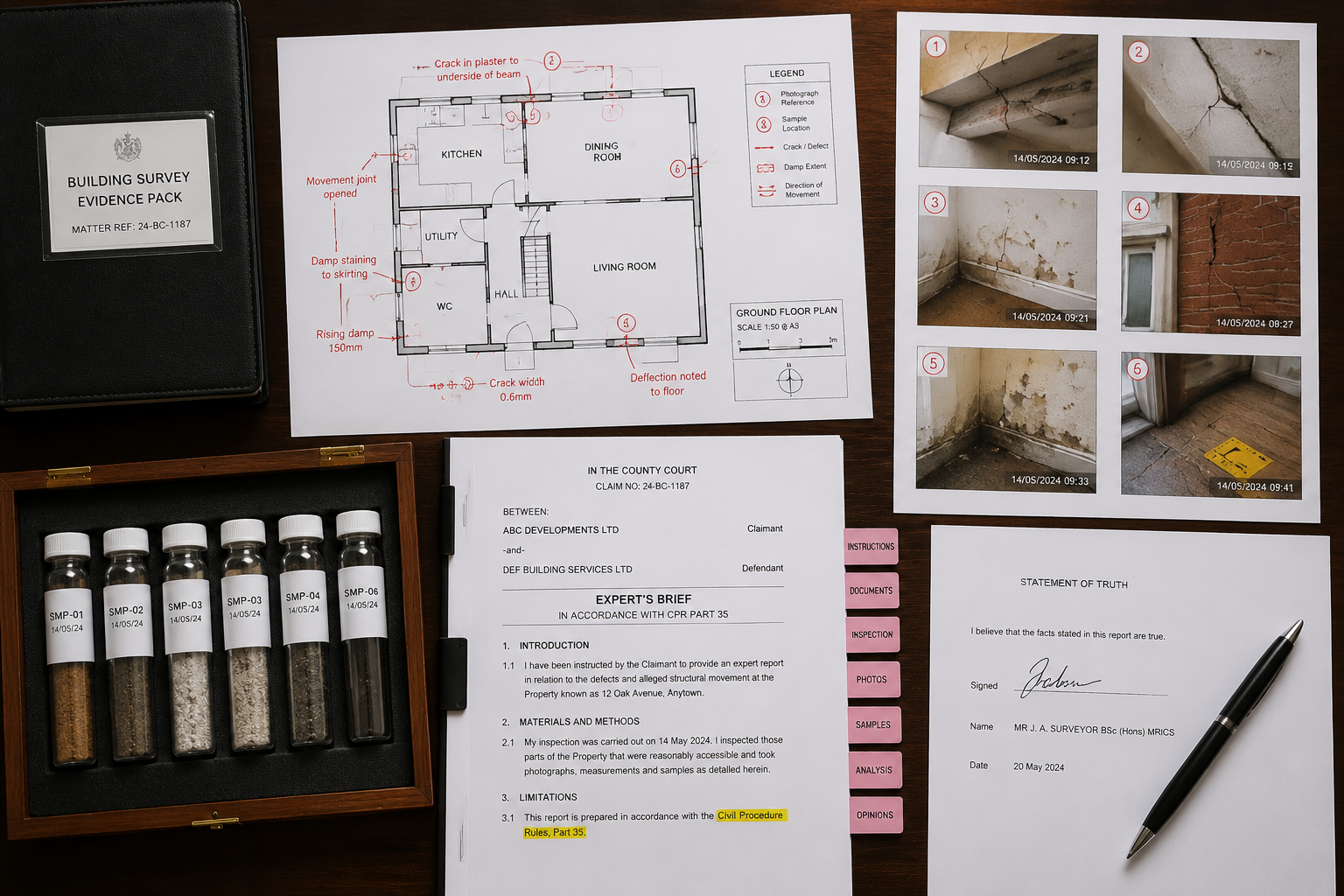
Building survey evidence standards for expert witness work require a level of documentation discipline that goes well beyond a standard RICS building survey. Every piece of evidence gathered on site must be capable of withstanding scrutiny in a formal legal setting.
Photography Protocols for Legal Evidence
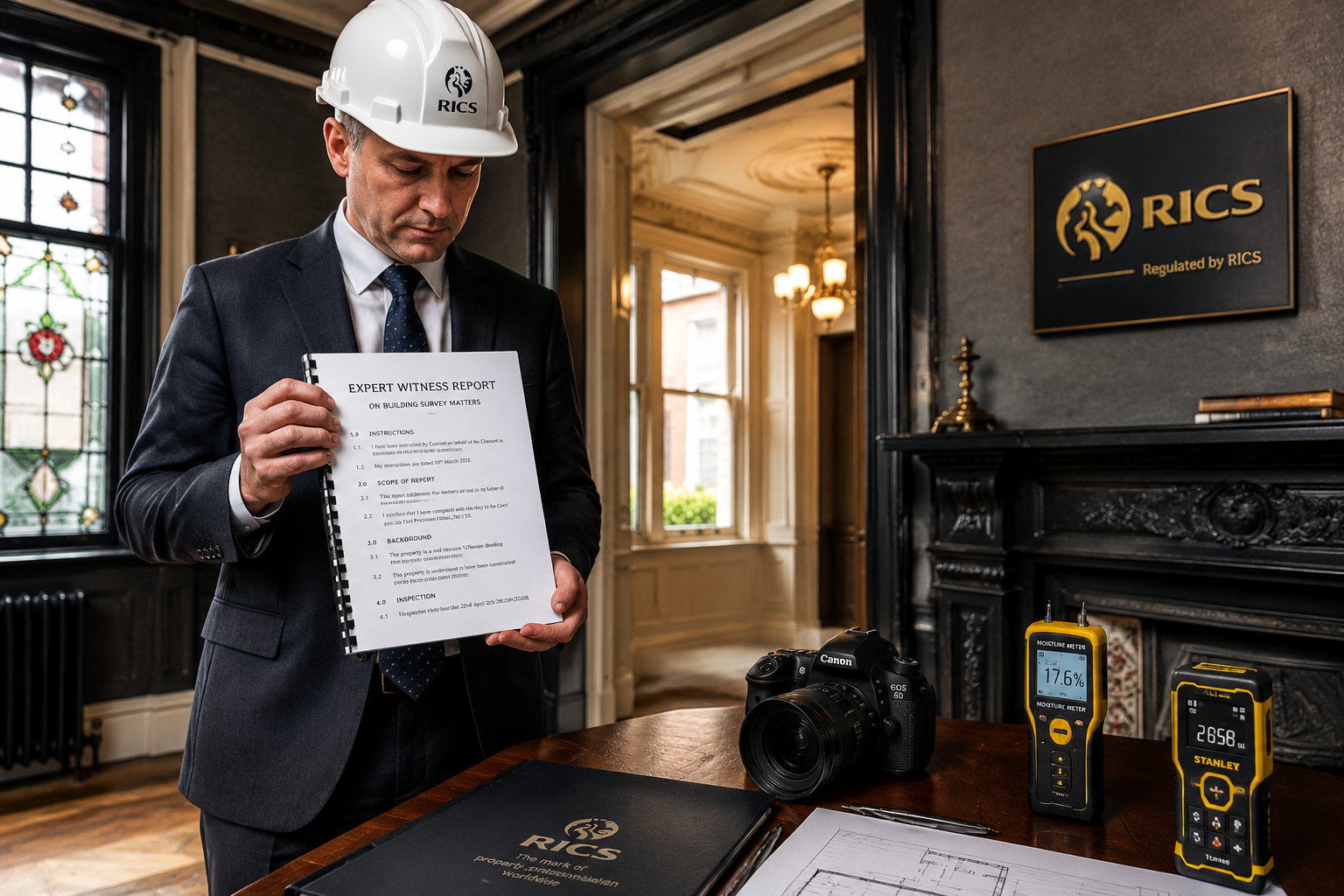
Photographs are among the most powerful tools in a building surveyor's expert witness toolkit — but only when captured and catalogued correctly. Courts expect photographic evidence to meet the following standards:
| Requirement | Detail |
|---|---|
| Timestamps | Camera metadata must show accurate date and time |
| Location context | Wide-angle establishing shot before close-up detail |
| Scale reference | Ruler or scale marker included in defect photographs |
| Sequential numbering | Each image assigned a unique reference number |
| Chain of custody | Log confirming who took the photograph and when |
Photographs without timestamps or contextual reference shots are routinely challenged in cross-examination. A surveyor working on expert building evaluation assignments should use a camera with GPS tagging where possible, and always maintain a written photographic log that corresponds to the report's appendices.
Sampling and Testing Records
Where invasive investigation or material sampling is involved — such as for damp, timber decay, or structural analysis — the documentation requirements become even more stringent. Surveyors must record:
- The exact location of each sample, referenced to a dimensioned floor plan
- The method of extraction and any disturbance caused
- The instrument used (including calibration certificate and serial number)
- Environmental conditions at the time of testing (temperature, humidity)
- Chain of custody for any samples sent to a laboratory
For damp surveys that may feed into expert witness reports, moisture meter readings should be taken at multiple points across an affected area, not just at the worst location. Selective recording is a common pitfall that opposing counsel will exploit.
Site Notes and Contemporaneous Records
Handwritten or digital site notes made at the time of inspection carry significant evidential weight. They demonstrate that the surveyor's conclusions were formed from direct observation, not reconstructed later. Best practice includes:
- Noting the time of arrival and departure
- Recording who was present during the inspection
- Documenting any access restrictions that limited the survey
- Flagging areas that could not be inspected and why
These contemporaneous records become part of the evidence bundle and may be disclosed to the opposing party. They must therefore be accurate, professional in tone, and free from speculative commentary.
Structuring the Expert Witness Report to RICS and CPR Standards
Building survey evidence standards for expert witness work: court-ready documentation and RICS protocols converge most visibly in the structure and content of the written expert report. The fifth edition of the RICS standard provides detailed guidance on the required format, ensuring consistency across the profession [1].
Mandatory Report Components
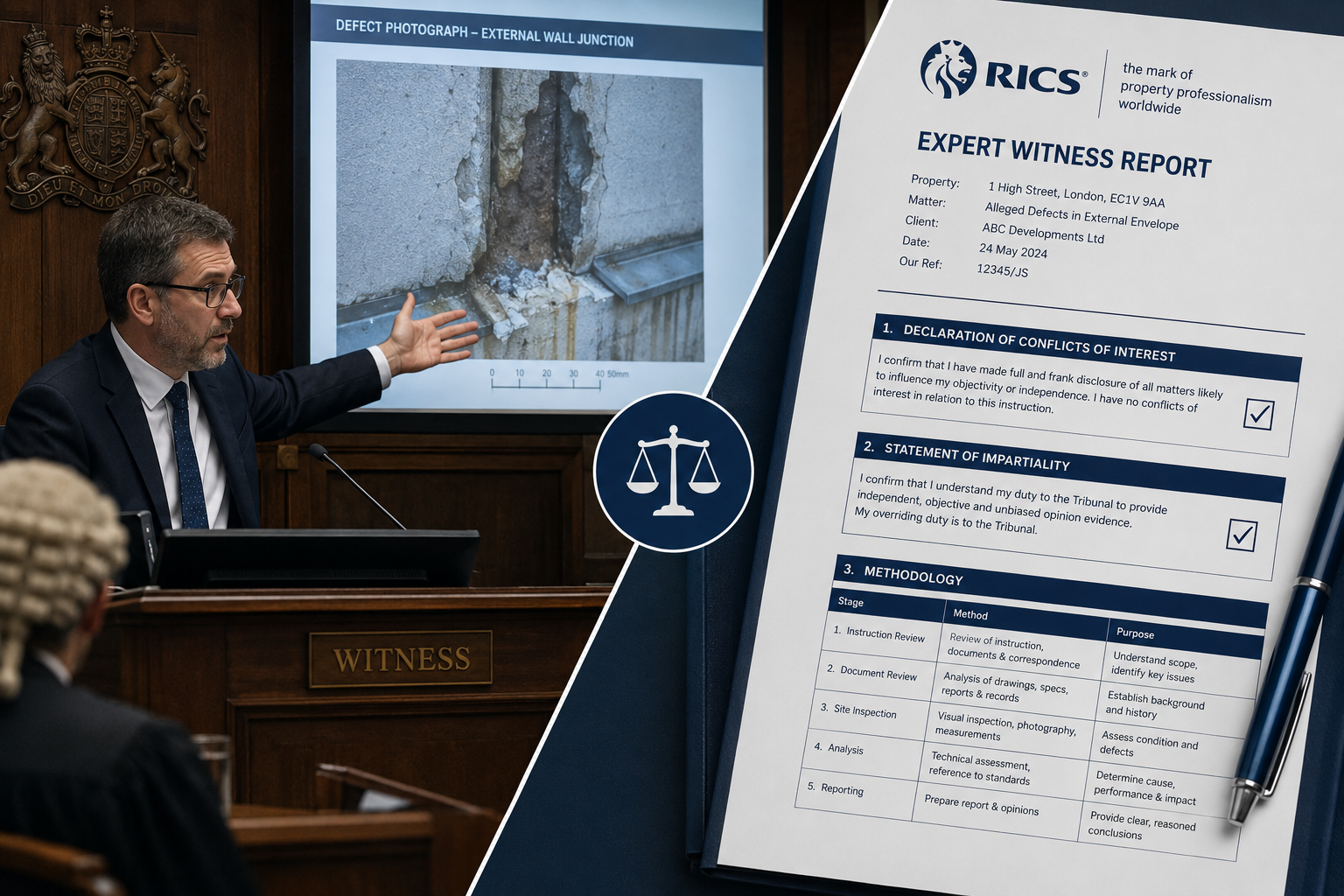
A compliant expert witness report must include the following sections, in a logical order that allows the tribunal to follow the expert's reasoning:
- Introduction — The surveyor's qualifications, the scope of instruction, and the documents reviewed
- Statement of truth — A signed declaration confirming the report is accurate and the expert understands their duty to the court
- Summary of findings — A concise overview of the key conclusions
- Methodology — A clear explanation of how the inspection was conducted and what standards were applied
- Detailed analysis — The technical findings, supported by referenced photographs and test data
- Expert opinion — The surveyor's professional conclusions on the matters in dispute
- Appendices — Photographs, test results, plans, and any other supporting documents
The Civil Procedure Rules Part 35 governs expert evidence in England and Wales, and compliance is mandatory [4]. Reports that omit the statement of truth or fail to address the specific questions put to the expert risk being struck out entirely.
Avoiding Common Drafting Pitfalls
Several drafting errors repeatedly undermine the credibility of building survey expert reports:
- Advocacy language — Phrases that argue a case rather than present objective findings
- Unsupported conclusions — Opinions stated without reference to the evidence that supports them
- Scope creep — Commenting on matters outside the surveyor's expertise or the agreed instruction
- Inconsistency — Contradictions between the body of the report and the appendices
- Vague quantification — Describing defects as "significant" without providing measurable data
Surveyors who regularly produce building surveys for residential or commercial clients must adjust their writing style considerably when preparing expert reports. The audience is no longer a property buyer — it is a judge, arbitrator, or tribunal panel who will scrutinise every word.
Managing Conflicts of Interest
The RICS standard provides explicit guidance on identifying and disclosing conflicts of interest [2]. A conflict may arise from a prior relationship with one of the parties, a financial interest in the outcome, or previous involvement with the property in question. Surveyors must:
- Conduct a conflict check before accepting any expert witness instruction
- Disclose any potential conflict to all parties immediately upon discovery
- Recuse themselves if the conflict cannot be adequately managed
Failure to disclose a conflict is one of the most serious professional failures an expert witness can commit. It can result in the evidence being excluded, the case being compromised, and disciplinary proceedings before RICS.
Professional Competence, CPD, and the RICS Expert Witness Certificate
The built environment is not static. Building regulations change, new materials emerge, and construction techniques evolve. The RICS standard acknowledges this directly by emphasising the need for continuous professional development among expert witnesses [3].
Staying Current Within Your Expertise
An expert witness can only give reliable evidence on matters within their current competence. A surveyor who last worked on a particular construction method a decade ago may not be the appropriate expert for a dispute involving that method today. Courts and tribunals are increasingly alert to experts who overstate the currency of their knowledge.
RICS recommends that surveyors acting as expert witnesses maintain a structured CPD programme that includes:
- Technical updates relevant to their area of practice
- Training on legal procedures and court etiquette
- Peer review of expert reports before submission
- Attendance at relevant professional seminars and case reviews
Surveyors working across London and the South East — whether engaged in building surveyor services or dispute resolution — should ensure their CPD log reflects active engagement with expert witness practice, not just general surveying skills.
The RICS Expert Witness Certificate
RICS offers a 12-week online programme leading to the Expert Witness Certificate [3]. The course covers the expert's duty to the tribunal, the appointment process, report preparation, and cross-examination skills. Completion of this programme signals to instructing solicitors and courts that the surveyor has received structured training in expert witness practice — a meaningful differentiator in a competitive market.
The certificate does not replace experience, but it provides a recognised benchmark of competence that can be referenced in the expert's CV and report introduction.
Common Pitfalls That Undermine Expert Credibility in Court
Even experienced surveyors can damage their credibility as expert witnesses through avoidable errors. Understanding these pitfalls is as important as mastering the technical standards.
Exceeding the Scope of Expertise
Courts take a dim view of experts who venture beyond their area of competence. A building surveyor instructed to comment on structural defects should not offer opinions on geotechnical matters unless they hold appropriate qualifications in that field [2]. Overreaching undermines the entire report, not just the sections in question.
Missing Procedural Deadlines
CPR Part 35 sets strict timetables for the exchange of expert reports and the filing of joint statements. Missing these deadlines can result in the expert's evidence being excluded — regardless of its quality [4]. Surveyors must treat legal deadlines with the same seriousness as a completion date in a property transaction.
Failing to Update the Report
If new information comes to light after a report has been submitted — for example, additional test results or a revised schedule of works — the expert has a duty to update their report promptly. Sitting on material information that changes the expert's opinion is a serious professional failing.
Inadequate Site Access Records
If access to part of the property was restricted during the inspection, this must be clearly stated in the report, along with its potential impact on the expert's conclusions. Surveyors who fail to flag access limitations leave themselves open to the suggestion that their findings are incomplete or unreliable.
For surveyors who handle complex cases involving dilapidations reports or party wall disputes, these documentation disciplines are directly transferable to expert witness contexts and should be embedded in standard practice from the outset.
Conclusion
Building survey evidence standards for expert witness work: court-ready documentation and RICS protocols represent a demanding but achievable framework for surveyors who wish to operate effectively in legal and tribunal settings. The RICS fifth edition standard, published in 2025, provides a clear and comprehensive roadmap — covering independence, report structure, conflict management, and the overriding duty to the tribunal [1][2].
The actionable steps for any surveyor considering or already undertaking expert witness work are straightforward:
- Review the fifth edition of the RICS "Surveyors Acting as Expert Witnesses" standard in full and ensure current practice aligns with its requirements.
- Implement a structured site documentation protocol covering timestamped photography, calibrated instrument logs, and contemporaneous notes for every inspection that may feed into litigation.
- Conduct a rigorous conflict-of-interest check before accepting any expert instruction and document the outcome.
- Invest in the RICS Expert Witness Certificate or equivalent CPD to demonstrate formal competence to instructing solicitors and courts.
- Engage a peer reviewer to check draft expert reports before submission, focusing on impartiality, scope, and compliance with CPR Part 35.
The credibility of an expert witness is built over time through consistent, disciplined practice — and lost quickly through a single avoidable error. For building surveyors, the standards are clear. Meeting them is a matter of professional commitment.
References
[1] Viewcompounddoc – https://consultations.rics.org/surveyorsasexpertwitness/viewCompoundDoc?docid=16248980&partid=16250356&pfv=y&utm_source=openai
[2] Surveyors Acting As Expert Witnesses – https://www.rics.org/profession-standards/rics-standards-and-guidance/sector-standards/dispute-resolution-standards/surveyors-acting-as-expert-witnesses?utm_source=openai
[3] Role Responsibilities Expert Witnesses Built Environment – https://www.rics.org/news-insights/role-responsibilities-expert-witnesses-built-environment?utm_source=openai
[4] Expert Witness Duties Responsibilities – https://ww3.rics.org/uk/en/journals/built-environment-journal/expert-witness-duties-responsibilities.html?utm_source=openai