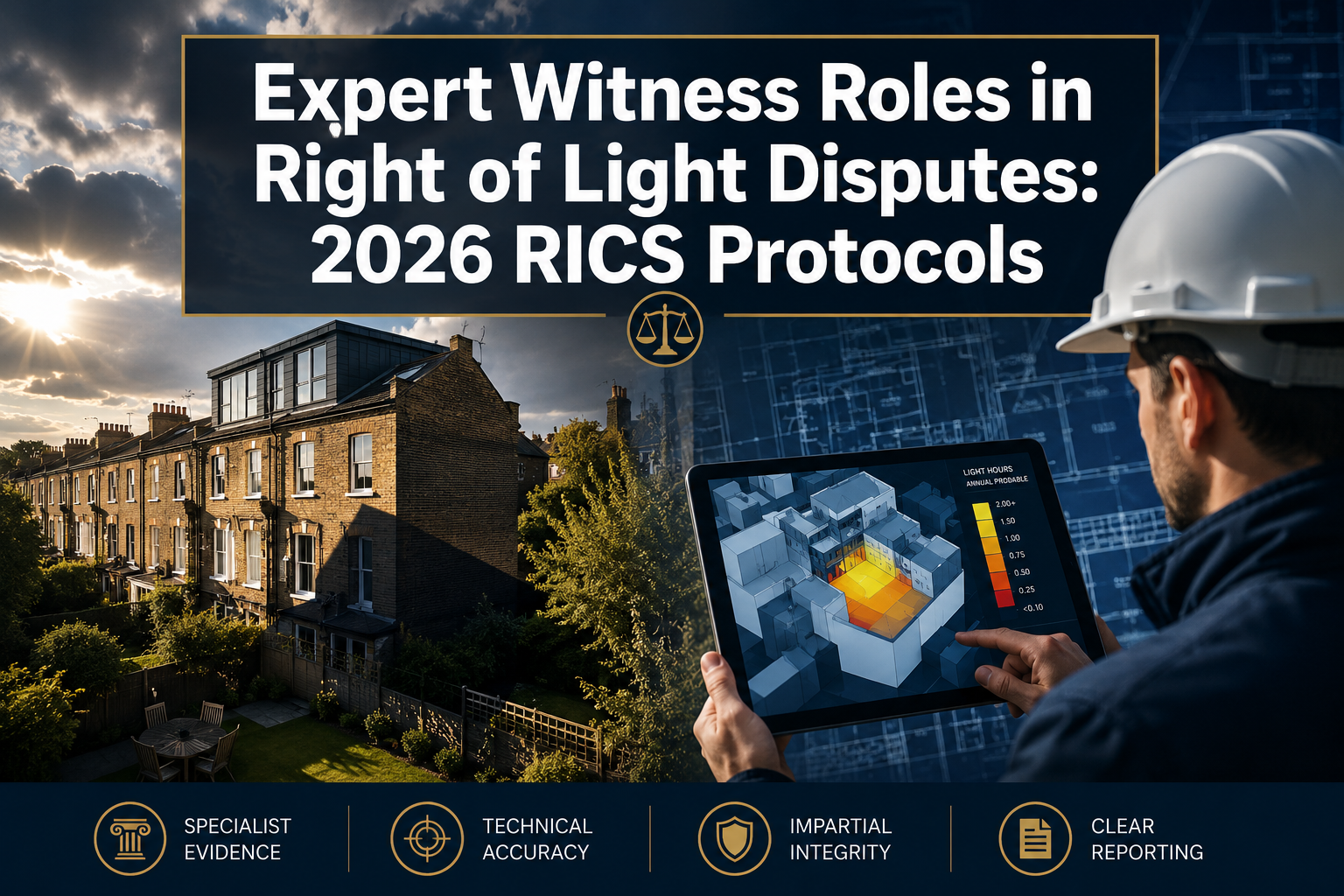
Fewer than one in five homeowners who pursue a right of light claim ever reach a courtroom — yet the quality of expert witness evidence prepared for those cases routinely determines whether the remaining disputes settle quickly or drag on for years at enormous cost. In 2026, the stakes have risen sharply. The fifth edition of the RICS professional standard "Surveyors Acting as Expert Witnesses," released in April 2026, combined with the updated Rights of Light professional standard from March 2024, has fundamentally reshaped what courts expect from surveyors instructed in loft conversion and rear extension disputes [1][4]. Understanding expert witness roles in right of light disputes and the 2026 RICS protocols for loft and rear extension claims is now essential knowledge for any property professional, developer, or adjoining owner navigating this complex area of law.
Key Takeaways
- The 2026 RICS fifth edition standard requires expert witnesses to demonstrate impartiality, competence, and adequate resources before accepting any right of light instruction.
- Courts operating under Civil Procedure Rules (CPR) Part 35 place the expert's primary duty to the tribunal, not to the instructing party.
- Three-dimensional modelling tools and Waldram diagram analysis are now standard methods for quantifying light loss in loft and rear extension disputes.
- AI-assisted valuation evidence must comply with the RICS "Responsible Use of Artificial Intelligence" standard introduced in March 2026.
- Success-based fees for expert witnesses are strictly prohibited under RICS rules, and professional indemnity insurance must be adequate for expert witness work.
What Is a Right of Light and Why Do Loft and Rear Extensions Trigger Disputes
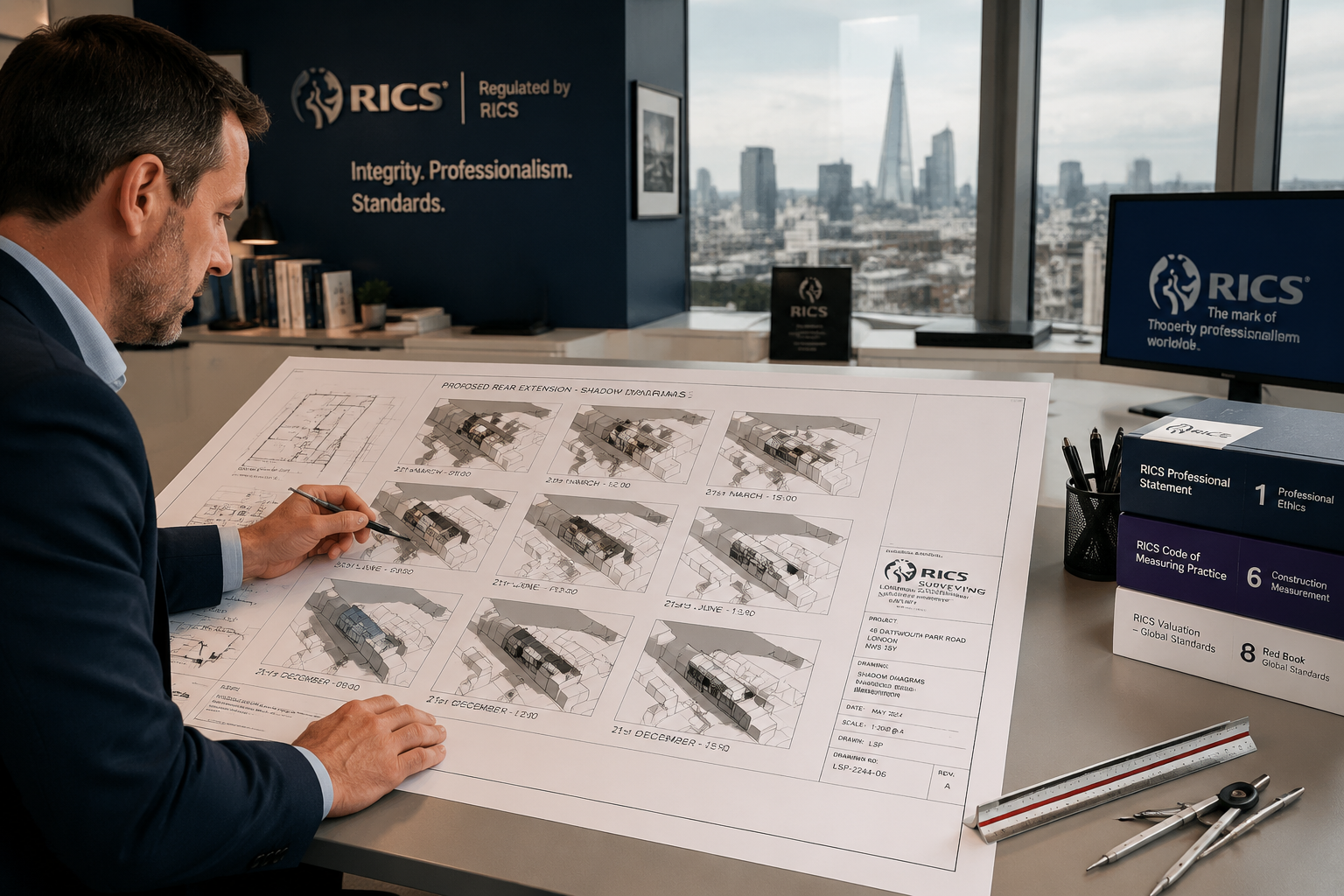
A right of light is a legal easement that entitles the owner of a building to receive natural daylight through defined apertures — typically windows. Once a property has enjoyed natural light through a window for 20 or more years without interruption, that right can become legally protected under the Prescription Act 1832. Loft conversions and rear extensions are among the most common triggers for disputes because they alter the height and massing of a building in ways that directly affect neighbouring properties' access to daylight.
The critical threshold used by courts is whether a proposed or completed development reduces the light available to a neighbouring property below what is sufficient for comfortable use according to the ordinary notions of mankind. This standard, established in Colls v Home and Colonial Stores Ltd [1904], remains the benchmark in 2026. What has changed dramatically is how expert witnesses are expected to measure, model, and present that reduction.
Common scenarios involving loft and rear extension claims include:
- A rear extension that blocks morning light to a neighbour's kitchen or living room
- A loft conversion with a dormer window that alters the roofline and reduces sky visibility for adjacent properties
- A side-return extension that narrows the gap between terraced properties and reduces oblique daylight
- A mansard roof addition that increases overall building height beyond the original ridge line
Understanding property boundary disputes and how they interact with right of light claims is important, because the two issues often arise simultaneously when extensions approach shared boundaries.
The 2026 RICS Framework: Expert Witness Roles in Right of Light Disputes and Updated Protocols
The April 2026 fifth edition of the RICS professional standard for surveyors acting as expert witnesses represents the most significant revision in over a decade [1]. It consolidates and clarifies obligations that previously existed across multiple guidance documents, and it introduces specific provisions relevant to technology-assisted evidence — a direct response to the growing use of AI and 3D modelling in property disputes.
Core Duties Under the Updated Standard
The overriding duty of any expert witness in right of light proceedings is to the court or tribunal, not to the party who instructed them. This principle, long established under CPR Part 35, is now reinforced with greater specificity in the 2026 RICS standard [2]. The expert must:
| Duty | Requirement |
|---|---|
| Impartiality | Opinions must be independent and uninfluenced by the instructing party's preferred outcome |
| Competence | The surveyor must possess specific expertise in rights of light, not merely general surveying experience |
| Completeness | All material facts must be disclosed, including those that are adverse to the instructing party |
| Timeliness | The expert must have sufficient resources to complete the assignment within required court timescales |
| Correction | Errors must be corrected promptly when new information emerges [8] |
A surveyor who cannot meet all five requirements must decline the instruction. The 2026 standard makes this explicit: accepting an expert witness role without the requisite competence is itself a professional conduct matter [1].
Distinguishing Expert Witnesses, Single Joint Experts, and Independent Experts
The updated RICS framework draws a clear distinction between three roles that are frequently confused [2]:
Expert Witness: Instructed by one party, provides opinion evidence to the court. Owes primary duty to the tribunal.
Single Joint Expert (SJE): Appointed jointly by both parties, typically in lower-value or less complex disputes. The SJE's report is shared between all parties and the court simultaneously.
Independent Expert: Appointed under a contractual dispute resolution mechanism, not court proceedings. Operates under different rules and owes duties defined by the appointment agreement rather than CPR Part 35.
In right of light disputes involving loft and rear extensions, the choice between an expert witness and an SJE is often determined by the value of the claim and the complexity of the light loss analysis required. Where 3D modelling is necessary to accurately quantify the loss, courts are increasingly reluctant to rely on a single joint expert alone.
Evidence Preparation Under CPR Part 35: 3D Modelling and Quantifying Light Loss
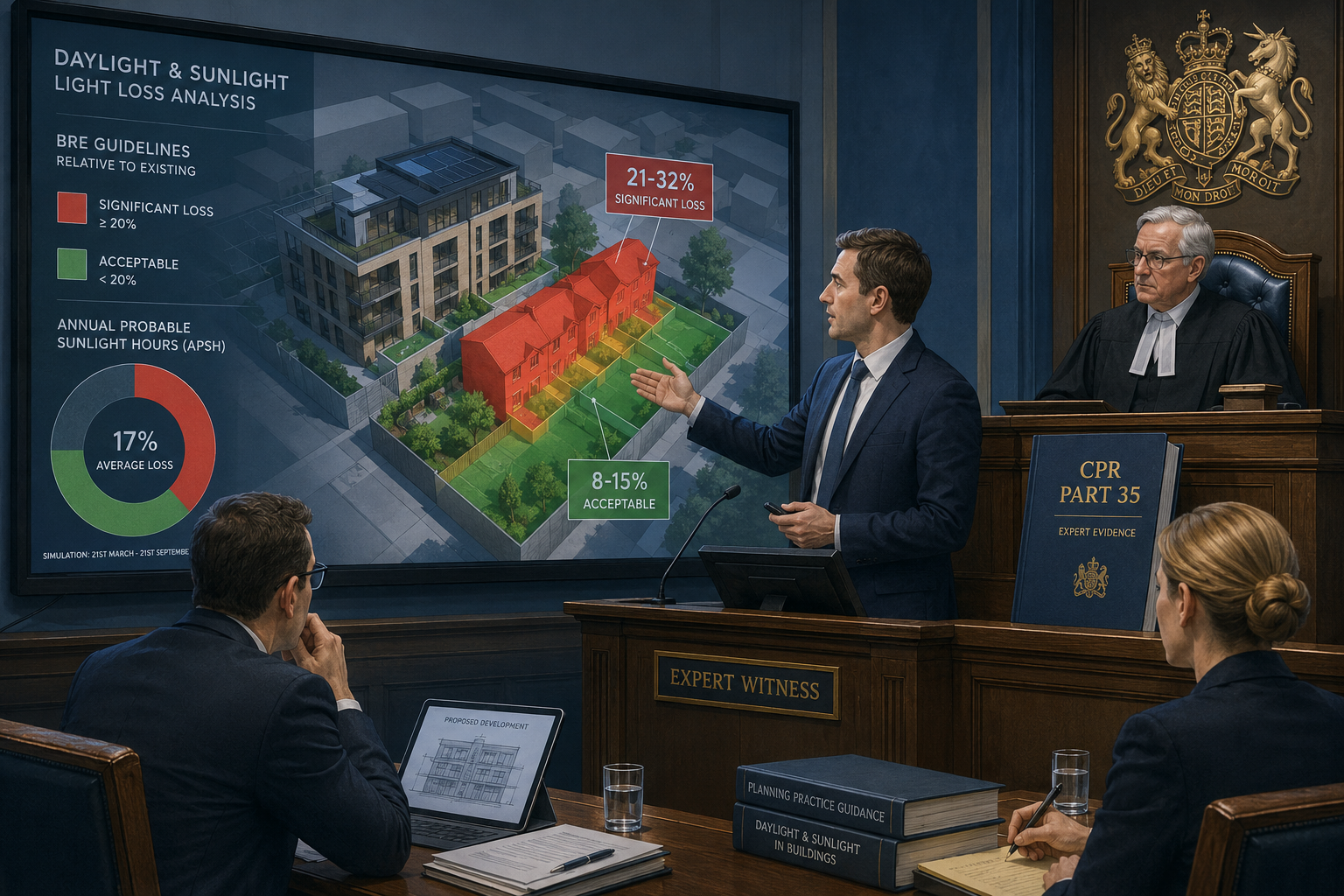
The most technically demanding aspect of expert witness roles in right of light disputes under 2026 RICS protocols for loft and rear extension claims is the preparation of evidence that meets CPR Part 35 requirements while accurately representing complex spatial data. Courts have become significantly more sophisticated in their expectations, and the days of relying solely on hand-drawn Waldram diagrams are largely over in contested cases.
The Waldram Diagram: Still Relevant, Now Enhanced
The Waldram diagram remains the foundational tool for right of light analysis. It translates the three-dimensional geometry of a room and its surroundings into a two-dimensional representation of the sky visible through a window. The percentage of the room receiving adequate daylight — conventionally defined as 0.2% of the sky factor or above — is then calculated.
However, in 2026, courts expect this analysis to be supported by or integrated with three-dimensional modelling that allows the judge to visualise the impact of the proposed or completed development. The key methods now in use include:
- Point cloud scanning: Laser scanning of existing buildings to create accurate 3D models of the built environment before and after an extension
- BIM (Building Information Modelling) integration: Using architectural BIM data from planning applications to model proposed extensions and calculate their shadow impact
- Daylight and sunlight simulation software: Tools such as VELUX Daylight Visualizer, Radiance, and proprietary surveying platforms that generate quantified light loss data across multiple reference points within a room
- Animated shadow studies: Time-lapse 3D animations showing how light access changes across a day and across seasons, which courts find particularly persuasive in understanding real-world impact
The expert witness must be able to explain and defend all modelling assumptions in cross-examination. This includes the choice of reference plane height, the sky luminance distribution model used, and the treatment of reflections from adjacent surfaces.
Preparing the Expert Report for Court
An expert report in a right of light dispute must comply with CPR Part 35 and Practice Direction 35. Under the 2026 RICS standard, the report structure should include [5]:
- Statement of truth and declaration of independence: Confirming the expert understands their duty to the court
- Qualifications and experience: Demonstrating specific competence in rights of light analysis
- Instructions received: A clear summary of what the expert was asked to do
- Methodology: A transparent account of all analytical methods used, including any software tools
- Findings: The quantified light loss expressed as a percentage reduction in adequately lit floor area
- Opinion: Whether the reduction constitutes an actionable infringement
- Limitations: An honest account of any uncertainties or data gaps
- Appendices: Full Waldram diagrams, 3D model outputs, and supporting calculations
"Courts increasingly expect expert witnesses to convey their views in a clear and measured manner, using appropriate methods and accepting limitations where relevant." [5]
This expectation for clarity is particularly important in loft and rear extension claims, where the technical complexity of light modelling can easily obscure the core question the court needs to answer.
The Role of AI-Assisted Evidence in 2026
The RICS "Responsible Use of Artificial Intelligence" standard, introduced in March 2026, directly affects how expert witnesses may use AI-generated data in right of light proceedings [3]. With over 60% of property disputes now involving algorithmically generated valuation data, the standard requires surveyors to:
- Validate all AI-generated outputs against independently verified data
- Disclose the AI tools used and their known limitations within the expert report
- Be prepared to explain and defend AI-assisted conclusions in cross-examination without relying on the algorithm as a black box
- Ensure that AI tools used for light modelling or valuation have been trained on data appropriate to the UK residential market
This is particularly relevant in rear extension disputes where AI-assisted comparable analysis is used to quantify the financial loss suffered by the neighbouring property owner — a figure that directly affects the level of damages or injunction relief sought.
Surveyors involved in construction projects and home extension work should be aware that AI-generated planning data used during the design phase may later be scrutinised as part of expert evidence if a dispute arises.
Professional Standards, Accreditation, and Ethical Obligations
The RICS Expert Witness Accreditation Service
RICS has developed the Expert Witness Accreditation Service to provide courts and instructing solicitors with confidence that an accredited expert has been trained, assessed, and is subject to ongoing monitoring [7]. In right of light disputes, where the technical analysis is highly specialised, accreditation is increasingly treated as a baseline expectation rather than an optional credential.
The accreditation process involves:
- Completion of the RICS Expert Witness Certificate (a 12-week online programme)
- Assessment of report writing and oral evidence skills
- Periodic review to ensure continued competence [5]
For surveyors who provide expert party wall advice or handle property boundary disputes, adding right of light expert witness accreditation represents a natural extension of their dispute resolution practice.
Prohibited Conduct: Success-Based Fees
One of the most clearly stated prohibitions in the 2026 RICS standard is the ban on success-based fees for expert witnesses [6]. A surveyor who accepts a fee contingent on the outcome of the case — whether the client wins or loses — has fundamentally compromised their independence. This is not merely an ethical concern; it is grounds for the court to disregard the expert's evidence entirely and potentially for RICS to take disciplinary action.
The prohibition applies to:
- Percentage-of-damages fee arrangements
- Conditional fee agreements tied to litigation outcomes
- Any arrangement where the expert's remuneration increases if the instructing party succeeds
Legitimate fee arrangements are fixed fees, hourly rates, or stage-based payments that are not contingent on outcome.
Professional Indemnity Insurance Requirements
Expert witnesses in right of light disputes must hold professional indemnity insurance that is adequate for the scale and complexity of the work being undertaken [8]. Standard surveying PII policies may not automatically cover expert witness activities, and surveyors should confirm with their insurer that their policy extends to this role before accepting any instruction.
The average cost of a boundary dispute can run into tens of thousands of pounds, and right of light claims involving development projects can involve significantly higher sums. The expert's PII coverage should be proportionate to the potential liability exposure.
Practical Guidance for Developers and Adjoining Owners
For Developers Planning Loft or Rear Extensions
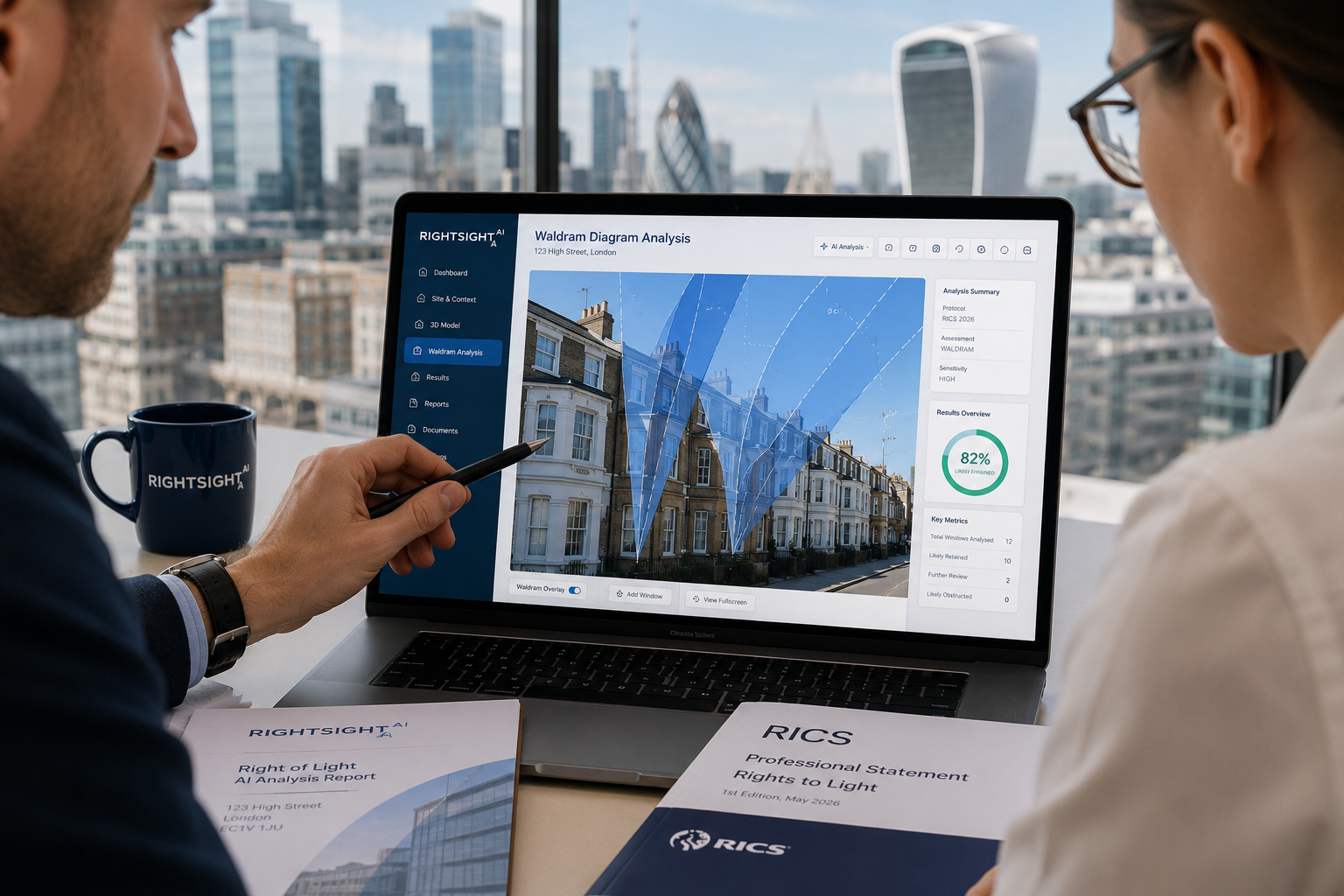
The most effective way to manage right of light risk is to commission a pre-application daylight and sunlight assessment before submitting planning permission. This assessment, carried out by a qualified surveyor, identifies whether the proposed extension is likely to infringe on neighbouring rights and allows the design to be modified before any legal exposure arises.
The updated Rights of Light professional standard from March 2024 includes a legal protocol specifically designed to facilitate early information exchange between developers and adjoining owners [4]. Following this protocol — which includes formal notification, provision of technical data, and a structured negotiation period — can significantly reduce the likelihood of court proceedings and the associated costs.
Key steps for developers include:
- Engaging a RICS-accredited right of light surveyor at the design stage
- Obtaining a formal right of light assessment as part of the planning process
- Considering a light obstruction notice to interrupt prescriptive rights where appropriate
- Exploring insurance-backed indemnity policies if proceeding with a development that carries residual risk
For those planning home improvement projects involving extensions or loft conversions, understanding these obligations before breaking ground can prevent costly disputes later.
For Adjoining Owners Affected by a Neighbour's Extension
If a neighbouring extension has already been built or is under construction, adjoining owners should act promptly. The right to seek an injunction to have a structure removed or modified is time-sensitive, and delay can be interpreted as acquiescence.
Practical steps include:
- Commissioning an independent right of light assessment from a RICS-accredited surveyor
- Reviewing whether the affected windows have enjoyed uninterrupted light for 20 or more years
- Engaging a solicitor with property litigation experience to advise on the merits of an injunction versus a damages claim
- Considering the RICS dispute resolution protocol as an alternative to court proceedings
Understanding property rights more broadly can help adjoining owners appreciate the full range of legal tools available to them, including party wall rights, planning objections, and nuisance claims that may run alongside a right of light action.
Surveyors who also handle building surveyor services are well placed to advise on the structural and legal dimensions of a dispute simultaneously, providing a more integrated service to affected property owners.
Conclusion
Expert witness roles in right of light disputes under the 2026 RICS protocols for loft and rear extension claims demand a combination of technical precision, legal awareness, and rigorous professional conduct. The April 2026 fifth edition of the RICS expert witness standard has raised the bar significantly: surveyors must demonstrate specific competence, maintain genuine independence, and produce evidence that meets the exacting requirements of CPR Part 35 [1][2].
Three-dimensional modelling and AI-assisted analysis have become standard tools in contested cases, but they must be deployed transparently and defensibly [3]. The expert's primary duty remains to the court, and any arrangement — financial or otherwise — that compromises that duty is both professionally and legally unacceptable [6].
Actionable next steps for those involved in right of light disputes in 2026:
- Engage a RICS-accredited expert witness with specific experience in rights of light, not just general surveying practice.
- Commission a pre-application daylight assessment before any loft or rear extension proceeds to identify and mitigate risk early.
- Follow the RICS Rights of Light legal protocol to facilitate early negotiation and reduce the likelihood of costly litigation.
- Ensure any AI-assisted evidence used in proceedings complies with the March 2026 RICS AI standard and can be defended in cross-examination.
- Confirm that the instructed expert holds adequate professional indemnity insurance and is not operating under any prohibited success-based fee arrangement.
- Act promptly if affected by a neighbour's extension — delay can compromise both injunction rights and negotiating leverage.
The combination of updated RICS standards, evolving court expectations, and increasingly sophisticated analytical tools means that right of light disputes in 2026 are more technically demanding than ever. Selecting the right expert, at the right stage, with the right credentials, is the single most important decision any party to such a dispute can make.
References
[1] Viewcompounddoc – https://consultations.rics.org/surveyorsasexpertwitness/viewCompoundDoc?docid=16248980&partid=16249876&pfv=y&utm_source=openai
[2] Expert Witnesses Single Joint Experts And Independent Experts – https://www.rics.org/dispute-resolution-service/drs-information-hub/expert-witnesses-single-joint-experts-and-independent-experts?utm_source=openai
[3] Expert Witness Roles Under New Rics Ai Standards 2026 Cpr Protocols For Tech Enhanced Valuation Evidence – https://manchestersurveyors.com/expert-witness-roles-under-new-rics-ai-standards-2026-cpr-protocols-for-tech-enhanced-valuation-evidence/?utm_source=openai
[4] Rights Of Light 3rd Ed Ps March 2024 – https://www.rics.org/content/dam/ricsglobal/documents/standards/rights-of-light-3rd-ed-ps-march-2024.pdf?utm_source=openai
[5] Role Responsibilities Expert Witnesses Built Environment – https://www.rics.org/news-insights/role-responsibilities-expert-witnesses-built-environment?utm_source=openai
[6] Expert Witness Duties Responsibilities – https://ww3.rics.org/uk/en/journals/built-environment-journal/expert-witness-duties-responsibilities.html?utm_source=openai
[7] Expert Witness Accreditation Service – https://www.rics.org/dispute-resolution-service/panel-of-experts/expert-witness-accreditation-service?utm_source=openai
[8] Expert Witness Valuation Reports For Right Of Light Disputes Rics Protocols And Courtroom Strategies In 2026 – https://kingstonsurveyors.com/expert-witness-valuation-reports-for-right-of-light-disputes-rics-protocols-and-courtroom-strategies-in-2026/?utm_source=openai