


Party wall disputes in the UK have surged by 40% in 2026 compared to the previous year, with the average additional surveyor cost per unresolved dispute now reaching £3,500 [1]. For homeowners planning kerb appeal upgrades — from driveway restorations to boundary wall replacements — this figure is not abstract. It represents the financial penalty for skipping the procedural groundwork that separates a smooth renovation from a costly legal standoff. Understanding Party Wall Essentials for Regional Kerb Appeal Projects: North-South Strategies in Stabilising 2026 Prices is no longer optional; it is the difference between a project that adds value and one that erodes it.
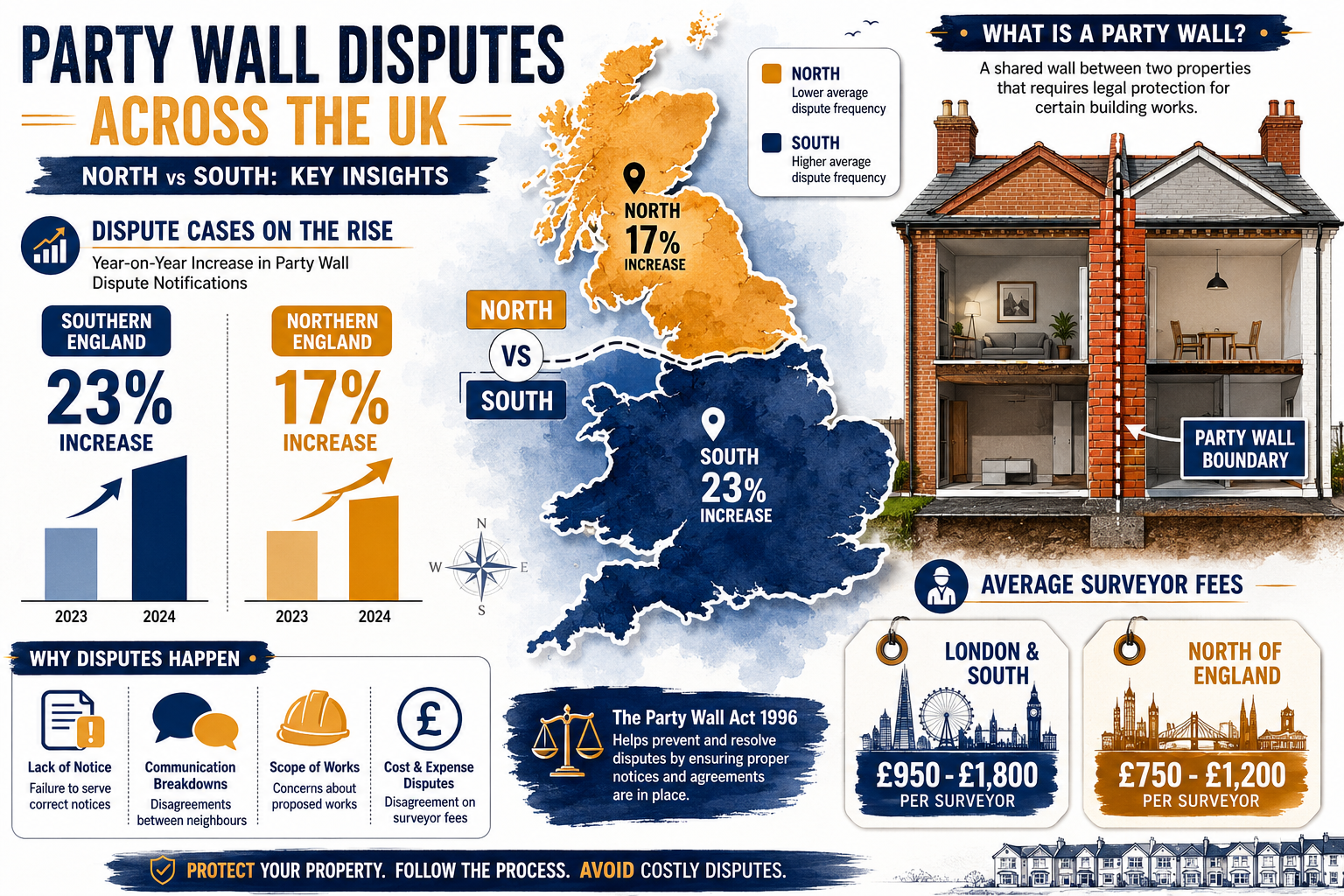
The regional dimension matters more than most homeowners realise. Southern England, particularly London and the South East, faces a 23% rise in boundary dispute frequency since 2024, driven by high-density development. Northern regions, meanwhile, are seeing a 17% increase in excavation-related party wall matters as suburban expansion accelerates [2]. These divergent pressures demand tailored notice strategies, not a one-size-fits-all approach.
Key Takeaways
- Party wall disputes have risen 40% in 2026, making early compliance essential to avoid average additional costs of £3,500 per dispute.
- Southern England faces a 23% rise in boundary disputes; northern regions see a 17% increase in excavation-related matters — each requiring distinct notice strategies.
- Kerb appeal improvements such as landscaping and driveway restoration can yield ROI of 100-150%, but only when party wall procedures are handled correctly from the outset.
- Surveyor fees and timelines differ significantly by region: London projects cost £950-£1,800 per neighbour and take 3-4 months; northern projects cost £750-£1,200 and take 2-3 months.
- A Schedule of Condition is a non-negotiable protection tool, costing £300-£600 regionally and £600-£1,000 in London, that prevents compensation claims after works complete.
Why Regional Divergence Defines Party Wall Strategy in 2026
The UK property market in 2026 is not a single entity. It is a collection of micro-markets, each responding to different economic pressures, planning densities, and construction volumes. The January 2026 RICS Residential Survey signals a shift towards price stabilisation, with 43% of professionals expecting price rises over the next 12 months [8]. However, this headline figure conceals a sharp North-South divide that directly shapes how kerb appeal projects should be planned and executed.
In London and the South East, nearly 40% of party wall disputes escalate beyond the initial notice stage [7]. Construction activity has resumed after periods of price-driven stagnation, and neighbours in high-density terraced streets are acutely sensitive to any works affecting shared boundaries. A front garden redesign involving new boundary walls, a raised driveway, or excavation near a shared foundation can trigger formal objections within days of a notice being served.
In northern cities — Manchester, Leeds, Sheffield, and their surrounding suburbs — the challenge is different. Suburban expansion is generating a wave of side-extension and rear-extension projects, many of which involve excavation close to neighbouring foundations. The 17% increase in excavation-related party wall matters [2] reflects this trend. Homeowners in these areas often underestimate the legal reach of the Party Wall etc. Act 1996, assuming that works on what appears to be their own land require no formal notification.
The practical implication: a homeowner in Wandsworth planning a front boundary wall replacement needs a different notice strategy than a homeowner in Salford planning a side extension with a new retaining wall. Both are subject to the same Act, but the risk profile, timeline, and likely neighbour response differ considerably.
For those unfamiliar with the legal framework, reviewing UK boundary wall rules provides a solid starting point before any notice is prepared.
Kerb Appeal Upgrades That Trigger Party Wall Obligations
Not every kerb appeal improvement requires a party wall notice. But several of the highest-ROI exterior upgrades do, and homeowners frequently discover this too late.
Works That Typically Require Notice
| Improvement Type | Party Wall Trigger | Estimated ROI |
|---|---|---|
| Boundary wall replacement or raising | Yes — if on or near the boundary | 80-120% |
| Driveway excavation near shared wall | Yes — if within 3m of neighbour's foundation | 100-150% |
| Retaining wall installation | Yes — if adjacent to party boundary | Varies by height |
| Front extension or porch addition | Yes — if touching shared wall | 80-100% |
| Landscaping with deep planting excavation | Possibly — depth and proximity dependent | 150%+ |
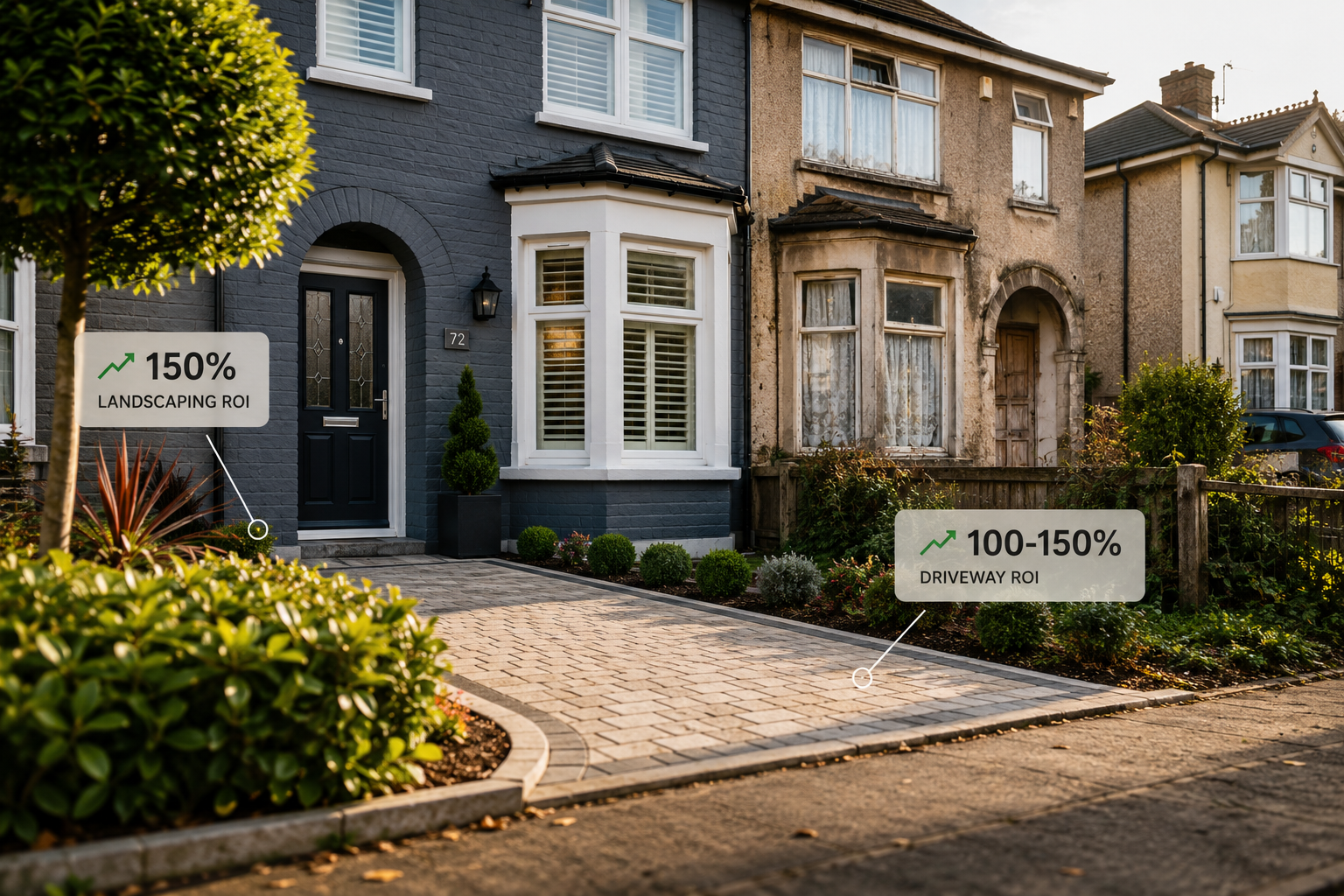
Professional landscaping and garden maintenance can yield an ROI exceeding 150%, while driveway and path restoration delivers 100-150% ROI, and exterior painting offers 80-120% [3]. These are compelling numbers. But they assume the project completes without legal interruption. A court injunction halting construction mid-project can eliminate those gains entirely and add significant legal costs on top.
Retaining walls — a common feature in kerb appeal redesigns involving level changes — carry their own cost structure. In 2026, retaining wall installation ranges from approximately $20 to $100+ per square foot depending on material and terrain, with a typical residential project (50 linear feet, 3 feet tall) costing between $4,000 and $15,000 installed [4]. Larger walls in difficult terrain can exceed $50,000. When these walls sit near a party boundary, the party wall process adds procedural cost and time — but also legal protection for both parties.
Understanding boundary wall height limits is equally important when planning any front or side boundary feature, as permitted development rights interact with party wall obligations in ways that can catch homeowners off guard.
North-South Notice Strategies: Tailoring the Approach
The core of Party Wall Essentials for Regional Kerb Appeal Projects: North-South Strategies in Stabilising 2026 Prices lies in recognising that notice preparation is not a bureaucratic formality — it is a strategic tool. How and when a notice is served can determine whether a project proceeds smoothly or becomes mired in dispute.
Southern Strategy: Precision and Pre-Emptive Engagement
In London and the South East, the high rate of dispute escalation [7] points to a clear lesson: serve notices early, communicate proactively, and invest in a detailed Schedule of Condition before works begin.
Key southern notice principles:
- Serve notice at least 2 months before planned works start (the statutory minimum, but earlier is better in high-density areas)
- Include detailed drawings showing the exact scope of works relative to the shared boundary
- Arrange a pre-notice conversation with neighbours to explain the works and address concerns informally
- Appoint an experienced party wall surveyor early, before the notice is served, to guide the process
- Budget for the London fee multiplier: surveyor fees in London range from £950 to £1,800 per neighbour, with processes taking 3-4 months [2]
In areas like Southwark, where Victorian terracing creates tightly packed shared walls, the Schedule of Condition is particularly critical. It documents the existing state of the adjoining property before works begin, providing a clear baseline if any damage claims arise later. Regional costs for this document run £300-£600, rising to £600-£1,000 in London [6].
Northern Strategy: Excavation Awareness and Suburban Sensitivity
In northern regions, the surge in excavation-related party wall matters [2] suggests that homeowners and their contractors are proceeding with groundworks without fully appreciating the Act's reach. The Party Wall etc. Act 1996 covers not just works on shared walls but also excavation within 3 metres of a neighbouring building where the excavation goes deeper than the neighbour's foundations.
Key northern notice principles:
- Commission a structural engineer's review (£500-£1,000) before finalising excavation plans near boundaries [6]
- Serve notice promptly — northern timelines average 2-3 months, but suburban neighbours can still dissent and trigger the appointment of surveyors
- Use the lower regional fee structure (£750-£1,200 per neighbour) as a budgeting baseline, but include contingency for disputes
- Recognise that suburban neighbours may be less familiar with the party wall process and may need clearer explanation to avoid unnecessary dissent
For homeowners in areas experiencing rapid suburban growth, understanding what a party wall surveyor does helps set realistic expectations about the process and the surveyor's role as a neutral professional, not an adversary.
Budgeting for Party Wall Compliance in 2026: A Practical Framework
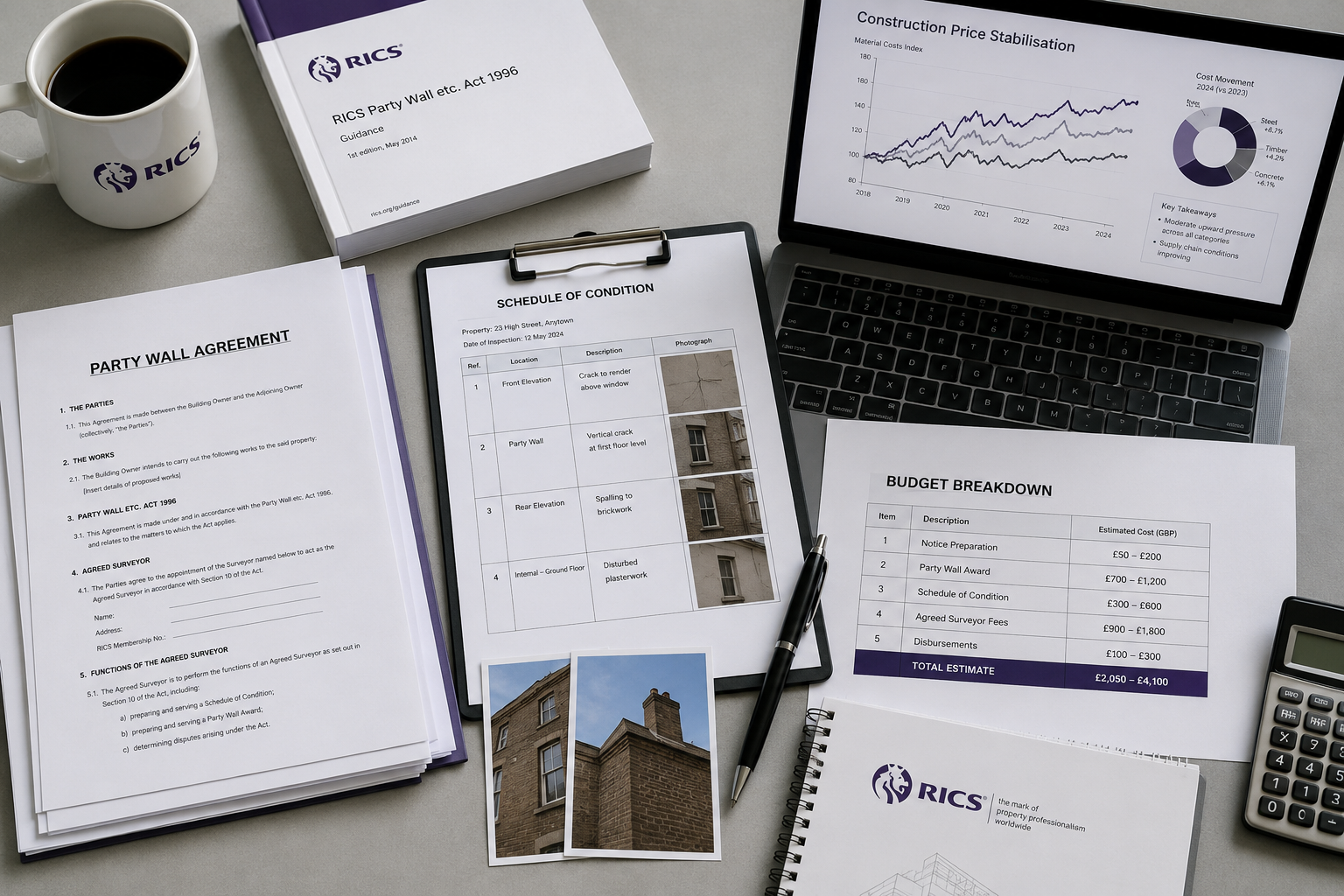
One of the most consistent errors homeowners make is treating party wall costs as an afterthought. In 2026, a practical budget for a typical residential kerb appeal project involving party wall works should include the following components [6]:
| Cost Item | Regional (North) | London/South East |
|---|---|---|
| Notice preparation and service | £50-£200 | £100-£300 |
| Party wall award | £700-£1,200 | £1,400-£2,400 |
| Schedule of Condition | £300-£600 | £600-£1,000 |
| Structural engineer review | £500-£1,000 | £750-£1,500 |
| Dispute contingency | £500-£1,500 | £1,000-£3,000 |
| Total estimated range | £2,050-£4,500 | £3,850-£8,200 |
London projects should apply a 1.5-2x multiplier to surveyor fees compared to regional averages [6]. This is not arbitrary — it reflects the complexity of high-density urban developments, the greater likelihood of neighbour dissent, and the higher professional rates in the capital.
"Proceeding without the required party wall procedures can lead to court injunctions halting construction and substantial compensation claims. Retrospective compliance costs, including legal fees, often exceed the expenses of proper initial procedures." [6]
This is not a theoretical risk. In London and the South East, where 40% of disputes escalate beyond the initial notice stage [7], the cost of non-compliance is a live and frequent outcome.
For those seeking expert party wall advice before committing to a budget, early professional consultation typically costs far less than the disputes it prevents.
Stabilising Project Value: How Party Wall Compliance Supports 2026 Pricing
The connection between party wall compliance and property valuation is direct, even if it is rarely discussed in those terms. Party Wall Essentials for Regional Kerb Appeal Projects: North-South Strategies in Stabilising 2026 Prices is ultimately about protecting the value that kerb appeal improvements are designed to create.
In regions experiencing price flatness — particularly London and the South East — surveyors are advised to prioritise recent comparable evidence, apply explicit directional adjustments, and consider property type differentiation to ensure accurate valuations [9]. A property where kerb appeal works have been completed without proper party wall compliance carries a legal liability that informed buyers and their solicitors will identify during conveyancing. This can suppress offers, delay transactions, or require expensive retrospective agreements.
The January 2026 RICS data showing 43% of professionals expecting price rises [8] suggests cautious optimism. Capital in 2026 is active but highly selective, favouring assets with durable cash flow and pricing that reflects current debt costs [5]. For residential properties, this translates to a preference for homes where improvements are legally sound and documentation is complete.
Three ways party wall compliance stabilises project value:
- Removes legal liability from the title — a properly executed party wall award and Schedule of Condition mean no outstanding claims can be made against the property post-sale
- Supports accurate valuation — surveyors can apply full kerb appeal uplift when works are documented and compliant, rather than discounting for legal uncertainty
- Accelerates conveyancing — solicitors reviewing a complete party wall file can proceed without raising requisitions that delay exchange
For homeowners in areas like Bromley, Croydon, or Hammersmith — where high-density streets and active construction create frequent party wall situations — working with a local surveyor who understands the specific neighbourhood context is a material advantage.
Those planning home improvement projects that include any boundary works should treat party wall compliance as part of the project specification, not a separate administrative task.
Common Mistakes That Escalate Costs and Disputes
Understanding the failure modes is as important as knowing the correct process. The following errors are consistently associated with escalating costs and delayed projects in 2026.
Mistake 1: Assuming permitted development means no party wall notice is needed
Permitted development rights govern planning permission. They do not override the Party Wall etc. Act 1996. A project can be fully permitted development and still require a party wall notice.
Mistake 2: Serving notice too late
The statutory notice period is 1-2 months depending on the type of works. Serving notice the week before works start is not compliance — it is an invitation to dissent and delay.
Mistake 3: Using informal letters instead of formal notices
A letter to a neighbour explaining planned works is not a party wall notice. Formal notices must comply with specific requirements under the Act. Informally worded letters do not start the statutory clock running.
Mistake 4: Skipping the Schedule of Condition
Without a pre-works record of the adjoining property's condition, any crack or damage that appears after works complete becomes a disputed liability. The Schedule of Condition resolves this before it becomes a problem.
Mistake 5: Assuming the northern fee structure applies to London projects
Homeowners relocating from northern cities to London frequently underestimate party wall costs. The London fee multiplier is real and should be factored into project budgets from the outset [6].
Conclusion: Actionable Next Steps for North and South Homeowners
The data from 2026 is clear: party wall disputes are rising, costs are escalating, and the regional differences between North and South are shaping how projects should be planned and executed. Party Wall Essentials for Regional Kerb Appeal Projects: North-South Strategies in Stabilising 2026 Prices is not simply a compliance checklist — it is a framework for protecting the investment that kerb appeal improvements represent.
For homeowners in London and the South East:
- Appoint a party wall surveyor before finalising project plans
- Serve notice at least 2 months in advance and engage neighbours informally beforehand
- Budget £3,850-£8,200 for full party wall compliance on a typical project
- Commission a Schedule of Condition as a non-negotiable first step
For homeowners in northern regions:
- Review excavation plans carefully against the 3-metre rule before breaking ground
- Use the 2-3 month timeline as a planning baseline, not an optimistic target
- Budget £2,050-£4,500 for compliance, including dispute contingency
- Do not confuse permitted development approval with party wall compliance
For all homeowners:
- Treat party wall compliance as part of the project specification, not an afterthought
- Document everything — notices, responses, awards, and Schedules of Condition
- Seek expert party wall advice early; the cost of a consultation is a fraction of the cost of a dispute
The kerb appeal gains are real — 150% ROI on landscaping, 100-150% on driveways [3] — but they are only realised when the legal foundation is solid. In a market where price stabilisation is the dominant theme of 2026, protecting every percentage point of added value through proper compliance is not caution. It is strategy.
References
[1] Party Wall Surveys Amid 2026 Construction Boom Resolving High Demand Disputes In Uk Housing Hotspots – https://manchestersurveyors.com/party-wall-surveys-amid-2026-construction-boom-resolving-high-demand-disputes-in-uk-housing-hotspots/?utm_source=openai
[2] Party Wall Act Compliance In Regional Market Contrasts Survey Strategies For North Vs South 2026 Developments – https://wimbledonsurveyors.com/party-wall-act-compliance-in-regional-market-contrasts-survey-strategies-for-north-vs-south-2026-developments/?utm_source=openai
[3] Valuation Adjustments For Poor Kerb Appeal In 2026 Quantifying Impacts From Roofs To Regional Landscaping Neglect – https://wimbledonsurveyors.com/valuation-adjustments-for-poor-kerb-appeal-in-2026-quantifying-impacts-from-roofs-to-regional-landscaping-neglect/?utm_source=openai
[4] Retaining Wall Cost Guide – https://homecostlab.com/guides/retaining-wall-cost-guide/?utm_source=openai
[5] Sorting Year How Capital Pricing And Execution Are Shaping Multifamily 2026 – https://www.northmarq.com/insights/research/sorting-year-how-capital-pricing-and-execution-are-shaping-multifamily-2026?utm_source=openai
[6] Cost Breakdown Of Party Wall Agreements In 2026 Surveyor Fees Who Pays What And Budgeting For Disputes – https://manchestersurveyors.com/cost-breakdown-of-party-wall-agreements-in-2026-surveyor-fees-who-pays-what-and-budgeting-for-disputes/?utm_source=openai
[7] Party Wall Act Compliance In London South East Price Stabilization Surveyor Checklists For 2026 – https://wimbledonsurveyors.com/party-wall-act-compliance-in-london-south-east-price-stabilization-surveyor-checklists-for-2026/?utm_source=openai
[8] Leveraging Rics January 2026 Residential Survey Recovery Signals In Party Wall Project Valuations 2 – https://wimbledonsurveyors.com/leveraging-rics-january-2026-residential-survey-recovery-signals-in-party-wall-project-valuations-2/?utm_source=openai
[9] Valuation Strategies For Regional Price Flatness In Spring 2026 Rics Data For Divergent Uk Markets – https://nottinghillsurveyors.com/blog/valuation-strategies-for-regional-price-flatness-in-spring-2026-rics-data-for-divergent-uk-markets?utm_source=openai