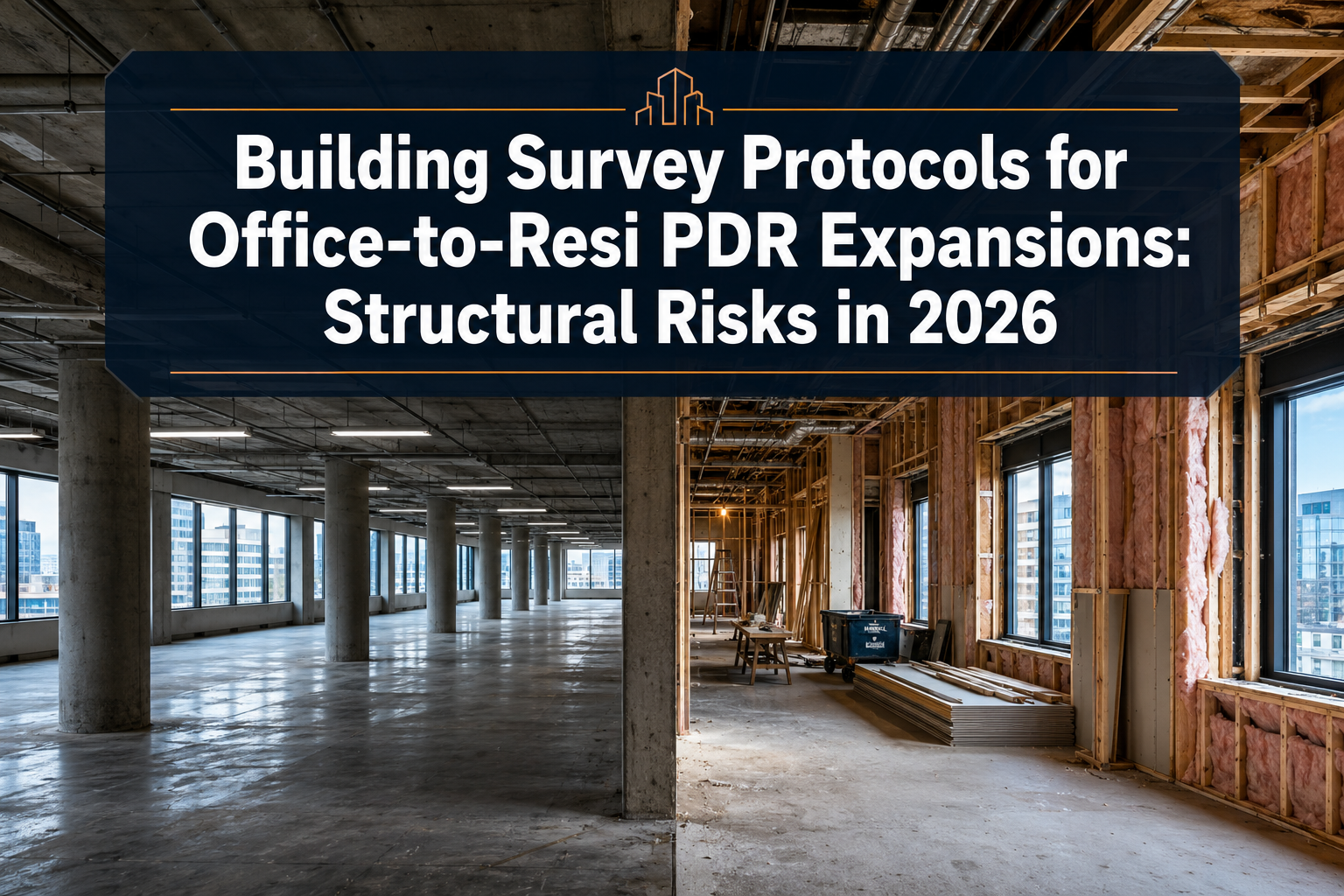
Approximately 1.2 million square metres of redundant office space across England is now considered viable for residential conversion under expanded Permitted Development Rights (PDR) — yet fewer than one in three of those buildings has received a structural survey adequate to identify the risks that routinely derail conversion projects. As the government presses toward its 2026 housing targets, the gap between planning optimism and engineering reality is widening fast. Understanding robust building survey protocols for office-to-resi PDR expansions: structural risks in 2026 housing targets has never been more commercially or legally critical for developers, investors, and surveyors alike.
Key Takeaways
- RICS now recommends Level 3 full structural surveys for all office-to-residential conversions, as hidden defects can add 15-30% to projected conversion costs [1].
- Deep floor plates, irregular column grids, and legacy cladding systems are the three most common structural barriers identified during pre-conversion surveys.
- Mechanical, electrical, and plumbing (MEP) upgrades frequently consume up to one-third of the total conversion budget [4].
- Expanded PDR in 2026 accelerates planning approvals but does not remove the obligation for thorough building condition assessments before works begin [6].
- Early defect identification — particularly around fire compartmentation and damp ingress — is the single most effective cost-control measure available to conversion teams [1].
Why Expanded PDR in 2026 Raises the Structural Stakes
The 2026 expansion of Permitted Development Rights has made office-to-residential conversion faster and cheaper to approve than at any point in the past decade. Local authority pre-application consultation is no longer mandatory for many Class MA conversions, and the prior approval process has been streamlined. For developers, this is welcome news. For structural surveyors, it is a warning signal.
Streamlined planning does not mean streamlined risk. When prior approval timescales are compressed, the temptation to abbreviate pre-purchase due diligence grows. Yet the buildings entering the conversion pipeline in 2026 are, on average, older and more structurally complex than those converted in the earlier PDR wave of 2013-2019. Many are 1960s and 1970s concrete-frame structures with asbestos-containing materials, original single-glazed curtain walling, and MEP systems designed for entirely different occupancy patterns [4].
Government policy incentives and streamlined planning processes are accelerating conversions, but these do not eliminate the need for thorough building assessments to identify potential structural risks [1]. A prior approval granted in six weeks can still conceal a structural remediation programme that takes eighteen months and doubles the original budget.
The core principle is this: PDR removes a planning barrier, not a physical one. Every structural deficiency that existed before the prior approval was granted still exists the morning after it is issued.
Building Survey Protocols for Office-to-Resi PDR Expansions: Structural Risks in 2026 Housing Targets — The RICS Framework
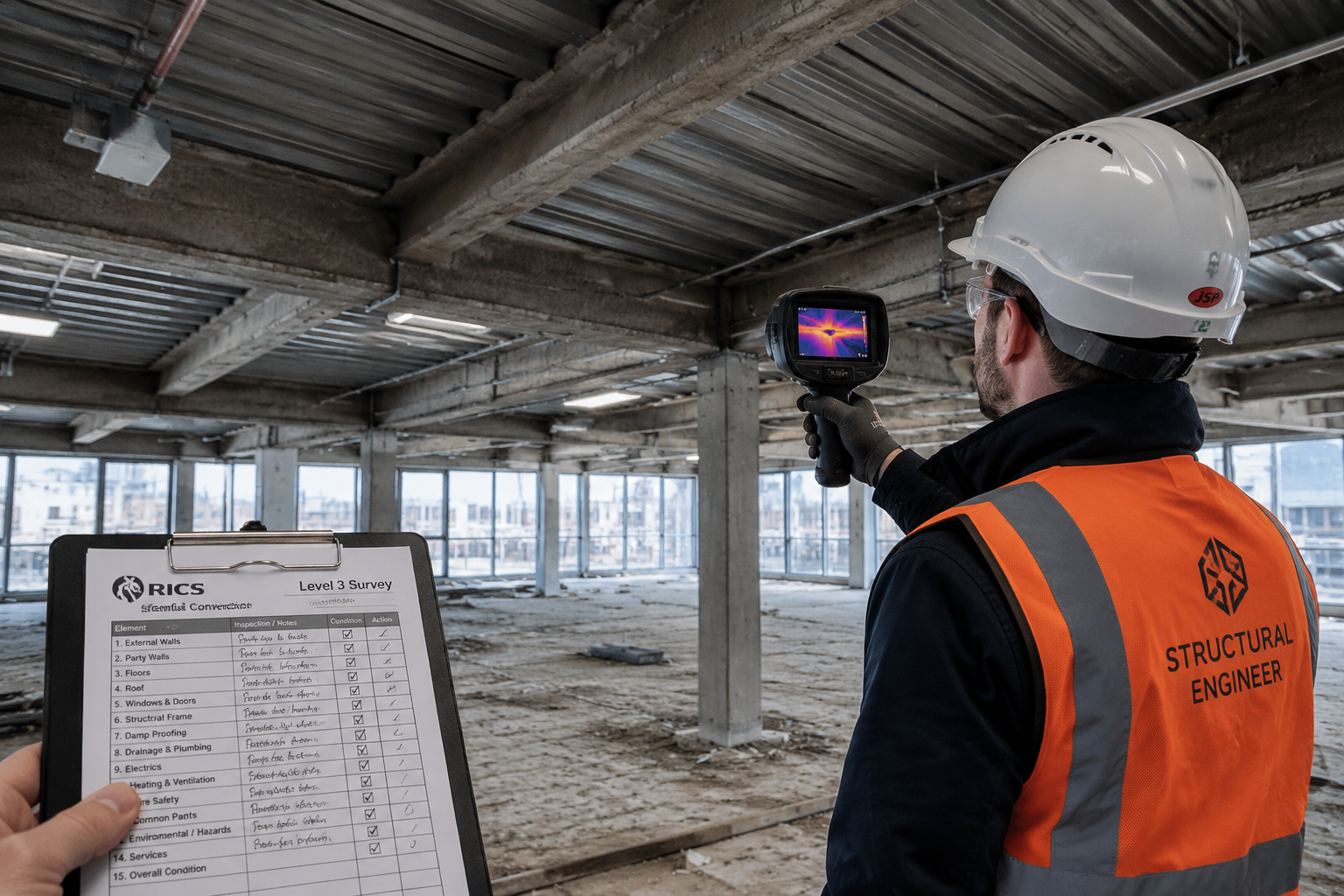
The Royal Institution of Chartered Surveyors recommends a Level 3 Building Survey — the most comprehensive residential survey type — as the minimum appropriate standard for office-to-residential conversion projects [1]. For larger or more complex buildings, a bespoke structural engineer's report should accompany the Level 3 survey rather than replace it.
A properly scoped full structural inspection for a conversion project will typically address the following areas in sequence:
1. Structural Frame and Foundation Assessment
The starting point is always the primary load-bearing structure. Office buildings constructed before 1985 frequently used flat-slab concrete frames, post-tensioned slabs, or steel portal frames — all of which carry specific conversion risks.
- Flat-slab punching shear: Residential layouts introduce new point loads from partition walls and bathroom pods that were not part of the original structural design. Punching shear failure at column heads is a documented risk.
- Post-tensioned slabs: Cutting into these for new service penetrations without specialist advice can release stored tension and cause catastrophic slab failure.
- Foundation adequacy: Residential use typically increases dead load compared with open-plan office use. Ground-bearing capacity must be re-verified against the proposed residential loading.
Surveyors should request original structural drawings where available and commission a targeted ground investigation if the building's foundation type is unknown or if the site has a history of made ground.
2. Floor Plate Depth and Natural Light Feasibility
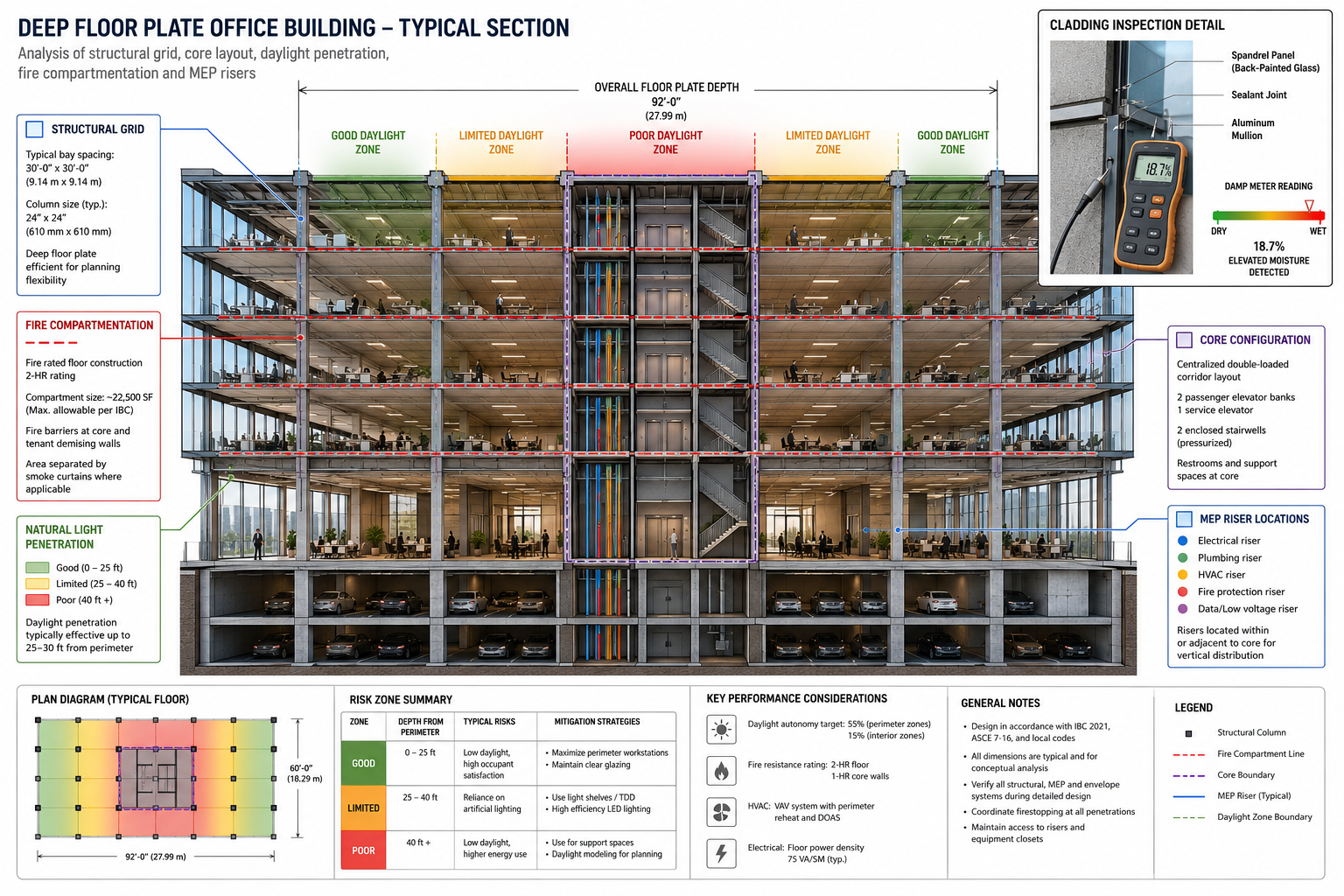
One of the most frequently underestimated structural and spatial risks in office-to-resi conversion is floor plate depth. Buildings with deep floor plates — typically 80 to 100 feet from window to core — pose significant challenges for residential conversions due to insufficient natural light and ventilation [3]. Habitable rooms require a minimum daylight factor under Building Regulations, and this cannot be engineered away without major structural intervention such as light wells or atria.
A building survey protocol must include a daylight and sunlight pre-assessment at the survey stage, not after planning is secured. Discovering that 40% of proposed units fail the BRE daylight standard after prior approval has been granted is an expensive lesson.
3. Cladding and External Envelope Inspection
Post-Grenfell legislation has placed cladding inspection at the centre of any high-rise conversion assessment, but the risk extends well beyond buildings over 18 metres. Legacy office cladding systems — including rain-screen aluminium composite panels, early EIFS (External Insulation and Finish Systems), and single-skin curtain walling — present multiple overlapping risks:
- Fire spread: Combustible insulation behind metal panels may not be visible without intrusive investigation.
- Thermal performance: Original cladding rarely meets current Part L energy efficiency requirements for residential use.
- Damp ingress: Failed sealant joints and inadequate cavity drainage in curtain walling systems are a primary source of interstitial condensation and mould growth — a direct Awaab's Law compliance risk [5].
Surveyors should carry out intrusive cladding inspections at representative locations, not rely solely on visual observation from ground level or cherry picker. A damp survey and detailed report should be commissioned wherever moisture readings at the envelope exceed baseline thresholds.
4. MEP Systems: The Hidden Budget Killer
Upgrading mechanical, electrical, and plumbing systems is often the largest single cost in a conversion project, sometimes comprising up to one-third of the total budget [4]. Office buildings are designed for centralised HVAC, large electrical distribution boards serving open-plan floors, and minimal domestic hot water provision. Residential use requires the opposite: individual unit heating controls, separate metered supplies, and hot water systems scaled to domestic demand patterns.
The building survey protocol must include a specialist MEP condition report, not just a visual inspection by the general building surveyor. Key items to assess include:
| MEP System | Office Standard | Residential Requirement | Typical Remediation |
|---|---|---|---|
| Heating | Central air handling | Individual unit MVHR or wet system | Full replacement |
| Electrical | 3-phase distribution | Single-phase per unit with separate metering | New risers and boards |
| Hot water | Minimal provision | Full domestic hot water per unit | New plant room |
| Drainage | Low-flow commercial | High-flow residential | New stack and lateral runs |
Early identification of MEP deficiencies at the survey stage allows developers to build accurate remediation costs into their acquisition appraisal rather than discovering them during detailed design.
Structural Risks in 2026 Housing Targets: Advanced Defect Detection Methods
Modern building surveyor services for conversion projects increasingly deploy technology that goes well beyond the traditional visual inspection and tap test. Surveyors are now utilising thermal imaging cameras, damp meters, and ground-penetrating radar to detect hidden structural issues [5]. These tools are not optional extras for complex conversion projects — they are standard practice under a rigorous protocol.
Thermal Imaging
Thermal imaging cameras identify temperature differentials across surfaces that indicate moisture ingress, missing insulation, air leakage, and concealed voids. In an office-to-resi context, thermal imaging is particularly valuable for:
- Mapping cold bridges at curtain walling junctions
- Identifying areas of wet insulation within roof build-ups
- Locating hidden water ingress paths behind dry-lined walls
Ground-Penetrating Radar (GPR)
GPR is used to map reinforcement layouts in concrete slabs without destructive investigation. This is essential before any core drilling for new service penetrations and before structural engineers confirm slab capacity for new residential loading. In post-tensioned slabs, GPR can locate tendon positions and avoid the catastrophic consequences of accidental tendon cutting.
Damp Meters and Borescope Inspection
Calibrated damp meters provide quantitative moisture readings at wall and floor surfaces. Where readings are elevated, borescope cameras allow surveyors to inspect concealed cavities — including wall ties, cavity insulation condition, and the presence of debris bridging — without opening up the structure.
These advanced methods align directly with the requirements of Awaab's Law, which places a legal duty on landlords and building owners to address damp and mould hazards within defined timescales [5]. For conversion projects that will result in social or affordable housing, demonstrating that a comprehensive pre-conversion damp assessment was carried out is increasingly a condition of grant funding.
Fire Safety, Core Configuration, and Regulatory Compliance
Fire Compartmentation
Building Regulations Approved Document B mandates stringent fire safety measures for residential conversions, including 60-minute fire resistance between dwellings and proper sealing around all service penetrations [6]. In office buildings, floor-to-floor fire compartmentation is often absent or inadequate for residential standards. The building survey must map existing compartmentation and identify every location where new fire stopping will be required.
This is not a minor finishing item. In a multi-storey office conversion, fire stopping remediation can involve hundreds of individual penetrations through structural floors and walls. Each one requires a tested, third-party certified system appropriate to the substrate. The cost and programme implications are significant and must be captured at survey stage.
Structural Grid and Core Configuration
Irregular core configurations and structural column placements in office buildings can complicate residential unit layouts, requiring detailed structural reviews to ensure feasibility [3]. A standard 9-metre office structural grid does not divide neatly into residential units of 45-65 square metres without either accepting awkward room shapes or relocating structural elements — neither of which is cheap.
The building survey protocol should include a preliminary unit layout study overlaid on the confirmed structural grid. This exercise, carried out before acquisition, frequently reveals that a building's theoretical residential capacity — as stated in a planning consultant's appraisal — is materially lower than the structural reality allows.
Party Wall Considerations
Where conversion works affect shared walls with adjoining properties, the Party Wall etc. Act 1996 applies regardless of PDR status. Developers should engage a qualified party wall surveyor early in the process to serve notices and manage neighbour obligations. Failure to comply with the Act can result in injunctions that halt construction entirely. For more detail on obligations and procedures, the Party Wall Act 1996 guide provides a thorough overview of the legal framework.
Building Survey Protocols for Office-to-Resi PDR Expansions: Structural Risks in 2026 Housing Targets — Compliance and Cost Control
Structural Observation Programs
Some jurisdictions are moving toward mandatory Structural Observation Programs (SOPs) that require qualified engineers to observe key structural elements during construction and verify compliance with approved plans and seismic or loading design requirements [2]. While SOPs are not yet universally mandated in England, they represent best practice for complex conversion projects and are increasingly required by funders and insurers.
An SOP framework for an office-to-resi conversion would typically include:
- Pre-construction verification of existing structural conditions against survey findings
- Staged inspections at foundation exposure, frame modification, and slab penetration stages
- Sign-off by the structural engineer of record before concealment of any modified structural element
- Final structural completion certificate confirming compliance with the approved structural design
Updated Building Codes and Compliance Obligations
Recent updates to building codes have introduced more stringent requirements for residential conversions, particularly concerning structural integrity and safety standards [7]. In England, this includes compliance with the Building Safety Act 2022 framework as it applies to higher-risk buildings, updated Approved Documents covering structure (Part A), fire safety (Part B), and energy efficiency (Part L), and the emerging requirements of the Future Homes Standard.
Surveyors and developers working under PDR must not assume that prior approval insulates a project from Building Regulations compliance. Prior approval addresses planning matters only. Full plans Building Regulations approval — or an initial notice through an Approved Inspector — remains mandatory for all conversion works.
Using Survey Findings to Negotiate Acquisition Price
A comprehensive Level 3 building survey does more than identify risk — it creates a quantified evidence base for price negotiation. Structural defects, MEP replacement requirements, cladding remediation costs, and fire stopping programmes can all be costed and presented to a vendor as grounds for a price reduction. Using an RICS survey to negotiate property price is a well-established practice in residential transactions, and the same principle applies with even greater force in commercial-to-residential conversions where defect costs are typically much larger.
For London-based projects, working with experienced London building inspections professionals who understand both the commercial and residential regulatory environments is particularly valuable given the complexity of the capital's building stock and planning context.
Conclusion
The 2026 push toward office-to-residential conversion under expanded PDR is a genuine opportunity to address the housing shortage — but only if the structural risks are identified and priced correctly before commitment is made. The evidence is consistent: hidden defects in older office buildings add 15-30% to projected conversion costs [1], MEP replacement can consume a third of the total budget [4], and deep floor plates or irregular column grids can reduce viable unit counts well below planning appraisal assumptions [3].
Actionable next steps for developers, investors, and surveyors in 2026:
- Commission a RICS Level 3 Building Survey and a concurrent specialist structural engineer's report before any acquisition of an office building for residential conversion.
- Include thermal imaging, GPR, and calibrated damp metering as standard elements of the survey scope — not optional add-ons.
- Carry out a preliminary unit layout study overlaid on the confirmed structural grid before finalising the acquisition appraisal.
- Engage a party wall surveyor and fire safety consultant at the survey stage, not after planning is secured.
- Use survey findings to negotiate the acquisition price and build a contingency fund of at least 15% for structural and MEP remediation.
- Implement a Structural Observation Program during construction to verify compliance and protect against future liability.
The buildings are there. The demand is real. The survey protocols exist. The only variable is whether development teams choose to apply them rigorously — or discover their necessity at a much higher cost later in the programme.
References
[1] Building Survey Protocols For Office To Residential Conversions Spotting Risks In 2026 Revivals – https://princesurveyors.co.uk/blog/building-survey-protocols-for-office-to-residential-conversions-spotting-risks-in-2026-revivals/
[2] Structural Observation Program – https://www.slc.gov/buildingservices/2026/04/22/structural-observation-program/
[3] Conversion – https://offmarketx.ai/intelligence/guide/conversion
[4] Underutilized Offices To Homes The Rise Of Office To Residential Conversions – https://www.sterlingassetgroup.com/insights/underutilized-offices-to-homes-the-rise-of-office-to-residential-conversions
[5] Building Survey Protocols For Structural Collapse Risks Awaabs Law 2026 Extensions And High Risk Property Assessments – https://nottinghillsurveyors.com/blog/building-survey-protocols-for-structural-collapse-risks-awaabs-law-2026-extensions-and-high-risk-property-assessments
[6] Office To Residential Conversion Building Surveys Structural Due Diligence In 2026s Permitted Development Surge – https://princesurveyors.co.uk/blog/office-to-residential-conversion-building-surveys-structural-due-diligence-in-2026s-permitted-development-surge/
[7] How Building Code Shapes Pathways And Experience In High Rise Office To Residential Conversion – https://aiaphiladelphia.org/news/committee-news/1628/1628-How-Building-Code-Shapes-Pathways-and-Experience-in-High-Rise-Office-to-Residential-Conversion