
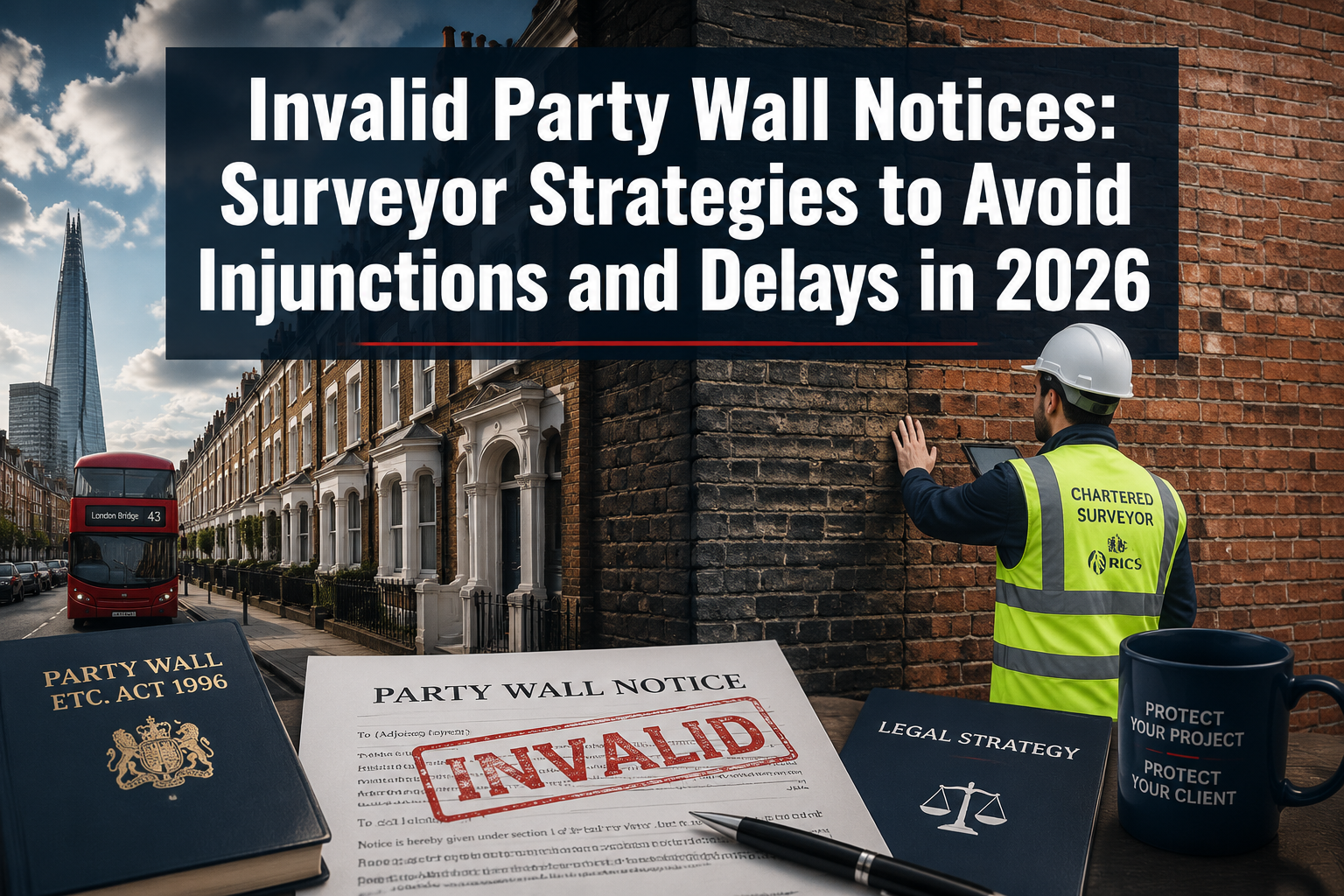
Nearly 40% of party wall disputes in 2026 trace back to errors made at the very first stage of the process — the notice itself [1]. For building owners planning extensions, loft conversions, or basement excavations, a defective notice is not a minor administrative hiccup. It can trigger injunctions, restart statutory timelines, and add months of costly delay to a project. This guide on Invalid Party Wall Notices: Surveyor Strategies to Avoid Injunctions and Delays in 2026 examines the legal requirements for notice drafting and service, the most common failure points, and the proactive strategies that experienced surveyors use to keep projects on track — particularly during busy construction seasons when errors multiply under pressure.
Key Takeaways
- Nearly 40% of party wall disputes begin with errors at the notice stage, making correct drafting the single most important risk-control step.
- Improper service methods — such as email-only delivery or serving tenants instead of freeholders — account for around 30% of notice failures.
- Vague work descriptions, wrong notice types, and missing statutory information are the three most common drafting errors that invalidate notices.
- Silence from an adjoining owner after 14 days is deemed dissent, not consent — a misunderstanding that regularly derails project timelines.
- Engaging a qualified party wall surveyor early, ideally 8 to 12 weeks before work begins, is the most reliable way to avoid injunctions and delays.
The Legal Framework: What Makes a Party Wall Notice Valid
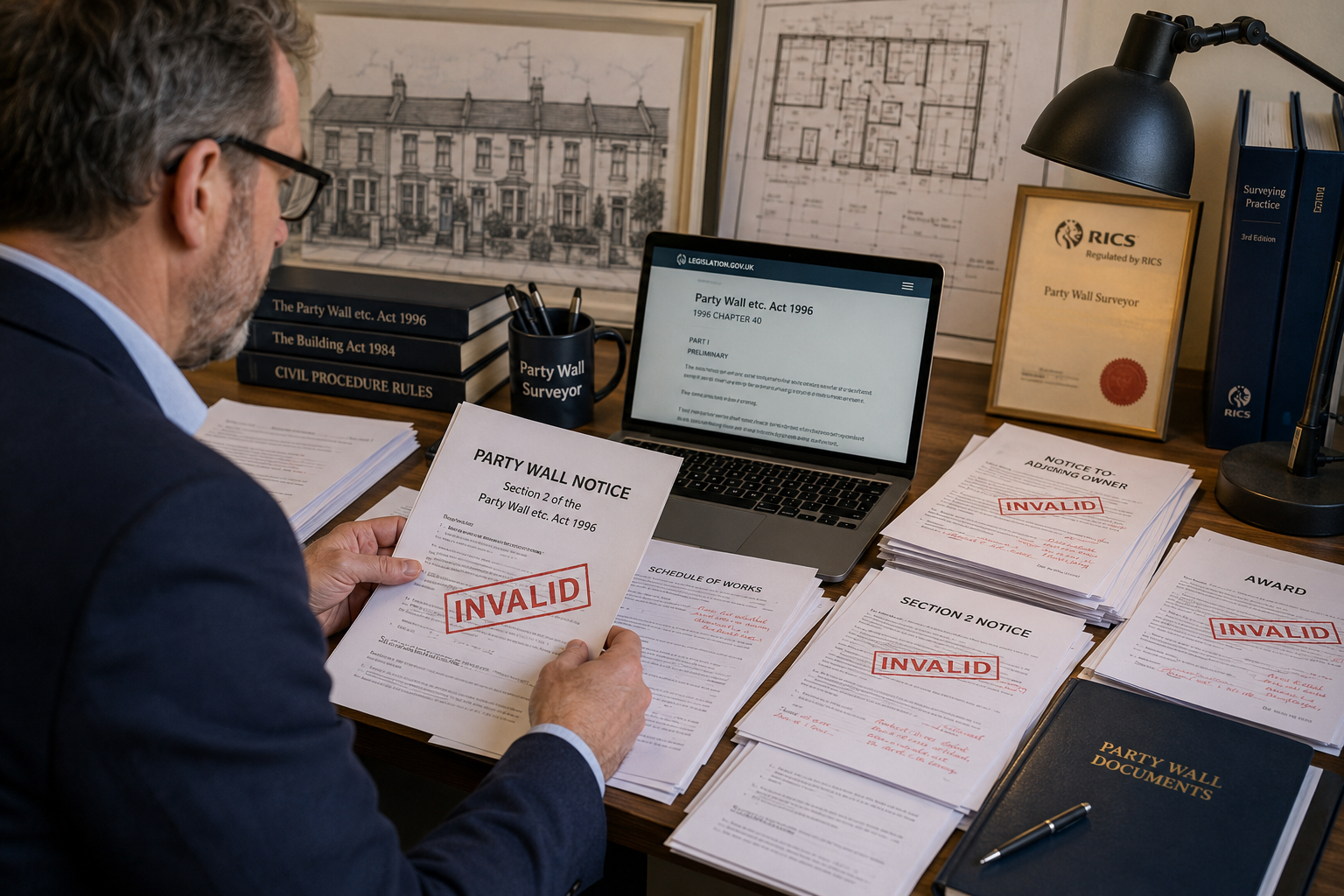
The Party Wall etc. Act 1996 sets out a clear framework for how notices must be drafted, served, and responded to. A valid notice is the foundation of the entire process. Without it, any subsequent award or agreement may be legally unenforceable, and the building owner risks court intervention.
Statutory Information That Must Be Included
A party wall notice must contain specific information to be legally effective. Omitting any of the following can render it invalid [4]:
- Full legal names of the building owner and all adjoining owners
- Full postal addresses of both properties
- A clear and detailed description of the proposed works
- The proposed start date of the works
- The type of notice being served (Party Structure Notice, Line of Junction Notice, or Three Metre/Six Metre Notice)
- A statement of rights under the Act
Surveyors should treat each item on this list as a mandatory checklist, not a suggestion. Even a small error — such as using a trading name instead of a legal name, or listing an approximate rather than a confirmed start date — can provide grounds for an adjoining owner or their surveyor to challenge the notice's validity [8].
The Three Notice Types and When to Use Each
Serving the wrong type of notice is a surprisingly common error. Confusing a Party Structure Notice with a Line of Junction Notice, for example, can invalidate the entire process and force the building owner to restart [2].
| Notice Type | When It Applies | Statutory Notice Period |
|---|---|---|
| Party Structure Notice | Works to an existing party wall or floor | 2 months |
| Line of Junction Notice | Building a new wall at or astride the boundary | 1 month |
| Three/Six Metre Notice | Excavation near adjoining foundations | 1 month |
Surveyors must assess the nature of the proposed works carefully before selecting the notice type. A loft conversion that involves cutting into a shared wall requires a Party Structure Notice. A new garden wall built on the boundary line requires a Line of Junction Notice. Getting this wrong at the outset wastes weeks and damages the working relationship with the adjoining owner.
For a broader understanding of when these obligations arise, the guide on when you need a party wall agreement provides a useful starting point for building owners.
The Most Common Errors That Invalidate Notices in 2026
Understanding where notices fail is the first step toward preventing those failures. In 2026, with construction activity at high levels across London and the South East, the volume of notices being served has increased — and so has the rate of errors.
Improper Service Methods
Approximately 30% of party wall notice failures are caused by improper service methods [1]. The Act requires notices to be served in one of three ways:
- Delivered in person to the adjoining owner
- Sent by post to the adjoining owner's usual or last known residence
- Fixed to a conspicuous part of the premises (only if the owner cannot be found)
Email-only delivery is not a valid method of service under the Act unless the adjoining owner has explicitly agreed to receive notices electronically in writing. Surveyors who rely on email without postal confirmation risk having the notice challenged and declared invalid. Similarly, serving a notice to a tenant rather than the freeholder is a frequent mistake — the Act requires notices to be addressed to all legal owners, including freeholders and leaseholders where applicable [5].
Vague or Incomplete Work Descriptions
Over 25% of cases where adjoining owners object to proposed works involve notices with vague or incomplete descriptions [1]. A notice that simply states "rear extension works" without specifying dimensions, structural methods, materials, or the depth of any excavation gives the adjoining owner and their surveyor very little to assess. This ambiguity is a legitimate ground for dissent and can trigger the appointment of surveyors, adding cost and time to the process.
A well-drafted notice should include:
- Dimensions of the proposed structure (height, width, depth)
- Details of any underpinning or excavation
- Materials to be used for any new wall
- Whether any existing party wall will be cut into or raised
- Proposed working hours and site access requirements
Incorrect Timing
Serving a notice too close to the intended start date is one of the most avoidable errors. The statutory notice periods — two months for a Party Structure Notice and one month for Line of Junction and excavation notices — do not include time for the adjoining owner to respond, appoint a surveyor, or for a party wall award to be agreed [3]. Surveyors recommend planning 8 to 12 weeks ahead of the intended start date to absorb these stages without disrupting the construction programme [2].
During busy construction seasons — typically spring and autumn — surveyors' diaries fill quickly. A notice served in February for an April start date may technically comply with the two-month period, but it leaves no room for dissent, surveyor appointment, or award preparation. Projects that cut timing this fine regularly experience delays.
Assuming Silence Equals Consent
This is a misunderstanding that causes significant problems. If an adjoining owner does not respond to a party wall notice within 14 days, the Act deems this a dissent, not consent [6]. The building owner must then appoint a party wall surveyor, and the adjoining owner may also appoint their own. This process takes additional time and incurs fees that the building owner is typically responsible for.
Building owners who proceed with works assuming that silence means approval are exposing themselves to injunction risk. An adjoining owner who discovers works have begun without a valid award in place can apply to the court for an injunction to halt the project — a costly and embarrassing outcome that a properly managed notice process would have prevented entirely.
For guidance on what to do when a notice is received from the other side, the resource on what to do when you receive a party wall notice explains the adjoining owner's rights and obligations clearly.
Surveyor Strategies to Avoid Injunctions and Delays in 2026

Experienced party wall surveyors use a set of proactive strategies to prevent the errors described above. These strategies are particularly important in 2026, when construction activity is high and the margin for error is narrow.
Strategy 1: Conduct a Pre-Notice Audit
Before drafting any notice, a competent surveyor will carry out a pre-notice audit. This involves:
- Verifying legal ownership through Land Registry searches to confirm freeholder and leaseholder identities
- Reviewing planning permission to ensure the proposed works are accurately described in the notice
- Inspecting the boundary to confirm which notice type applies
- Checking for existing party wall agreements that may affect the current project
This audit takes a few days but prevents the far more damaging delays caused by serving an invalid notice. Surveyors working with chartered surveyor credentials will typically include this as a standard part of their service.
Strategy 2: Use Precise, Technical Language in Descriptions
Vague language is the enemy of a valid notice. Surveyors should use the same level of detail in a notice description as would appear in a structural engineer's specification. Where drawings are available, referencing them by drawing number and attaching copies to the notice significantly reduces the risk of challenge.
"A notice that leaves the adjoining owner guessing about the nature or extent of the works is a notice that invites dissent."
If the scope of works changes after the notice is served, a new or supplementary notice may be required. Surveyors should advise building owners of this risk at the outset so that design changes are finalised before the notice is drafted.
Strategy 3: Serve Notices by Recorded Delivery and Keep Evidence
Every notice should be served by first-class recorded delivery post, with the tracking receipt retained as evidence. Where notices are hand-delivered, a witness should be present and a signed delivery note obtained. This evidence becomes critical if the validity of service is ever challenged in court or before a tribunal.
Surveyors should also keep a dated copy of every notice served, along with the envelope and postage label where possible. This file of evidence is the surveyor's first line of defence against any claim that a notice was not properly served [4].
Strategy 4: Prepare a Schedule of Condition Before Works Begin
A schedule of condition is a detailed photographic and written record of the adjoining property's state before any works commence. While not strictly required by the Act, it is strongly recommended by experienced surveyors [3]. Without it, any claim by an adjoining owner that the works caused damage to their property becomes very difficult to defend.
The schedule of condition is typically annexed to the party wall award and provides a baseline against which any alleged damage can be assessed objectively. Skipping this step is a false economy that regularly leads to expensive disputes after the works are complete.
Strategy 5: Engage Early and Communicate Proactively with Adjoining Owners
Many disputes are not really about the law — they are about relationships. Adjoining owners who feel informed and respected are far less likely to dissent or seek legal intervention. Surveyors who contact adjoining owners before serving formal notices, explain the process clearly, and answer questions openly tend to achieve consent more quickly and with less friction.
This approach is particularly effective during busy construction seasons when adjoining owners may already be dealing with noise and disruption from other nearby projects. A brief informal conversation before the formal notice arrives can make the difference between consent and dissent.
For building owners in specific areas of London, local expertise matters. Surveyors covering areas such as Croydon, Camden, and Chiswick will be familiar with the density of party wall situations in those neighbourhoods and can advise on local norms and expectations.
Strategy 6: Do Not Rely on DIY Notices for Complex Projects
While the Act does not legally require a building owner to use a surveyor to serve a notice, the evidence is clear that DIY notices carry a significantly higher risk of error [6]. For straightforward projects with straightforward boundaries and cooperative neighbours, a building owner may manage the process adequately. For anything involving excavation, structural alterations, or difficult neighbour relationships, professional involvement is essential.
The cost of engaging a party wall surveyor at the outset is modest compared to the cost of restarting a notice process, defending an injunction application, or dealing with a post-works damage dispute.
Case Studies: When Invalid Notices Led to Real Consequences
Case Study 1: The Email-Only Notice
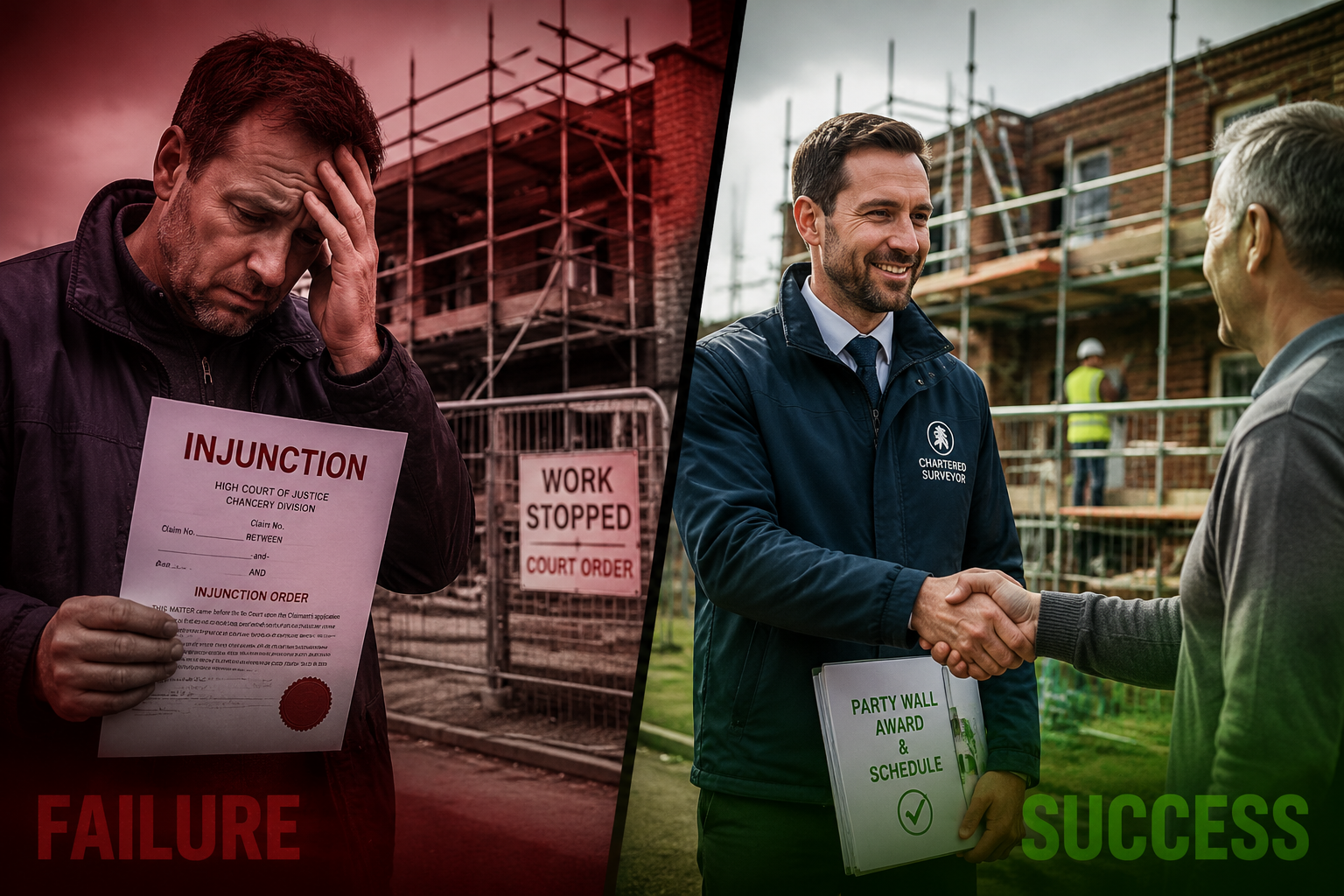
A building owner in South London served a party wall notice by email only, believing that the adjoining owner's acknowledgement of the email constituted valid service. The adjoining owner's solicitor later argued — successfully — that email service was not valid under the Act. The notice was declared invalid, the works were halted by court order, and the building owner had to restart the entire notice process, losing six weeks and incurring significant legal costs [7].
Lesson: Always serve by recorded post. Email acknowledgement is not a substitute for valid statutory service.
Case Study 2: The Vague Description
A loft conversion notice described the works as "structural alterations to the roof and party wall." The adjoining owner's surveyor requested clarification on the extent of the works, which the building owner's team was slow to provide. The dispute escalated, a third surveyor was appointed, and the award took four months to finalise — two months longer than it should have taken. The project's contractor had already mobilised and had to stand down, resulting in a significant variation charge [1].
Lesson: Invest time in a precise, detailed work description before the notice is served. Ambiguity costs money.
Case Study 3: The Missed Freeholder
A building owner served a notice on the occupying tenant of the adjoining property, not realising the property was leasehold. The freeholder, who lived abroad, was never notified. Works commenced, and the freeholder — alerted by the tenant — applied for an injunction. The court granted it, and the building owner faced both legal costs and the cost of making the site safe during the halt [5].
Lesson: Always verify ownership through Land Registry before serving any notice. Tenants are not the correct recipients unless they also hold a relevant interest.
Building a Compliance Checklist for 2026 Projects
Surveyors advising building owners in 2026 should work from a structured compliance checklist. The following framework covers the key risk points:
Before Drafting the Notice
- Confirm legal ownership of all adjoining properties via Land Registry
- Identify all relevant notice types for the proposed works
- Finalise the scope of works with the design team
- Set a realistic start date that allows for full statutory periods plus dispute resolution time
When Drafting the Notice
- Include all statutory information (names, addresses, description, start date, rights statement)
- Use precise, technical language for the work description
- Reference and attach any relevant drawings
- Select the correct notice type for each element of the works
When Serving the Notice
- Serve by recorded first-class post or personal delivery with a witness
- Retain all proof of postage and delivery
- Diarise the 14-day response window from the date of service
- Do not assume silence is consent — follow up if no response is received
After Service
- Prepare a schedule of condition of the adjoining property before works begin
- Ensure any party wall award is agreed and signed before work commences
- Keep all documentation on file throughout the construction period
For building owners and surveyors dealing with boundary disputes or property rights questions that intersect with party wall matters, specialist advice from a qualified surveyor is strongly recommended before any notice is served.
Conclusion
Invalid Party Wall Notices: Surveyor Strategies to Avoid Injunctions and Delays in 2026 is not an abstract legal topic — it is a practical challenge that affects real projects, real budgets, and real relationships between neighbours. The data is clear: the majority of party wall problems are preventable, and they are prevented by getting the notice right the first time.
The strategies outlined in this article — pre-notice audits, precise drafting, correct service methods, proactive communication, and early professional engagement — are not complex. They require discipline, knowledge of the Act, and a commitment to thoroughness. Surveyors who apply these strategies consistently will protect their clients from injunctions, avoid costly delays, and build a reputation for reliable, professional service.
Actionable next steps for building owners and surveyors in 2026:
- Start the party wall process at least 8 to 12 weeks before the planned construction start date.
- Verify legal ownership of all adjoining properties before drafting any notice.
- Engage a qualified party wall surveyor for any project involving shared walls, boundaries, or excavation.
- Never rely on email alone for notice service — always use recorded post and retain proof.
- Commission a schedule of condition before any works begin, regardless of whether the adjoining owner has consented.
For projects across London and the surrounding areas, working with an experienced local surveyor is the most reliable way to navigate the party wall process without disruption. Get a quote from a qualified surveyor to begin the process with confidence.
References
[1] Common Mistakes In Party Wall Notices How Surveyors Fix Dissent And Delays – https://partywallsurveyorlondon.uk/blogs/common-mistakes-in-party-wall-notices-how-surveyors-fix-dissent-and-delays/?utm_source=openai
[2] Party Wall Notices In Practice The Most Common Drafting Errors That Trigger Delay Or Invalidity – https://kingstonsurveyors.com/party-wall-notices-in-practice-the-most-common-drafting-errors-that-trigger-delay-or-invalidity/?utm_source=openai
[3] Party Wall Notices – https://plansmadeeasy.org/party-wall-notices/?utm_source=openai
[4] Invalid Party Wall Notice Guidance – https://www.simplesurvey.co.uk/article/invalid-party-wall-notice-guidance/?utm_source=openai
[5] Can I Do A Party Wall Agreement Myself Or Need A Surveyor – https://legalclarity.org/can-i-do-a-party-wall-agreement-myself-or-need-a-surveyor/?utm_source=openai
[6] Party Wall Notice – https://iconsurveyors.co.uk/blog/party-wall-notice/?utm_source=openai
[7] Last Minute Party Wall Awards Risks Delays And How Surveyors Can Rescue A Project – https://partywallsurveyorlondon.uk/blogs/last-minute-party-wall-awards-risks-delays-and-how-surveyors-can-rescue-a-project/?utm_source=openai
[8] What Makes A Party Wall Notice Valid – https://www.houricanassociates.com/party-wall-news/what-makes-a-party-wall-notice-valid/?utm_source=openai