


Yorkshire and the Humber recorded the highest annual house price rise in England at 3.9% in early 2026, while London simultaneously posted a 3.3% annual decline — a divergence that signals a structural repositioning of value across the country [3]. For surveyors, investors, and buyers focused on the flat market, this regional split is not background noise. It is the central fact shaping every valuation decision in 2026.
Valuing Flats in Northern England's 2026 Recovery: Surveyor Tools for Price Surge Opportunities is now a discipline that demands both regional data literacy and command of emerging technology. The old approach — relying primarily on comparable sales and manual inspections — is being supplemented, and in some cases replaced, by AI-powered models, GeoConnect pre-valuation tools, and retrieval-enhanced appraisal methods. Getting the combination right is what separates a precise valuation from a costly misjudgement.

Key Takeaways
- Northern England, particularly Yorkshire, the Humber, and the North East, is outperforming the wider UK housing market in 2026, making flat valuations in these areas especially time-sensitive.
- RICS net balance data confirms that Northern England and Scotland continue to lead UK regional market performance, providing surveyors with a reliable benchmark for pricing confidence.
- AI-powered Automated Valuation Models (AVMs) are achieving accuracy rates of 95-97%, while GeoConnect tools can complete pre-valuation insights in under 60 seconds.
- Affordability factors and leasehold stock repositioning are creating specific valuation challenges for flats that differ from houses in the same postcode.
- Selecting the right combination of surveyor tools — and understanding their limitations — is critical to identifying genuine price surge opportunities rather than short-term anomalies.
Why Northern England's Flat Market Demands Specialist Valuation Attention in 2026
The RICS UK Residential Survey for April 2026 confirmed that Northern England, alongside Scotland and Northern Ireland, continues to outperform other UK regions in housing market resilience [1]. This is not a temporary blip. It reflects underlying affordability advantages, population migration from southern cities, and sustained regeneration investment in cities like Manchester, Leeds, Sheffield, and Newcastle.
For flats specifically, the picture is more nuanced than headline house price data suggests. Several factors are reshaping how surveyors must approach valuations in this segment:
Affordability repositioning: As average property values in England stood at £290,000 in March 2026 [2], Northern England flats remain significantly below this benchmark, attracting first-time buyers and buy-to-let investors priced out of southern markets. This demand pressure is pushing prices upward in city-centre flat stock.
Leasehold complexity: Many Northern England flats are leasehold properties with varying lease lengths, ground rent structures, and service charge histories. These factors can dramatically affect market value in ways that standard comparables do not capture. Understanding what to check before buying a leasehold property is essential context for any flat valuation in this market.
Stock repositioning: Older converted flats in mill buildings and Victorian terraces are being repositioned against new-build developments. The valuation gap between these categories is widening, requiring surveyors to apply more granular comparable analysis.
Rental yield pressure: Strong rental demand in Northern cities is inflating investment-driven purchase prices, sometimes ahead of what comparable sales data alone would support. Surveyors must account for yield-driven buyer behaviour when assessing market value.
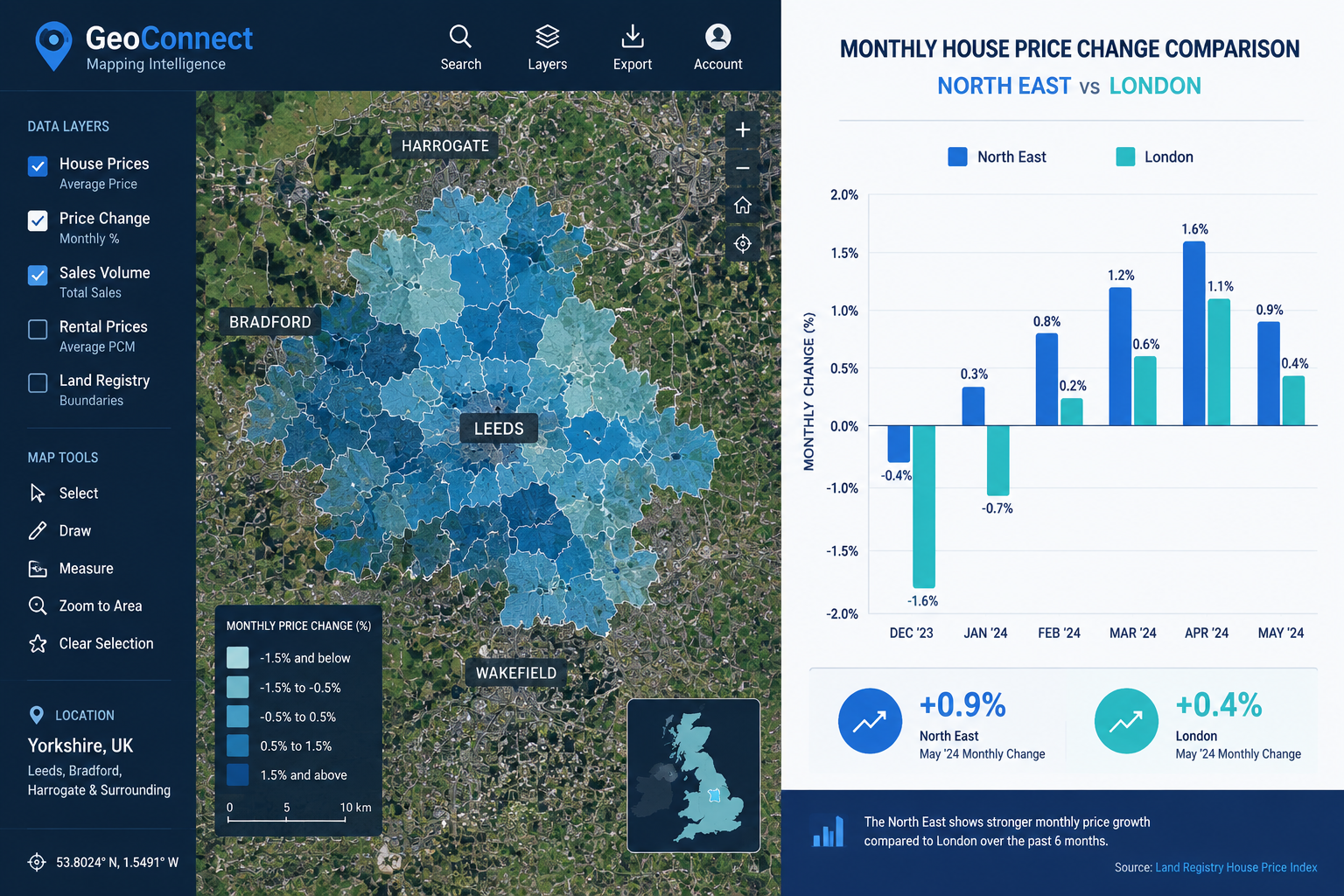
"The North East experienced a significant monthly increase of 2.7% in February 2026, while London saw a monthly price fall of 1.9% in the same period." [3]
This divergence underscores why a London-calibrated valuation framework cannot simply be transposed onto Northern England flat stock.
RICS Net Balances as a Valuation Anchor for Northern Upturns
The RICS net balance metric — which measures the difference between the percentage of surveyors reporting price rises and those reporting falls — is one of the most reliable leading indicators available for regional market direction. In 2026, Northern England net balances have remained positive, providing surveyors with a data-backed foundation for pricing confidence in flat valuations [1].
Using RICS net balances effectively means understanding what they do and do not tell you:
| RICS Net Balance Signal | What It Indicates for Flat Valuations |
|---|---|
| Strongly positive (above +30) | Upward price momentum; comparables may understate current market value |
| Mildly positive (+10 to +30) | Stable growth; comparables remain reliable with modest upward adjustment |
| Neutral (-10 to +10) | Flat market; comparables are a strong guide with minimal adjustment needed |
| Negative (below -10) | Downward pressure; comparables may overstate current market value |
When RICS data signals strong positive net balances in a specific Northern region, surveyors valuing flats should treat recent comparable sales with a time-adjusted lens. A comparable sale from six months prior in a rising market will understate current value. Applying a time adjustment factor — derived from the rate of price change indicated by RICS and Land Registry data — is a professional standard that becomes especially important during upturn phases.
Forward-looking RICS indicators also matter. The April 2026 survey noted that subdued conditions are likely to persist in some UK regions due to higher mortgage rates and geopolitical uncertainty [1]. However, Northern England's relative affordability provides a buffer. Surveyors should weight this regional resilience when assessing whether a price surge is sustainable or speculative.
Practical application for flat valuations:
- Cross-reference RICS regional net balances with Land Registry monthly data for the specific postcode district
- Apply time adjustments to comparables older than three months in active upturn markets
- Document the net balance data used in the valuation report to demonstrate market-awareness reasoning
- Distinguish between city-centre flat submarkets (higher demand, stronger net balances) and peripheral stock (more variable)
For surveyors seeking to understand how an RICS survey can help negotiate property prices, the net balance framework provides the evidential backbone for those negotiations.
Surveyor Tools for Price Surge Opportunities: AI, GeoConnect, and Beyond
Valuing Flats in Northern England's 2026 Recovery: Surveyor Tools for Price Surge Opportunities requires a working knowledge of the technology now available to the profession. Three categories of tools are reshaping flat valuations in 2026.
AI-Powered Automated Valuation Models
AI-powered Automated Valuation Models (AVMs) are now capable of analysing thousands of data points simultaneously — including satellite imagery, neighbourhood trend data, planning application histories, and transport connectivity scores. The best-performing tools in 2026 are achieving accuracy rates of 95-97% [4].
However, a comparative study of 15 AI property valuation tools found that only six met the accuracy and reliability standards required by professionals [8]. This means tool selection is not a trivial decision. Surveyors should evaluate AVMs against the following criteria:
- Training data relevance: Has the model been trained on Northern England flat data specifically, or on national averages that may be skewed by London and the South East?
- Update frequency: Does the model refresh with new comparable sales data monthly or quarterly?
- Transparency of methodology: Can the surveyor interrogate the model's comparable selection and weighting logic?
- Leasehold adjustment capability: Does the tool account for lease length, ground rent, and service charge variables that are critical for flat valuations?
AVMs work best as a starting point and cross-check rather than a final answer. A surveyor who uses an AVM output without physical inspection and professional judgement is not fulfilling their duty of care.
GeoConnect Pre-Valuation Tools
GeoConnect tools represent a significant step forward in pre-valuation intelligence. These platforms provide technology-enhanced property insights before the surveyor sets foot on site, enabling valuations to be completed in under 60 seconds with 94% accuracy [5]. For Northern England flat markets moving quickly, this speed advantage is commercially and professionally significant.
GeoConnect tools typically provide:
- Flood risk and environmental data layered onto specific addresses
- Planning history including any permitted development or change-of-use applications nearby
- Comparable transaction mapping showing recent flat sales within a defined radius
- Infrastructure and transport scoring relevant to rental demand and capital value
The pre-valuation insight generated by GeoConnect tools allows surveyors to arrive at inspections with a calibrated price hypothesis, which they then test against physical condition, leasehold terms, and local market intelligence. This is particularly valuable in Northern England cities where regeneration activity can mean one street has a very different value trajectory from the next.
Retrieval-Enhanced Appraisal Methods
Recent research has highlighted the effectiveness of retrieval-enhanced real estate appraisal methods, which improve the selection of comparable properties through machine learning [9]. Traditional comparable selection relies on the surveyor's knowledge and database access. Retrieval-enhanced methods use algorithms to identify the most statistically relevant comparables from a much larger dataset, reducing the risk of cherry-picking or missing a key sale.
For flat valuations in Northern England, where the comparable pool can be thin in some postcodes, this approach can significantly improve valuation confidence. The algorithm can weight comparables by floor level, aspect, lease length, and building type — variables that matter enormously for flats but are often inadequately captured in manual comparable selection.
CAD and Precision Measurement Tools
For surveyors conducting full building surveys on flat developments, precision measurement tools remain foundational. Platforms such as Carlson Survey IntelliCAD 2026 offer advanced coordinate geometry, surface modelling, and field data import capabilities that enhance the accuracy of structural assessments [6]. While these tools are more relevant to development appraisals and structural surveys than standard residential valuations, they are increasingly part of the toolkit for surveyors assessing converted buildings and mixed-use flat developments common in Northern England's regeneration zones.
Understanding the key differences between Level 2 and Level 3 surveys is important context here — the appropriate survey level determines which tools are deployed and what depth of analysis is required.
Addressing Affordability and Stock Repositioning in Flat Valuations

Affordability is the engine driving Northern England's flat market recovery in 2026. But affordability is also a valuation variable that many surveyors underweight. When a market is attracting buyers specifically because of relative affordability, the ceiling price is not set by what comparable sales show — it is set by what buyers can afford to pay and what competing markets are charging.
Key affordability metrics surveyors should incorporate:
- Local income-to-price ratios for the specific city or district
- Mortgage affordability thresholds at current interest rates
- Rental yield benchmarks, which set a floor for investor-driven demand
- Comparison with equivalent flat stock in competing cities (e.g., Manchester vs Leeds vs Sheffield)
Stock repositioning adds another layer. In cities like Manchester and Leeds, the flat market is segmenting rapidly between:
- New-build city-centre flats — high specification, strong rental demand, premium pricing
- Converted heritage buildings — mill conversions, warehouse apartments — commanding lifestyle premiums
- Older purpose-built blocks — subject to cladding remediation issues, EPC upgrade requirements, and variable service charge histories
- Suburban flat stock — lower price points, different demand drivers, often leasehold with longer lease terms
Each of these categories requires a different valuation approach. A surveyor applying the same methodology across all four categories will produce unreliable outputs. The structural survey importance of understanding building type and construction quality is particularly acute for older Northern England flat stock, where post-Grenfell cladding assessments and EWS1 certificates can be the difference between a mortgageable and an unmortgageable asset.
Lease length and informal extensions are another critical variable. Flats with fewer than 80 years remaining on the lease face a marriage value penalty that can reduce market value by 10-20% or more. Surveyors must factor this into valuations and flag it clearly. For buyers considering lease extension options, understanding the advantages and disadvantages of informal lease extensions is directly relevant to the valuation outcome.
Damp and timber issues in older Northern England flat stock also require specific attention. Many converted buildings in the region have inherent moisture management challenges. A valuation that does not account for the cost of remedying damp and timber problems will overstate market value. Surveyors should be familiar with damp and timber report pricing and what to expect to provide clients with complete cost-of-ownership context.
Building a Robust Valuation Report for Northern England Flats
A valuation report for a flat in Northern England's 2026 recovery market should demonstrate several elements that go beyond a standard comparable analysis:
1. Regional market context section
Reference RICS net balance data and Land Registry monthly indices for the specific region. State clearly whether the market is in an upturn phase and what time adjustment, if any, has been applied to comparables.
2. Tool-assisted comparable analysis
Document which AVM or GeoConnect tool was used in the pre-valuation stage, what output it produced, and how the surveyor's professional judgement modified or confirmed that output.
3. Leasehold schedule
For any leasehold flat, include a summary of lease length, ground rent terms, service charge history, and any known major works planned. State the impact of these factors on market value explicitly.
4. Condition and defect summary
Reference any structural, damp, or cladding issues identified during inspection. Provide a cost range for remediation where possible, and state the impact on market value.
5. Market outlook commentary
Reference forward-looking RICS indicators and local regeneration plans. Note any factors that could accelerate or constrain price growth in the subject property's submarket.
Surveyors who want to understand which home survey is right for a specific property can use that framework to determine the appropriate level of investigation before producing a valuation report.
AI integration is also transforming how valuation reports are structured and delivered. AI tools are now providing instant property valuations, virtual tours, and predictive analytics that can be embedded directly into client-facing reports [7]. This is raising client expectations — buyers and investors in Northern England's active flat market increasingly expect data-rich, visually clear reports that justify the valuation figure with evidence rather than assertion.
Conclusion: Actionable Steps for Surveyors in Northern England's Flat Market
The convergence of regional outperformance, technology advancement, and structural market repositioning makes 2026 a pivotal year for flat valuations in Northern England. Surveyors who adapt their toolkit and methodology to this environment will deliver more accurate valuations and identify genuine price surge opportunities. Those who rely on legacy approaches risk producing figures that are either too conservative to reflect real market momentum or too optimistic to withstand scrutiny.
Actionable next steps for surveyors:
- Integrate RICS net balance data into every Northern England flat valuation as a formal market context reference, applying time adjustments to comparables in confirmed upturn markets.
- Evaluate and adopt at least one AI-powered AVM and one GeoConnect pre-valuation tool, ensuring both are validated against Northern England flat transaction data.
- Develop a leasehold assessment checklist specific to Northern England flat stock, covering lease length, EWS1 status, service charge history, and ground rent terms.
- Build affordability benchmarking into valuation methodology, cross-referencing local income-to-price ratios and rental yield data alongside comparable sales.
- Ensure valuation reports clearly document the tools used, the professional judgements applied, and the market evidence supporting the final figure.
For buyers, investors, and developers seeking to act on Northern England's 2026 flat market recovery, commissioning a survey from a qualified RICS surveyor who understands both the regional market dynamics and the emerging toolkit is the most important first step. The data is pointing north — the question is whether the valuation methodology is keeping pace.
References
[1] UK Residential Survey April 2026 – https://www.rics.org/news-insights/uk-residential-survey-april-2026?utm_source=openai
[2] UK House Price Index For March 2026 – https://www.gov.uk/government/news/uk-house-price-index-for-march-2026?utm_source=openai
[3] UK House Price Index For February 2026 – https://www.gov.uk/government/news/uk-house-price-index-for-february-2026?utm_source=openai
[4] Best AI Tools Property Valuation – https://4now.ai/guides/best-ai-tools-property-valuation?utm_source=openai
[5] Technology Enhanced Pre Valuation Property Insights GeoConnect Tools For 2026 Risk Assessment – https://manchestersurveyors.com/technology-enhanced-pre-valuation-property-insights-geoconnect-tools-for-2026-risk-assessment/?utm_source=openai
[6] Carlson Survey IntelliCAD – https://carlsonps.com/products/carlson-survey-intellicad?utm_source=openai
[7] AI Real Estate – https://singularitymoments.com/ai-real-estate/?utm_source=openai
[8] Best AI Property Valuation Tools 2026 – https://getaitoolhub.com/articles/best-ai-property-valuation-tools-2026?utm_source=openai
[9] arxiv – https://arxiv.org/abs/2603.12986?utm_source=openai