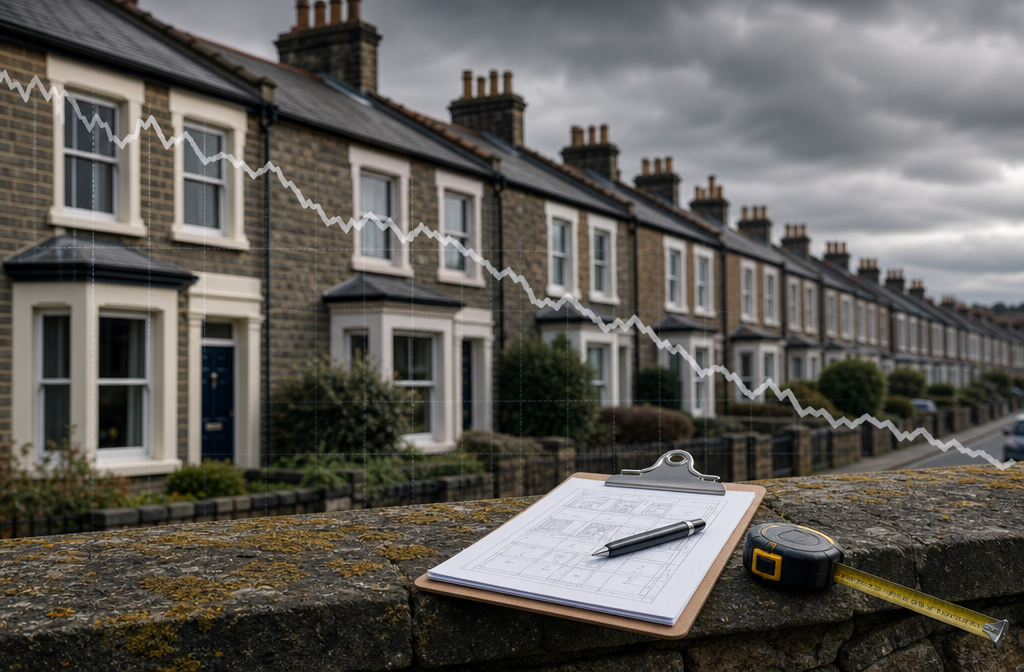
Three consecutive months of falling house prices, a 10% drop in mortgage approvals, and 60% of surveyors reporting weaker buyer demand — the May 2026 RICS UK Residential Market Survey paints a picture that property professionals cannot afford to ignore. For anyone commissioning or conducting a valuation right now, understanding the dynamics behind these numbers is not optional. Valuations in a stagnant UK housing market: interpreting the latest RICS market survey data has become one of the most pressing conversations in the property profession, and the answers have direct consequences for buyers, sellers, lenders, and surveyors alike.
Key Takeaways
- The RICS May 2026 survey confirms that 60% of surveyors are seeing declining buyer inquiries, making comparable evidence harder to source and valuations more complex.
- UK house prices fell 0.5% month-on-month in April 2026, the third consecutive monthly decline, according to the UK House Price Index.
- Regional divergence is significant: London and the South East show the sharpest activity drops, while the North West remains comparatively more resilient.
- Mortgage approvals fell 10% year-on-year in April 2026, tightening the pool of active buyers and compressing transactional evidence available to valuers.
- Surveyors and buyers must adopt a more cautious, evidence-led approach to valuations, leaning on professional RICS-regulated assessments rather than estate agent asking prices.
What the RICS May 2026 Survey Actually Says
The RICS UK Residential Market Survey is one of the most closely watched barometers of housing market health in the country. Its monthly data draws on responses from chartered surveyors across England, Scotland, and Wales, capturing sentiment on new buyer inquiries, agreed sales, price expectations, and stock levels. The May 2026 edition delivered a notably downbeat reading.
Key findings from the May 2026 survey include:
- 60% of surveyors reported a net decline in new buyer inquiries
- New instructions to sell remained broadly flat, meaning supply has not tightened enough to support prices
- Near-term price expectations turned negative across most regions
- Agreed sales volumes fell for the fourth consecutive reporting period
Simon Rubinsohn, RICS Chief Economist, noted that "the current market conditions are creating significant challenges for accurate property valuations, necessitating a cautious approach from surveyors." That phrase — cautious approach — carries real weight. It signals that the profession itself is acknowledging the difficulty of pinning down market value when transactional evidence is thin and buyer sentiment is fragile.
Understanding the Broader Data Context
The RICS survey does not operate in isolation. Cross-referencing it with other datasets strengthens the picture considerably.
| Indicator | Figure | Source |
|---|---|---|
| Monthly house price change (April 2026) | -0.5% | UK House Price Index |
| Year-on-year mortgage approval change | -10% | Bank of England |
| First-time buyer mortgage approval change | -7% | Bank of England |
| New housing starts decline (Q1 2026 vs Q1 2025) | -15% | Office for National Statistics |
| Surveyors reporting valuation difficulty | 45% | RICS May 2026 Survey |
The convergence of falling transaction volumes, reduced lending, and weakening new-build supply creates a feedback loop. Fewer sales mean fewer comparables. Fewer comparables mean wider uncertainty bands in valuations. Wider uncertainty bands mean lenders apply more conservative loan-to-value ratios, which in turn reduces the pool of qualifying buyers further.
Valuations in a Stagnant UK Housing Market: Interpreting the Latest RICS Market Survey Data Through a Regional Lens

Not all parts of the UK are experiencing the same degree of stagnation. The RICS data reveals a pronounced regional split that has direct implications for how valuers approach comparable analysis.
London and the South East: The Hardest Hit
In London and the South East, 70% of surveyors reported a decline in market activity in the May 2026 survey. This is the highest proportion of any region. The reasons are well-documented: affordability constraints remain severe, stamp duty costs are proportionally higher on more expensive stock, and the correction in prime and super-prime segments has filtered down into mainstream markets.
For valuers working in these areas, the challenge is acute. When transaction volumes fall sharply, the pool of genuine arm's-length comparable sales shrinks. A valuer may find that the most recent comparable for a three-bedroom semi-detached in a South East commuter town is six months old — and in a declining market, six-month-old evidence can overstate current value by a meaningful margin.
Buyers and sellers in these areas should consider commissioning a professional RICS property valuation rather than relying on automated valuation models or estate agent appraisals, both of which lag market movements significantly.
The North West: Relative Resilience
By contrast, only 50% of surveyors in the North West reported declining activity. Relative affordability, stronger rental yields, and ongoing regeneration investment in cities such as Manchester and Liverpool have provided a partial buffer. However, "relative resilience" should not be mistaken for strength. Even in more robust regions, the direction of travel is downward, and valuers must apply appropriate adjustments.
What Regional Divergence Means for Comparable Selection
When conducting valuations in a stagnant UK housing market, the selection of comparables becomes more art than science. Surveyors must:
- Weight recent sales more heavily than older transactions, even if the older sales are geographically closer
- Apply explicit downward adjustments where the comparable sale predates the current period of decline
- Cross-reference asking price data with actual achieved prices, which are increasingly diverging
- Consider time-on-market data as a proxy for demand depth in specific micro-markets
This is precisely why the RICS HomeBuyer Survey and the more detailed RICS Building Survey remain essential tools — they provide a structured, regulated framework for assessment that accounts for both physical condition and market context.
How Surveyors Are Responding: Methodology Under Pressure
The statistic that 45% of surveyors are reporting difficulty in accurately assessing property values is not a sign of professional failure. It is a sign of professional honesty. In a functioning market with healthy transaction volumes, comparable evidence is plentiful and recent. In a stagnant market, valuers must work harder, document more carefully, and communicate uncertainty more transparently.
The Challenge of Thin Comparable Evidence
Valuation methodology under RICS Red Book standards requires surveyors to identify and analyse comparable transactions. When the market stagnates, the number of usable comparables falls. A property that would ordinarily have five or six strong comparables within a half-mile radius and a six-month window may now have two or three — and those may be from a period when prices were higher.
Surveyors are responding by:
- Widening the geographic search radius for comparables while applying location adjustments
- Extending the time window for comparable evidence while applying temporal adjustments
- Placing greater weight on asking price trends and time-to-sale data as supplementary evidence
- Documenting assumptions and adjustments more explicitly in valuation reports to satisfy lender requirements
For buyers who want to understand how a professional assessment can strengthen their negotiating position, the guide on how an RICS survey can help you negotiate the price of a property in London provides practical context on using survey findings as a lever in price discussions.
Mortgage Valuations and Lender Caution
The 10% year-on-year fall in mortgage approvals reported by the Bank of England in April 2026 reflects both reduced borrower demand and tighter lender underwriting. Lenders are acutely aware that valuations conducted at the peak of a declining market can result in negative equity within months of completion.
As a result, many lenders are:
- Requesting more detailed valuation reports with explicit comparable evidence
- Applying conservative loan-to-value caps in areas with the sharpest price falls
- Requesting re-valuations on transactions where there has been a significant delay between offer and completion
For buyers navigating this environment, understanding what to do before an RICS home survey can help ensure the process runs smoothly and that the surveyor has access to all relevant information.
The Rental Market as a Pressure Valve
One consequence of the stagnant sales market is a 5% increase in rental demand in urban areas, as potential buyers opt to wait rather than commit to a purchase in an uncertain environment. This shift has implications for investment property valuations. Capitalisation rates and gross rental yields are moving as rental demand rises, but capital values fall. Investors holding property for income may find their assets performing differently from those held for capital growth.
The 55% of property investors currently adopting a "wait and see" approach, according to the British Property Federation's May 2026 survey, reflects a rational response to this uncertainty. However, it also means that investment-led demand — which can support prices in certain segments — is temporarily withdrawn from the market.
Valuations in a Stagnant UK Housing Market: What Buyers and Sellers Should Do Now
Understanding the data is one thing. Acting on it appropriately is another. Whether buying, selling, or simply monitoring a property portfolio, the current environment demands a more rigorous approach to valuation than many participants have been accustomed to in recent years.
For Buyers
Do not rely solely on asking prices. In a declining market, asking prices often lag actual transaction values by weeks or months. Estate agents have commercial incentives to maintain high asking prices, even when achieved prices are falling. A professional RICS valuation provides an independent, evidence-based assessment of market value that is not subject to these pressures.
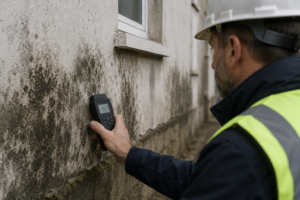
Commission a full survey before exchanging contracts. With a 15% decline in new housing starts in Q1 2026 and reduced developer activity, the existing housing stock is ageing without the pipeline of new-build alternatives that might otherwise give buyers leverage. Physical condition issues — damp, structural movement, roof deterioration — become more significant negotiating points in a buyer's market. Understanding the difference between a HomeBuyer Report and a Building Survey is an important first step in selecting the right level of inspection.
Use the survey findings to negotiate. In a stagnant market, sellers are more motivated to negotiate. A survey that identifies material defects provides documented grounds for a price reduction. First-time buyers, who have seen a 7% fall in mortgage approvals year-on-year, face particular affordability pressure and should use every legitimate tool available to reduce acquisition costs.
For Sellers
Price realistically from the outset. Properties that are overpriced in a stagnant market tend to sit on the market, accumulate stigma, and ultimately sell for less than a correctly priced property would have achieved at launch. The data is clear: buyer inquiries are falling, and those buyers who are active have more choice and more negotiating power than at any point in recent years.
Be prepared for downward valuation adjustments. If a buyer's lender commissions a mortgage valuation and it comes in below the agreed purchase price, the transaction will either need to be renegotiated or the buyer will need to fund the shortfall from their own resources. In the current environment, this scenario is more common than it has been for several years.
Consider the condition of the property carefully. Buyers in a stagnant market are more selective. Properties in poor condition face a double discount: one for the market conditions and one for the remediation costs. Addressing obvious defects before listing — or pricing them in transparently — reduces the risk of a survey-triggered renegotiation later.
For Property Investors
Analysts at Savills have projected that the UK housing market will remain broadly stagnant for the next 12 months, with a potential gradual recovery beginning in mid-2027. For investors with a medium-term horizon, this creates both risk and opportunity.
Those considering leasehold acquisitions should pay particular attention to the specific valuation complexities that leasehold tenure introduces. A lease extension valuation conducted in the current market environment will reflect depressed capital values, which can actually reduce the premium payable — a potential advantage for leaseholders acting now rather than waiting for recovery.
The Government Response and Its Likely Market Impact
The UK government announced a review of housing policies in May 2026, with potential measures including incentives for first-time buyers and adjustments to stamp duty. While policy announcements can shift sentiment quickly, their impact on valuations takes longer to materialise.
Stamp duty adjustments, in particular, have a direct effect on effective purchase costs and can stimulate demand at specific price points. However, the history of stamp duty holidays — most recently in 2020-2021 — suggests that they tend to pull demand forward rather than create sustained market recovery. Valuers and buyers should be cautious about pricing in policy-driven uplift before the details of any changes are confirmed and implemented.
The government's review also touches on housing supply, with the 15% decline in new housing starts a clear signal that developer confidence needs to be restored. Supply-side measures tend to operate over longer timeframes than demand-side interventions, meaning their impact on valuations is unlikely to be felt within the 12-month stagnation window projected by analysts.
Conclusion
Valuations in a stagnant UK housing market: interpreting the latest RICS market survey data is not an abstract exercise. The May 2026 data — falling buyer inquiries, declining transaction volumes, reduced mortgage approvals, and widening regional disparities — has direct, practical consequences for every property transaction taking place right now.
Actionable next steps for different stakeholders:
- Buyers should commission an independent RICS valuation and a full structural survey before committing to any purchase, using professional findings to negotiate on both price and condition.
- Sellers should price properties in line with current achieved values, not aspirational asking prices, and address material defects before listing.
- Investors should review their portfolios with a qualified surveyor, paying particular attention to leasehold assets and the impact of current market conditions on capital values.
- Lenders and brokers should ensure that valuation instructions are directed to RICS-regulated professionals with local market expertise, particularly in London and the South East where market activity has fallen most sharply.
The property market will recover. It always does. But navigating the period between now and that recovery requires clear-eyed analysis, professional advice, and a willingness to act on evidence rather than optimism. The RICS survey data provides that evidence. The question is whether market participants choose to use it.